Sterling Halloran was halfway through wiping fingerprints from the chrome bumper of his dark-green 1968 Ford Mustang when Hadley Lockwood marched across the cul-de-sac waving a sheet of paper above her head.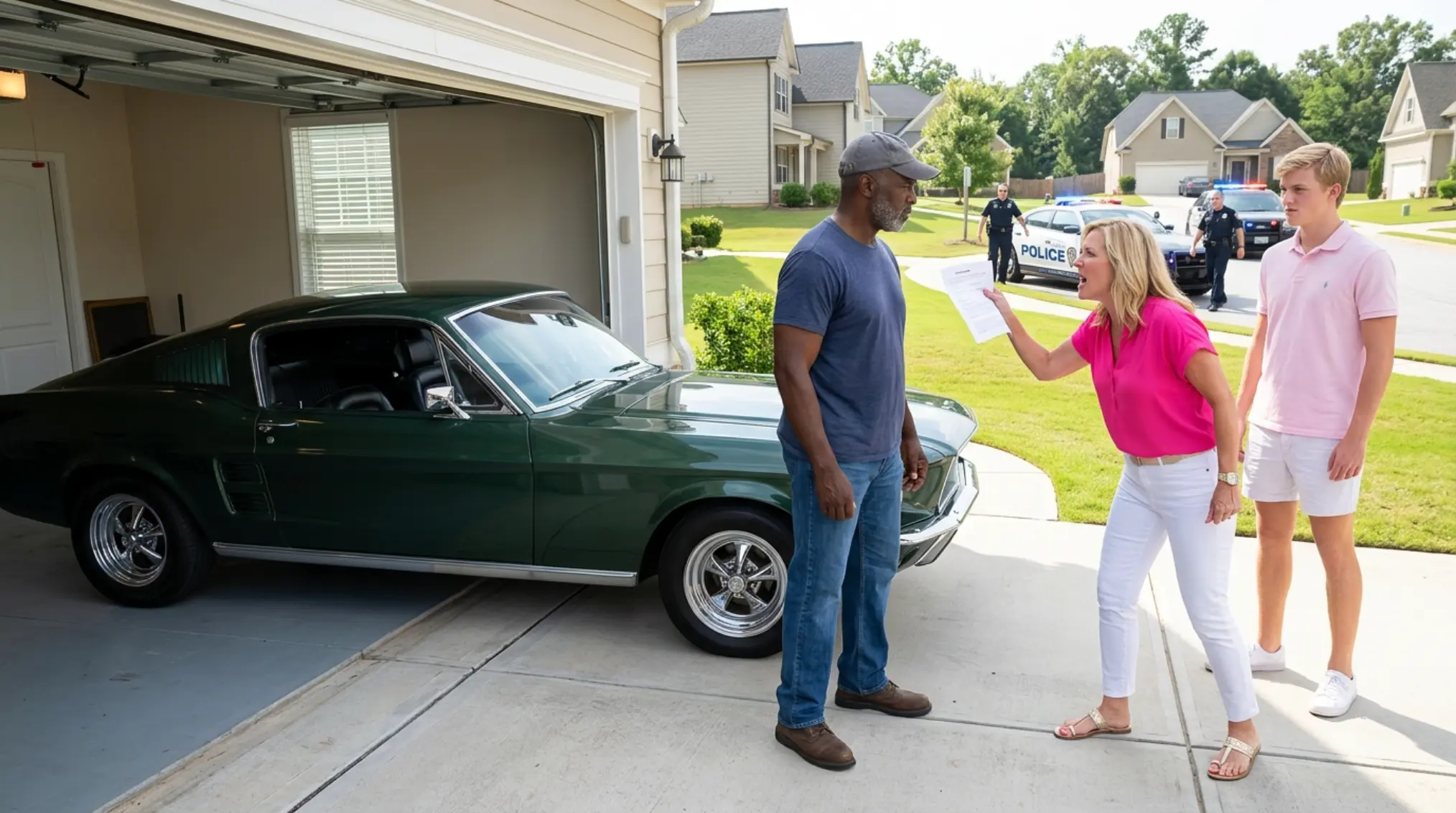
Her nineteen-year-old son, Bryson, followed three steps behind.
Sterling did not look up immediately.
He had spent enough years dealing with angry people to recognize when someone wanted an audience, and Hadley always wanted an audience.
She wore a bright-pink blouse, white ankle pants, gold sandals, and an expensive watch that caught the Georgia afternoon sun every time she jabbed the paper in Sterling’s direction.
Bryson wore a pale-pink polo, white shorts, and spotless white sneakers. His expression carried the confidence of a young man who had been told all morning that by sunset the Mustang would belong to him.
Sterling remained beside the car.
The Mustang sat half inside the open garage, its deep-green paint almost black beneath the shade. Chrome trim ran clean along the body. The restored wheels reflected the driveway. Under the hood was the V8 Sterling had rebuilt with his son Tate over countless weekends.
The car was not simply valuable.
It contained pieces of his life he could never replace.
Hadley stopped inches from him.
“Move away from the vehicle.”
Sterling finally looked at her.
“Excuse me?”
She slapped the paper against his chest.
“My son owns this Mustang now.”
Sterling caught the document before it fell.
He looked down.
A bill of sale.
His name appeared beneath a signature line.
So did Bryson Lockwood’s.
Purchase amount: thirty-five thousand dollars.
Sterling looked back at Hadley.
“You forged one signature too many.”
Bryson stepped closer and slapped his palm against the Mustang’s roof.
“Mom said this car’s mine. Move, or the cops will drag you off your own driveway.”
Sterling’s eyes dropped to Bryson’s hand resting on the paint.
“Take your hand off the car.”
Bryson smiled.
“What are you going to do?”
Hadley pointed toward the street.
“I already called them.”
Sterling looked past her.
Two marked police cruisers were turning into Briarwood Glen Estates.
He slowly removed his old gray baseball cap.
Hadley smiled.
“There. Now maybe you’re starting to understand.”
Sterling held the cap loosely in one hand.
“No, Hadley.”
The first cruiser stopped twenty feet from the driveway.
“I think you’re about to.”
Two officers stepped out.
Sergeant Tucker Brennan recognized Sterling first.
His entire expression changed.
Officer Lane Murchison followed his sergeant’s stare from the green Mustang to the gray-haired Black man standing beside it.
Sterling turned fully toward them.
Both officers stopped.
Then snapped to attention.
Two hands rose in perfect salute.
“Chief Halloran, sir.”
Hadley Lockwood’s mouth fell open.
Bryson removed his hand from the Mustang.
Sterling returned the salute.
And for the first time since moving into Briarwood Glen, he allowed Hadley to discover exactly who the quiet man she had been threatening for months really was.
Sterling had moved into the neighborhood eighteen months earlier because he wanted fewer people to know his name.
For six years, he had served as chief of the Cederville Police Department, supervising more than forty officers and carrying nearly three decades of law-enforcement experience behind him.
But on weekends, Sterling was not interested in being Chief Halloran.
He was simply Sterling.
A widower.
A father.
A man who liked old engines, strong coffee, and quiet mornings.
His wife, Margaret, had died unexpectedly four years earlier.
A brain aneurysm had taken her before Sterling had time to understand she was sick.
One moment she was making coffee.
Hours later he was sitting beneath hospital lights listening to a surgeon explain that nothing could have saved her.
After the funeral, Sterling spent weeks avoiding the garage.
Because inside sat the Mustang.
Margaret had bought the rusted fastback as a project for Sterling and their son Tate.
“Two stubborn men need something useful to argue about,” she had joked.
The car was barely recognizable then.
Rust.
Missing trim.
Torn interior.
Engine barely worth rebuilding.
Sterling, Tate, and Margaret spent years bringing it back.
Margaret chose the green.
Tate chose the black interior.
Sterling rebuilt the engine.
Then Margaret died before they finished.
Afterward, father and son completed it together.
Every bolt became memory.
Every scratch mattered.
That was why Sterling refused the first offer Hadley made.
She had appeared at his door with a pound cake shortly after he moved in.
At first she seemed friendly.
She introduced herself as HOA President Hadley Lockwood and talked for nearly ten minutes about community standards, landscaping expectations, parking rules, and “protecting property values.”
Then she saw the Mustang through the open garage.
Her personality changed instantly.
“Oh my.”
Sterling followed her stare.
“That’s beautiful.”
“Thank you.”
“What year?”
“Sixty-eight.”
“Fastback?”
“Yes.”
“My son would lose his mind.”
Sterling smiled politely.
Hadley walked toward the garage without being invited.
He subtly stepped into her path.
“Did you restore it?”
“My family did.”
“How much?”
Sterling frowned.
“How much what?”
“How much would you take?”
“It’s not for sale.”
Hadley laughed as though he had told a joke.
“Everything has a number.”
“This doesn't.”
She smiled.
“We’ll see.”
At the time, Sterling dismissed the remark.
That was his mistake.
Three weeks later, Hadley returned with her husband Whit.
Whit offered twenty-five thousand dollars.
Sterling refused.
Then thirty.
Then thirty-five.
Sterling refused every offer.
Bryson appeared several times afterward, wandering near the driveway whenever the garage was open.
“Seriously, Mr. Halloran, my dad pays cash.”
“Still not for sale.”
“You don't even drive it much.”
“That doesn't make it yours.”
Bryson laughed.
“You old guys always get sentimental over cars.”
Sterling looked at him.
“Young men sometimes mistake wanting something for being entitled to it.”
Bryson stopped smiling.
That evening, the first HOA violation arrived.
The complaint said the Mustang was visibly dusty and harmed neighborhood appearance.
Sterling stared at the notice.
The car was inside his garage.
The attached photograph had apparently been taken through the partially open door.
Fine: two hundred dollars.
Sterling paid.
Not because Hadley was right.
Because he wanted to see what she would do next.
Law enforcement had taught him patience.
People who abused power often destroyed themselves if nobody interrupted them too early.
Three weeks later came another fine.
Excessive engine noise after quiet hours.
Sterling checked his cameras.
The Mustang had not started that week.
He paid anyway.
Then another complaint appeared.
Oil staining on the driveway.
Sterling walked outside.
A dark puddle sat near the garage.
His Mustang had not been parked there in nine days.
He checked his camera angle.
Unfortunately, the spill happened just beyond the clearest section of footage.
But near the air-conditioning unit he found an empty red plastic oil jug.
He placed it inside a clean bag.
Wrote the date.
Stored it.
Hadley kept pushing.
Sterling kept documenting.
His son Tate noticed.
“Dad, why are you letting her do this?”
Sterling sat at the kitchen island.
“Because she thinks I’m weak.”
“Are you?”
Sterling smiled.
“No.”
“Then why not stop her?”
“Because people like Hadley are careful when they know someone can fight back.”
Tate frowned.
“And?”
“I want to know how far she goes when she thinks nobody can.”
The answer came faster than Sterling expected.
An HOA inspection notice demanded access to his garage.
Sterling refused.
Hadley sent three men wearing matching navy polo shirts.
None were licensed inspectors.
None had court authority.
Sterling calmly denied entry.
Two days later, Bryson approached Tate near the community pool.
According to Tate, Bryson smiled and said, “Tell your dad to quit being stupid. That Mustang’s going to be mine one way or another.”
That sentence changed Sterling’s approach.
He quietly contacted Sergeant Wynn Mercer in Internal Affairs.
“Do me a favor.”
Mercer raised an eyebrow.
“When a police chief says that, I usually get nervous.”
“I want background on an HOA president.”
“What kind?”
“Police complaints. Vehicle disputes. Anything tied to Briarwood Glen.”
“Name?”
“Hadley Lockwood.”
Mercer returned four days later carrying a thick folder.
“Chief, you need to sit down.”
Sterling did.
Hadley had filed numerous vehicle-related complaints against residents over several years.
Several centered on claims that vehicles had been promised or sold to her son or people connected to the family.
Most went nowhere.
But four residents eventually sold vehicles at unusually low prices after prolonged HOA pressure.
That alone was suspicious.
Then Mercer showed him the money.
Briarwood Glen had collected enormous amounts in fines.
A significant percentage flowed into a development LLC tied to Whit Lockwood.
That LLC purchased distressed homes from residents who had accumulated large HOA debts.
Then resold them.
Sterling stared at the documents.
“They’re squeezing homeowners.”
“That’s what it looks like.”
“Fine them until they can't breathe.”
“Then offer solutions.”
“Cars.”
“Houses.”
Mercer nodded.
Sterling leaned back.
The Mustang was no longer simply a neighborhood dispute.
He immediately removed himself from operational control.
Detective Holt Bramwell from Major Crimes took over.
The district attorney became involved.
Sheriff investigators began tracing LLC payments.
Sterling became what he needed to be.
A witness.
And bait.
The forged bill of sale arrived Saturday afternoon.
Sterling already knew something was coming.
One of Tate’s friends had learned Bryson was trying to recruit witnesses who would claim Sterling sold the Mustang.
The boy refused and told Tate.
Investigators prepared accordingly.
Sterling put the Mustang halfway into the driveway.
He wore jeans, a faded navy T-shirt, old shoes, and his gray baseball cap.
Nothing about him suggested police command.
His badge stayed hidden.
Hadley walked outside carrying the forged document.
Bryson followed.
Then she called police.
The report stated that Sterling had stolen a Mustang legally purchased by Bryson.
Hadley demanded officers recover the vehicle.
Sergeant Brennan and Officer Murchison were dispatched without being told the full investigation.
That mattered.
Sterling wanted their reaction to be genuine.
It was.
The moment both officers saluted him, Hadley looked as if the street had tilted beneath her feet.
She turned toward Brennan.
“What is this?”
Brennan lowered his hand.
“Ma’am, remain where you are.”
Hadley pointed at Sterling.
“He is refusing to surrender property that belongs to my son!”
Sterling stepped forward.
“The Mustang belongs to me.”
Bryson lifted the forged receipt.
“We've got proof.”
Sterling looked at him.
“No.”
He nodded toward the page.
“You brought evidence.”
Bryson’s face changed.
Hadley grabbed the document from him.
“This is a legitimate contract.”
Sterling turned toward Brennan.
“Sergeant, preserve that paper.”
Hadley pulled it toward her chest.
“You’re not taking anything.”
Brennan’s voice hardened.
“Mrs. Lockwood, do not destroy or conceal that document.”
She looked around.
Neighbors had begun emerging from their homes.
Phones appeared.
Hadley’s face reddened.
“This is an abuse of power! He’s using his position to steal my son’s property!”
Sterling did not raise his voice.
“That’s why I’m not running the investigation.”
Then an unmarked dark sedan entered the cul-de-sac.
Detective Holt Bramwell stepped out.
Hadley looked from Sterling to Holt.
Then to the cruisers.
Then to the growing crowd.
Her confidence finally cracked.
Holt approached.
“Mrs. Lockwood?”
“Yes.”
“Detective Bramwell, Major Crimes.”
“What does Major Crimes have to do with a car dispute?”
“A lot.”
He held out his hand.
“The bill of sale.”
Hadley hesitated.
Bryson whispered, “Mom.”
“Quiet.”
Holt waited.
Finally Hadley handed him the paper.
He placed it in an evidence sleeve.
“Did you prepare this document?”
“No.”
“Who did?”
“My attorney.”
“Name?”
Hadley froze.
The supposed attorney listed on earlier HOA letters had already been contacted.
He denied preparing the document.
Investigators also discovered the notarization belonged to a notary whose commission was no longer valid.
Holt looked toward Bryson.
“You signed this?”
Bryson swallowed.
“My mom said—”
Hadley spun around.
“Don't say anything.”
Holt looked back at her.
“That's probably the first good advice you've given him today.”
The sheriff’s vehicles entered the neighborhood minutes later.
That was when everyone understood the confrontation had never really been about one car.
Two deputies went toward the Lockwood residence carrying a search warrant.
Another team was already headed toward Whit’s commercial office.
Hadley stepped backward.
“What is happening?”
Holt answered.
“Search warrants.”
“For what?”
“Financial records. HOA files. Electronic devices. Business documents.”
“This is insane.”
Sterling remained beside the Mustang.
Hadley looked at him.
“You did this.”
He shook his head.
“You did.”
Her anger exploded.
“You've been lying to us this entire time!”
“About what?”
“Who you are!”
Sterling stared at her.
“You never asked.”
“You let me believe you were just some—”
She stopped herself.
“Some what?”
Hadley said nothing.
Sterling stepped closer.
“You looked at my clothes, my truck, my house, and decided how much power you thought I had.”
He pointed toward the green Mustang.
“Then you decided you could take something from me because you believed nobody important would care.”
“That isn't true.”
“The evidence will decide that.”
Behind them, Bryson slowly sat on the curb.
The bravado had disappeared.
He stared at his white sneakers.
“Mom,” he whispered, “you said the paperwork was real.”
Hadley snapped toward him.
“Stop talking.”
Sterling watched the young man.
He felt little satisfaction.
Bryson had participated.
But Sterling also recognized the influence of a parent who spent years teaching a child that entitlement was normal.
That did not erase responsibility.
It explained part of it.
The search uncovered more than Sterling expected.
Secondary HOA ledgers.
Vendor payments.
Documents tied to distressed property purchases.
Draft violation notices.
Lists of homeowners categorized according to debt exposure.
Vehicle records.
Copies of purchase agreements.
And a folder containing earlier versions of Sterling’s forged Mustang bill of sale.
Investigators found digital metadata showing edits made from a computer registered to the Lockwood household.
Whit was detained later that afternoon for questioning.
By evening, the Briarwood Glen board held an emergency meeting.
Hadley was removed as president.
Whit was removed as treasurer.
The association’s financial authority was transferred temporarily to an outside management firm.
Then residents began talking.
People who had stayed silent for years brought boxes.
Emails.
Receipts.
Fine notices.
Threatening letters.
One elderly homeowner had paid eleven thousand dollars after repeated penalties.
Another family sold a classic pickup for less than half its market value after Hadley filed repeated abandoned-vehicle complaints.
A widow described selling her house to Whit’s development LLC because HOA liens made refinancing impossible.
The investigation widened.
Sterling attended none of the strategy meetings.
He remained separated from prosecution decisions because he was directly involved.
That was deliberate.
Hadley later accused him publicly of using his position for revenge.
The district attorney answered with a simple statement:
The evidence existed before the arrest.
Independent investigators handled the case.
Sterling was a complainant.
Not the prosecutor.
Months later, Hadley accepted a plea agreement involving fraud-related charges, false reporting, and restitution obligations.
Whit faced separate charges tied to financial transactions and real-estate activity.
Several civil settlements returned money to homeowners.
Some property transactions were reviewed.
Not every accusation became a conviction.
Not every suspicious fine proved criminal.
But the structure that allowed the Lockwoods to dominate Briarwood Glen collapsed.
Bryson received a reduced outcome after cooperating with investigators and admitting he knew the Mustang had never been sold to him.
Sterling saw him once afterward.
The young man was leaving the courthouse with his attorney.
Bryson stopped.
“Chief?”
Sterling turned.
Bryson looked embarrassed.
“I shouldn't have touched the Mustang.”
Sterling almost smiled.
“That’s not the important part.”
“I know.”
“Do you?”
Bryson looked down.
“My mom kept saying if people wouldn't sell, you pressure them until they do.”
Sterling remained quiet.
Bryson continued.
“I thought that was just how business worked.”
“It isn't.”
“I know that now.”
Sterling nodded.
“Good.”
Bryson walked away.
Sterling hoped he meant it.
Briarwood Glen rebuilt its association.
The new bylaws prohibited board members from holding undisclosed financial interests in companies buying neighborhood property.
Independent review became mandatory for large fines.
Vehicle complaints required documented ownership verification before police contact.
Homeowners gained a clear appeal process.
The changes were not glamorous.
That was why Sterling liked them.
Good systems were often boring.
Hadley had made everything personal.
The new association tried to make everything procedural.
Six months passed.
No one photographed Sterling’s driveway.
No strange oil appeared.
No fake inspectors knocked.
Nobody mentioned his mailbox.
One Saturday morning, Sterling rolled the Mustang outside.
Tate was home from college.
They washed it together.
Tate ran a cloth across the hood.
“You ever going to sell this thing?”
Sterling looked offended.
“After everything we just went through?”
Tate laughed.
“Just checking.”
They finished the car around noon.
Then Sterling opened the glove box.
A small brass plaque remained attached inside.
Margaret had installed it years earlier.
For my two favorite men.
Tate touched it.
“Still think Mom would've laughed when those officers saluted you?”
Sterling smiled.
“She would've laughed at Hadley first.”
“Then you.”
“Definitely me.”
Tate shut the glove box.
They climbed inside.
The V8 started with a deep mechanical rumble.
Sterling drove slowly through Briarwood Glen.
People waved.
Some knew who he was now.
That part could not be undone.
But strangely, Sterling no longer minded.
He drove beyond the subdivision and turned toward the cemetery where Margaret was buried.
They parked nearby.
Tate stayed inside the Mustang.
Sterling stood beside the grave for several minutes.
“You would've liked the color in this light,” he said quietly.
The wind moved through the trees.
There was no answer.
There never was.
But Sterling had learned how to speak into that silence anyway.
The Mustang remained in the family.
Sterling drove it monthly.
Sometimes alone.
Sometimes with Tate.
Occasionally to community events.
Its value increased.
He never checked by how much.
Numbers did not matter.
Hadley had misunderstood that from the beginning.
She saw a rare car and assumed the only disagreement was price.
Sterling saw Margaret laughing in the garage.
Tate dropping a wrench and swearing for the first time.
Late evenings rebuilding the transmission.
A family project that survived the person who started it.
Thirty-five thousand dollars could not purchase that.
Neither could fifty thousand.
Or a forged receipt.
Years later, people in Briarwood Glen still told the story about the afternoon Hadley called police to seize Sterling Halloran’s Mustang.
They always emphasized the salute.
Two officers stepping from cruisers.
The ordinary-looking homeowner removing his cap.
Both men suddenly standing straight.
Hadley’s face collapsing.
It made a perfect neighborhood legend.
But Sterling thought the salute was the least important part.
Hadley did not lose because he was police chief.
She lost because she forged paperwork.
Because she filed false claims.
Because she underestimated the people she pressured.
Because she believed repetition turned dishonesty into authority.
Sterling’s title made the driveway moment spectacular.
His documentation made the case possible.
Every fine.
Every photograph.
Every letter.
Every receipt.
Every threatening message.
Every date.
He had kept them because experience taught him that arrogance produces patterns.
You do not need to shout over a pattern.
You preserve it.
Then one day the person who believes nobody can stop them does something so obvious that all the smaller pieces suddenly make sense.
For Hadley Lockwood, that moment came when she called the police to take a green 1968 Mustang she had already promised to her son.
She expected two officers to remove Sterling from his own driveway.
Instead, they looked at him.
Recognized their chief.
And saluted.
That was the instant Hadley realized she had called the wrong officers.
But by then, the much bigger mistake had already happened.
She had targeted the wrong man long enough for him to document everything.