The black SUV sat in the driveway of 14 Brierwood Court with its rear hatch raised beneath a clear Tennessee afternoon sky. Brown paper grocery bags filled the trunk, their tops crowded with fresh vegetables, packaged meat, milk, bread, and the rotisserie chicken Darnell Okafor had planned to eat after a long week at work. Darnell, a forty-six-year-old Black American man with deep brown skin, close-cropped black hair, a trimmed beard, and a tall, powerful build, stood beside the vehicle in a black casual jacket, dark shirt, blue jeans, and heavy black boots. His expression remained controlled, but the muscles in his jaw tightened as sixteen-year-old Cody Whitmore planted himself between Darnell and the groceries.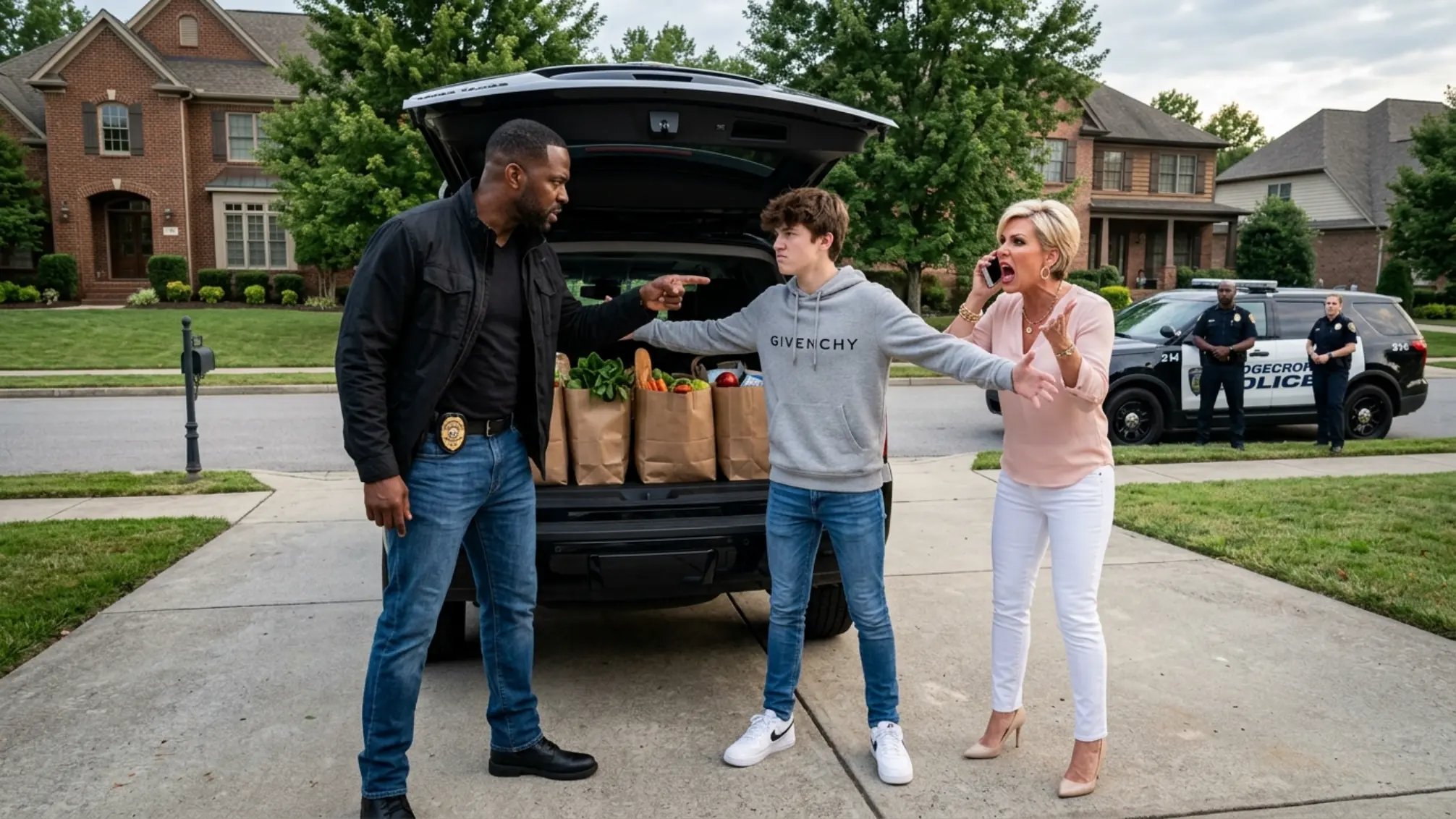
Cody wore a gray Givenchy hoodie, fitted jeans, and clean white sneakers. His messy brown hair hung over his forehead, and the entitled scowl on his face carried the confidence of a teenager who had spent years hearing that his mother controlled Meadowlark Estates. Four minutes after Cody demanded the food, his mother marched across the cul-de-sac with her phone already pressed to her ear. Bettina Whitmore wore a fitted light-pink blouse, white pants, beige heels, and gold jewelry, her short blonde hair carefully styled and her face flushed with anger.
Bettina’s eyes dropped to the gold badge clipped at Darnell’s waist. For one second, her voice disappeared, but she recovered quickly and turned away as though she had not seen it. She continued speaking to dispatch, describing Darnell as an aggressive homeowner threatening a minor and obstructing HOA representatives. Cody looked from the badge to his mother, waiting for her expression to tell him whether he should retreat.
Darnell did not touch the boy. He did not raise his voice or move toward Bettina. He simply rested one hand on the edge of the SUV’s open trunk and watched her complete the call she believed would restore her authority.
“You should put the bags down,” Bettina said after ending the call. “The officers will need to see the items you refused to surrender.”
“They’re my groceries.”
“They are compensation.”
“For what?”
“Your unpaid obligations to this community.”
Darnell looked at the bags, then at Cody. “Your mother sent you to take food from my vehicle as payment for HOA fines?”
Cody crossed his arms. “She said you owe us.”
Bettina stepped between them. “Do not interrogate my son.”
“I asked him one question.”
“You intimidated him.”
“He blocked my trunk and demanded my property.”
“He was carrying out instructions from the board president.”
Darnell almost smiled. Bettina had just described the attempted theft as official HOA business while standing on his driveway and waiting for police officers who worked under him. She did not seem to understand that every sentence was making the situation worse.
Fourteen months earlier, Darnell had moved to Meadowlark Estates because he wanted quiet. After twenty-two years in law enforcement, including patrol work, homicide investigations, command assignments, and departmental administration, he had recently been appointed police chief of Ridgecroft. The promotion came with more responsibility, longer hours, and the constant pressure of knowing that every decision he made could affect hundreds of officers and thousands of residents.
His therapist suggested he stop living in the apartment above the precinct parking garage. Darnell bought a three-bedroom home with a small deck, a tired dogwood tree, and enough lawn to make Sunday mornings feel peaceful. He introduced himself to neighbors as a city employee and intentionally avoided discussing his rank.
He had learned that people changed when they discovered he was a police chief. Some treated him like their personal emergency contact. Others became nervous and defensive, as though he were secretly investigating every car parked too close to the curb. Darnell wanted to be the neighbor who waved, mowed his lawn, helped someone move a sofa, and returned home without carrying the entire city through his front door.
Bettina interpreted his privacy differently.
She had served as president of the Meadowlark Estates HOA for six consecutive years. She had written amendments governing mailbox colors, approved landscaping stones, holiday decorations, exterior lighting, and the precise distance garbage containers could remain visible from the street. She carried laminated color samples during inspections and wore HOA-branded clothing as if the association were a government agency.
Her first notice arrived three weeks after Darnell moved in. It cited the mailbox post for being white rather than “antique linen.” The fine was forty dollars.
Darnell paid it.
He did not agree with the violation, but he had seven active cases waiting on his desk and a department budget meeting scheduled for Thursday. Fighting over two nearly identical shades of paint did not seem worth the time. Bettina read the payment as surrender.
By September, a new violation arrived almost every Tuesday. His gutters allegedly needed cleaning. His recycling bin sat three inches too close to the property line. Decorative stones around the dogwood tree violated an architectural rule, even though the stones had been installed years before he purchased the house.
Darnell answered the stone complaint with a copy of his property inspection report. Instead of withdrawing the notice, Bettina sent Cody to his house.
Cody arrived in a golf cart and stood on Darnell’s porch wearing the same smirk he carried beside the SUV. He announced that his mother had found a storm-water violation beneath Darnell’s driveway and intended to report him to the county. Darnell calmly asked for the exact code citation in writing.
Cody had no answer.
The threat disappeared, but Bettina’s campaign intensified. She began telling neighbors that the new homeowner refused to respect community standards. She suggested that Darnell had undisclosed code problems and warned residents against entering informal property agreements with him.
Darnell recognized the strategy. During his years as a detective, he had watched experienced manipulators isolate targets before applying pressure. Bettina’s tactics were less sophisticated, but the pattern was identical.
He began documenting every notice.
For each complaint, he recorded the date, time, rule cited, photographs of the property, and whether the rule supported Bettina’s claim. He read all forty-seven pages of the association bylaws and obtained the original covenants from the county recorder’s office.
At the same time, Darnell became a better neighbor.
He helped Marcus Donovan refinish a fence. He spoke with Everett Sims, a seventy-one-year-old widower who had lived in Meadowlark Estates for eighteen years. He learned that the Osay family had paid fines for a storage shed built before the HOA existed and that retired teacher Millicent Vance had removed her wind chimes after receiving repeated warnings.
The fear bothered Darnell more than the fines.
People had accepted Bettina’s version of authority because challenging her required time, paperwork, and money. She understood exhaustion and used it better than any bylaw. Residents did not believe she was always right; they believed resisting her was not worth the consequences.
Bettina noticed Darnell was becoming popular and proposed a mandatory property-audit amendment. Any homeowner who received three violations in one year would be subject to a full inspection by a designated board representative.
The designated representative was Bettina.
Darnell had received eleven notices.
He attended the November board meeting and listened while Bettina presented the amendment as a necessary response to “chronic noncompliance.” She never used his name, but everyone in the room understood whom she meant.
After the meeting, Darnell spoke with the association management representative, Philip Greer. Philip confirmed that the rule required a public comment period and could not take effect until January 15.
Darnell wrote down the date.
The first grocery confrontation happened two days later. Cody appeared beside Darnell’s driveway while he unloaded food and claimed his mother had sent him to collect the bags because of what Darnell owed the HOA. Darnell refused and told Cody that Bettina could speak with him directly.
Bettina arrived eleven minutes later wearing an embroidered HOA fleece. She spent more than twenty minutes explaining that Darnell’s resistance had created unnecessary administrative costs and that cooperation would benefit everyone.
Darnell listened without interrupting.
The next morning, he contacted attorney Cecily Farr, a specialist in municipal and property law. Cecily reviewed the bylaws, original covenants, fine schedules, and financial disclosures. Three days later, she called Darnell with findings that changed the conflict.
The mandatory audit amendment was probably invalid because it contained no appeal process. The association’s fine schedule had never been ratified by a full resident vote, despite the original covenants requiring one. Every fine issued under that schedule during the previous four years could be challenged.
The third discovery was more serious.
The HOA’s annual financial statement listed more than nine thousand dollars in payments for administrative services. Those payments had gone to Whitmore Property Management Solutions, a private company registered to Bettina.
There had been no disclosure, independent approval, or resident vote.
“She’s been paying herself,” Darnell said.
“Through the HOA,” Cecily replied. “And the other board members may have personal fiduciary exposure now that we have documented it.”
Darnell printed Cecily’s memorandum and placed it inside a manila folder. He did not confront Bettina. He continued gathering records.
At the county recorder’s office, Darnell discovered another clause buried in the original covenants. If the HOA initiated enforcement without documented evidence of an actual violation, it could be responsible for three times the assessed fine plus reasonable administrative expenses.
Bettina had issued eleven notices against him. Darnell possessed evidence contradicting every one.
Cecily sent formal letters to the management company and the two remaining board members. One challenged the audit amendment and fine schedule. The other demanded a complete accounting of the payments made to Bettina’s company.
Darnell then gathered signatures from homeowners who had experienced similar treatment. State law and the association’s covenants allowed residents to demand a special membership meeting if at least ten percent of the development signed a petition.
He needed eighteen signatures.
He obtained twenty-three.
The meeting request was filed on January 12, three days before Bettina planned to conduct her mandatory inspection of Darnell’s home. When she learned about the petition, she responded with a handwritten letter accusing him of harassment and threatening to contact the police unless he withdrew it.
Darnell photographed the letter and sent it to Cecily.
He did not withdraw anything.
On January 14, Bettina sent Cody through the neighborhood to warn petition signers that they might face legal consequences for supporting Darnell. Cody reached four houses before Marcus Donovan ordered him off his property.
That evening, Darnell notified the police department’s duty sergeant that someone might attempt an unauthorized entry at his home the following morning. He did not ask for special treatment. He requested only that an experienced supervisor respond if Bettina called.
At 8:43 the next morning, Cody’s golf cart appeared at the end of the driveway. Bettina followed on foot wearing her HOA fleece, carrying a clipboard, and wearing a measuring tape on her belt.
She rang the doorbell and announced that the mandatory compliance audit was beginning.
Darnell refused entry.
Bettina immediately called the police.
Sergeant Antoinette Webb arrived at 9:04. She walked up the driveway while Bettina raised her clipboard and began explaining that a combative homeowner was obstructing an official inspection.
Webb asked Bettina for her name. Then she asked Darnell.
“Darnell Okafor,” he said.
The sergeant gave him a small professional nod but did not reveal his position. Cecily appeared in the doorway holding the legal notices and explained that the audit amendment had been formally challenged as invalid.
Bettina insisted that the board had authority.
Cecily opened another document. “There is also the matter of approximately nine thousand dollars in association payments made to a company registered in your name.”
Bettina’s clipboard lowered.
A local reporter named JoEllen Paske approached from a car parked two houses away. Darnell had contacted her because the dispute involved association funds and potential public-interest concerns.
Bettina looked toward Sergeant Webb. “Are you going to allow this man to threaten me?”
Webb’s expression remained neutral. “What threat?”
“He has involved lawyers and reporters.”
“That is not a crime.”
“He is refusing an official inspection.”
“The attorney has presented written notice disputing its legality.”
Bettina pointed at Darnell. “Do you know who I am in this neighborhood?”
Darnell looked at her steadily.
Then he said the words she had never expected to hear.
“I’m the police chief of Ridgecroft.”
Cody stopped moving.
Bettina looked at Sergeant Webb, waiting for contradiction.
Webb gave none. “He is the chief.”
The reporter raised her notepad. “Mrs. Whitmore, can you comment on HOA payments made to Whitmore Property Management Solutions?”
Bettina left without answering.
That should have ended the confrontation, but it did not. Bettina viewed her retreat as temporary and continued searching for a way to regain control. She privately told residents that Darnell had abused his police authority to intimidate the board, despite the fact that he had used attorneys, public records, and resident petitions rather than his office.
The grocery confrontation occurred several weeks later.
Darnell returned from the market and found Cody waiting beside his driveway. This time, the boy did not merely suggest that Darnell owed the family. He blocked the SUV’s trunk and directly demanded the bags.
Darnell set them down slowly.
“Think very carefully,” he warned.
Cody refused to move.
Bettina arrived with her phone and called police dispatch, claiming Darnell had threatened her son. She believed the chief’s identity did not matter because, in her mind, the HOA governed his conduct inside Meadowlark Estates.
Two patrol cruisers arrived. Sergeant Webb stepped from the first vehicle, accompanied by Officers Franklin Reed and Maya Torres.
Bettina rushed toward them.
“Arrest him,” she demanded. “He threatened a minor who was collecting HOA property.”
Webb looked toward the groceries. “What HOA property?”
“The food is compensation for unpaid fines.”
“Do you have a court order authorizing seizure?”
“The board does not need one.”
Webb turned to Cody. “Did you attempt to take these bags?”
Cody looked at his mother.
“Answer the sergeant,” Darnell said.
“My mom told me to get them.”
Bettina interrupted. “He is sixteen. You cannot question him without me.”
“You called us,” Webb replied. “You reported an alleged crime. We are investigating the entire incident.”
Darnell opened the security application on his phone. A camera above his garage had recorded Cody blocking the trunk, demanding the bags, and refusing to leave. It also captured Bettina describing the food as compensation and threatening Darnell with police action.
Webb watched the recording once.
Then she looked at Bettina. “You sent your son onto this man’s property to take groceries over disputed civil fines?”
“He owes the association.”
“You cannot collect a debt by taking someone’s property.”
“I am the HOA president.”
“That does not give you seizure authority.”
Bettina’s voice rose. “I govern this neighborhood.”
Darnell stepped beside Webb, his badge now visible. “You govern meetings. You do not own these homes, these driveways, or the people living here.”
The officers ordered Cody away from the vehicle. Webb warned Bettina that sending him to take property again could result in criminal charges. She documented the attempted seizure, the false characterization of the incident, and Bettina’s admission that the demand was connected to disputed HOA fines.
Neighbors watched from porches and sidewalks.
Bettina stood in her light-pink blouse with her phone hanging at her side. For the first time in years, she could not threaten someone privately and control how the story reached the community.
The special membership meeting was held on February 7. Representatives from 112 of Meadowlark Estates’ 174 homes filled the clubhouse.
Bettina did not attend.
Cecily presented the invalid fine schedule, the unlawful audit amendment, and the payments to Bettina’s company. Darnell presented the documented pattern of unsupported violations, retaliatory threats, the handwritten demand that he withdraw the petition, and the police report from the grocery incident.
Millicent Vance brought the wind-chime warning. The Osay family presented records showing years of payments for a shed older than the HOA. Everett Sims described how Bettina isolated residents she intended to target.
The vote to remove her was 104 to eight.
The remaining board members resigned. A new board was elected, including Marcus Donovan and two residents who had never previously believed challenging Bettina was possible.
The legal settlement took several months. Bettina agreed to repay most of the administrative money received through her company. The association withdrew every unsupported fine issued against Darnell and reimbursed residents with documented claims under the original covenant’s triple-damages clause.
The new board abolished the mandatory audit policy, established a transparent appeal process, and required public disclosure of every contract involving board members or relatives. It also prohibited minors from delivering violation demands, collecting property, or acting as unofficial enforcement agents.
Cody stopped driving the golf cart around the neighborhood.
Darnell saw him at the market one afternoon loading groceries into a car. The teenager looked embarrassed, older somehow, and uncertain whether to speak.
“Hey,” Cody said.
“Hey,” Darnell replied.
Darnell did not blame a sixteen-year-old forever for following a script written by an adult. But he also understood that unchecked entitlement becomes character when no one forces it to confront consequences.
By spring, the dogwood tree in Darnell’s yard bloomed again. White flowers covered branches that had looked nearly dead through winter. Millicent rehung her wind chimes, and the Osay family received reimbursement for the invalid shed fines.
The neighborhood became quieter, not because rules disappeared, but because they applied fairly.
One Sunday afternoon, Darnell returned from the grocery store and raised the SUV’s trunk. No one crossed the driveway. No golf cart appeared, no phone was raised, and no HOA president arrived to explain why his property belonged to someone else.
Everett waved from across the street.
Darnell lifted one grocery bag and smiled.
Bettina had called the police believing a badge would enforce her authority. Instead, the call exposed that her authority had never extended beyond the limits everyone had been too exhausted to make her respect.