The patrol boat was still fifty yards from the dock when Sheriff Daniel Mercer stood behind the wheel, narrowed his eyes, and recognized the man waiting beside the weathered piling.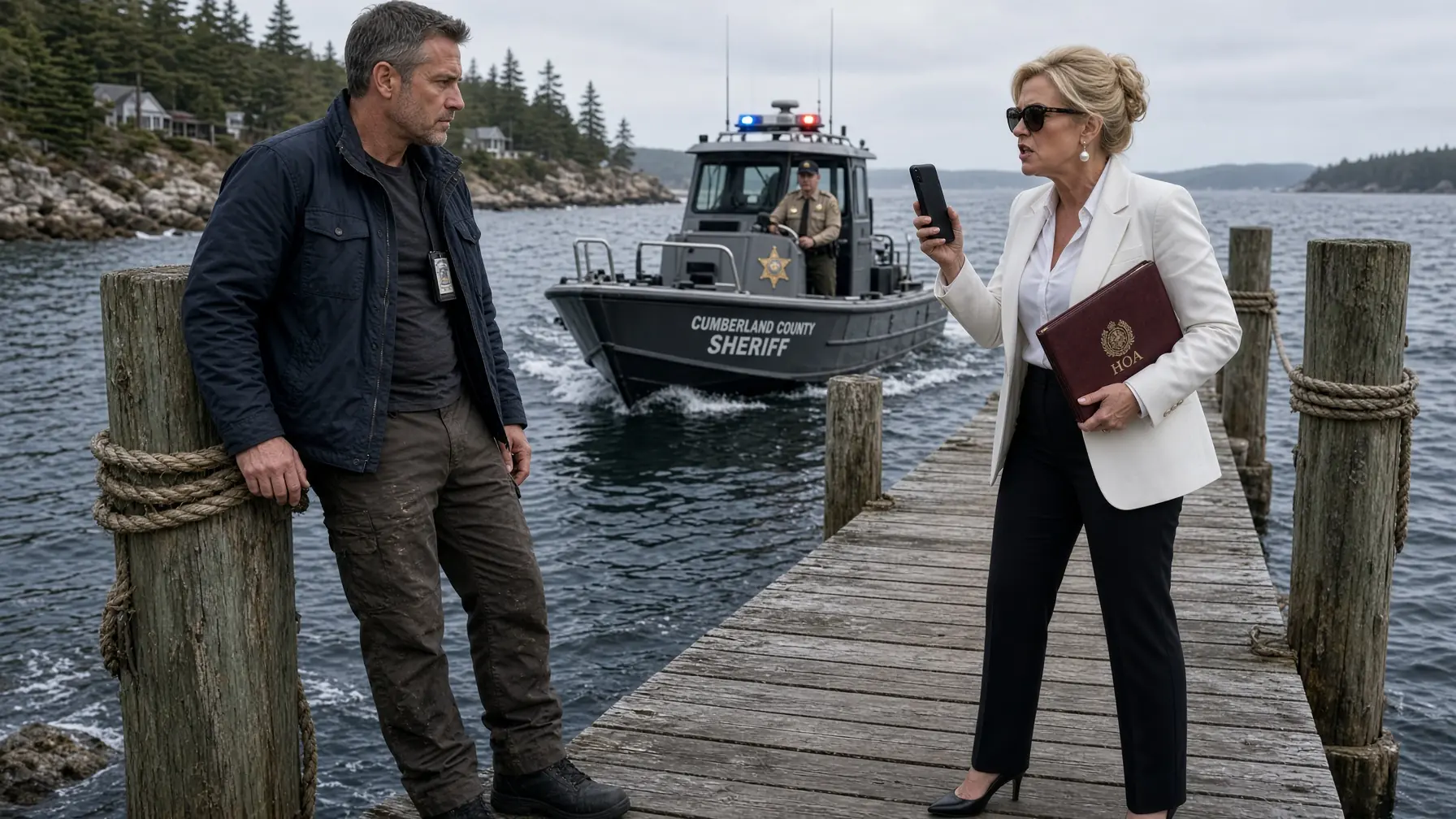
That was the exact moment Victoria Langford, president of the Harbor Point Homeowners Association, should have stopped talking.
She did not.
Instead, she adjusted her oversized sunglasses, tightened one hand around the burgundy HOA folder tucked against her white blazer, and pointed toward the approaching boat as though she had personally summoned an army.
“Good,” she snapped. “The sheriff’s here. Now maybe you’ll finally understand that this dock does not belong to you.”
Nathan Cole said nothing.
At forty-seven, Nathan had the irritating calm of a man who had spent most of his career standing in places where shouting accomplished nothing. He was tall, athletic, lightly tanned from years around the water, with short salt-and-pepper hair, gray-blue eyes, and a trimmed beard. He wore a dark navy field jacket over a charcoal shirt, rugged gray pants, and waterproof boots.
One hand rested against an old wooden dock post wrapped in thick marine rope.
Behind him, a narrow gravel path climbed toward the stone cottage sitting among pines on Heron Island, a small privately owned island just offshore from one of Maine’s most expensive lakefront communities.
Victoria pointed at him again.
“I told you yesterday. That dock violates Harbor Point shoreline standards.”
Nathan looked toward the polished white houses across the channel.
“My island isn’t in Harbor Point.”
“It is surrounded by Harbor Point-controlled water access.”
“No.”
“The community marina is less than a quarter mile away.”
“That still doesn’t make this your dock.”
Victoria stepped closer.
“You rebuilt the outer section without submitting plans to our architectural committee.”
Nathan almost smiled.
“I submitted them to the state.”
“I don’t care.”
That got his attention.
Victoria slapped the folder against the dock post.
“The HOA has rules governing every visible structure along this shoreline.”
Nathan looked at her.
“You should probably stop saying that before the sheriff gets here.”
She laughed.
“You think he’s going to defend you?”
Nathan glanced at the patrol boat.
“I think he’s already recognized me.”
Victoria turned.
Sheriff Mercer was no longer simply approaching.
He was staring directly at Nathan.
The sheriff eased the patrol boat alongside the dock. A deputy tied the bow line.
Mercer stepped onto the planks.
“Morning, Nathan.”
Victoria’s mouth opened.
Nathan nodded.
“Sheriff.”
Mercer looked at the burgundy folder.
Then Victoria.
“What’s going on?”
She recovered quickly.
“Sheriff, thank God. This man has been hostile for twenty minutes. He has constructed an unauthorized private dock, blocked HOA access to the island shoreline, and refused a direct order to leave the structure until the board determines ownership.”
Mercer stared at her.
“Leave the structure?”
“Yes.”
The sheriff looked down at the dock beneath his boots.
Then toward Nathan.
Then back at Victoria.
“Ma’am, this is his dock.”
Her expression hardened.
“That’s what he claims.”
Mercer slowly turned toward Nathan’s jacket.
A metal badge was clipped just inside.
Victoria noticed it for the first time.
She scoffed.
“He showed me that too.”
Mercer’s eyebrows rose.
“And?”
“I told him anyone can buy a badge.”
Nathan exhaled through his nose.
Mercer looked at her for several seconds.
Then said:
“Ma’am, put the folder down.”
Victoria blinked.
“Why?”
“Because you just called me to remove the state investigator who signs half the waterfront enforcement referrals that come through my office.”
The entire dock went silent except for water tapping against the pilings.
Victoria looked at Nathan again.
This time, she actually studied him.
The badge.
The field jacket.
The radio clipped near his waist.
The waterproof document case sitting beside the dock box.
Nathan opened his jacket fully.
STATE WATERFRONT ENFORCEMENT
SENIOR INVESTIGATOR
NATHAN COLE
Victoria’s face changed.
But only for a second.
Then arrogance rushed back in to fill the space where embarrassment should have been.
“That doesn’t give him the right to violate HOA rules.”
Nathan looked at Mercer.
The sheriff almost laughed.
And that was how a ridiculous argument over a private island dock became the beginning of the most uncomfortable investigation Harbor Point had seen in twenty years.
Nathan Cole had owned Heron Island for eleven years.
His grandfather had purchased it in the early 1970s, back when the surrounding shoreline was mostly cabins, fishing camps, and unimproved forest.
The island was small.
Just under eight acres.
A granite shoreline wrapped most of it, with one protected cove on the eastern side.
Nathan’s grandfather built the original dock there using treated timber and heavy cedar pilings.
The cottage came later.
Then electricity.
Then a small boathouse.
By the time Nathan inherited the property, developers had transformed the mainland.
Harbor Point Estates appeared first.
Then Harbor Point Marina.
Then the HOA.
Large homes spread across the shoreline.
Residents paid enormous dues for landscaped common areas, security gates, tennis courts, and shared boating facilities.
Heron Island remained outside everything.
Separate deed.
Separate tax parcel.
Separate utilities.
No HOA membership.
No covenant linking it to Harbor Point.
Nathan preferred it that way.
He spent weekdays working for the state’s waterfront compliance division, investigating illegal shoreline construction, wetland encroachment, unpermitted dredging, marina violations, and environmental damage.
Weekends were different.
Weekends belonged to Heron Island.
Fishing.
Coffee.
Repair work.
Silence.
Until Victoria Langford decided the island offended her sense of control.
Victoria had become Harbor Point HOA president eighteen months earlier.
She was fifty-six, polished, wealthy, and perfectly capable of turning a routine committee meeting into something resembling a corporate takeover.
Her preferred uniform was a tailored blazer, expensive sunglasses, black trousers, and heels that made no sense on gravel.
She had rewritten marina rules.
Introduced new shoreline standards.
Expanded architectural inspections.
Created parking restrictions for trailers.
Residents complained privately.
Very few challenged her.
Nathan ignored all of it.
Then his dock required rebuilding.
Thirty years of ice movement had damaged several pilings. The outer twelve feet had begun to settle unevenly, and two deck boards had become unstable.
Nathan did exactly what his job trained him to do.
Survey.
Engineering review.
Environmental compliance.
State permit.
Local permit.
Marine contractor.
No shortcuts.
The rebuilt dock used nearly the same footprint as the old one.
No dredging.
No expansion into navigation space.
Everything passed inspection.
Four days after completion, Nathan found an envelope tucked under the windshield wiper of his truck at the mainland parking area.
HARBOR POINT HOA — IMMEDIATE VIOLATION NOTICE
He laughed before opening it.
Inside was a demand to dismantle the dock within thirty days.
The notice claimed the new structure violated “uniform shoreline appearance standards” and had not been approved by the Harbor Point Architectural Review Committee.
Nathan emailed the HOA office.
Heron Island is not part of Harbor Point. Please correct your records.
Victoria answered personally.
All structures visible from the Harbor Point shoreline affect community property values and are therefore subject to review.
Nathan stared at the message.
Then replied:
No.
That should have ended the conversation.
It did not.
Another notice arrived.
Then another.
The HOA claimed daily fines.
Nathan ignored them.
Victoria sent a letter threatening legal action.
Nathan forwarded it to the state attorney assigned to his department.