“My mom’s the HOA president, dude. This cabin belongs to the community now.”
Seventeen-year-old Ethan Moore stood on Brian Nelson’s private dock as though he were inspecting a property already transferred into his name. Mirrored sunglasses covered his eyes, a vape rested behind one ear, and his designer shoes left wet prints across boards Brian had repaired himself. Behind the teenager, two friends filmed the lake while discussing where to place speakers, alcohol coolers, and tables for the graduation party they intended to hold there Friday night.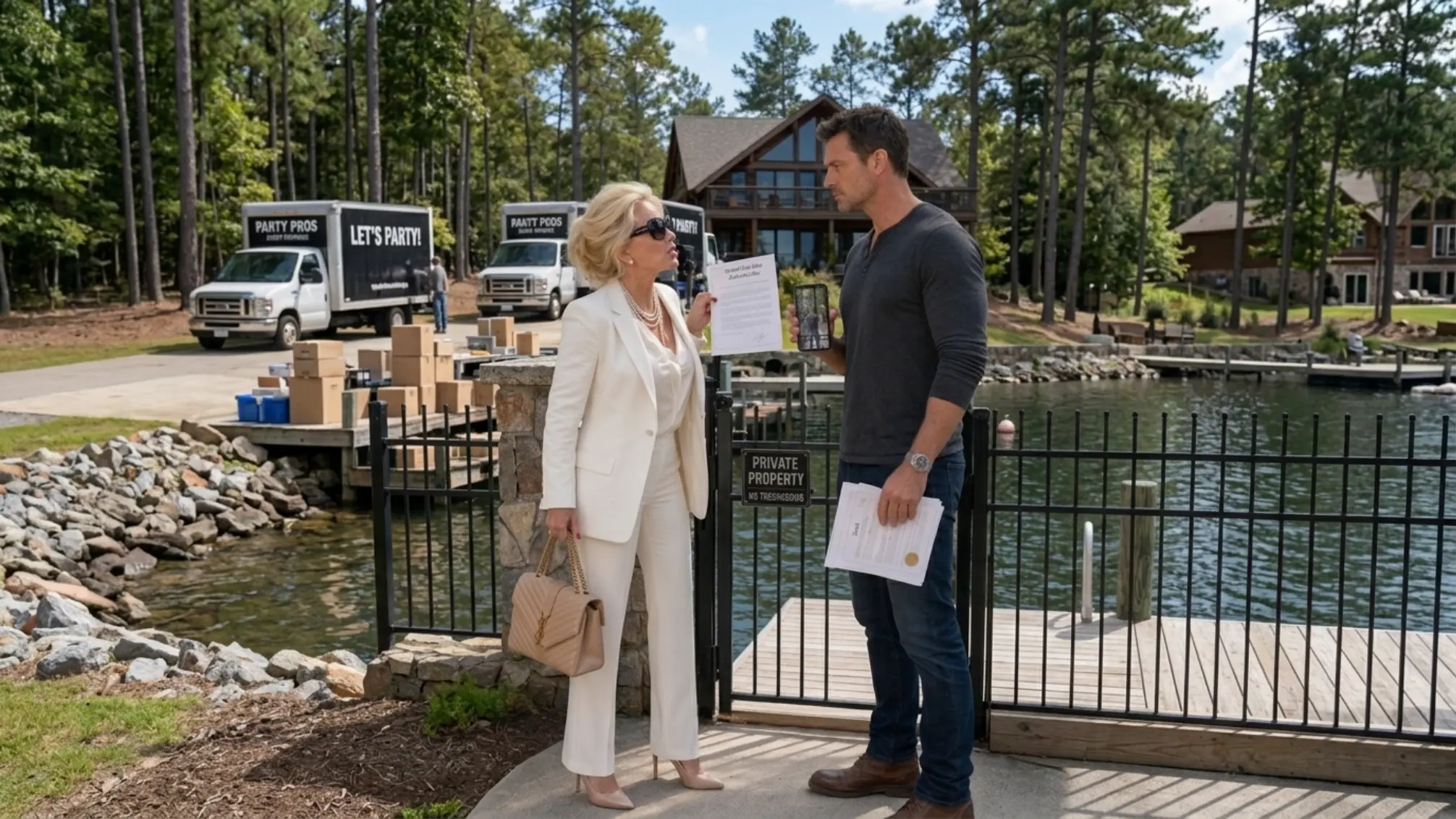
Brian remained on the porch with a coffee mug in one hand.
“Get off my property.”
Ethan laughed. “You didn’t hear me. My mother approved the cabin for the HOA party.”
“She can approve your house, her house, or the community center.”
“She runs Crystal Pines.”
“She does not run this land.”
Ethan removed his sunglasses. “You really want to fight the entire neighborhood over one party?”
Brian’s expression did not change. “No. I’m giving you one chance to leave before this becomes a criminal matter.”
The teenager glanced at his friends and smiled, trying to recover the authority he had expected Brian to fear.
“You’re threatening the HOA?”
“I’m warning a trespasser.”
Ethan stepped backward, but not before taking Brian’s father’s old fishing hat from a chair beside the dock. He placed it backward on his own head while one friend took a photograph.
“Friday at six,” he said. “Have the place unlocked.”
Brian watched them leave without chasing them.
Anger would have been easy. Evidence was more useful.
His name was Brian Nelson, and he had purchased the lakeside cabin six months earlier because he wanted silence after more than twenty years in law enforcement. Crystal Pines stood across the county line from the town where he served as chief of police, and the cabin itself was deliberately located outside the homeowners association’s legal boundary.
At least, that was what the deed and zoning map said.
Grace Moore believed differently.
At fifty-two, Grace had ruled Crystal Pines for nearly a decade. She appeared at board meetings in white or pale-pink suits, layered pearls, oversized sunglasses, and heels that struck the community-center floor like a warning. Residents joked that she could fine someone before learning their name, but few laughed where she could hear them.
Grace controlled the landscaping committee, neighborhood newsletter, community-events account, and nearly every board appointment. She fined retired residents for wind chimes, threatened a single mother over a garden ornament, and required homeowners to repaint houses because certain shades of beige were insufficiently “harmonious.”
Her favorite phrase was community improvement.
Brian had heard similar language from politicians, dishonest contractors, and officers trying to excuse misconduct. It usually meant that someone wanted control without admitting it.
Two weeks after moving into the cabin, Brian received his first HOA violation.
The letter claimed his cedar-brown exterior paint violated Crystal Pines’ approved palette. He was instructed to repaint the cabin in Lake Sand, Pebble Mist, or Tranquil Taupe.
Brian called the management office.
“My property is outside the association.”
The receptionist became quiet. “I’ll ask Mrs. Moore to contact you.”
Grace called two hours later.
“Mr. Nelson, I understand you’re confused about the updated neighborhood boundaries.”
“I’m looking at the county map.”
“The HOA integrated the lakeside properties last year.”
“The county recorded no such change.”
“You may not have the newest version.”
“Then send me the filing number.”
Grace paused.
“Must everything become confrontational?”
“Asking for evidence is not confrontation.”
She never sent a filing number.
Brian ignored the paint demand, but he began watching Grace more closely. He saw residents lower their voices when her white SUV passed. He watched board members agree with proposals they had privately criticized, and he heard stories about fines disappearing for Grace’s friends while doubling for anyone who challenged her.
Ethan’s claim about the cabin revealed that Grace’s entitlement had passed directly to her son.
Three days after the dock confrontation, Brian received an official-looking email bearing the Crystal Pines seal.
The HOA had supposedly approved his cabin for a youth graduation celebration. Under an invented section of the community charter, the association claimed temporary rights to use “community-adjacent property” for approved events benefiting residents.
The notice instructed Brian to leave the cabin unlocked Friday at five.
He read it twice.
Then he drove to the county records office.
A clerk pulled the zoning maps, deed history, and subdivision filings. The Crystal Pines boundary stopped half a mile before Brian’s dock. No easement, shared-use agreement, or HOA annexation affected his property.
“Why are they sending you notices?” the clerk asked.
“Because they think repeating a lie turns it into jurisdiction.”
Brian made certified copies of every document.
The following morning, Grace called.
“I’m confirming that you received the event authorization.”
“I received your forged notice.”
Her voice hardened. “Be careful with that word.”
“Be careful with my property.”
“The HOA has revised authority over community-adjacent land.”
“That phrase has no meaning under county law.”
“We can impose fines and revoke neighborhood access.”
“I don’t belong to your neighborhood.”
Grace laughed softly. “Everyone belongs to someone’s rules, Mr. Nelson.”
“That is true.”
She mistook the answer for surrender.
Brian installed motion-activated cameras around the cabin, dock, driveway, and gate. Each recording uploaded automatically to a secured cloud account. He laminated copies of the deed and zoning records, then contacted an attorney experienced in property disputes.
The lawyer reviewed Grace’s notice.
“She invented this clause.”
“I know.”
“Do you want me to send a cease-and-desist letter?”
“Not yet.”
“You’re waiting for her to escalate.”
“I’m waiting for proof.”
Brian also reviewed Crystal Pines’ publicly available financial reports. One expense immediately caught his attention: Community Youth Engagement Initiative — $12,000.
No resident he contacted had heard of the program.
There were no public receipts, schedules, or reports describing how the money had been spent. Several payments had been authorized solely by Grace, although the bylaws required two board signatures for expenses above $2,500.
Two days later, Grace’s SUV entered Brian’s driveway.
She stepped out wearing an immaculate white pantsuit, pearls, oversized sunglasses, and bright-red nails wrapped around a clipboard. Ethan followed in a designer hoodie, grinning like the cabin had already become his inheritance.
Grace stopped before Brian’s locked gate.
“Open this.”
“No.”
“The event will proceed as authorized.”
“Authorized by whom?”
“The HOA.”
“You mean you.”
“I represent one hundred twenty families.”
Brian held up his deed. “None of them own this.”
Grace lifted the forged authorization. “Community benefit can create temporary usage rights.”
“Not outside HOA jurisdiction.”
She pointed toward the cabin. “You purchased beside Crystal Pines. You benefit from our roads, security, landscaping, and property values.”
“My access road is county-maintained, my security is private, and your landscaping ends at the community sign.”
Ethan laughed.
Grace stepped closer. “Unlock that cabin. My son’s celebration outranks your pathetic deed.”
Brian raised his phone.
The screen displayed security footage of Ethan entering the dock, taking the fishing hat, and measuring the space for party equipment.
“Your son trespassed, stole property, and filmed himself doing it.”
Grace barely looked. “Teenagers make mistakes.”
“So do HOA presidents.”
“I own this community. I’ll have you removed before sunset.”
Brian opened his jacket just enough to reveal the badge clipped at his waist.
“Perfect. Keep talking while the warrant team parks behind you.”
Grace’s lips parted slightly.
Then she recovered.
“A badge doesn’t intimidate me.”
“It wasn’t shown for intimidation.”
“You’re using your position to settle a personal disagreement.”
“No. I’m giving you an opportunity to leave private property voluntarily.”
Grace snapped the clipboard shut. “Friday at six. Do not make this harder than necessary.”
Brian watched her return to the SUV.
“You’re the one making it harder.”
After they left, he called an investigator he trusted at the county sheriff’s office.
“I may need several units at Crystal Pines Friday night.”
“What kind of situation?”
“Unauthorized entry, possible underage alcohol, property damage, and maybe financial fraud.”
The investigator whistled. “That is quite a party.”
“It hasn’t started yet.”
Brian submitted the suspicious HOA records to the county financial-crimes unit. He did not request special treatment and removed himself from direct investigative decisions concerning Grace’s finances.
He wanted the case to survive accusations that he had built it for revenge.
On Wednesday morning, a camera alert showed Ethan returning with two friends. One operated a drone over the cabin while another photographed the dock. Ethan entered the porch, put on Brian’s father’s hat again, and uploaded a picture online.
My lake life. Party prep. Thanks, Mom.
Brian saved the post.
That afternoon, three beer-pong tables were delivered to his address. The driver confirmed that Grace had personally authorized the location.
On Thursday, party-rental trucks arrived carrying speakers, lights, coolers, and folding furniture. One employee noticed the private-property sign and hesitated.
“Mrs. Moore said to ignore that,” a teenager told him.
Brian stepped onto the porch.
“Evening, gentlemen.”
The workers stopped.
“You’re early for tomorrow’s arrests.”
The rental crew immediately reloaded the equipment and left. Ethan’s friends followed after realizing Brian had photographed their vehicle plates.
At eleven that night, Grace appeared alone.
She approached the cabin, tested the locked door handle, and looked directly into one security camera.
“He’ll regret this,” she muttered.
The microphone captured every word.
Friday evening arrived bright, humid, and unnaturally calm.
At 5:47, the first vehicles entered Brian’s driveway. BMWs, Jeeps, and one stretch SUV rolled toward the gate. Teenagers emerged carrying beer cases, portable lights, and speakers.
Ethan led them.
Brian’s father’s fishing hat sat on his head like a stolen crown.
“Mom said it’s approved,” he shouted.
Someone cut the chain.
They pushed through the gate, dragged coolers across the lawn, and began assembling equipment near the dock. Several teenagers entered the cabin after forcing a rear window. Others jumped directly into the lake.
Brian remained inside his office, monitoring every camera.
He called the sheriff’s staging team.
“They’re entering now.”
“Do you want units moving?”
“Not yet. Hold outside visual range.”
Grace arrived one hour later.
Her white SUV led two catering vehicles onto the property. She stepped out wearing pearls, a pale blazer, and heels completely unsuitable for the grass. A champagne flute rested in one hand.
“Welcome, everyone!” she announced. “The HOA is proud to sponsor this celebration for our amazing young residents.”
Teenagers cheered.
Grace spotted Brian standing on the porch.
“Mr. Nelson, thank you for finally supporting the community.”
Brian lifted his phone. “I’m recording that.”
“Lighten up. It’s for the children.”
“Then hold it at your house.”
“We are all part of one community.”
“Not legally.”
Her smile tightened.
By nine o’clock, teenagers were drinking openly. Beer cans floated near the dock, music shook the cabin windows, and fireworks exploded beside dry pine needles. One boy poured fuel near a portable fire pit while another held a lighter.
Brian recorded timestamps and sent updates to the waiting officers.
At 9:42, someone vomited beside his grill.
At 9:51, Ethan climbed onto a cooler.
“This is our lake now!” he shouted. “HOA rules!”
The crowd cheered.
Grace raised her champagne glass.
Brian’s phone vibrated.
“Units ready,” the sheriff’s commander said. “Your call.”
“Give them fifteen minutes.”
Grace approached the porch again, visibly intoxicated.
“You need to stop filming.”
“No.”
“This is community property tonight.”
Brian pulled a certified county map from the table. “This address remains entirely outside your association.”
Grace stared at the document without reading it.
“Don’t make me call the police.”
Brian smiled.
“That’s the best idea you’ve had all night.”
He stepped inside, put on his navy command jacket, clipped his badge visibly to the front, and returned to the porch.
The nearest conversations stopped.
Grace’s champagne glass slipped from her hand and shattered.
Brian’s voice carried across the lawn.
“Everyone here is trespassing on private property. Anyone under twenty-one possessing alcohol, step away from the containers. Everyone else, prepare to present identification.”
Ethan stared at him.
“You’re a cop?”
“Chief of police.”
The music stopped.
Sirens rose from beyond the trees.
Red and blue light washed across the lake as sheriff’s cruisers entered through the damaged gate. Deputies spread across the property while teenagers dropped cups, hid bottles, and began calling parents.
Grace moved toward Brian.
“This is an abuse of power.”
“No. This is the consequence of your choices.”
“They are children.”
“They are minors drinking on property they entered illegally after your son cut the lock.”
“The HOA authorized the event.”
“You authorized yourself.”
She pointed at him. “I’ll sue you.”
“You can discuss that after booking.”
One deputy brought Brian an invoice recovered from the catering truck. The $3,286 expense had been charged to the same Community Youth Engagement account Brian reported earlier.
Grace’s signature appeared at the bottom.
“That is a legitimate community expense,” she insisted.
“Paid from the program no resident knew existed?”
Her face changed.
Ethan attempted to slip toward the road but was stopped by a deputy. Officers recovered Brian’s father’s fishing hat from him, along with alcohol and a key taken from inside the cabin.
Brian accepted the hat.
“This belonged to my father.”
Ethan’s confidence had disappeared. “I was going to give it back.”
“You took it because you believed nobody could stop you.”
“My mother said—”
“Your mother’s title does not change the law.”
Another vehicle entered the driveway.
County Investigator Linda Hayes stepped out carrying a search warrant. Her team approached Grace’s SUV and began removing account folders, a laptop, receipts, and several checks.
Grace went pale.
“What is this?”
Hayes held up the warrant. “We’ve been tracing HOA funds since Chief Nelson reported irregularities.”
“You cannot search my car.”
“A judge disagreed.”
Officers discovered payment records connecting Grace’s personal accounts to HOA money. Over three years, funds intended for youth programs, landscaping, and neighborhood repairs had paid for luxury handbags, spa visits, home renovations, Ethan’s car insurance, and private catering.
The missing amount initially appeared to be $12,000.
The complete audit eventually placed it near $48,000.
Grace stared at Brian as Hayes read her rights.
“You set me up.”
“I told you no.”
“You waited until the party.”
“I waited until the evidence was complete.”
Her wrists were cuffed.
“You’ll regret this.”
Brian looked toward the destroyed lawn, broken gate, floating beer cans, and officers separating frightened teenagers from intoxicated adults.
“You confused patience with weakness.”
By midnight, the property was empty.
Most minors were released to parents after citations and interviews. Ethan faced charges for trespassing, property damage, theft, possession of alcohol, and unlawful entry.
Grace was booked for criminal trespass, fraud, embezzlement, forgery, and contributing to the delinquency of minors.
The following morning, her photograph spread across local news pages. Residents who had once feared her began providing investigators with violation letters, manipulated invoices, and stories of retaliatory fines.
Several board members admitted Grace routinely approved payments without votes.
One produced altered bylaws containing the invented “community-adjacent property” clause. The wording had been added after Brian purchased the cabin and never legally adopted.
At the preliminary hearing, Grace’s attorney described the party as a misunderstanding. He claimed she believed the cabin had become part of Crystal Pines through informal community integration.
Brian testified calmly.
“She didn’t misunderstand the boundary. I showed her the deed, survey, and county map. She chose to ignore them.”
The prosecutor displayed the video of Grace testing Brian’s locked door.
Then came the recording of her threatening him, the newsletter advertising his cabin, the catering invoice, the altered bylaw, and footage of Ethan cutting the gate chain.
Grace’s attorney stopped calling the incident a misunderstanding.
Crystal Pines suspended her immediately.
A retired accountant named Helen Graves became interim president and ordered a complete independent audit. Investigators discovered forged signatures, hidden transfers, and a $40,000 loan taken against HOA assets without board approval.
Grace’s husband provided additional banking records before filing for divorce.
Facing overwhelming evidence, Grace accepted a plea agreement. She received three years in state custody with part of the sentence suspended, mandatory restitution, probation, and permanent disqualification from managing community funds.
At sentencing, the judge asked whether she wished to speak.
“I only wanted to maintain order,” Grace said.
The judge studied her.
“Order does not require theft. Community does not require trespassing. Leadership does not require fear.”
Grace lowered her eyes.
Months later, Ethan appeared at Brian’s cabin wearing a plain gray shirt instead of designer clothing. He was completing court-ordered community service along the lakeshore.
“I came to apologize,” he said.
Brian waited.
“For the party. The gate. Your father’s hat. All of it.”
“What changed?”
Ethan looked toward the water. “I finally understood that my mother saying something didn’t make it legal.”
“That is a start.”
“I don’t want to become like her.”
“Then stop believing other people’s boundaries are insults directed at you.”
Ethan nodded.
Brian extended his hand.
The teenager shook it without swagger.
Under Helen’s leadership, Crystal Pines rewrote its financial controls. All major spending required independent review, board votes became public, and violation hearings included neutral appeals.
Residents held their first genuine community picnic near the lake six months later.
This time, Brian received an invitation.
No forged authorization.
No broken locks.
No one claimed ownership of his cabin.
As evening settled across the water, Brian stood at the end of his repaired dock with his father’s fishing hat hanging safely inside the cabin. Families laughed near the community park, teenagers played music at a reasonable distance, and no one was afraid that one woman’s clipboard could destroy their peace.
Grace had believed leadership meant controlling every fence, house, account, and person around her.
Ethan believed his mother’s title made him untouchable.
Both learned the same lesson at Brian’s locked gate.
Authority does not grow because someone speaks loudly enough.
And when Grace Moore finally forced her party onto the wrong man’s property, she did not take possession of a lake cabin.
She delivered her fraud, her forged documents, and her entire collapsing empire directly into the hands of the police chief waiting inside.