Marcus Reed noticed the black tape on his mailbox at 10:17 on a Tuesday morning.
He had stepped outside expecting nothing more complicated than bringing the recycling bin back from the curb. Instead, he found Deborah Whitmore, president of the Oakridge Estates Homeowners Association, standing beside his mailbox in a perfectly tailored pale blush-pink suit. Her blonde hair rested neatly against her shoulders, one hand held a folder of HOA notices, and the other was pressing a wide strip of black tape directly across the silver numbers identifying his house.
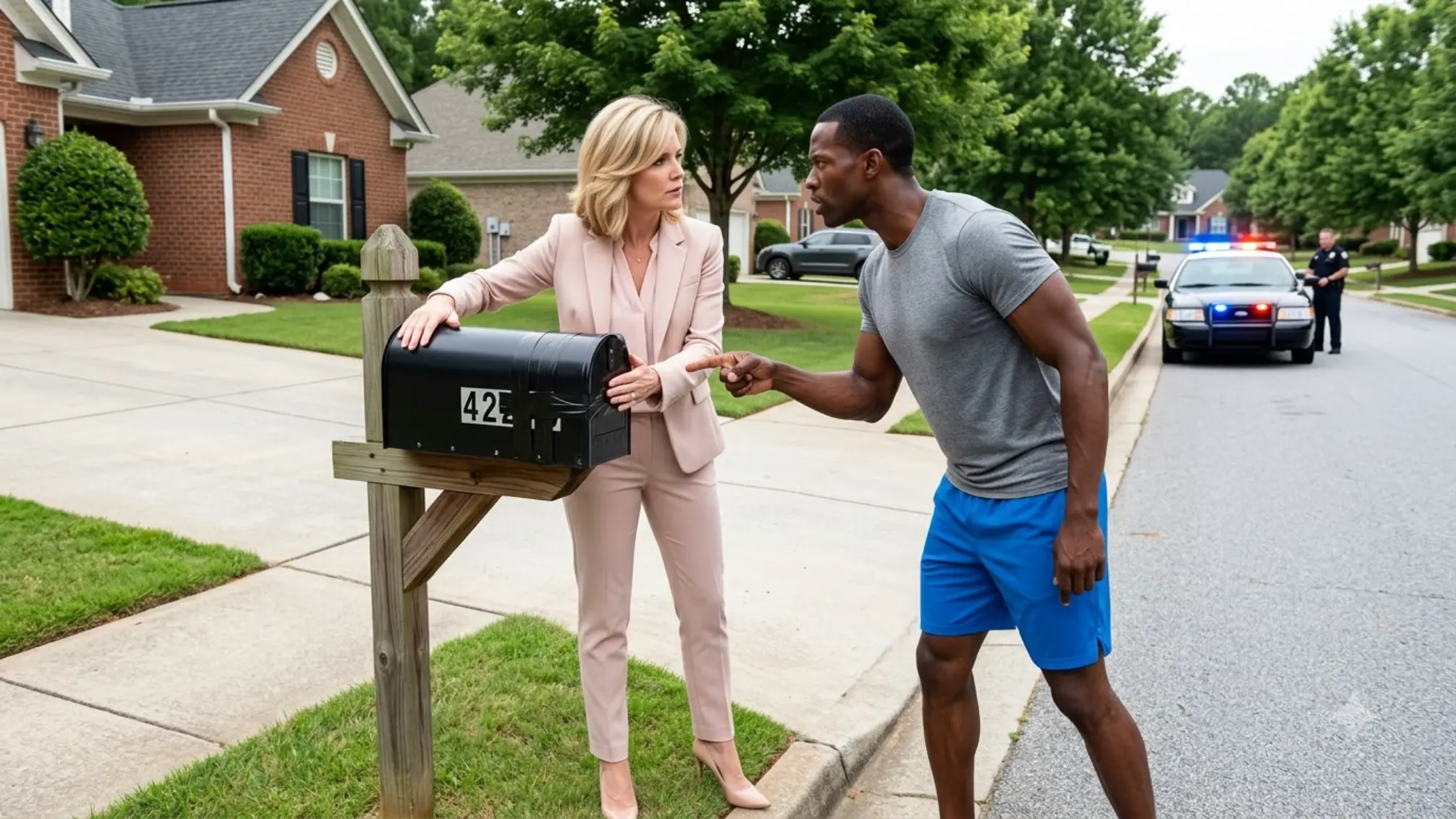
Marcus stopped halfway down the driveway.
He was thirty-nine, athletic, dressed in blue shorts and a gray T-shirt after finishing his morning workout. For nearly eight years, he had owned the brick house at the end of Laurel Ridge Drive without receiving anything more serious than routine landscaping reminders. That changed when Deborah became HOA president and decided Oakridge Estates needed what she called “visual discipline.”
“Take that off my mailbox,” Marcus said.
Deborah did not turn immediately.
She smoothed the tape with two fingers.
“Your address numbers violate the updated appearance standards.”
Marcus stared at her.
“They’re numbers.”
“They’re oversized.”
“They came with the mailbox.”
“That doesn’t make them compliant.”
Marcus walked closer.
The address had always been clearly visible from the street: 1259 in large silver numerals against the black box. Deborah had now covered the final two numbers almost completely.
“You cannot hide my address.”
“I’m correcting an HOA violation.”
“No. You’re making my house harder to identify.”
Deborah finally faced him.
Her expression was calm enough to be insulting.
“You were given two written notices.”
Marcus remembered them.
The first claimed his mailbox numbers were “inconsistent with the preferred visual uniformity of the community.”
He had ignored it because the HOA bylaws contained no rule governing the font or size of address numbers.
The second notice threatened a seventy-five-dollar fine.
Marcus responded by requesting the specific covenant provision authorizing it.
Deborah never provided one.
Instead, she arrived personally.
Marcus pointed at the tape.
“Remove it.”
Deborah lifted her chin.
“Your mailbox violates my standards. I’m fixing it whether you like it or not.”
Marcus stepped closer.
“You covered my damn address. That stopped being HOA business the second emergency services need to find this property.”
Her mouth tightened.
“Watch your tone.”
“Watch what you’re doing.”
“I can fine you until you’re begging to leave this neighborhood.”
Marcus almost laughed.
“You think you own the street?”
“I enforce the standards residents agreed to.”
“I agreed to covenants. I didn’t agree to you inventing rules.”
Deborah picked up her folder.
“You’ll receive another violation notice this afternoon.”
Marcus reached toward the tape.
Deborah slapped his hand away.
That changed everything.
Marcus froze.
Deborah froze too.
For one second, both understood she had crossed another line.
Marcus lowered his hand slowly.
“Do not touch me again.”
She recovered first.
“Then stop interfering with HOA enforcement.”
Marcus looked toward the corner of the street.
A white police cruiser had just turned into Oakridge Estates.
Deborah saw it and smiled.
“Perfect.”
She clearly believed authority had arrived for her.
Marcus pulled out his phone.
“Good. Tell that officer the same lie, because I already gave him the emergency call recording.”
Her smile disappeared.
“What recording?”
Marcus looked directly at her.
“The one from last Saturday.”
Four days earlier, Marcus’s seventy-two-year-old father, Leon Reed, had been staying at the house while recovering from minor surgery.
Leon was stubborn, independent, and deeply offended by anyone suggesting he needed supervision.
Marcus had gone to the grocery store for less than twenty minutes.
When he returned, he found his father sitting on the kitchen floor.
Leon had become dizzy while reaching for water.
He fell.
His shoulder struck a cabinet.
Worse, he could not stand without severe pain.
Marcus called 911 immediately.
The dispatcher confirmed the address.
“1259 Laurel Ridge Drive.”
“Yes.”
An ambulance was sent.
Marcus waited near the front window.
Five minutes passed.
Then eight.
Then twelve.
Leon’s breathing became faster.
Marcus called again.
The dispatcher sounded confused.
“The crew is on Laurel Ridge, but they’re not seeing 1259.”
Marcus rushed outside.
That was when he noticed the address.
Black tape covered part of the mailbox numbers.
Not all of it.
Enough to make 1259 look like 12 from a distance.
Marcus tore it away.
Then ran into the street.
An ambulance was slowly moving toward the intersection.
He waved both arms.
They stopped.
Leon was transported to the hospital.
Fortunately, the injury was not life-threatening.
A fractured shoulder.
Severe bruising.
Painful, but treatable.
The delay, however, terrified Marcus.
When he returned home that evening, he checked the security camera mounted above his garage.
At 8:42 the previous morning, Deborah appeared on video.
She parked near his mailbox.
Walked to it.
Applied the tape.
Photographed the result.
Then drove away.
Marcus watched the clip three times.
The next morning he contacted the HOA.
Deborah answered his email personally.
Temporary corrective masking was applied due to your continued noncompliance. Replace the numbers with approved numbers and the issue will be resolved.
Marcus read the sentence in disbelief.
Corrective masking.
She had invented bureaucratic language for covering an emergency address.
Marcus downloaded the security footage.
Saved her email.
Requested the 911 call record.
Then contacted an attorney named Rachel Benton, who specialized in property disputes.
Rachel’s response was immediate.
“She admitted doing this?”
“In writing.”
“Do not delete anything.”
“I wasn’t planning to.”
“And don’t argue with her.”
Marcus looked toward the mailbox.
“That part might be difficult.”
Rachel laughed.
“Then argue intelligently.”
By Tuesday, Marcus had the dispatcher audio.
The first call included his address clearly.
The second included the ambulance crew asking dispatch for confirmation because the visible number could not be identified.
Marcus gave copies to Rachel.
Then Deborah arrived with more tape.
Now the police cruiser stopped behind them.
Officer Daniel Harris stepped out.
He was a veteran county officer in his early fifties with the weary expression of a man who had already dealt with several neighborhood disputes that week.
“Morning.”
Deborah spoke immediately.
“Officer, I’m HOA president. This resident is interfering with authorized association enforcement.”
Harris looked toward Marcus.
Then toward the mailbox.
“What enforcement?”
Deborah pointed.
“Noncompliant numbers.”
Harris stared at the black tape.
“You covered the address?”
“It’s temporary.”
Marcus held up his phone.
“Last Saturday an ambulance couldn’t identify the house because she did exactly this.”
Harris’s expression changed.
Deborah turned sharply toward Marcus.
“That is not proven.”
Marcus opened the audio file.
He pressed play.
The dispatcher’s voice came through the phone.
“Unit Twelve, confirm you’re unable to locate 1259 Laurel Ridge.”
Another voice answered.
“Correct. We’re passing what appears to be number twelve. No visible 1259.”
Marcus stopped the recording.
Officer Harris looked at Deborah.
“Did you cover the numbers before that call?”
She hesitated.
Marcus answered.
“Camera footage says yes.”
“I was correcting a violation.”
Harris’s voice became harder.
“Ma’am, emergency address numbers are not decoration.”
Deborah crossed her arms.
“I understand that.”
“Apparently not.”
Her face reddened.
“You don’t understand HOA regulations.”
Harris looked at her.
“I understand an ambulance had trouble locating a patient.”
Silence.
Marcus peeled the black tape from the mailbox.
This time Deborah did not stop him.
Officer Harris asked to see the security video.
Marcus showed him.
The clip was clear.
Deborah.
Tape.
Mailbox.
Photograph.
Harris wrote down information.
Deborah became increasingly defensive.
“Are you charging me with something?”
“I haven’t said that.”
“This is private HOA property enforcement.”
“The mailbox is on his property.”
“Our covenants give inspection authority.”
“Inspection is not the same as obscuring an emergency address.”
Deborah looked toward Marcus.
“This is ridiculous.”
Marcus shook his head.
“My father was lying on the floor.”
“You’re blaming me for an ambulance driver missing a house.”
“I’m blaming you for hiding the number they were looking for.”
“That’s not the same thing.”
“It was to the dispatcher.”
Officer Harris raised one hand.
“That’s enough.”
Deborah looked stunned.
She was not accustomed to being stopped in the middle of a sentence.
Harris turned toward Marcus.
“Keep the footage. Keep the recordings. Your attorney may want all of it.”
Deborah heard the word.
“Attorney?”
Marcus looked at her.
“You threatened to fine me until I left the neighborhood.”
Her expression changed.
“You’re suing the HOA?”
“I haven’t decided what I’m doing.”
“That affects every homeowner.”
“No.”
Marcus stepped closer.
“What affects every homeowner is an HOA president who thinks her title lets her tamper with emergency identification.”
Deborah collected her folder.
“You will regret turning this into something bigger.”
Marcus nodded toward Officer Harris.
“Say that again.”
She stopped.
Harris looked directly at her.
Deborah said nothing else.
She walked toward her car.
By lunchtime, Oakridge Estates knew.
Neighborhood information moved faster than any official HOA email.
A woman two streets over had filmed part of the confrontation from her porch.
Another resident had seen the cruiser.
Someone posted in the neighborhood group:
Why was police at Marcus Reed’s house with Deborah?
Within twenty minutes, fifty comments appeared.
Marcus did not participate.
Then something unexpected happened.
Residents began sharing their own experiences.
A retired teacher named Susan Mitchell posted photographs showing tape Deborah had placed over a decorative number plaque after claiming it was the wrong color.
A young couple said the HOA threatened them for installing brighter address numbers because the wife worked night shifts and wanted emergency responders to find the house quickly.
Another homeowner uploaded a warning letter demanding removal of reflective driveway numbers.
The issue was larger than Marcus.
Deborah had spent nearly a year trying to standardize address displays across the subdivision.
She had focused on aesthetics.
Nobody had seriously challenged the policy.
Until an ambulance got lost.
The emergency HOA board meeting took place Thursday evening.
More than sixty residents attended.
Usually, board meetings attracted six people and a dog.
This one filled the community clubhouse.
Deborah sat at the center table wearing another tailored pink suit.
Marcus sat three rows back beside Rachel Benton.
The board vice president, Howard Fields, opened the meeting.
“We’re here to discuss concerns regarding address-display enforcement.”
Deborah leaned toward her microphone.
“There has been substantial misinformation.”
Marcus heard Rachel whisper:
“Here we go.”
Deborah continued.
“No HOA action prevented emergency services from reaching any residence.”
Several people immediately objected.
Howard struck the table.
“Order.”
Deborah produced printed documents.
“The resident at 1259 Laurel Ridge has repeatedly refused to bring his mailbox into aesthetic compliance.”
Marcus raised his hand.
Howard recognized him.
Marcus stood.
“My father was injured Saturday.”
The room quieted.
“I called 911.”
He held up a speaker.
“The ambulance crew could not identify my address because the final numbers had been covered.”
Deborah interrupted.
“That’s your interpretation.”
Marcus looked toward Rachel.
She nodded.
He played the recording.
Everyone heard it.
The dispatcher.
The confused ambulance crew.
Marcus waving them down.
The clubhouse became completely silent.
Then Marcus displayed the security video on the projector.
Deborah walked onto his property.
Applied the tape.
Photographed the mailbox.
Left.
A woman in the second row said, “You did that?”
Deborah leaned toward the microphone.
“Under enforcement authority.”
Rachel stood.
“No provision in the recorded covenants authorizes the HOA to physically obscure a legally displayed residential address.”
Deborah’s attorney, seated beside her, shifted uncomfortably.
Rachel continued.
“In addition, county fire guidance recommends clear address visibility from the roadway. Whatever aesthetic rule the board believes it was enforcing, the action created an obvious emergency-response hazard.”
Howard looked at Deborah.
“Did legal counsel approve this policy?”
Deborah hesitated.
The attorney answered.
“No.”
That single word changed the room.
Howard stared.
“You never sent this to counsel?”
Deborah’s composure cracked slightly.
“It was routine enforcement.”
The attorney shook his head.
“Physical masking was not part of any policy reviewed by this office.”
Residents began talking over one another.
Howard called for order again.
Marcus remained standing.
“I’m not here because I hate the HOA.”
That surprised people.
“I bought in this neighborhood knowing there were rules.”
He looked directly at Deborah.
“But rules protecting property values are not permission to create danger.”
Deborah folded her arms.
“My intentions were never dangerous.”
Marcus answered immediately.
“Intentions don’t help an ambulance find a house.”
The room went quiet again.
Rachel distributed copies of Deborah’s email describing the tape as “temporary corrective masking.”
Board members read it.
Howard’s face hardened.
“You put this in writing?”
Deborah stared at him.
“I was documenting enforcement.”
Howard removed his glasses.
“We need executive session.”
Deborah leaned toward him.
“For what?”
“To discuss your authority.”
Her face went pale.
Residents waited almost an hour.
When the board returned, Howard read a prepared statement.
Effective immediately, all enforcement concerning address numbers was suspended.
All residents were instructed to maintain clear, unobstructed emergency identification.
Any HOA employee or board member was prohibited from altering a homeowner’s address marker without written legal authorization.
Then came the final item.
“Pending further investigation, Deborah Whitmore is suspended from exercising enforcement authority as HOA president.”
Gasps moved through the room.
Deborah stared at Howard.
“You cannot do this.”
“The board just voted.”
“I built this association.”
Howard’s voice remained calm.
“No. Homeowners did.”
Deborah stood.
Her chair scraped backward.
She looked toward Marcus.
“You did this.”
Marcus shook his head.
“No.”
He pointed toward the projection screen still showing her at his mailbox.
“You did.”
Deborah left.
The investigation lasted six weeks.
It uncovered dozens of violation letters issued under policies that had never been formally adopted.
Fines had been threatened without board votes.
Residents had been pressured to remove reflective emergency markers, accessibility railings, and several other modifications because Deborah considered them visually inconsistent.
Most actions had caused inconvenience.
Marcus’s incident demonstrated the potential consequence.
The HOA’s insurance carrier became involved.
So did county emergency management.
Nobody wanted another ambulance searching for a house hidden behind aesthetic enforcement.
Deborah resigned before the final removal vote.
Marcus did file a civil claim.
Not for millions.
Not to destroy the association.
The settlement covered his father’s additional medical transport expenses, attorney fees, and several costs associated with the incident.
More importantly, the agreement required policy changes.
Oakridge Estates adopted a written emergency-access standard.
Address numbers had to remain visible from the road.
Reflective numbers were explicitly permitted.
No board member could enter a homeowner’s property to modify safety-related markings.
Disputed violations required written citation to the actual covenant provision involved.
And emergency or accessibility issues overruled purely cosmetic preferences.
Marcus’s father recovered slowly.
Six weeks after the fall, Leon returned to Laurel Ridge wearing a shoulder sling and carrying enough opinions to qualify as a neighborhood committee by himself.
He stood beside the mailbox.
The numbers were back.
Larger than before.
Reflective.
1259.
Leon smiled.
“You made them bigger.”
Marcus nodded.
“County recommendation.”
“HOA like that?”
“New HOA does.”
Leon looked toward him.
“What happened to the blonde lady?”
“Resigned.”
“Because of me?”
Marcus laughed.
“Dad, please don’t take credit for falling down.”
Leon shrugged carefully.
“I contributed.”
Marcus shook his head.
His father touched the mailbox.
“You know what bothers me?”
“What?”
“That woman probably thought this was about numbers.”
Marcus looked at him.
“It started that way.”
“No.”
Leon shook his head.
“It started because somebody believed being in charge meant nobody could tell her no.”
Marcus considered that.
His father had a point.
Three months later, Oakridge Estates elected a new board.
Howard Fields became president temporarily.
The first meeting under the revised rules lasted only forty minutes.
No shouting.
No invented policies.
No threats.
Marcus attended because Howard had asked him to join the safety committee.
He initially refused.
Then his father laughed at him.
“You complain about the HOA for three months and now they invite you to improve it, you’re going to sit home?”
So Marcus joined.
His first proposal was simple.
Every home should receive free reflective address numbers meeting fire-department visibility recommendations.
The HOA approved it unanimously.
Installation was voluntary.
Almost everyone participated.
One Saturday morning, Marcus helped an elderly neighbor replace faded numbers on her porch.
As he tightened the final screw, she smiled.
“You ever think you’d become an HOA volunteer?”
Marcus laughed.
“Absolutely not.”
She pointed toward his house.
“Funny how things happen.”
Marcus looked across the street.
His mailbox stood clearly visible.
Four ordinary digits.
Before Deborah Whitmore covered them, Marcus had barely noticed them.
Afterward, he understood what they represented.
A direction.
A location.
A way for somebody coming to help to know exactly where a human being needed them.
That was something no neighborhood aesthetic could ever be more important than.
Almost a year after the incident, Marcus saw Deborah again.
She was walking through a shopping center carrying grocery bags.
They noticed each other simultaneously.
Neither could pretend otherwise.
Deborah stopped.
Marcus did too.
For a second, he expected defensiveness.
Instead she said:
“I heard your father recovered.”
“He did.”
“I’m glad.”
Marcus nodded.
Deborah looked away.
“I should never have covered those numbers.”
“No.”
“I thought you were challenging me.”
“I was challenging the rule.”
“I didn’t understand the difference.”
Marcus studied her.
She seemed smaller without the board title.
Not physically.
Just human.
“I became obsessed with making people respect the HOA,” she said.
Marcus answered quietly.
“Respect usually disappears when you have to force it.”
She accepted that.
“I’m sorry about your father.”
Marcus did not tell her everything was fine.
It had not been fine.
He did not offer immediate absolution.
But he nodded.
“Thank you.”
Then they walked away in opposite directions.
That night, Marcus sat on his porch while Leon visited for dinner.
An ambulance passed the entrance to Oakridge Estates.
Its lights flashed briefly through the trees.
Leon looked toward the street.
“Think they can find this place now?”
Marcus smiled.
“Pretty sure they can see our number from another county.”
“Good.”
The ambulance disappeared.
Marcus looked toward the black mailbox illuminated by the porch light.
There it was.
1259.
Clear.
Reflective.
Impossible to miss.
Months earlier, Deborah Whitmore had covered those numbers because she believed an HOA president could decide what looked acceptable on a homeowner’s property.
She learned instead that authority had boundaries.
The neighborhood learned something too.
Rules could protect communities.
But rules without judgment could endanger the people they were supposed to serve.
Marcus never cared that Deborah disliked his mailbox.
He cared that his father had been lying injured inside while paramedics searched for a home whose identity someone had intentionally hidden.
That was why he saved the footage.
Why he played the recording.
Why he confronted the board.
Not because he wanted revenge.
Because next time, the person waiting for help might not have twelve extra minutes.
And after what happened at 1259 Laurel Ridge Drive, nobody in Oakridge Estates ever covered an address number again.