“Your cable is against HOA landscaping rules.” Linda Mercer said it like a judge handing down a sentence, standing in the middle of Jamal Reed’s front lawn with a pair of heavy red bolt cutters resting against the open utility box beside his driveway. Her bright red blazer, white pants, dark sunglasses, and black HOA PRESIDENT folder made her look more like she had arrived for a press conference than a confrontation. Jamal stopped halfway down his walkway, stared at the tool in her hands, and felt his jaw tighten. “Put those down, that’s my internet line.”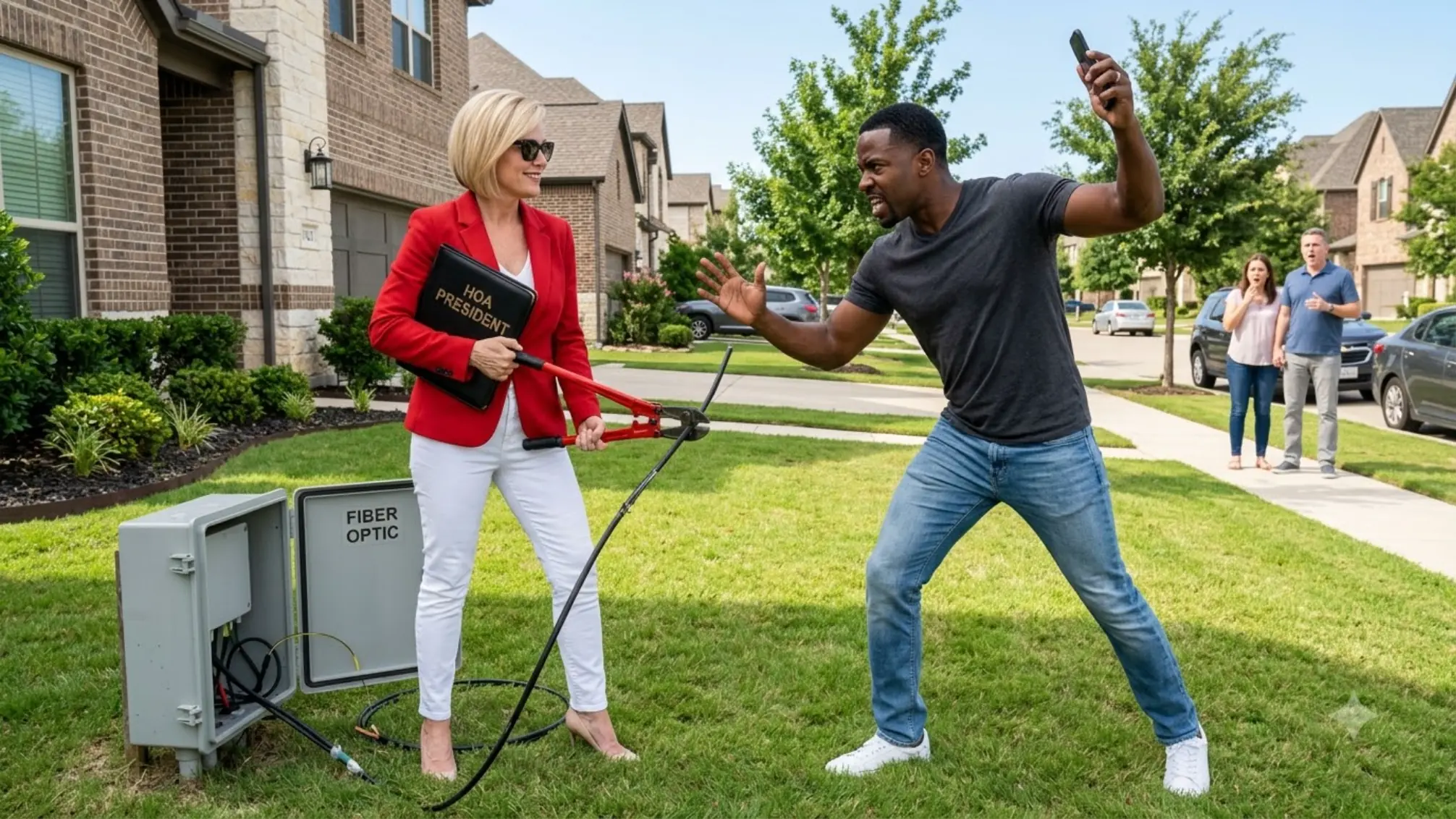
Linda did not move. She was fifty-two, white, polished, and famous throughout Brookstone Ridge for treating every rule in the homeowners association handbook like a personal commandment carved into stone. “Touch me and I’ll have you fined, trespassed, and removed from this neighborhood,” she snapped, tightening her grip on the cutters. Jamal raised his phone and pointed its camera toward her. “Go ahead—when police get here, let them read who you texted before cutting it.”
For the first time, Linda’s expression shifted. It lasted less than a second, just enough for Jamal to notice before the contempt returned to her face. Behind them, neighbors had begun stepping onto porches, drawn by the argument and by the strange sight of the HOA president standing over a homeowner’s utility equipment with bolt cutters. Jamal kept recording.
He was thirty-eight, a Black American software engineer who worked remotely for a cybersecurity company in Dallas. He had bought the two-story white house on Willow Crest Drive fourteen months earlier because Brookstone Ridge seemed quiet, clean, and far enough from downtown to feel peaceful without turning his commute into a nightmare. Most days he wore exactly what he wore now: a charcoal T-shirt, faded jeans, and white sneakers. Nothing about him looked threatening, but Linda Mercer had treated his arrival in the neighborhood like a problem that needed managing.
The first letter came three weeks after he moved in. His recycling bin had remained visible from the street until 8:07 p.m., seven minutes later than the community standard. The second letter warned that the basketball hoop in his driveway created an “inconsistent streetscape aesthetic,” even though three white families on the next block had identical hoops. Jamal had ignored the tone, paid no fines because none were enforceable, and documented everything.
Then came the landscaping notices. Linda claimed his grass was one inch too high, his mailbox numbers were the wrong shade of bronze, and a fiber-optic installation marker near the hedge created a “visual nuisance.” Jamal responded calmly each time, requesting the exact HOA provision she believed he had violated. Most of the time, the letters stopped after that.
The internet cable was different. Two weeks earlier, Jamal’s provider had upgraded the underground fiber connection running from a utility easement to the side of his house. The technician left a small weatherproof service line partly visible beside the shrub bed because the final protective conduit had been backordered. Jamal had received written confirmation from both the provider and the city that the temporary installation was permitted.
Linda did not care. She emailed him twice demanding immediate removal. Jamal sent back the provider documentation and told her the cable was not HOA property.
The next morning, Linda appeared in person. She walked onto his lawn without permission, opened the utility enclosure, photographed the line, and left before Jamal could reach the front door. His security camera recorded the entire visit. He saved the footage and assumed that would be the end of it.
It was not. At 2:17 that afternoon, Jamal received an alert from his smart-home system that his internet connection had dropped. Because his backup mobile network switched on automatically, his exterior security cameras remained live. He opened the camera feed and saw Linda standing in his yard.
She had bolt cutters.
Jamal had been working from the upstairs office and was outside in less than thirty seconds. That was where the confrontation began.
Linda pointed toward the exposed cable. “You were given forty-eight hours.”
“You were given the installation approval.”
“I don’t recognize that approval.”
“You don’t have to.”
Linda pulled the cutters open. “The board authorized correction.”
Jamal’s voice hardened. “Show me the vote.”
She froze.
“Show me the board minutes authorizing you to cut private telecom equipment.”
Linda closed the cutters with a metallic snap. “You don’t get to interrogate me.”
“I get to ask why you’re standing on my property with a tool capable of destroying something that doesn’t belong to you.”
Several yards away, Jamal’s neighbor Martha Ellis had begun filming from her porch. Across the street, another homeowner slowly lowered a grocery bag and watched. The neighborhood was quiet enough that every word carried.
Linda looked around and realized she had an audience. Instead of backing down, she raised her voice.
“This resident has repeatedly violated association standards.”
Jamal almost laughed. “Resident?”
Linda continued. “He has been warned multiple times.”
“About grass, a basketball hoop, and now a cable the city says is legal.”
Linda pointed at him. “Your attitude is exactly the problem.”
“My attitude?”
“You came into this neighborhood acting like the rules don’t apply to you.”
Jamal stared at her.
That sentence had history behind it.
Not just one argument.
Not one cable.
Fourteen months of selective enforcement had finally found a voice.
He stepped closer, still keeping several feet between them. “Put the cutters down.”
Linda lifted her chin. “No.”
“Then I’m calling police.”
“Call them.”
“I already did.”
Her hand tightened around the cutters.
Jamal noticed.
So did the camera.
Within six minutes, a Brookstone Ridge patrol SUV pulled onto Willow Crest Drive. Officer David Mills, a white man in his early forties, stepped out first, followed by Officer Tasha Green, a Black woman in her thirties. Both officers saw Linda standing beside the open utility box before Jamal said a word.
Mills looked at the bolt cutters. “Who owns those?”
Linda raised them slightly. “I do.”
“And the cable?”
Linda hesitated.
Jamal answered. “My internet provider.”
Linda snapped, “The HOA has jurisdiction over visible exterior modifications.”
Officer Green looked toward Jamal. “Did she cut anything?”
“Connection went down while she was standing here.”
Linda shook her head. “Coincidence.”
Jamal held up his phone. “My camera caught her opening the box.”
Officer Mills glanced toward Linda. “Did you open it?”
“I inspected a violation.”
“That wasn’t the question.”
Linda’s posture stiffened.
Officer Green walked toward the utility box and crouched beside it. Inside, one cable was partially crushed, its outer casing visibly damaged where the jaws of the cutters had pressed into it. The line had not been completely severed, but it was enough to disrupt the signal.
Green looked up. “This looks fresh.”
Linda crossed her arms. “I was preventing continued noncompliance.”
Officer Mills stared at her. “You damaged the cable?”
“I was enforcing HOA standards.”
“That’s a yes?”
Linda’s face tightened.
Jamal said nothing.
He did not need to.
Officer Mills asked for identification from both of them. Linda handed over her license and immediately added, “I’m the elected HOA president.”
Mills looked at the card, then at her. “That doesn’t change property law.”
Her lips parted slightly.
Officer Green asked Jamal to show the video. He opened the security clip.
The footage showed Linda entering the yard at 2:15 p.m. She looked toward the street, pulled the bolt cutters from the back of her SUV, opened the utility enclosure, and positioned the jaws around the cable. At 2:17, the camera briefly shifted to backup mode.
Nobody spoke for several seconds after the clip ended.
Linda finally said, “There are circumstances you’re not understanding.”
Officer Mills folded his arms. “Help me understand.”
She gestured toward Jamal’s house. “The cable was unauthorized.”
Jamal immediately opened the email from the provider and city permitting office.
Mills read it.
The officer’s expression changed.
“It says here the line is lawful within the utility easement.”
Linda’s voice sharpened. “That does not supersede private community standards.”
Officer Green looked at her. “HOA standards don’t normally authorize criminal damage.”
Linda laughed nervously. “Criminal damage? This is absurd.”
Jamal remained calm.
“That’s what I said when she threatened to remove me from the neighborhood.”
Green turned toward him. “She said that?”
“It’s on video.”
Linda’s eyes narrowed. “He’s twisting my words.”
“Then we’ll listen.”
The second recording was clearer. Linda could be heard saying, “Touch me and I’ll have you fined, trespassed, and removed from this neighborhood.”
Officer Mills looked toward her.
“Removed how?”
Linda’s face reddened. “It was a figure of speech.”
“You threatened to have a homeowner trespassed from his own property?”
“I meant through HOA remedies.”
“What remedy allows that?”
Linda stopped answering.
Officer Green noticed the black folder under Linda’s arm. “What’s in there?”
“Association records.”
“Any work order related to this property?”
Linda hugged it closer to her side. “Those are confidential.”
Jamal watched her carefully.
Something about the sudden defensiveness caught his attention.
“Ask her about the other addresses,” he said.
Linda’s head snapped toward him.
Officer Mills looked at Jamal. “What other addresses?”
Jamal pointed toward her phone. “When I came outside, she was texting someone. I saw a message preview that said ‘Willow Crest done. Two more tonight.’”
Linda’s face changed completely.
Officer Green noticed.
“What did the message refer to?”
“Nothing.”
Mills looked at the phone in Linda’s hand. “Can we see it?”
“No.”
“You’re not required to consent.”
“Then I don’t.”
Jamal nodded slowly. “That’s what I thought.”
Linda glared at him.
Officer Mills stepped aside and contacted a supervisor. The initial incident had changed from a neighborhood dispute into possible intentional property damage, and Jamal’s statement suggested the event might not be isolated. The officers could not simply search Linda’s phone because he suspected something, but they could preserve the device if investigators developed sufficient legal grounds.
Linda knew that too.
She suddenly turned toward her SUV.
Officer Green moved into her path.
“Ma’am, where are you going?”
“Home.”
“Stay here while we finish.”
“I have nothing else to say.”
Her phone was still in her hand.
The screen lit up.
Another message appeared.
Officer Green did not touch the device, but from where she stood she could see the preview.
Maple Lane still has the camera. Wait until dark.
Green’s expression changed.
“So there are other houses.”
Linda locked the screen immediately.
“That is none of your business.”
Now it was.
Officer Mills asked dispatch whether the department had received recent reports of damaged internet, cable, sprinkler, or exterior utility lines within Brookstone Ridge. The answer came back almost immediately.
Three.
One fiber line cut.
One landscape-lighting cable severed.
One irrigation controller disconnected.
All within the previous six weeks.
Jamal looked toward Linda.
She stared straight ahead.
Officer Green asked for the addresses.
The first was 411 Maple Lane.
The second was 702 Garden Crest.
The third was 188 Willow Crest.
Jamal lived at 188.
Linda’s face went pale.
Mills looked toward her.
“Do you know the homeowners at the other two addresses?”
“As HOA president, I know most residents.”
“Were they in violation?”
Linda did not answer.
Jamal asked quietly, “Who lives there?”
Officer Green checked the dispatch notes.
“At Maple Lane, a Hispanic family.”
She looked at the next record.
“Garden Crest, Black homeowner.”
Silence.
Linda finally snapped. “Don’t turn this into race.”
Jamal’s eyes hardened.
“Nobody said race.”
She realized the mistake immediately.
The officers exchanged a glance.
Linda stepped backward.
“This is ridiculous.”
Jamal crossed his arms. “You knew exactly what we were talking about before anyone said it.”
Linda’s voice rose. “I enforce rules against everyone.”
“Show the violations.”
“I don’t answer to you.”
“You’re standing on my lawn after crushing my internet line.”
“I answer to the board.”
Jamal nodded.
“Good.”
He turned toward Martha Ellis, who was still filming from across the street.
“Martha, are you still on the board?”
Martha lowered her phone.
“I resigned three months ago.”
“Why?”
She looked directly at Linda.
“Because she started sending violation notices without votes.”
The neighborhood went quiet again.
Linda shouted, “That is a lie.”
Martha walked closer but remained on the sidewalk.
“You want me to pull the emails?”
Linda’s jaw clenched.
Martha continued. “You sent me a list of homes you called ‘problem properties.’”
Jamal looked at her.
“How many?”
“Twelve.”
“Do you still have it?”
“Yes.”
Linda took a step toward her.
Officer Green immediately moved between them.
“Stay where you are.”
Martha unlocked her phone and searched her email. Within a minute, she found the message.
Subject line: Priority Enforcement Properties.
Twelve addresses.
Jamal’s was number four.
Maple Lane was number seven.
Garden Crest was number eleven.
Martha handed her phone to Officer Mills.
“There’s an attachment.”
The spreadsheet contained columns labeled:
PROPERTY CONDITION
COMPLIANCE HISTORY
OWNER COOPERATION
ESCALATION OPTIONS
The officers scrolled.
Beside Jamal’s address, one note read:
Challenges authority. Document everything until actionable.
Beside Maple Lane:
Family frequently parks relatives’ vehicles. Increase inspection frequency.
Beside Garden Crest:
Owner refuses verbal corrections. Formal pressure recommended.
Jamal looked at Linda.
“This wasn’t landscaping.”
Linda’s hands were shaking now.
“It’s standard enforcement.”
Martha shook her head.
“No, it isn’t.”
Officer Mills called a detective.
The situation was no longer likely to end with a simple report.
Linda was asked to place her phone on the hood of the patrol SUV while investigators determined whether they had grounds to seize it pending a warrant. She refused twice, then finally complied after officers made clear she could not leave with potential evidence if a court order was being sought.
Jamal stood on his lawn and watched the woman who had spent fourteen months acting as if Brookstone Ridge belonged to her suddenly discover how little authority an HOA title carried outside an HOA meeting.
That night, police obtained a warrant.
The phone changed everything.
Investigators recovered months of messages between Linda and two homeowners who unofficially helped her patrol the neighborhood. She had sent photographs of properties, vehicle license plates, landscaping details, utility boxes, and even screenshots from neighborhood social-media accounts.
One message read:
Reed keeps challenging every notice. We need something physical.
Another said:
If cable is visible again, I’ll take care of it myself.
Another:
Maple Lane family installed another camera. Wait until they leave.
Police also found photographs taken after several acts of damage.
A disconnected irrigation control.
Cut landscape wiring.
A smashed mailbox sensor.
A torn security-camera cable.
The investigators could not prove Linda personally committed every act, but they had enough to connect her to multiple incidents through messages, locations, and photographs.
The board called an emergency meeting forty-eight hours later.
More than one hundred homeowners attended.
Linda arrived with an attorney.
For the first time in years, she did not sit at the center of the table.
The vice president did.
Jamal sat near the back beside Martha.
He had no interest in making a speech.
The documents were stronger.
The HOA attorney opened by confirming that Linda had never possessed unilateral authority to remove, cut, alter, or damage telecommunications equipment. There had been no board vote authorizing action against Jamal’s fiber line. There was no landscaping rule prohibiting the temporary conduit.
Then came the notices.
The attorney had reviewed three years of enforcement records.
The numbers were impossible to explain away.
A small group of homes had received nearly four times as many inspections as comparable properties elsewhere in the subdivision. Several had been cited for conditions that existed openly at houses never warned once.
Basketball hoops.
Guest vehicles.
Visible trash bins.
Holiday decorations.
Exterior cameras.
Satellite dishes.
Jamal’s mailbox-number complaint looked especially absurd when photographs showed five board members with different-number finishes.
Residents became angry.
Not loud at first.
Then very loud.
One man stood and demanded to know why his family had received six warnings about visiting relatives parking overnight when the rule did not prohibit overnight guests. Another homeowner described Linda photographing her children while measuring the distance between bicycles and the driveway edge.
A retired teacher produced eighteen letters Linda had sent in eleven months.
Martha read the Priority Enforcement Properties email aloud.
That ended whatever support Linda had left.
The board voted 6–0 to remove her as president pending a full recall.
She resigned before the recall could occur.
The criminal investigation continued.
Linda eventually faced charges related to property damage, tampering, and unlawful entry connected to several documented incidents. The consequences were not exaggerated into some impossible life sentence; the evidence was enough on its own. She entered a plea agreement that included restitution, probation, community service, and an order prohibiting her from serving in association leadership during the term of supervision.
Two homeowners involved in the text threads were separately investigated. One admitted helping disconnect landscaping equipment but denied participating in cable cutting. Another turned over additional messages after receiving legal advice.
The HOA itself faced civil claims.
Its insurance carrier demanded governance reforms before renewing coverage.
Brookstone Ridge hired an independent management company.
Violation notices now required photographic evidence and citation of an exact rule.
Repeat enforcement against one property required secondary review.
Board members could no longer personally enter private lots except for genuine emergencies or with written authorization.
And every enforcement action became visible to all board members through a shared digital system.
Jamal insisted on one additional rule.
“No secret target lists.”
Nobody argued.
Months later, his new fiber line ran invisibly beneath fresh conduit along the side of the house. The provider had repaired the damage within twenty-four hours and replaced the temporary installation at no cost after learning what happened. Jamal installed another security camera, but unlike Linda predicted, he did not point it toward the street to watch neighbors.
He pointed it toward his own property.
One Saturday morning, Martha stopped while walking her dog.
“You ever think about running for the board?”
Jamal laughed.
“Absolutely not.”
“You’d probably be good at it.”
“That’s exactly how people get trapped.”
Martha smiled.
“You changed half the rules anyway.”
Jamal shook his head.
“No.”
He looked down the street.
“The phone changed the rules.”
Martha laughed.
“That phone just proved what she was already doing.”
Jamal nodded.
That was true.
The evidence mattered because it transformed what had always been dismissed as tone, suspicion, selective enforcement, and uncomfortable patterns into something concrete.
Dates.
Addresses.
Messages.
Instructions.
Photos.
Decisions.
Linda had spent years depending on ambiguity.
She never wrote, I am targeting these residents because of who they are.
She did not need to.
She wrote enough to show that certain homeowners became problems simply because they questioned her authority, resisted unnecessary pressure, or refused to behave grateful when she corrected them.
The system worked because complaints were treated individually.
One grass warning looked petty.
One parking notice looked ordinary.
One cable complaint looked technical.
Put everything together, and the pattern appeared.
A year after the incident, Brookstone Ridge held its annual neighborhood barbecue.
Jamal almost skipped it.
Then Martha showed up at his door holding two folding chairs and refused to accept excuses.
The event looked different from previous years.
Kids played basketball in the cul-de-sac.
Someone had parked a pickup truck partially on the curb.
Three recycling bins were still visible after sunset.
Nobody exploded.
Nobody issued warnings.
Jamal stood beside the food table when a new homeowner approached.
“Are you Jamal Reed?”
He nodded.
The man smiled.
“I heard the story.”
Jamal sighed.
“Which version?”
“The one where some HOA lady cut your internet and police found half the neighborhood in her phone.”
Jamal laughed.
“That version keeps getting more dramatic.”
“Did she really threaten to have you removed from your own neighborhood?”
“That part happened.”
The man shook his head.
“What did you say?”
Jamal looked across the grass.
He remembered the bolt cutters.
The red blazer.
The open utility box.
Linda standing on his property absolutely certain that nobody would challenge the authority she had invented for herself.
“I told her to put them down.”
“That’s it?”
“At first.”
The homeowner laughed.
“What would you say now?”
Jamal considered it.
Then he smiled.
“Probably the exact same thing.”
Across the lawn, children shouted as a basketball bounced toward the sidewalk.
Martha called for someone to bring more ice.
The sun dropped behind rows of identical suburban roofs that had once seemed like symbols of strict order.
Now they simply looked like homes.
Jamal went back to his conversation.
His internet worked.
His basketball hoop remained in the driveway.
His mailbox numbers had never changed.
And somewhere inside the Brookstone Ridge HOA archive sat a thick folder documenting how one broken fiber line forced an entire neighborhood to finally examine who had been writing its rules—and who those rules had really been used against.