At 10:16 on a bright Saturday morning in Scottsdale, Arizona, Darius Cole was standing in his kitchen when every connected device in his house seemed to fail at once. His music stopped first, cutting off halfway through a song, followed by the security panel near the garage flashing a connection warning. A video call running on his laptop froze, the television displayed a network error, and seconds later his phone automatically switched from Wi-Fi to cellular service. Darius stared toward the front window and immediately knew this was not an ordinary outage.
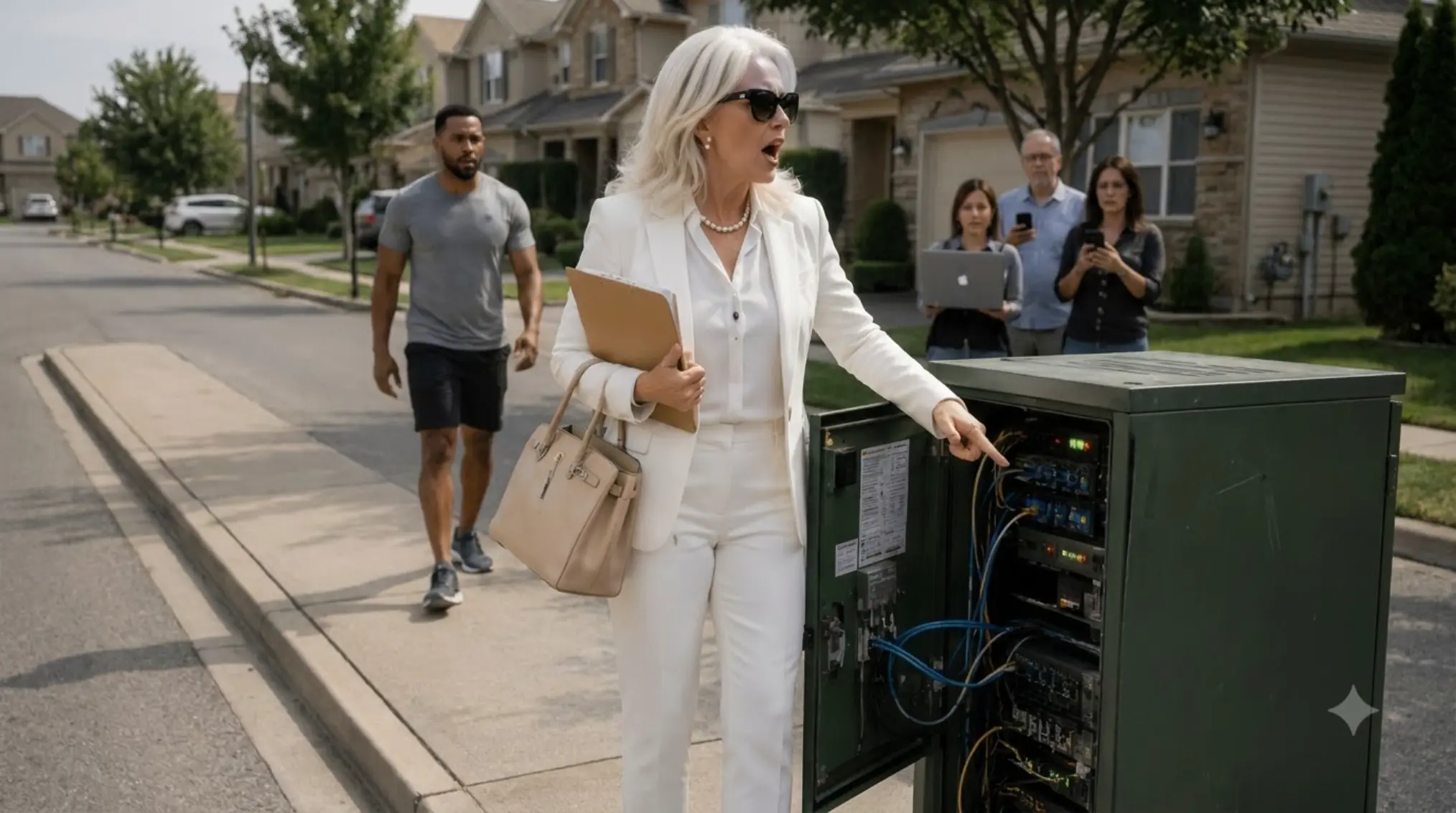
Three minutes earlier, one of his exterior cameras had sent an unusual motion alert.
The camera covered the sidewalk and the green telecommunications cabinet positioned on a utility easement near the corner of his property. That cabinet belonged to Sonoran Fiber Communications, the company providing fiber internet to most of Desert Vista Estates. Residents passed it every day without thinking about it, and Darius had never touched it in the four years he had lived there. The only people he had ever seen open the cabinet wore telecommunications uniforms and arrived in marked service trucks.
The woman standing beside it now wore nothing resembling a technician’s uniform.
Deborah Whitmore, fifty-eight, president of the Desert Vista Homeowners Association, stood on the sidewalk in an immaculate all-white tailored pantsuit, white silk blouse, pearl necklace, pearl earrings, oversized black sunglasses, and nude pointed heels. Her platinum-blonde hair rested neatly against her shoulders, and a large beige designer handbag hung from one arm while she pressed a thick HOA clipboard against her ribs. The green cabinet door was wide open beside her, exposing rows of fiber connections, network modules, labeled ports, blue and yellow cables, and blinking indicator lights.
Darius watched the security feed for two seconds.
Then he ran.
He came through his front door wearing a fitted gray T-shirt, black athletic shorts, and running shoes, still holding his phone in one hand. At thirty-eight, Darius was tall and athletic, with deep-brown skin, closely faded black hair, and the controlled posture of someone who had learned through years in corporate technology consulting that panic usually made bad situations worse. He did not panic when he saw Deborah reaching deeper into the cabinet.
He shouted.
“Get your hands out of there!”
Deborah turned.
She did not look surprised.
Instead, she smiled.
“I’m shutting up your internet,” she said, reaching toward a blue cable. “Maybe now you’ll finally understand that HOA decisions aren’t optional.”
Darius slowed several feet away.
“What did you just say?”
“You heard me.”
“That equipment doesn’t belong to the HOA.”
Deborah glanced toward the open cabinet with complete confidence.
“It’s inside our community.”
“That does not make it yours.”
She pointed at him.
“You owe the association eight hundred and fifty dollars in technology compliance fees.”
“No, I don’t.”
“You were notified.”
“I disputed a fee that does not exist in the bylaws.”
“It exists because the board approved it.”
“Show me the vote.”
Deborah’s jaw tightened.
Darius had been asking for that vote for six weeks.
No one had provided it.
The dispute began when residents received a new charge titled Community Digital Infrastructure Assessment. According to Deborah’s letter, every homeowner was required to pay $425 twice per year to support “future-proof connectivity, cybersecurity monitoring, and neighborhood network modernization.” It sounded official enough that dozens of residents paid without asking questions.
Darius did ask questions.
His profession made the wording suspicious immediately.
He worked as a network systems consultant for regional hospitals and financial firms, and nothing in the letter clearly described what homeowners were buying. Desert Vista already had privately contracted internet through several providers. The HOA owned no neighborhood data network, operated no broadband infrastructure, and had never maintained the fiber cabinets installed along public utility easements.
Darius emailed Deborah.
Please provide the contract, board resolution, scope of services, vendor identity, and legal authority supporting this assessment.
She responded with one sentence.
The board has already reviewed this matter and payment remains due.
Darius asked again.
She sent a violation notice.
He requested a hearing.
She postponed it.
He requested board minutes.
She sent him minutes from an unrelated landscaping meeting.
He requested the technology agreement.
She threatened late fees.
By the time the total reached $850, Darius had concluded that either the association’s documentation was unbelievably poor or Deborah did not want residents seeing something.
Now she was standing inside a telecommunications cabinet.
“Deborah,” Darius said, “close the door and step away.”
She laughed.
“You don’t order me around.”
“I’m trying to stop you from damaging infrastructure you don’t understand.”
“I understand perfectly.”
“No, you clearly don’t.”
Her face hardened.
She reached inside.
Darius took another step forward.
“Do not pull anything.”
Deborah grabbed one of the blue fiber jumpers.
“You thought you could refuse the technology fee while everyone else paid.”
“That cable may not even serve my house.”
“I have the map.”
“What map?”
“The neighborhood map.”
“That is not a network diagram.”
Deborah pulled.
The cable came free.
Several lights inside the cabinet immediately changed.
Two turned red.
Another went dark.
Darius froze.
Deborah smiled triumphantly.
“There.”
Then his phone began vibrating.
One notification.
Then three.
Then seven.
Across the street, Martin Keller, a sixty-four-year-old accountant who worked from home, stepped onto his porch carrying an open laptop.
“Did anyone else just lose internet?”
A woman three houses down opened her front door.
“My security system is offline!”
Another neighbor emerged holding a tablet.
Then another.
Darius looked back at the cabinet.
The indicator bank was collapsing.
Deborah had not disconnected one customer line.
She had disturbed an upstream distribution connection.
“Deborah.”
Something in his tone changed.
She looked at him.
“What?”
“You didn’t disconnect my internet.”
She folded her arms.
“Of course I did.”
Darius pointed toward the growing crowd.
“You disconnected everybody.”
Her smile disappeared.
At the same moment, a man farther down the street shouted from his driveway.
“My office connection just died!”
A teenager opened a garage door manually because the smart controller had stopped responding.
An elderly resident came outside holding a medical monitoring tablet that displayed an offline warning.
Phones began ringing.
Darius looked directly at Deborah.
“Congratulations. You just knocked the subdivision offline.”
Her first response was not apology.
It was denial.
“That’s impossible.”
“No.”
“You’re exaggerating.”
“Look around.”
“They’re probably having a normal outage.”
“You pulled a live distribution connection thirty seconds before the outage began.”
“You don’t know that.”
Darius lifted his phone.
“I have three cameras watching you open the cabinet.”
Deborah stopped.
For the first time, she looked toward his house.
A small camera sat beneath the roofline.
Another covered the driveway.
The doorbell camera pointed almost directly toward the utility box.
Darius tapped the screen.
“I also have audio.”
She stepped closer.
“You cannot record HOA business without permission.”
Darius almost smiled.
“You’re standing outside on a sidewalk beside infrastructure owned by a telecommunications provider.”
“This is association property.”
“No, it isn’t.”
“I am the HOA president.”
“That still doesn’t make you the internet company.”
Martin Keller had crossed the street by then.
He looked from Deborah to Darius.
“What happened?”
Darius pointed toward the cabinet.
“She opened it and pulled a fiber connection.”
Martin stared.
“You did what?”
Deborah raised one hand.
“This is a compliance matter involving Mr. Cole.”
Martin held up his laptop.
“My accounting session dropped in the middle of a client conference.”
“That has nothing to do with this.”
Darius said, “It has everything to do with this.”
More residents arrived.
Within five minutes, nearly twenty people were standing along the sidewalk.
Some had phones.
Some had laptops.
One woman named Rachel Nguyen held the disconnected tablet used by her elderly father’s remote cardiac monitoring equipment.
“It says it can’t sync.”
Deborah looked uncomfortable.
“Use your phone.”