“You don’t belong in this neighborhood with a motorcycle like that, so hand that BMW Motorrad to my son before I bury you in violations.”
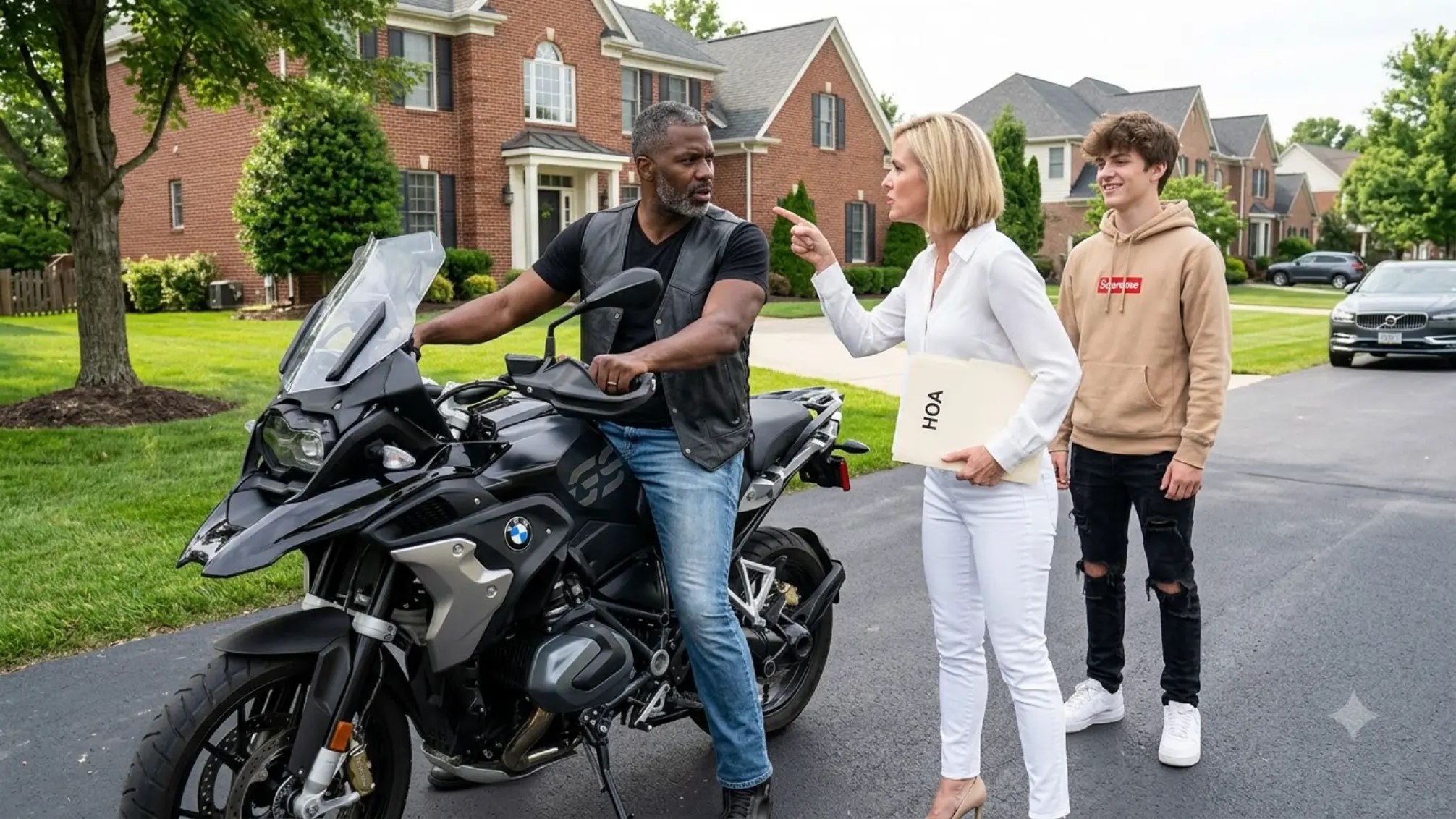
Vanessa Whitmore stood inches from Darius Bennett’s face, one red-painted fingernail aimed between his eyes. Her crisp white blouse, fitted white trousers, beige heels, gold hoop earrings, and carefully styled blonde bob made her look prepared for a private-club luncheon rather than an argument in someone else’s driveway. A cream-colored Magnolia Crest HOA folder rested beneath her arm, and the cold confidence in her expression suggested she believed whatever she wrote inside it would automatically become law.
Darius remained seated on the polished black BMW Motorrad beneath him. He was forty-four, tall and powerfully built, with deep brown skin, short salt-and-pepper hair, a square jaw, and a trimmed gray beard. A fitted black T-shirt showed beneath his leather riding vest, while faded jeans and heavy boots made it clear he had been preparing to leave when Vanessa and her son blocked the driveway.
“You’ve lost your mind if you think I’m giving your boy anything I paid for,” Darius said.
Behind Vanessa stood her eighteen-year-old son, Evan, wearing a tan Supreme hoodie, ripped black jeans, and clean white sneakers. He leaned against his mother’s silver SUV with his arms crossed, staring at the motorcycle as though the transfer had already been approved.
“Mom, just report him,” Evan said. “He won’t be riding it after they start taking his house.”
Darius slowly removed his phone from the motorcycle mount.
“Say that again a little louder,” he said. “Because the state attorney just heard your whole plan.”
The smile vanished from Evan’s face.
Vanessa glanced at the phone. A call timer remained visible beneath the name STATE ATTORNEY RENEE ALVAREZ. The speaker icon was illuminated, and a woman’s voice came through clearly.
“Mr. Bennett, do not end this call.”
Vanessa’s finger lowered.
For the first time since entering the driveway, she appeared to understand that she had threatened the wrong homeowner at precisely the wrong moment.
Darius had lived in Magnolia Crest, a gated neighborhood outside Jacksonville, Florida, for eleven months. He owned a commercial motorcycle restoration company specializing in high-performance European machines, though he rarely brought customer bikes home. The black BMW Motorrad beneath him was his personal motorcycle, purchased after seven years of saving and restored with parts he installed himself.
It was not a decoration.
It was not community property.
And it was certainly not a gift for Vanessa’s son.
The trouble began three weeks after Darius moved into Magnolia Crest. Vanessa arrived at his house carrying the same cream HOA folder and announced that motorcycles created an undesirable image. She claimed Magnolia Crest’s architectural rules prohibited “commercial-looking vehicles” from remaining visible in driveways.
Darius asked to see the rule.
Vanessa responded with a tight smile.
“Most cooperative residents don’t force the board to quote every paragraph.”
“I’m not asking for every paragraph,” Darius said. “I’m asking for the one you say I violated.”
A notice appeared in his mailbox the following morning. It imposed a two-hundred-dollar administrative charge for storing unauthorized machinery in a residential area. Darius reviewed all sixty-eight pages of the HOA declaration and found no restriction against motorcycles.
He appealed in writing.
The charge disappeared without explanation.
Two weeks later, Vanessa accused him of operating his business from the house because a delivery van brought a BMW engine casing to his garage. Darius produced the delivery receipt showing that the casing belonged to his personal motorcycle, not a customer. That violation also vanished.
Then came complaints about engine noise.
Darius installed a camera with a sound meter beside his garage. The motorcycle never exceeded the neighborhood’s permitted daytime level. Vanessa stopped mentioning noise and claimed his black riding gear frightened children.
Darius asked which HOA rule regulated clothing.
She did not answer.
What she did instead was begin bringing Evan to inspections.
The teenager had recently received a learner’s motorcycle license and had become fixated on Darius’s BMW. Whenever Darius cleaned the machine in the driveway, Evan appeared near the sidewalk, photographing it or asking questions about its engine, suspension, and market value.
At first, Darius answered politely.
Then Evan asked whether he could ride it.
“No.”
“Just around the block.”
“No.”
“My mom runs the HOA.”
“That doesn’t change the answer.”
Evan stared at the motorcycle.
“She could make keeping it here difficult.”
Darius looked up from the fuel tank.
“Was that a warning?”
“It was advice.”
Three days later, Vanessa issued a seven-hundred-and-fifty-dollar “enhanced vehicle review assessment.” The notice claimed that the BMW created insurance risks and required a special neighborhood permit.
No such permit existed.
Darius appealed again.
This time, the HOA board scheduled a hearing. Vanessa controlled the meeting, interrupted him whenever he cited the governing documents, and refused to identify the insurance policy supposedly affected by his motorcycle.
At the end, she leaned across the table.
“There are easier ways to resolve this.”
“What ways?”
“My son needs transportation.”
Darius stared at her.
Vanessa opened the folder and slid a handwritten page toward him. It proposed that Darius temporarily transfer the motorcycle to the HOA for “community youth transportation use.” The association would then waive all current and future vehicle-related penalties.
The document did not identify a return date.
It did not provide insurance coverage.
It transferred possession directly to Evan.
“You’re asking me to surrender a forty-thousand-dollar motorcycle to your son,” Darius said.
“I’m offering a compromise.”
“This is extortion.”
Vanessa gathered the paper.
“Be careful with accusations.”
“Be careful with written evidence.”
Her expression changed then, just as it changed when she saw the state attorney’s name on his phone. Vanessa was accustomed to residents becoming frightened by official-looking folders, legal phrases, and threats involving liens. She was not accustomed to someone preserving what she put in writing.
Darius filed a complaint with the Florida Attorney General’s consumer-protection division and the local State Attorney’s Office. He included the fake assessment, the proposed motorcycle transfer, recordings of HOA meetings, and emails in which Vanessa connected property penalties to personal demands.
He expected a formal acknowledgment and little else.
Instead, Assistant State Attorney Renee Alvarez called him personally.
Darius’s documents matched complaints from four other Magnolia Crest residents. One homeowner had been forced to surrender a utility trailer after Vanessa threatened foreclosure over invented landscaping fines. An elderly man had transferred ownership of a vintage pickup to Evan’s cousin in exchange for the cancellation of twelve thousand dollars in penalties.
Another family had paid Vanessa’s private “inspection company” nearly nine thousand dollars after she threatened to declare their roof unsafe.
Alvarez suspected that Vanessa was using the HOA as a private collection system.
She asked Darius not to confront her unnecessarily. She also instructed him to preserve every message and call if Vanessa contacted him again.
The morning of the driveway confrontation, Darius had been speaking with Alvarez about an upcoming evidence meeting. His phone was mounted beside the BMW’s instrument panel, and the call remained active when Vanessa’s SUV stopped across the driveway.
She stepped out wearing white.
Evan followed, staring directly at the motorcycle.
Vanessa approached without greeting Darius and placed a newly prepared notice against the BMW’s fuel tank. It declared the motorcycle a prohibited nuisance and announced that the HOA intended to tow it within twenty-four hours.
Darius removed the paper.
“You don’t have towing authority on private property.”
“I have emergency enforcement authority.”
“For what emergency?”
“The machine creates a safety hazard.”
“It hasn’t moved.”
“Your attitude is the hazard.”
Alvarez heard every word through the phone.
Darius intentionally left the speaker muted at first, allowing Vanessa to continue without realizing anyone else was listening. She ordered him to turn over the keys to Evan, claiming the transfer would satisfy the penalties and demonstrate “good community citizenship.”
When Darius refused, Vanessa made the threat that changed the investigation.
She said she could manufacture enough violations to place a lien on his home.
Then Evan added that Darius would lose the house.
That was when Darius lifted the phone and revealed the live call.
Vanessa attempted to recover quickly.
“I don’t know who is on that phone, but you are misrepresenting a private compliance discussion.”
Alvarez answered.
“My name is Renee Alvarez. I am an assistant state attorney for the Fourth Judicial Circuit. I have heard the entire discussion.”
Vanessa’s face tightened.
“This man is harassing an HOA officer.”
“Did you demand that he transfer his motorcycle to your son in exchange for canceling property fines?”
“No.”
Darius pointed toward Evan.
“He’s standing here waiting for the keys.”
Evan stepped away from the SUV.
“This has nothing to do with me.”
Vanessa turned toward him.
“Don’t speak.”
Alvarez continued through the phone.
“Mrs. Whitmore, do not enter Mr. Bennett’s garage, touch the motorcycle, or remove any property. Law enforcement has been contacted.”
Vanessa looked toward the neighborhood entrance.
“You called the police?”
“I requested officers after hearing a threat involving a planned fraudulent lien.”
Vanessa grabbed Evan’s arm.
“We’re leaving.”
Darius did not block them.
He simply raised the phone and photographed the temporary notice she had placed on his motorcycle. Vanessa reached toward the paper, but Darius pulled it away before she could take it.
“That belongs to the HOA,” she said.
“You handed it to me.”
“It contains confidential material.”
“It contains my address and a threat to tow my motorcycle.”
“Give it back.”
“No.”
Evan stepped toward Darius.
The young man was nearly six feet tall, but Darius remained broader and steadier. He did not raise his fists or move away from the BMW.
“Don’t make this worse,” Evan said.
Darius looked at him.
“Your mother just tried to take my motorcycle while a prosecutor listened. Worse already arrived.”
Two patrol cars entered Magnolia Crest before Vanessa reached her SUV.
Officers separated the three of them and asked Darius to explain the confrontation. Alvarez stayed on the line and provided her identity, case number, and a summary of what she had heard.
Vanessa immediately claimed the conversation had been misunderstood. She said the motorcycle transfer was merely a voluntary community-service proposal and that her comments about taking Darius’s house referred to lawful HOA collection procedures.
An officer examined the temporary towing notice.
“This says the motorcycle will be removed tomorrow.”
“It violates community safety standards.”
“Which standard?”
Vanessa opened her folder.
For several seconds, she flipped through pages without finding anything that supported her claim.
“The board has broad discretionary authority.”
“Did the board vote on towing this specific motorcycle?”
“The board delegated enforcement to me.”
“Do you have minutes showing that?”
“They’re in the HOA office.”
The second officer spoke with Evan.
The teenager first denied expecting the motorcycle. Then the officer asked why he had brought a helmet.
A black riding helmet sat in the rear seat of Vanessa’s SUV.
Evan claimed it always stayed there.
The officer opened his phone after receiving permission from the State Attorney’s Office to view screenshots already included in the complaint. One message from Evan to a friend read:
Getting the BMW Saturday. Mom finally has him trapped with the house fines.
Another showed a photograph of Darius’s motorcycle with the caption:
This will be mine once she files the lien.
Evan stopped answering questions.
The officers did not arrest Vanessa in the driveway. Instead, they delivered a preservation notice covering her HOA files, emails, financial records, vendor contracts, and communications with her son. They also warned her that removing or altering any documents could create additional criminal exposure.
Vanessa laughed.
“You’re treating neighborhood paperwork like organized crime.”
Alvarez’s voice came through the phone one final time.
“That will depend on what the paperwork shows.”
The search began that afternoon.
Investigators obtained a warrant after comparing Darius’s evidence with prior homeowner complaints. The Magnolia Crest HOA office occupied a room inside the neighborhood clubhouse. Vanessa was ordered to provide keys, but she claimed she had misplaced one for the locked archive cabinet.
A locksmith opened it.
Inside were two sets of records.
The official files showed ordinary violations involving lawns, fences, paint colors, and parking. A second collection contained handwritten notes on residents’ assets, employment schedules, loan information, and personal vulnerabilities.
Darius’s file included photographs of the BMW, estimates of its value, and copies of his mortgage records obtained without permission. A note beside his address read:
Strong equity. No spouse listed. Vehicle pressure may produce compliance.
Another page contained a schedule of escalating fines that did not appear anywhere in the association’s governing documents. If Darius refused to surrender the motorcycle, Vanessa planned to fine him for unauthorized storage, commercial activity, excessive noise, visual nuisance, insurance risk, and aggressive conduct toward an HOA officer.
The combined penalties would exceed fifteen thousand dollars within two months.
She had already prepared a lien notice.
It was dated for the following week.
Investigators then searched Vanessa’s home.
In her garage, they found property belonging to multiple Magnolia Crest residents: power tools, an antique lawn tractor, two bicycles, a utility trailer, a vintage jukebox, and a restored pickup tailgate bearing another homeowner’s name.
Vanessa claimed every item had been voluntarily donated to the HOA.
No donation records existed.
Several items had been transferred directly to Evan or sold through online accounts connected to him. The utility trailer taken from one resident appeared in photographs advertising Evan’s small landscaping business.
The vintage pickup transferred by the elderly homeowner had been resold for twenty-six thousand dollars.
The man had received nothing.
Detectives also found blank HOA violation forms bearing preprinted signatures from two board members. Vanessa could complete the forms, create fines, and claim the board had approved them without scheduling a meeting.
One director admitted signing blank pages because Vanessa told him it saved time.
Another said he never reviewed the supporting evidence.
The entire system depended on residents believing that official-looking documents were legitimate.
Darius’s BMW was the first demand that reached the State Attorney’s Office before the property changed hands.
Vanessa’s financial records exposed the larger motive. She had created a private company called Whitmore Community Compliance and billed Magnolia Crest for inspections she personally conducted as HOA president. Residents paid fines to the association, and the HOA then paid her company for enforcement work.
She profited twice.
First through fees.
Then through property.
When residents could not pay, she offered private settlements requiring them to surrender valuable items or sign agreements benefiting her family. Evan photographed and listed the property online. Vanessa changed HOA records to show that the penalties had been satisfied through approved settlements.
The board rarely questioned her because she controlled the documents presented at meetings.
Two days after the driveway confrontation, Vanessa and Evan were arrested.
Vanessa faced charges related to extortion, attempted property fraud, organized fraud, falsifying HOA records, and conspiracy. Evan faced charges connected to receiving and selling property obtained through the scheme.
The white outfit and Supreme hoodie from the driveway appeared in security footage shown repeatedly during local coverage. Darius refused interview requests. He did not want the case reduced to a viral argument beside an expensive motorcycle.
The BMW was only the object that revealed the system.
The true victims included homeowners who had surrendered property because they feared losing their houses.
Mrs. Helen Walker, a seventy-six-year-old widow, had given Vanessa her late husband’s antique jukebox after receiving nine thousand dollars in false drainage penalties. Vanessa told her that surrendering the machine would demonstrate cooperation and prevent a lien.
The jukebox was worth nearly eighteen thousand dollars.
Vanessa’s company sold it to a collector in Georgia.
A young father named Luis Ramirez lost his utility trailer after being accused of operating an illegal construction company from his garage. In reality, he worked as a carpenter and stored his own tools at home.
He needed the trailer for work.
Losing it cost him jobs.
Investigators recovered some property, but much had already been sold. The State Attorney’s Office traced payments through Evan’s accounts and froze the remaining funds.
Magnolia Crest held an emergency board meeting.
More than a hundred residents filled the clubhouse. The vice president attempted to describe Vanessa as a single dishonest officer who had betrayed the board’s trust.
Darius stood near the back.
“You signed blank violation forms.”
The vice president lowered his eyes.
“We believed she would use them appropriately.”
“You gave her authority without evidence.”
“We made an administrative mistake.”
“Helen Walker lost the last valuable thing her husband left her.”
The room became silent.
Luis raised his voice from the opposite wall.
“I lost work because you signed papers you never read.”
The remaining board members resigned before the meeting ended.
Residents hired an independent attorney and forensic accountant. The review found more than four hundred questionable fines issued over five years. Nearly one-third lacked supporting photographs or rule citations.
Twenty-two residents had surrendered money or property through private settlement agreements.
Seven had considered selling their homes.
Darius’s planned lien would have been the largest.
Vanessa’s attorney argued that homeowners voluntarily accepted the settlements. The State Attorney responded with emails showing Vanessa threatening foreclosure, public embarrassment, towing, and legal expenses if residents refused.
Voluntary agreements did not begin with fabricated debt.
During the preliminary hearing, the prosecutor played the driveway recording.
Vanessa’s voice filled the courtroom:
Hand that BMW Motorrad to my son before I bury you in violations.
Then Evan’s voice followed:
He won’t be riding it once they start taking his house.
Alvarez testified that she heard the statements live and immediately recognized them as consistent with the complaints already under investigation.
Vanessa’s attorney suggested she had spoken emotionally.
The prosecutor displayed the lien notice prepared before the confrontation.
Emotion did not explain a completed legal document dated for the following week.
The case ended with negotiated pleas after three board members agreed to testify. Vanessa admitted using false HOA penalties to pressure residents into surrendering property. Evan admitted selling items while knowing they had been obtained through threats involving association fines.
Restitution orders exceeded half a million dollars.
Vanessa was permanently prohibited from serving on an HOA board, managing residential property, operating a compliance company, or holding financial authority over community associations. Evan was ordered to surrender the proceeds from his online sales and complete additional penalties related to the conspiracy.
At sentencing, Vanessa attempted to justify herself.
“I believed strict enforcement protected the neighborhood’s reputation.”
Darius sat beside Helen and Luis.
When the judge invited victim statements, he stood.
“You didn’t protect Magnolia Crest,” he said. “You studied what people owned and calculated how frightened they had to become before giving it to your family.”
Vanessa stared at the table.
“You saw a widow’s memories, a carpenter’s tools, and my motorcycle as inventory.”
He paused.
“The only reason you failed with me is that someone with authority heard you say the quiet part out loud.”
Magnolia Crest changed its rules after the case.
No violation could be issued without photographs, an exact rule citation, and review by two board members. Liens required an independent hearing and written notice from an attorney with no relationship to HOA vendors.
Board members could no longer sign blank forms.
Private settlements involving personal property were prohibited entirely.
Darius joined the temporary records committee but refused nomination for president. He wanted transparent systems, not another powerful personality deciding what residents deserved.
His BMW remained in his garage.
Months after the case ended, Darius rolled it into the driveway on a clear Saturday morning. He polished the tank, checked the tire pressure, and prepared for a ride along the coast.
A new family had moved into Vanessa’s former house. Their teenage son stood near the sidewalk admiring the motorcycle but did not enter the driveway.
“That’s a BMW Motorrad, right?” he asked.
Darius nodded.
“Can I look closer?”
“You can look.”
The boy approached carefully.
“How fast does it go?”
“Faster than you need to know.”
The boy smiled.
“Can I touch it?”
“Not today.”
“Okay.”
He stepped back without arguing.
Darius fastened his helmet.
The exchange lasted less than a minute, but it carried more respect than every conversation Vanessa and Evan had brought to his driveway.
The engine started with a deep, controlled rumble.
Darius looked once toward the house where Vanessa had once believed an HOA folder gave her ownership over whatever she wanted. Then he pulled into the street and rode through Magnolia Crest’s open gate.
Vanessa had demanded the BMW because she believed authority could turn desire into entitlement.
Instead, the motorcycle became the one piece of property she never took—and the evidence that returned everything else.