“Fill it free, or I’ll shut this filthy station down,” Margaret Kilroy snapped, jerking the fuel nozzle toward her black GMC.
Wyatt Hollis caught the hose before she could force it into the tank. Snow blew across the pumps of Hollis Gas and Grocery, collecting along the shoulders of his charcoal work jacket. Margaret stood inches from him in a fitted white blazer, white trousers, beige heels, oversized sunglasses, and a silver HOA badge she wore as though it carried the authority of the state. “Touch my pump again,” Wyatt said, knocking her hand away, “and you’ll regret coming here.”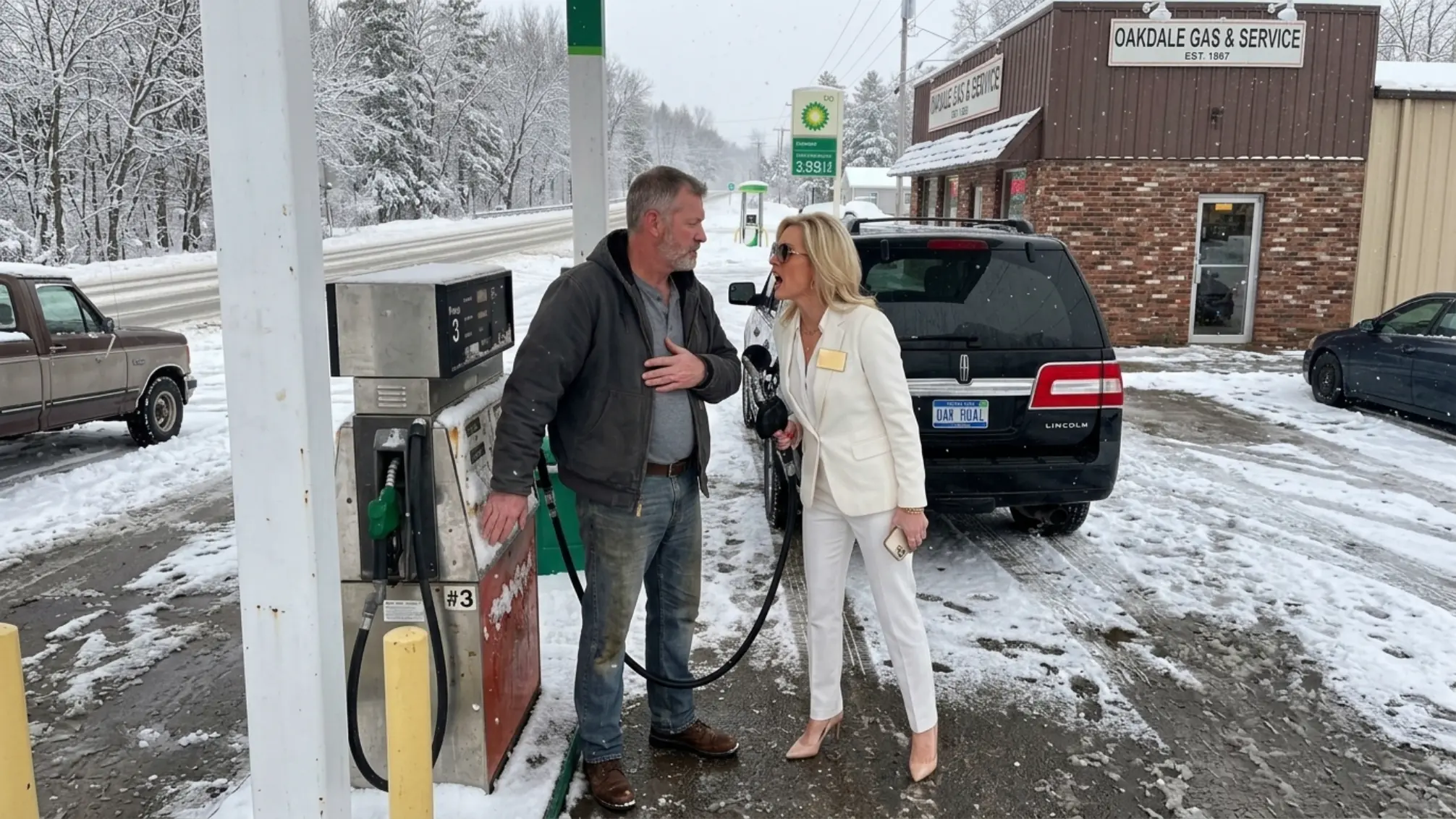
Margaret stepped closer, her face tightening with outrage. “I’ll call the police and have you dragged out of your own station.”
Wyatt opened his jacket just enough to reveal the gold shield clipped beneath it. “Call them. I’m the chief they answer to.”
For two silent seconds, the only sound was the wind moving across Highway 41.
Then Margaret laughed.
It was a hard, disbelieving laugh from a woman who assumed any badge could be purchased online. She lifted her phone, aimed its camera toward Wyatt, and announced that she was recording an aggressive business owner threatening the president of Birch Harbor Estates.
Wyatt did not stop her.
He had spent twenty-eight years in law enforcement. People who lied confidently often became their own best witnesses when given enough time to speak.
“My residents pay taxes that maintain the road in front of this station,” Margaret said. “We bring valuable customers into this town. Your business benefits from us, so a community fuel arrangement is the least you owe.”
“The posted price is what you owe.”
“I am not paying retail.”
“Then you are not receiving fuel.”
Her mouth tightened. “You have no idea who you’re dealing with.”
Wyatt glanced at the silver badge pinned to her blazer. “A woman trespassing beside pump four?”
Margaret reached for the nozzle again.
Wyatt moved between her and the pump. He did not raise his voice, but the coldness in his expression finally made her pause.
Inside the station, Wyatt’s younger sister, Cora, stood behind the register with both arms crossed. Four regular customers had stopped drinking coffee and turned toward the front windows.
None looked surprised.
Margaret Kilroy had spent nearly two years demanding discounts from almost every independent business in Oakdale, Michigan.
Oakdale was a small Upper Peninsula town pressed between cedar swamp and the southern shore of Lake Superior. Winters lasted long enough to become a personality test. Everyone knew who repaired snowplows, who baked the best pasties, who needed help stacking firewood, and who had failed to return a borrowed ladder.
The Hollis family had owned the gas station since 1962.
Wyatt’s grandfather, Esco Hollis, opened it with one pump, eleven cans of motor oil, and a refrigerator filled with his wife’s homemade pasties. Wyatt’s father expanded the grocery shelves, added a bait cooler, and taught his children that the price marked on an item was a promise to the customer, not an invitation to bargain.
Wyatt worked there as a teenager before joining the Marine Corps. After four years as a military police corporal, he returned home, joined the Oakdale Police Department, and helped his widowed father raise Wyatt’s younger brother.
He became a patrol officer, then sergeant, detective, and finally chief.
When his father died, Wyatt inherited the station.
Cora managed the daily business. Wyatt handled maintenance, supplier contracts, and whatever work remained after his police duties. Neither sibling considered the station merely a source of income.
It was the last place their father had worked, the first place their grandfather had built, and the unofficial living room of Oakdale.
Margaret did not care about any of that.
She and her husband had purchased a nearly million-dollar house in Birch Harbor Estates, a private development three miles north of town. Thirty-six large homes stood behind a landscaped entrance beside Lake Superior.
Margaret became HOA president within eighteen months.
She promised residents a “true private resort experience.” What she meant was that every local business should subsidize it.
She asked the Oakdale Pasty Café for discounted weekend catering. The owner refused.
She demanded reduced prices on firewood from the hardware cooperative. Its seventy-one-year-old owner told her, “The trees do not know your HOA.”
She requested lower deer-processing rates, discounted snow removal, free landscaping consultations, and wholesale grocery prices.
Every business rejected her.
Margaret saved Hollis Gas and Grocery for last because fuel offered more than personal savings.
During her first visit in 2022, she proposed a ten-percent discount for all Birch Harbor residents. Wyatt explained that the station earned only a few cents per gallon and would lose money under her proposal.
Then she mentioned the HOA’s private fuel facility.
She asked Wyatt to provide gasoline at wholesale cost so Birch Harbor could supply its residents directly.
Wyatt refused.
Wholesale fuel contracts required licenses, storage compliance, tax reporting, environmental safeguards, and supplier authorization. An HOA could not simply purchase thousands of gallons because its president wanted another amenity.
Margaret left without buying coffee.
Eighteen months passed before she returned wearing white and demanding a full tank for free.
Wyatt still did not know what had changed.
He was about to learn.
Margaret held up her phone. “I am calling 911.”
“Please do.”
“You threatened to injure me.”
“The station cameras recorded otherwise.”
Her thumb stopped above the screen.
There were six cameras covering the property. Two faced the pumps, one covered the entrance, another recorded the register, and two monitored the parking lot.
Margaret looked briefly toward the canopy.
Then she made the call anyway.
“This is Margaret Kilroy at Hollis Gas and Grocery,” she told the dispatcher. “The owner has refused service, threatened me physically, and discriminated against Birch Harbor residents. I fear for my safety.”
Wyatt recognized the dispatcher’s voice immediately.
Patty Sanderson had known him since third grade and worked Oakdale dispatch for more than thirty years. She remained completely professional.
“Stay where you are, ma’am,” Patty said. “An officer is coming.”
Six minutes later, a new Oakdale patrol car entered the station.
Officer Daniel Polanski stepped out. He was twenty-six, six months out of the academy, and only four days beyond his final field-training evaluation.
Margaret rushed toward him.
“That man attacked me,” she said, pointing at Wyatt. “He refused legal service and threatened to break my hand. I want him arrested.”
Daniel looked toward his chief, then back at Margaret.
“Ma’am, did he touch you?”
“He grabbed the pump from me.”
“Were you authorized to operate it?”
“It is a public fuel pump.”
“Did you attempt to take fuel without payment?”
Margaret’s face reddened. “I demanded the community arrangement my HOA is entitled to.”
Daniel removed his notebook. “What arrangement?”
Wyatt spoke calmly. “She demanded free fuel. When refused, she threatened to close the station and called police.”
“That is not what happened,” Margaret snapped.
Daniel looked toward the camera above pump four.
“Chief, is the footage available?”
Margaret went still.
Daniel had addressed Wyatt by title.
She looked from the young officer to the badge beneath Wyatt’s jacket. “Chief?”
Wyatt said nothing.
Daniel keyed his shoulder radio. “Dispatch, confirm the identity of the station owner.”
Patty answered immediately.
“Wyatt Hollis, Oakdale chief of police.”
Margaret’s lips parted.
Daniel closed the distance between them slightly. “Ma’am, the person you accused is my supervisor. That does not mean your complaint will be ignored, but it does mean I will document every word carefully. Filing a knowingly false report is a criminal offense.”
“I may have overstated parts of it.”
“Which parts?”
“I felt threatened.”
“That is not what I asked.”
Margaret glanced toward Wyatt. The arrogance had not disappeared, but it had changed shape. She was already searching for a way to turn retreat into victory.
“I was under stress,” she said. “The HOA has complicated amenity responsibilities.”
Daniel wrote her exact words.
Wyatt noticed the phrase immediately.
Amenity responsibilities.
The first time Margaret mentioned the private fuel pump, she called it a convenience. Now she spoke as though the facility had become an operational burden.
When Daniel finished taking her statement, he escorted her away from the pumps. She drove back toward Birch Harbor without purchasing a gallon.
The regular customers entered the station silently.
Cora returned to the crossword puzzle she had abandoned.
“That woman is hiding something,” she said.
Wyatt removed his gloves. “I know.”
“Do you know what?”
“No.”
Sulo Kantelli, owner of the hardware cooperative, stirred his coffee. “Then find out before she blows up the lake.”
He meant it as dry Upper Peninsula humor.
The truth was closer than anyone realized.
Wyatt preserved the camera footage and Daniel’s body-camera recording. Then he called Lieutenant Hannelore Idakowski at the Michigan State Police post in Negaunee.
They had trained together decades earlier.
Wyatt explained Margaret’s demands, her reference to a private fuel facility, and the false complaint. Hannelore searched the active case system.
Her voice changed.
“We have eleven open complaints connected to Margaret Kilroy or Birch Harbor Estates.”
“What kind?”
“Three false-report complaints, two consumer-fraud allegations, and one anonymous tip about unlicensed fuel storage.”
Wyatt leaned forward. “Read me the tip.”
A former groundskeeper named Pella Lehtinen reported helping pour a concrete pad for an underground tank at the Birch Harbor amenity park. He had never seen a state inspector, permit notice, leak monitor, or environmental contractor visit the property.
Wyatt knew Pella.
The man had worked summer shifts at the Hollis station before becoming a maintenance contractor. He was careful, practical, and not given to exaggeration.
“Bring in EGLE,” Wyatt said. “And the county prosecutor.”
Two mornings later, six people gathered inside the Oakdale Pasty Café before opening.
Pella arrived carrying a manila folder and a thermos of black coffee. He placed sixteen photographs across the table.
They showed a large underground tank being installed beneath what Birch Harbor’s county permit described as a covered storage shed. Other images showed a small fuel pump hidden near the gatehouse, hoses covered beneath black tarps, unlabeled monitoring equipment, and dark staining around the concrete pad.
Pella had photographed weekly fuel deliveries before leaving the HOA’s employment.
Charles Kotila from Michigan’s environmental agency studied the images for eleven minutes.
“This is an unpermitted underground storage tank inside a protected shoreline and groundwater zone,” he finally said.
“How large?” Hannelore asked.
“Approximately thirty-three hundred gallons.”
The assistant county prosecutor, Annika Ronquist, opened her legal pad.
“If it has leaked?”
“Emergency removal, soil testing, groundwater sampling, and federal notification.”
“And criminal exposure?”
Charles looked at the photographs again. “That depends on who knew what and how long they operated it.”
Pella answered.
“Margaret ran the pump personally. Her husband tracked deliveries. Residents paid through an HOA account.”
The investigation expanded immediately.
Records showed Margaret purchased fuel at retail from businesses outside Oakdale, transported it in fifty-gallon drums, and transferred it into the underground tank. She then sold it to Birch Harbor residents with a markup of thirty cents per gallon.
The money did not remain in the HOA account.
It flowed into Birch Harbor Hospitality Ventures, a private company owned by Margaret and managed on paper by her husband.
Across eighteen months, the operation generated about eighty-six thousand dollars and approximately fifty-one thousand dollars in profit.
Wyatt understood why she wanted wholesale fuel.
A supplier arrangement through Hollis Gas and Grocery would have dramatically increased her margins while making the operation appear connected to a licensed station.
She had not demanded free gasoline because she was merely entitled.
She needed Wyatt’s business to legitimize her illegal one.
Environmental inspectors visited Birch Harbor under the cover of a routine groundwater survey. Soil samples from six locations contained hydrocarbon contamination above the state action level.
The seventh sample showed groundwater contamination.
Fuel had already escaped the tank.
The matter moved from regulatory violation to public danger.
The EPA prepared an emergency order. State investigators traced HOA withdrawals, fuel invoices, delivery records, and transfers into Margaret’s company.
Then an unexpected witness appeared.
Joyce Larkin, the HOA secretary, arrived at Wyatt’s house carrying a banker’s box and a tuna casserole.
She had spent two years quietly copying every suspicious document Margaret ordered her to file.
The box contained financial statements, false vendor invoices, payment authorizations, the disguised tank-construction permit, and thirty-one pages of handwritten notes documenting conversations between Margaret and her husband.
Joyce had remained silent because she feared losing her home through retaliatory fines.
“What changed?” Wyatt asked.
Joyce looked down at the box.
“She called the police on you,” she said. “Then I realized she would eventually do something worse to someone who couldn’t fight back.”
The evidence was overwhelming.
Margaret had diverted more than two hundred thousand dollars from HOA reserves through false invoices and private companies. She had operated an unlicensed fuel business, concealed an underground tank, ignored signs of leakage, and repeatedly filed false complaints against people who resisted her.
Still, she believed she was winning.
She submitted a formal petition demanding that Oakdale revoke Hollis Gas and Grocery’s commercial license.
Her complaint described the sixty-two-year-old station as a nuisance interfering with the “community character” of Birch Harbor Estates. She claimed its prices were discriminatory and its refusal to provide HOA fuel represented unfair trade practice.
The township placed her request on the April meeting agenda.
Margaret prepared a nine-minute speech.
She did not know investigators had added a seventh agenda item under sealed authority.
The Oakdale Township Hall filled with 117 residents on the evening of April 16. Margaret entered wearing a navy blazer and pearls, carrying a leather portfolio. Her husband sat beside her.
Joyce sat one row behind them.
Outside Birch Harbor, EPA contractors, environmental officers, and state police waited beside excavation equipment.
At precisely 7:14 p.m., they entered the HOA property.
The township meeting began at the same moment.
Routine business occupied the first half hour. Then the supervisor called Margaret forward.
She approached the podium confidently.
For nine minutes, she accused Hollis Gas and Grocery of illegal operation, outdated facilities, environmental risk, aggressive ownership, and damage to local property values. She demanded immediate revocation of the station’s commercial license.
When she finished, several Birch Harbor residents applauded politely.
The supervisor invited Wyatt to respond.
He approached without notes.
“The Hollis family has operated its station on commercially zoned property since 1962,” he said. “It holds every required state license and has no unresolved consumer or environmental complaint in its history.”
Margaret folded her arms.
Wyatt continued.
“Her petition has no factual or legal basis. However, the board added an emergency item this morning. I request we proceed directly to item seven.”
Margaret looked toward her portfolio.
Her copy contained only six items.
Lieutenant Hannelore Idakowski walked to the podium in full uniform.
“At 7:14 this evening,” she announced, “the Environmental Protection Agency and Michigan environmental authorities executed an emergency endangerment order at Birch Harbor Estates.”
Margaret’s face changed.
“Investigators identified an unpermitted underground fuel tank operating at the HOA amenity park. The tank is currently being pumped and excavated. Soil and groundwater contamination have been confirmed.”
Margaret rose halfway from her chair.
“That is private property.”
Hannelore looked directly at her. “Environmental law still applies.”
The lieutenant listed the charges: false police reports, consumer fraud, illegal retail fuel sales, operation of an unpermitted tank, financial theft, and misuse of HOA reserve funds totaling more than two hundred thousand dollars.
Sheriff Halford stood from the back row holding an arrest warrant.
“Margaret Kilroy, please come with me.”
She did not move.
Her husband stared at the floor.
“Wyatt did this,” Margaret said. “This is retaliation because he refused my partnership.”
Wyatt remained beside the podium. “Your records did this.”
“You searched my HOA illegally.”
“A court authorized every warrant.”
“I have connections.”
“So does the evidence.”
Sheriff Halford approached.
Margaret stepped backward, knocking her chair aside. “You cannot arrest an elected HOA president during an official township proceeding.”
“HOA office is not immunity.”
She looked toward the residents from Birch Harbor. “Tell them. This investigation will destroy your property values.”
No one stood.
Joyce Larkin slowly removed an envelope from her bag.
“I gave them the records,” she said.
Margaret stared at her secretary. “You?”
“I copied everything.”
“You ungrateful little coward.”
Joyce’s hands trembled, but her voice did not. “I was a coward when I stayed quiet.”
Sheriff Halford placed Margaret in handcuffs.
The room remained silent as he read her rights.
At the same moment, contractors three miles away opened the illegal tank and began pumping out contaminated fuel.
Margaret was led through the side door past neighbors who had once believed her untouchable.
Her husband was arrested later that evening.
The criminal cases ended months afterward.
Margaret pleaded guilty to multiple state charges. She received a sentence including confinement, restitution, suspended time under strict conditions, and a permanent ban from serving as an officer in any Michigan homeowners association.
Her husband received federal prison time for wire fraud and environmental violations. He was ordered to contribute to the cleanup and repay stolen HOA funds.
Removing the tank and repairing the contaminated soil cost approximately one hundred forty-seven thousand dollars.
Birch Harbor residents recalled Margaret and elected Joyce interim president.
Joyce’s first official act was not another amenity project.
She drove to Hollis Gas and Grocery and asked whether Birch Harbor could help organize a Lake Superior shoreline cleanup.
Cora agreed before Wyatt finished his coffee.
One hundred forty-one volunteers came.
They removed eleven truckloads of tires, broken appliances, bottles, and abandoned debris from the shoreline and nearby woods. Pella brought his pickup. Officer Polanski brought his dog. Local businesses supplied food and equipment.
That winter, Wyatt converted the station’s rear lot into a legitimate community fuel cooperative.
Low-income households received a small discount on home-heating fuel. Birch Harbor’s new HOA matched the station’s contribution.
Sixty-one families enrolled during the first winter.
Three later asked to surrender their cards after receiving raises because they believed someone else needed the help more.
Wyatt kept his grandfather’s photograph above the register.
The old station remained exactly where it had stood since 1962, selling gasoline at the posted price and offering help when help was real rather than demanded.
Margaret had believed community service meant forcing others to finance her comfort.
Wyatt believed it meant keeping homes warm without stealing from the business providing the fuel.
She wore a silver HOA badge and threatened to call the police.
He wore the gold badge of the chief she called.
But the badges were never what defeated her.
The cameras recorded the lie.
The photographs exposed the tank.
The bank records followed the money.
The witnesses finally spoke.
Margaret thought entitlement was power. Wyatt understood that evidence did not need to shout, threaten, or step into anyone’s face.
It only needed to be preserved long enough to reach the right room.
She entered his gas station demanding free fuel.
Three months later, she entered the township hall demanding his business license.
Then the agenda changed, the sheriff stood, and the woman who believed every local business owed her something finally learned exactly what her own choices had cost.