“Your illegal bike lowers our property values, and my son wants it—hand over the keys before I have you arrested.”
Cynthia Blake jabbed a fabricated seizure notice against Jack Mercer’s chest while her sixteen-year-old son stood behind her with his arms crossed and a satisfied grin. The polished black Harley-Davidson rested on Jack’s driveway, its chrome engine reflecting the clean Saturday sunlight and the red of Cynthia’s expensive blazer. Jack slowly removed his sunglasses, folded the blue polishing cloth in his hand, and stared at the woman as though waiting for her to admit she was joking.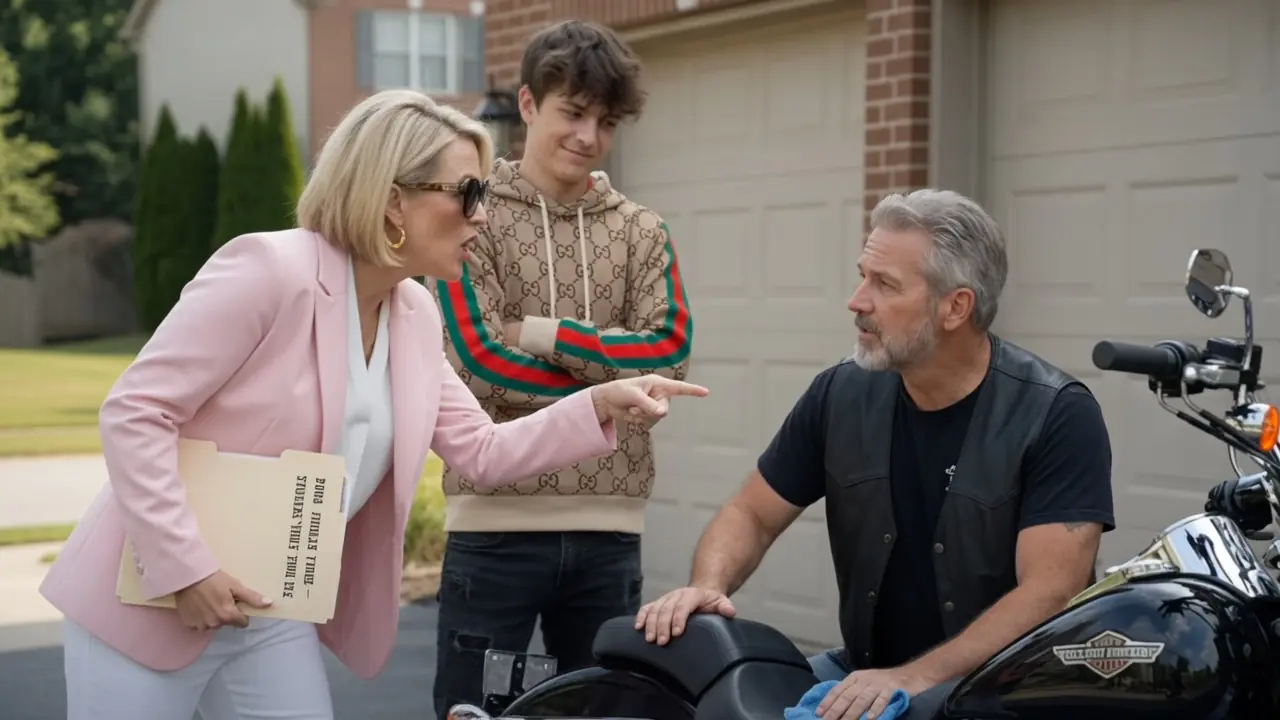
She did not.
“You forged a seizure order,” Jack said, “because you raised a spoiled thief who thinks wanting something makes it his.”
Cynthia’s face tightened. Her son, Dylan, stepped closer to the motorcycle and ran his eyes across its leather seat, chrome exhaust, and custom handlebars as though choosing where he would place his own belongings.
“It’ll look better in our garage anyway,” Dylan said. “You’re too old for it.”
Jack rested one hand on the Harley. “Touch it, and you’ll learn the difference between looking at property and attempting to steal it.”
Cynthia immediately raised her phone. “I’ll have you dragged off this driveway, then my son will ride that Harley home while you watch from a cell.”
Jack turned his own phone toward her. A call had been active for the previous four minutes.
“Keep talking,” he said. “The state attorney heard every word, and she’s coming to decide which one of you gets charged first.”
For the first time since marching onto his property, Cynthia stopped speaking.
The voice from Jack’s phone was calm and unmistakably female.
“I heard enough, Mr. Mercer. Do not surrender the keys, the motorcycle, or that document. I am twelve minutes away.”
Cynthia’s confidence returned in the form of an exaggerated laugh. “You expect me to believe the state attorney is personally driving to your house?”
Jack slipped the phone into his shirt pocket without ending the call. “You believed I would hand over a twenty-eight-thousand-dollar motorcycle because your son pointed at it.”
“That motorcycle violates community standards.”
“No, it doesn’t.”
“It creates excessive noise.”
“The engine is off.”
“You operate it before permitted hours.”
“I leave for work at eight thirty.”
Cynthia waved the paper. “The HOA board authorized immediate seizure after repeated violations.”
Jack looked at the document again. The Maple Heights Homeowners Association logo appeared across the top, but the font was wrong, the property description contained a spelling error, and the signature belonged to someone who had resigned from the board eight months earlier.
Jack had spent thirty years repairing aircraft engines for the United States Air Force and later managing safety inspections for a private aviation company. He noticed small inconsistencies because his career had taught him that overlooked details caused the largest failures.
“This board member moved to Arizona last year,” he said.
Cynthia folded the paper quickly. “The authorization remains valid.”
“Then why is the date from yesterday?”
“Because that is when the order was issued.”
“By a man who no longer lives in the state?”
Dylan shifted behind her, but Cynthia stepped forward and lowered her voice.
“You are new here, Mr. Mercer. You don’t understand how Maple Heights operates.”
Jack had purchased the brick house six months earlier after retiring from aviation work. He chose the neighborhood because it appeared quiet, well maintained, and close enough to visit his widowed sister without crossing the city.
The garage was large enough for his tools and motorcycle.
The Harley had belonged to Jack’s younger brother, Michael.
Michael bought it after surviving cancer the first time. He called the motorcycle Midnight and rode it across eleven states before the illness returned. During his final week, he made Jack promise the Harley would never become an ornament hidden beneath a tarp.
“You ride it,” Michael told him. “Every mile I don’t get, you take for both of us.”
Jack had kept that promise.
He rebuilt the carburetor, replaced the worn leather seat, and repaired every scratch except one narrow mark across the fuel tank. Michael had earned that scar while riding through Colorado, and Jack refused to erase it.
Cynthia knew none of that.
She saw a desirable motorcycle and a son who had become accustomed to receiving whatever caught his attention.
The problem began two weeks earlier, when Dylan watched Jack roll the Harley out of his garage. The boy crossed the street without permission, sat on the motorcycle, and began twisting the throttle while Jack was inside retrieving his helmet.
Jack found him attempting to start it.
“Get off.”
Dylan looked more annoyed than embarrassed. “I’m just checking it out.”
“You are sitting on private property.”
“My mom runs the HOA.”
“That does not make this hers.”
Dylan eventually climbed down, but before leaving, he asked how much Jack wanted for it.
“It is not for sale.”
“Everything is for sale.”
“Not this.”
Dylan returned twice that week.
The first time, he brought a friend and took photographs beside the Harley while Jack was grocery shopping. The second time, Jack’s driveway camera recorded Dylan trying the garage handle after midnight.
Jack sent both recordings to Cynthia.
Her response arrived twenty minutes later.
Teenagers make harmless mistakes. Please avoid escalating normal curiosity into hostility.
Jack replied that another attempt to enter his garage would be reported to the police.
The following morning, a violation notice appeared on his door. It accused him of operating an unregistered commercial repair business because he occasionally worked on the motorcycle inside his own garage.
Jack requested the rule supporting the violation.
Cynthia sent no answer.
Two days later, she issued another notice claiming the Harley created a visual nuisance when parked on the driveway. The community bylaws prohibited abandoned vehicles, but the motorcycle was licensed, insured, polished, and never left outside overnight.
Jack appealed both notices to the HOA board.
Cynthia scheduled the hearing at ten o’clock on a weekday, knowing he had a medical appointment with his sister. When Jack requested another time, she ruled that his absence meant he accepted the penalties.
Then she sent the seizure notice.
Jack did not know whether to laugh or call an attorney, so he did both.
The attorney he called was Lena Brooks, an old family friend who had attended college with Michael before entering public service. Lena now served as the state attorney responsible for a regional office handling public corruption, organized fraud, and financial crimes.
Jack expected advice.
Instead, Lena became quiet when he read the notice aloud.
“Send me a photograph.”
He did.
“This is not merely an invalid HOA letter,” she said. “It appears to imitate a government seizure order.”
“That sounds more serious than a neighborhood dispute.”
“It is. Do not confront her alone. Start recording, and call me the moment she appears.”
Cynthia appeared the following Saturday with Dylan behind her and the false order in her hand.
Now, standing beside Jack’s Harley, she realized her performance had become evidence.
“You recorded me without consent,” she said.
“This state permits one-party recording.”
“You provoked me.”
“I was cleaning my motorcycle.”
Dylan moved toward the seat again.
Jack stepped between them.
The teenager puffed out his chest. “What are you going to do?”
“Give you one final opportunity to leave my property voluntarily.”
Cynthia pulled her son back, but not because she respected Jack’s warning. She looked down the street, searching for approaching vehicles.
“Call whoever you want,” she said. “The police know me.”
“I’m sure they do.”
“I arranged the department’s neighborhood appreciation luncheon last year.”
“That sounds useful if they get hungry during your arrest.”
Dylan laughed before realizing Jack was not joking.
Cynthia’s eyes narrowed. “You think one phone call makes you powerful?”
“No. Ownership papers make the motorcycle mine. Your recorded threat makes your problem yours.”
A patrol car turned onto Maple Heights Drive.
Cynthia smiled triumphantly. “Good. I called before coming here.”
Jack looked toward the cruiser. “You reported me?”
“I told them an unstable resident threatened an HOA officer and a minor.”
“You entered my driveway demanding my motorcycle.”
“I came to execute a lawful community order.”
The patrol car stopped at the curb. Officer Marcus Hill stepped out, followed by Officer Rachel Kim. Both wore body cameras and approached carefully, unaware of which account was accurate.
Cynthia raised the document before they reached the driveway.
“Officers, this man is refusing to comply with an authorized seizure and threatened my son.”
Officer Hill did not take the paper immediately. “Who issued the seizure?”
“The Maple Heights HOA board.”
“An HOA cannot seize a registered vehicle.”
“This is a special enforcement action.”
Officer Kim looked toward Jack. “Sir, are you armed?”
“No.”
“Any weapons inside the motorcycle compartments?”
“No compartments, and no weapons.”
“Did you threaten either of them?”
“I warned the boy not to touch my motorcycle after he repeatedly attempted to take it.”
Dylan interrupted. “He said he’d put me on the ground.”
Jack looked at him. “No, I didn’t.”
Cynthia placed a protective hand on her son’s shoulder. “He has been harassing Dylan for weeks.”
Jack pointed toward the security camera above his garage. “The recordings are available.”
Officer Hill finally accepted the paper. He read the first paragraph, then examined the signature and embossed seal printed near the bottom.
“This seal belongs to the county civil enforcement office,” he said.
Cynthia lifted her chin. “The HOA works closely with the county.”
Officer Hill looked at her. “County seals cannot be used on private association letters.”
“It was part of a template.”
“Who created it?”
“Our legal committee.”
Jack almost smiled. Maple Heights had no legal committee.
Before Cynthia could invent another explanation, a dark blue sedan pulled behind the patrol car. Lena Brooks stepped out wearing a gray business suit and carrying a leather folder. She was forty-seven, composed, and known for allowing people to continue talking until they created stronger evidence against themselves.
Cynthia looked at her official identification and then at Jack.
“You actually called the state attorney.”
Lena approached without acknowledging the surprise. “Mr. Mercer, are you safe?”
“Yes.”
“Has anyone touched the motorcycle?”
“Not today.”
Dylan looked toward the garage camera.
Lena turned to Cynthia. “I am State Attorney Lena Brooks. I need the original document in your hand.”
Cynthia pulled it closer to her body. “This is HOA property.”
“It contains a government seal.”
“It is only a copy.”
“Then surrendering it should not be difficult.”
Cynthia looked toward the officers. “Are you going to let her intimidate me?”
Officer Hill answered, “Ma’am, provide the document.”
She finally handed it over.
Lena opened her folder and placed a genuine county seizure form beside Cynthia’s paper. The imitation copied several legal paragraphs almost word for word, including warnings about obstruction and criminal penalties.
Someone had modified the title, inserted the HOA’s name, and added Jack’s motorcycle identification number.
Lena examined Cynthia. “Where did you obtain the VIN?”
“It was visible.”
“It is stamped beneath the frame.”
Dylan’s face changed.
Jack noticed.
Lena did too.
She turned toward the teenager. “Did you enter Mr. Mercer’s garage?”
“No.”
“Did you crawl beneath the motorcycle?”
“No.”
Jack unlocked his phone and opened another security clip. Three nights earlier, Dylan had crossed the driveway at 1:14 in the morning, entered through a side window he forced open, and spent six minutes inside the garage.
The camera showed him photographing the frame.
Cynthia stared at the video. “That could be anyone.”
The red hoodie was identical to the one Dylan currently wore.
Officer Kim looked at him. “Turn around.”
Cynthia stepped between them. “You are not arresting my child over a misunderstanding.”
“He entered a locked structure,” Officer Kim said. “We need to investigate.”
“He had permission.”
Jack’s voice hardened. “No, he did not.”
Cynthia turned toward him. “You told him he could look at the bike.”
“I told him to stay away from it.”
Dylan’s confidence finally broke. “Mom said we needed the number for the paperwork.”
Everyone became silent.
Cynthia spun toward him. “Stop talking.”
Lena’s expression did not change. “What paperwork?”
Dylan looked frightened now, less like an arrogant thief and more like a boy who had suddenly understood that his mother’s authority could not protect him.
“She said once the seizure paper was ready, the police would make him give us the keys.”
Cynthia grabbed his arm. “He’s confused.”
“I’m not confused,” Dylan said. “You said the board could take stuff when people don’t pay fines.”
Jack had paid every legitimate HOA fee.
Lena asked Officer Kim to separate mother and son before questioning them further. Cynthia protested loudly, but the officers moved her toward the sidewalk while Dylan remained near the patrol car.
Neighbors had begun gathering.
Some stood on porches. Others recorded from the street. Cynthia had spent years using public embarrassment as a weapon against residents, and now the entire community watched her lose control of the narrative.
A gray-haired neighbor named Alice Foster approached Lena cautiously.
“She tried something like this with my husband’s fishing boat.”
Cynthia shouted from the sidewalk, “Go back inside, Alice!”
Alice did not.
She explained that the HOA had issued an illegal storage fine against their small boat, then threatened to tow it unless they paid Cynthia’s husband two thousand dollars for “private compliance services.”
Another resident stepped forward.
Then another.
A young couple said Cynthia fined them for installing a wheelchair ramp for their daughter. A widower said she forced him to pay a special landscaping penalty directly to an account controlled by her consulting company.
Jack realized the motorcycle was not the beginning of the problem.
It was only the first time Cynthia targeted someone with the resources, evidence, and patience to stop her.
Lena requested the association’s financial records that afternoon.
Cynthia refused, claiming the state attorney had no jurisdiction over a private HOA. Lena explained that private associations remained subject to fraud, forgery, extortion, and theft laws.
When investigators obtained a warrant, they found two sets of financial books.
The official records showed routine maintenance costs and community expenses.
The hidden records revealed fabricated fines, cash payments, and contracts awarded to companies controlled by Cynthia’s relatives. More than one hundred eighty thousand dollars had disappeared from HOA accounts over three years.
The motorcycle seizure was part of a broader pattern.
Cynthia invented violations against residents she considered easy to frighten. Those who paid were left alone. Those who resisted faced escalating notices, threats of liens, and forged legal documents designed to resemble county orders.
Dylan had been taught that these tactics were legitimate.
His mother repeatedly told him that association property included anything the HOA declared noncompliant. When he wanted Jack’s Harley, Cynthia believed she could manufacture enough fines to force a transfer or frighten Jack into surrendering it.
The motorcycle’s value made the plan unusually ambitious.
It also made the evidence impossible to ignore.
Cynthia was arrested on charges including forgery, attempted theft, fraud, misuse of a government seal, conspiracy, and filing a false police report. Her husband was charged after investigators discovered he helped route HOA money through a fake compliance company.
Dylan entered juvenile proceedings for breaking into Jack’s garage.
Jack declined to demand the harshest punishment.
The boy had acted knowingly, but he had also been raised inside a household where manipulation was presented as leadership. The juvenile judge ordered restitution, counseling, community service, and a prohibition against entering Jack’s property.
Dylan also had to write a formal apology.
The first version blamed his mother.
Jack returned it unread.
“The judge ordered you to explain what you did,” he said during a supervised meeting. “Not what she told you to do.”
Dylan wrote it again.
This time, he admitted he wanted the motorcycle, believed Jack looked too old and ordinary to deserve it, and assumed his mother could turn that desire into authority. He described entering the garage, photographing the VIN, and lying to the police.
Jack accepted the second letter.
“Are you still angry?” Dylan asked.
“Yes.”
“Then why aren’t you trying to send me away?”
“Because punishment should prevent the next crime, not merely satisfy the last victim.”
Dylan looked toward the Harley parked beyond the community-center window. “Will you ever let me ride it?”
“No.”
The answer came so quickly that the boy almost smiled.
“But,” Jack continued, “there is an old motorcycle engine in my garage that needs rebuilding. After your court order ends, you can ask whether I need help.”
“You would teach me?”
“I said you could ask.”
Six months later, Dylan asked.
Jack made him begin by sweeping the garage floor.
Then he taught the boy how to organize tools, read service manuals, and understand why ownership meant responsibility rather than control. Dylan never touched the Harley without explicit permission.
He worked instead on a damaged Honda engine Jack purchased for two hundred dollars.
The first time it started, Dylan stared at the machine with a pride completely different from the smug satisfaction he once displayed beside Midnight.
He had repaired something rather than demanded it.
Meanwhile, Maple Heights elected a new HOA board. Alice Foster became president despite insisting she was too old for the position. The residents created transparent financial reports, limited enforcement powers, and required independent review before any fines could be issued.
The new bylaws stated clearly that the association had no authority to seize personal property.
No one believed the sentence had ever been necessary before Cynthia.
The stolen funds were gradually recovered through insurance, restitution, and the sale of assets purchased with association money. Residents received refunds for fabricated fines, though some damage could not be measured in dollars.
Cynthia eventually accepted a plea agreement.
She lost her professional license, served time in county custody, and was ordered to repay the association. During sentencing, she claimed everything began because she wanted to protect neighborhood standards.
Lena responded that standards enforced through forgery were not standards.
They were weapons.
One year after the confrontation, Jack rode Midnight to Michael’s favorite overlook in the Blue Ridge Mountains. He carried the original photograph of his brother beside the motorcycle and placed it beneath a small stone near the guardrail.
The ride back took him through Maple Heights shortly before sunset.
Dylan was outside the community workshop, repairing a donated lawnmower as part of his service program. He heard the Harley and looked up, but he did not approach the driveway.
Jack stopped at the curb.
“How’s the engine?”
“Fuel line was clogged.”
“You check the filter?”
“First thing.”
Jack nodded.
Dylan glanced at Midnight. “Still not for sale?”
“Still not.”
“Worth asking.”
“No, it wasn’t.”
The boy smiled.
Jack continued home and parked the Harley in the garage. The scratch on the fuel tank caught the overhead light, reminding him of the brother whose final gift had nearly been stolen by people who mistook intimidation for law.
He covered the motorcycle, locked the garage, and checked the camera.
Not because he still feared Cynthia.
Because protecting something mattered even after the person threatening it was gone.
Years later, neighbors continued telling the story as though the most important moment occurred when the state attorney stepped from her car. They remembered Cynthia’s face, the forged document, and the officers separating her from her son.
Jack remembered an earlier moment.
A woman stood in his driveway pointing at property she did not own, while a teenager smiled because he believed wanting the Harley gave him a claim to it.
Authority had not corrupted them in a single day.
It had trained them slowly to confuse rules with ownership, fear with respect, and silence with permission.
Cynthia believed Jack would surrender because he lived alone.
She believed age made him weak, retirement made him irrelevant, and an HOA title made her untouchable.
She failed to understand that Jack had spent his life around machines where false confidence could kill people. He trusted evidence, procedures, and details others overlooked.
The false signature.
The government seal.
The copied legal language.
The camera above the garage.
And the open phone line in his pocket.
Cynthia came for a motorcycle because her son wanted it.
She left without her office, her freedom, or the power she had spent years abusing.
Midnight remained exactly where Michael intended it to be—beneath Jack’s hands, on an open road, carrying two brothers forward one mile at a time.