The industrial drainage pump roared so loudly that Jack Turner felt the vibration through the soles of his work boots. Clear water exploded from the mouth of a thick steel pipe and rushed across the muddy ground, cutting a fast channel toward a county drainage ditch while the level of his private reservoir dropped by the minute. Standing between Jack and the yellow pump was Melissa Harper, the fifty-five-year-old president of the Pinehurst Estates Homeowners Association, dressed in a crimson-red blazer, white blouse, black pencil skirt, and pointed heels that were already sinking into the wet soil. Her blonde hair was twisted into a flawless bun, perfectly round black sunglasses concealed her eyes, and one manicured finger was aimed directly at Jack’s face.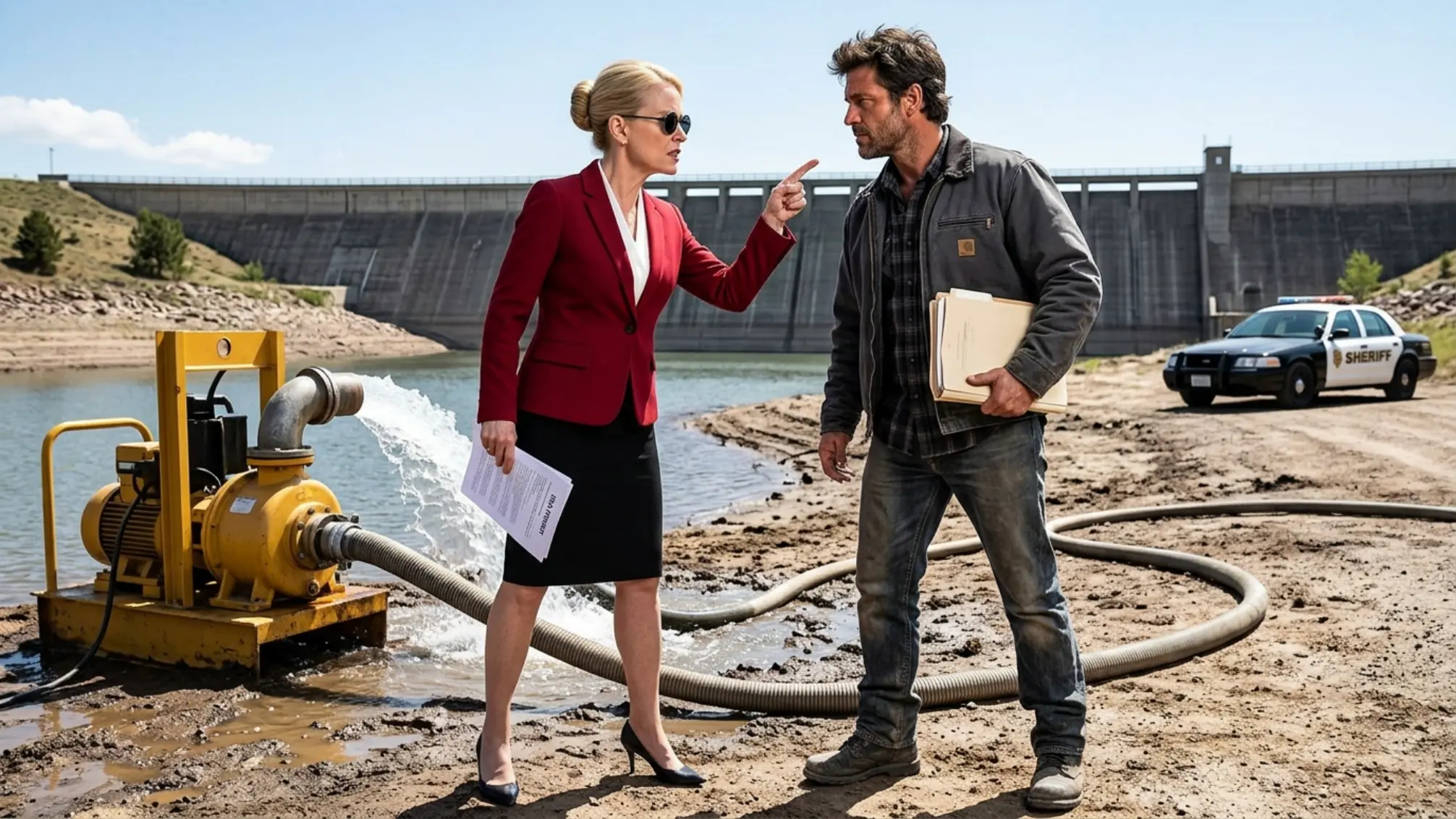
Jack stood opposite her with a thick property-deed folder pressed against his chest. At forty-two, he had the weathered face, broad shoulders, and quiet physical confidence of a man who had spent decades around heavy machinery, remote construction sites, and people who mistook patience for weakness. His charcoal work jacket was dusty from the long drive home, and dark stubble covered his jaw. Behind Melissa, hoses crawled across the bank like black snakes, and the concrete emergency dam stretched beneath the bright Colorado sky.
HOA President (jabbing her finger forward): “Why are you threatening my crew when the HOA legally ordered this ugly reservoir drained?”
Reservoir Owner (stepping into her space): “Because you invaded private land and emptied a state-protected emergency water reserve.”
HOA President (shoving the papers toward his chest): “Come one inch closer, and that sheriff arrests you while my pump finishes the job.”
Reservoir Owner (clenching the deed folder): “Call him—then explain why your signature authorized eight million dollars in destruction.”
Melissa lowered the papers slowly, but her mouth curled into a contemptuous smile. She believed Jack was bluffing, because in her six years as HOA president, most homeowners had surrendered the moment she mentioned fines, liens, lawyers, or police. She had ordered fences removed, vehicles towed, gardens destroyed, and family businesses cited for violations that existed only because she interpreted vague rules as absolute authority. No one had ever stood this close to her and spoken as though she were the trespasser.
“You should be careful,” she said, tilting her sunglasses down just enough to reveal pale blue eyes filled with irritation. “Your land borders Pinehurst Estates, and that gives this association authority over anything that affects our community’s appearance.”
“My property is not part of your association.”
“The reservoir affects our property values.”
“That does not make it yours.”
Melissa turned toward the pump and raised two fingers. The machine operator, positioned far down the bank and barely visible through the mist, increased the engine speed. The pipe shuddered, and another violent surge of water poured onto the ground. Jack watched several silver trout twist helplessly in the shallows near the exposed clay edge, their ecosystem collapsing while Melissa treated the destruction like a landscaping project.
He wanted to seize the emergency cutoff and shut the pump down himself. He wanted to rip the permit papers from her hand and force her to read the state seal printed across the documents in his folder. Instead, Jack took out his phone, recorded the equipment, the cut fence, the pumping hoses, and Melissa standing beside the operation. Then he photographed the document in her hand, including the unmistakable signature authorizing the drainage.
Melissa laughed. “Take all the pictures you want.”
“I intend to.”
“You think photographs will frighten me?”
“No,” Jack said. “Evidence usually frightens people later.”
Six months earlier, Jack had left Colorado for a water-resources project in Alaska. Turner Hydro Solutions, the company he had built over nearly twenty years, had been hired to inspect a remote emergency corridor serving several isolated communities. The job required long days, freezing temperatures, and almost no communication beyond scheduled satellite calls. Jack had trusted that the property he had spent twelve years developing would still exist when he returned.
The reservoir was not a decorative pond. It held several million gallons of water collected through licensed underground channels connected to two natural aquifers. It had been designed under a formal agreement with the State Water Resources Board and listed as a contingency supply for county emergencies, including wildfires and drought-related infrastructure failures. Its construction, environmental restoration, aquatic system, reinforced berm, pumps, controls, and monitoring equipment had cost approximately eight million dollars.
Melissa knew none of that because she had never asked.
During Jack’s absence, she had described the reservoir at an HOA meeting as an “unauthorized water feature” that disrupted the visual consistency of the neighborhood’s western boundary. She claimed standing water attracted insects, reduced the desirability of nearby homes, and created a view inconsistent with Pinehurst Estates’ landscaping standards. Three board members voted to drain it, two voted against, and Melissa immediately hired an industrial contractor using money from the HOA’s community-improvement reserve.
She chose the timing carefully. Jack was thousands of miles away, his house was unoccupied, and his site manager had been told that the board possessed legal authority. Melissa personally visited the property repeatedly, supervised the hoses, directed the removal of control equipment, and assured workers that no private owner could challenge the association’s financial resources. By the time Jack returned, millions of gallons had already been discharged.
The sheriff’s cruiser parked near the access road belonged to Deputy Aaron Cole, who had arrived after Melissa reported that an “aggressive landowner” was interfering with authorized HOA work. When Cole approached the reservoir bank, Melissa immediately pointed toward Jack. She told the deputy that Jack had threatened her, obstructed contractors, and refused to comply with a legal community order.
Cole looked at Jack, then at the water rushing from the pipe. “Sir, I need you to step away from the equipment.”
Jack handed him the deed folder. “Before you touch me, read the first page.”
Melissa folded her arms. “Deputy, this is unnecessary. The association’s authority is clearly documented.”
Cole opened the folder. The first document was the state registration for the reservoir. The second was the county contingency-water agreement. The third contained a map showing that Jack’s property lay entirely outside Pinehurst Estates and had never been subject to its covenants. By the time Cole reached the environmental permit, his expression had changed.
“Mrs. Harper,” he said carefully, “do you have a court order authorizing entry onto this land?”
“I have an HOA resolution.”
“That was not my question.”
Melissa’s jaw tightened. “The reservoir impacts our residents.”
“Do you have the owner’s written consent?”
“The board does not require his consent.”
Cole looked toward the cut perimeter fence. “I am not seeing anything here that gives your association authority over this property.”
Melissa stepped closer. “Deputy, I called you to remove him.”
“And I am telling you that this appears to be a civil property dispute involving possible criminal trespass and property damage.”
For the first time, her confidence slipped. It lasted less than a second, but Jack saw it. Melissa quickly recovered, pushed her sunglasses back into place, and said the HOA’s attorney would explain everything. She insisted the contractors continue until legal counsel arrived.
Jack turned to Deputy Cole. “That reservoir is part of the county’s emergency water plan. Every minute that pump runs increases the damage.”
Cole walked toward the equipment and ordered the crew to stop. The engine slowed, the steel pipe coughed out one final surge, and silence rolled across the exposed basin. It was the first quiet moment since Jack had arrived, and in that silence came the weak, desperate movement of fish trapped in shrinking pools.
Melissa stared at the motionless pump. “You have no idea what you have just done.”
Jack looked down at the dying reservoir. “Neither do you.”
That afternoon, Jack contacted Margaret Howell, a Denver attorney specializing in water law and private-property litigation. He sent her the video, Melissa’s signed authorization, the HOA resolution, his state permits, and photographs of the damaged infrastructure. Margaret called him back forty minutes later and asked only one question.
“Did she really sign this herself?”
Jack said she had.
Margaret exhaled softly. “Then tell everyone on your property not to touch anything until our environmental engineers arrive.”
Dr. Patricia Wells reached the site the following morning with a team of hydrologists, structural specialists, and aquatic ecologists. They photographed dead trout across the exposed clay bed, documented cut pipes, collected soil samples, and examined the damaged berm. Heavy machinery had destroyed hundreds of feet of native vegetation, and the rapid removal of water had destabilized part of the internal embankment.
The preliminary report was fourteen pages long. It concluded that the reservoir could not simply be refilled. The clay liner had cracked under direct sun, the control structure had been dismantled, aquifer inlets had been capped, and a section of the berm faced possible subsidence during heavy rain. The native trout population, established over nine years, was a total loss.
The first repair estimate exceeded four million dollars.
That number did not include Jack’s lost business contracts, the county’s loss of emergency storage, or the years required to restore the ecosystem. It also did not include punitive damages for deliberate misconduct. When Margaret reviewed the report, she told Jack that Melissa had not removed an unattractive pond.
“She destroyed regulated infrastructure,” Margaret said. “And she did it after entering land her association does not control.”
The HOA’s attorney, Gerald Faust, responded with a two-page letter arguing that the board had acted in good faith under its landscaping regulations. He demanded that Jack submit to the association’s internal grievance process and warned that public accusations against Melissa could constitute defamation. The letter cited HOA covenants eleven times and state law zero times.
Margaret’s reply was shorter. She rejected the internal grievance process, identified fourteen possible statutory violations, demanded preservation of every email, invoice, meeting recording, and text message connected to the drainage, and notified the HOA’s insurance carrier of an impending lawsuit. Copies were also delivered to the county water authority, the State Water Resources Board, and the environmental enforcement division.
Within three days, investigators were walking through the damaged reservoir.
Melissa continued attending community meetings as though nothing had changed. She told residents that Jack was a wealthy businessman attempting to intimidate volunteers. She described the reservoir as a private luxury and suggested that the dead fish had been exaggerated for emotional effect. She also claimed the association’s insurance policy would protect residents from any financial consequence.
Then discovery began.
The HOA was ordered to produce eight months of meeting minutes, internal messages, financial records, legal invoices, and contracts. The minutes showed that Melissa had presented the drainage operation as an opportunity that had to be completed while Jack remained in Alaska. One board member had asked whether the reservoir might be legally protected. Melissa answered that Jack would have registered it with the HOA if that were true.
No law required him to do so.
The contractor’s invoices revealed that the HOA had spent nearly eighty thousand dollars draining the reservoir, cutting pipes, removing equipment, and disposing of wildlife. The money had come from a reserve account intended for roads, lighting, and emergency repairs. There had been no separate resident vote and no independent legal review.
Three board members resigned when Margaret scheduled their depositions.
The most damaging evidence came from the HOA administrative assistant’s archived email account. Late one night, eight weeks before the drainage began, Melissa had sent a message to two board members who questioned the risk. The message contained only a few lines.
“Proceed while Turner is still away. He will not dare sue. Even if he does, the HOA has more money than he does.”
Margaret placed the printed email in front of Jack during a meeting in Denver. He read it twice without changing expression. Then he looked up.
“I want punitive damages.”
“I was hoping you would say that,” Margaret replied.
The contractors also cooperated. Their owner, Tom Rigby, testified that Melissa had personally supervised the project and dismissed concerns raised by his crew. One worker remembered asking whether they had permission from the property owner. Melissa told him the HOA controlled all visible water features bordering Pinehurst Estates and threatened to replace him if he refused to continue.
Tom had photographs taken for insurance purposes. Several showed Melissa standing beside the pump in different outfits on different days. In one, she wore the same crimson blazer and round black sunglasses Jack had seen when he returned. She was smiling while the reservoir drained behind her.
Jack’s security cameras provided the final piece. Three cameras had recorded almost the entire operation and automatically stored the footage off-site. The videos showed trucks arriving, fences being cut, pipes being disconnected, water levels falling, and Melissa visiting the site nine times.
One clip contained clear audio.
A worker warned her that the owner might sue. Melissa stood on the exposed reservoir bottom, looked toward the cameras without noticing them, and replied, “If he sues, the association will bury him. We have resources he does not.”
The trial began in November before Judge Harold Cartwright. Every seat in the district courtroom was filled, and dozens of Pinehurst Estates residents stood in the hallway. Melissa sat beside her attorneys wearing a cream blazer instead of red, her blonde hair arranged in the same precise bun. Her round black sunglasses were gone.
Margaret’s opening statement lasted forty minutes. She explained what Jack had built, what legal protections covered it, and what Melissa had ordered destroyed. She displayed the state registration, the county agreement, the environmental permit, and photographs of the reservoir before and after the drainage.
The defense argued that Melissa had misunderstood the limits of HOA authority. Her attorneys said she acted to protect property values and never intended to cause serious damage. They described the destruction as an unfortunate consequence of a community-management decision made in good faith.
Then Margaret introduced the email.
She asked the court clerk to read it aloud.
“Proceed while Turner is still away. He will not dare sue. Even if he does, the HOA has more money than he does.”
The courtroom became completely silent. Melissa stared at the table. Several jurors looked directly at her.
The security footage played next. The jury watched her direct workers, inspect the pumps, and stand inside the shrinking reservoir. When the clip reached her statement about burying Jack with the HOA’s resources, Judge Cartwright leaned forward.
“Play that again,” he said.
The second viewing was worse for Melissa than the first.
Dr. Wells testified for nearly four hours. She explained the damage to the clay liner, inlet network, ecosystem, and embankment. Every cost estimate was supported by contractor bids, engineering reports, inspection records, and environmental calculations. A court-appointed expert later concluded that Dr. Wells had underestimated two categories of damage.
Melissa did not testify.
Her attorneys knew Margaret would confront her with the email, the photographs, the signed authorization, and the video. Any attempt to describe her conduct as a misunderstanding would collapse under cross-examination. So Melissa remained silent while the evidence spoke for her.
The jury deliberated for one day and six hours.
When they returned, Jack sat beside Margaret with his hands folded. Melissa remained upright at the defense table, her face pale but controlled. Judge Cartwright read the verdict in a steady voice.
The jury found Melissa and the HOA liable for trespass, destruction of property, interference with a protected water resource, ecological damage, and business losses. Actual damages exceeded four million dollars. Then the judge reached the punitive award.
“Eight million dollars.”
A murmur moved through the courtroom before the bailiff called for silence. The total judgment was slightly more than twelve million dollars. Melissa did not move until Judge Cartwright announced that the evidence would also be referred to the county attorney for possible criminal and environmental charges.
Then her head lowered.
The insurance carrier refused to cover the punitive damages because the policy excluded deliberate acts. The restructured HOA negotiated responsibility for part of the actual damages, funded through reserves and a special assessment. Melissa remained personally exposed to the eight-million-dollar punitive judgment.
She appealed for fourteen months and lost.
Her house in Pinehurst Estates was sold to satisfy part of the judgment. She resigned from every community board she served, though several organizations had already requested her departure. Additional audits uncovered irregular spending from the HOA reserve accounts, leading to separate civil proceedings.
Jack spent those months rebuilding.
The damaged berm was reinforced, the basin excavated and relined, and the underground collection system reconstructed. New controls were installed with redundant security features. Native vegetation was replanted, and Dr. Sarah Kowalski, an aquatic ecologist, designed a recovery program for the lost trout population.
Two years after Jack returned from Alaska, water once again covered the reservoir floor.
It did not refill in a single dramatic rush. The aquifers restored it slowly, inch by inch, reflecting more of the Colorado sky each week. Native grasses reclaimed the berm, waterfowl returned, and the first trout fingerlings disappeared beneath the surface.
One evening, Jack stood where Melissa had pointed her finger at him beside the roaring pump. The industrial hoses were gone. The sheriff’s cruiser was gone. The cracked basin had become still water again.
Sandra, one of the former HOA board members who had voted against the drainage, walked over from the neighboring property. She stood beside Jack and watched two birds settle near the eastern reeds.
“It’s beautiful,” she said.
Jack nodded. “It always was.”
“Was it worth fighting for?”
He looked across the reservoir he had built, lost, and built again. He thought about the dead fish, the destroyed pipes, the courtroom, and the email Melissa believed would never leave a private inbox.
“Yes,” Jack said. “Because people like her depend on everyone else deciding that defending what belongs to them is too expensive.”
Sandra watched the fading light move across the water. “She thought the HOA had more money than you.”
Jack placed his hands in his jacket pockets.
“She never understood that the money was not what made me dangerous.”
“What did?”
Jack looked toward the restored emergency dam, the new control system, and the state inspection marker fixed securely beside the bank.
“I knew exactly what she had destroyed.”