Marcus Reed heard the tanker before he saw it. A heavy diesel engine rumbled outside his home at 8:17 on a Thursday morning, followed by the metallic groan of equipment being lowered onto pavement. When he stepped through the front door wearing a black work jacket, jeans, and the baseball cap he normally used while doing yard work, he found a gray vacuum truck parked diagonally across his driveway. HOA president Elaine Porter stood beside it in a pale-pink blazer and white pants, directing two contractors toward a thick discharge hose.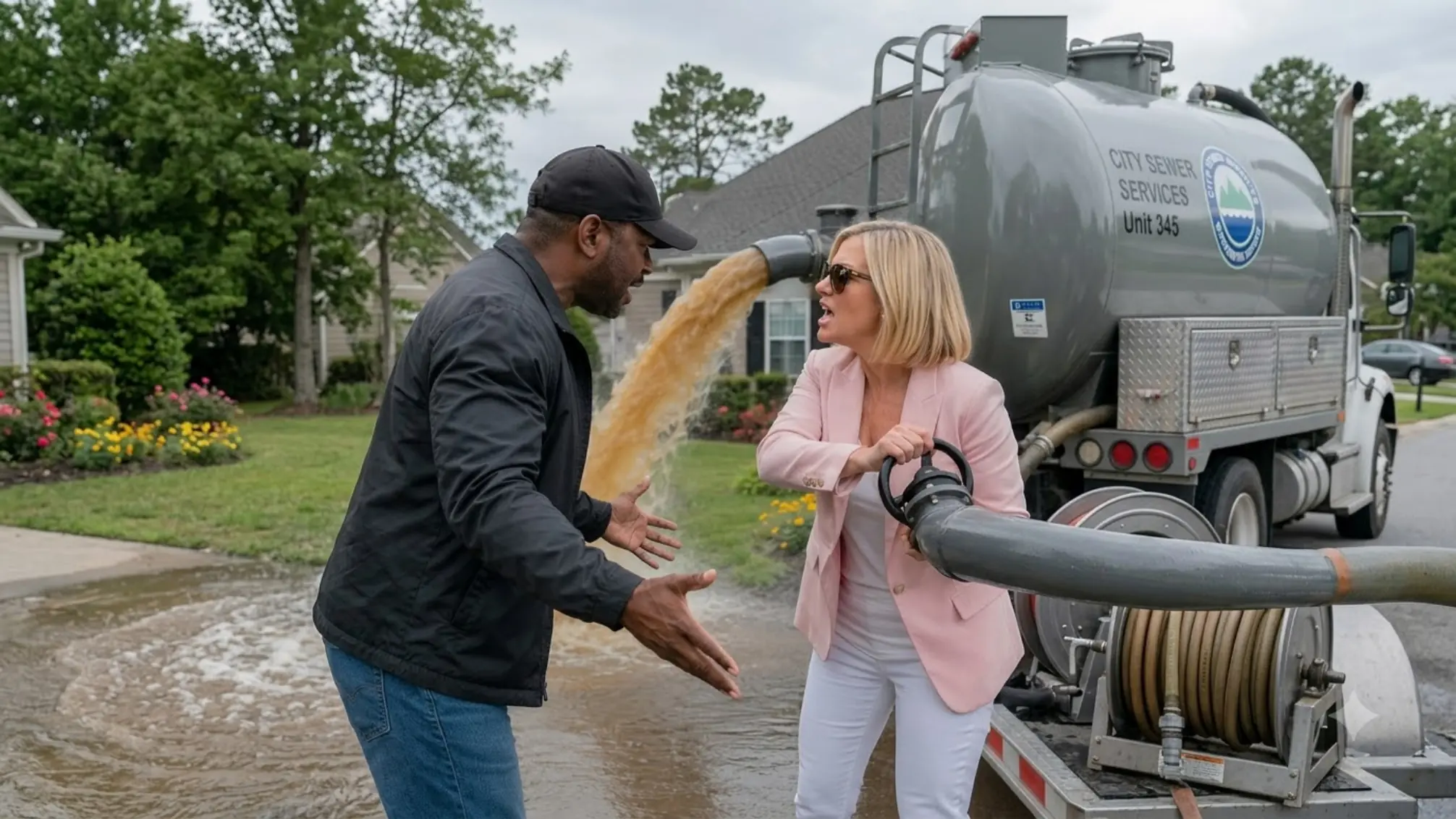
“What are you doing?” Marcus called.
Elaine turned with the expression of someone irritated that a piece of furniture had begun speaking. “Association maintenance.” She pointed toward the far edge of Marcus’s property, where a shallow drainage swale ran behind a row of hydrangeas. “We’re clearing the eastern retention basin, and this parcel is the designated discharge route.”
Marcus looked at the tanker, then at the hose. “Not through my yard.”
Elaine opened the black folder beneath her arm. She had been president of the Oak Briar Estates Homeowners Association for six years, and she carried association paperwork the way some people carried weapons. “Section fourteen, community drainage easement. The HOA may access affected parcels for stormwater management.”
Marcus walked closer but did not touch the folder. “Access is not permission to discharge thousands of gallons of pond water across my property.” Elaine laughed once and looked toward the contractors. “This is exactly why boards shouldn’t explain technical matters to homeowners.”
Marcus’s eyes narrowed. “I understand the technical matter.”
“Then you understand you need to move.”
One contractor, a stocky man named Dale Foster, lowered the hose. He looked uncomfortable. “Mrs. Porter, maybe we should confirm the outfall location one more time.”
Elaine snapped toward him. “Your company was hired to pump the basin. Pump it.”
Dale hesitated. “The work order says temporary discharge area approved by association.”
“And I am the association president.”
Marcus took out his phone.
Elaine noticed immediately.
“Oh, please. Record all you want.”
“I intend to.”
She stepped closer. “You bought into an HOA neighborhood, Mr. Reed. That means you don’t get to decide which rules apply only when you like them.”
Marcus stared at her. “Neither do you.”
That sentence changed her expression.
Elaine had been irritated before.
Now she was offended.
For three years, Marcus had watched her run Oak Briar Estates through a combination of selective enforcement, social pressure, and paperwork most homeowners did not have the time or patience to challenge. A basketball hoop left overnight earned one family a violation letter while Elaine’s closest friend kept three unauthorized structures behind her house. Grass half an inch beyond the association recommendation generated photographs and fines, but board members received friendly reminders.
Marcus rarely argued.
He documented.
That habit came from his profession. Marcus was a civil drainage engineer who spent fourteen years designing stormwater systems, reviewing grading plans, and evaluating drainage failures for commercial and residential developments. Elaine knew he worked in engineering but apparently had never asked what kind.
That morning, the detail suddenly mattered.
Marcus zoomed his phone camera toward the tanker’s company markings. Then he photographed the hose connection, the truck plate, Elaine’s folder, and the two contractors standing beside the discharge line. “Has the retention basin been tested?”
Elaine rolled her eyes.
“For what?”
“Sediment contamination, hydrocarbons, fertilizer concentrations, bacterial load.”
“It’s rainwater.”
“No.”
Marcus pointed toward the truck.
“If you’re vacuuming settled material from the bottom of a neighborhood retention basin, you’re not handling clean rainwater anymore.”
Elaine folded her arms. “You think using big words changes the easement?”
“No.”
He looked at her.
“But the recorded termination does.”
For the first time, Elaine paused.
“What termination?”
Marcus almost answered.
Instead, he looked toward Dale.
“Do you have a county discharge permit?”
Dale’s face tightened.
“Our office was told the HOA handled site authorization.”
“That isn’t what I asked.”
Elaine stepped between them.
“You’re interfering with contracted association work.”
Marcus lifted his phone.
“I’m asking whether a tanker is about to discharge material from a sediment basin onto residential property without confirming a lawful receiving area.”
Elaine pointed toward his house.
“Go inside.”
Marcus smiled without humor.
“You’re standing on my driveway.”
Elaine turned toward Dale.
“Open it.”
Dale did not move.
Elaine’s voice sharpened.
“I said open it.”
His coworker looked toward him.
Dale finally walked to the rear control assembly and opened the valve cautiously.
The first surge hit the pavement with startling force.
Brown water exploded from the pipe.
It struck the driveway, spread across the concrete, and began running toward Marcus’s lawn. Pieces of leaves, dark sediment, and foul-smelling organic material moved inside the flow.
Marcus stepped backward.
“Close it.”
Elaine stood beside the valve.
“No.”
“Elaine, close it.”
“You have been warned repeatedly about obstructing association drainage access.”
Marcus looked toward his phone.
The recording timer continued.
“Close that valve now. You’re dumping contaminated water onto private property.”
Elaine’s face flushed.
“I’ll flood this entire driveway before I let one homeowner tell me how to run my community.”
Marcus turned the phone so the screen faced her.
“Perfect.”
He held her stare.
“Say it again while the county inspector listens.”
Elaine froze.
“What?”
Marcus tapped the screen.
The call had been active for nearly four minutes.
A voice came through the speaker.
“Mr. Reed, this is Inspector Lena Morales. I heard her.”
Dale immediately closed the valve.
The muddy stream weakened.
Elaine stared at Marcus.
“You called the county?”
“I called them yesterday.”
Her confidence flickered.
“Yesterday?”
Marcus pointed toward the retention basin beyond the houses.
“Because I saw your contractors measuring pump access Tuesday afternoon.”
He had not confronted anyone then.
He had done what he always did when something did not make sense.
He checked records.
The original Oak Briar development plans dated back twenty-two years. Marcus pulled the county plats online, then visited the recording office because several older pages were missing from the digital archive. The original developer had indeed created temporary construction and drainage easements across multiple parcels.
Elaine had found one of those pages.
What she apparently had not found was the later filing.
Seven years after the neighborhood was completed, the county accepted permanent stormwater infrastructure along a separate corridor. The temporary discharge easement affecting Marcus’s parcel had been formally terminated.
The document had a recording number.
A survey reference.
County signatures.
And the legal description of Marcus’s lot.
Marcus printed three certified copies.
One was inside his house.
One was with his attorney.
The third was photographed on his phone.
Elaine shook her head. “There is no termination.”
Marcus opened the document.
“There is.”
She snatched the phone from his hand.
Marcus immediately took it back.
“Do not touch my property again.”
Elaine stared at the screen.
Her lips moved while she read.
“This doesn’t mean what you think.”
Marcus almost laughed.
“It says ‘termination of temporary drainage easement.’”
“The HOA still has stormwater authority.”
“Over common infrastructure.”
He pointed down.
“Not a permanent right to use my driveway as a disposal channel.”
Dale stepped away from the truck.
“Mrs. Porter, I think we’re stopping.”
Elaine spun toward him.
“You have a contract.”
“And now I have a property owner disputing site authorization while a county inspector is on the phone.”
He pointed toward the pipe.
“My company isn’t taking that risk.”
Elaine’s face became red.
Neighbors had started emerging from houses.
The sound of the tanker had attracted attention, but the sight of brown water across Marcus’s driveway attracted phones. Within minutes, six people stood along the sidewalk.
One was Jennifer Sloan, who had received more than four thousand dollars in HOA fines during the previous eighteen months.
Another was Robert Mills, whose dispute with Elaine over a backyard fence had lasted nearly a year.
Neither liked her.
Elaine knew it.
She grabbed her folder.
“This meeting is over.”
Marcus looked toward the dirty water.
“No.”
Elaine stopped.
“You ordered contaminated basin water discharged onto my property after I objected.”
“I relied on association documents.”
“You relied on half of them.”
She pointed toward him.
“Be very careful what you accuse me of.”
Marcus lowered his phone.
“I’m accusing you of exactly what the recording shows.”
A white county SUV arrived seventeen minutes later.
Inspector Lena Morales stepped out wearing a reflective field vest and carrying a tablet. She immediately photographed the water on the driveway before speaking to anyone. Then she walked toward the tanker and asked Dale for his company work order.
Elaine inserted herself between them.
“I’m Elaine Porter, HOA president.”
Lena nodded.
“I’ll speak with you in a moment.”
Elaine was clearly not accustomed to waiting.
Lena examined the work order.
It identified Oak Briar HOA as the contracting party.
Purpose: retention-basin cleaning.
Disposal instruction: authorized HOA drainage easement adjacent to 1147 Brookstone Lane.
Marcus’s address.
Lena looked at Elaine.
“Who provided the disposal instruction?”
Elaine folded her arms.
“The board.”
“Who specifically?”
“The association authorized it.”
Lena waited.
Elaine disliked silence.
“I did.”
Lena entered something on her tablet.
Marcus watched.
There was no smile.
No dramatic reaction.
Just documentation.
That worried Elaine more than shouting might have.
Lena collected water and sediment samples. She photographed the pipe, tire placement, runoff path, and muddy residue that had reached the edge of Marcus’s landscaping.
Then she asked for the easement documentation.
Elaine opened her folder and produced the old plat.
Marcus handed Lena his certified termination copy.
The inspector compared the recording numbers.
Her eyebrows rose slightly.
“Mrs. Porter, where did you obtain this earlier document?”
“Association archive.”
“Did the archive contain the later filing?”
“No.”
Marcus interrupted.
“The HOA management portal does.”
Elaine turned toward him.
He continued.
“File name DR-17B.”
Her expression changed.
Marcus had found the digital copy the previous night after searching archived board attachments.
More importantly, someone had opened it three weeks earlier.
The access log showed an HOA administrator account.
Elaine’s.
Lena asked, “You have evidence of that?”
Marcus opened another screenshot.
Date.
Time.
User.
Document.
Elaine’s voice became sharp.
“Those logs don’t prove I read it.”
“No.”
Marcus nodded.
“They prove your account opened it.”
The distinction mattered.
He was careful not to claim more than the evidence supported.
Lena asked Elaine whether the board had voted on the discharge plan.
Elaine said yes.
“Meeting date?”
Elaine hesitated.
“Last month.”
“Minutes?”
“Not finalized.”
Marcus knew that was false.
He had attended the meeting.
No tanker operation had been discussed.
Jennifer Sloan spoke from the sidewalk.
“I was there too.”
Elaine turned.
“This does not involve you.”
Jennifer lifted her phone.
“You made everybody’s business yours for six years.”
That evening, the county issued an immediate stop-work notice covering the retention-basin pumping operation until proper disposal arrangements were approved. The tanker left Oak Briar with most of its contents still inside. Elaine departed ten minutes later without speaking to Marcus.
Marcus spent the next two hours rinsing nothing.
That surprised Robert Mills, who offered to help wash the driveway.
“Don’t.”
Robert frowned.
“Why?”
“Evidence.”
Marcus photographed every stain.
He placed small flags along the runoff boundary.
Then he called an environmental testing company.
By Friday morning, technicians had collected soil and water samples.
The results arrived four days later.
The basin material was not some deadly toxic waste, despite neighborhood rumors rapidly describing it that way. Marcus refused to exaggerate. But laboratory testing showed elevated nutrients, bacterial contamination, petroleum residues consistent with roadway runoff, and sediment concentrations unsuitable for intentional discharge across landscaped residential property.
That was enough.
Then the financial records surfaced.
Oak Briar’s official contractor bid for lawful off-site disposal had been $18,600.
The tanker company Elaine selected charged $6,900 if permitted to pump the basin and discharge locally.
A savings of $11,700.
Marcus stared at the invoice.
Suddenly the motive became less mysterious.
Elaine had not chosen his property randomly.
His parcel sat downhill from the basin and was close enough to reduce trucking time dramatically.
The terminated easement offered a convenient justification.
Marcus requested HOA records under the association’s inspection procedures.
Elaine initially refused.
His attorney sent a formal demand.
Three days later, the board scheduled an emergency meeting.
The clubhouse was packed.
Elaine sat at the front wearing another pale blazer, though this time she had no sunglasses and no control over the room’s mood. Beside her were four board members who looked as though they had spent the previous week learning things they wished they had known earlier.
Marcus sat in the second row.
He carried one folder.
Nothing more.
Elaine opened the meeting.
She described the tanker incident as “an unfortunate disagreement regarding competing interpretations of legacy drainage rights.”
Marcus heard several people laugh.
Elaine continued.
“The board acted in good faith to address urgent retention-basin maintenance while protecting association finances.”
Marcus raised his hand.
Elaine ignored him.
Robert called from the back.
“Let him speak.”
Others joined.
Elaine finally nodded.
Marcus stood.
“I have one question.”
She looked at him.
“Did the board approve discharging the basin onto my property?”
Silence.
Board treasurer Carol Jensen leaned toward her microphone.
“No.”
Elaine turned sharply.
Carol continued.
“We approved basin cleaning.”
Another board member nodded.
“We never discussed Brookstone Lane.”
Elaine’s expression hardened.
Marcus opened his folder.
“The contractor work order identifies my property specifically.”
Carol looked toward him.
“Who signed it?”
Marcus held up the copy.
“Elaine Porter.”
The room erupted.
Elaine struck the table.
“Order!”
Nobody listened.
Marcus waited.
Eventually the room quieted.
He continued.
“The lawful off-site disposal quote was eighteen thousand six hundred dollars.”
Carol’s eyes widened.
“What?”
Marcus looked toward her.
“You never saw that?”
“No.”
Elaine interrupted.
“It was excessive.”
Marcus pulled out the second quote.
“The local discharge plan cost sixty-nine hundred.”
Carol turned toward Elaine.
“Where did the other proposal go?”
Elaine’s face tightened.
“I exercised executive authority to choose a reasonable vendor.”
“You saved money by dumping it on Marcus’s property?” Jennifer asked.
Elaine pointed toward her.
“That is not what happened.”
Marcus spoke calmly.
“That is exactly what the work order describes.”
He placed photographs on the table.
Brown water blasting from the pipe.
Elaine holding the valve.
The discharge running across his driveway.
Neighbors murmured.
Then Marcus played the recording.
Elaine’s voice filled the clubhouse.
I’ll flood this entire driveway before I let one homeowner tell me how to run my community.
Nobody moved.
Elaine stared forward.
Marcus stopped playback.
“I don’t need anyone to interpret that.”
Carol closed her eyes.
The board called an executive recess.
Forty minutes later, they returned.
Carol spoke.
“The board has voted three to one, with Mrs. Porter abstaining, to remove Elaine Porter as HOA president effective immediately pending an independent review.”
Elaine stood.
“You cannot do this.”
Carol looked at her.
“We just did.”
Elaine grabbed her folder.
“You people have no idea what I’ve done for this neighborhood.”
Jennifer answered from the back.
“That’s exactly what we’re trying to find out.”
The independent review lasted six weeks.
It discovered more than the tanker incident.
Elaine had repeatedly approved expenses below thresholds requiring broader board review, often splitting work into separate invoices. Some decisions were legitimate.
Others were questionable.
Three contractors had close personal relationships with people in Elaine’s social circle.
No evidence established that Elaine had personally stolen association money.
Marcus insisted people stop saying she had.
But auditors found serious governance failures, poor documentation, unauthorized commitments, and multiple instances where Elaine acted beyond powers granted to the president.
The retention-basin contract became the clearest example.
Elaine knew the lawful disposal option.
Her account had accessed the terminated easement file.
She signed the cheaper discharge order anyway.
Whether she had actually read every page became almost irrelevant to the board’s governance findings.
She had exercised authority without verifying the authority existed.
The county issued civil penalties connected to the unauthorized discharge and cleanup requirements.
The HOA’s insurance carrier became involved.
Oak Briar reimbursed Marcus for environmental testing, landscaping remediation, attorney expenses allowed under the settlement, and driveway cleaning.
Marcus refused an additional confidentiality provision.
Elaine hated that.
“This is revenge,” she told him during mediation.
Marcus looked at her.
“No.”
“You want everyone to know.”
“I want every homeowner to know what documents govern their property.”
“That’s punishment.”
“No.”
Marcus leaned forward.
“Secrecy would protect the problem.”
The settlement required Oak Briar to publish current easement maps, contractor authorization procedures, and board-approval requirements on its homeowner portal.
It also changed the president’s power.
No single officer could authorize environmental work affecting privately owned lots without documented board approval and verification of recorded property rights.
Major drainage projects required an independent engineering review.
Marcus did not ask to become president.
People immediately asked anyway.
He refused.
“I already have a job.”
Jennifer laughed.
“You’re the only person here who reads the documents.”
“That should not qualify somebody for office.”
Eventually Carol Jensen became president.
Her first meeting lasted thirty-seven minutes.
No one shouted.
No violations were issued.
Nothing dramatic happened.
Residents considered it wildly successful.
Three months after the tanker incident, Elaine put her house on the market.
Marcus saw the listing but said nothing.
One evening she appeared at the edge of his driveway while he was repairing a sprinkler head.
She wore jeans instead of white pants.
No folder.
No sunglasses.
For several seconds they simply looked at each other.
“I’m moving next Friday,” she said.
Marcus nodded.
“I heard.”
Elaine looked toward the section of driveway where the dirty water had once flowed.
“I really thought that easement still applied.”
Marcus set down the wrench.
“Maybe.”
She seemed surprised.
“You believe me?”
“I believe you may have convinced yourself.”
Elaine looked away.
“That sounds worse.”
“It probably is.”
Her expression tightened.
“I was trying to save the association eleven thousand dollars.”
“You were saving eleven thousand dollars by making your property problem someone else’s property problem.”
Elaine nodded slowly.
“I understand that now.”
Marcus waited.
She took a breath.
“I’m sorry.”
He studied her.
Not because he wanted to make her suffer.
Because apologies were easy when consequences had already arrived.
“What exactly are you sorry for?”
Elaine thought about it.
“For believing being president meant I could make the decision because I thought it was best.”
Marcus nodded.
“That’s closer.”
She almost smiled.
“I suppose you’re not going to make this comfortable.”
“No.”
“Fair.”
Elaine turned to leave.
Then stopped.
“For what it’s worth, you were right about the documents.”
Marcus picked up his wrench.
“I know.”
She laughed despite herself.
“Still irritating.”
“Good luck with the move.”
Elaine walked home.
A year later, Oak Briar’s retention basin needed cleaning again.
This time the board solicited three bids.
The selected contractor pumped the sediment into sealed tankers and transported it to an approved facility.
The project cost more.
Homeowners received a detailed explanation of the expense.
Nobody complained.
Marcus stood near his mailbox watching the final truck leave.
Robert Mills walked over.
“Remember last time?”
Marcus looked toward him.
“Hard to forget.”
Robert nodded toward Marcus’s clean driveway.
“No river of brown sludge.”
“High standard.”
They laughed.
Carol approached carrying a folder.
Marcus immediately pointed at it.
“No.”
She stopped.
“You don’t even know what I’m asking.”
“If it involves joining the board, no.”
“It doesn’t.”
“Then maybe.”
Carol handed him the annual drainage report.
“Independent engineer says the basin outlet needs modification.”
Marcus opened it.
“Good recommendation.”
“You agree?”
“Yes.”
Carol smiled.
“See? That was painless.”
Marcus handed it back.
“That’s what happens when you ask before opening a tanker valve.”
Years later, neighbors still told the story of the morning Elaine Porter tried dumping thousands of gallons across Marcus Reed’s property.
Some versions became absurd.
One claimed federal agents arrived.
Another claimed the water contained industrial chemicals capable of killing every lawn in Raleigh.
Neither was true.
Marcus always corrected them.
The actual story needed no exaggeration.
An HOA president wanted to save money.
She found an old easement.
She failed to verify that it still existed.
She authorized a contractor to discharge retention-basin material onto a homeowner’s property.
The homeowner documented it.
The county stopped it.
Records showed what happened.
The board corrected the system that allowed it.
That was enough.
The most important photograph from the incident was not the one showing Elaine gripping the valve.
It was not even the image of brown water exploding across the driveway.
Marcus kept a photograph of the two documents lying beside each other on his kitchen table.
The old easement.
The termination.
Both official.
Both recorded.
One created authority.
The other ended it.
Elaine had built everything on the first page and ignored the second.
That mistake became Marcus’s favorite explanation whenever neighbors complained that property records, bylaws, votes, permits, and procedures were boring.
“Boring paperwork,” he would say, “is usually what tells powerful people where they have to stop.”
And on Brookstone Lane, everyone finally understood exactly what he meant.