“What the hell are you doing in my yard, Deborah?”
Marcus Reed shoved open the patio door so hard that the handle struck the wall behind him. He was still wearing the dark plaid pajama pants and charcoal sleep shirt he had gone to bed in, his feet shoved hastily into house slippers, but the exhaustion on his face had disappeared the second he saw what was floating in his swimming pool.
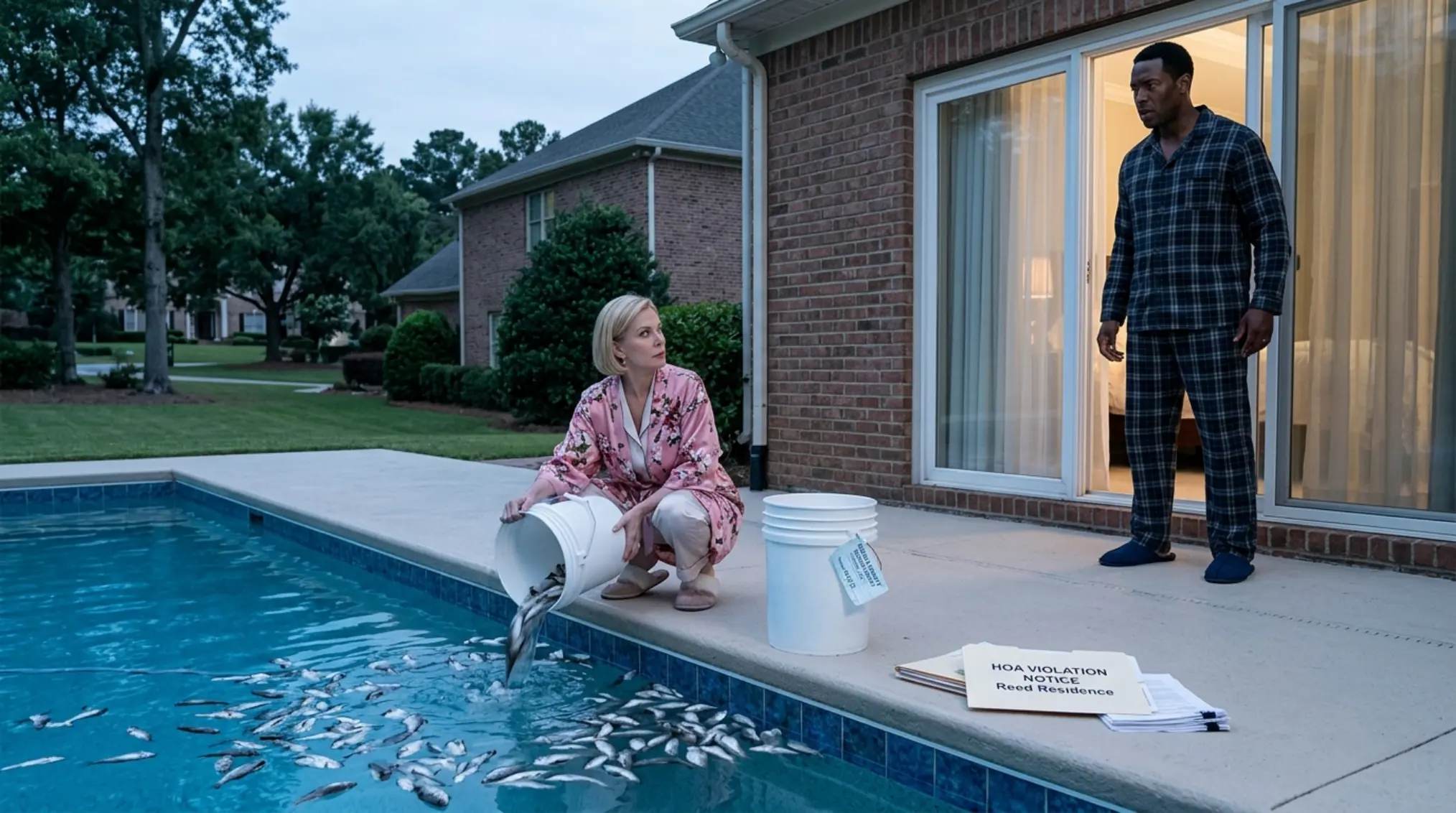
Hundreds of dead fish covered the water.
Small silver bodies drifted against the blue tiles, some already sinking toward the bottom while others collected against the pool skimmer. A foul smell rose into the cool Georgia morning, mixing with chlorine and damp grass until Marcus had to fight the urge to gag.
Standing beside the pool was Deborah Vance, president of the Cedar Grove Homeowners Association.
She was fifty-nine, white, blond hair cut into a neat bob, and still dressed as though she had walked straight from her bedroom. A pink satin robe covered in pale floral patterns was tied tightly around her waist, matching slippers on her feet.
In one hand she held an empty white bucket.
Beside her sat a folder.
Marcus’s eyes moved from the bucket to the fish.
Then to Deborah.
She did not look embarrassed.
She looked irritated that he had woken up.
Deborah lifted the folder.
“By noon this pool will stink so badly the entire block will know you're a public-health problem.”
Marcus stared.
“What?”
She opened the folder and pulled out a printed violation notice.
“You have forty-eight hours to correct the condition of this pool before daily HOA penalties begin.”
Marcus stepped onto the patio.
“You dumped those fish in there.”
Deborah’s mouth tightened.
“Can you prove that?”
Marcus almost laughed.
He raised the phone in his right hand.
The camera was recording.
Deborah’s expression changed.
Only slightly.
But enough.
Marcus walked toward the pool.
“Say it again.”
“Turn that phone off.”
“No.”
“You cannot record me without permission.”
“You’re standing inside my fenced backyard.”
“I’m here on HOA business.”
“At five forty-seven in the morning?”
Deborah crossed her arms.
“You’ve ignored multiple sanitation warnings.”
Marcus looked at the perfectly maintained patio.
Then at the dead fish she had just dumped into his water.
“What warnings?”
“You'll receive the documentation.”
“I’m looking at the documentation.”
He pointed toward the floating fish.
Then something near the edge caught his attention.
A white paper tag floated partially submerged beside the skimmer.
Marcus crouched.
Deborah immediately stepped toward him.
“Don't touch that.”
He stopped.
Looked at her.
Then deliberately reached into the water.
“Marcus.”
He lifted the tag.
Water ran down his arm.
Most of the ink was smeared, but the printed company name remained readable.
VANCE COASTAL SEAFOOD DISTRIBUTION.
Marcus looked at Deborah.
Her face changed.
The surname was not a coincidence.
He knew enough about the neighborhood to know Deborah’s brother-in-law, Charles Vance, operated a seafood wholesaling business outside Atlanta.
Marcus held the dripping tag toward his phone camera.
“Good.”
Deborah stared.
“Stay right there.”
“What are you doing?”
“Giving the police something easier to follow than the smell.”
Marcus Reed had lived in Cedar Grove for four years.
He was thirty-nine, owned a regional commercial-security company, and had spent most of his adult life learning that powerful people rarely announced when they were abusing authority.
They wrote letters.
Created procedures.
Invented fees.
Used technical language.
Deborah Vance had mastered all four.
When Marcus bought the house, he barely noticed the HOA.
He paid his annual dues, kept the lawn trimmed, maintained the exterior, and attended only one meeting during his first two years.
Then the fines began.
The first was seventy-five dollars because his trash can remained visible from the street after 7 p.m.
Marcus had been traveling for work.
His neighbor had moved the container twenty minutes late.
The second violation concerned a contractor’s van parked in his driveway while the contractor repaired the pool heater.
The third claimed his backyard fence stain was “inconsistent with approved neighborhood color standards.”
Marcus checked the architectural guidelines.
The color was explicitly approved.
He appealed.
The fine disappeared.
Deborah did not.
A week later, another notice arrived.
Then another.
Marcus eventually attended a board meeting and asked a question that changed everything.
“Why has the landscaping budget increased thirty-one percent in two years?”
Deborah sat at the head table wearing a cream blazer and the expression of someone listening to a child interrupt dinner.
“Vendor costs have increased.”
Marcus held up the budget.
“Which vendor?”
“The association uses several.”
“I requested the invoices.”
“They contain proprietary pricing information.”
“It’s HOA money.”
Several residents nodded.
Deborah’s smile vanished.
“We will provide appropriate financial disclosures according to state requirements.”
Marcus sat down.
He received nothing.
Two months later, he formally requested records again.
This time the management company claimed several documents were temporarily unavailable.
Then came the pool violations.
Deborah said his private swimming pool failed to meet unspecified “community appearance standards” because of visible pool furniture.
Marcus challenged that too.
Another fine disappeared.
The pattern became obvious.
Anyone who questioned Deborah suddenly discovered rules nobody else seemed required to follow.
Marcus began saving everything.
Emails.
Letters.
Photographs.
Meeting minutes.
Not because he expected something dramatic.
Because documentation turned opinion into evidence.
That habit was why Deborah’s pre-dawn visit became the worst decision she ever made.
The police arrived at 6:19 a.m.
Two officers walked through the side gate after Marcus met them at the driveway.
Deborah was still there.
She had tried leaving once.
Marcus had not physically stopped her, but he told her the officers were already on the way and reminded her the side gate camera had recorded her entry.
She decided staying might look better.
It did not.
Officer Lena Brooks looked at the pool.
Then at Deborah.
Then back at the pool.
“What exactly happened?”
Deborah answered first.
“I’m HOA president. I came to document a sanitation problem.”
Marcus laughed.
Brooks looked toward him.
“Mr. Reed?”
Marcus held out his phone.
“You should watch this.”
The video began inside the living room.
Through the narrow opening in the curtain, Deborah was clearly visible carrying the first white bucket.
She looked over both shoulders.
Then dumped dead fish into the pool.
The second bucket followed.
Brooks watched without speaking.
When the video ended, she looked at Deborah.
“You brought the fish?”
Deborah adjusted the belt of her robe.
“They were being used to demonstrate a preexisting sanitation issue.”
Brooks stared.
Marcus blinked.
“Demonstrate?”
Deborah continued.
“The pool had already generated complaints.”
Brooks asked, “Do you have permission to enter this property?”
“As HOA president, I have inspection authority.”
Marcus pulled a document from the folder he had brought outside.
“Our covenants require written notice except for emergencies affecting common property.”
Brooks read it.
“This pool isn't common property.”
“No.”
“Any emergency?”
“Only the one she created.”
The second officer photographed the fish.
Brooks asked Deborah whether she intended to damage the filtration system.
“Of course not.”
Marcus pointed toward the water.
“There are hundreds of dead fish in it.”
Deborah’s voice sharpened.
“They're biodegradable.”
Marcus looked at Brooks.
“Please put that sentence in the report.”
The officer nearly smiled.
Then Marcus handed her the wet delivery tag.
Brooks read the company name.
“Vance Coastal Seafood Distribution.”
She looked at Deborah.
“Related to you?”
Deborah hesitated.
“My brother-in-law operates the company.”
Marcus folded his arms.
Brooks asked, “Did you obtain these fish from him?”
“That isn't relevant.”
“It becomes relevant when material from his company is used while allegedly trespassing and damaging property.”
Deborah became quiet.
The officer placed the tag in an evidence bag.
That small piece of paper changed the entire case.
By eight o’clock, the pool service company arrived.
The technician’s name was Jorge Alvarez.
He stood at the edge for nearly thirty seconds.
“I’ve seen leaves.”
Marcus nodded.
“Okay.”
“Dead frogs.”
“Sure.”
“A raccoon once.”
Marcus frowned.
“I’m sorry?”
“Long story.”
Jorge pointed toward the water.
“But this is new.”
“How bad?”
“Bad.”
He explained that decomposing organic material could overload the filtration system, create bacterial contamination, clog lines, stain surfaces, and require a full drain and sanitation.
“Estimate?”
“Could be seven thousand. Maybe more.”
Marcus exhaled.
Jorge looked toward him.
“Insurance?”
“Probably.”
“Who did this?”
“HOA president.”
Jorge laughed.
Marcus did not.
The laughter stopped.
“You’re serious.”
Marcus showed him a still image from the video.
Jorge shook his head.
“People are insane.”
Marcus looked toward the floating fish.
“No.”
He thought about the violation folder.
“People get comfortable.”
The next surprise came from inside Deborah’s prepared paperwork.
When police allowed Marcus to photograph the violation letter, he noticed the timestamp.
5:31 a.m.
The fish had not entered his pool until approximately 5:44.
The alleged violation had been written thirteen minutes before the condition existed.
Marcus stared at the screen.
That was not sloppy.
That was planning.
The letter described:
“Strong organic odor.”
“Visible decomposing animal matter.”
“Failure to maintain sanitary recreational water.”
All before Deborah dumped anything.
Marcus immediately sent the document to his attorney, Rachel Mendoza.
Rachel called within ten minutes.
“She wrote the accusation before creating the evidence.”
“That’s how it looks.”
“Do not post anything online.”
“I wasn't planning to.”
“Good.”
“What should I do?”
“Preserve everything.”
“I already am.”
“I know you are.”
She paused.
“Marcus, this may be bigger than vandalism.”
He looked toward the company name on the delivery tag.
“I think so too.”
Rachel began with the seafood company.
Vance Coastal Seafood Distribution was legitimately owned by Deborah’s brother-in-law, Charles.
But public corporate records showed something interesting.
The company had received several payments from the Cedar Grove HOA during the previous eighteen months.
Not for seafood.
The invoices were classified as:
Pond remediation.
Wildlife disposal.
Drainage sanitation.
Cedar Grove had one small decorative retention pond.
Marcus had never seen a Vance Coastal vehicle anywhere near it.
He requested HOA financial records again.
This time, more than forty residents signed the request.
Deborah denied nothing publicly.
Instead, she sent a neighborhood-wide email.
The subject line read:
MISINFORMATION AND HARASSMENT OF HOA LEADERSHIP
She accused an unnamed resident of manipulating video, interfering with association duties, and spreading defamatory claims.
Marcus read the email twice.
Then called Rachel.
“She just gave us another document.”
Rachel sighed.
“You enjoy evidence too much.”
“I enjoy people writing down their mistakes.”
The neighborhood meeting happened four days later.
The clubhouse was overflowing.
Residents stood along walls.
Some watched through the open doors.
Deborah arrived in a pink blazer, accompanied by the HOA’s general counsel.
No robe.
No sunglasses.
No buckets.
Marcus sat in the first row.
Deborah opened the meeting.
“We are here because false allegations have damaged confidence in this board.”
Marcus raised one hand.
“Can we start with the fish?”
Murmurs moved through the room.
Deborah ignored him.
Her attorney explained that the board could not comment on an active police investigation.
Marcus nodded.
“Fine.”
He stood.
“But we can discuss the violation letter.”
Deborah’s attorney looked concerned.
Marcus projected the document onto the clubhouse screen.
The timestamp appeared.
5:31 a.m.
Then he projected a frame from his security camera.
Deborah entering his backyard.
5:41.
Then another.
First bucket poured.
5:44.
Marcus turned toward the room.
“She documented dead fish in my pool thirteen minutes before she put the first fish there.”
Silence.
A resident near the back whispered, “Oh my God.”
Deborah stood.
“That letter was generated from a draft template.”
Marcus looked at her.
“Then why does it describe decomposing animal matter?”
Her attorney touched her arm.
She sat.
Marcus continued.
Next slide.
The delivery tag.
VANCE COASTAL SEAFOOD DISTRIBUTION.
He looked toward Deborah.
“Your brother-in-law?”
She said nothing.
“Should I answer for you?”
“Yes,” someone shouted.
Deborah finally spoke.
“Yes.”
Marcus displayed HOA payment records.
Residents began murmuring.
“One hundred sixteen thousand dollars in payments to Vance Coastal over eighteen months.”
The treasurer’s face changed.
Marcus noticed.
He turned.
“You didn't know?”
The treasurer looked at Deborah.
“I knew about environmental-service payments. I didn't know who owned the company.”
That was the moment the room shifted.
This was no longer Marcus versus Deborah.
It was the board versus information it had never been given.
A retired accountant named Susan Parker stood.
“What environmental services?”
Deborah responded.
“Retention-pond remediation and wildlife management.”
Susan opened her laptop.
“The county handles wildlife removal from that pond under our municipal agreement.”
Everyone turned toward her.
Deborah’s attorney whispered again.
Susan continued.
“And I checked the county records before this meeting.”
She lifted a printed document.
“Cedar Grove has not requested private pond remediation in three years.”
Now the room erupted.
The board voted that night to suspend Deborah’s financial authority pending an independent audit.
She lost four to one.
She cast the only opposing vote.
Her access to the association bank account was frozen before midnight.
The forensic audit took six weeks.
Investigators found legitimate expenses mixed with questionable ones, which made the scheme harder to detect.
Vance Coastal had occasionally provided disposal services after storms.
But invoices also appeared for work that could not be verified.
Payments were repeatedly divided into amounts below thresholds requiring full board approval.
One month showed three separate “emergency wildlife sanitation” invoices within twelve days.
No emergency existed.
Other vendors linked to Deborah’s relatives appeared too.
A landscaping company operated by a cousin.
A consulting LLC registered to the home address of her adult daughter.
A maintenance vendor owned by a longtime family friend.
Not every contract was fraudulent.
But Deborah had repeatedly failed to disclose conflicts.
And several payments lacked adequate documentation.
The HOA’s attorney referred the findings to authorities.
The board filed civil claims seeking recovery.
Meanwhile, the pool vandalism investigation continued independently.
Police obtained delivery records from Vance Coastal.
The dead fish had been classified as unsellable inventory scheduled for disposal.
Charles Vance told investigators Deborah had requested them personally.
He claimed she said they were needed for “a neighborhood pond project.”
That statement did not help her.
Neither did security footage from his warehouse showing the buckets being loaded into her SUV the evening before Marcus found them in his pool.
Deborah resigned as HOA president two months after the incident.
She continued denying financial theft.
Her attorney described the fish incident as a “serious lapse in judgment during a prolonged neighborhood dispute.”
Marcus thought that phrase deserved an award.
A serious lapse in judgment.
Hundreds of dead fish.
Prewritten violation.
Trespassing.
Family business.
Six weeks of audit findings.
All wrapped inside five polite words.
The civil case required Deborah to reimburse Marcus for the pool damage as part of a settlement.
New filter equipment.
Professional sanitation.
Tile cleaning.
Water replacement.
Testing.
Total:
$9,430.
Marcus cared more about what happened to the HOA.
The new board published every vendor relationship.
Family connections had to be disclosed.
Contracts above ten thousand dollars required competitive bids.
Violation letters needed photographic evidence and review by someone other than the person issuing the complaint.
No HOA officer could enter a fenced residential property without written authorization except for a genuine emergency.
Financial reports became available through an online portal.
Attendance at meetings tripled.
Deborah had spent years accumulating authority because everyone else had been too busy to notice how she used it.
The fish changed that.
Three months later, Marcus stood beside his restored pool.
The water was clear again.
His niece floated on an inflatable ring while his sister sat beneath an umbrella.
Rachel arrived carrying a bottle of wine.
“You're swimming in it?”
Marcus laughed.
“It’s been sanitized four times.”
“I still know what was in there.”
“Please don't remind me.”
She handed him the bottle.
“Final audit report came out.”
“I saw.”
“Board recovered another sixty-two thousand through vendor settlements.”
Marcus whistled.
“What happens to Deborah?”
“Some issues remain under review. Civil consequences are already substantial.”
He nodded.
Rachel studied him.
“You disappointed?”
“No.”
“Really?”
“I never needed her handcuffed on television.”
“What did you want?”
Marcus looked at the pool.
“For people to stop being afraid of a woman with a clipboard.”
Rachel smiled.
“That's oddly specific.”
“You never lived under her HOA.”
Deborah sold her house the following spring.
Marcus watched the moving truck leave from the same window where he had first seen her carrying the buckets.
He did not record.
There was nothing left to prove.
A young couple purchased the property.
Two weeks after moving in, they knocked on Marcus’s door.
The husband smiled nervously.
“We heard something happened with the previous owner.”
Marcus leaned against the doorway.
“You could say that.”
“Was she really the HOA president?”
“Yes.”
“And she dumped…”
He hesitated.
Marcus finished it.
“Hundreds of dead fish into my pool.”
The wife covered her mouth.
“That is insane.”
Marcus smiled.
“Welcome to Cedar Grove.”
They laughed.
Then the husband asked, “How’s the HOA now?”
“Boring.”
“Good?”
“The best kind.”
A year after the incident, the HOA board installed new officers.
Meetings became shorter.
Financial reports clearer.
Fines dropped sharply.
Most importantly, disagreements stopped automatically becoming personal wars.
Residents still argued.
About trees.
Fences.
Parking.
Budgets.
But people could ask questions without expecting retaliation the following morning.
Marcus remained active for exactly one year.
Then he stopped attending every meeting.
Susan asked why.
“Thought you wanted oversight.”
“I wanted normal oversight.”
“You trust the board?”
Marcus considered.
“I trust that eighty people show up now.”
Susan smiled.
“That helps.”
“Yes.”
He looked toward the clubhouse.
“Power hates witnesses.”
Years later, Cedar Grove residents still told new neighbors about what they called Fishgate.
The story grew with every retelling.
Some claimed Deborah dumped a thousand fish.
Others said Marcus chased her around the pool in pajamas.
One version somehow included a police helicopter.
Marcus corrected nobody.
The truth was strange enough.
He remembered the actual morning clearly.
The scraping noise.
The curtain.
Deborah checking over her shoulder.
The first bucket tipping.
Silver bodies hitting blue water.
His initial anger.
And then the decision that changed everything.
He did not run outside immediately.
He recorded.
That video captured more than vandalism.
It captured intent.
Then came the prewritten violation letter.
The wet delivery tag.
The family business.
The payments.
The audit.
Each piece led to another.
Deborah believed she was creating evidence against Marcus.
Instead, she created evidence against herself.
That irony was almost perfect.
She wanted the neighborhood to believe Marcus neglected his property.
So she manufactured a public-health hazard.
She intended to photograph the result.
Fine him.
Perhaps embarrass him at the next meeting.
Maybe she thought he would pay rather than fight.
Maybe that had worked on other homeowners.
But Deborah made one mistake.
She assumed Marcus was asleep.
He wasn't.
He was standing behind the curtain in blue pajamas with a phone in his hand.
And the worst thing Deborah dumped into his pool that morning was not dead fish.
It was proof.
Proof that the violations were personal.
Proof that evidence could be manufactured.
Proof that association power had been used as retaliation.
And eventually, proof that the organization needed far more scrutiny than anyone had given it.
The fish were removed.
The water was replaced.
The smell disappeared.
But the lesson stayed.
An HOA was supposed to manage shared responsibilities.
Not private grudges.
A title did not turn trespassing into inspection.
A violation form did not turn fabrication into fact.
And the person holding the rulebook was still required to follow the rules.
Deborah Vance learned that too late.
Marcus learned something else.
Sometimes the smartest response to someone abusing power was not shouting louder.
Sometimes it was pulling the curtain back two inches.
Pressing record.
And letting them finish what they came to do.