Marcus Reed was halfway through his second lap when the sound of a diesel engine rolled across his backyard.
At forty, Marcus usually spent Saturday mornings the same way. He woke before his twelve-year-old daughter Nia, made coffee, checked overnight emails from his construction company, then swam twenty laps before breakfast. The routine had survived a divorce, a company expansion, three difficult years of single fatherhood, and nearly every argument the Fairview Estates Homeowners Association could invent.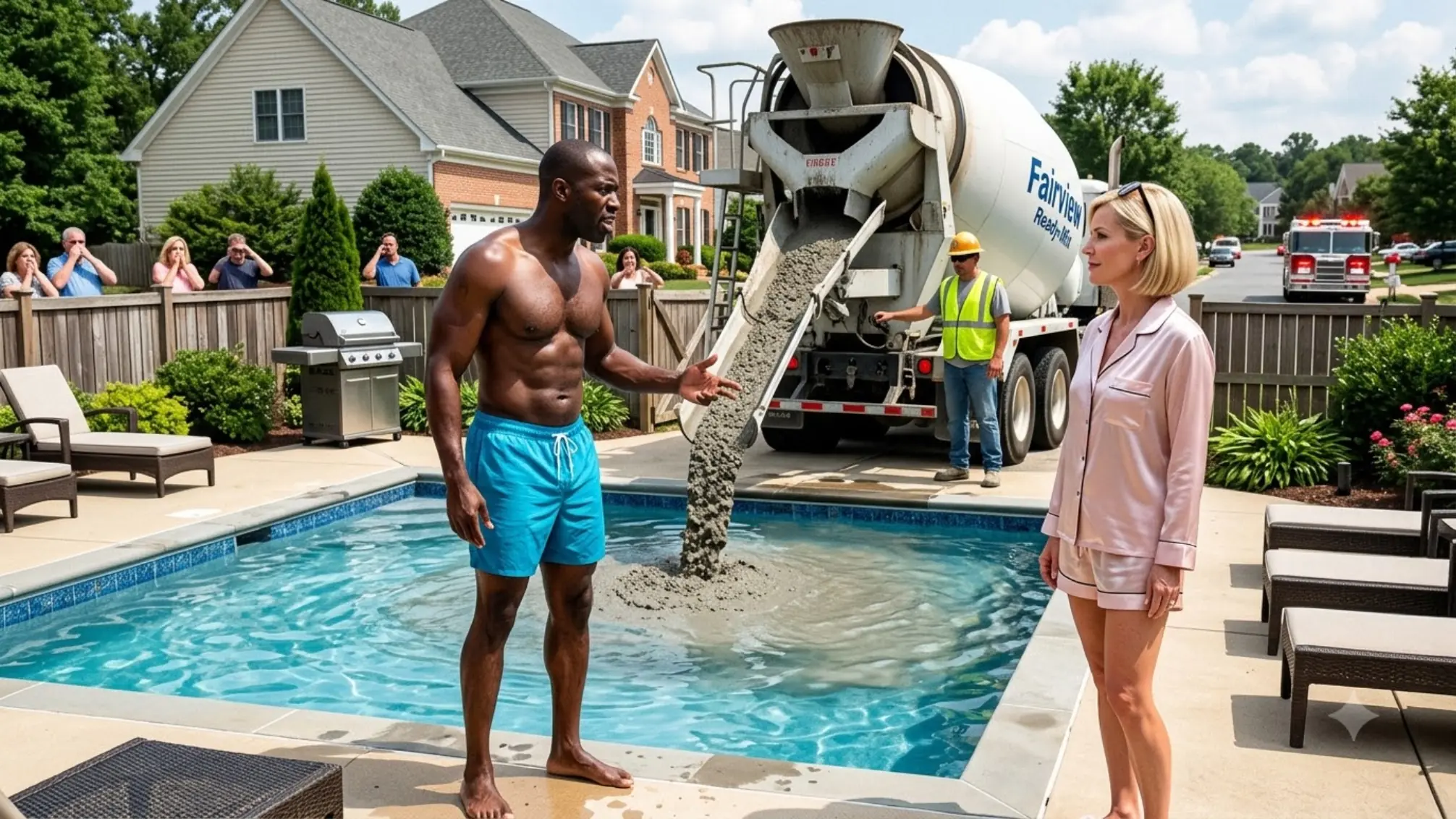
That morning should have been ordinary.
Then the concrete truck backed through his side gate.
Marcus surfaced near the shallow end and stared at the enormous rotating drum rolling toward his pool deck. A long black chute extended from the truck, and beside it stood Cynthia Whitmore, president of the Fairview Estates HOA, dressed in pale-pink silk pajamas and matching shorts as though she had walked over from breakfast rather than organized the destruction of somebody’s property.
Marcus climbed from the water.
He wore only bright ocean-blue swim trunks.
“What the hell are you doing?”
Cynthia turned slowly.
Her blonde bob was perfectly arranged. Sunglasses rested on top of her head, and she held a clipboard against one hip.
“Correcting a violation.”
Marcus looked from her to the truck.
“You brought a concrete mixer into my backyard.”
“Yes.”
“Get it out.”
Cynthia smiled.
“You were given notice.”
“For what?”
“The unauthorized swimming pool.”
Marcus laughed once because nothing else made sense.
“The pool has been here eleven years.”
“And you were ordered to remove it.”
“No. You sent me a letter saying the HOA was reviewing whether it complied with updated landscaping standards.”
“That review is complete.”
Marcus stepped closer.
“Show me the board authorization.”
Cynthia glanced toward the driver.
“Begin.”
The driver hesitated.
Marcus turned.
“Do not touch that pool.”
Cynthia raised one hand.
“The association has already assumed responsibility.”
“For destroying private property?”
“For correcting a violation after owner refusal.”
Marcus stared at her.
“You entered my locked yard.”
“The gate was opened by the contractor.”
“That doesn’t make this better.”
Cynthia’s smile sharpened.
“You've spent nine months fighting every decision this board makes, Marcus. Today you’re going to learn that eventually the rules win.”
Marcus looked toward the concrete chute.
Then at the pool.
Then back at her.
“These aren’t the rules.”
“They are now.”
The driver looked uncomfortable.
“Ma’am, I really need someone to confirm—”
Cynthia shoved a document toward him.
“You have written authorization.”
Marcus stepped forward.
“From who?”
Cynthia held it away.
“The HOA.”
Marcus’s jaw tightened.
“That pool is permitted by the county.”
“This isn’t a county matter.”
“It’s my property.”
“It is inside an HOA.”
“Which doesn’t make you the owner.”
Cynthia pointed toward the water.
“Fill it.”
The concrete began flowing.
A thick gray stream rolled from the chute and crashed into the clear blue water.
Marcus stood frozen.
For several seconds, his mind rejected what his eyes were seeing.
Concrete spread through the shallow end, turning the water cloudy as heavy material sank toward the bottom.
Cynthia folded her arms.
“I warned you.”
Marcus looked at her.
“You hired a cement truck to destroy private property.”
“You refused compliance.”
“You just buried yourself with that pool.”
She laughed.
“Cry to your lawyer later. By sundown, this whole eyesore will be solid.”
Marcus pulled his phone from a towel beside the pool.
Cynthia smirked.
“Yes, call your attorney.”
Marcus dialed another number.
The person answered on the second ring.
“Fairview Fire Station Three.”
“This is Marcus Reed at 117 Willow Crescent.”
A pause.
The dispatcher’s tone changed.
“Mr. Reed?”
“Yes.”
“What happened?”
“The HOA is filling the emergency reserve pool with concrete.”
Silence.
Then:
“Say that again.”
Marcus kept staring at Cynthia.
“They have a truck in my backyard. Concrete is going into the pool right now.”
The dispatcher did not ask another question.
“Stop everyone from touching the drafting equipment. Crews are coming.”
Marcus ended the call.
Cynthia tilted her head.
“Fire department?”
“Yes.”
“Why?”
Marcus looked toward the rapidly clouding pool.
“You’ll find out.”
The first siren became audible less than two minutes later.
Cynthia’s confidence flickered.
“You called emergency services over a landscaping dispute?”
Marcus did not answer.
Another siren joined the first.
Then another.
The concrete truck driver stopped the flow.
Cynthia snapped toward him.
“Why did you stop?”
“Because I’m not standing here while fire engines are coming.”
“You work for me.”
“No, ma’am. My company works under a signed job order.”
“And I signed it.”
The driver climbed down.
“That’s becoming the part I’m worried about.”
The first red engine turned onto Willow Crescent.
Neighbors began emerging from their houses.
Fairview Estates was a wealthy Virginia subdivision of broad lawns, stone facades, decorative trees, and homes spaced far enough apart to suggest privacy while still allowing every resident to know when somebody else had a plumber.
Within seconds, half the block was outside.
The fire engine stopped in front of Marcus’s house.
Fire Chief Raymond Caldwell stepped down.
He was fifty-six, broad-shouldered, gray-haired, and immediately serious when he saw the concrete truck.
Two firefighters followed him carrying equipment.
Caldwell walked through the side gate.
He looked at Marcus.
Then Cynthia.
Then the pool.
“What happened?”
Cynthia stepped forward before Marcus could speak.
“Chief, this is an HOA enforcement matter. Mr. Reed is attempting to interfere with authorized property correction.”
Caldwell stared at her.
“What did you put in that pool?”
“Concrete.”
“I can see that.”
His voice became colder.
“Why?”
“It violated community standards.”
Caldwell turned to Marcus.
“How much has gone in?”
“Maybe two or three yards.”
One firefighter crouched beside a capped metal fitting near the deep end.
“Chief.”
Caldwell walked over.
The firefighter pointed.
The fitting was part of an underground suction system connected to the pool.
Caldwell looked toward Cynthia.
“Did anyone touch this connection?”
She frowned.
“What is it?”
Marcus laughed bitterly.
“You didn’t even know.”
Cynthia ignored him.
“Chief, whatever equipment that is, the homeowner should have disclosed it.”
Caldwell stood.
“He did.”
Her expression changed.
“What?”
Caldwell pointed toward a small metal plate mounted discreetly near the fence.
FAIRVIEW EMERGENCY WATER RESERVE — FIRE DEPARTMENT ACCESS.
Cynthia stared.
“That was approved nine years ago.”
Caldwell continued.
“After the Willow Ridge wildfire and the pressure failure in this section.”
Several neighbors had gathered near the open gate.
Cynthia looked around.
“What does his swimming pool have to do with neighborhood fire protection?”
Marcus answered.
“Everything.”
Caldwell explained.
Fairview Estates sat near a wooded preserve. Years earlier, a brush fire had spread dangerously close to the subdivision. Fire crews discovered that hydrant pressure at the end of Willow Crescent could fall sharply when multiple engines drew from the system simultaneously.
The county required improvements.
The HOA did not want to pay for a new water-main extension.
Marcus had just purchased his home at the time.
The previous owner had installed a large pool.
Marcus agreed to let the fire department install an emergency drafting connection running from the pool to a protected access point near the side fence.
Two additional homeowners farther down the subdivision entered similar agreements.
The HOA received reduced infrastructure costs because of them.
Cynthia had become president four years later.
Apparently she had never bothered reading the emergency access agreements.
Caldwell looked at the concrete spreading through the water.
“This pool is listed in our emergency pre-plan.”
Cynthia crossed her arms.
“Surely you have hydrants.”
“We do.”
“Then this is irrelevant.”
“No.”
Caldwell’s expression hardened.
“It is redundancy.”
“I don’t understand.”
“That’s becoming obvious.”
Several neighbors reacted quietly.
Caldwell continued.
“If the main loses pressure during a structure fire or vegetation event, this reserve gives us immediate local drafting capacity.”
Cynthia glanced toward the truck.
“But there are other pools.”
“Not with approved drafting systems.”
Her face became pale.
Marcus remained silent.
Caldwell stepped closer.
“Who authorized this?”
Cynthia lifted her chin.
“The HOA.”
“I need the individual.”
“I am HOA president.”
“You signed the work order?”
“Yes.”
“Did you contact Fire Prevention?”
“No.”
“Did you request county verification of utility or emergency-use restrictions?”
“This is private HOA property governance.”
Caldwell looked at Marcus’s house.
Then back at her.
“This is privately owned property containing registered emergency infrastructure.”
Cynthia opened her mouth.
Nothing came.
The concrete driver approached.
“Chief, should we leave?”
Caldwell looked at the chute.
“Do not move the truck until we confirm you won’t damage the buried connection.”
The driver nodded quickly.
Cynthia turned sharply.
“You are taking instructions from him now?”
The man stared at her.
“Absolutely.”
The crowd at the gate grew.
Marcus’s next-door neighbor, Helen Parker, stepped forward.
She was seventy-three and had lived in Fairview Estates longer than Cynthia.
“Cynthia.”
Cynthia turned.
Helen pointed toward the pool.
“Were you really filling his entire pool?”
“It violated revised standards.”
“What revised standards?”
Cynthia looked away.
That question mattered.
Because Marcus had been asking it for months.
The conflict began the previous autumn.
Cynthia introduced a new “visual uniformity initiative” after complaining that Fairview Estates had become inconsistent.
She wanted patio furniture approved.
Outdoor play equipment screened.
Decorative lighting restricted.
Garage doors closed whenever possible.
Pools, in Cynthia’s view, needed landscaping barriers to prevent neighboring homes from seeing “recreational clutter.”
Marcus’s pool could be seen slightly from the second-story windows of Cynthia’s house two properties away.
She began sending notices.
Marcus requested the governing amendment.
Cynthia provided meeting minutes.
He asked for the membership vote required to change use restrictions.
She provided board guidelines.
He asked for the recorded covenant amendment.
Nothing came.
Then the fines started.
Two hundred dollars.
Five hundred.
One thousand.
Marcus disputed each one.
Cynthia grew angrier every time.
Eventually, the board scheduled a hearing.
Marcus attended with an attorney.
The board postponed the matter.
Cynthia apparently decided to create her own solution before the hearing resumed.
Now that solution sat in Marcus’s swimming pool beneath several thousand gallons of contaminated water.
A second fire vehicle arrived.
Then a county fire-prevention SUV.
Deputy Fire Marshal Elena Torres stepped into the backyard carrying a tablet.
She walked straight toward Caldwell.
“I checked the records.”
Cynthia looked hopeful for some reason.
Torres continued.
“Emergency water agreement is active.”
Marcus nodded.
“The property transferred with it?”
“Yes.”
“Any termination?”
“No.”
Torres looked toward the pool.
“This is a problem.”
Cynthia stepped forward.
“What kind of problem?”
Torres turned.
“Potential interference with designated emergency-access infrastructure.”
“It’s a swimming pool.”
“It is both.”
Cynthia’s jaw tightened.
“I did not remove any fire department equipment.”
“You filled the water source connected to it with concrete.”
“I was enforcing HOA regulations.”
Torres’s expression did not change.
“Show me the regulation.”
Silence.
Marcus almost laughed.
The sentence had finally come from someone Cynthia could not dismiss as a difficult homeowner.
“Show me the authority allowing you to enter this property and permanently disable this pool.”
Cynthia looked toward her clipboard.
“I have the violation history.”
“That isn't what I asked.”
The neighbors murmured.
Cynthia flipped through papers.
Torres waited.
Nothing.
Finally Cynthia said, “Our property manager has the full file.”
“Call them.”
Cynthia hesitated.
Torres folded her arms.
“Now.”
The call went badly.
Neil Foster, Fairview Estates’ property manager, answered.
Cynthia placed him on speaker because Torres requested it.
“Neil, confirm that Marcus Reed’s pool was approved for HOA removal.”
Silence.
Then Neil said, “Approved by who?”
Cynthia’s expression changed.
“The board.”
“No.”
The backyard became completely quiet.
Cynthia lowered the phone slightly.
“What do you mean, no?”
“The board authorized legal review.”
“We discussed corrective action.”
“We discussed options.”
“You told me enforcement could proceed.”
“Through notice and hearing.”
Marcus closed his eyes briefly.
Cynthia’s voice rose.
“You knew I hired the contractor.”
Another pause.
“No, I didn't.”
Every phone in the crowd seemed to rise simultaneously.
Cynthia stared toward the neighbors.
Neil continued through the speaker.
“You emailed yesterday saying you were conducting a site inspection.”
“You approved the expenditure.”
“I approved a preliminary contractor estimate.”
Torres looked toward Cynthia.
Her face had gone completely white.
Marcus spoke quietly.
“You did this yourself.”
Cynthia turned on him.
“Don’t act innocent. You deliberately ignored months of HOA direction.”
“I asked for the rule.”
“You knew what we wanted.”
“That isn't the same thing.”
She stepped toward him.
“You think because you own a construction company you understand every technicality better than everyone else.”
“No.”
Marcus pointed toward the ruined pool.
“I understand enough to call people before I pour concrete into something I don’t own.”
Cynthia’s lips tightened.
For once, she had no comeback.
The concrete truck remained in Marcus’s backyard for another two hours while crews confirmed that its weight had not damaged the buried pipe.
The pool itself was a disaster.
Concrete had settled across part of the floor.
The filtration system had pulled contaminated water into several components before Marcus shut it down.
Removing everything would require draining the pool, breaking and lifting partially cured material, replacing damaged equipment, inspecting the shell, and potentially resurfacing the entire structure.
A pool contractor estimated the first repair cost at more than $68,000.
Then he revised it upward.
Marcus did not shout when he heard the number.
Cynthia did.
“That is ridiculous!”
The contractor looked at her.
“You ordered ready-mix into an operating swimming pool.”
“It was supposed to be filled permanently.”
“Then rebuilding it costs money.”
“I am not personally responsible.”
Marcus’s attorney arrived before lunch.
Rachel Sloan listened to the story once.
Then again.
She examined Cynthia’s work order.
Marcus watched her eyebrows rise.
“What?”
Rachel turned toward Cynthia.
“You signed this as property owner.”
Cynthia stared.
“I signed as HOA president.”
Rachel pointed toward the signature block.
The contractor’s form listed:
Authorized Property Representative/Owner.
Cynthia had signed beneath it.
“That is standard paperwork.”
Rachel nodded.
“It is also a representation that you possessed authority over the property.”
“I did.”
“Based on what?”
Cynthia stopped.
Rachel continued.
“Because so far, nobody from the board agrees.”
Cynthia walked away.
By evening, Fairview Estates was divided into three groups.
Those furious at Cynthia.
Those terrified about what the HOA’s insurance might have to pay.
And those quietly checking every violation letter they had received during her presidency.
Marcus wanted only one thing.
His pool restored.
Nia arrived home from her mother’s house Sunday afternoon.
She walked into the backyard, saw the gray mess, and stared.
“What happened?”
Marcus rubbed the back of his neck.
“Long story.”
“Is the pool gone?”
“Temporarily.”
“Why is there concrete in it?”
“The HOA made a mistake.”
Nia looked at him.
“That looks like a really big mistake.”
Marcus laughed despite himself.
“Yes.”
She noticed the fire department marker near the fence.
“Did the firefighters come?”
“Yes.”
“Was there a fire?”
“No.”
“Then why?”
Marcus sat beside her.
He explained the emergency water agreement.
Nia listened carefully.
“So our pool helps firefighters?”
“If they ever need it.”
“And she ruined it?”
“Yes.”
“Is she going to jail?”
Marcus smiled.
“Probably not.”
Nia seemed disappointed.
“She destroyed our pool.”
“That doesn’t automatically mean jail.”
“What happens?”
“Insurance. Lawyers. Board review. Maybe court.”
“That sounds boring.”
“It is.”
“Can you yell at her?”
Marcus laughed.
“I already wanted to.”
“Why didn’t you?”
“Because yelling doesn’t get concrete out of pools.”
Nia considered that.
“Lawyers do?”
“Expensive ones, apparently.”
The HOA held an emergency meeting Monday night.
More than one hundred residents packed the clubhouse.
Cynthia sat at the front beside four board members.
She no longer wore silk pajamas.
Her cream business suit and carefully styled hair could not hide how tired she looked.
Board treasurer Harold Price opened the meeting.
“The association’s counsel has advised us not to discuss pending liability in detail.”
A resident shouted, “Did Cynthia authorize the truck?”
Harold closed his eyes.
“Yes.”
The room erupted.
He raised both hands.
“The board did not approve destruction of Mr. Reed’s swimming pool.”
Cynthia leaned toward her microphone.
“I acted based on longstanding enforcement authority.”
Harold looked toward her.
“We do not have authority to physically alter private property without completing the required process.”
Cynthia stared straight ahead.
Another board member, Laura Bennett, spoke.
“We also discovered the pool is included in the county emergency water agreement.”
Someone called out, “How did the president not know that?”
Nobody answered.
Marcus sat beside Rachel.
He had no desire to speak.
Then Cynthia looked directly at him.
“This situation never would have happened if Mr. Reed had cooperated.”
The room went quiet.
Marcus slowly stood.
Rachel whispered, “Careful.”
He nodded.
Cynthia continued.
“For months, he rejected reasonable community expectations.”
Marcus walked toward the microphone.
“Name the rule.”
Cynthia froze.
“Excuse me?”
“The rule.”
He looked toward everyone.
“The exact covenant allowing you to remove my pool.”
Silence.
“Read it.”
Cynthia shuffled papers.
Marcus waited.
People began looking at one another.
Finally she said, “The board has broad enforcement powers.”
“That’s not a section.”
“You know the intent.”
“No.”
Marcus’s voice remained calm.
“I know you wanted something.”
He looked directly at her.
“That does not turn wanting it into law.”
Applause began somewhere in the back.
Marcus raised one hand.
It stopped.
He continued.
“I don’t want revenge.”
Cynthia’s eyes narrowed.
“I want the pool restored.”
He turned toward the board.
“I want the fire department connection restored and certified.”
Then toward the residents.
“And I want every homeowner in this neighborhood to receive the actual rule when they're fined.”
Harold nodded.
“That is reasonable.”
Marcus looked back at Cynthia.
“You should never have needed to know who I was, what company I owned, or how much I could spend on lawyers before respecting the boundary of my property.”
Cynthia looked down.
The board voted that night.
Four to one.
Cynthia was suspended as HOA president pending formal removal proceedings.
She voted against.
It did not help.
The investigation took seven weeks.
It uncovered no giant conspiracy.
That almost made everything worse.
Cynthia had not been stealing money.
She had not secretly profited from the contractor.
She had simply become convinced that being HOA president meant her interpretation of the neighborhood rules was enough.
Staff stopped challenging her because arguments were exhausting.
Board members let her handle enforcement because nobody else wanted the job.
Residents paid questionable fines because paying was easier than fighting.
Over time, inconvenience became authority.
The pool was simply the moment that authority crashed into something impossible to ignore.
Insurance eventually covered most of the restoration.
The HOA paid the deductible.
Cynthia’s personal umbrella insurer became involved because she had acted outside board authorization.
The concrete contractor escaped major liability after producing Cynthia’s signed representation of authority.
Marcus did not sue for millions.
He did not try taking Cynthia’s house.
He accepted restoration costs, legal expenses, lost-use compensation, and repair of the emergency system.
Four months later, water returned to the pool.
Nia was the first person in.
She jumped from the edge wearing purple goggles and surfaced laughing.
Marcus sat nearby.
A red fire engine stopped in front of the house.
Chief Caldwell stepped through the gate.
“Testing day.”
Marcus smiled.
“Try not to drain the whole thing.”
“No promises.”
Firefighters connected to the emergency drafting port and conducted a flow test.
Everything worked.
Nia watched.
“This is cool.”
Marcus laughed.
“You said that after I spent four months fixing it.”
“Yes.”
Caldwell handed Marcus the recertification document.
“Officially back in service.”
Marcus looked toward the pool.
Clear water.
No concrete.
No argument.
Just water.
Across the street, Cynthia stood beside a moving truck.
She had lost the recall vote two months earlier.
Shortly afterward, she decided to sell her house.
She crossed toward Marcus’s driveway but stopped at the sidewalk.
That mattered.
“Marcus.”
He walked over.
Cynthia looked thinner than before.
Less polished.
More human.
“I wanted to apologize.”
Marcus waited.
“What I did was wrong.”
“Yes.”
Her eyes tightened slightly at the bluntness, but she continued.
“I really believed I was protecting Fairview.”
“I know.”
That surprised her.
“You do?”
Marcus nodded.
“That’s what made you dangerous.”
She looked away.
He continued.
“If you thought you were hurting the neighborhood, somebody could've changed your mind.”
“But I thought I was helping.”
“And stopped checking.”
Cynthia nodded slowly.
“I saw every disagreement as disrespect.”
Marcus said nothing.
“I thought if I gave people exceptions, everything would fall apart.”
“You didn’t give exceptions.”
He looked toward the pool.
“You started inventing authority.”
She swallowed.
“I know that now.”
A long silence followed.
Then Cynthia looked toward the fire engine.
“So that pool really is part of their emergency plan.”
Marcus almost smiled.
“You still doubted it?”
“No.”
She smiled weakly.
“I suppose I deserved that.”
Marcus offered his hand.
Cynthia looked at it before taking it.
“No hard feelings?” she asked.
Marcus thought about the sixty-eight-thousand-dollar first repair estimate.
The attorneys.
The meetings.
Nia losing an entire summer of swimming.
The concrete.
“I didn't say that.”
For the first time, Cynthia laughed.
“Fair enough.”
She returned to the moving truck.
Two years later, Fairview Estates looked almost unchanged.
The same expensive homes.
The same lawns.
The same pool.
But the HOA had changed.
Every violation notice now had to quote the specific governing section.
Emergency infrastructure appeared on board training materials.
No physical corrective action could occur on private property without legal review and documented authorization.
And every new HOA president received a folder whose first page contained a photograph.
Marcus’s swimming pool full of concrete.
Beneath it was one sentence:
Authority must be verified before it is exercised.
Marcus found out about the folder from Harold.
He laughed for nearly a minute.
The story became neighborhood legend.
People exaggerated it.
Some claimed six fire engines surrounded Cynthia.
Others claimed the fire chief arrested her beside the pool.
Neither happened.
The truth was more ordinary.
And more useful.
A woman convinced herself that a title gave her permission to stop asking questions.
A homeowner refused to surrender simply because an official-looking letter demanded it.
A concrete truck arrived.
Then the fire department arrived.
And suddenly everybody discovered that rules existed in both directions.
One Saturday morning, Marcus sat beside the restored pool while Nia swam.
She surfaced near the edge.
“Dad?”
“What?”
“When I get a house, should I join an HOA?”
Marcus stared at her.
She started laughing before he answered.
“Very funny.”
“I’m serious.”
Marcus looked around Fairview Estates.
Trimmed hedges.
Quiet street.
Well-maintained common spaces.
Neighbors who mostly liked each other.
He shrugged.
“HOAs aren't automatically bad.”
Nia looked genuinely shocked.
“After all this?”
“Tools aren't bad because somebody uses them wrong.”
She considered that.
“So Cynthia used it wrong?”
“Yes.”
“What stops the next person?”
Marcus pointed toward the clubhouse.
“Rules.”
Nia waited.
“And?”
“People willing to read them.”
She nodded.
Then pushed away from the edge.
Marcus watched her swim across the water.
Clear water moved behind her.
No concrete.
No damage.
No argument.
Near the fence, the fire department access plate caught the afternoon light.
Marcus smiled.
For months, Cynthia had insisted his pool was an eyesore that threatened Fairview Estates.
In the end, everyone learned the opposite.
The pool had quietly been protecting the neighborhood for years.
And the person who claimed the greatest authority over Fairview had nearly destroyed that protection simply because she never stopped long enough to ask what the thing in front of her actually was.