For nearly thirty years, nobody in Briarwood Heights questioned who owned the narrow strip of shoreline running between the neighborhood road and Lake Briarwood.
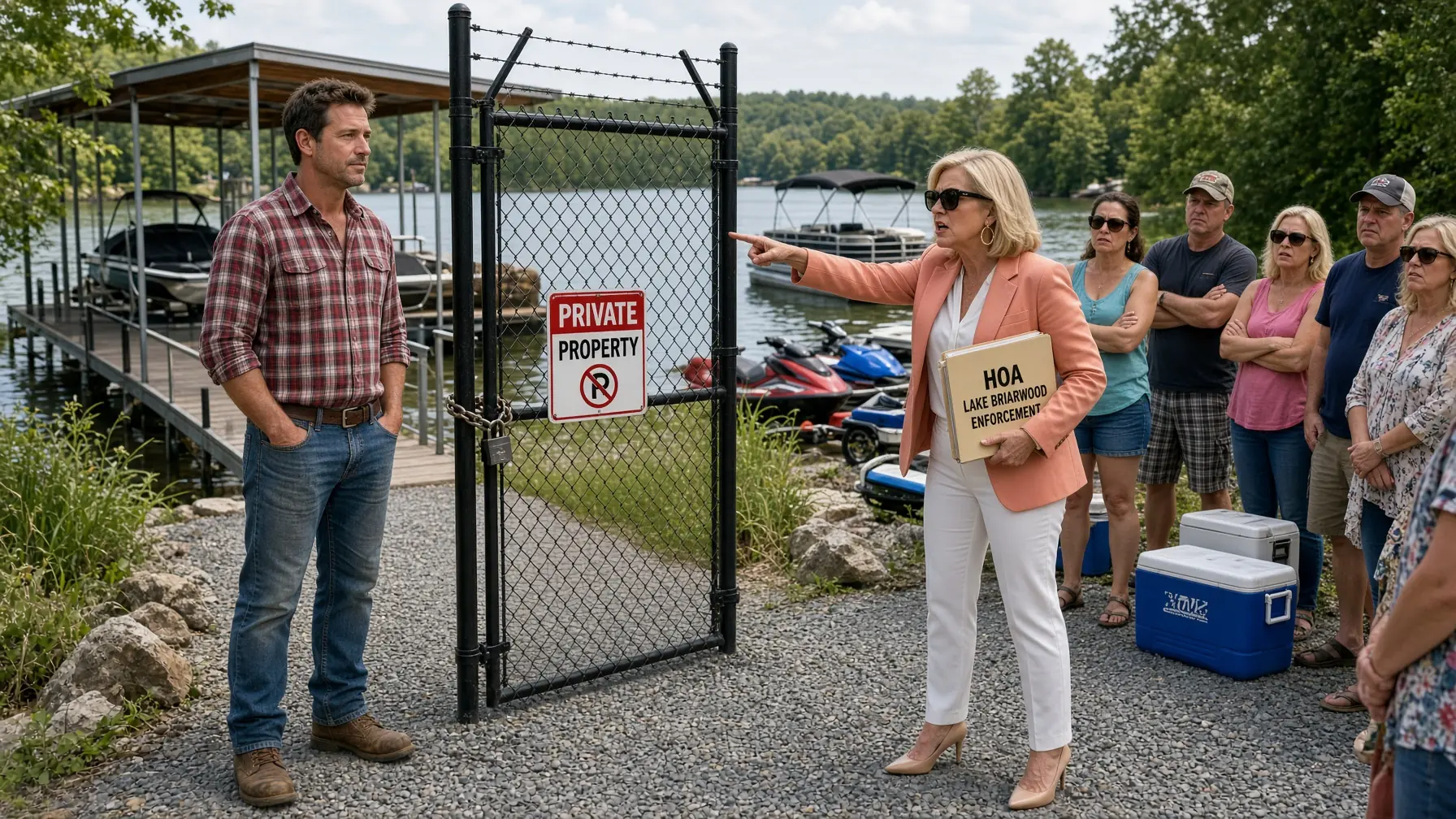
They simply used it.
Families walked the gravel path with coolers. Teenagers carried kayaks toward the water. Retired couples sat on two wooden benches overlooking the lake. On summer mornings, pickups backed boat trailers down toward the natural launch area. Every July, the homeowners association turned the shoreline into the center of its annual Lake Day celebration.
Most residents assumed the land belonged to the HOA.
It did not.
The shoreline belonged to Ethan Mercer.
And when HOA President Sophia Whitmore threatened Ethan’s home over a boat dock she had absolutely no authority to regulate, she accidentally reminded him that his family had been allowing the neighborhood onto that land only because they were being good neighbors.
Ethan was forty-three years old when the trouble started. He was a tall, rugged white American homeowner with short dark-brown hair, light stubble, and the patient temperament of someone who had spent most of his adult life fixing problems instead of arguing about them.
The lakefront property had been in his family for three generations.
His grandfather bought it when the area outside Atlanta was still mostly woods, old farms, and narrow country roads. Long before Briarwood Heights existed, Ethan’s grandfather built a modest house near the water and constructed a wooden dock where he spent weekends fishing.
Then development arrived.
A large company purchased most of the surrounding land and began building hundreds of upscale houses.
The Mercer property created an awkward hole in the middle of the development.
The company tried to buy it.
Ethan’s grandfather refused.
They offered more money.
He refused again.
They suggested he join the new homeowners association.
He laughed.
His land remained completely independent.
That should have ended the matter.
But the developers had another problem.
The neighborhood’s designated common shoreline was shallow and muddy. It was practically useless for launching boats.
The best lake access sat directly across Ethan’s family property.
So the original developer approached his grandfather with a proposal.
Would he allow neighborhood residents to cross a narrow path along the outer edge of his property to reach the deeper water?
His grandfather agreed.
Not because the HOA owned anything.
Not because the developer forced him.
Because he wanted peaceful relations with the people moving around him.
A simple agreement was signed.
Residents could use the shoreline path for recreational lake access.
For decades, the arrangement worked.
The HOA installed two benches.
A wooden welcome sign appeared.
Landscapers occasionally trimmed the path.
Older board members understood that they were guests.
Ethan’s parents respected the arrangement after inheriting the property.
When Ethan eventually became owner, he saw no reason to change anything.
Then Sophia Whitmore became HOA president.
Sophia had moved into Briarwood Heights only a few years earlier, but she quickly acted as though the entire neighborhood had been waiting for her to take command.
She was fifty-two, blonde, polished, and almost always dressed as though she were walking into either a board meeting or a real-estate closing. She preferred tailored blazers, white trousers, expensive heels, large sunglasses, and folders thick with rules.
Within months of becoming president, she rewrote landscaping guidelines.
She tightened parking restrictions.
She introduced stricter architectural reviews.
She sent violation notices over trash bins, mailbox styles, outdoor furniture, and lawn decorations.
Most residents complained privately.
Sophia seemed to enjoy the resistance.
The one thing she could not control was Ethan’s property.
That irritated her.
Then Ethan rebuilt his dock.
The original wooden structure his grandfather had built had finally reached the end of its life.
Some pilings were deteriorating.
Deck boards had warped.
A winter storm had damaged the outer section.
Ethan decided not to patch it again.
He hired a licensed marine contractor and planned a complete replacement.
Because his property was not part of the HOA, he had no reason to ask Sophia for permission.
He did, however, need legitimate government approvals.
Ethan spent months handling them.
County planning.
Structural review.
Environmental requirements.
Shoreline regulations.
Detailed drawings.
Permits.
Inspections.
The project cost far more than he originally hoped, but he did it correctly.
The contractor removed the damaged old structure and installed reinforced pilings, composite decking, and a modern boat lift.
Three weeks later, the dock was finished.
Four days after that, Sophia mailed Ethan a violation notice.
He read it twice.
Then laughed.
The notice claimed Ethan had constructed an unauthorized marine structure on a “managed community shoreline.”
It ordered him to stop using the dock immediately.
It demanded complete removal within fourteen days.
Failure to comply would result in fines of one hundred dollars per day.
Ethan assumed somebody had made an administrative mistake.
He collected his deed, county survey, permits, and property records and attended the next HOA meeting.
Sophia sat at the front beside the board.
When resident comments began, Ethan walked forward.
“I think there’s a misunderstanding.”
Sophia stared at him.
“My property is not inside your association.”
He offered the paperwork.
She did not take it.
Instead, Sophia leaned back and folded her arms.
“Your property connects to our neighborhood road.”
“Yes.”
“And your shoreline directly affects the visual appearance of our community.”
“That doesn’t put my land inside your HOA.”
Sophia smiled.
“The board has authority over anything affecting neighborhood presentation.”
Ethan held out the survey again.
“County records show the boundary clearly.”
“I don’t care what your county paperwork says.”
Several residents looked toward one another.
Ethan lowered the documents.
Sophia continued.
“The dock was never approved by our architectural committee.”
“It didn’t need to be.”
“That is your opinion.”
“No.”
Ethan tapped the permit folder.
“That is the legal reality.”
Her expression hardened.
“If the dock isn’t removed within fourteen days, the fines begin automatically.”
Ethan realized conversation was useless.
He walked out.
The dock stayed exactly where it was.
Fifteen days later, the first fine arrived.
One hundred dollars.
A week later, another notice claimed he owed seven hundred.
Then the balance crossed one thousand.
Finally, Sophia sent a letter threatening a lien against Ethan’s home and eventual foreclosure if he refused to pay.
That was when Ethan stopped treating the situation like an annoying HOA dispute.
He hired a real-estate attorney named Daniel Price.
Daniel reviewed the documents.
The answer was immediate.
“They have zero jurisdiction.”
Ethan nodded.
“That’s what I told them.”
“They can’t fine you.”
“I know.”
“They definitely can’t place a legitimate HOA lien on property that was never part of the association.”
“Good.”
Daniel kept reading.
Then he stopped.
“There is one thing I want to check.”
“What?”
“The old lake-access arrangement.”
Ethan frowned.
“What does that have to do with the dock?”
“Maybe nothing.”
Daniel closed the folder.