The five-ton sign had stood beside Carver Mill Bridge longer than most people in Eagle Ridge had lived in North Carolina.
Black letters.
White background.
Nothing dramatic.
5 TON LIMIT.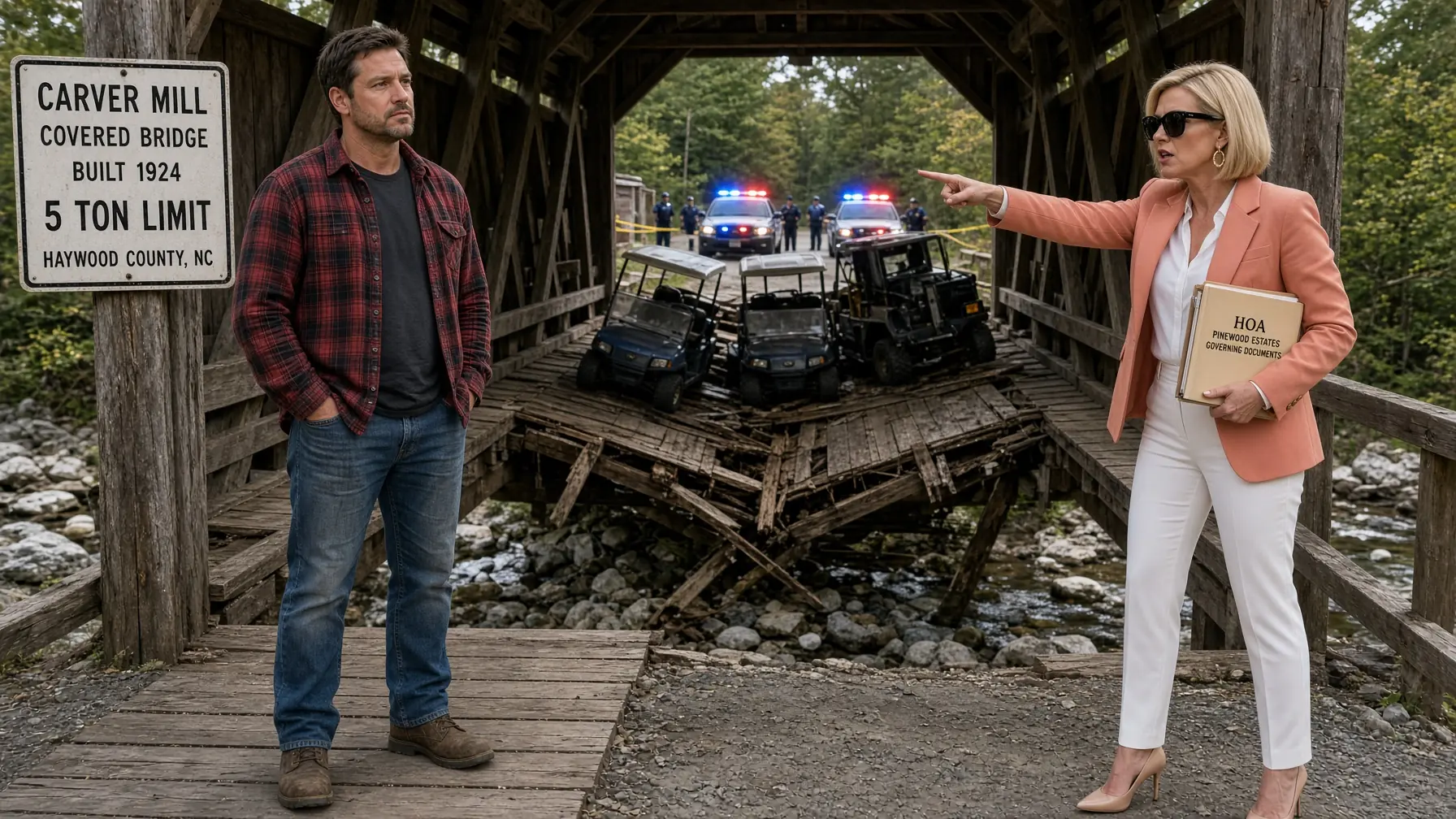
For years, everyone understood what it meant.
Then Tessa Hulcom became president of the Eagle Ridge Mountain Estates HOA and decided a posted limit was merely an inconvenience.
By the time she understood how wrong she was, a fifty-thousand-pound dump truck was trapped inside a broken section of Brennan Carver’s century-old bridge, police cruisers were blocking both ends, investigators were moving toward her husband’s property, and every document she had spent months pretending did not matter was finally sitting in the hands of people she could not intimidate.
Brennan Carver was forty-four years old when the fight began.
He was a licensed professional engineer specializing in historic bridge restoration, but Carver Mill Bridge had never been simply another engineering project.
His great-grandfather Augustus built the wooden covered bridge in 1923 across Sourwood Creek in Haywood County.
His grandfather maintained it for nearly half a century.
His father, Wendell, rebuilt major portions of it in 2008 after structural damage weakened the south truss.
Brennan had worked beside him.
He remembered carrying lumber.
Holding lights.
Learning why one split timber mattered more than ten pieces that still looked perfect.
His father had taught him something simple.
Bridges rarely failed because nobody saw the danger.
They failed because somebody saw it and decided it could wait.
Wendell died the previous year.
Two days after the funeral, Brennan drove alone to Carver Mill Bridge and stood with his forehead against the old cedar siding until the grief became something he could carry.
The bridge smelled like creek water, wood preservative, and his father’s truck.
Brennan understood then that he had inherited more than property.
He had inherited responsibility.
The bridge’s posted limit was 10,000 pounds.
Five tons.
The number was not decorative.
Engineering calculations supported it.
The old timber span could safely handle residential vehicles, pickups, ordinary family traffic and small trailers.
It could not safely handle loaded construction trucks.
That restriction was also written into the easement allowing residents of Eagle Ridge Mountain Estates to cross Brennan’s property.
Residential traffic was permitted.
Heavy commercial vehicles were not.
For years, that arrangement worked.
Then Tessa Hulcom took control of the HOA.
Tessa was forty-three, blonde, polished, and accustomed to rooms rearranging themselves around her personality. She wore country-club clothes, expensive sunglasses and a smile that somehow became more threatening when she was angry.
Her husband, Roland Hulcom, owned Hulcom Paving and Excavation.
That connection would become important.
At first, the violations seemed almost casual.
A moving truck crossed.
Then a roll-off dumpster.
Then a concrete truck.
Brennan noticed the concrete truck because a motion camera near the bridge alerted his phone while he was working at his engineering office.
He opened the footage.
A fully loaded commercial truck carrying the Hulcom company logo was rolling across Carver Mill Bridge.
Brennan stared at the screen.
The truck weighed several times the bridge’s safe limit.
He drove toward Eagle Ridge immediately.
By the time he arrived, the concrete truck had already crossed and was pouring a foundation at a new construction site.
Tessa stood nearby holding her phone.
“Morning, Brennan.”
“That concrete truck crossed my bridge.”
“It did.”
“It had no legal right to.”
Tessa smiled.
“We have homes under construction.”
“That truck weighs several times the posted limit.”
“We’ve had trailers using that crossing for decades.”
“A livestock trailer is not a loaded concrete truck.”
She tilted her head.
“You worry too much.”
Brennan stared at her.
“The easement specifically prohibits commercial traffic.”
Tessa’s smile grew.
“If you think the HOA is violating something, file a lawsuit.”
Brennan said nothing.
She continued.
“Until then, contractors are going to keep coming. We have eleven new builds scheduled.”
There it was.
Not confusion.
Not a misunderstanding.
Intent.
She knew about the restriction.
She simply believed Brennan would not have the money, patience, or nerve to stop her.
He went home and opened every bridge file his family had preserved.
The original easement.
Inspection reports.
Engineering calculations.
Repair records.
Photographs.
He read until nearly midnight.
The next morning, he called a state bridge engineer named Granger Pelum, a man who had inspected Carver Mill Bridge more than once.
Brennan explained the overweight crossing.
Granger became quiet.
“One truck can do damage you won’t see immediately.”
“I know.”
“Deck compression. Loose joints. Hidden fractures.”
“I’m going under it tonight.”
“Take photographs.”
“I will.”
“And Brennan?”
“Yes?”
“If this keeps happening, that bridge will eventually lose.”
Brennan hated hearing those words.
That evening, he brought his eleven-year-old daughter Tully with him.
She carried the flashlight while Brennan crawled beneath the structure.
He found three new stress fractures.
One ran several feet along a structural member.
He photographed everything and marked the damage in the bridge inspection notebook his father had started decades earlier.
When he climbed back onto the creek bank, Tully sat beside him.
“Is the bridge going to break?”
Brennan looked at his daughter.
“It might if they keep ignoring the limit.”
Tully considered that.
“Then stop them.”
Brennan smiled faintly.
“I’m working on it.”
Three days later, Tessa made the situation worse.
A thick HOA envelope arrived.
Inside was a document claiming the association had “amended” the old crossing easement.
The supposed amendment removed the commercial-vehicle restriction.
It also removed the five-ton reference.
Tessa had signed it.
Roland had signed it.
Two HOA board members had signed it.
Brennan had not.
That meant the paper did almost nothing legally.
The easement crossed Brennan’s private land.
The HOA could not simply rewrite his property rights by voting among themselves.
Brennan called his attorney, Whitlock Trent.
Whitlock read the document and laughed.
“They actually sent this to you?”
“Yes.”
“Signed?”
“Four signatures.”
“Brennan, do not argue with them.”
“What?”
“Keep it.”
“You don’t want me to respond?”
“No.”
Whitlock became serious.
“They’ve handed you written evidence that they know a restriction exists and believe they can ignore your ownership to remove it.”
Brennan looked down at the document.
“So we let them keep digging.”
“Exactly.”
Tessa interpreted silence as weakness.
More trucks crossed.
Brennan documented every one.
Photographs.
Dates.
License plates.
Approximate weights.