“Pay the lien, or I’ll take your house.”
Bethany Thornfield stood in the middle of my driveway wearing a pale-pink blazer, white trousers, oversized sunglasses, and the satisfied smile of someone who believed she had already won. She hugged a thick black binder to her chest and pointed toward the front door where my seventeen-year-old son, Noah, watched with both hands clenched at his sides.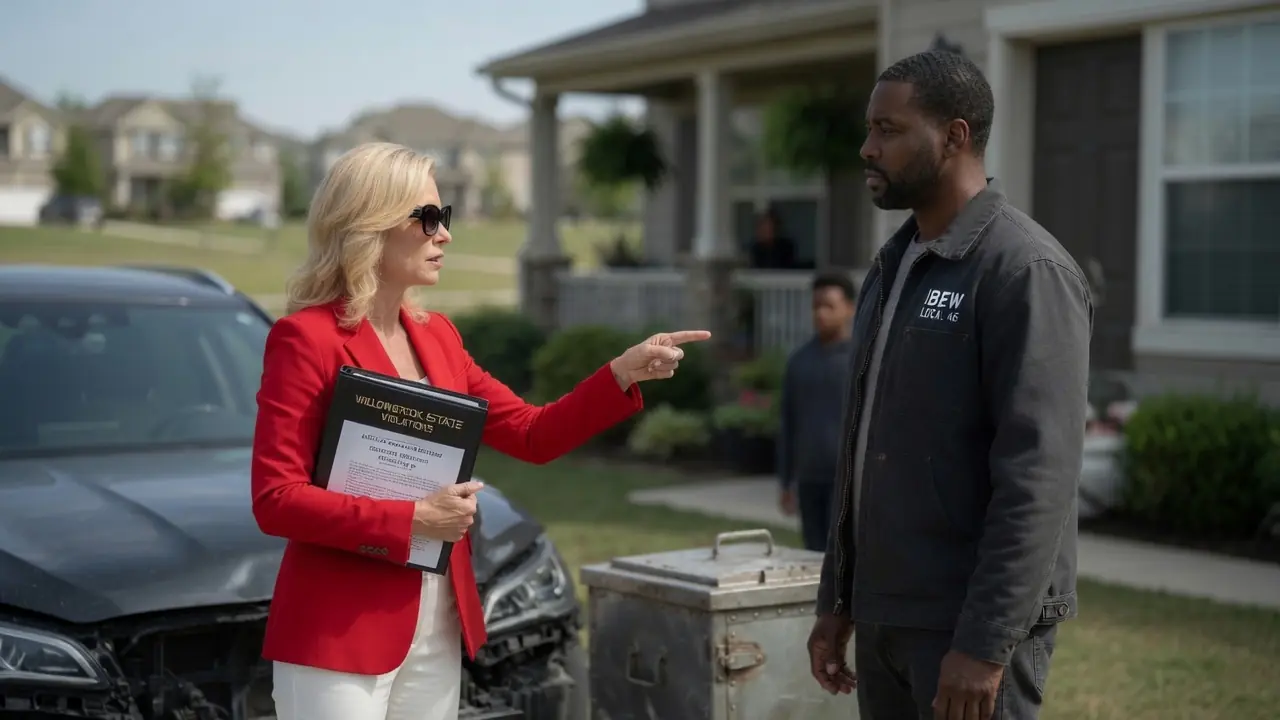
“You kept knocking over my trash can,” I said coldly. “And every attack was recorded.”
Bethany’s smile widened. “I run this neighborhood. No one here will challenge me.”
I raised my phone and looked past her shoulder. “Turn around. The police and every neighbor just did.”
Two patrol vehicles waited at the curb. More than forty homeowners stood along the sidewalk, and a local news crew had positioned its camera beside my mailbox. Bethany’s face remained confident for another second before she noticed the financial-crimes investigator walking toward her with a warrant.
Three months earlier, I had believed Willowbrook Estates would become the quiet home my son and I desperately needed.
My name is Marcus Delroy. I was forty-two, a union electrician with two decades of experience, and a single father still trying to understand how to raise a teenage boy after losing my wife, Danielle, to cancer. Noah had spent four years watching me pretend that working harder could replace the person missing from our family.
The house on Maple Street seemed perfect.
It had a small front lawn, a two-car garage for my tools, and enough room behind the kitchen for the memorial garden Noah wanted to build for his mother. His new high school had a strong engineering program, and the community brochure described Willowbrook as safe, welcoming, and family-centered.
Bethany arrived before we finished unloading the truck.
She walked across the driveway in expensive heels, carrying a leather folder with the words WILLOWBROOK HOMEOWNERS ASSOCIATION embossed in gold. Her blonde hair remained perfectly arranged despite the wind, and she examined my work van as though it were leaking something unpleasant onto her street.
“I’m Bethany Thornfield, HOA president,” she said. “We take community appearance very seriously.”
I introduced myself and Noah.
Her eyes moved from my brown skin to the union decals on my van, then toward the stack of electrical equipment near the garage. “Commercial vehicles must remain visually unobtrusive.”
“It’s parked entirely inside my driveway.”
“For now.”
That was the first warning.
The second arrived two days later in the form of a fifty-dollar citation for leaving moving boxes visible from the street. The third claimed Noah’s basketball hoop violated community character, even though four houses nearby had identical ones.
I paid nothing.
Instead, I photographed the other hoops, quoted the exact bylaw, and emailed the evidence to the board. The citation disappeared without explanation.
Bethany began visiting more often after that.
She measured my grass, inspected my mailbox, and photographed Noah’s friends whenever they parked near the curb. When he planted purple flowers in memory of Danielle, Bethany issued another warning because the species was not on the approved landscaping list.
“They were my mother’s favorite,” Noah told her.
Bethany did not even look at him. “Personal grief does not exempt a property from aesthetic standards.”
I stepped between them.
“Speak to me, not my son.”
She smiled. “Then control your property.”
Noah waited until she left before pulling the flowers from the front garden. He replanted them behind the house, where Bethany could not see them from the road.
“This place doesn’t feel like ours,” he said.
“It will.”
I sounded more certain than I felt.
The trash-can attacks began the following Tuesday.
At exactly 6:47 in the morning, a loud crack dragged me from the kitchen. By the time I reached the window, Bethany’s white luxury SUV was reversing away from my driveway.
My black plastic bin lay split across the pavement.
Coffee grounds covered the curb. Broken containers and food scraps had scattered into the lawn, while a leaking bag left a trail across the concrete. Bethany paused in the street for several seconds before driving away.
Mrs. Cecilia Park appeared behind her fence.
“She hit it deliberately,” she whispered. “Then she backed up and hit it again.”
I cleaned the driveway, replaced the bin, and went to work.
That afternoon, an HOA citation appeared in my email.
Waste debris compromising community cleanliness: $75.
The woman had created the mess and fined me for it.
The following Tuesday, another bin was destroyed.
A week later, it happened again.
Each time, Bethany arrived at the same hour. She struck the bin with the front corner of her SUV, reversed, and drove into it a second time. Each afternoon, I received a new citation accusing me of careless waste management.
By the fourth week, I had installed two security cameras.
The next Tuesday produced perfect footage.
Bethany’s SUV entered the frame at 6:47. She accelerated directly toward the bin, hit it, reversed, struck it again, then remained behind the wheel laughing while garbage rolled across my driveway.
Noah watched the recording beside me.
“She knows you have to clean it before work.”
“She wants me late.”
“Why?”
“Because enough small problems can make someone give up.”
Noah looked toward the house. “She wants us to move.”
He was right.
I began researching families who had left Willowbrook during Bethany’s eight years as president. Seven properties had changed owners after escalating violation disputes.
The former residents had something else in common.
Most were minority families, single parents, elderly homeowners, or newcomers without relatives nearby.
One divorced mother moved after the HOA placed a lien on her house for unpaid landscaping fines. A Black military family sold below market value after receiving almost weekly citations. An elderly Korean couple left when Bethany repeatedly accused them of operating an illegal business because relatives visited often.
The same property company purchased four of those homes.
Thornfield Residential Partners.
Bethany claimed the name was a coincidence.
It belonged to her brother.
That discovery changed the entire situation.
She was not only harassing people she disliked. She was pushing selected homeowners toward financial desperation, then directing their properties to a family company that purchased them cheaply.
The trash can was not random cruelty.
It was the beginning of a familiar campaign.
I approached the other families quietly.
Mrs. Cecilia invited me into her kitchen, where she showed me years of violation notices. Bethany had called her wind chimes “foreign visual clutter” and fined her husband for keeping traditional garden stones near the porch.
Miguel and Maria Rodriguez had been cited for an unapproved playground structure their children used in the backyard. The structure was smaller than the one at Bethany’s own house.
Mr. Washington, a retired Army medic, had been ordered to remove a memorial flag because Bethany said it created a political appearance.
Everyone had complained separately.
That was exactly why nothing changed.
Bethany made each family believe they were alone.
We began meeting in my garage every Thursday evening. Mrs. Cecilia had once worked as a paralegal and understood how to preserve records. Miguel photographed every selectively enforced violation, while Mr. Washington organized the timeline with military precision.
Noah created encrypted digital backups.
I studied the HOA bylaws.
Bethany relied on vague language such as “community harmony,” “appropriate appearance,” and “neighborhood expectations.” Those phrases allowed her to punish almost anything while pretending every decision was subjective.
But one section gave homeowners the right to install reinforced waste enclosures for security, wildlife prevention, and protection from repeated damage.
The structure needed city approval and written HOA notification.
It did not require Bethany’s personal permission.
I hired a licensed contractor to build a secure brick enclosure beside the driveway. It contained a steel-reinforced concrete base and held a removable plastic bin inside. The exterior matched my house, remained fully on my property, and passed the municipal inspection.
I sent the HOA proper notice.
Bethany ignored it.
From the street, the dark upper section looked like another heavy-duty trash container.
No sharp edges. No hidden machinery. No trap.
Only a fixed, legally approved structure that would no longer collapse when struck.
The next Tuesday, Noah and I stood behind the living-room window.
Bethany’s SUV appeared at 6:47.
“She’s coming too fast,” Noah said.
“She has eleven weeks of proof that nobody stops her.”
The vehicle turned toward the driveway.
For a moment, I considered running outside and warning her. Then I remembered every citation, every destroyed bin, and every frightened family forced from Willowbrook.
Bethany still had time to steer away.
She chose not to.
The SUV struck the enclosure with a violent metallic crunch. The bumper folded inward, a headlight shattered, and steam escaped from beneath the hood.
The enclosure remained standing.
Bethany stumbled out, one hand pressed against her chest. She stared at the intact structure as though the laws of the world had suddenly changed without consulting her.
I went outside immediately.
“Are you injured?”
“You did this!” she screamed.
“You drove into my property.”
“You built that thing because you knew I would hit it!”
Noah stepped onto the porch holding his phone.
I looked toward the camera above the garage. “How could I know that unless you had been hitting my bins intentionally?”
Her face changed.
Neighbors emerged from their houses.
Mrs. Cecilia called the police while Miguel recorded the damaged SUV and its tire tracks crossing my driveway. Bethany continued shouting about sabotage until Officer Elena Martinez arrived.
“This man installed a weapon disguised as a trash can,” Bethany said.
Officer Martinez examined the brick structure. “It’s a fixed waste enclosure.”
“It destroyed my car!”
“You drove into it.”
“I lost control.”
I handed the officer my tablet.
“Would you like to see the previous eleven times she lost control in exactly the same place?”
We watched the recordings together.
Bethany attempted to leave before they ended, but another officer asked her to remain. Her insurance company later denied the damage claim because the videos showed intentional conduct.
She was also charged with repeated property destruction.
I believed embarrassment would make her retreat.
Instead, she became desperate.
Three days later, a certified lien notice arrived.
According to the paperwork, I owed $3,480 for waste violations, unauthorized parking, improper landscaping, legal costs, and administrative penalties. If I failed to pay within ten days, the HOA could begin foreclosure proceedings.
Several charges dated from before I purchased the home.
Two board members’ signatures appeared beneath the notice.
I called both.
Neither had signed it.
Bethany had forged the approval.
Noah found me reading the documents at the kitchen table.
“Can she really take the house?”
“No.”
“You hesitated.”
“She can create trouble. That isn’t the same as winning.”
He sat across from me. “I don’t want to lose another home.”
The fear in his voice reminded me of the hospital, of Danielle’s final weeks, and of every promise I had made while knowing I could not control the future.
I folded the document.
“We are not leaving.”
Bethany issued similar liens against the Cecilia, Rodriguez, and Washington homes. She believed the legal language would frighten us back into isolation.
Instead, everyone brought their papers to my garage.
The documents were nearly identical.
They contained impossible dates, incorrect property descriptions, and signatures copied from old meeting records. Mrs. Cecilia identified multiple violations of state law in less than an hour.
We filed complaints with the county recorder, state HOA oversight office, and local prosecutor.
Then Bethany made the mistake that exposed the money.
She issued an emergency assessment demanding $2,400 from every homeowner within seventy-two hours. The notice claimed the community faced urgent legal and infrastructure costs.
No major repair existed.
There was only Bethany’s damaged SUV, her growing attorney bill, and the criminal investigation she now needed to fight.
The bylaws required thirty days’ notice and approval from two-thirds of homeowners before any special assessment. Bethany had forged four board signatures to bypass the vote.
The HOA’s bank froze the payment demand.
During its internal review, an auditor discovered transfers from Willowbrook’s reserve account into Thornfield Community Consulting. The company belonged to Bethany’s sister and had no employees, office, or legitimate contracts.
More than $18,000 had been transferred during the previous year.
Additional payments had gone directly to Bethany’s personal attorney after the SUV collision.
The deeper investigators looked, the worse it became.
Landscaping contracts had been inflated. Administrative fees were paid to relatives. Maintenance work listed as completed had never occurred.
Then auditors found the property files.
Bethany maintained a private spreadsheet ranking homeowners by how easily they could be pressured to sell.
Beside my address, she had written:
Single father. Recently widowed. Working-class income. Limited support. Likely to surrender after legal pressure.
Beside the Cecilias:
Elderly immigrants. Avoid public conflict.
Beside the Rodriguez family:
Young children. Vulnerable to school and code complaints.
It was not careless discrimination.
It was a business strategy.
Bethany targeted people she believed could be driven out cheaply. Thornfield Residential Partners then approached with low offers before a lien or foreclosure became final.
The company had purchased four homes that way.
Two were later resold for substantial profit.
Reporter Diana Walsh had been investigating predatory HOA practices in nearby counties. When Mrs. Cecilia sent her the spreadsheet, she immediately recognized Bethany’s name.
Bethany had served on boards in two previous communities.
Both had faced similar accusations.
Both disputes ended in confidential settlements before criminal investigators became involved.
Willowbrook would not become the third place where she escaped quietly.
The final confrontation occurred on a Friday morning.
Bethany arrived at my house carrying her black binder and wearing the same pink blazer from her first visit. She had filed another lien overnight, even though the county recorder had already warned her to stop submitting disputed documents.
Noah stood behind me on the porch.
Bethany pointed toward the house.
“Pay the lien by Friday, or I’ll take this house and throw you and your son onto the street.”
“You kept knocking over my trash can,” I said. “And every attack was recorded.”
“I run this neighborhood,” she replied. “No one here will challenge me.”
I raised my phone.
“Turn around.”
Detective Aaron Price approached from the first patrol vehicle. Officer Martinez followed him, while two investigators from the state financial-crimes unit waited near Bethany’s SUV.
Across the street stood nearly every family she had threatened.
Diana Walsh’s camera was already recording.
Bethany looked from the police to the homeowners.
“This is harassment.”
Detective Price held up a document. “We have a warrant covering HOA financial records, electronic devices, property files, and all lien documentation in your possession.”
“These are confidential association materials.”
“Not when they contain evidence of forgery.”
She gripped the binder more tightly.
Diana stepped forward. “Mrs. Thornfield, did your family company purchase homes from residents after you fined or threatened them?”
“No.”
“County records show four purchases.”
“I do not control my brother’s business.”
“Why did your private spreadsheet identify homeowners likely to surrender under pressure?”
Bethany froze.
Noah stepped closer to me.
“You wrote that losing my mother made us weak?”
Bethany glanced at him, and I saw the answer in her expression.
I moved between them.
“You do not speak to my son.”
Detective Price requested the binder again.
When Bethany refused, he removed it under the authority of the warrant. Her confidence finally cracked as investigators opened the trunk of her SUV and found boxes of homeowner files she had removed from the HOA office.
The emergency board meeting took place the following afternoon.
Ninety-four homeowners crowded into the Willowbrook community center. Bethany arrived with an attorney and attempted to cancel the meeting, but Mrs. Cecilia presented a petition signed by more than two-thirds of residents.
Mr. Washington introduced the motion to remove Bethany as president.
Miguel Rodriguez seconded it.
The vote was ninety-one in favor, two against, with Bethany refusing to participate.
Mrs. Cecilia became interim president.
Her first official action was suspending every fine, lien, and enforcement action issued during Bethany’s administration. Her second was ordering a complete independent audit and opening all board records to homeowners.
Bethany stood near the exit with her face twisted in anger.
“Without me, property values will collapse.”
I looked around the room.
The Cecilia family stood beside the Rodriguezes. Mr. Washington had brought coffee for everyone. Children played near the back while homeowners who had once avoided one another exchanged phone numbers.
“This neighborhood improved the moment people stopped fearing you,” I said.
The criminal case lasted eight months.
Bethany pleaded guilty to embezzlement, filing fraudulent property documents, forgery, retaliation, and misuse of association funds. The court ordered restitution and permanently prohibited her from holding a leadership position in any homeowners association.
The property company was investigated separately.
Two former residents received compensation after proving they had been pushed into below-market sales through fraudulent liens. Another family regained money taken through improper fines.
Willowbrook recovered enough funds to create a legal-defense account for homeowners facing future abuse.
The new board rewrote every vague rule.
No fine could be issued by one person. Every citation required photographs, a specific bylaw, and review by at least two members.
All contracts became public.
Homeowners gained the right to appeal before an independent committee, and emergency assessments required a recorded community vote.
Mrs. Cecilia rehung her wind chimes.
Miguel rebuilt his children’s play structure.
Mr. Washington raised his memorial flag.
Noah replanted Danielle’s purple flowers in the front garden.
Nobody challenged them.
The reinforced trash enclosure remained beside the driveway, though I added a wooden top and climbing vines until it looked more like part of the landscaping than evidence from a war.
Neighborhood children began using it as home base during games.
Noah received a full scholarship to study civil engineering the following spring. His application essay described how systems became dangerous when ordinary people believed authority could not be questioned.
The night his acceptance arrived, we sat beside Danielle’s flowers.
“What did you learn from all this?” I asked.
He looked toward the driveway.
“That bullies search for weak points.”
“And?”
“Sometimes the weak point only stays weak until someone rebuilds it.”
Two years later, Willowbrook’s property values had increased. More importantly, families actually knew one another.
Monthly HOA meetings became community dinners.
New residents received welcome baskets instead of inspection folders. Every October, the neighborhood organized a fundraiser for legal support programs helping homeowners challenge fraudulent associations.
People still called the enclosure “Marcus’s trash can.”
It had never really been about the trash.
Bethany believed she could destroy small things until the larger life around them collapsed. A broken bin caused cleanup. Cleanup caused tardiness. Tardiness threatened employment. Fines created debt, and debt created fear.
She expected fear to make families surrender quietly.
Instead, each attack became evidence.
Each forged notice created another witness.
Every family she isolated eventually found the others.
On the morning Noah left for college, he placed the final suitcase inside my truck and paused beside the driveway.
“You keeping that thing forever?”
“The enclosure?”
“The legendary trash can.”
I placed one hand against the brick.
“It still works.”
He smiled. “It stopped one SUV.”
“No.”
I looked toward the houses where our neighbors were coming outside to say goodbye.
“It stopped an entire system.”
Bethany had kept knocking over my trash can because she believed I would eventually become tired enough to leave.
She never understood that electricians spend their lives locating failures, tracing hidden connections, and strengthening the part of a system that keeps breaking.
I did not defeat her with anger.
I documented the damage, learned the rules, and found the neighbors she had spent years keeping apart.
The reinforced enclosure stopped her vehicle.
The people standing together stopped everything else.