Marcus Reed never imagined that coming home early on a Friday afternoon would turn into the biggest neighborhood conflict of his life.
After nine days away, all he wanted was a quiet evening.
A cold drink.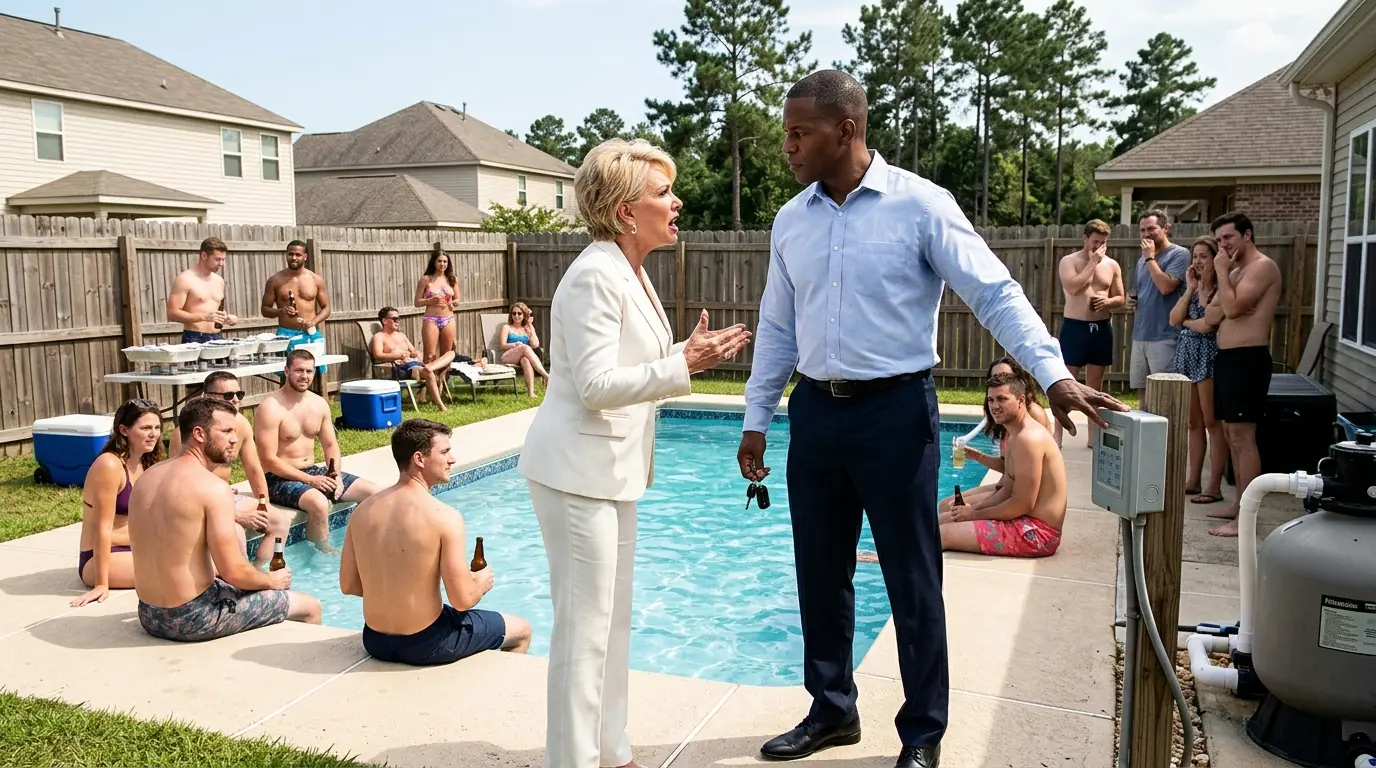
A swim in his pool.
A peaceful night in his own backyard.
Instead, he found strangers parked in his driveway, unfamiliar cars lining the street, and a catering truck blocking the entrance to his home.
At first, Marcus thought there had been some kind of mistake.
Maybe a neighbor was having a party nearby.
Maybe someone had accidentally parked in the wrong place.
But then he saw the signs.
People walking through his side gate.
Music coming from his backyard.
Children running around the pool.
Adults sitting in his chairs.
Someone was using his property.
And they were acting like they belonged there.
Marcus parked three houses away because there was no space near his own home.
He grabbed his suitcase from the trunk and walked toward his driveway.
The closer he got, the more confused he became.
His gate was open.
The same gate he always kept locked.
The same gate only his family had access to.
He stepped inside.
And stopped.
His private backyard had been transformed.
Decorations hung from the fence.
Tables covered the patio.
Food containers filled the outdoor kitchen.
A group of people he had never met were laughing beside his pool.
Then he saw her.
Caroline Whitmore.
The HOA president.
Standing in the center of his backyard.
Holding a drink.
Greeting guests.
Like she owned the place.
Marcus stood silently for several seconds.
Not because he was afraid.
Because he was trying to understand what he was seeing.
Caroline noticed him.
Her smile disappeared.
“Oh.”
The word came out quietly.
Almost like she knew immediately that something had gone wrong.
Marcus placed his suitcase down.
“Caroline.”
She forced a smile.
“Marcus. You’re back early.”
“That’s my backyard.”
A few guests looked over.
The music continued.
The conversation continued.
But the mood changed.
Caroline looked around.
Then back at him.
“Yes.”
She said it like it was obvious.
“Yes, it is.”
Marcus stared.
“Then why are there thirty people standing in it?”
The silence grew.
Some guests started looking uncomfortable.
Caroline adjusted her white blazer.
Her expensive outfit looked completely out of place beside a group of people who had just realized they might not belong there.
“It’s a neighborhood event.”
Marcus looked around.
“A neighborhood event?”
“Yes.”
“And who approved it?”
Caroline smiled.
“The HOA.”
Marcus almost laughed.
“The HOA approved using my private property?”
Caroline’s expression hardened.
“Marcus, don’t make this difficult.”
That sentence immediately told him everything.
She was not apologizing.
She was annoyed that he was resisting.
Marcus had lived in Pinewood Estates for six years.
He knew exactly what the HOA could do.
And what it could not do.
The organization existed to manage shared community areas.
Road maintenance.
Common spaces.
Neighborhood standards.
It did not own his backyard.
It did not own his pool.
It did not have permission to invite strangers onto his property.
Caroline knew that.
Or at least, she should have.
“You opened my gate.”
She looked away for half a second.
That was enough.
Marcus noticed.
“How did you get access?”
Caroline hesitated.
“The HOA has emergency access information.”
Marcus looked at her.
“Emergency?”
“Yes.”
“What emergency?”
Nobody answered.
Because there was no emergency.
There was only convenience.
The guests started leaving slowly.
Not because Marcus told them to.
Because they realized the situation.
A woman sitting near the pool whispered:
“I thought this was approved.”
Another guest looked embarrassed.
“We were told it was a community benefit.”
Marcus heard that.
And it bothered him.
Not because people came.
Because they were misled.
Caroline had not just crossed a property line.
She had crossed a trust line.
The next morning, Marcus received an email from the HOA.
A formal notice.
He was accused of disrupting a community gathering.
He read the message twice.
Then smiled.
Not because it was funny.
Because it was unbelievable.
The person who entered his property without permission was accusing him of causing problems.
He forwarded the email to his attorney.
Then he waited.
Caroline did not wait.
She scheduled an emergency HOA meeting.
The announcement claimed Marcus had created unnecessary conflict and threatened neighborhood unity.
The meeting room was packed.
Caroline stood at the front.
She had prepared.
A presentation.
Documents.
Charts.
Everything.
She was comfortable there.
Because this was her world.
Public meetings.
Rules.
Authority.
“Everyone,” she began, “we are here because one homeowner has chosen to attack the spirit of our community.”
Marcus sat quietly.
He knew what she was doing.
She was changing the story.
Making herself the victim.
“The pool gathering was designed to bring neighbors together.”
She clicked the remote.
Photos appeared.
Smiling people.
Food.
Decorations.
A perfect community image.
“What we experienced was hostility.”
Several people looked at Marcus.
Waiting.
Caroline continued.
“We need to discuss whether one individual should be allowed to disrupt community activities.”
Marcus finally stood.
“Can I ask a question?”
Caroline smiled.
“Of course.”
“Whose pool was it?”
The room became quiet.
Caroline hesitated.
“Your pool.”
“Whose backyard?”
“Your property.”
“Who gave permission?”
Silence.
That was the first crack.
Because the entire argument depended on avoiding one simple fact.
Nobody had permission.
Marcus placed a folder on the table.
Inside were property documents.
The deed.
The boundary records.
The HOA agreement.
“I reviewed the HOA rules.”
He looked around.
“There is no section giving the HOA authority to enter private property.”
Caroline crossed her arms.
“You’re focusing on technicalities.”
Marcus looked at her.
“No.”
A pause.
“I’m focusing on ownership.”
That sentence changed the atmosphere.
Because everyone understood the difference.
A community mattered.
But a community could not exist by ignoring individual rights.
Caroline tried a different approach.
She argued that Marcus was selfish.
That he did not care about neighbors.
That he refused to share.
But the residents remembered something.
Marcus had helped them before.
He helped during storms.
He fixed problems.
He checked on elderly neighbors.
He was not someone who hated the community.
He was someone who believed the community needed boundaries.
An older neighbor named Frank stood.
“Caroline.”
She looked surprised.
“Yes?”
“I have lived here twenty years.”
He pointed toward Marcus.
“That man has helped more people here than any HOA meeting ever has.”
The room became silent.
Others started agreeing.
The story was changing.
Caroline realized she was losing control.
And that was when she made her biggest mistake.
She threatened legal action.
“If necessary, the HOA will pursue enforcement.”
Marcus looked at her.
“Enforcement for what?”
She did not answer.
Because there was nothing.
No violation.
No rule.
No authority.
Only assumption.
The investigation that followed changed everything.
Residents requested HOA records.
They reviewed access policies.
They examined how Caroline operated.
They discovered that she had created a culture where people were afraid to question her.
She had convinced residents that the HOA had more power than it actually did.
The pool incident was not the first time.
It was simply the first time someone pushed back publicly.
Months later, Caroline resigned.
The new HOA board created new rules.
Private property boundaries became a priority.
Residents received clear information about what the HOA could and could not do.
The neighborhood changed.
Not because people stopped caring about community.
Because they finally understood what community meant.
Respect.
Trust.
Consent.
Marcus never closed himself off after the incident.
His pool remained open.
But only to people he invited.
Every summer, he hosted a small neighborhood barbecue.
No HOA announcements.
No forced invitations.
No rules pretending to create friendship.
Just neighbors.
People talking.
People laughing.
People choosing to be there.
One evening, a new neighbor asked Marcus:
“Do you regret what happened?”
Marcus looked toward the pool.
“No.”
The neighbor seemed surprised.
“Even with all the trouble?”