The orange compact tractor rolled slowly across the freshly cut lawn of a quiet Ohio subdivision, its wide mower deck humming beneath the chassis while the rear soil attachment bounced lightly over the uneven ground. Forty-two-year-old Ethan Cole, a broad-shouldered white American farmer with short brown hair and weathered hands, sat behind the wheel wearing a fitted gray T-shirt, faded work pants, and dusty brown boots. He was turning near the sidewalk when Karen Whitmore came running from across the street in a crisp white blouse, black pants, and spotless athletic shoes, clutching an HOA violation folder against her chest. She stepped directly into his path, raised one hand, and screamed, “Get the tractor out here—this is not a farm.”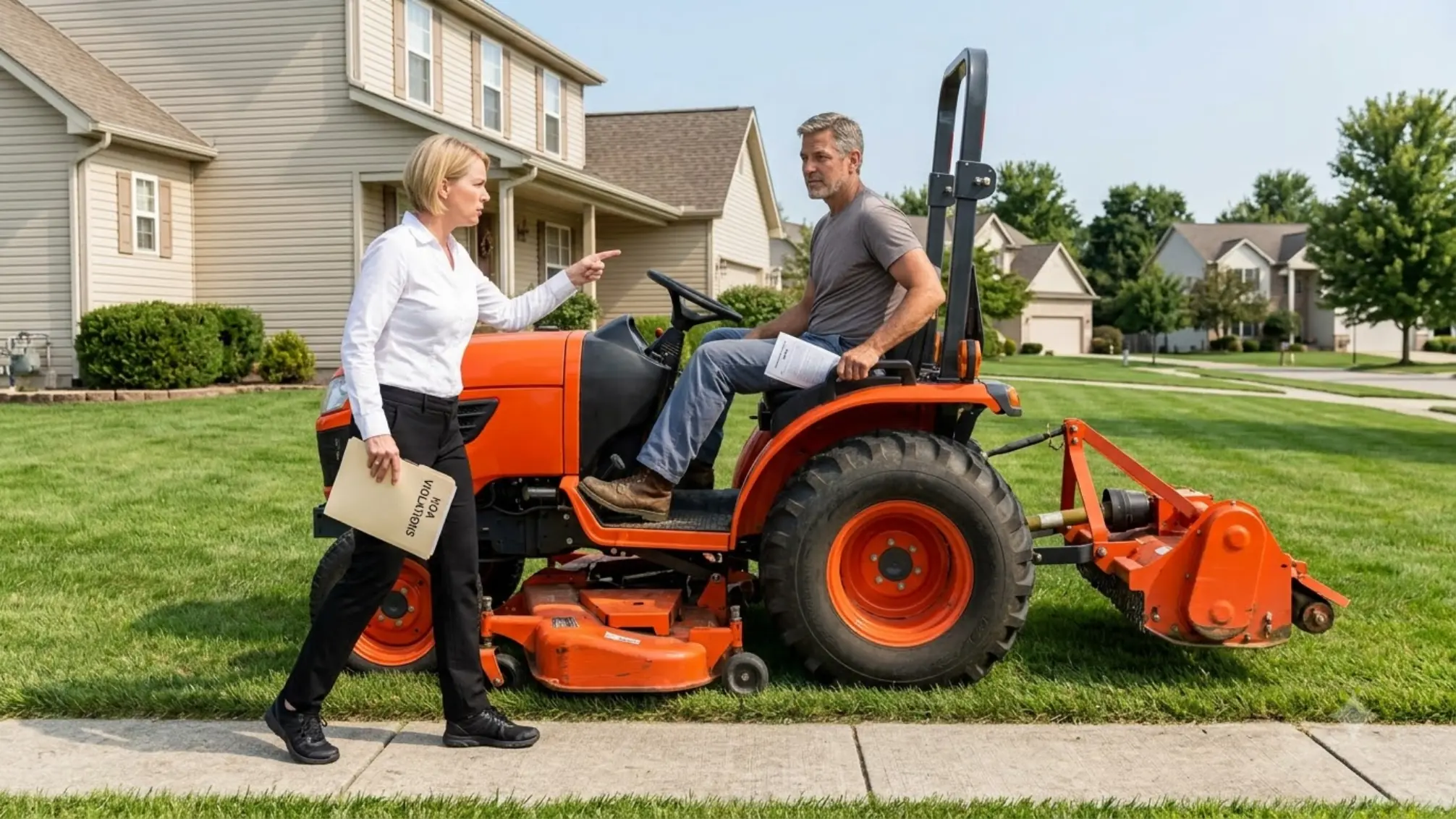
Ethan immediately shut off the engine.
The sudden silence seemed to make Karen’s anger louder. She pointed at the orange machine as though it were leaking oil across a marble floor rather than sitting on grass that had belonged to Ethan’s family for nearly seventy years. Several curtains shifted inside nearby homes, but no one came outside. Everyone in Maple Crest Estates knew what happened when Karen Whitmore believed someone had challenged her authority.
Ethan climbed halfway down from the tractor and rested one boot on the lower step.
“It’s my property, Karen.”
Karen marched closer until she stood beside the enormous rear tire. “Move it, or I’ll have it seized.”
Ethan reached into his back pocket and pulled out a folded document inside a clear protective sleeve. “Try it—then explain whose land your HOA sits on.”
For the first time since she arrived, Karen stopped talking.
The document was not a maintenance receipt, a vehicle registration, or a printed copy of the HOA bylaws. It was a certified property deed bearing the seal of Hamilton County and the legal description of an eighteen-acre parcel known for generations as Cole Orchard. Ethan unfolded the first page slowly, revealing a color survey attached behind it.
A red boundary line cut straight through the subdivision’s decorative entrance, crossed beneath the walking path, and stopped behind the community clubhouse Karen used for board meetings.
Karen glanced at the map, then laughed.
“That is impossible.”
Ethan stepped completely off the tractor. “That is what I said when your violation notice claimed my barn was an unauthorized accessory structure.”
“This neighborhood was developed fifteen years ago. Those boundaries were settled before the first house was sold.”
“Then the developer should have bought the land before building on it.”
Karen’s expression tightened. “You are trying to intimidate me with an old piece of paper.”
“No,” Ethan said. “I am showing you a recorded deed.”
The conflict had begun six weeks earlier, when Ethan returned to Maple Crest after his father suffered a stroke. The Cole family had farmed the land long before the subdivision existed. Ethan’s grandfather planted apple trees there in 1958, when the surrounding area consisted of pasture, cornfields, and a narrow county road that flooded each spring.
Over time, most neighboring farmers sold their acreage to developers. The Cole family sold only twenty-two acres from the eastern edge of their property, keeping the farmhouse, barn, orchard, and eighteen acres surrounding them. The sale agreement included one unusual condition: the retained parcel would remain permanently outside any future homeowners association unless a Cole family owner joined voluntarily in writing.
No one ever had.
For fifteen years, Ethan’s father, Walter Cole, maintained the orchard without trouble. He used a small tractor to mow between the rows, repaired fences, and sold apples from a roadside stand each autumn. Maple Crest residents bought cider from him, brought their children to pick pumpkins, and treated the orchard as part of the neighborhood’s character.
Then Karen Whitmore became HOA president.
Karen was a fifty-year-old white American real estate agent who had purchased one of the largest homes near the clubhouse. She believed Maple Crest should look less like a rural Ohio community and more like the luxury developments shown in the brochures she handed to clients. Within months of her election, she introduced stricter lawn standards, decoration limits, visitor-parking rules, and architectural restrictions.
Walter ignored her notices because he was not an HOA member.
Karen initially backed down after the board’s attorney confirmed that the Cole parcel was excluded. But when Walter’s stroke forced him into assisted rehabilitation and Ethan temporarily moved into the farmhouse, Karen saw an opportunity. She assumed the son would not understand the old agreement as well as the father had.
Her first notice accused Ethan of storing commercial agricultural equipment in a residential zone.
The “commercial equipment” was the orange tractor that had mowed the property for eleven years.
Ethan replied with a copy of the parcel exemption.
Karen sent a second notice claiming the tractor created excessive noise. Ethan measured the sound level and documented that it remained below county limits. She then accused him of operating an unauthorized business because he had repaired three damaged apple trees and reopened the small produce stand near the road.
The stand had operated legally since 1972.
Ethan responded to every letter with permits, tax records, and property documents. Karen never acknowledged the evidence. Instead, she sent increasingly aggressive warnings carrying the HOA logo and threats of fines, liens, towing, and legal action.
Ethan finally attended a board meeting to resolve the matter directly.
Karen refused to place him on the agenda because, as she correctly stated, he was not an HOA member. Five minutes later, she claimed the board still possessed authority over his land because it was “visually integrated” into Maple Crest.
“That is not a legal category,” Ethan told her.
“It is a community standard.”
“Community standards do not rewrite deeds.”
Karen ordered security to escort him from the clubhouse. Ethan left calmly, but as he walked across the parking lot, he noticed something strange. The southern wall of the clubhouse stood much closer to his orchard fence than he remembered from childhood.
That night, he opened the old metal document box his father kept beneath the farmhouse stairs.
Inside were original plats, surveys, tax maps, and the 2009 development agreement signed when Walter sold part of the farm. Ethan spread everything across the kitchen table and compared it with the county’s online property map.
The boundaries did not match what existed on the ground.
According to the recorded deed, the developer had purchased twenty-two acres beginning at a stone marker near the eastern drainage ditch. Yet the subdivision entrance, clubhouse driveway, and part of a retention pond extended west of that marker.
They had been built on land the Coles never sold.
Ethan initially assumed the old map contained an error. He hired a licensed American surveyor named Rebecca Shaw to verify the boundaries. Rebecca spent two days locating buried pins, reviewing historic records, and measuring from the original stone marker.
Her conclusion was unambiguous.
The HOA monument sign, fifteen feet of the entrance road, nearly one-third of the retention pond, and the southern section of the clubhouse parking lot were located on Ethan’s property. Even more serious, the clubhouse itself crossed the boundary by approximately eight feet.
Rebecca found no recorded easement granting permanent use.
There had once been a temporary construction-access agreement allowing the developer to move equipment across the Cole parcel while building the subdivision. That agreement expired thirteen years earlier. Nothing authorized the HOA to occupy the land indefinitely.
Ethan called his father at the rehabilitation center.
Walter remained weak, but his mind was clear.
“The developer promised he would move the road after construction,” Walter said. “Then he claimed the county made him leave it. I argued for years, but your mother got sick, and I stopped fighting.”
“Did you ever sign the land over?”
“Never.”
“What about the clubhouse?”
Walter was silent for several seconds. “That was supposed to be a temporary sales building. They said they would remove it after the last house sold.”
Instead, the developer transferred the building to the HOA and left the property boundaries unresolved.
Ethan did not immediately confront Karen. He ordered a title search, obtained certified county records, and asked a property attorney to review the development agreement. Every document supported the same conclusion: the Cole family owned the disputed strip, and the HOA had no deed, purchase contract, permanent easement, or adverse-possession claim strong enough to override the recorded ownership.
Before Ethan could present the findings, Karen escalated the tractor dispute.
She sent a private towing company to the farmhouse. The driver arrived while Ethan was at the rehabilitation center visiting Walter. Fortunately, Ethan’s neighbor, Daniel Brooks, saw the truck entering the orchard and called him.
Ethan spoke to the driver by phone.
The tow operator refused to remove the tractor after learning it was stored inside a locked barn on private agricultural property. Karen had falsely claimed it was abandoned beside the community walking trail.
Ethan preserved the driver’s statement.
Three days later, Karen hired a landscaping crew to install a row of decorative shrubs near the clubhouse. Workers crossed Ethan’s surveyed boundary and began digging within the orchard’s outer row. One shovel severed an irrigation line his father had installed more than twenty years earlier.
Ethan stopped the work and showed the crew the new survey stakes.
Karen arrived wearing a white blazer and demanded that the workers continue. When Ethan refused to move, she threatened to call the sheriff and have him arrested for interfering with HOA property.
The crew supervisor looked at the boundary markers, apologized to Ethan, and removed his workers.
Karen stood beside the unfinished holes and said, “You are making enemies you cannot afford.”
Ethan answered, “You are digging on land you do not own.”
The confrontation with the tractor occurred the following Monday. Ethan had been mowing the grass beside the orchard when Karen ran toward him with another violation folder. This time, she claimed the tractor itself violated Maple Crest’s appearance standards and had to leave the neighborhood immediately.
She did not know that Ethan had placed the certified deed in his pocket that morning because his attorney had advised him to carry it whenever working near the disputed boundary.
Now she stared at the survey while the tractor sat silently behind him.
Karen pointed toward the clubhouse roof visible beyond the lawns. “That building has belonged to Maple Crest for fifteen years.”
“The building may belong to the HOA,” Ethan said. “The ground beneath part of it does not.”
“You cannot own pieces of our common property.”
“I do not own pieces of your property. Your common property was built across mine.”
Karen snatched the survey from his hand.
Ethan took it back before she could tear it.
“Do that again,” he said quietly, “and we will add destruction of evidence to the list.”
Karen stepped away. “What do you want?”
“I wanted you to stop sending false violations.”
“You hired a surveyor over a tractor?”
“No. I hired a surveyor because you kept claiming authority over land your board never bothered to verify.”
She looked once more at the boundary line crossing beneath the clubhouse. “The HOA attorney will destroy this.”
“Then you should call him.”
Karen did.
Less than an hour later, the HOA’s attorney, Michael Trent, arrived with two board members. Ethan invited them into the farmhouse kitchen and placed certified copies of the deed, survey, title report, development agreement, and temporary access document across the table.
Michael read in silence.
Karen stood behind him with her arms crossed. “Tell him the HOA controls the parcel.”
Michael did not answer immediately.
He turned to the last page of the construction-access agreement, then compared its expiration date with the recording stamp on the clubhouse transfer.
Finally, he removed his glasses.
“Karen, the HOA does not own the disputed land.”
Her face changed. “That is not possible.”
“The legal description in our deed ends east of the Cole boundary.”
“The clubhouse has been there for fifteen years.”
“That does not make the survey disappear.”
She lowered her voice. “Can we claim adverse possession?”
Michael looked toward Ethan. “Not easily. The original use began with written permission, which defeats the hostile-use requirement for much of the relevant period. The documents also show repeated objections from Mr. Cole’s father.”
Ethan placed three old letters on the table. Walter had sent them to the developer in 2011, 2013, and 2016, each objecting to continued use of the land.
Michael read them and sighed.
Karen turned toward Ethan. “Are you planning to demolish the clubhouse?”
“I have not decided what happens next.”
“You cannot threaten an entire neighborhood because you dislike me.”
“This is not about disliking you. It is about ownership.”
The board scheduled an emergency community meeting for Thursday evening. Karen sent an email beforehand claiming that Ethan intended to close the entrance road, drain the retention pond, and tear down the clubhouse unless residents supported legal action against him.
None of that was true.
Ethan responded by sending the board a single-page statement. He explained that he had not demanded demolition or blocked access. He requested only three things: immediate withdrawal of every false HOA violation, compensation for the damaged irrigation line, and a formal process to resolve the encroachment.
Karen refused.
At the meeting, she stood before nearly one hundred residents and described Ethan as an opportunistic farmer trying to extort the community. She displayed photographs of the tractor, barn, and produce stand as evidence that he was harming property values.
When she finished, Ethan walked to the front carrying a wooden document box.
He began with the original 2009 deed. Then he displayed the exemption clause proving that Cole Orchard had never joined the HOA. He showed the survey locating the clubhouse, entrance road, and retention pond partly on his land.
Finally, he projected the letters his father had sent years earlier.
Residents read the same sentence repeated in each one:
Permission for temporary construction access does not transfer ownership and may be revoked.
Karen interrupted. “Those letters were never delivered.”
Ethan displayed certified-mail receipts bearing the developer’s signature.
The room erupted in whispers.
Michael Trent stepped forward and confirmed that the documents appeared valid. He also revealed that Karen had continued sending enforcement notices after the law firm warned her in writing that the Cole parcel was outside HOA authority.
Board member Linda Parker turned toward her. “You knew?”
Karen gripped the edge of the table. “The neighborhood could not function if every outsider ignored our rules.”
“He is not an outsider,” Linda said. “His family owned this land before any of us arrived.”
Ethan then displayed the altered towing request Karen had sent to the private company. She had described his tractor as abandoned on common property and attached a map that shifted the orchard boundary nearly forty feet west.
The map bore Karen’s signature.
Michael’s expression became severe. “Where did this come from?”
“It is an internal enforcement diagram.”
“It changes a recorded property boundary.”
“It simplifies it.”
“You cannot simplify ownership by moving a line.”
The tow company’s written statement appeared on the projector next. The driver confirmed that Karen ordered him to enter a locked private barn and remove the tractor without a court order.
Several residents began demanding her resignation.
Karen raised her voice above them. “You are all forgetting what I have done for Maple Crest. I protected your property values. I maintained standards. I kept this neighborhood from turning back into farmland.”
Ethan looked toward the large clubhouse windows. Beyond them, the dark outline of his orchard stretched beneath the evening sky.
“This neighborhood was farmland,” he said. “You built your homes beside it because people liked the trees, the open ground, and the history. Then you decided the family who preserved those things no longer belonged.”
The room fell quiet.
The board voted six to one to remove Karen as president pending a full investigation. Karen cast the only opposing vote. Her access to enforcement systems, board email, and HOA financial accounts was disabled that evening.
The investigation uncovered more than property harassment.
Karen had encouraged the HOA to spend nearly $38,000 improving the clubhouse without verifying the land beneath it. She had also approved landscaping work across Ethan’s boundary and concealed Michael’s earlier legal warning from the rest of the board.
Emails showed that she hoped to pressure Ethan into selling the orchard cheaply. A real estate developer she regularly worked with wanted to replace the farmhouse and trees with twelve luxury townhomes. Karen expected to receive the exclusive sales contract.
The tractor notices were not about appearance.
They were part of an effort to make continued farming so expensive and exhausting that Ethan would leave.
The board reported the altered boundary map and false towing order to county authorities. Karen resigned from the HOA before the investigation concluded, and her real estate brokerage suspended her pending review of the undisclosed development arrangement.
The HOA still faced the encroachment problem.
Ethan could have demanded removal of the disputed structures. His attorney explained that he possessed significant leverage because the clubhouse could not legally be refinanced, insured, or sold while crossing an unresolved property line.
Some residents feared he would close the entrance road.
Instead, Ethan proposed a settlement.
The HOA would purchase a carefully surveyed strip beneath the existing clubhouse and road at fair market value. The retention-pond section would remain Ethan’s property under a permanent environmental easement preventing future construction. In return, Maple Crest would recognize the orchard’s agricultural status, prohibit further interference with lawful farming, and create a landscaped buffer between the homes and cultivated land.
The board accepted unanimously.
Part of the purchase payment funded Walter’s rehabilitation and repaired the orchard’s aging irrigation system. Ethan used the remainder to restore the old roadside produce stand and plant twenty new apple trees.
The HOA also rewrote its enforcement procedures. No president could issue violations without citing an exact rule. Property boundaries had to be verified before any action involving land use, towing, or construction. Board legal opinions could no longer be hidden from other directors.
Linda Parker became the new president.
Her first official act was canceling every fine Karen had issued against Ethan.
Walter returned home several months later, walking slowly with a cane. Ethan drove him through the orchard on the same orange tractor Karen had tried to remove. New survey markers stood near the clubhouse, and a wooden fence clearly separated Cole Orchard from Maple Crest’s common property.
A new sign appeared beside the walking trail:
COLE ORCHARD — ESTABLISHED 1958
PRIVATE AMERICAN FAMILY FARM
PLEASE RESPECT THE BOUNDARY
In autumn, Maple Crest held its community harvest festival on the orchard’s outer field with Ethan’s permission. Families picked apples, drank cider, and allowed their children to climb onto the parked tractor for photographs.
Walter sat beside the produce stand, watching neighbors carry baskets between the trees.
“She really told you this was not a farm?” he asked.
Ethan smiled. “She did.”
Walter looked toward the subdivision, where the clubhouse roof rose beyond the fence. “Funny thing to say while standing on one.”
The remaining legal matters concluded quietly. Karen paid restitution for the damaged irrigation system and agreed never to serve on another Maple Crest board. Her proposed townhome deal collapsed when the developer learned Ethan had placed the orchard under a family conservation agreement protecting it from high-density construction.
The land would remain a farm.
Ethan continued living in the farmhouse and caring for the trees. He still drove the orange tractor across the lawn, but no one ran toward him with violation folders anymore. Residents waved as he passed, and some stopped to ask when the next apple harvest would begin.
The tractor had never threatened Maple Crest.
It had only reminded Karen that the neighborhood’s neat lawns and expensive homes did not erase what existed before them. She believed an HOA title gave her power over every person and every piece of ground she could see.
Ethan needed only one deed to prove otherwise.
Karen had ordered him to take the tractor away because the neighborhood was not a farm.
Then the farmer unfolded the map—and showed her that part of the neighborhood had been built on his.