Marcus Reed left the red sponge beside the bucket and looked past Karen Whitmore toward the neighbors gathering along Hawthorne Lane. Soap slid down the hood of his restored 1969 Chevrolet Chevelle, leaving silver trails across the deep red paint. He had planned to spend Saturday afternoon polishing the car while his twelve-year-old daughter finished a school project inside. Instead, the president of Briarwood Estates had marched onto his driveway with a violation folder, her nineteen-year-old son Tyler behind her, and the confidence of someone who believed rules belonged to whichever person shouted them first.
Karen lowered her sunglasses. “Do not play games with me. The Whitmore family has lived here for twenty-three years, and I know every homeowner on this street.”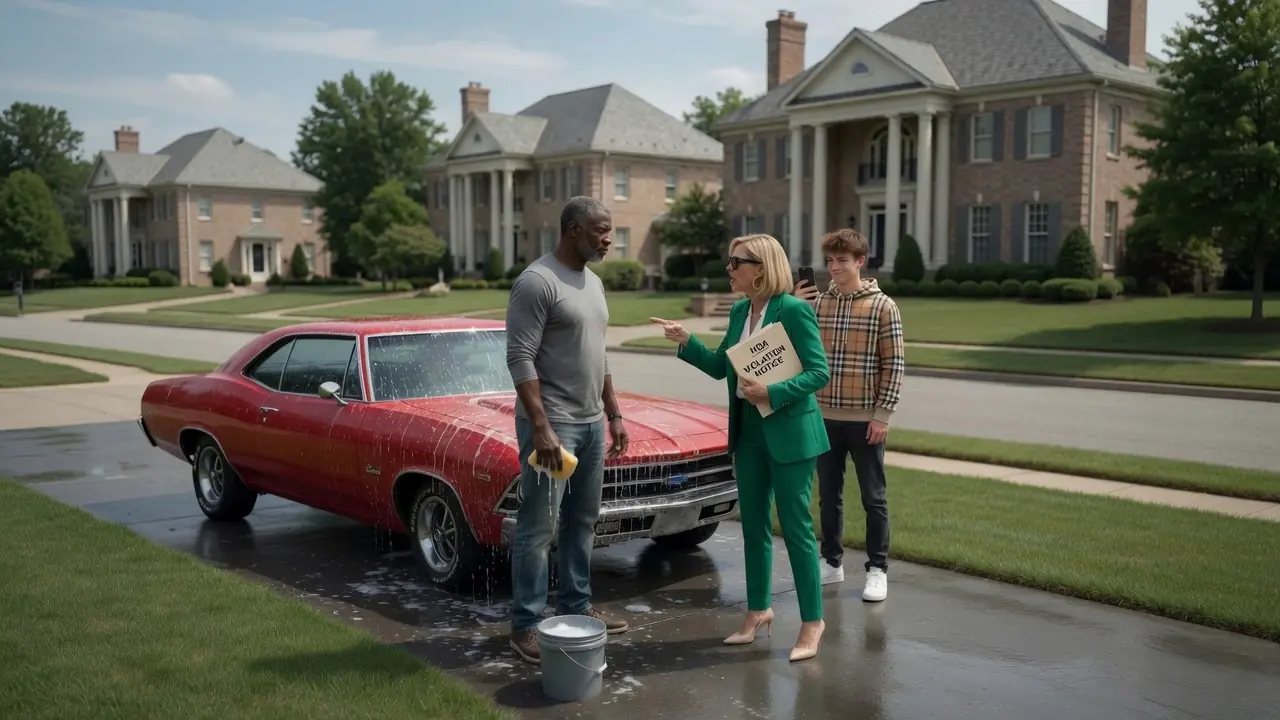
Marcus wiped his wet hands on a towel. “Then your memory needs work.”
“This property belongs to Meridian Residential Holdings.”
“It belonged to Meridian eight months ago.”
Karen opened the thick folder and removed a copy of the subdivision map. “According to our records, the residence remains corporate-owned. That means you are either a contractor, a tenant violating community restrictions, or someone who wandered onto private property.”
Tyler laughed while keeping his phone aimed at Marcus. The beige designer hoodie he wore cost more than some families’ monthly rent, and his expression suggested that humiliating a stranger had become his entertainment for the afternoon. Behind him, two neighbors whispered near a mailbox while another woman watched from her porch.
Marcus glanced at the phone. “Make sure you record everything.”
“I am,” Tyler said. “This will be hilarious when Mom has security remove you.”
Karen lifted her chin. “You have ten seconds to leave before I report a suspicious trespasser.”
Marcus reached into the open car and removed a black leather document case from the passenger seat. “You already called someone.”
The faint sound of an approaching vehicle grew louder. A white SUV bearing the Briarwood Estates security logo turned onto the street, followed by Karen’s pearl-colored Mercedes.
Karen smiled. “You should have listened.”
The security vehicle stopped at the curb. But the man who stepped out was not one of the guards Karen normally ordered around. Daniel Brooks, the HOA’s contracted security supervisor, approached with a tablet in one hand and an uncomfortable expression on his face.
“Ms. Whitmore,” he said, “the board instructed us not to take enforcement action at this address.”
Karen’s smile vanished. “I am the board president.”
“The vice president issued the instruction with signatures from three directors.”
“On what authority?”
Daniel looked toward Marcus. “Mr. Reed requested an emergency meeting.”
Karen turned back to him. “You requested nothing. You are not even a registered owner.”
Marcus opened the leather case.
Inside were the recorded deed, the closing statement, the county tax certificate, and a letter from Meridian Residential Holdings confirming the sale. Every page carried his full legal name and the address beneath their feet.
Karen stared at the documents but refused to touch them.
“Copies can be fabricated,” she said.
“The originals are already with the board.”
Tyler lowered his phone slightly. “Mom?”
“Keep recording,” she snapped. “He is attempting to intimidate an association officer.”
Marcus looked toward the brick house behind him. It was the largest residence on Hawthorne Lane, though that had never been why he bought it. His late father, Samuel Reed, had helped pour its original foundation thirty years earlier when Briarwood Estates was still an empty field surrounded by woods. Samuel had worked construction during the day and repaired cars in his garage at night, saving enough to send Marcus through college.
He had never been allowed to buy in Briarwood.
When Samuel applied for a vacant lot in 1994, the developer told him all parcels had been reserved. Two weeks later, a white coworker purchased one without difficulty. Samuel rarely spoke about the rejection, but Marcus remembered driving past the subdivision as a child and watching his father stare through the truck window.
After Samuel died, Marcus discovered a box containing old photographs, rejected applications, and a handwritten note.
A house is wood and brick. Home is whether people let you stand there without explaining yourself.
Marcus bought the Hawthorne Lane property months later. He did not announce his arrival, host a party, or tell the neighborhood that his urban-development company had recently acquired Meridian Residential Holdings. He wanted a quiet home for himself and his daughter, Maya, not another public symbol of success.
Karen Whitmore made quiet impossible.
The first violation arrived three days after he moved in. It accused him of leaving construction debris in the driveway, though the “debris” was a sealed box containing parts for the Chevelle. The second letter claimed his exterior lights were too bright. The third alleged that Maya’s bicycle violated rules against unattended equipment.
Marcus answered each notice with photographs and references to the HOA bylaws.
Karen responded by increasing the fines.
She never visited his property personally until that Saturday. For months, she communicated through unsigned warnings, security patrols, and anonymous complaints. Marcus suspected she was trying to pressure him into leaving, but suspicion was not evidence.
Then the county clerk called him Friday morning.
Someone had submitted a lien against his home for thirty-eight thousand dollars in unpaid HOA assessments. The document claimed Marcus purchased the property two years earlier and ignored every payment since closing.
That was impossible.
He had owned the house for eight months, and his account showed every monthly assessment paid automatically. The lien included his name, but the signature accepting service was not his. More importantly, the document contained a transfer clause allowing Briarwood Estates to initiate a forced sale after sixty days.
The beneficiary listed beneath the clause was Whitmore Community Management.
Karen’s private company.
Marcus sent the document to a forensic examiner. By Saturday morning, he knew the signature had been copied from a contractor agreement he signed with the HOA after repairing a damaged retaining wall near the community playground.
The lien was forged.
Karen had expected him to panic, negotiate privately, or sell before discovering how the paperwork worked. Instead, Marcus called every board member, the county recorder, and the association’s outside attorney. Three directors agreed to an emergency meeting after seeing the evidence.
Karen had not received the invitation because the board wanted her confrontation documented before warning her.
Tyler was providing that documentation himself.
Karen stepped closer to Marcus and lowered her voice. “Whatever game you are playing ends now.”
“You forged a lien against my home.”
Her face remained still, but Tyler’s phone caught the quick movement of her eyes toward the neighbors.
“That is defamatory.”
“The service signature came from the retaining-wall contract.”
“You cannot prove who prepared the document.”
“The notary already admitted you brought it to her.”
Karen’s confidence cracked for the first time. “She is lying.”
“She surrendered her ledger this morning.”
Tyler looked at his mother. “What lien?”
“Stop talking.”
“You told me he was squatting.”
“I told you this property was under association review.”
“No,” Marcus said. “You told your son I didn’t belong here. That part was true.”
Karen pointed toward the street again. “Daniel, remove him until ownership can be verified.”
Daniel did not move.
“My instructions are to preserve the scene and prevent anyone from entering Mr. Reed’s home without permission.”
“This association pays your company.”
“The association does,” he replied. “Not you personally.”
A few neighbors drew closer. One was an elderly Black woman named Lorraine Bennett who lived two streets away. She had received six landscaping violations in one year, more than any other resident in Briarwood. Another was Miguel Alvarez, whose contractor van had been towed twice despite carrying a valid parking permit.
They had both contacted Marcus after hearing about the emergency meeting.
Karen saw them and understood that the confrontation was expanding beyond one driveway.
“You’ve been collecting complainers,” she said.
Lorraine folded her arms. “We’ve been comparing letters.”
Miguel held up a file. “Your company charged me twelve hundred dollars for towing vehicles that were legally parked.”
Karen turned toward Tyler. “End the recording.”
Tyler hesitated.
“Now.”
Marcus looked directly at him. “Your mother ordered you to film because she believed the video would shame me. The moment it became evidence, she wanted it gone.”
Tyler lowered the phone, but he did not stop recording. A red symbol remained glowing near the top of the screen.
Karen did not notice.
The emergency meeting began forty minutes later inside the Briarwood clubhouse. Every seat was filled, and residents stood along the walls. The long conference table faced a large television where copies of violation notices, financial records, and the forged lien waited to be displayed.
Karen entered through the side door with Tyler behind her. She had replaced her sunglasses with reading glasses and arranged her face into the controlled expression she used during annual meetings.
Marcus sat beside Maya in the first row.
The twelve-year-old girl wore her hair in two braids and held a photograph of her grandfather standing beside the Chevelle when it was still rusted and unfinished. Marcus had considered leaving her at home, but Maya insisted on attending.
“She told you that you didn’t belong,” Maya said. “I want to see who tells her she was wrong.”
The vice president, Elaine Porter, called the meeting to order. She was a retired judge who had spent four years allowing Karen to handle daily operations because no one else wanted the work. Her discomfort had become complicity, and she knew it.
“Ms. Whitmore,” Elaine began, “you are temporarily suspended from exercising presidential authority during this hearing.”
Karen remained standing. “You cannot suspend an elected officer without prior notice.”
“The bylaws permit emergency suspension when the association faces financial or legal harm.”
“You are reacting to accusations from a man who purchased his way into influence.”
Marcus did not respond.
Elaine asked the association attorney to present the lien. The document appeared on the screen, followed by Marcus’s authentic signature and the copied version attached to the filing. A forensic comparison highlighted identical pen stops, pressure points, and irregularities.
The signatures were not merely similar.
They were exact.
A natural signature changes every time it is written. An exact match meant one image had been reproduced from another.
Karen adjusted her glasses. “Someone in the management office could have inserted that image.”
Elaine displayed the notary ledger.
The entry listed Karen Whitmore as the person who delivered the lien package. Beside it was a photocopy of her driver’s license, required by the notary.
Karen’s voice sharpened. “The notary did not witness Marcus sign anything.”
“That is precisely the problem,” the attorney said.
The room stirred.
Elaine then displayed bank transfers from the HOA’s operating account to Whitmore Community Management. Over three years, Karen’s company received nearly four hundred thousand dollars for “compliance administration,” “property recovery,” and “special enforcement.”
The board had approved only ninety thousand.
The remaining payments were authorized using electronic signatures belonging to directors who denied approving them.
Karen looked toward the treasurer. “Those services were necessary.”
“Did the board approve them?” Elaine asked.
“The board trusted me to manage urgent matters.”
“That was not the question.”
Karen placed both hands on the table. “Briarwood was declining before I took control. People ignored paint standards, parked commercial vehicles everywhere, and turned premium homes into rentals. I protected property values while the rest of you avoided difficult decisions.”
Lorraine stood. “You fined me because my grandson’s car was in my driveway.”
“You exceeded the overnight guest limit.”
“He was caring for me after surgery.”
“You never submitted the proper medical form.”
Miguel raised his towing receipts. “You targeted my van because you said contractors lower the community image.”
“Commercial vehicles are restricted.”
“Your husband parks his law-firm SUV outside every night.”
Karen dismissed him with one hand. “This meeting concerns Mr. Reed.”
Marcus rose slowly.
“No,” he said. “This meeting concerns the system you built around deciding who looks like an owner.”
He connected his phone to the television and displayed a spreadsheet his team had created from five years of HOA records. Residents had voluntarily shared notices, fines, towing receipts, and appeals.
The pattern was impossible to ignore.
Black and Latino homeowners received nearly four times as many violations as white residents. Younger single parents were cited more frequently for noise and guests. Homes owned by elderly residents accumulated escalating fines that were later transferred to Whitmore Community Management for collection.
In seven cases, Karen’s company offered to purchase the property shortly after the fines exceeded ten thousand dollars.
Two owners accepted.
One was a seventy-three-year-old widow who believed she would otherwise lose everything.
Karen stared at the screen. “Statistics can be manipulated.”
“Then let’s use your words,” Marcus said.
He nodded toward Tyler.
The young man looked at his mother, then at the residents watching him. His face no longer carried the smug amusement he showed in the driveway.
Marcus had spoken to him privately before the meeting. He did not threaten him or ask him to betray his mother. He only explained that deleting the recording after receiving an evidence-preservation notice could create legal consequences.
Tyler connected his phone to the television.
The driveway video began.
Karen’s voice filled the clubhouse.
Get off this driveway—you clearly don’t belong here.
Then Marcus’s answer.
This is my driveway.
The video continued beyond the four lines everyone had heard outside. Tyler had kept recording while Karen spoke quietly near her Mercedes, believing Marcus could not hear her.
“Once the lien matures,” she told her son, “he’ll either sell or lose the property. Meridian already wants the house back, and we can purchase it through the management company before anyone else knows.”
Tyler’s recorded voice asked, “What if he proves he owns it?”
“He can own the paper,” Karen replied. “I decide whether this neighborhood makes him comfortable enough to stay.”
The clubhouse erupted.
Karen turned toward her son with an expression more wounded than angry. “You recorded a private conversation.”
“You told me to record everything,” Tyler said.
“You knew what I meant.”
“I thought you were protecting the neighborhood.”
“I was.”
“No,” he said quietly. “You were teaching me to laugh at people before knowing them.”
Karen reached for the phone cable.
Elaine ordered security to stop her.
Daniel stepped between Karen and the table without touching her. “Please sit down.”
For a moment, she looked as though she might strike him. Then she saw the residents’ phones raised around the room and understood that no version of the event could be controlled anymore.
The association attorney presented one final document.
Meridian Residential Holdings had not asked Karen to recover Marcus’s home. The company had sold it legally and closed its interest months earlier. The email Karen used to support the lien came from a fabricated address resembling Meridian’s official domain.
But there was another truth Karen had not known.
Marcus owned Meridian.
Reed Urban Development acquired the company during a restructuring one year earlier. Marcus had signed his home purchase through an independent subsidiary to keep the transaction private and prevent his employees from receiving special treatment.
Karen laughed bitterly when she learned.
“So this was a trap.”
“No,” Marcus said. “I bought a home. You created the trap yourself.”
“You could have announced who you were.”
“Why should my title decide whether you respect my deed?”
“You let me believe you were ordinary.”
Maya stood beside her father.
“He is ordinary at home,” she said. “He burns pancakes and forgets where he leaves his keys.”
Laughter moved through the room, relieving the tension for only a moment.
Then Maya looked directly at Karen.
“But ordinary people still own things.”
The sentence silenced everyone again.
The board voted unanimously to remove Karen as president and terminate the contract with Whitmore Community Management. Her access to HOA accounts, resident records, and enforcement systems was revoked immediately.
The county recorder canceled the fraudulent lien that afternoon.
The consequences did not end with removal.
A forensic audit uncovered fourteen additional false service charges, three manipulated foreclosure notices, and more than six hundred thousand dollars transferred to Karen’s company without proper authorization. The district attorney opened an investigation into fraud, forgery, and attempted property theft.
Karen claimed the board had approved her actions informally. Several directors admitted they signed blank authorization forms because she described them as routine. Their negligence did not excuse her conduct, but it forced the community to confront how easily power had concentrated around one person.
The two properties purchased through Karen’s company became part of the criminal case. One was returned to the elderly widow after the HOA’s insurance carrier funded a settlement. The other had already been resold, but the former owner received compensation covering the property’s true market value and legal expenses.
Tyler cooperated with investigators.
His relationship with his mother fractured, though Marcus refused to treat that outcome as a victory. Tyler had repeated her contempt because it was the language of power inside his home. Learning differently would require more than one recording and one public apology.
Several weeks later, Tyler appeared at Marcus’s driveway while he was working on the Chevelle.
He wore a plain sweatshirt instead of the designer hoodie and carried the HOA violation folder Karen dropped during the confrontation.
“I found this in her office,” he said.
Inside were handwritten notes beside residents’ names. Karen had labeled some homes weak, likely seller, renter type, and pressure opportunity.
Beside Marcus’s address, she had written:
New Black owner. Test limits early.
Tyler looked sick as Marcus read it.
“I didn’t know she wrote things like that.”
“You heard what she said outside.”
“I thought she was angry.”
“Anger reveals what people usually hide.”
Tyler stared at the Chevelle. “My dad says I should stay out of it.”
“What do you think?”
“I think staying out of it is how she kept doing it.”
Marcus closed the folder. “Give this to the district attorney yourself.”
Tyler nodded.
Before leaving, he looked toward the sponge and bucket. “That car was your father’s?”
“He bought it damaged when I was nine. We restored most of it together.”
“Can I see the engine?”
Marcus considered him for a moment, then opened the hood.
He did not offer instant forgiveness. But he showed Tyler where Samuel had marked each repaired component with a small engraved S. Change, Marcus believed, began when someone stopped performing innocence and started learning what their choices had helped build.
Briarwood Estates rewrote its governance rules during the following months. No president could authorize payments alone. Enforcement decisions required written evidence and independent review. Residents could appeal violations to a rotating panel whose members could not access the complainant’s identity until examining the facts.
The association also prohibited anonymous complaints involving ordinary household activity unless they included verifiable evidence.
Elaine resigned as vice president after the reforms passed.
“I should have asked more questions years ago,” she told Marcus.
“Yes,” he replied.
She seemed surprised that he did not comfort her.
Marcus had learned that accountability weakened whenever the injured person was expected to relieve everyone else’s guilt. Elaine apologized publicly, helped recover the records, and spent months assisting residents whose appeals had been ignored.
That mattered more than easy forgiveness.
Lorraine Bennett became the new board president.
Her first meeting lasted twenty-three minutes, contained no shouting, and ended with every financial record posted to the residents’ portal. Miguel Alvarez joined the property committee and helped rewrite the vehicle policy so work vans were treated according to size and parking safety rather than social image.
Marcus refused every nomination.
He had no desire to own the HOA.
He wanted it to stop acting as though ownership made anyone superior.
One Saturday the following spring, Marcus and Maya washed the Chevelle together. The fraudulent lien had been removed, Karen’s trial was approaching, and Hawthorne Lane felt different now that security vehicles no longer slowed beside certain houses without reason.
Maya sprayed too much water across the hood and soaked her father’s shirt.
Marcus stared at her.
She dropped the hose. “That was an accident.”
“You are holding the evidence.”
She laughed and ran around the car while he chased her with the sponge.
Lorraine walked past and waved. Miguel’s van sat legally in his driveway. Tyler was helping an elderly neighbor repair a broken fence as part of a community-service agreement he had accepted after admitting he participated in harassment.
The neighborhood had not become perfect.
Some residents still resented the reforms. Others insisted Karen’s financial misconduct mattered more than the prejudice that guided it, as though the two could be separated. A few sold their homes rather than accept rules that treated every owner equally.
Marcus did not mourn their departure.
He finished rinsing the Chevelle and stood beside Maya as sunlight reflected from the red hood. She touched the small engraved S beneath the engine cover.
“Grandpa never got to live here,” she said.
“No.”
“Would he like it now?”
Marcus looked toward the brick houses, the open lawns, and the residents speaking to one another without Karen’s folder hovering between them.
“He’d like that we don’t have to explain why we’re standing in our own driveway.”
Maya smiled and handed him the towel.
Karen believed belonging was something she could grant, withdraw, or sell through forged paper. She believed a title made her the owner of every family’s comfort and every street’s reputation.
The deed proved Marcus owned the house.
But the moment that changed Briarwood came before anyone read it.
It came when he stood beside his father’s car, looked directly at the woman ordering him away, and answered with four words she had never expected him to say:
“This is my driveway.”