Darius Cole was halfway through a conference call when his front-door camera sent an alert he almost ignored. The thirty-nine-year-old cybersecurity consultant lived in Willow Ridge, a polished master-planned neighborhood outside Houston where identical stone mailboxes, trimmed lawns, and beige brick homes stretched across six quiet streets. When he glanced at the camera feed, he expected to see a delivery driver dropping off a package. Instead, he saw two strangers carrying his beige living-room couch down his driveway while HOA board member Vanessa Pike stood behind them holding a clipboard.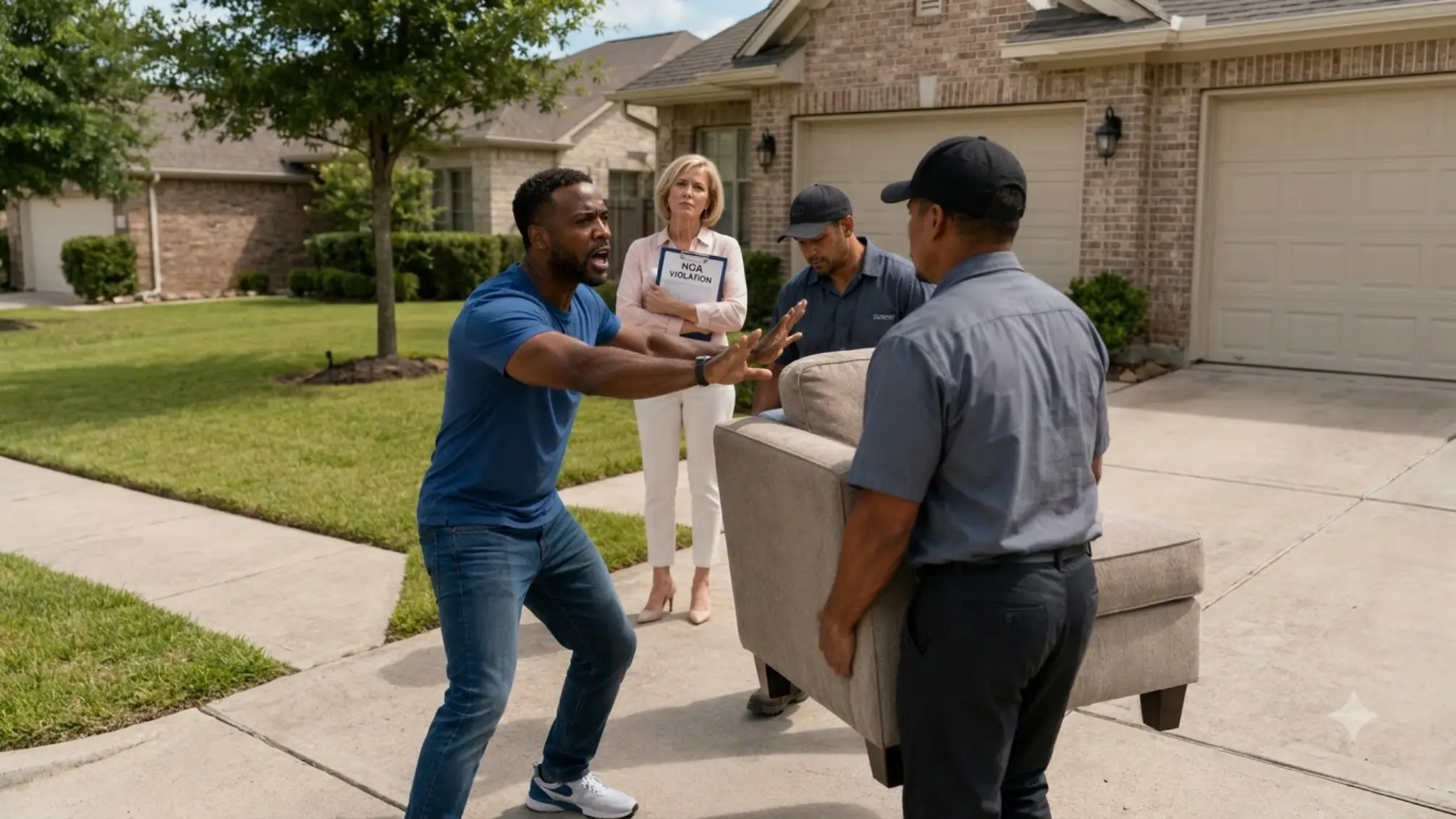
Darius ended the call without explanation and ran downstairs. He pushed through the front door wearing a blue T-shirt, jeans, and white sneakers, his face tightening as he saw the movers already several yards from the garage. Vanessa stood near the lawn in a light pink blouse, fitted white pants, nude heels, and the expression of someone supervising work she believed she had every right to order. Darius threw both hands forward and shouted, “Put that couch down right now—that’s my property, and you don’t get to rob me with a clipboard.”
The movers froze. Vanessa did not. She adjusted the folder against her chest and said coldly, “That furniture is in violation, and if you keep yelling, I’ll have every piece dragged off this property.” Darius stared at her for a second, trying to decide whether she actually believed what she was saying.
“What violation?” he asked. Vanessa pointed toward the covered back patio. “Outdoor furniture visible from a common-use line. Section fourteen, neighborhood appearance standards.” Darius looked at the couch again, then at her. “That couch was inside my house ten minutes ago.”
One mover slowly lowered his end. The other looked at Vanessa. She snapped, “Keep moving.” Darius stepped directly into their path and said, “Nobody takes another step until somebody shows me a signed legal order.”
Vanessa’s face hardened. “You’ve been warned repeatedly about noncompliance.” Darius pulled out his phone. “I’ve been warned about a basketball hoop, a delivery van, and a planter you claimed was three inches too tall.” Vanessa folded her arms. “And every time you challenge the board instead of cooperating.” Darius gave a short laugh. “That’s because you keep inventing rules after deciding you don’t like something.”
Their conflict had started almost the week Darius moved into Willow Ridge fourteen months earlier. His first HOA notice involved the black pickup truck he parked in his own driveway while moving furniture into the house. Vanessa claimed commercial-looking vehicles could not remain visible overnight, even though his truck had no logo, equipment rack, or business markings. When Darius asked for the exact section of the bylaws, she responded with a different complaint about temporary moving boxes visible through his garage.
The next notice concerned his mother’s car during a weekend visit. Another claimed his lawn service had arrived twenty minutes earlier than permitted. Then came a warning about an American flag mounted beside his front porch because Vanessa said the bracket did not match the neighborhood’s approved exterior hardware. Darius answered every letter politely, asked for supporting language, and kept copies of everything.
What bothered Vanessa most was not that he violated rules. It was that he read them. Darius had spent his career finding weaknesses in corporate security systems, and he approached HOA notices the same way: identify the authority being claimed, locate the governing document, compare the two, and ask questions. Vanessa seemed accustomed to homeowners paying small fines because arguing felt more exhausting than surrendering fifty dollars.
Darius rarely surrendered anything he could prove was wrong. That became clear three months earlier when Vanessa issued a $250 fine because his teenage nephew had parked partially across the sidewalk for nineteen minutes. Darius checked the governing documents and discovered the board had never legally adopted the parking policy Vanessa cited. He challenged the fine, and the management company removed it.
Two weeks later, Vanessa began inspecting his house almost daily. She photographed his trash bins before collection time, measured the distance between his hedge and sidewalk, and once stood across the street taking pictures of contractors replacing a bathroom window. Darius installed additional exterior cameras. Vanessa called them “hostile neighborhood surveillance.”
Now she was standing on his driveway while strangers carried his couch toward a moving truck. Darius felt anger settling into something colder. “Who authorized you to enter my home?” Vanessa replied, “The association authorized corrective action.” Darius looked past her toward the truck. “That wasn’t my question.”
The movers exchanged nervous glances. Vanessa lifted her clipboard. “You received notice.” Darius said, “I received an email yesterday about patio visibility. It said nothing about entering my house.” Vanessa’s eyes narrowed. “The board is permitted to cure ongoing violations after proper notice.”
Darius looked toward his open front door. “You entered a locked residence?” One mover answered before Vanessa could stop him. “Door was open when we got here.” Darius immediately turned. “No, it wasn’t.”
The mover swallowed. “Ma’am said somebody from management unlocked it.” Vanessa snapped, “You don’t need to explain our procedures to him.” Darius slowly raised his phone. “Actually, he absolutely does.” Vanessa’s expression changed when she realized the camera was recording.
She stepped toward Darius. “Put that away.” He smiled without humor. “No.” Vanessa lowered her voice. “You are creating a hostile confrontation with contractors who are simply following association instructions.” Darius glanced at the movers. “Gentlemen, did either of you receive proof she owns this property or has permission to remove items from inside it?”
Neither answered. Vanessa spoke for them. “They work for the association.” Darius said, “That doesn’t answer the question.” One mover finally set his end of the couch completely onto the driveway. “I’m not touching anything else until this gets sorted out.”
Vanessa spun toward him. “I’m paying your company.” The mover shook his head. “You told dispatch this was an authorized repossession-style cleanup.” Darius’s eyes narrowed. “Repossession?” Vanessa said immediately, “He’s using the wrong term.”
Darius looked toward the second mover. “What exactly were you told?” The man hesitated, then said, “We were told the homeowner abandoned furniture after repeated HOA notices and management had access authorization.” Darius stared at Vanessa. “You told them my property was abandoned?”
Vanessa’s jaw tightened. “You ignored written orders.” Darius answered, “I was upstairs working.” She pointed toward the couch. “You left prohibited furniture visible from the rear drainage path for three days.” Darius blinked. “That couch was delivered yesterday afternoon.”
Vanessa said nothing. Darius continued, “And it has never been on the patio.” Vanessa looked toward the movers as if blaming them for still being present. “The association has photographic documentation.” Darius nodded. “Perfect. Show me.”
She opened the folder. For several seconds, she searched through papers that suddenly seemed less impressive. Darius waited. Vanessa finally pulled out a photograph of a beige couch visible through glass doors at the rear of his house.
He stared at it. Then he laughed. “That photo was taken through my backyard fence.” Vanessa said, “From common property.” Darius shook his head. “There is no common property behind my fence.”
Willow Ridge’s rear drainage easement ended six feet before Darius’s property line. He knew because Vanessa had tried to fine him for installing a small garden border there earlier that year. The survey documents from that dispute were still saved on his phone. Darius opened the property map and held it toward her. “Whoever took that picture was standing inside my backyard.”
Vanessa looked away. “That’s irrelevant.” Darius’s voice sharpened. “It becomes relevant when the same person later arranges to enter my house.” One of the movers quietly took two steps away from the couch.
Darius’s phone buzzed. His security system had automatically uploaded the last hour of camera footage to encrypted cloud storage because motion was detected at multiple entrances. He tapped the notification and opened the backyard camera. At 12:37 p.m., Vanessa appeared at the side gate.
She was not alone. A man wearing a maintenance-company shirt followed her. Vanessa looked toward the street, used a key on the side gate, and entered Darius’s property. The maintenance worker opened the back patio door using another key.
Darius stopped breathing for a moment. He had never given the HOA a key. His property-management relationship involved no master-access agreement because he owned the home outright. The only authorized spare belonged to his sister, who lived twenty minutes away.
He turned the screen toward Vanessa. “Where did he get that key?” Her expression finally lost its confidence. “Emergency access.” Darius looked at her. “There is no emergency access.”
Vanessa stepped closer. “You need to calm down.” Darius’s voice dropped. “You entered my property with a copied key, opened my house, and hired people to remove furniture.” She snapped, “Don’t twist this into something criminal.”
One of the movers raised his hands. “We’re leaving.” Vanessa turned sharply. “You’re under contract.” He replied, “Not for this.”
The second mover reached for his phone. “I’m calling our office.” Vanessa pointed toward him. “If you leave this incomplete, I will refuse payment.” He shrugged. “Better than getting arrested for taking somebody’s couch.”
Darius looked toward Vanessa. “I already called the police.” She smiled coldly. “Good. They know me.” Darius shook his head. “That might not help as much as you think.”
Officer Lena Brooks arrived first. She was a forty-three-year-old Black woman with twelve years in the Harris County area and the kind of calm expression that usually meant she wanted people to talk themselves into their own problems. Her partner, Officer Samuel Price, followed several minutes later. They listened separately to Darius, Vanessa, and the movers.
Vanessa began with authority. “This is an HOA enforcement matter.” Lena replied, “People entering a house and removing property isn’t automatically an HOA matter.” Vanessa handed her several notices. “He was repeatedly warned.”
Lena read the first page. “This says patio furniture visible from an easement.” Darius pointed toward the couch. “That furniture came from my living room.” The mover confirmed it. Vanessa immediately said the contractors misunderstood the removal scope.
Lena looked at her. “Who told them to enter the house?” Vanessa crossed her arms. “The maintenance representative handled access.” Samuel asked, “Where is he now?” Vanessa said she did not know.
Darius handed Lena his phone. “Camera footage.” They watched Vanessa and the maintenance worker enter through the side gate, then approach the rear door. Lena replayed the section twice. “Do you recognize the man?”
Vanessa hesitated. “His name is Carl Bennett. He does work for the association.” Samuel asked, “Did he have permission from Mr. Cole to enter the house?” Vanessa answered, “The association had authority.”
Samuel looked toward Darius. “Did you authorize entry?” Darius said, “Absolutely not.” Lena turned back to Vanessa. “Then I’m asking specifically what legal authority allowed you to enter a privately owned residence.”
Vanessa began citing HOA covenants. Lena stopped her. “Do any of those authorize entry into the interior of the home for a furniture violation?” Vanessa’s face tightened. “I’m not an attorney.”
Darius almost laughed. “You were an attorney five minutes ago.” Vanessa glared at him. Lena raised one hand. “Everybody stay focused.”
The officers called the HOA management company. The regional manager sounded confused from the moment Lena described the situation. There had been no board-approved removal action against Darius’s home. No attorney had issued an entry authorization, and no management supervisor had approved access.
Then Lena mentioned Carl Bennett. The regional manager went silent. “Carl doesn’t work for us anymore.” Vanessa’s eyes widened.
“He was terminated six weeks ago,” the manager continued. “Why is he at a homeowner’s property?” Vanessa said quickly, “He still has contractor access.” The manager responded, “He absolutely should not.”
Samuel looked at her. “How did he get a key?” Vanessa’s hands tightened around the folder. “I don’t know.” Darius said, “Your camera footage might.”
He had more than outdoor video. His smart lock recorded every successful access attempt and stored which digital or mechanical override profile had been used. The patio lock log showed Maintenance Master 03 activated at 12:41 p.m.
The management company confirmed Master 03 should have been disabled when Carl was terminated. Somebody had reactivated the access profile two days earlier. Only three administrators could do that.
Vanessa was one of them.
Lena asked to see her phone. Vanessa immediately refused. “No.” Lena nodded. “That’s your right.”
But the refusal did not end anything. Officers could preserve the available evidence, document statements, and refer the digital-access issue for follow-up. Darius also informed them he intended to file a formal complaint for unauthorized entry and attempted removal of property.
Vanessa’s confidence returned slightly. “Nothing was stolen.” Darius looked at the couch sitting halfway down his driveway. “Because I caught you.”
The movers left after providing statements. Before driving away, their dispatcher emailed Darius the work order Vanessa had submitted. The description made the officers look at each other.
Authorized HOA property abatement. Owner nonresponsive. Interior access approved. Remove specified furnishings to association storage pending compliance.
Darius asked, “Association storage?” Vanessa said nothing. The work order listed a warehouse address.
Lena ran it.
The address did not belong to the HOA.
It belonged to a private storage company called Pike Property Services.
Darius looked at Vanessa’s last name.
So did both officers.
Samuel asked, “Any relation?” Vanessa’s face tightened. “My husband owns it.”
The driveway became silent.
Darius slowly folded his arms. “So you enter houses, remove property, and send it to your husband’s company?” Vanessa snapped, “That is a disgusting accusation.”
Lena looked at the work order. “Then why is this couch scheduled for delivery there?” Vanessa had no answer.
The case expanded quickly. Investigators obtained HOA records showing Pike Property Services had received more than $38,000 in “compliance storage” payments over eighteen months. Most homeowners never knew the company was owned by Vanessa’s husband because invoices used a mailing address registered to a separate LLC.
Darius was not the first homeowner whose property had been removed. A retired couple had lost patio furniture after an alleged violation. A single mother paid $900 in “storage and compliance fees” to recover outdoor equipment. Another Black homeowner had lawn tools removed from an unlocked shed after Vanessa classified them as visible nuisance items.
Each event had been processed as HOA enforcement. Nobody had connected them.
Darius did.
His cybersecurity background made the access logs especially useful. With the board’s approval after Vanessa was temporarily suspended, investigators reviewed administrative activity involving digital lock profiles on homes enrolled in the community’s optional smart-security program. Vanessa had reactivated expired maintenance credentials nine times.
Five reactivations occurred within twenty-four hours of property-removal actions.
The HOA attorney nearly dropped the report when he read it.
“This association has never authorized interior seizure of homeowner property,” he told an emergency board meeting. More than eighty residents filled the clubhouse. “There is no covenant provision allowing a board member to enter a residence because furniture is visible from outside.”
Vanessa sat at the far end of the table with her attorney. She had stopped wearing the pink blouse that became recognizable from neighborhood security footage. Her lawyer repeatedly reminded people not to assume criminal guilt from administrative findings.
Darius agreed with that part. “Fine,” he said when given the microphone. “Then let’s talk about documents.”
He displayed the work order. Then the access log. Then the management-company statement confirming Carl had been terminated.
Finally, he displayed invoices from Pike Property Services.
Residents started shouting.
One elderly homeowner stood up. “You charged me twelve hundred dollars for storage!” Vanessa’s attorney tried to object to the informal accusation. The homeowner raised a receipt.
Another woman stood. “You took my patio heater.” A man from the back shouted, “She took my pressure washer.”
The board president called for order.
Darius remained at the microphone. “This is why every complaint looked small.” The room quieted slightly. “One couch. One heater. One tool set. One storage fee.”
He looked around.
“Put them together and it stops looking like neighborhood enforcement.”
The board voted that night to remove Vanessa from all administrative access pending a formal recall. Three days later, she resigned from the board. The recall proceeded anyway because residents wanted the findings entered into association records.
Police and prosecutors continued reviewing the broader evidence. Darius never demanded some dramatic punishment that the facts could not support. He wanted the investigation handled correctly.
Evidence showed Vanessa had directed unauthorized entries and routed removed property toward her husband’s storage company. Carl Bennett admitted Vanessa paid him privately to perform several “compliance removals” after his contract with the HOA ended. In exchange for cooperation, he provided messages, access instructions, and copies of work orders.
Those messages were devastating.
One read: Cole keeps challenging everything. We need something he can’t argue his way out of.
Another said: Use the rear access. Cameras are mostly front-facing.
Vanessa had been wrong about that.
Darius had installed three rear cameras after her earlier visits.
Investigators also recovered messages about other homes. The language was not always explicitly racial, but patterns emerged in which residents who challenged fines or questioned Vanessa’s authority became enforcement priorities.
One message about Darius read: He thinks because he has money and cameras he controls the street.
Darius stared at that sentence longer than the rest.
He had never believed he controlled anything.
He simply believed ownership meant Vanessa did not.
Months passed before the legal cases resolved. Vanessa eventually entered a plea tied to unauthorized entry, property interference, and financial misconduct involving association-related services. Restitution was ordered for affected homeowners, and Pike Property Services lost its community contracts.
Her husband claimed he did not know how Vanessa obtained the business. Investigators found enough records to show he benefited financially but insufficient evidence that he participated in every unauthorized entry. The civil cases continued separately.
Willow Ridge changed too.
The HOA bylaws were amended to prohibit board members from directing property removal without written legal review and a recorded vote. Any contractor affiliated with a board member or immediate family required full disclosure and competitive bidding.
Smart-lock access became homeowner-controlled.
The association permanently disabled all master profiles except for true emergency services authorized through a third-party management system.
Most importantly to Darius, violation notices now had to include exact governing language.
No more vague references.
No more “community standards” used as a substitute for actual rules.
One Saturday morning, nearly a year after the couch incident, Darius sat on that same beige sofa in his living room while watching a football game with his nephew. The couch had survived with only a small scrape near one wooden leg.
His nephew pointed toward it. “That’s the famous couch?”
Darius laughed. “Apparently.”
“How much is it worth?”
“Maybe eighteen hundred.”
His nephew stared. “All that happened over an eighteen-hundred-dollar couch?”
Darius shook his head.
“No.”
He looked toward the front window.
“It happened because somebody thought a clipboard gave them rights over things that weren’t theirs.”
His nephew considered that.
“You hate HOAs now?”
Darius smiled.
“No.”
The answer surprised him.
“I hate unchecked authority.”
The teenager nodded slowly as though storing the sentence somewhere.
A knock sounded at the door.
Darius checked the camera out of habit.
Two HOA board members stood outside.
He opened it.
One was Martha Ellis, the new president. She held a folder.
Darius looked at it suspiciously.
“Should I be worried?”
She laughed.
“No violation.”
“Good start.”
“We’re updating homeowner emergency-contact records.”
Darius accepted the form.
Martha glanced toward the living room.
“That the couch?”
“Don’t get any ideas.”
She laughed again.
“I don’t have a storage company.”
“Even better.”
They talked for several minutes.
Nothing tense happened.
Nobody threatened fines.
Nobody measured landscaping.
Nobody entered without permission.
Darius considered that progress.
The neighborhood itself looked almost identical to the day Vanessa stood in his driveway. Same sidewalks. Same mailboxes. Same trimmed hedges.
But the relationship between homeowners and the board had changed.
People attended meetings.
They asked questions.
They requested documentation.
Some board members complained that everything took longer now.
Darius considered that a feature, not a flaw.
Authority should sometimes move slowly.
Especially when it was approaching someone else’s property.
One evening, Darius reviewed footage from his cameras while clearing old storage. He found the original clip by accident.
Vanessa in pink.
The movers carrying the couch.
Darius running toward them with both hands raised.
He almost deleted it.
Then he watched one more time.
The version remembered around Willow Ridge focused on the moment police discovered Pike Property Services was owned by Vanessa’s husband.
That was the dramatic part.
Darius thought the most important moment came earlier.
When the first mover put the couch down.
The man had been hired to do a job.
Vanessa told him she had authority.
She threatened not to pay him.
And he still stopped when the situation looked wrong.
Darius saved the clip.
Sometimes preventing something unjust required a court.
Sometimes a police investigation.
Sometimes security footage.
And sometimes it required one ordinary person deciding that “I was told to do it” was not a good enough reason.
Months later, Darius received a letter from one of the homeowners whose belongings had been removed before his incident.
Her name was Gloria Bennett, seventy-two years old.
She wrote that the HOA had returned the money she paid to recover patio furniture taken two years earlier.
At the bottom she added:
I thought I was the only person they treated like this, so I stayed quiet. Thank you for making the rest of us realize we weren’t alone.
Darius read that line twice.
That was the real consequence Vanessa had never anticipated.
Every enforcement action depended on isolation.
Every homeowner thought their argument was personal.
A planter.
A couch.
A pressure washer.
A vehicle.
A storage charge.
Once people compared experiences, the pattern became visible.
Darius folded Gloria’s letter and placed it inside the same folder containing the original HOA notices.
He did not frame it.
He did not post it online.
He simply kept it.
The following summer, Willow Ridge held its annual neighborhood block party.
Darius volunteered his driveway for extra tables.
Someone joked that the HOA might fine him for unauthorized furniture.
Darius pointed toward the beige couch, which his nephew had jokingly dragged near the front window.
“Careful,” he said. “That thing has a criminal record.”
Everyone laughed.
Even Martha.
Children ran across lawns while adults stood beside grills and coolers.
For once, nobody seemed worried about whether chairs lined up perfectly or someone’s decorative planter violated a color standard.
Darius looked down the street.
A neighborhood could have rules without becoming a place where rules replaced common sense.
That had been the lesson.
Vanessa Pike once believed the HOA title on her folder turned personal preference into authority.
She believed repeated letters created ownership over other people’s decisions.
She believed contractors would follow orders, residents would pay fees, and small violations would never become important enough for anyone to examine the system behind them.
Then she walked into Darius Cole’s house and touched something undeniably his.
A couch.
Simple.
Ordinary.
Impossible to explain away once cameras showed exactly how it left the living room.
That couch exposed the copied access credentials.
The credentials exposed the unauthorized entries.
The entries exposed the work orders.
The work orders exposed Pike Property Services.
The storage company exposed the money.
And the money exposed a pattern that had been hiding behind the words HOA enforcement for nearly two years.
Darius never thought of himself as the man who brought Vanessa down.
He disliked the phrase.
It gave her too much importance.
He preferred a simpler version.
One afternoon, two movers arrived to take something that belonged to him.
He asked them to stop.
They did.
Then he asked everyone involved to prove they had the right to do what they were doing.
They couldn’t.
And sometimes, that one question is all it takes to turn authority back into accountability.