Brenda Holloway’s clipboard struck the thick evidence folder in Marcus Reed’s hands with a crack that silenced the entire porch. The sixty-four-year-old HOA president stood inches from him, her purple blazer trembling with rage as she pointed toward the front door of his Austin home. Behind her, two uniformed police officers held copies of the papers she had presented as an emergency interior-inspection order. Their marked SUV remained parked in the driveway, its body cameras recording the confrontation from multiple angles.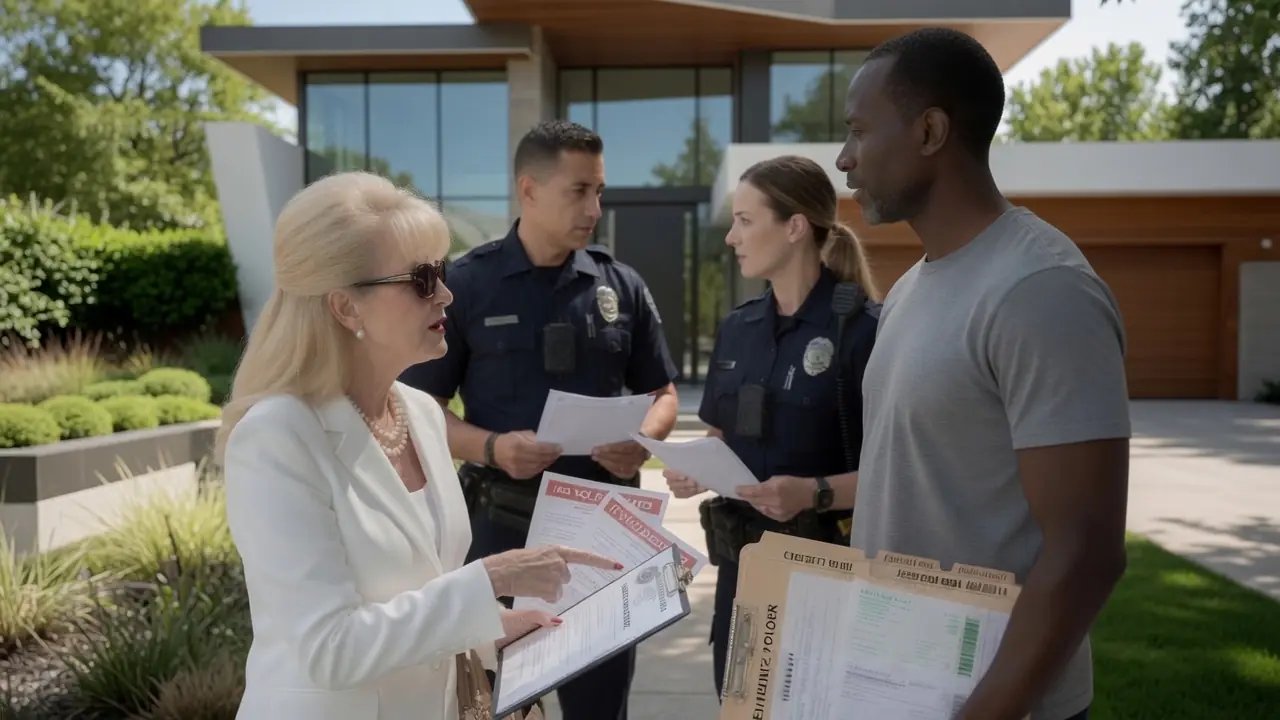
Marcus did not move away from the doorway. At forty-four, the widowed single father had spent enough years protecting his eleven-year-old daughter, Maya, to recognize when intimidation was dressed up as official authority. He kept his voice controlled, though every muscle in his body tightened when Brenda reached toward the doorknob again. His daughter was inside the house, watching through the upstairs window after he had ordered her to lock herself in his bedroom.
Officer Daniel Ortiz stepped forward and raised one hand. “Mrs. Holloway, step away from the homeowner.”
“He is obstructing an authorized inspection,” Brenda snapped. “The HOA received multiple reports of dangerous electrical modifications, unauthorized residents, and possible commercial activity inside this property.”
Officer Julia Park glanced at the front of the house. Nothing about it suggested an emergency. The lawn was trimmed, the exterior paint met the neighborhood’s approved color chart, and there were no visible signs of fire, flooding, structural collapse, or criminal activity. A child’s bicycle rested neatly beside the garage wall.
“Who reported these conditions?” Julia asked.
“That information is confidential.”
“Who issued the order?”
Brenda tapped the document in Daniel’s hands. “The city’s neighborhood safety division. It is all right there.”
Marcus opened his evidence folder and removed a certified copy of his deed, the HOA bylaws, and three letters from the City of Austin. “The city confirmed yesterday that there are no active inspections, emergency orders, or code complaints against my house.”
Brenda’s mouth tightened. “He is lying.”
Daniel studied the paper she had brought. Across the top, red capital letters read EMERGENCY ADMINISTRATIVE ENTRY AUTHORIZATION. The bottom carried the printed name and signature of Victor Salazar, a senior code-enforcement administrator.
The form looked official at first glance. It displayed a city seal, an authorization number, and language claiming that refusing entry could result in arrest. Yet Daniel noticed that the date format differed from the standard format used on other city notices.
He looked at Brenda. “Did a city employee give this document to you personally?”
“Our legal department obtained it.”
“Which attorney?”
“That is not relevant.”
“It became relevant when you asked us to arrest someone with it.”
Brenda stepped toward Marcus again. “You heard the officer. Open the door.”
Marcus held his position. “You are never entering this house.”
She lowered her voice, her expression twisting into something colder than anger. “Your wife understood what happened to people who challenged this association.”
The sentence landed harder than the clipboard had.
Marcus stared at her. His wife, Nia, had been dead for two years. She had served as treasurer of the Oak Terrace Homeowners Association before resigning six months prior to the car accident that took her life. Until that morning, Brenda had always claimed Nia resigned because motherhood and accounting work had become too demanding.
Marcus had never believed it.
“You should explain what you mean,” he said.
Brenda seemed to realize too late that the officers’ cameras had captured every word. She adjusted her sunglasses and forced a dismissive smile.
“I mean she understood the importance of cooperation.”
Marcus opened his folder wider. “She understood something. That’s why she kept these.”
Inside were bank confirmations, invoices, emails, handwritten notes, and a small encrypted storage drive. Marcus had discovered them three weeks earlier inside a locked metal cashbox concealed behind insulation in the garage attic. The box carried Nia’s handwriting across the lid:
FOR MARCUS—ONLY IF BRENDA COMES FOR THE HOUSE.
The words had frightened him more than any violation notice.
Brenda saw the labeled evidence tabs and lunged for the folder.
Marcus pulled it back before she could seize it. Daniel moved between them immediately while Julia ordered Brenda to place both hands where they could be seen.
“He stole HOA records!” Brenda shouted. “Those documents belong to the association.”
Marcus felt the final piece settle into place. He had never told her what the folder contained.
“How do you know these are HOA records?” he asked.
Brenda stopped speaking.
The front door opened a few inches behind Marcus. Maya’s frightened face appeared in the narrow gap.
“Dad?”
“Go back upstairs, sweetheart.”
Brenda pointed at the child. “There! He is exposing a minor to an unsafe residence. Officers, you need to remove her immediately.”
Marcus turned so quickly that Brenda stepped back. “You threaten my daughter again, and this conversation ends with your attorney.”
Julia moved closer to the door and spoke gently to Maya. “Your father is okay. Please stay inside for us.”
Maya nodded and closed the door.
Brenda began reading from the forged order, raising her voice as though volume might transform it into law. She claimed she possessed the authority to inspect every room, photograph personal property, examine utility panels, and remove documents connected to HOA governance. The final provision allowed her to secure the residence if the owner resisted.
Daniel held up the paper. “An HOA president cannot secure a private home.”
“This order gives me temporary enforcement authority.”
“No city document gives a civilian that authority.”
Brenda reached for her phone. “I am calling your supervisor.”
Daniel nodded. “Please do. While you do that, we’re verifying this form.”
Julia contacted dispatch and requested confirmation from the city’s neighborhood safety division. Brenda paced near the porch steps, speaking rapidly into her phone and accusing Marcus of fraud, code violations, and threatening behavior. Marcus remained beside his door, still holding the folder.
He had learned not to interrupt people who were building evidence against themselves.
The trouble with Brenda had begun five months earlier when she announced a new “interior community preservation program.” According to her letter, every homeowner would receive an annual inspection to ensure that private renovations did not threaten neighborhood property values. Inspectors would check paint colors, flooring visible from windows, garage storage, plumbing fixtures, electrical panels, and occupancy records.
Marcus read the bylaws twice.
The HOA had the authority to inspect shared landscaping and exterior modifications visible from public areas. It had no right to enter private residences without the owner’s consent or a valid court order.
He declined the inspection.
Brenda responded with a five-hundred-dollar noncompliance fine.
Marcus challenged it in writing. She doubled the amount, then added a daily penalty. When he continued refusing entry, anonymous complaints began arriving at city departments.
One alleged that Marcus operated an illegal repair business from his garage. Another claimed that twelve unrelated adults lived inside the house. A third accused him of storing hazardous chemicals beside Maya’s bedroom.
Every inspection cleared him.
Yet the complaints continued.
Brenda appeared at his door almost every week, sometimes accompanied by an HOA employee and sometimes by contractors carrying cameras. She claimed the association’s rules outranked municipal privacy protections. Marcus recorded every visit and refused them all.
Then someone tried to open his garage using an old keypad code at two in the morning.
His security camera captured Brenda’s assistant, Evan Pike, standing beside the door with a ring of labeled keys. Evan fled when the exterior light activated. Brenda later claimed he had been checking street addresses for an emergency contact list.
Marcus changed every lock and installed additional cameras.
Two days later, the HOA filed a lien against his house for twenty-eight thousand dollars in accumulated inspection penalties.
That was when he climbed into the garage attic searching for the original closing documents Nia had stored years earlier. Instead, he found her locked cashbox.
Nia had been a forensic accountant. She approached financial records the way Marcus approached structural engineering projects: patiently, skeptically, and with respect for small inconsistencies. During her final year as HOA treasurer, she noticed that reserve funds for drainage repairs were being transferred to a contractor called Sterling Community Compliance.
The contractor had no employees, office, equipment, or public telephone number.
Over four years, Oak Terrace paid Sterling more than one million dollars for inspections, emergency repairs, property monitoring, and legal documentation. Many of those services never occurred.
The company was registered to Brenda Holloway’s adult son.
Nia’s notes showed that Brenda used unauthorized interior inspections to identify homeowners who were unlikely to fight back. Elderly residents, immigrants, recently divorced parents, widows, and families struggling with medical expenses received extensive violation lists after inspectors entered their homes.
They were then ordered to hire Sterling Community Compliance for repairs.
Some paid thousands to replace functioning electrical panels, remove harmless garage shelves, or repair plumbing that had never failed. Others could not afford the work and accepted high-interest payment plans arranged through another company controlled by Brenda’s brother.
Homeowners who resisted received liens.
Several eventually sold their properties below market value to an investment group called Holloway Residential Partners.
Nia’s final spreadsheet contained a column titled RESISTANCE RATING.
Marcus’s family had been marked in yellow.
Beside their name, Nia had written:
BRENDA KNOWS I FOUND THE SHELL PAYMENTS. DO NOT LET HER INSIDE. SHE BELIEVES THE ORIGINAL CONFIRMATIONS ARE IN THE HOUSE.
Marcus had immediately contacted an attorney and the state financial-crimes division. Investigators told him not to confront Brenda or reveal the evidence until they secured court orders for the HOA’s financial records.
He agreed.
Then Brenda arrived with two police officers and a forged document demanding access to the exact house Nia had warned him to protect.
Dispatch called Julia back while Brenda was still arguing into her phone.
Julia listened, asked for the information to be repeated, and looked toward Daniel.
“Victor Salazar retired eighteen months ago,” she said. “He has not issued any orders since then.”
Brenda stopped pacing.
Daniel examined the signature again. “Mrs. Holloway, where did this come from?”
“I already told you—our legal department.”
“The authorization number belongs to a recycling-bin violation from 2021.”
“That is a clerical error.”
“The city seal on this page was discontinued three years ago.”
Brenda removed her sunglasses. Her eyes moved from the officers to Marcus’s folder and then to the front door. For the first time, her confidence appeared to fracture.
“You cannot prove I created it.”
“No one accused you of creating it,” Marcus said.
She pointed at him. “He planted this whole thing because he wants control of the association.”
Marcus almost laughed. “I want you off my porch.”
Daniel instructed Brenda to turn around and place her hands behind her back while they investigated the forged order. She refused, clutching the clipboard to her chest.
“I am the elected president of a community representing four hundred homes.”
“That does not exempt you from a lawful detention.”
“You will both lose your badges.”
Daniel remained calm. “Turn around.”
Brenda swung the clipboard toward his body camera. Julia caught her wrist before it made contact. Within seconds, the HOA president was pressed against the porch column and placed in handcuffs.
Her beige handbag fell open on the concrete.
A ring of keys slid out.
Each key carried a small white label with an Oak Terrace street address.
Marcus recognized his own address immediately.
Julia photographed the keys without touching them. There were at least thirty.
Brenda claimed they were emergency copies voluntarily provided by homeowners. Daniel asked why one was labeled with Marcus’s address when he had never given the HOA a key.
She had no answer.
The officers searched her only after formally placing her under arrest for attempted assault and suspected use of a forged government document. Inside her folder, they found blank inspection forms carrying copied city seals, photographs taken through homeowners’ windows, lists of interior valuables, and draft lien notices.
One page contained Marcus’s name.
Next to it, Brenda had written:
ENTER BEFORE AUDIT. REMOVE ALL TREASURER COPIES. USE CHILD-SAFETY CLAIM IF NECESSARY.
Marcus read the sentence twice.
His anger arrived so intensely that he had to set the evidence folder on the porch railing to keep his hands steady. Brenda had not merely planned to fine him or frighten him. She intended to use his daughter as leverage to enter his home and destroy Nia’s evidence.
The police requested detectives and a financial-crimes investigator. Marcus’s porch remained an active scene for nearly three hours. Officers photographed the keys, copied documents, forged order, body-camera footage, and security recordings.
Maya eventually came downstairs.
Marcus sat beside her on the interior staircase while investigators worked outside. She held his hand with both of hers.
“Was she going to take our house?” Maya asked.
“She was going to try.”
“Because Mom found something?”
“Yes.”
“Did Mom know this would happen?”
Marcus looked toward the garage where he had discovered the cashbox. “Your mother knew Brenda would be afraid of the truth.”
Maya leaned against him. “Were you afraid?”
“Very.”
“You didn’t look afraid.”
“That doesn’t mean I wasn’t.”
The search of the HOA office occurred the following morning. Investigators recovered financial ledgers, forged inspection authorizations, copied keys, private photographs, and a locked cabinet containing files on more than one hundred homeowners.
Each file included a resistance score, estimated home equity, family circumstances, and suggested pressure tactics.
An elderly widower was marked as vulnerable because his children lived out of state. A recently divorced mother was targeted because legal fees had damaged her credit. A Vietnamese American family was described as unlikely to challenge official-looking documents.
Marcus’s file included information about Nia’s death, Maya’s school, and his work schedule.
The investigation expanded rapidly.
Sterling Community Compliance had received $2.4 million in HOA funds, compulsory repair payments, and lien settlements. Bank records showed that the money paid Brenda’s mortgage, luxury travel, vehicle expenses, and political donations.
Holloway Residential Partners purchased eleven homes after Brenda’s penalties forced owners toward foreclosure. The company later resold those properties at substantial profits.
Several board members claimed they had trusted Brenda’s reports without verifying them. Two had received discounted renovations from Sterling. Another had approved payments in exchange for waived HOA dues.
The city employee whose old signature appeared on the forged inspection order, Victor Salazar, met with investigators personally. He confirmed that the signature had been copied from a permit he issued eight years earlier.
He had never met Brenda.
He had never authorized an HOA inspection.
He had never given any private association the power to enter a home.
The criminal case became impossible to dismiss as a neighborhood dispute.
Brenda faced charges connected to forgery, attempted unlawful entry, financial fraud, identity misuse, theft, extortion, conspiracy, evidence tampering, and fraudulent liens. Her son and brother were also charged for operating the shell companies.
Oak Terrace held an emergency meeting two weeks later.
The community center overflowed with residents demanding answers. Marcus attended with Maya seated beside him and Nia’s evidence folder resting on the table.
The interim board played the police body-camera footage.
Brenda appeared on the screen in her purple blazer, pointing toward Marcus’s front door.
“I run this neighborhood—I’ll break that door down and have you dragged out in cuffs!”
The room erupted, not with laughter but with the furious voices of residents who finally understood how she had spoken when she believed power protected her.
Then investigators displayed the resistance files.
People saw their ages, finances, divorces, illnesses, accents, and family difficulties converted into tools for exploitation. Several residents cried. Others stood and described how Brenda’s inspections had invaded their homes and driven them into debt.
Marcus spoke last.
“This did not continue because she was smarter than everyone,” he said. “It continued because official-looking papers frightened people into believing they had no right to say no.”
He placed Nia’s handwritten warning on the screen.
DO NOT LET HER INSIDE.
“My wife understood that a locked door is not an act of aggression. Asking for proof is not disobedience. Protecting your family is not obstruction.”
The association removed every officer connected to Brenda’s scheme. An independent management company took temporary control while residents rewrote the rules.
Interior inspections were permanently prohibited unless requested by the homeowner or supported by a genuine government order. Financial records became available through a secure resident portal. Payments above ten thousand dollars required multiple approvals and outside verification.
All liens created under Brenda’s program were reviewed.
Fraudulent penalties were canceled. Families who had lost money received restitution from recovered accounts, seized property, insurance settlements, and civil judgments. Residents who had sold homes under coercion received additional compensation.
Marcus refused offers to become HOA president.
He agreed to serve temporarily on an oversight committee, but only until new safeguards were established. He had no interest in replacing Brenda’s authority with his own.
He wanted authority divided so no one could abuse it so easily again.
At trial, Brenda’s attorney argued that she had acted aggressively because she genuinely believed Marcus’s home contained dangerous violations. Prosecutors presented her handwritten instruction to remove Nia’s evidence and use Maya as leverage.
They also played the body-camera footage of Brenda revealing knowledge about the folder before Marcus described its contents.
Her own words established motive, intent, and consciousness of guilt.
Brenda was convicted on multiple counts. She received a custodial sentence, financial penalties, and an order prohibiting her from managing residential property or serving in any homeowners association after release.
Her purple blazer became one of the final evidence photographs shown in court. A torn corner of the forged inspection order remained caught beneath its gold button from the moment she had struck Marcus’s folder.
Six months after the confrontation, Marcus replaced his front door.
The old one was still secure, but the sight of it reminded Maya of Brenda standing on the porch and demanding that police remove her father. Marcus let his daughter choose the new color.
She selected dark blue.
Above the inside frame, they mounted a small brass plate engraved with words taken from one of Nia’s notes:
A HOME IS SAFE WHEN TRUTH IS WELCOME AND FEAR IS NOT.
The neighborhood became quieter after the investigation. Residents who had once avoided one another began sharing records, checking on elderly neighbors, and warning new homeowners that no HOA officer possessed the right to enter without consent.
Officer Daniel Ortiz occasionally drove past during patrol. The first time Marcus saw him again, Daniel stopped only long enough to ask whether the family was doing well.
“We are,” Marcus said.
Maya opened the door behind him. “And nobody came inside.”
Daniel smiled. “That’s because your father knew the difference between authority and intimidation.”
One evening, Marcus found Maya at the kitchen table reading a copy of Nia’s original spreadsheet. She pointed at the resistance rating beside their family’s name.
“Mom marked us in yellow.”
“She was warning me.”
Maya picked up a pen, crossed out the word VULNERABLE, and wrote FOUGHT BACK beneath it.
Marcus did not correct her.
Brenda Holloway had arrived expecting the police to arrest a homeowner for protecting his own doorway. She believed her title, forged paperwork, and rehearsed outrage would overpower one widowed father standing between her and the evidence she wanted destroyed.
Instead, the officers recorded her threats.
Her counterfeit order exposed the signature she had stolen. Her handbag revealed the keys she had copied. Her folder uncovered the families she had targeted. And the evidence Nia left behind dismantled the entire system Brenda had built around fear.
Marcus never needed to drag her from the porch or match her fury with his own.
He only needed to keep the door closed long enough for the truth to arrive.