The first thing Marcus Bennett heard was not the doorbell.
It was the metal scrape of a key forcing itself into the lock of his front door.
He had been standing at the kitchen island of his modern Scottsdale home, helping his nine-year-old daughter, Ava, finish a science project about desert ecosystems. The foam-board display was spread across the counter beside tiny plastic cacti, printed photographs of coyotes, and a half-eaten bowl of strawberries. Marcus had just reached for the glue when the front door swung inward without his permission.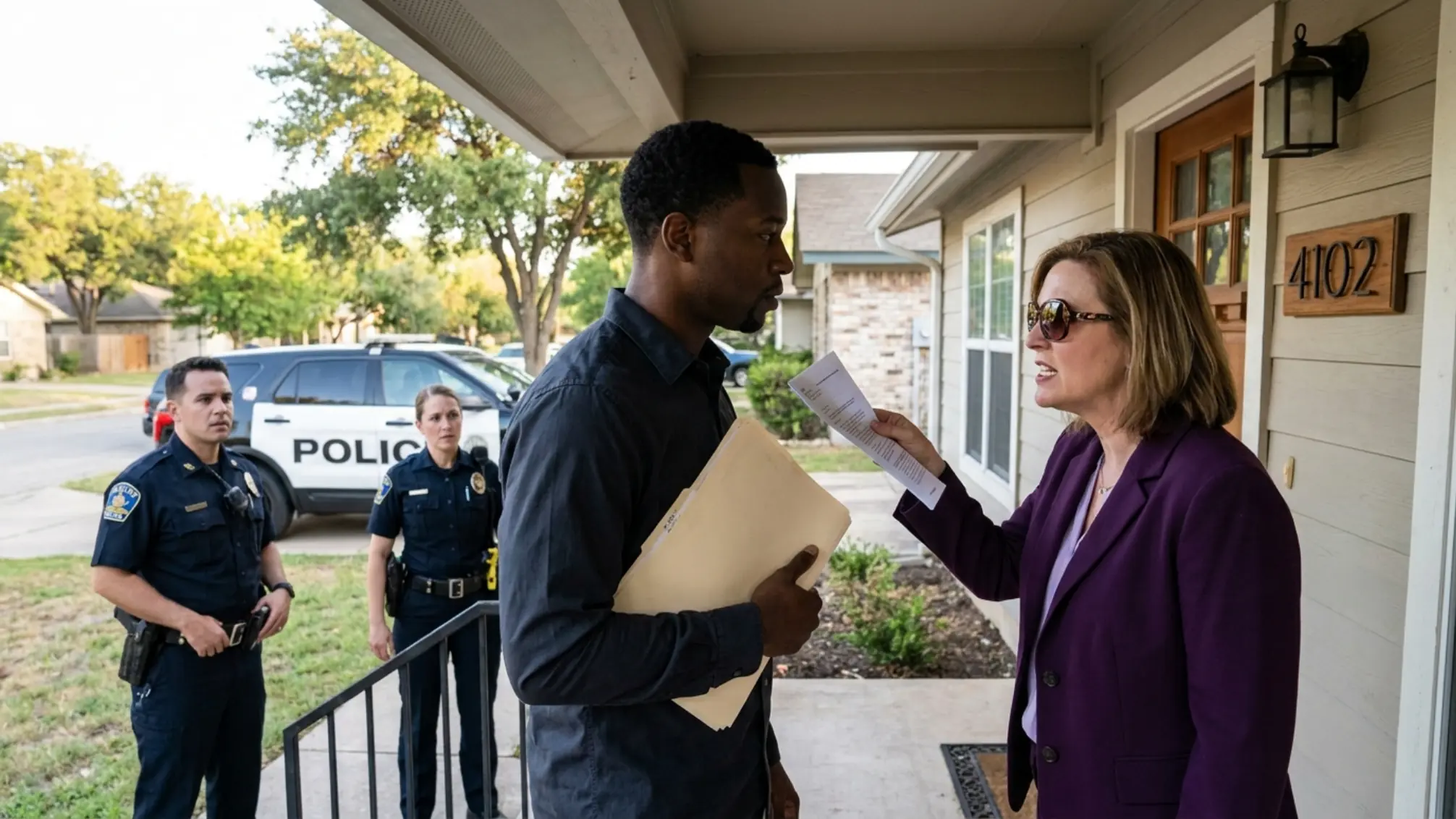
Lorraine Whitmore entered first.
The fifty-eight-year-old HOA president wore a pale orange designer skirt suit, pearl earrings, nude heels, and the expression of a woman who believed rules existed only when she was the one enforcing them. Two uniformed police officers followed several steps behind her, both visibly uncomfortable about crossing the threshold.
Lorraine held a clipboard in one hand and a document stamped with an official-looking city seal in the other.
“There he is,” she said. “Officers, arrest him and clear the house.”
Ava froze beside the kitchen island.
Marcus moved in front of his daughter before looking at the officers. He was thirty-six, tall and athletic, with deep-brown skin, close-cropped black hair, and the controlled posture of a man who had learned never to give angry people the reaction they wanted.
“Who gave you permission to enter my home?” he asked.
Lorraine raised the document. “The emergency inspection order did.”
Marcus did not touch it.
“This is private property.”
“Not when it poses a danger to the community.”
Officer Daniel Ruiz, the older of the two officers, stepped forward. “Mr. Bennett, the HOA reported a structural hazard and possible electrical violations. We were told a city inspector had issued an immediate-access order.”
“No city inspector contacted me.”
Lorraine smiled. “Because you ignored three certified notices.”
“I received three HOA letters demanding access to my attic.”
“Exactly.”
“An HOA letter is not a warrant.”
Her smile disappeared.
Ava reached for Marcus’s hand. He felt her fingers trembling and lowered his voice.
“Sweetheart, take your project upstairs and stay in your room.”
Lorraine pointed sharply toward the staircase. “No one leaves. We don’t know whether the upper floor is safe.”
Marcus turned back to her.
“Do not speak to my daughter.”
The room became silent.
Lorraine stepped closer and pushed the document against his chest. “You violated a binding inspection order. These officers are here to remove you while my contractor evaluates the property.”
“Your contractor?”
“Desert Crest Compliance Services.”
Marcus’s eyes narrowed.
He had seen that name before.
For six months, Lorraine had pressured homeowners throughout Arroyo Vista Estates to allow “emergency inspections” of roofs, wiring, drainage systems, solar panels, and foundations. Residents who refused were fined hundreds of dollars per day. Those who cooperated were told their homes required expensive repairs that could be performed only by contractors approved through the HOA.
Most people paid because fighting seemed more expensive.
Marcus had not.
He had spent twelve years working as a forensic accountant before leaving corporate investigations to care for Ava after his wife’s death. Numbers were his profession, but patterns were his instinct. The inspection notices had bothered him from the beginning—not because of what they said, but because of how carefully they avoided saying anything specific.
No licensed inspector was named.
No municipal department was listed.
Every repair estimate came from one of three companies.
All three sent invoices to the same post-office box.
Marcus had quietly begun collecting records.
Lorraine mistook his silence for surrender.
“You’ve delayed this inspection long enough,” she said. “Officers, take him outside.”
Officer Ruiz did not move. “Ma’am, before we remove anyone, I need to confirm the legal authority on that document.”
Lorraine turned on him. “I already gave dispatch the case number.”
“And I need to verify it independently.”
“The city attorney signed it.”
Marcus finally took the paper.
Lorraine tried to pull it back, but he kept hold of one corner.
“Let go,” she snapped.
“You brought it into my house.”
“It belongs to the association.”
“It claims to authorize entry into my property. That makes it evidence.”
Her face tightened.
Marcus examined the header. At first glance, the document looked legitimate. It carried the seal of Scottsdale’s Development Services Department, a typed order number, and the signature of Deputy Building Official Harold Keene.
But the spacing was wrong.
Marcus had obtained genuine municipal inspection orders during his research. The city’s document system generated a thirteen-digit tracking code beneath the seal. Lorraine’s order had only eleven. The signature block also used an outdated job title that Scottsdale had stopped using two years earlier.
He looked at the date.
The order claimed it had been issued the previous Friday.
Harold Keene had retired six months ago.
Marcus folded the paper once.
“Officer Ruiz, would you like to know why dispatch can’t verify this?”
Lorraine stepped into his face. “You’re a homeowner, not a threat. Drop that paper before you make this worse.”
Marcus reached toward the kitchen counter and lifted a thick folder.
“Touch me, and I’ll read out the fake permit, the forged signature, and every dollar you stole.”
The younger officer, Elena Park, shifted her attention toward Lorraine.
“What does he mean by forged signature?”
“He’s trying to distract you.”
Marcus opened the folder.
“I have seven inspection orders issued to seven different homeowners during the last four months. Every one carries Harold Keene’s signature after his retirement. Three use the same order number, even though they supposedly involve different houses.”
Lorraine’s face lost some of its color.
Officer Ruiz held out his hand. “Let me see the document.”
Marcus gave it to him.
Ruiz read the signature block, then used his radio.
“Dispatch, verify emergency inspection order SC-48117, reportedly issued through Development Services.”
Static answered before a dispatcher began searching the city database.
Lorraine spoke quickly. “The system may not reflect private enforcement actions.”
Ruiz looked up. “City inspection orders aren’t private.”
“You don’t understand the HOA’s agreement with the municipality.”
“Then explain it.”
She lifted her chin. “The association has delegated authority to protect property values and neighborhood safety.”
Marcus laughed once without amusement.
“You don’t have delegated authority. You have a forged PDF and a contractor waiting down the street.”
Officer Park moved toward the front window.
A white utility van sat near the curb. Its side displayed the logo of Desert Crest Compliance Services. Two men waited inside, watching the house.
“Did you call them before the officers arrived?” she asked.
Lorraine did not answer.
Marcus removed several invoices from the folder.
“Desert Crest charged the Langford family eighty-four thousand dollars for foundation repairs. The permit history shows no structural work was performed. Sunline Restoration billed the Chens sixty-one thousand for roof replacement, but aerial photographs show the original roof is still there. Mesa Shield Electrical charged an elderly couple thirty-seven thousand for rewiring that never happened.”
“You stole confidential HOA records,” Lorraine said.
“No. Homeowners gave me copies after they realized your contractors had lied.”
“You’ve been organizing residents against the board.”
“I’ve been following the money.”
The dispatcher’s voice came through Ruiz’s radio.
“Unit Twelve, Development Services reports no order matching that number. Harold Keene is no longer employed by the city. They request a copy of the document for fraud review.”
Lorraine’s eyes moved toward the open doorway.
Officer Park stepped into her path.
“Stay inside, ma’am.”
Lorraine gave a sharp laugh. “This is absurd. At worst, a clerk entered the wrong number.”
Marcus spread more documents across the kitchen island.
Ava’s desert project remained beside them, an innocent backdrop to years of suspicious transfers and inflated repair bills.
“These are HOA payment summaries from the last thirty months,” Marcus said. “Arroyo Vista paid more than two-point-four million dollars to Desert Crest, Sunline Restoration, and Mesa Shield Electrical.”
Ruiz examined the pages. “How did you get financial summaries?”
“The association is required to provide annual disclosures to homeowners.”
Lorraine folded her arms. “There is nothing illegal about hiring contractors.”
“Agreed. The problem is that the three companies aren’t independent.”
Marcus placed corporate-registration records on top of the invoices.
“Desert Crest is registered to Whitmore Property Consulting. Sunline Restoration is registered to your son-in-law’s former business address. Mesa Shield’s mailing account is controlled by your campaign treasurer from the last HOA election.”
Lorraine stared at him.
“All three companies transfer money into the same holding company,” Marcus continued. “Copper Ridge Advisory.”
Officer Park read the name from the page. “Who owns that?”
Marcus turned to the final document.
“Lorraine Whitmore and her husband.”
The pale orange suit suddenly looked less like armor.
“That company manages legitimate investments,” Lorraine said.
“Then explain why it received nine hundred and sixteen thousand dollars within forty-eight hours of HOA contractor payments.”
“You accessed private banking information.”
“I analyzed public lien filings, property records, and civil disclosures. Your contractors borrowed against invoices, then listed Copper Ridge as the beneficiary. You built the trail yourself.”
Lorraine pointed at him. “He’s harassing me. I want him arrested.”
Ruiz’s expression hardened.
“For what offense?”
“Threatening an elected board officer.”
“You’re not an elected government officer.”
“I represent three hundred and twelve homes.”
“And you entered one without valid legal authority.”
Lorraine turned toward the door again.
This time, she ran.
Officer Park caught her arm before she reached the foyer. Lorraine twisted violently and struck the officer’s shoulder with her clipboard.
“Take your hands off me!”
Park forced her against the wall while Ruiz removed the forged document from her grip.
“You are being detained,” he said. “Stop resisting.”
“This is my community!”
“No,” Marcus said from the kitchen. “It belongs to the people whose money you took.”
Lorraine glared at him over her shoulder.
“You think those files make you powerful?”
“No. They make you accountable.”
A voice came from the staircase.
“Dad?”
Ava stood halfway down, clutching the edge of the railing.
Marcus immediately crossed the room.
“I told you to stay upstairs.”
“I heard yelling.”
He knelt and placed both hands gently on her shoulders.
“You’re safe.”
“Are they arresting you?”
The question cut deeper than Lorraine’s threats.
“No, sweetheart.”
Lorraine laughed bitterly from the foyer. “Not yet.”
Marcus looked back at her.
Officer Ruiz raised his radio. “Dispatch, request a financial-crimes supervisor and contact Development Services. We may have forged municipal documents tied to organized contractor fraud.”
Lorraine stopped laughing.
Within thirty minutes, Marcus’s home became the center of an investigation larger than anyone in Arroyo Vista had imagined. City fraud investigators arrived first, followed by detectives from Scottsdale Police Department’s financial-crimes unit. They photographed the false inspection order, collected the invoices, and interviewed Marcus in the living room while Ava sat beside him.
The contractors waiting in the van attempted to leave.
Patrol officers stopped them at the neighborhood gate.
Inside the van, investigators found blank inspection forms, counterfeit city seals, locksmith tools, and prewritten repair contracts listing Marcus’s property. The largest estimate was for one hundred and forty-eight thousand dollars in alleged foundation stabilization.
No one had inspected the foundation.
The contract had been prepared before Lorraine entered the house.
By sunset, Lorraine was released pending further investigation, but her phone, clipboard, laptop, and HOA access credentials were seized. She returned to her mansion at the opposite end of the neighborhood convinced that her position and attorneys would protect her.
She was wrong.
The forged order used against Marcus was not the first.
Investigators discovered forty-three nearly identical documents issued to homeowners over three years. Each order frightened residents into admitting Lorraine’s “inspectors,” who then reported urgent defects and demanded immediate repairs.
The victims were carefully chosen.
Elderly homeowners living alone.
Recent widows.
Immigrant families unfamiliar with HOA law.
Parents facing medical debt.
Anyone likely to pay rather than fight.
Some financed the repairs through loans arranged by Copper Ridge Advisory. Others were threatened with daily fines until they signed contracts. When homeowners could not pay, the HOA placed liens on their properties.
Lorraine profited twice—first through the contractors, then through fees and interest attached to the liens.
Three families had already sold their homes to avoid foreclosure.
Marcus spent the following weeks helping detectives reconstruct the transactions. He created a timeline linking every inspection order to each contractor payment, lien, and transfer into Copper Ridge accounts.
The total reached $2,417,860.
That number did not include interest collected from homeowners or property acquired through forced sales.
The investigation eventually identified another participant: HOA treasurer Charles Whitaker, Lorraine’s brother. He approved contractor payments without competitive bids and altered meeting minutes to make the contracts appear authorized.
The recorded minutes claimed the board had voted unanimously.
Two former board members testified that those meetings had never occurred.
Ava struggled after the confrontation.
She began checking the front lock repeatedly before bed. Whenever a car slowed outside, she looked through the curtains. Marcus tried to reassure her, but he understood that a child could not forget the sight of strangers entering her home and demanding her father’s arrest.
One evening, she found him reviewing files at the kitchen island.
“Can she come back?” Ava asked.
“No.”
“What if she makes another paper?”
“She won’t.”
“How do you know?”
Marcus closed the folder.
“Because now people know what she did.”
Ava looked at the science project still leaning against the wall. She had received an A, though Marcus had nearly forgotten to take it to school after the police left.
“Why did the officers believe her?” she asked.
“They believed the paper might be real.”
“But it wasn’t.”
“No.”
“Then people shouldn’t follow papers without checking.”
Marcus smiled sadly.
“You’re right.”
The HOA called an emergency community meeting ten days after Lorraine’s detention. More than two hundred residents filled the clubhouse. People who had once avoided criticizing her now carried boxes of invoices and inspection notices.
Lorraine attended with two attorneys.
She wore a navy suit instead of pale orange and sat behind a table near the front, refusing to look at Marcus.
Her attorney spoke first.
“Mrs. Whitmore denies all allegations of intentional wrongdoing. Any irregularities resulted from administrative errors committed by third-party vendors.”
A seventy-six-year-old widow named Helen Morris rose from the second row.
“Your third-party vendor told me my wiring would burn down my house unless I paid forty-two thousand dollars that afternoon.”
The attorney tried to interrupt.
Helen held up photographs.
“An independent electrician inspected it last week. He said no wires had been replaced and no emergency existed.”
Another homeowner stood.
Then another.
A retired teacher described losing his home after Lorraine filed seventy-eight thousand dollars in liens. A young couple said they had postponed medical treatment for their daughter to pay for a roof repair that never occurred.
Lorraine remained expressionless until Marcus approached the microphone.
“You entered my home because you believed fear had worked on everyone before me,” he said. “You brought officers because you wanted your forged order to appear more powerful than my property rights.”
Her attorney stood. “This meeting is not a criminal proceeding.”
“No,” Marcus replied. “It’s the first time the people who trusted this board get to speak without your client controlling the minutes.”
The room erupted in applause.
The remaining board members voted to remove Lorraine and Charles immediately. An independent management company took temporary control, and every active lien connected to the fraudulent inspections was suspended.
Three months later, prosecutors filed charges.
Lorraine Whitmore faced counts of fraud, forgery, burglary, criminal impersonation, conspiracy, money laundering, and attempted unlawful eviction. Charles faced financial-fraud and records-tampering charges. The owners of all three contractor companies were charged with conspiracy and theft.
The most damaging evidence came from Lorraine’s laptop.
Investigators recovered a spreadsheet ranking homeowners by “resistance level.” Marcus’s name appeared in red beside the words:
HIGH RISK—FINANCIAL BACKGROUND. FORCE ACCESS WITH POLICE PRESENCE. REMOVE RECORDS IF POSSIBLE.
The inspection had never been about his foundation.
Lorraine intended to enter his home, locate the documents he had collected, and remove them under the pretense of a safety inspection.
The forged order was both a weapon and a search strategy.
At trial, Lorraine claimed she believed every document was valid. Prosecutors displayed emails in which she instructed a graphic designer to copy Scottsdale’s seal and update old inspection templates.
One message read:
Make it look official enough that homeowners stop asking questions.
Another directed contractors to prepare repair estimates before inspections occurred.
Marcus testified for two days.
Lorraine’s attorney tried to portray him as an angry resident obsessed with destroying the HOA president. Marcus answered every question with dates, amounts, document numbers, and bank records.
“You disliked Mrs. Whitmore before the alleged entry,” the attorney said.
“I distrusted her invoices.”
“You began investigating her without authority.”
“I reviewed records belonging to homeowners who requested my help.”
“You wanted her removed from power.”
“I wanted her to explain where the money went.”
The attorney stepped closer.
“Do you consider yourself a hero, Mr. Bennett?”
Marcus looked toward the jury.
“No. I consider myself a father whose daughter watched strangers enter her home because a forged piece of paper made a crime look official.”
The courtroom became silent.
The jury deliberated for less than four hours.
Lorraine was convicted on all major counts. Charles and two contractors accepted plea agreements before sentencing, providing evidence that Lorraine had designed the operation and controlled the financial transfers.
The judge sentenced her to seventeen years in state prison and ordered restitution exceeding $2.4 million. Properties owned by Copper Ridge Advisory were seized, and the proceeds went into a fund for affected homeowners.
Several families recovered their houses.
Others received enough compensation to rebuild their lives, though no payment could return the months or years lost to fear.
Arroyo Vista changed after the trial.
The HOA adopted open financial reporting, independent audits, competitive contractor bidding, and a rule requiring homeowners to receive direct verification from city departments before any emergency entry request.
No board representative could enter a home without the owner’s consent, a genuine judicial warrant, or an immediate life-threatening emergency confirmed by public authorities.
Marcus was asked to run for HOA president.
He refused.
Instead, he agreed to chair an unpaid financial-oversight committee for one year while the neighborhood rebuilt trust. He wanted safeguards, not authority.
Six months after the incident, Officer Ruiz visited Marcus’s home.
He stood at the doorway without crossing.
“I wanted to apologize,” Ruiz said.
“You checked the order.”
“After entering.”
“You followed what looked like an emergency document.”
“I should have verified it before stepping inside.”
Marcus considered him for a moment, then opened the door wider.
“Come in.”
Ava sat at the kitchen island constructing another school project. This one was about systems of checks and balances.
Ruiz noticed the title and smiled.
“Good subject.”
Ava looked at him seriously. “It means nobody gets to decide everything alone.”
“That’s exactly what it means.”
Before leaving, Ruiz handed Marcus a framed copy of the original forged inspection order. Across it, the evidence department had stamped one word in red:
FRAUDULENT.
Marcus stared at the paper that had once been waved inside his home as though it carried more authority than he did.
He considered throwing it away.
Instead, he hung it in his office beside the first restitution report.
Not as a reminder of Lorraine.
As a reminder of how easily official language could hide an unofficial crime—and how important it was for someone to ask the question she had spent years preventing:
Who verified this?
Lorraine Whitmore entered Marcus Bennett’s home expecting police officers to remove a single father who refused to obey her.
She believed her title would silence him.
She believed her forged order would frighten him.
She believed the files in his hands were only paper.
But page one exposed the false signature.
The next pages exposed the contractors.
And the numbers beneath them revealed the $2.4 million fraud she had built one frightened homeowner at a time.
In the end, the officers did remove someone from Marcus’s home.
It just wasn’t the man Lorraine had ordered them to arrest.