At 7:42 on a quiet Thursday evening, Cameron Reed returned from a charity dinner and found the president of his homeowners association kneeling beneath his bedroom window with six plastic bags of illegal powder scattered across the mulch.
Vivian Harrow wore the polished uniform she chose whenever she wanted the neighborhood to mistake authority for elegance: a fitted white blazer, a silk blouse, white trousers, gold bracelets, pearl earrings, and expensive flats that were already sinking into the damp soil.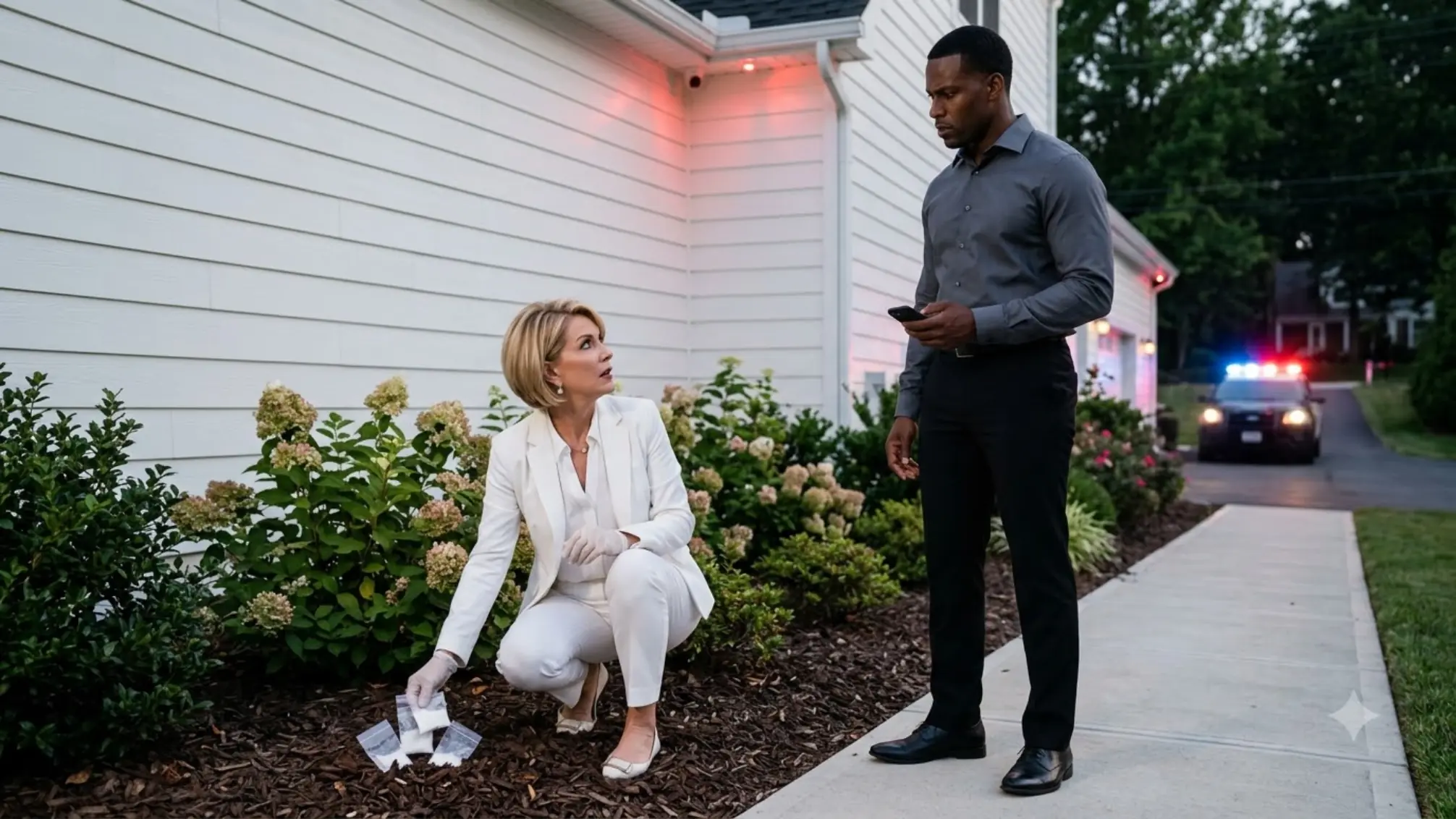
Her carefully styled blonde hair remained perfect, but her hands were dirty.
One hand held an open freezer bag. The other pushed two smaller packets beneath a flowering azalea.
Cameron stopped beside the stone walkway.
He was thirty-nine, tall and athletic, with deep brown skin, closely trimmed hair, and a calm face that became more frightening when anger removed every trace of warmth. His charcoal dress shirt was open at the collar, and his tailored black trousers still carried the sharp lines of the evening’s formal event.
Vivian did not hear him approach.
She was too busy arranging evidence.
Cameron Blackwood (coldly, holding up his phone): “You chose the wrong yard.”
Vivian Harrow froze.
Her head turned slowly.
For one second, terror stripped away every piece of confidence she normally wore. Then she recovered, stood upright, and brushed mulch from her white trousers.
Vivian Harrow (smirking, dropping another bag beside the shrubs): “Enjoy the raid. Your little empire ends tonight.”
Cameron looked from her face to the packages in the flower bed.
“You entered my property to plant narcotics.”
Vivian Harrow (angrily, stepping toward him): “No one will believe you after police find what you’ve been hiding.”
Cameron Blackwood (fiercely, pointing toward the flashing alarm panel): “They won’t need to. My system filmed you, locked every exit, and called them before you stood up.”
A soft mechanical click sounded behind her.
The gate through which Vivian had entered locked automatically.
Her expression changed again.
Red security lights began flashing along the side of Cameron’s house. They were silent outside, but inside the property’s control room, an emergency system had already transmitted video, time stamps, access data, and a live alarm to the city police department.
Vivian rushed toward the gate and pulled the handle.
It did not move.
“What did you do?”
“I secured my home.”
“You cannot trap me here.”
“I didn’t invite you inside. The system detected an intrusion and followed its programmed emergency procedure.”
She reached into her handbag.
Cameron lifted one hand.
“Keep both hands visible.”
Vivian laughed, though her breathing had become shallow.
“You think I’m armed?”
“I think you broke into my garden carrying six bags of illegal powder. I’m not making assumptions about what else you brought.”
She pulled out her phone instead.
The screen lit for less than a second before the device displayed NO SERVICE.
Cameron’s property had not blocked her signal. The police department had remotely restricted outside commands to the alarm system after receiving the active intrusion notification. Vivian simply had no cellular reception between the stone wall and the thick landscaping.
She stared toward the street.
Sirens were already approaching.
Three months earlier, Cameron had not believed Vivian capable of staging a criminal case.
He knew she was vindictive.
He knew she was dishonest.
He knew she had used HOA violations to frighten elderly homeowners, pressure families into expensive repairs, and punish anyone who questioned her contracts.
But planting narcotics required a different level of desperation.
That desperation began after Cameron purchased the largest house in Briarwood Estates.
The property had once belonged to a retired developer who built the gated community twenty-two years earlier. It included a guesthouse, a private garden, a detached office, and two undeveloped acres near the community’s western boundary.
Vivian approached Cameron during his first week in the neighborhood.
She arrived carrying a welcome basket and a folder containing what she called “voluntary modernization agreements.” The agreement proposed transferring a narrow strip of Cameron’s western land to the HOA for a future security road.
Cameron reviewed the survey.
The requested strip was not narrow.
It covered nearly one-third of his undeveloped property and provided direct access to a county road scheduled for commercial expansion.
He refused.
Vivian returned with a revised offer.
He refused again.
Within ten days, violation notices began appearing.
His outdoor lights were allegedly too bright.
His garden wall was supposedly six inches too high.
The color of his guesthouse door was declared inconsistent with approved community tones, even though the same color appeared on four neighboring houses.
Every violation disappeared when Cameron demanded supporting rules.
New ones replaced them.
Vivian assumed he would eventually become exhausted and sign the land agreement.
She underestimated him.
Cameron was the founder and chief executive of Blackwood Secure Infrastructure, a company that designed intrusion detection, encrypted access systems, and emergency security networks for hospitals, data centers, hotels, and residential developments.
He understood how institutions hid abuse behind complicated procedures.
More importantly, he understood records.
Every HOA notice went into a digital file.
Every email received an independent archive.
Every visit to his property was captured by cameras installed entirely within his legal boundaries.
Vivian complained that the cameras invaded community privacy.
A city inspector confirmed they did not.
She demanded that Cameron connect them to the HOA security network.
He refused.
Two weeks later, someone attempted to erase footage from the community server showing Vivian’s vehicle near his western fence.
Cameron’s independent cameras preserved it.
He began investigating.
Public records showed that Vivian’s husband owned Harrow Development Partners, a company that had quietly purchased land surrounding the future county-road expansion. If Cameron transferred his western acres to the HOA, the association could later lease or sell access rights to her husband’s company.
The land was worth far more than Vivian had offered.
Cameron presented the conflict during an HOA meeting.
Vivian denied everything.
She claimed her husband’s investments were private and unrelated to association business.
Most board members remained silent.
Some were embarrassed.
Others looked afraid.
The vote to transfer Cameron’s land failed, but only by one vote.
Afterward, Vivian stopped pretending to be friendly.
She filed a complaint accusing Cameron of running an illegal commercial office from his home. A city investigation cleared him because the detached office met every zoning requirement.
She accused him of storing restricted equipment. Inspectors found security demonstration panels and legally registered electronics.
She claimed unusual visitors entered the property at night. The visitors were engineers working across international time zones and Cameron’s younger sister, a surgeon who often finished late hospital shifts.
Each accusation failed.
Then police received an anonymous report alleging that Cameron’s company served as a front for a regional criminal organization.
Detectives visited his office.
Cameron cooperated fully.
The report contained no evidence and was closed quickly, but one detail disturbed him. The caller described the location of a locked storage room inside his detached office.
Only someone who had entered the property or viewed confidential renovation plans could know where it was.
Cameron upgraded his security system.
He installed pressure sensors beneath exterior paths, contact alarms on gates, and discreet cameras inside garden fixtures. The system distinguished residents, expected guests, maintenance workers, and unauthorized movement.
He also added a silent emergency protocol.
If someone entered the property using a stolen or falsified credential, the system would not sound a loud alarm. It would lock exterior exits, preserve every camera feed, alert Cameron, and contact police automatically.
Vivian triggered that protocol at 7:39 on Thursday evening.
Her access device had opened the side gate through a maintenance override stolen from Briarwood’s property-management office.
The system recognized the credential as valid for common areas but unauthorized for Cameron’s deeded property.
It let her enter.
Then it began recording.
Two police cruisers stopped outside the house.
Officer Daniel Hayes entered through the front gate with Officer Maria Ortiz and Sergeant Leah Coleman. Their body cameras were already active.
Cameron met them near the side garden with both hands visible.
Vivian stood several feet away beside the scattered packages.
She began speaking before anyone asked a question.
Vivian Harrow (panicked, pointing at Cameron): “Thank God you’re here. I discovered these drugs while conducting an HOA inspection, and he locked me inside.”
Sergeant Coleman looked at her white clothing, dirty hands, and open handbag.
“What inspection were you conducting after seven thirty in the evening?”
“An emergency landscape inspection.”
“Who reported the emergency?”
“A homeowner.”
“Which homeowner?”
“I cannot disclose confidential complaints.”
Cameron handed Officer Ortiz his phone.
“The system uploaded the complete video to your department before I reached the garden.”
Vivian’s face tightened.
Sergeant Coleman looked toward the packets.
“No one touch anything until evidence technicians arrive.”
Vivian stepped away from them.
“I never touched those bags.”
Cameron said nothing.
Officer Ortiz played the first video.
It showed Vivian entering through the side gate carrying a blue tote bag. She looked toward the house, waited, then walked directly to the flower bed.
The second camera provided a closer angle.
Vivian removed six packets from the tote.
She placed three under the azaleas, one beside an irrigation box, and two near the foundation.
A microphone hidden beneath a garden light captured her whispering to someone through an earpiece.
“It’s done. Call in the tip.”
Officer Ortiz paused the recording.
Every officer looked at Vivian.
Vivian Harrow (shaken, backing toward the locked gate): “That footage was edited.”
Cameron Blackwood (coldly, folding his arms): “It was transmitted live to police servers.”
Sergeant Coleman asked Vivian to place her hands behind her back.
She refused.
“This is absurd. I am the HOA president.”
“That does not authorize planting controlled substances.”
“You do not know what those bags contain.”
Officer Hayes looked at her. “You just said they were drugs.”
Vivian realized her mistake too late.
She had identified the substance before police tested it.
Her shoulders lowered.
Sergeant Coleman repeated the instruction.
This time, Vivian complied.
The handcuffs closed around her wrists while residents gathered beyond Cameron’s wall, watching patrol lights flash across the street.
Vivian tried one final strategy.
“He forced me to do this.”
Cameron stared at her.
“How?”
“He threatened to expose private board records unless I helped him stage an attack.”
Sergeant Coleman looked toward Cameron.
“Do you have any communication with her supporting that claim?”
“All of my communication is archived.”
Vivian laughed bitterly.
“Of course it is.”
Evidence technicians arrived and photographed every packet before collecting them. Preliminary testing confirmed the bags contained a controlled narcotic mixed with harmless filler.
The amount was enough to support a serious possession charge if officers believed it belonged to Cameron.
The placement was also deliberate.
Two bags rested near the detached office, suggesting distribution through his business. Others were hidden near the main house to imply he stored substances across the property.
Vivian had not planned only to embarrass him.
She intended to connect him to the anonymous criminal-ring accusation and destroy both his freedom and his company.
Detectives obtained a warrant to search Vivian’s vehicle.
Inside the trunk, they found disposable gloves, two additional packets, a printed map of Cameron’s property, copies of his building plans, and an unregistered HOA master-access device.
They also found a prepaid phone.
Its most recent message had been sent at 7:40.
Package planted. Make the call now.
The recipient was listed only as M.
By midnight, Vivian was being questioned at police headquarters.
Cameron remained at home while investigators completed their work. He watched technicians move through the garden his late mother had helped him design.
She had selected the azaleas herself.
Now police were digging through their roots because Vivian believed the appearance of drugs near a Black homeowner would be enough to make every other fact irrelevant.
That realization hurt more than the property damage.
Vivian had not merely planned to frame a wealthy executive.
She had chosen a story she believed police, neighbors, and news outlets would accept quickly: a successful Black man hiding criminal money behind a legitimate company.
She expected prejudice to complete the work her evidence began.
But she had made one small mistake.
She assumed Cameron’s alarm existed only to make noise.
It existed to create proof.
The prepaid phone led detectives to Malcolm Reese, Briarwood’s property-management director. He controlled maintenance credentials, resident records, architectural plans, and access to the HOA office.
Malcolm was arrested the next morning.
His messages revealed that he had supplied Vivian with Cameron’s building plans and created the unauthorized gate credential. He also scheduled the anonymous police call for exactly five minutes after she entered the property.
When detectives searched his office, they found draft violation notices, falsified security reports, and a folder labeled WESTERN ACCESS PROJECT.
The folder connected the framing attempt to a much larger scheme.
Vivian and Malcolm had spent four years targeting homeowners whose properties stood near planned roads, utility routes, and commercial projects. They manufactured HOA violations, inflated fines, and threatened liens until owners agreed to sell or transfer land.
Harrow Development Partners purchased several parcels through shell companies.
Some owners believed they had simply lost financial battles with the association.
In reality, Vivian selected them because private development information showed their land would soon increase in value.
Cameron’s western acres represented the final piece needed for a service road connecting a proposed shopping center to the county expansion.
Without his property, the project could not receive traffic approval.
Vivian first attempted to pressure him financially.
When that failed, she tried to make him look dangerous.
If police arrested Cameron on drug charges, his company’s board might remove him temporarily. His lenders could freeze projects. Legal expenses and reputational damage would weaken his ability to fight the HOA.
Vivian planned to offer a settlement.
Transfer the land, and certain witnesses would suddenly become uncertain about who owned the bags.
The messages documented everything.
One read:
He believes his cameras protect him. Once police find the packages, no one will care about an HOA dispute.
Another said:
Make it look connected to the business. Rich men survive possession. CEOs do not survive distribution.
Cameron read the messages three weeks later in his attorney’s office.
He did not celebrate.
He felt cold.
His attorney, Naomi Ellis, closed the folder.
“She planned to use criminal charges as leverage.”
“She planned to use my race as leverage.”
Naomi nodded.
“She assumed the accusation would feel believable before anyone asked whether it was true.”
Cameron looked toward the city beyond the windows.
“Then the story cannot end with her arrest.”
He requested a complete independent audit of Briarwood’s HOA.
The board resisted until state prosecutors confirmed association systems had been used during the framing attempt. A judge froze Vivian’s authority, suspended enforcement actions, and ordered preservation of every financial record.
The audit revealed more than six million dollars in questionable land transfers, legal fees, penalties, and vendor contracts.
Vivian’s husband’s companies benefited from twelve property transactions.
Malcolm received hidden payments through a consulting business owned by his brother.
Two board members approved contracts in exchange for investment opportunities.
Residents who challenged the deals were labeled hostile, unstable, or dangerous.
One elderly homeowner had sold her garden lot after receiving forty-three violations in eight months.
A widowed father lost access to a shared road after refusing a below-market offer.
A young couple paid nearly thirty thousand dollars in legal fees defending a fence that already complied with the rules.
The criminal case expanded.
Vivian was charged with conspiracy, evidence tampering, possession with intent to frame another person, trespassing, false reporting, fraud, and offenses connected to the land scheme.
Malcolm accepted a plea agreement and testified against her.
Vivian refused every deal.
She insisted she had acted to protect Briarwood from Cameron’s influence.
At trial, her attorney argued that Cameron’s sophisticated security system had allowed him to manipulate the footage.
Technical experts proved otherwise.
The video carried independent police-server time stamps. Every file had been encrypted before Cameron viewed it. Door sensors, gate records, and body-camera footage created a continuous timeline no one could alter without leaving evidence.
Officer Ortiz testified that Vivian identified the packets as drugs before testing.
Sergeant Coleman described finding her beside the planted bags.
Malcolm explained how the plan was created.
Then Cameron took the witness stand.
Defense Attorney (skeptically, approaching him): “Mr. Blackwood, you wanted control of the HOA, didn’t you?”
Cameron Blackwood (calmly, resting his hands on the rail): “I wanted control of my own property.”
Defense Attorney (pressing, raising his voice): “You installed a system designed to trap Mrs. Harrow.”
Cameron Blackwood (firmly, holding his gaze): “I installed a system designed to document unauthorized entry.”
Defense Attorney (sharply, pointing toward him): “Without your cameras, no one could prove those bags were hers.”
Cameron Blackwood (coldly, looking toward Vivian): “That was why she chose my yard. She believed accusation would matter more than proof.”
Vivian was convicted on every major count.
Her husband later pleaded guilty to fraud connected to the land acquisitions. Two board members were removed and charged separately. Malcolm received a reduced sentence for his cooperation but permanently lost his property-management license.
Briarwood returned land where possible.
Former owners received compensation from seized company assets.
Fraudulent violations were canceled, and the association adopted new rules preventing any board officer from controlling complaints, penalties, appeals, and property negotiations at the same time.
Every master credential now required two-person authorization.
Emergency access automatically notified the homeowner and local security.
Cameron refused repeated requests to become HOA president.
He nominated Helen Price, a retired accountant who had challenged Vivian’s budgets for years.
Helen accepted on one condition.
“No private meetings and no hidden contracts.”
Cameron agreed.
Six months after the trial, Cameron replanted the damaged flower bed.
His sister helped replace the azaleas. His father repaired the irrigation line investigators had removed. Cameron installed no additional cameras because the existing system had already done exactly what it was designed to do.
Near the side gate, he placed a small metal plaque.
It did not warn about surveillance.
It carried only one sentence:
An accusation is not evidence.
The neighborhood became quieter after that.
Not perfect.
No community ever was.
But residents began asking questions before accepting official explanations. Complaints were reviewed publicly. Contracts listed every relationship. Access records could not disappear inside one manager’s computer.
Vivian entered Cameron’s garden believing six planted bags would erase his reputation before he could defend himself.
She had selected the location, created the false tip, and prepared the story police were supposed to believe.
She expected officers to arrive and see a Black executive standing beside illegal drugs.
Instead, they arrived and saw her hands in the soil.
Her greatest mistake was not entering the wrong house.
It was believing the alarm existed only to scare intruders away.
Cameron’s alarm did something far more dangerous to people like Vivian.
It remembered everything.