“Hand over the bags. My mom says you owe us.”
Sixteen-year-old Logan Whitmore stood directly behind the open trunk of my silver sedan, arms crossed over his gray school hoodie as though the matter had already been decided. Two paper bags filled with vegetables, bread, and canned food rested beside him, while another remained in my right hand. I had just returned from the grocery store after working twelve straight hours, and the last thing I expected to find in my driveway was a teenager attempting to confiscate my dinner.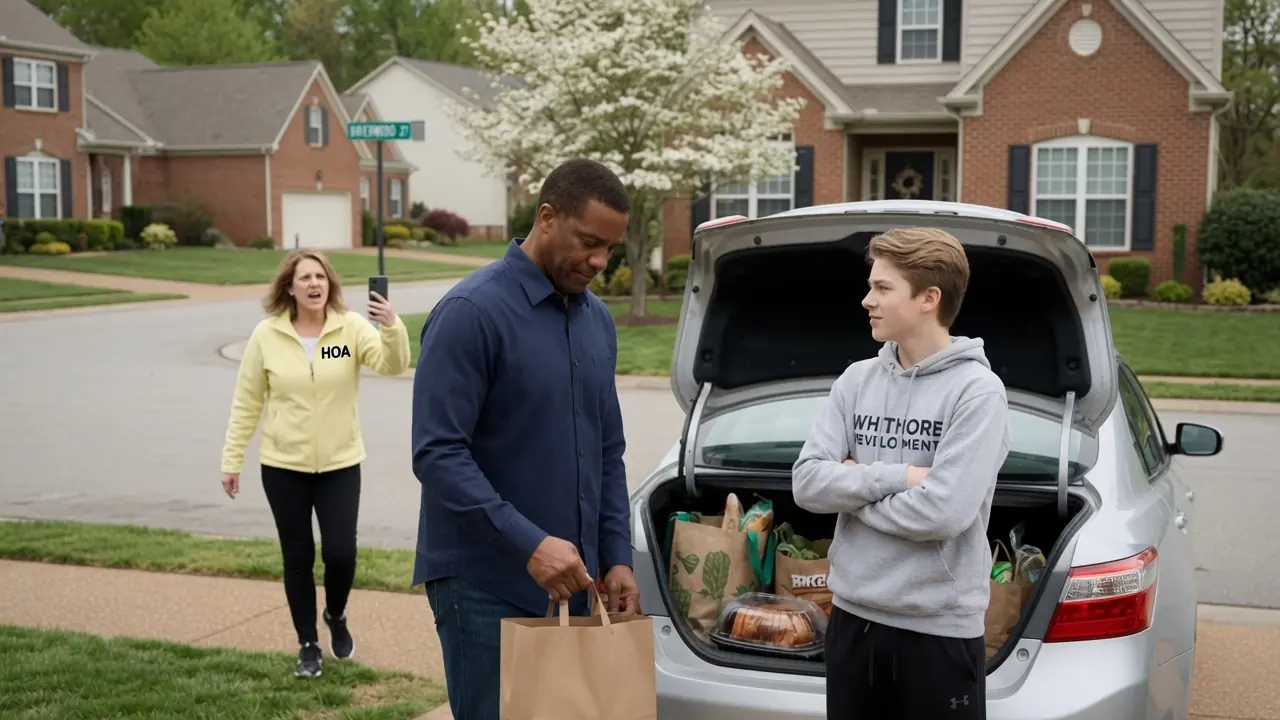
I lowered the bag carefully onto the pavement. “Son, you want to think very carefully about what you just said.”
Logan smirked. “Or what? You going to call the cops?”
I looked at him for exactly three seconds. He mistook my silence for hesitation, but I was studying his posture, the phone recording from his sweatshirt pocket, and the woman marching toward us from across the lawn. His mother, Patricia Whitmore, wore a navy HOA polo shirt and held her own phone upright, making sure every second of the confrontation was captured.
Patricia had appointed herself president of the Maple Ridge Homeowners Association six months earlier. Since then, she had treated the position as though the neighborhood had elected her governor, judge, and sheriff. She issued warnings for garbage cans left outside ten minutes too long, children’s bicycles placed near porches, and flowers she claimed were the wrong shade of yellow.
I had ignored most of her notices because many of them were unenforceable. That morning, however, she had taped a red envelope to my front door demanding six hundred dollars for “unauthorized commercial activity.” The supposed business consisted of a police department vehicle stopping outside my home twice during the previous month.
The officers had not been customers. They were members of my command staff dropping off documents while I recovered from a minor knee injury. Patricia knew that because I had explained it in writing, but she refused to withdraw the fine.
Instead, she had apparently told her son that my groceries could be taken as partial payment.
Patricia stopped a few feet from my driveway and aimed her phone at my face. “Logan, don’t touch him. Men like this become aggressive when they’re challenged.”
I glanced at her. “Men like what, Mrs. Whitmore?”
She gave me the thin smile she used whenever she wanted to disguise an insult as official business. “Residents who believe community rules don’t apply to them.”
“My HOA account is current,” I said. “Your six-hundred-dollar charge is invalid, and you have no authority to seize private property.”
“You were given several opportunities to cooperate.” Patricia gestured toward the groceries. “Since you ignored the notices, we are entitled to recover the debt.”
Logan reached into the trunk and grabbed one of the paper bags. The bottom tore slightly beneath the weight of several cans, but he pulled it toward himself anyway. I stepped between him and the vehicle without touching him.
“Put it back.”
His smile disappeared for a moment. “My mother said I could take it.”
“Your mother cannot authorize theft.”
Patricia raised her voice so people inside nearby houses could hear. “Stop threatening my child!”
Curtains shifted in two front windows. A garage door across the street stopped halfway open, and my neighbor Mr. Alvarez appeared behind it, staring at the scene. Patricia’s performances always required an audience.
“I have not threatened anyone,” I said. “Your son is attempting to remove property from my vehicle after being told to stop.”
“He’s collecting what you owe the community.”
“No. He is committing an offense because you encouraged him to.”
Logan laughed again, but there was less confidence behind it now. “Mom already called the cops. She told them you shoved me.”
I slowly turned toward Patricia. “You reported that I assaulted your son?”
Her eyes sharpened with satisfaction. “I reported what I witnessed.”
“You arrived after he blocked my trunk.”
“I saw enough.”
The sound of approaching sirens drifted through the neighborhood. Patricia straightened her shoulders and lowered her phone long enough to smooth her hair. She expected uniformed officers to validate her authority, remove me from my own driveway, and give her another story to tell at the next association meeting.
I heard two patrol cars turn onto Maple Ridge Drive. “Good,” I said. “Ask dispatch whose badge number your son just reported.”
Patricia frowned. “What is that supposed to mean?”
I did not answer. The first cruiser stopped at the curb, followed closely by a second. Officers Daniel Ruiz and Ashley Monroe stepped out, both wearing department-issued body cameras and maintaining the cautious posture required for a reported assault involving a minor.
Officer Ruiz looked first at Patricia, then at Logan, and finally at me.
His expression changed instantly.
“Chief Reed?”
The color drained from Patricia’s face.
Officer Monroe straightened and nodded respectfully. “Good afternoon, Chief.”
I had served as chief of the Richmond County Police Department for three years, though I rarely wore my uniform outside formal events. Most residents of Maple Ridge knew I worked in law enforcement, but I had never announced my rank. At home, I wanted to be Marcus Reed, the widowed father who trimmed his own hedges, grilled on Saturdays, and occasionally forgot to bring his trash cans inside.
Patricia had never bothered to learn anything about me beyond the assumptions she had already made.
Logan released the grocery bag. One can rolled onto the driveway and stopped against my shoe.
Patricia recovered enough to speak. “I don’t care who he is. He threatened my son, and I want him arrested.”
Officer Monroe glanced at me. “Chief, do you want us to request an outside supervisor?”
“Yes,” I said. “Call the county sheriff’s office. I don’t want anyone claiming our department handled this improperly.”
Patricia’s confidence returned slightly. She apparently believed my request proved that I was in trouble. “Exactly. Someone independent needs to deal with him.”
Officer Ruiz looked at Logan. “Did Chief Reed touch you?”
Logan stared at his mother.
Patricia answered for him. “He lunged at my son.”
“I asked Logan,” Ruiz said.
The teenager swallowed. “He stepped toward me.”
“Did he strike you, shove you, or grab you?”
“No, but—”
“Did he threaten physical harm?”
Logan’s gaze shifted toward the phone in his pocket. “He said my mom’s scheme could become a criminal complaint.”
Officer Monroe looked at the groceries, the torn bag, and the can beside my shoe. “Why were you standing at the chief’s trunk?”
Patricia stepped forward. “The association was collecting an unpaid fine.”
“With groceries?” Monroe asked.
“It was a temporary lien recovery.”
I almost admired how confidently Patricia invented legal phrases. She had spent years working as an office administrator for a property management company and had absorbed enough terminology to intimidate people who did not know the law. Unfortunately for her, she was now speaking to two officers who did.
Officer Ruiz folded his arms. “An HOA cannot send a minor to seize groceries from a resident’s vehicle.”
Patricia’s voice rose. “I am the association president.”
“That does not give you law-enforcement authority.”
The county sheriff’s supervisor arrived twelve minutes later. Captain Helen Morris was a calm, experienced woman who had worked with me on several joint investigations. She greeted everyone professionally without acknowledging our previous relationship beyond confirming my identity.
By then, more neighbors had gathered near the sidewalk. Some recorded openly. Others stood with crossed arms, no longer afraid of Patricia’s fines now that her authority was being questioned in public.
Captain Morris asked for all available recordings. I immediately gave her access to the security camera mounted above my garage. Patricia hesitated before surrendering her phone, claiming the battery had died. Officer Monroe pointed out that the screen was still glowing.
Logan reluctantly removed his phone from his pocket.
The videos told the entire story.
My garage camera showed Logan approaching before I had even turned off the car. It captured him opening the trunk without permission, blocking me from removing the groceries, and demanding the bags. Patricia’s recording began later, but it still contained her instructions for Logan to “take enough food to cover at least fifty dollars.”
The most damaging video was Logan’s. He had started recording before crossing the street because his mother wanted footage for the HOA’s social media page. Her voice could be heard telling him, “Make him angry. If he touches you, we’ll have leverage.”
Logan sat on the curb while Captain Morris replayed that sentence.
Patricia’s mouth opened and closed twice before any words emerged. “That was taken out of context.”
“What context makes that acceptable?” Captain Morris asked.
“I was trying to protect the neighborhood.”
“By encouraging your son to provoke a resident?”
“He refused to pay.”
“An association dispute does not authorize theft, trespassing, harassment, or filing a false police report.”
Patricia turned toward me. “You’re using your position to intimidate me.”
“I have not given a single order to any officer here,” I said. “I requested outside supervision specifically to avoid that accusation.”
She looked toward the watching neighbors, searching for support. None came.
Mr. Alvarez stepped out from behind the half-open garage. He was seventy-two and walked with a cane after hip surgery. Patricia had fined him repeatedly because his daughter parked in his driveway while bringing groceries inside.
“She did the same kind of thing to me,” he said. “Sent her husband to photograph my daughter’s license plate and told us they’d tow the car while she was still unloading my medication.”
A younger woman named Emily Chen raised her hand. “She threatened to report my home daycare as an illegal business, even though the county licensed it.”
Another neighbor spoke from the sidewalk. “She fined us because our son’s wheelchair ramp didn’t match the house.”
Within minutes, the confrontation stopped being only about my groceries. Residents described months of threats, fabricated penalties, selective enforcement, and intimidation. Patricia had targeted elderly homeowners, renters, single parents, and anyone she believed lacked the time or money to challenge her.
She had never expected the stories to be told together.
Captain Morris asked Patricia whether she wished to make a formal statement. Patricia requested an attorney.
That was the first sensible decision she made all afternoon.
Because Logan was a minor and had returned the groceries without causing significant damage, I declined to press for his arrest. He had acted arrogantly, but the recordings made it clear that his mother had directed him. Captain Morris referred the case to juvenile services and recommended a diversion program involving community service and counseling.
Patricia was cited for filing a false report and contributing to the delinquency of a minor. The possible theft and harassment charges were forwarded to the county prosecutor for review. She was not taken away in handcuffs because she did not pose an immediate danger, which disappointed several neighbors expecting a more theatrical ending.
Real accountability, however, rarely ends when the patrol cars leave.
That evening, I carried the groceries inside and discovered that the torn bag had spilled a jar of tomato sauce beneath the spare tire. I cleaned the trunk, cooked a late dinner, and called my twenty-year-old daughter, Naomi, who was studying criminal justice two states away.
She laughed when I told her what Logan had said. “Dad, please tell me you gave him the chief stare.”
“I don’t know what that is.”
“The look where you go silent and people start reviewing every decision they’ve made since kindergarten.”
“I simply asked him to reconsider.”
“That means you gave him the stare.”
Naomi’s laughter helped release the frustration I had held throughout the afternoon. Since my wife’s death five years earlier, my daughter had become the person who reminded me that I was allowed to be human before I was required to be composed.
Still, I knew the problem went beyond Patricia.
The following morning, I opened the HOA documents I had ignored for too long. The association collected nearly two hundred thousand dollars annually from 143 homes. Patricia controlled the violation committee, approved vendors, and rarely provided detailed financial reports.
I contacted an attorney privately, not through the police department. Then I requested the records every homeowner had a legal right to inspect.
Patricia refused.
She sent an email claiming I had lost access to HOA services because of my “outstanding disciplinary status.” My attorney responded within an hour, citing state law and demanding the records within five business days.
By sunset, thirty-eight homeowners had joined the request.
A week later, Patricia called an emergency association meeting inside the Maple Ridge clubhouse. She intended to portray herself as the victim of a powerful government official. She arranged the chairs in neat rows, placed an American flag beside the podium, and printed packets titled “Defending Community Integrity.”
Nearly every household attended.
Patricia opened by accusing me of exploiting my title to escape neighborhood rules. She claimed the incident at my driveway had been a misunderstanding caused by Logan’s “youthful enthusiasm.” She also described the fines against other residents as necessary discipline.
When she finished, I stood at the back of the room.
“I am not asking anyone here to excuse me from legitimate rules,” I said. “I am asking whether those rules were adopted properly, enforced equally, and used for the community rather than against it.”
Patricia interrupted. “This is exactly the intimidation I warned you about.”
I held up the association bylaws. “The president may not create fines without board approval. Twelve of the penalties issued this year were never voted on.”
The room became silent.
I continued. “The association also paid more than forty thousand dollars to Whitmore Property Compliance for inspections and administrative consulting.”
Patricia’s husband shifted in his chair.
“That company,” I said, “was registered eight months ago at your home address.”
Several residents began speaking at once.
Patricia slammed her palm against the podium. “That contract was completely legal.”
“Then you can explain why it was not disclosed to the board.”
Treasurer Michael Torres rose from the front row. He looked embarrassed and angry. “I never approved forty thousand dollars.”
Patricia turned toward him. “You signed the quarterly report.”
“You told me the payment was for landscaping and legal expenses.”
My attorney had advised me not to make criminal accusations without a full audit, so I stayed with the facts. “The membership has the right to demand independent financial review and to recall officers by majority vote.”
Patricia’s voice hardened. “You think you can walk in here and take over?”
“No. I think the homeowners can decide who represents them.”
Mr. Alvarez stood slowly with his cane. “I move to remove Patricia Whitmore as president.”
Emily Chen seconded the motion.
Patricia shouted that the meeting was invalid, but the association secretary had already confirmed the required number of members was present. Ballots were distributed and counted openly.
Eighty-nine homeowners voted for removal. Eleven voted against it. The remaining members abstained or had left before the count.
Patricia was no longer HOA president.
The independent audit began the next week. It found thousands of dollars in undisclosed payments, selective waivers for Patricia’s friends, and penalties issued without legal authority. Some residents had paid fines they never owed because they feared liens against their homes.
The board refunded those payments and terminated the contract with Whitmore Property Compliance. The county prosecutor later opened a separate investigation into whether association funds had been misappropriated.
I did not run for president.
Several residents asked me to, but I believed replacing one powerful figure with another would teach the wrong lesson. Instead, I helped form a temporary reform committee with term limits, public financial reports, and a requirement that every fine receive independent review.
Emily Chen became president three months later. Mr. Alvarez joined the accessibility committee, where he helped rewrite rules for ramps, medical parking, and home modifications. Meetings became shorter because residents no longer spent half the evening defending themselves against fabricated violations.
Logan entered a six-month diversion program. As part of it, he completed community service at a regional food bank.
The first time I saw him there, I had arrived in uniform for a department volunteer event. He froze beside a pallet of canned soup, clearly expecting me to embarrass him in front of the other teenagers.
I walked over and handed him a box.
“You know how to lift properly?”
“Yes, sir.”
“Bend your knees. That box is heavier than it looks.”
He followed my instructions and placed it on a cart. For several minutes, we worked without discussing the driveway incident.
Eventually, he said, “I shouldn’t have tried to take your groceries.”
“No, you shouldn’t have.”
“My mom said HOA property was basically community property.”
“You knew that didn’t sound right.”
He lowered his eyes. “I guess I didn’t want to argue with her.”
“Doing the wrong thing because someone older told you to do it does not remove your responsibility.”
“I know.”
“But accepting responsibility is how you avoid becoming trapped by one bad decision.”
Logan nodded. “Why didn’t you have me arrested?”
“Because I believed you needed consequences that taught you something, not consequences that simply followed you.”
He looked toward the shelves of donated food. “My mom says you ruined our family.”
“I did not tell her to file a false report, misuse association money, or send you to take someone else’s property.”
He was quiet for a long time. “She never admits when she’s wrong.”
“Then you will have to decide whether you repeat that habit.”
Over the following months, Logan completed every required hour. He learned to stock shelves, organize deliveries, and speak respectfully to families who needed assistance. The food bank director later told me he had become one of their most dependable volunteers.
Patricia’s story ended differently.
The prosecutor charged her with filing a false report and two financial offenses related to association funds. She accepted a plea agreement requiring repayment, probation, and community service. Her husband sold their house after the legal expenses and restitution became too difficult to manage.
On the morning the Whitmores moved away, Logan came to my door alone.
He held a paper grocery bag filled with bread, soup, vegetables, and a jar of tomato sauce.
“My community service supervisor said donations should go where they’re needed,” he said. “I know you don’t need food, but I wanted to replace what I tried to take.”
I looked inside the bag. “Your mother know you’re here?”
“No.”
“Then this is your decision?”
“Yes, sir.”
I accepted the bag. “Thank you.”
He turned to leave, then stopped. “Chief Reed?”
“Yes?”
“When you looked at me that day, did you already know my mom had lied to the police?”
“I suspected it.”
“And you weren’t scared?”
“I was concerned. Being chief does not prevent a false accusation from causing harm.”
He seemed surprised by that answer. “But the officers knew you.”
“This time they did. Not everyone receives that benefit.”
Logan looked down at the driveway where he had once stood blocking my trunk. “I understand.”
I believed he finally did.
The following spring, the Maple Ridge HOA hosted its first neighborhood food drive. Instead of issuing fines for boxes left on porches, volunteers collected donations from every street and delivered them to the same food bank where Logan had served.
We gathered beneath the white flowering tree near my driveway. Children carried cereal boxes, retirees brought canned goods, and officers from my department helped load a truck. Mr. Alvarez sat beside the sign-in table while Emily Chen moved through the crowd greeting residents by name.
Naomi came home from college for the weekend and watched the volunteers fill the truck.
“So this all started because someone tried to steal your groceries?” she asked.
“It started because too many people stayed silent while someone abused a small amount of authority.”
She smiled. “That sounds like something the police chief would say.”
“It sounds like something a homeowner should say.”
Before the truck departed, I placed Logan’s replacement bag among the donations. I had kept it unopened because its meaning mattered more than what was inside.
The neighborhood did not become perfect after Patricia left. People still disagreed about parking, noise, budgets, and landscaping. The difference was that disagreement no longer meant humiliation, retaliation, or fear.
Rules were discussed openly. Financial records were available to everyone. Residents could appeal violations without being treated like criminals.
Most importantly, people began looking out for one another instead of searching for reasons to report one another.
Patricia had believed authority meant forcing people to obey. Logan had believed confidence could transform a demand into a right. Both learned that power without accountability eventually exposes itself.
I had worn no badge when Logan blocked my trunk. I carried no weapon and made no threats. At that moment, I was simply a man standing in his own driveway, being told that someone else’s title gave them the right to take what belonged to him.
My position helped reveal the truth quickly, but it was never the reason I deserved respect.
No one should need to be a police chief before their boundaries matter.
No one should need wealth, rank, or powerful connections before a false accusation is examined carefully.
And no teenager should be taught that rules exist only as weapons against people his family has decided to look down on.
Months later, the red HOA notice still remained inside a folder in my home office. I kept it not as a trophy, but as a reminder.
The most dangerous abuses of authority do not always begin in government offices or courtrooms. Sometimes they begin with a clipboard, an invented fine, and a person who assumes no one will challenge them.
Sometimes they begin with a teenager standing beside an open trunk, arms crossed, repeating the words an adult put into his mouth.
“Hand over the bags. My mom says you owe us.”
He believed the outcome had already been decided.
He simply did not know the man he was trying to intimidate had spent his entire career teaching people that authority must answer to the truth.