For the first time since she marched onto the driveway, her eyes moved away from the shattered Lamborghini and settled on the phone in Marcus Cole’s hand. A grid of faces filled the screen: six Briarwood Estates board members, the association’s attorney, an insurance investigator, and a court-certified digital recorder. Every person was watching her stand over a dark-blue Lamborghini with broken glass scattered across its hood.
In the upper corner of the screen, a red symbol showed that the emergency meeting was being recorded.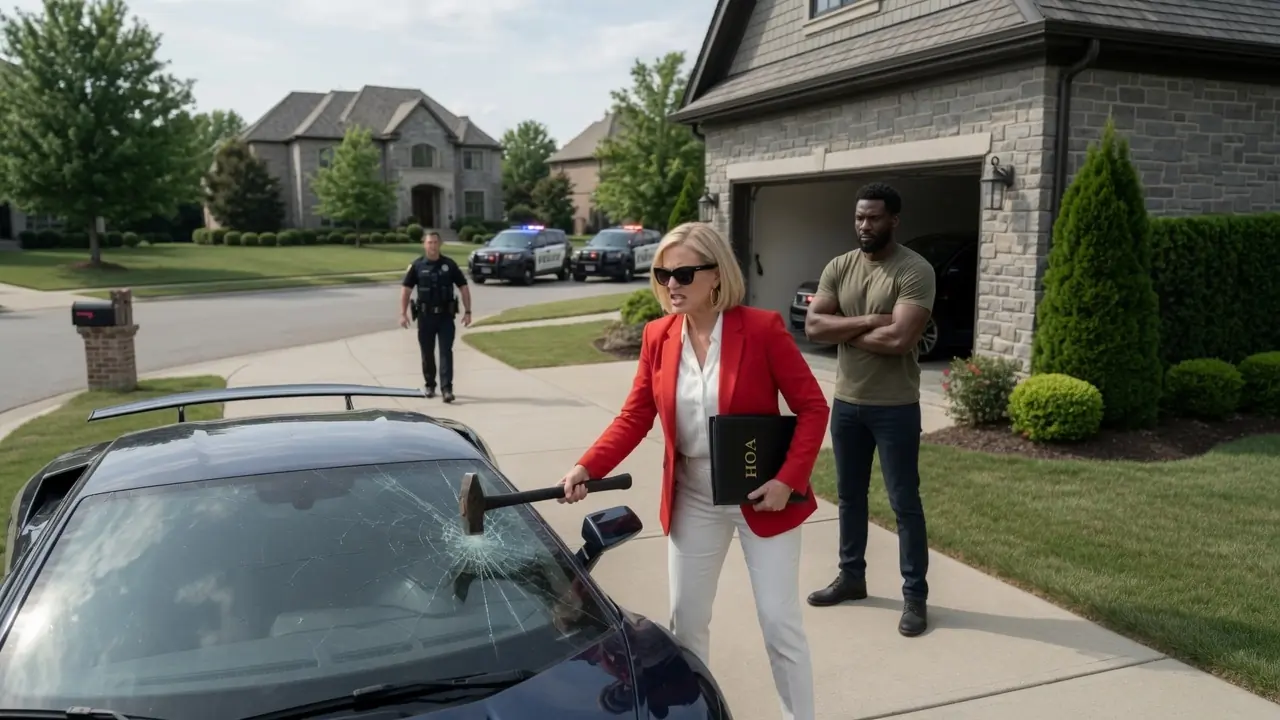
Karen lowered the hammer slightly. “You’re bluffing.”
Marcus remained beside the open garage, his expression calm despite the damage to the car. He was forty-four, tall and powerfully built, with deep brown skin, close-cropped black hair, and a neatly shaped beard. His fitted olive shirt was marked with dust from the shelves he had been assembling before Karen arrived.
“Twenty-four seconds,” he said.
Karen tightened both hands around the handle. “This vehicle violates community standards.”
“So you destroyed it?”
“It has been parked in public view for nine days.”
“It has been inside my driveway.”
“It attracts strangers. People have been stopping to photograph it.”
“Admiring a car is not an HOA violation.”
Karen pointed the hammer toward him. “You think buying one house gives you the right to turn Briarwood into a circus?”
Marcus glanced at his phone.
“Fourteen seconds.”
Karen stepped toward him. “End that call.”
“No.”
“I am ordering you as association president.”
“You are association president for another ten seconds.”
Her face changed.
For three years, Karen Whitmore had controlled Briarwood Estates through the confidence of a person who believed nobody would examine the difference between authority and intimidation. She issued violations without board approval, hired contractors through companies connected to her relatives, and treated every disagreement as evidence that the homeowner did not respect the neighborhood.
Most residents paid whatever she demanded.
Those who questioned her received more letters.
Marcus had received his first violation two days after moving into the modern brick house at the end of Hawthorne Court. The letter accused him of operating a commercial business from his garage because a delivery truck brought two tool cabinets and a vehicle lift.
He responded with the approved renovation permit.
Karen sent another letter claiming his exterior cameras violated community privacy.
He sent the section of the bylaws allowing security systems attached entirely to private property.
The third notice claimed his landscaping did not match the neighborhood’s “established character,” though the plants had been installed by the HOA’s recommended company.
Marcus recognized the pattern before she understood who she was targeting.
He was the founder and chief executive of Cole Mobility Technologies, a company that developed battery-management systems, vehicle-security software, and performance components for luxury manufacturers. He spent most of his career identifying systems designed to appear functional while hiding failures beneath them.
Karen Whitmore was another system.
The countdown on Marcus’s screen reached zero.
Elaine Brooks, the board’s vice president, appeared in the central window. She was a retired federal judge who had tolerated Karen longer than she cared to admit.
“The motion to remove Karen Whitmore as president of Briarwood Estates carries six votes to zero,” Elaine said. “The removal is effective immediately.”
Karen stared at the screen.
“You cannot vote without me.”
“The bylaws require the president to recuse herself when the motion concerns her own conduct,” Elaine replied.
“I was never notified.”
“Notice was delivered by certified mail, email, and personal service.”
“I received nothing.”
The association attorney lifted a document toward his camera. “You signed for the certified letter yesterday at 10:14 a.m.”
Karen’s mouth tightened. “I sign dozens of envelopes.”
Marcus lowered the phone slightly. “That has always been your defense.”
She looked at the destroyed windshield.
Until that moment, Karen had believed the Lamborghini represented her strongest accusation against Marcus. She told neighbors the car was probably rented, stolen, or purchased through money that could not have been honestly earned. She filed an emergency resolution declaring it a commercial promotional vehicle and ordered a towing company to remove it.
The board rejected the resolution.
Karen acted anyway.
That afternoon, she arrived carrying a violation folder and the sledgehammer she claimed was needed to “disable an unlawfully operated vehicle” until the tow truck came. Marcus had stepped outside when the first strike shattered the passenger side of the windshield.
He began streaming to the board before she raised the hammer again.
Now Karen dropped it.
The steel head struck the driveway with a dull crack.
Marcus looked at the phone. “You all saw her release the weapon.”
“We did,” Elaine said.
Karen moved toward the street. “This meeting is invalid, and that car is still in violation.”
Marcus stepped between her and the sidewalk without touching her. “You need to stay.”
“You do not control where I go.”
“No. The police do.”
The distant sound of sirens grew louder.
Karen turned back toward him. “You called the police on the HOA president?”
“I called them after you entered my property holding a sledgehammer.”
“I was enforcing the rules.”
“You committed felony property damage while the board watched.”
Her face hardened. “That car is not worth what you claim.”
Marcus looked toward the broken windshield. The Lamborghini was not an ordinary production model. It was one of three development vehicles used by Cole Mobility Technologies to test a new encrypted control architecture.
The exterior resembled a high-end road car, but the prototype equipment installed beneath the dashboard was valued at more than the vehicle itself.
Karen had struck directly above the sensor housing.
“You may want to save that argument for your attorney,” Marcus said.
Two police cruisers entered Hawthorne Court and stopped near the driveway. Officers approached cautiously after seeing the hammer on the ground and the broken vehicle beside it.
Karen immediately lifted both hands.
“Thank God you’re here,” she called. “This man has been threatening me.”
Marcus turned the phone so the officers could see the live meeting. “The entire incident is recorded from four cameras.”
Karen’s voice rose. “He edited the footage.”
“It is still live,” Elaine said from the phone.
Officer Nina Patel looked at the Lamborghini, the hammer, and Karen’s white sleeves marked with tiny fragments of safety glass.
“Who struck the vehicle?” she asked.
Karen pointed at Marcus. “He may have damaged it before I arrived.”
Marcus said nothing.
Officer Patel looked toward the camera mounted above the garage. A second camera faced the driveway from the porch, while the Lamborghini’s internal security system had transmitted footage to Cole Mobility’s encrypted servers the moment the first impact occurred.
“May we view the recordings?” Patel asked.
“Yes.”
Karen stepped toward her. “This is an HOA enforcement matter, not a criminal incident.”
Officer Patel looked at the destroyed windshield. “The HOA authorized you to use a sledgehammer?”
Karen’s answer came too slowly.
A second officer collected the hammer and placed it inside an evidence bag. Marcus provided the original video from the garage camera, beginning with Karen entering the property and ordering him to surrender the vehicle keys.
The recording captured every word.
It captured Karen claiming that someone “like him” could not legitimately own the car.
It captured the first strike.
It captured Marcus repeatedly telling her to stop.
It also captured something Marcus had not heard clearly while standing near the garage.
Before swinging the hammer, Karen had spoken into her phone.
“Start the towing claim now. Once the windshield is damaged, we can classify it as abandoned and unsafe.”
Officer Patel replayed the sentence.
“Who were you speaking to?” she asked.
Karen folded her arms. “The association’s towing contractor.”
Elaine answered from Marcus’s phone. “The board terminated that contractor last month.”
Karen looked toward the screen.
The towing company, Whitmore Recovery Services, was registered to Karen’s younger brother. For two years, the HOA paid it more than three hundred thousand dollars to remove vehicles from Briarwood.
Many of those vehicles had been legally parked.
Some were returned only after owners paid storage charges exceeding a thousand dollars. Others were sold at lien auctions conducted by another company sharing the same office address.
Marcus had discovered the connection six weeks earlier.
He had not been searching for it.
A retired teacher named Mrs. Lorraine Carter approached him after seeing Cole Mobility’s name on a delivery truck. Her grandson’s car had been towed from her driveway while he stayed overnight following her surgery. Karen claimed the guest permit was submitted twelve minutes late.
Whitmore Recovery charged Lorraine eighteen hundred dollars.
The car disappeared before she could raise the money.
Karen’s brother sold it at auction for nine thousand.
Lorraine showed Marcus every document.
The towing notice contained a digital approval signature belonging to Elaine Brooks. Elaine denied signing it. A forensic review revealed the signature had been copied from a routine landscaping contract.
Marcus asked other residents to examine their notices.
Within two weeks, twenty-three homeowners reported identical irregularities.
The same copied signatures appeared repeatedly.
Karen had also created a private “vehicle compliance fee” never approved by the board. The money flowed through the HOA account and into Whitmore Community Standards, a consulting company registered in her name.
Marcus organized the evidence and requested the emergency meeting.
Karen learned about it only after signing for the notification. She assumed the meeting concerned minor bookkeeping and decided a public confrontation would discredit Marcus before the board could hear him.
The Lamborghini gave her the opportunity.
She intended to film herself “protecting” Briarwood from an arrogant outsider who ignored community rules. Instead, the board watched her destroy private property and reveal her relationship with a terminated towing company.
Officer Patel finished reviewing the footage.
“Ms. Whitmore, turn around and place your hands behind your back.”
Karen laughed. “You cannot be serious.”
“Turn around.”
“I know the police chief.”
“He is not here.”
“I am a respected community leader.”
“You are being arrested for criminal property damage and trespassing.”
Karen looked toward Marcus. “You arranged this.”
“I told you to drop the hammer.”
“You wanted me to swing.”
“No. I expected you to.”
The distinction struck harder than anger.
Karen had spent years confusing predictability with strength. She believed residents feared her because she was powerful, when they had simply learned that she responded to resistance with escalation.
Marcus had not created her behavior.
He had preserved it.
The officers placed her in handcuffs. As they guided her toward the cruiser, neighbors emerged from houses along Hawthorne Court. Some recorded. Others watched silently.
Lorraine Carter stood near her mailbox.
Karen saw her and stopped. “You did this.”
Lorraine shook her head. “You stole my grandson’s car.”
“It was improperly registered.”
“He submitted the permit.”
“Twelve minutes late.”
“He submitted it before midnight.”
Karen turned toward the other residents. “You will regret letting this man take control of your community.”
Marcus remained beside the Lamborghini.
“I am not taking control.”
“That is what men like you always say before buying everything.”
Elaine’s voice came from the phone. “Marcus is not replacing you as president.”
Karen looked confused.
The board had already chosen to hold new elections under independent supervision. Marcus had refused nomination before the vote began.
He did not want Karen’s chair.
He wanted the records behind it.
The police cruiser carried her away.
The criminal property-damage case was only the beginning.
The following morning, investigators executed warrants at Karen’s home, the HOA office, and Whitmore Recovery Services. They seized computers, towing ledgers, title-transfer documents, and boxes of homeowner files.
The records revealed a larger operation than anyone expected.
Karen selected vehicles belonging to residents she considered unlikely to fight back: elderly homeowners, renters, young families, immigrants, and owners who had previously challenged HOA fines. Her brother towed the vehicles using fabricated authorizations.
If the owners paid immediately, the company collected inflated fees.
If they could not, the vehicles entered accelerated lien sales through falsified dates.
Karen’s companies shared the profits.
The Lamborghini had been different.
Karen could not secretly tow a rare vehicle with visible cameras and an owner standing nearby. She planned to damage it, label it unsafe, and use the destruction as justification for immediate removal.
Her brother had already prepared the paperwork before she entered Marcus’s driveway.
The documents listed the Lamborghini’s estimated value as forty-five thousand dollars.
It was insured for nearly two million, including prototype equipment.
Investigators found an unsigned sale agreement offering the vehicle to an overseas buyer for six hundred thousand dollars once it cleared the towing auction.
Karen had expected Marcus to lose the car before he understood what happened.
Instead, she had created the evidence that exposed every vehicle taken before it.
The board held a public meeting three days later.
The Briarwood clubhouse could not hold everyone, so residents gathered in the community park while the proceedings were projected onto a large screen. An outside accounting firm presented the first audit.
More than nine hundred thousand dollars had moved from association accounts into businesses connected to Karen and her brother.
Some payments were disguised as security costs.
Others appeared as legal reviews that no lawyer performed.
Karen also collected fines through a private portal that deposited money directly into her consulting company before sending a smaller portion to the HOA.
Marcus sat beside Lorraine in the second row.
Elaine opened the floor for testimony.
A Latino contractor named Javier Mendoza described how his work van was towed from his driveway four times despite a permanent permit. Karen told him commercial vehicles made Briarwood “look cheap.”
A Black nurse named Denise Palmer received seventeen noise violations while working overnight shifts and sleeping during the day. The complaints were filed when her house was empty.
An elderly widower lost his late wife’s car after Karen claimed it had not moved for thirty days. His doorbell camera showed him driving it twice during that period.
Every story shared the same structure.
Karen created a violation.
Her brother collected the vehicle.
The HOA supplied legitimacy.
The victim carried the burden of disproving paperwork produced by the people profiting from it.
Marcus was asked to speak.
He walked to the microphone without a prepared statement.
“Karen did not choose my car because it violated a rule,” he said. “She chose it because destroying something valuable in front of me made her feel more powerful than verifying who owned it.”
The screen behind him displayed a still image from the driveway recording. Karen stood with the hammer raised while Marcus held the phone.
“She believed the board would trust her title before reviewing my evidence. She believed the police would trust her accusation before viewing the video. And she believed this neighborhood would judge whether I deserved the car before asking whether she had the right to touch it.”
Residents remained silent.
Marcus looked toward Lorraine.
“The Lamborghini brought attention because it was expensive. But the system mattered long before she struck it. Mrs. Carter’s grandson’s car deserved the same protection. So did every work van, family sedan, and old vehicle someone could not afford to replace.”
The board approved sweeping reforms.
No vehicle could be towed without photographic evidence, written notice, a waiting period, and approval from two independent directors. Emergency towing required a documented safety hazard confirmed by someone with no financial connection to the contractor.
The HOA terminated every vendor tied to a board member or officer.
Financial records became visible to all homeowners through a secure portal. Residents could appeal fines to an outside reviewer rather than the same president who issued them.
Most importantly, Briarwood established a restitution fund using recovered money and insurance proceeds.
Lorraine’s grandson received compensation for the full value of his car.
Javier recovered every improper towing charge.
The widower received enough to purchase another vehicle matching his late wife’s model.
Marcus’s Lamborghini was transported to Cole Mobility’s research facility. Engineers replaced the windshield, repaired the damaged sensor housing, and confirmed that the prototype data remained intact.
The insurance company offered to repaint the hood.
Marcus refused.
One shallow dent remained near the passenger-side wiper, where the hammer struck after breaking through the glass.
He chose to preserve it beneath clear coating.
“You want to keep the damage?” his chief engineer asked.
“I want to keep the evidence.”
Karen and her brother were eventually charged with fraud, forgery, conspiracy, unlawful vehicle conversion, and theft. The property-damage charge involving the Lamborghini carried serious penalties because of the prototype equipment she knowingly continued striking after being warned.
Her attorney argued that she believed the car was worth far less.
The prosecutor answered that someone’s ignorance of value did not create permission to destroy it.
Karen accepted a plea agreement only after her brother agreed to testify against her. She lost her home, her consulting company, and every position of authority connected to community management.
During sentencing, she asked to speak.
She described herself as a woman who cared too much about standards and admitted that her methods sometimes became overly aggressive. She claimed Marcus used his wealth and technology to turn one emotional mistake into public destruction.
The judge reviewed the driveway footage.
“One emotional mistake does not generate years of forged notices,” she said. “One mistake does not create shell companies, falsified lien sales, and a prepared contract to sell a vehicle you had not yet seized.”
Karen lowered her eyes.
“You did not lose power because Mr. Cole was wealthy,” the judge continued. “You lost it because you used authority to convert your neighbors’ property into personal profit.”
She received a prison sentence, restitution order, and permanent prohibition from holding fiduciary authority over a homeowners’ association.
One year later, Briarwood held its annual neighborhood gathering in the park.
Lorraine had been elected board president after resisting the nomination for weeks. Her first official action was reducing the president’s unilateral authority.
Marcus remained an ordinary board-free homeowner.
He attended meetings, asked questions, and voted like everyone else.
The repaired Lamborghini appeared at the gathering as part of a youth engineering display. Children examined its battery system, security architecture, and sensors while Cole Mobility employees explained how modern vehicles protected ownership data.
A teenager pointed toward the dent beneath the windshield.
“Couldn’t your company fix that?”
Marcus smiled. “They could.”
“Then why leave it?”
“Because not every scar means something stayed broken.”
Later that afternoon, he drove the Lamborghini back to Hawthorne Court. Neighbors waved as he passed, not because the car made him important, but because they knew the man behind the wheel had refused to replace one form of unchecked control with another.
He parked in the driveway and opened the garage.
For a moment, he stood where Karen had raised the hammer.
Her first question had never truly concerned the vehicle.
She asked whether someone like him deserved a car like that because she believed value belonged only where people like her expected to see it. She believed wealth, ownership, and belonging required her approval.
Marcus had answered with four words.
“Karen, drop the hammer.”
She refused.
The hammer broke the glass.
The recording broke everything she had built behind it.