“I'LL DESTROY YOUR DAMN CAR!”
The metal bat struck the white Rolls-Royce Cullinan with a crack sharp enough to send two birds exploding out of the magnolia tree above the circular driveway. Glass spilled from the driver’s window onto pale stone. Barbara Whitmore drew the bat back, breathing hard, her neon-pink-and-purple floral blouse flashing in the Georgia afternoon sun, and struck again at the side mirror. The mirror collapsed against its housing. Splinters of plastic scattered near her jeweled sandals.
“Drop that bat! Right now!” a man shouted.
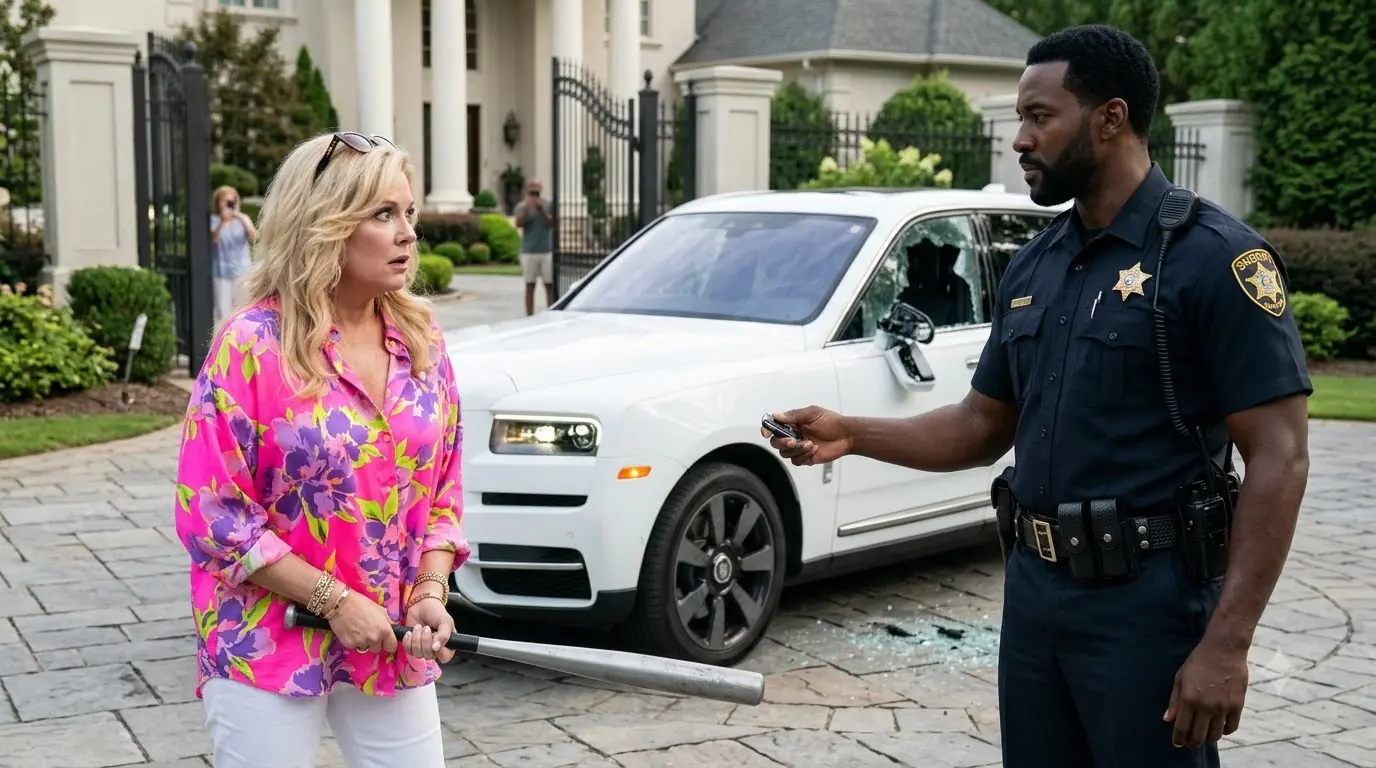
Barbara turned with the weapon still clutched in both hands. A tall Black man in a dark navy sheriff’s uniform was hurrying toward her from the garden path. His face was controlled, but the warning in his voice was unmistakable. Barbara recognized the uniform; she did not recognize the man as somebody she had ever permitted to tell her what to do.
“This is HOA property!” she snarled, pointing the bat toward him as though it were a scepter. “You have no idea who you're dealing with.”
The sheriff stopped at a safe distance. His eyes flickered to the shattered window, the broken mirror, and the trembling hands wrapped around the bat. Then he reached slowly toward his trouser pocket.
What he brought out was neither a citation book nor a pair of handcuffs. It was a black Rolls-Royce key fob. One press made the damaged Cullinan blink its headlights and give a soft, unmistakable chirp.
Barbara’s expression emptied. She looked from the key to the vehicle and back again. The bat slipped lower in her hands. Somewhere behind the iron gates, a phone kept recording.
Just twenty minutes earlier, Barbara had been certain she was about to teach an arrogant homeowner the most expensive lesson of his life.
That certainty had been building for nearly three years.
The estate stood at the end of a curved private approach in one of the wealthiest residential communities outside Atlanta. Tall iron gates framed a stone driveway that circled a fountain, and clipped hedges separated the lawn from gardens full of hydrangeas and pale roses. The house itself had wide windows, white columns, and a broad covered porch overlooking the trees. Every season brought another crew to maintain the gardens, polish the stone, and replace whatever Georgia weather had worn down.
For Barbara Whitmore, the estate had become an insult she could see from the community's main lane.
She was fifty-six, blonde, formidable, and president of the neighborhood homeowners association. She had won that position by doing the work other residents found exhausting: reading declarations, running meetings, enforcing architectural rules, and calling contractors until neglected common areas were repaired. For years, people thanked her. They liked the clean entrance signs and the tidy flower beds. They liked knowing someone was keeping records when a board member wanted to spend money without approval.
Then she began mistaking gratitude for obedience.
A homeowner who asked for the relevant rule was branded difficult. A resident who challenged a fine was said to be undermining the entire community. Barbara kept thick binders and spoke of them the way other people spoke of scripture, except she sometimes quoted passages that did not say what she claimed. Nobody wanted another three-hour argument in the clubhouse, so most people paid small disputed fees and moved on.
The owner of the estate at the end of the lane had not moved on.