Marcus Bennett saw the hammer come down through the glass before he heard the impact.
He had been standing inside the living room of his Plano, Texas home with a mug of coffee in one hand and his phone in the other when movement near the rear patio caught his attention. Outside, balanced on a blue step ladder beneath the roofline, Linda Crawford raised a black claw hammer over her shoulder and drove it directly into the security camera mounted beside his sliding glass door. Plastic cracked, the camera housing twisted sideways, and several pieces scattered across the concrete below her feet.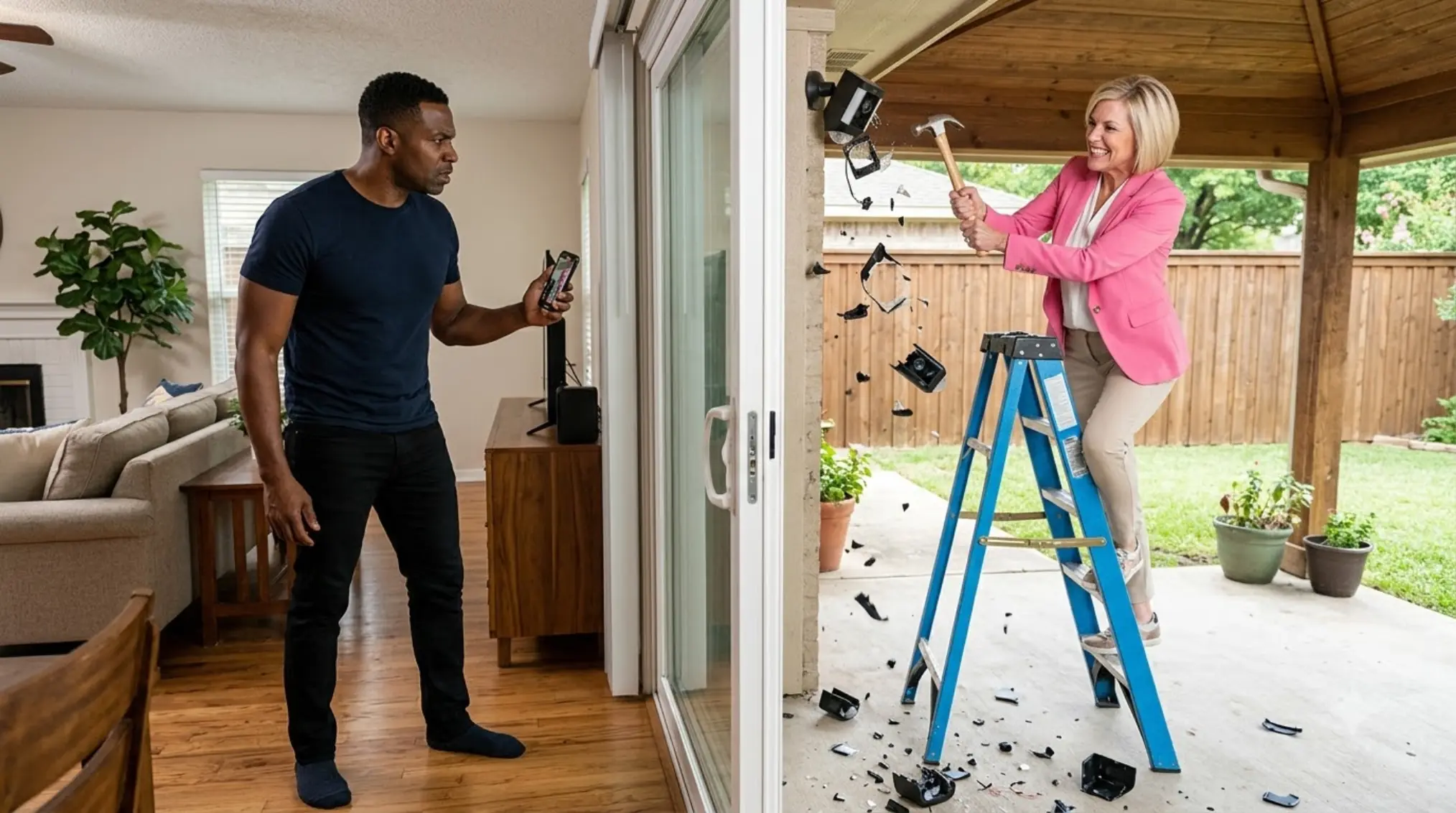
Marcus did not immediately move.
For two seconds, he simply stared through the glass.
Linda was the fifty-five-year-old president of the Brookstone Meadows Homeowners Association. Her blonde bob was perfectly styled despite the Texas heat, and she wore a fitted pink blazer over a white blouse, pale trousers, and expensive flats as if she had stepped out of a board meeting instead of climbing onto someone else’s ladder to destroy private property.
Then she swung again.
The camera snapped almost completely free from its mounting plate.
Marcus set his coffee down.
He pressed record on his phone.
Outside, Linda grabbed the broken camera with one hand and twisted it until the final cable tore loose.
“Keep hiding in there,” she shouted toward the glass. “This camera dies before anyone sees what I did.”
Marcus slid the door open.
The sound made Linda freeze.
“You just broke into the wrong lie, Linda,” he said. “That camera already backed up every second.”
Her face changed.
Only briefly.
Then anger covered the fear.
Linda climbed down one step, still gripping the hammer.
“You’ve been illegally recording HOA property.”
Marcus stepped onto the patio.
“This is my backyard.”
“You point that camera toward the common fence.”
“The common fence is fifty feet away.”
“It records people walking behind your house.”
“It records my patio, my gate, and anyone trespassing onto my property.”
Linda’s jaw tightened.
“Turn the other cameras off.”
“No.”
She raised the hammer slightly.
“Say my name to the police and I’ll bury you in fines until this house owns you.”
Marcus lifted his phone higher.
“Good. Say that again while you’re standing on my ladder with my camera in your hand.”
Linda finally looked at the phone.
The recording light was visible.
For the first time, she lowered the hammer.
The dispute had begun four months earlier with something so small Marcus almost ignored it.
A white envelope appeared beneath his front door.
Inside was an HOA violation notice.
UNAUTHORIZED EXTERIOR SURVEILLANCE DEVICE.
Fine: $250.
Marcus read it twice.
The camera listed in the violation was not visible from the street. It was mounted beneath the rear patio roof and pointed toward the side gate, where someone had begun entering his property while he was at work.
The trespassing started after Marcus replaced part of his backyard fence.
He had lived in Brookstone Meadows for seven years. At forty-two, he worked as a cybersecurity engineer for a Dallas health technology company and had deliberately chosen a quiet subdivision because he spent most weekdays staring at monitors and solving problems nobody else wanted to understand.
His house was not enormous.
Three bedrooms.
Two stories.
A small backyard.
A covered patio.
A workshop converted from half the garage.
After years of apartment living, it felt perfect.
Then Linda Crawford became HOA president.
She treated Brookstone Meadows as though every lawn, driveway, mailbox, hedge, fence, patio chair, and garbage bin existed under her personal supervision.
At first Marcus found her annoying rather than dangerous.
She issued warnings over grass being half an inch too tall.
She photographed vehicles parked in driveways.
She once sent a violation to an elderly couple because their Christmas wreath remained on the door until January 8.
People complained.
Nothing changed.
Linda won elections because turnout was low and most residents did not care enough to attend meetings.
Then the HOA announced a landscaping project behind Marcus’s property.
The association wanted to widen the maintenance path running behind six houses so contractors could bring larger equipment through.
The existing path was narrow but functional.
The expansion required several homeowners to surrender strips of backyard space.
Marcus declined.
His rear fence stood exactly on the surveyed line.
Linda did not like the answer.
“This benefits the community.”
“I understand.”
“Then why won’t you cooperate?”
“Because you’re asking me to give away part of my land.”
“Four feet.”
“It’s still mine.”
Linda crossed her arms.
“You barely use that section.”
Marcus looked at her.
“That isn’t how ownership works.”
The conversation ended badly.
Two weeks later, Marcus noticed his side gate standing open when he returned from work.
He always locked it.
Nothing appeared stolen.
The next week it happened again.
Then he found orange spray paint beside the rear fence.
Someone had marked a line approximately four feet inside his yard.
Marcus photographed it.
He emailed the HOA.
Linda replied that contractors were “evaluating future maintenance access.”
Marcus told her nobody had permission to enter.
She sent him a violation for “obstructing association infrastructure.”
That was when he installed the camera.
The first recording came three days later.
At 11:43 a.m., Linda entered through Marcus’s side gate with a contractor.
The contractor carried a measuring wheel.
Linda pointed toward the fence.
They measured several distances.
Then Linda walked across Marcus’s patio and peered through the sliding glass door.
Marcus watched the footage that night.
He was furious.
He saved a copy.
Then he emailed Linda.
Do not enter my property again without written permission.
Her response arrived eighteen minutes later.
The HOA has inspection authority where community infrastructure may be affected.
Marcus forwarded the exchange to attorney Rachel Kim.
Rachel handled commercial technology contracts but had represented Marcus during the purchase of the house and knew enough property law to recognize trouble.
“Does the HOA have an easement?”
“Not through the yard.”
“Do your covenants authorize physical entry for inspections?”
“Only for emergencies or required repairs.”
“Was there an emergency?”
“No.”
Rachel sighed.
“Then document everything.”
Marcus did.
He installed a second camera beneath the garage eave.
Then a video doorbell.
Then a small camera inside the workshop window covering the backyard indirectly.
Linda noticed the cameras.
She became obsessed with them.
At the next HOA meeting, she held up photographs.
“This resident is building a surveillance network targeting his neighbors.”
Marcus raised his hand.
“My cameras record my property.”
Linda ignored him.
A board member asked, “Do they record audio?”