HOA President (pointing at him, snarling): “Pay now—or your son watches me throw you into the street.”
Black Man (coldly, holding up the envelopes): “You stole my mail to create those fines.”
HOA President (clutching her binder): “I control this neighborhood—you’ll never prove it.”
Black Man (raising his phone): “Then explain the footage to the federal agents behind you.”
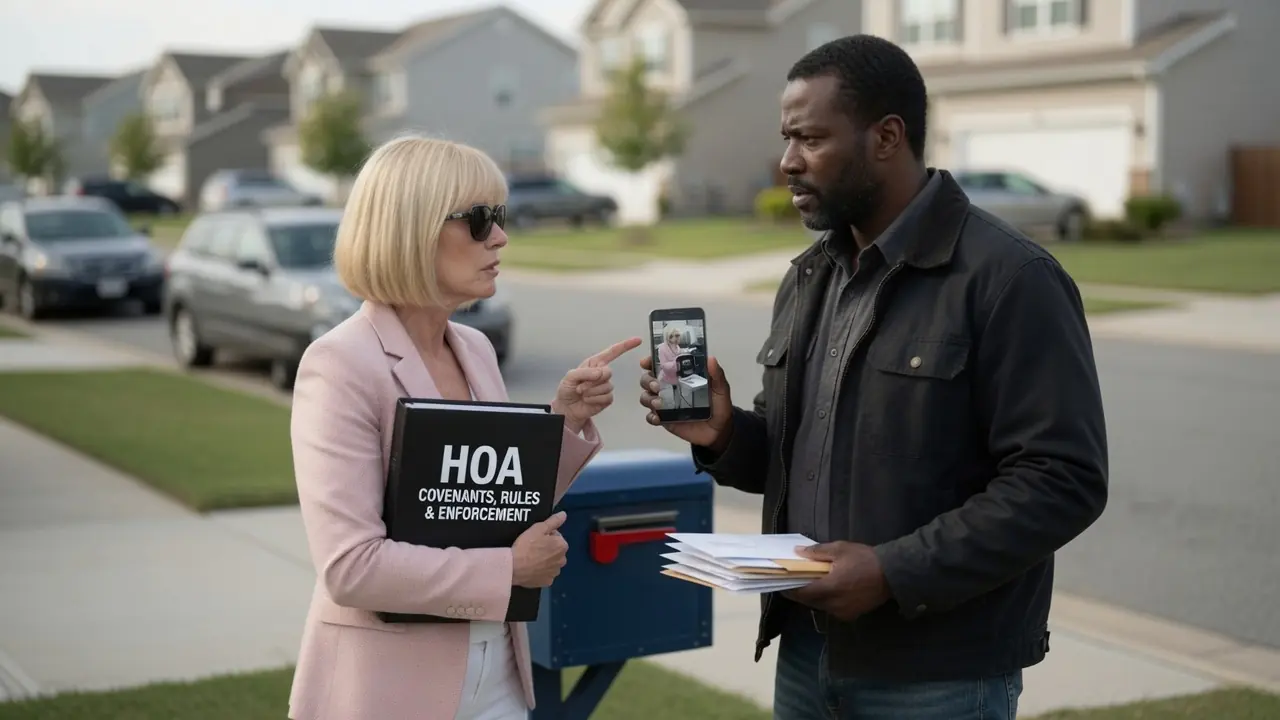
For the first time since Marcus Delroy had moved into Cedar Grove Estates, Constance Hale stopped talking. Her pointing finger remained suspended inches from his face, but the arrogance behind her oversized sunglasses suddenly disappeared. Two dark government vehicles had pulled alongside the neighborhood mailbox cluster, and three people in plain clothes were walking toward them with identification badges clipped to their jackets.
Marcus did not smile. He simply lowered his phone, stepped away from Constance, and watched her tighten both arms around the thick black binder pressed against her pink blazer. The binder contained the foreclosure notice she had intended to force him to sign, but Marcus suspected it held far more than that.
Behind them, his seventeen-year-old son Noah stood beside the driveway with his school backpack hanging from one shoulder. Noah had watched Constance target his father for six months, yet this was the first time he had seen her look frightened. He started walking toward Marcus, but Marcus lifted one hand, silently telling him to remain where he was.
The woman leading the approaching group introduced herself as Postal Inspector Elaine Foster. Her voice was calm, controlled, and professional, but Constance immediately began speaking over her. She claimed Marcus had become aggressive, that he had threatened the HOA president, and that she had been attempting to serve a lawful foreclosure notice.
Inspector Foster glanced toward Marcus’s phone. “Mr. Delroy has already provided us with the relevant recording,” she said. “We are here concerning suspected theft and obstruction of United States mail.”
Constance’s mouth tightened. “This is private HOA business. The mailbox area is association property.”
“The ground may belong to the association,” Foster replied. “The mail inside those boxes does not.”
Six months earlier, Marcus had believed Cedar Grove Estates would be a fresh beginning. His wife, Danielle, had died after a sudden illness two years before, leaving Marcus to raise Noah while keeping his electrical contracting company alive. Their old house carried too many memories of hospital calls, medication schedules, and nights spent pretending neither of them could hear the other crying.
Cedar Grove looked peaceful when they first toured it. The streets were lined with mature trees, the lawns were carefully maintained, and the houses were close enough for neighbors to wave without feeling crowded. Marcus bought a modest gray home near the end of Hawthorne Lane, believing the quiet neighborhood might give Noah room to recover.
Constance Hale introduced herself before the moving truck had finished unloading. She arrived wearing white pants, a pale pink blazer, pearl earrings, and oversized sunglasses despite the cloudy afternoon. She handed Marcus a welcome folder and explained that she had served as HOA president for nine years.
“We protect standards here,” she said while watching two movers carry Marcus’s tools into the garage. “Cedar Grove is not the sort of neighborhood where people run noisy businesses from their driveways.”
Marcus explained that he owned a licensed electrical contracting company and kept his equipment inside the garage. His work van had no permanent advertising because he used removable magnetic signs during business hours. Constance smiled without warmth and told him she was merely making expectations clear.
The first violation notice arrived eleven days later. It accused Marcus of leaving commercial equipment visible from the street, though the only item outside had been a folded ladder leaning against the garage for twenty minutes. He moved it immediately and sent photographs showing the cleared driveway.
A second notice appeared the following week, claiming his grass exceeded the permitted height. Marcus measured it at two and three-quarter inches, well below the HOA’s four-inch limit. When he emailed Constance, she replied that visual standards were determined at the board’s discretion.
The fines were small at first—twenty-five dollars, then fifty, then seventy-five. Marcus paid the first one because he did not have time to fight over a ladder. Paying it became his first mistake, because Constance treated payment as proof that he could be pressured.
Noah noticed the pattern before Marcus admitted it existed. White work trucks sat openly on other driveways, landscaping trailers remained parked on sidewalks, and one board member stored a fishing boat beside his garage throughout the summer. None of those homes received notices.
“She’s not enforcing rules,” Noah said one evening. “She’s choosing people.”
Marcus told his son not to assume motives they could not prove. He had spent twenty years as an electrician learning that suspicion was not evidence. A damaged wire could look harmless, and a harmless wire could look burned; the only way to know was to test the system.
The mail problems began in early spring. A supplier called asking why Marcus had ignored three overdue invoices, even though he had never received them. A client claimed she had mailed a signed contract and deposit check worth eighteen thousand dollars, but neither arrived.
Marcus contacted the post office and learned that several envelopes addressed to him had been scanned as delivered. He checked his mailbox lock, spoke with his carrier, and asked Noah whether he had accidentally brought the mail inside. Nothing explained the disappearances.
Then a certified letter from Cedar Grove’s management company appeared on his kitchen counter already opened. Noah had found it sticking halfway out of the mailbox. The notice stated that Marcus had failed to respond to prior collection letters and now owed more than four thousand dollars in accumulated fines, late fees, administrative charges, and legal costs.
Marcus had never seen the earlier letters. More disturbing, the document warned that failure to pay within thirty days could result in a lien against his property. Constance had transformed a handful of disputed violations into a threat against his home.
That evening, Marcus purchased two security cameras. One faced the mailbox cluster from his second-floor window, while the other was hidden inside a decorative light fixture near the edge of his property. He checked local laws, adjusted the angle to record only the public mailbox area, and began saving every clip.
For four days, nothing happened. Neighbors collected envelopes, delivery vehicles passed, and children rode bicycles along the sidewalk. On the fifth morning, Constance arrived shortly after the postal carrier left.
She wore the pink blazer Marcus had come to recognize, with the same oversized sunglasses and thick black binder under one arm. She opened her own mailbox, looked in both directions, and then used a small silver key to open the maintenance panel behind the cluster.
Marcus watched from his front window as she reached into the compartment feeding his box. She removed four envelopes, placed them inside her binder, closed the panel, and walked calmly toward her SUV. She moved with the confidence of someone who had done it many times.
Marcus did not confront her. He backed up the footage to three locations, photographed the empty mailbox, and called the United States Postal Inspection Service. The investigator who took his report asked him not to reveal that a federal complaint had been filed.
Over the next month, Marcus documented Constance removing his mail six more times. She took invoices, insurance correspondence, certified letters, and one envelope from the county auditor’s office. On two occasions, she opened the envelopes beside her vehicle before placing them inside her binder.
The postal inspectors asked Marcus to continue behaving normally while they investigated. They interviewed his carrier, reviewed delivery scans, and quietly contacted other residents. Marcus learned that he was not the only person whose mail had vanished.
Mrs. Evelyn Porter, a seventy-eight-year-old widow three houses away, had missed a property-tax notice and paid a penalty. A young couple had never received the approval letter for a home-equity loan. Another homeowner lost access to medical coverage after renewal documents disappeared.
Every victim had challenged Constance at least once. Evelyn had questioned landscaping expenses, the young couple had appealed a fence denial, and the homeowner with the insurance problem had requested the HOA’s financial records. The missing mail was not random.
Marcus began examining the fines against him. The dates on several notices did not match the dates listed in the HOA portal, and photographs attached as evidence had been taken weeks before the alleged violations. One image showing his work van was cropped so tightly that the magnetic business sign appeared permanent.
He requested Cedar Grove’s complete enforcement records under state law. The management company delayed, claimed his request was too broad, and demanded an unnecessary processing fee. Marcus responded through certified mail, citing the relevant statute and requesting written justification for any denial.
The records arrived eighteen days later. Marcus spent an entire weekend comparing violation reports, payment histories, meeting minutes, and property liens. Noah sat beside him with a laptop, building a spreadsheet as Marcus read out names and dates.
They discovered that Constance had targeted nine homeowners during the previous three years. Each received escalating fines for minor or fabricated violations, followed by legal fees that sometimes exceeded the original penalties by thousands of dollars. Four had sold their homes shortly after liens were filed.
A company called Hale Community Recovery had purchased two of those properties below market value. Its registered agent was Constance’s younger brother, Wesley Hale. The company renovated the houses and resold them for substantial profits.
Marcus stared at the registration page for a long time. The scheme was larger than stolen envelopes. Constance was using her HOA authority to isolate selected homeowners, interfere with their correspondence, manufacture financial pressure, and push them toward desperate sales.
The county auditor’s envelope she had taken from Marcus contained something she especially feared. Marcus requested a duplicate and discovered it confirmed that the HOA’s foreclosure-related lien documents contained an incorrect parcel description. The error could have delayed or invalidated legal action against his house.
By stealing that letter, Constance had prevented Marcus from learning about the defect. She intended to pressure him into signing a voluntary payment and property agreement before he could challenge the lien. The foreclosure notice in her binder was not merely a threat; it was an attempt to repair her flawed case using his signature.
Marcus gave everything to Inspector Foster and retained an attorney named Rachel Kim, who specialized in property and association law. Rachel warned him that federal investigators would focus on mail crimes, while the financial and foreclosure scheme might require separate civil and state investigations.
“Do not give her the reaction she wants,” Rachel said. “People like this rely on anger. Anger makes victims look unstable while the person holding the paperwork appears reasonable.”
Marcus understood. He stopped arguing with Constance, answered every notice in writing, and kept copies of every envelope. His silence unsettled her more than confrontation would have.
Constance escalated. She accused Marcus of operating an unauthorized commercial enterprise, claimed his work van created a safety hazard, and announced an emergency board hearing regarding his “repeated hostility toward community leadership.” The hearing was scheduled for a weekday morning when she knew Marcus had a major job.
He postponed the job and attended. Constance sat at the front of the clubhouse in her pink blazer and sunglasses, though the meeting was indoors. She presented photographs, violation logs, and selected email excerpts while describing Marcus as uncooperative.
Marcus waited until she finished. Then he placed copies of the full email chains on the table, including messages she had omitted. Two board members began asking why the evidence packets had been edited.
Constance ended the discussion by declaring that the board had already authorized foreclosure proceedings. Marcus asked to see the recorded vote. She claimed the minutes had not yet been finalized.
Noah, who had been waiting outside, saw three board members leave the clubhouse visibly disturbed. One of them contacted Marcus that evening and admitted there had been no foreclosure vote. Constance had told the management company that approval was unanimous without presenting the motion to the board.
That board member provided emails showing Constance had instructed staff to create retroactive minutes. Marcus sent them to Rachel, who forwarded them to investigators handling the suspected property scheme. What had begun with missing mail now involved falsified association records and possible conspiracy.
The pressure affected Noah more than he admitted. One night, Marcus found him packing valuable electronics into a box. Noah said they should sell anything unnecessary before Constance took the house.
Marcus sat on the bedroom floor beside him. He explained that the foreclosure was not complete, the lien was being challenged, and nobody would remove them without a legal process they were prepared to fight. Still, he could see that Constance’s threats had entered his son’s mind.
“This was supposed to be our safe place,” Noah whispered.
“It still is,” Marcus said. “A safe place isn’t one where nobody attacks you. It’s one where you know you don’t have to face the attack alone.”
Three days later, Constance delivered the final notice personally. She chose late afternoon, when Noah would be home from school and neighbors would be returning from work. Marcus believed she wanted witnesses to his humiliation.
She stood before the mailbox cluster with her black binder, pink blazer, white pants, pearls, and dark sunglasses. The foreclosure notice rested on top of a stack of papers, with a signature line marked by a red tab.
Constance demanded immediate payment of twenty-three thousand dollars. The amount included invented legal fees, emergency assessments, collection costs, and penalties that had never been approved by the board. She offered to suspend foreclosure if Marcus signed an agreement surrendering his right to challenge the debt.
Marcus asked why she had brought the document to the mailbox instead of sending it through his attorney. Constance smiled and said she wanted to give him one last opportunity to protect Noah from the consequences of his stubbornness.
That was when Marcus saw Inspector Foster’s vehicles turn onto Hawthorne Lane. The inspectors had scheduled their arrival after reviewing the latest camera footage, but Constance had unknowingly chosen the exact moment for her confrontation.
Marcus lifted the opened envelopes he had recovered from a trash container near the clubhouse. Constance had discarded them after photographing their contents. Her fingerprints, handwritten notes, and binder labels connected the stolen mail directly to the foreclosure campaign.
“Pay now—or your son watches me throw you into the street,” she snarled.
“You stole my mail to create those fines,” Marcus replied.
“I control this neighborhood—you’ll never prove it.”
Marcus raised his phone. “Then explain the footage to the federal agents behind you.”
Inspector Foster asked Constance to step away from the mailbox and place the binder on the ground. Constance refused, claiming it contained confidential HOA records. Another inspector informed her that they had a federal search warrant covering materials associated with intercepted correspondence.
Her grip tightened. She attempted to remove several papers, but Foster stopped her and repeated the instruction. With neighbors beginning to gather along the sidewalk, Constance finally lowered the binder.
Inside were copies of Marcus’s invoices, insurance letters, county correspondence, and certified notices. There were also envelopes addressed to Evelyn Porter and four other residents. Several had handwritten notes identifying financial vulnerabilities, mortgage balances, family circumstances, and estimated pressure points.
One page beside Marcus’s name read: “Widower. Single income. Business dependent on mailed contracts. Increase enforcement until sale becomes practical.” Noah saw the sentence over an inspector’s shoulder and turned pale.
Marcus placed a hand on his son’s back. Constance had reduced their grief, livelihood, and home to entries in a strategy document. Her mistake was preserving those calculations in the binder she carried everywhere.
The inspectors did not arrest her immediately. They secured the evidence, served additional warrants, and escorted her to her house while another team searched her HOA office. Constance continued insisting that all documents were association property.
Within forty-eight hours, the Cedar Grove board placed her on emergency suspension. The management company froze enforcement actions authorized under her presidency, including the lien against Marcus’s house. An independent attorney was appointed to review every foreclosure, fine, and property sale connected to Constance.
The investigation uncovered payments from the HOA reserve fund to consulting companies linked to Wesley Hale. Constance had used association money to pay legal and administrative costs associated with pressuring residents. When homeowners sold, her brother’s company received advance information and submitted rapid offers.
The stolen mail allowed Constance to learn which residents were financially vulnerable. Bank notices revealed late payments, medical letters revealed family crises, and business correspondence showed when income might be interrupted. She had turned private information into a targeting system.
Federal prosecutors charged Constance with multiple mail-related offenses, obstruction of correspondence, and conspiracy. State authorities added charges connected to fraudulent records and misappropriated association funds. Wesley was charged separately for his role in the property purchases.
The civil court invalidated the lien against Marcus’s home. Every fine created under Constance’s manipulated enforcement process was removed, and the HOA reimbursed his legal costs. The client whose deposit check had disappeared agreed to rehire Marcus for a different project after learning what had happened.
Not every loss could be restored. Marcus had missed contracts, damaged relationships with suppliers, and spent months believing his home might be taken. Evelyn could not recover the weeks of fear she endured after missing her tax notice.
Still, the neighborhood began repairing more than financial records. Residents replaced the entire HOA board, hired an independent management firm, and required that enforcement decisions be reviewed by at least three people. No officer could access mailbox maintenance panels without postal authorization and documented supervision.
Noah helped design a transparent online system where homeowners could see meeting votes, budgets, contracts, and violation appeals. The project became part of his application to study civil engineering and public policy. He said systems failed when too much power passed through one hidden connection.
Months later, Marcus and Noah stood beside the mailbox cluster while workers installed improved lighting and security equipment. The pink-blazered woman who once controlled the sidewalk was gone, and the thick black binder rested in a federal evidence room.
Evelyn Porter approached carrying a plate covered with foil. She handed Marcus a stack of homemade cornbread and told him the new board had approved his proposal for an emergency legal fund for elderly homeowners. Marcus reminded her that the proposal had belonged to the entire neighborhood.
“No,” Evelyn said. “The idea belonged to all of us. But you were the one who made us stop being afraid to say it.”
Marcus looked toward Noah, who was helping an older resident reset the lock on her mailbox. Their home had not become safe because Constance disappeared. It became safe because the people she had isolated finally compared records, shared evidence, and stood together.
Constance had believed her binder contained everyone’s weaknesses. In the end, it contained the proof that destroyed her control.
And the mailbox she had used to steal their futures became the place where Cedar Grove learned how to protect them.