“Touch that valve, and I’ll bury your worthless farm in lawsuits,” Vanessa Thorne snapped, shoving a thick HOA folder against Dale Harmon’s chest.
Dale knocked the folder aside without taking his other hand from the metal well valve. Behind him stretched more than a thousand acres of pasture, timber, and rolling Missouri farmland. Beneath his boots, a thick black pipe carried water under the fence toward the forty-seven expensive homes of Maplewood Estates.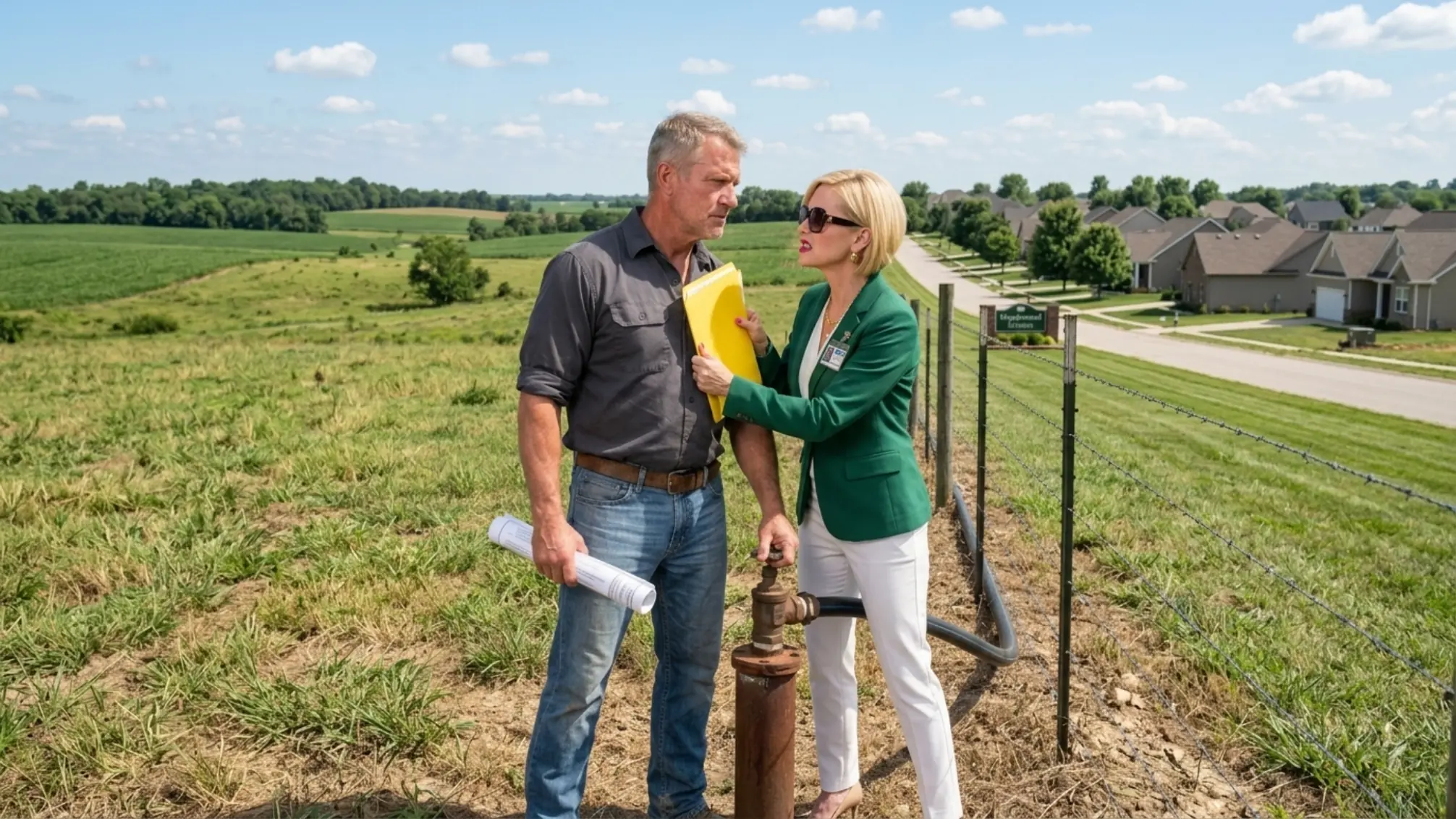
“Your HOA has been stealing my water for eleven years,” Dale said.
Vanessa stepped close enough that the tips of her beige heels touched the red boundary marker beside the wellhead. Her emerald-green blazer was perfectly tailored, her blonde bob remained untouched by the wind, and the silver HOA badge on her lapel reflected the afternoon sun. “Forty-seven families need it, so shut your mouth and keep it flowing.”
Dale tightened his hand around the valve.
“Threaten me again,” he said, “and they’ll learn you built their homes on stolen water.”
Vanessa stared at him as though no landowner had ever spoken to her that way. For seven years, she had served as president of Maplewood Estates, and during that time she had transformed a homeowners association into something resembling a private government. Contractors answered her calls immediately, residents feared her violation letters, and board members rarely questioned decisions she described as emergencies.
Dale had owned the neighboring farm for only three months.
She assumed that made him easier to intimidate.
Dale Harmon was fifty-four, recently retired, and more comfortable reading drainage maps than arguing with strangers. He had spent twenty-three years as a civil engineer specializing in land grading, water systems, erosion control, and rural infrastructure. When he left the profession, he wanted land he could manage without committees, shared fences, or neighborhood rules.
The property contained 1,012 acres in a quiet rural county. One hundred sixty acres could be farmed, two natural springs fed a seasonal creek, and oak-covered ridges protected broad areas of pasture. Dale bought it with cash and expected to spend the next decade repairing fences, restoring soil, and leaving something permanent for his children.
Maplewood Estates barely concerned him when he signed the deed.
The planned community bordered the western edge of the farm. Forty-seven large houses stood behind landscaped stone entrances, private roads, decorative ponds, and a clubhouse with a swimming pool. Dale saw the roofs through the trees but assumed the development and his land had little to do with each other.
That changed during the second week of ownership.
Dale hired a licensed surveyor named Gerald Pierce to certify every boundary before any construction began. Gerald was a quiet man who marked corners carefully, photographed every monument, and trusted measurements more than memories. On the third day, he asked Dale to meet him beside an old oak stand near the western fence.
A shallow wellhead stood thirty feet inside Dale’s property.
Attached to it was black polyethylene pipe nearly two inches wide. The pipe disappeared underground, crossed the certified boundary, and continued toward Maplewood Estates.
Gerald showed Dale the GPS coordinates, measurements, and deed map. “This well is yours.”
“And the pipe?”
“It leaves your land.”
“Any easement?”
“None shown in the title package.”
Dale did not cut the pipe.
He did not close the valve, call the HOA, or march into Maplewood Estates demanding explanations. He photographed the wellhead, wrote the date in a notebook, and asked Gerald to document everything in the certified survey.
Then he went home and read every page from the closing file.
There was no utility easement, water-right transfer, access agreement, or recorded license connecting the two properties. The title search contained no encumbrance permitting Maplewood Estates to take water. The well stood entirely on Dale’s farm, and the pipe crossed the boundary without legal authorization.
Two weeks later, Gerald delivered the completed survey.
The report included timestamps, photographs, coordinates, measurements, and a clear notation that no recorded easement had been located. Dale made two copies. One remained in a fireproof cabinet at the farmhouse, and the other went to Patricia Cole, a land-use attorney with thirty years of experience in rural property disputes.
Patricia called him that evening.
“The legal question is simple,” she said. “The wellhead is on your land. The pipe is on your land. Without an easement, they have no right to the water.”
“So I close the valve?”
“No.”
Dale waited.
“Not yet,” Patricia continued. “First, we build a record so complete that no one can rewrite the story later.”
Patience came naturally to Dale. Engineering had taught him that problems usually became expensive when people acted before understanding the full system. He began walking the western boundary every morning with a camera, handheld GPS unit, and notebook.
He photographed the well from four directions.
He placed the boundary marker and pipe in the same frame.
He recorded weather, visible activity, and any changes near the valve.
During the fifth week, a white contractor truck stopped on the Maplewood side. Two men opened a buried valve box approximately thirty feet beyond the fence, inspected the connection, and left. They never crossed onto Dale’s land, but their actions confirmed that the system remained active.
Dale photographed the truck.
Three days later, the first HOA letter arrived.
It was printed on Maplewood Estates letterhead and signed by Vanessa Thorne. The letter welcomed Dale to the area and referred to a “long-standing shared water source” near the property boundary. Vanessa wrote that the community expected him to honor the historical arrangement that had supported Maplewood families for more than a decade.
She attached no agreement.
She cited no easement.
She simply described continued access as something Dale owed.
He scanned the letter and sent it to Patricia.
Her reply came within an hour.
They have admitted using the well without identifying any legal right. Save everything. Do not respond.
Dale spent two days at the county recorder’s office. He pulled deeds, plats, permits, title transfers, subdivision records, and groundwater documents going back forty years. The well had been drilled eighteen years earlier by the previous farm owner, Elton Marsh.
Maplewood Estates did not exist at that time.
The development began fourteen years earlier, and its HOA was formed two years afterward. Nothing in the record granted the developer access to Elton’s well.
Dale located Elton’s daughter, Carol Marsh, through probate documents. She still lived twenty miles away in a small house surrounded by pecan trees. When Dale asked about the western well, Carol knew immediately what he meant.
“The developer asked Dad to let them use it during construction,” she said.
“What did he say?”
“No.”
“Was anything ever signed?”
“Nothing. They came back and said the connection would be temporary. Dad refused again.”
“But the pipe remained.”
Carol nodded. “By the time he discovered they were still taking water, he was sick. He talked about fighting them, but he barely had the strength to get through treatment.”
She agreed to give Patricia a notarized statement.
The statement destroyed any suggestion that the original landowner had willingly created an informal arrangement. Elton had rejected the request twice. The developer connected the pipe anyway and continued using it after the temporary construction period ended.
Maplewood Estates had not misunderstood.
Its water system began with a deliberate trespass.
Vanessa sent a second letter during Dale’s seventh week of ownership. This time, the polite welcome was gone. She accused him of conducting unauthorized activity near “community water infrastructure” and warned that any interference would be treated as a hostile act against forty-seven families.
Dale read the letter twice.
The HOA president was threatening him for inspecting a well located on his own farm.
Patricia sounded almost pleased when she received the copy. “She has now declared, in writing, that infrastructure on your land belongs to her community. She still has not cited one legal document.”
“Can we respond now?”
“One more step.”
Patricia wanted to know exactly how much water Maplewood was taking.
Dale hired a licensed hydrologist named Marcus Webb. Marcus installed a temporary flow meter entirely within Dale’s property and collected data for seventy-two hours. The well delivered approximately eighteen thousand gallons per day through the underground pipe.
More than half a million gallons left the farm every month.
Over eleven years, the total reached tens of millions.
Marcus prepared a signed professional report describing his equipment, methodology, measurements, and conservative estimate. Patricia then asked an experienced property appraiser to calculate the fair market value of the water taken and the effect on Dale’s property rights.
The resulting figure was large enough to threaten the HOA’s reserves.
Dale still did nothing to interrupt the supply.
He continued walking the boundary, recording flow, and documenting contractor visits. His restraint did not come from weakness. He understood that suddenly cutting water to forty-seven homes could allow Vanessa to present herself as the protector of innocent families.
He wanted the truth established first.
One Saturday morning, Maplewood board member Gary Purcell arrived at the farmhouse. Unlike Vanessa, he carried no violation folder and made no threats. He stood on the porch with his hands in his pockets and asked whether they could speak privately.
Dale invited him inside.
Gary admitted that several board members had become concerned after receiving copies of Vanessa’s letters. They knew no one had located an easement. He asked whether Dale might consider a payment arrangement allowing the community to keep using the well legally.
“That conversation may be possible,” Dale said.
Gary appeared relieved.
“But it happens through attorneys, with full records and fair compensation.”
Gary nodded. “That sounds reasonable.”
When Dale reported the meeting, Patricia told him not to negotiate yet.
“Informal envoys appear when the other side knows the official position is failing,” she said. “Let them confront their own records first.”
She filed a formal request for Maplewood’s governing documents, financial reports, and board minutes. Vanessa initially provided only two years of incomplete records. Patricia cited the state disclosure statute and threatened a regulatory complaint.
The full package arrived fourteen days later.
Patricia’s paralegal found the decisive document.
Eleven years earlier, the HOA board had discussed the well during an official meeting. The minutes recorded a four-to-one vote authorizing the board to pursue a formal easement from Elton Marsh.
At the following meeting, the action item contained only three words:
Easement pursuit tabled.
The board knew it needed permission.
It chose not to obtain it.
Instead, Maplewood continued pumping water for eleven years while concealing the legal problem from homeowners, buyers, and lenders.
Patricia placed the minutes on the table during their next meeting.
“This eliminates their good-faith defense,” she said. “They cannot claim they believed the water belonged to them when their own records show they knew an easement was required.”
Dale looked at the faded photocopy.
“What happens now?”
“Now we give them a lawful choice.”
The formal notice was eight pages long and delivered by certified mail to Vanessa, the HOA’s registered agent, and its property management company. It identified the encroachment, cited the survey, summarized the hydrology report, referenced Carol’s statement, and quoted the board minutes.
The letter presented three options.
Maplewood could negotiate a recorded easement, compensate Dale for historical water usage, and pay fair market rates going forward.
It could stop using the well, remove the pipe at its expense, and settle the past damages.
Or, if the HOA failed to respond within thirty days, Dale would file suit seeking full damages, attorney fees, and a court order ending the unauthorized extraction.
Vanessa called Dale on the eleventh day.
He allowed the call to go to voicemail.
“You moved here looking for a way to attack this community,” she said. “Forty-seven families have rights that existed long before you arrived. If you threaten our water security, I will make certain this farm becomes the most expensive mistake of your life.”
Dale saved the recording.
Vanessa’s attorney, Brett Calloway, contacted Patricia four days later. He argued that eleven years of continuous use created an implied easement and that previous owners had consented through inaction.
Patricia answered within forty-eight hours.
The HOA’s own minutes proved it knew no right existed. Elton’s refusal disproved consent. Dale’s survey and early documentation prevented any argument that he had accepted the encroachment after purchasing the property.
The deadline remained unchanged.
Two days before it expired, Brett requested negotiations.
The meeting occurred in Patricia’s conference room. Dale and Patricia sat on one side with two evidence binders. Vanessa, Brett, and the property manager sat across from them.
Vanessa wore the same emerald-green blazer she had worn at the well.
She spoke first.
“This entire matter could have been avoided if Mr. Harmon had behaved like a neighbor instead of an opportunist.”
Patricia opened the first binder.
She placed the certified survey on the table.
Then the county confirmation that no easement existed.
Then Marcus Webb’s flow report.
Then the appraisal.
Then Carol’s notarized statement.
Finally, she placed the HOA’s own minutes directly in front of Vanessa.
“We are not negotiating whether your organization took the water,” Patricia said. “Your records established that for us.”
Vanessa barely looked at the documents. “You cannot expect ordinary families to pay some imaginary debt because a previous board failed to complete paperwork.”
“You were a member of that board,” Patricia replied.
The room became silent.
Vanessa had served as secretary during the meeting when the easement pursuit was tabled. Her signature appeared beneath the minutes.
Dale watched her expression change.
For the first time, she understood that her own name connected her personally to the original decision.
The HOA offered less than one-third of the historical value and proposed an annual fee far below market rates. It refused to reimburse Dale’s legal costs.
Patricia wrote down the figures, thanked them, and ended the meeting without making a counteroffer.
Four days later, she filed suit.
The complaint alleged trespass, unauthorized extraction of a natural resource, unjust enrichment, and continuing interference with property rights. It requested damages, fees, and an injunction ending Maplewood’s use of the well.
Every major document was attached as an exhibit.
A local journalist discovered the public filing and published a short report. For the first time, Maplewood homeowners learned that their water came from a neighboring farm with no recorded easement.
Questions erupted.
Residents requested copies of deeds and disclosure documents. Several discovered that the water-right issue had never been mentioned when they purchased their homes. Others demanded the board produce proof that Vanessa’s public claims were true.
She responded on the HOA website.
She called Dale a predator who had purchased land specifically to target working families. She described the lawsuit as fraudulent and promised that the court would dismiss it.
Patricia preserved the statement.
At Maplewood’s annual meeting, more than thirty homeowners appeared instead of the usual eight. A resident named Paul Benton brought a copy of the lawsuit and read the eleven-year-old board minutes aloud.
“Why did the board vote to obtain an easement?” he asked Vanessa.
She gripped the podium. “Those minutes are being taken out of context.”
“What context makes stolen water legal?”
The room erupted.
Gary Purcell asked why the problem had never been disclosed to homeowners. Another resident asked whether Maplewood could lose water service. A third demanded to know how much the lawsuit would cost.
Vanessa ended the meeting early.
Regional newspapers published the story. Homeowners began contacting independent attorneys. The property manager resigned and hired personal counsel.
Brett approached Patricia with another settlement offer.
It was better.
It was still below the documented value.
Dale rejected it.
Six weeks later, the case entered county court before Judge Claire Sutton. Dale sat beside Patricia with two organized binders stacked on the table. Vanessa sat opposite them in a conservative navy suit, no longer wearing her HOA badge.
Patricia’s opening statement lasted less than five minutes.
“The well belongs to Mr. Harmon. No easement exists. Maplewood Estates took eighteen thousand gallons per day for eleven years. Its own minutes prove that its board knew permission was required and deliberately failed to obtain it.”
Brett argued community reliance, long-term use, and implied rights.
Judge Sutton asked him one question.
“Show me the recorded document allowing your client to take this water.”
He had none.
Gerald testified about the boundary and well location. Marcus explained the measured flow. The appraiser described the historical value using several accepted pricing methods.
Carol spoke about her father.
She told the court that Elton had refused the developer twice and remained angry about the pipe until illness left him unable to fight.
Then Patricia introduced the board minutes.
She read the easement vote aloud.
She pointed to Vanessa’s signature.
Vanessa later testified that the board believed Elton’s failure to remove the pipe amounted to permission. Judge Sutton asked why the HOA voted to obtain an easement if it believed it already had permission.
Vanessa hesitated.
“We wanted additional certainty.”
“Then why was the matter tabled?”
“I don’t recall.”
“Why was the water source not disclosed to buyers?”
“That was the property manager’s responsibility.”
The judge wrote for nearly a minute without speaking.
Her written ruling arrived three weeks later.
Dale won on every major count.
The court found that Maplewood had trespassed, extracted a natural resource without permission, and benefited financially from its conduct. The implied-easement defense was rejected because the board minutes demonstrated knowledge that no lawful right existed.
The HOA was ordered to pay ninety-two percent of the appraised historical value, all of Dale’s attorney fees, and the cost of removing the pipe. It had forty-five days to stop drawing water and ninety days to clear every piece of infrastructure from his property.
The ruling specifically named Vanessa’s signature on the old minutes.
Maplewood residents removed her as HOA president four days later.
Gary did not replace her.
Paul Benton, the homeowner who had read the minutes aloud, became interim president. He called Dale personally and promised the new board would comply without appeal.
The HOA arranged a connection to the county water system. It required a painful special assessment, but the families gained a lawful, permanent supply controlled by regulated infrastructure rather than a hidden pipe.
Contractors removed the connection on schedule.
Gerald returned to the farm and certified that the boundary was clean. The wellhead remained on Dale’s land, capped and quiet beside the oaks.
Vanessa appeared one final time while the crew pulled the last section of black pipe from the ground.
She stood on the Maplewood side of the fence in a green coat, watching mud fall from the tubing that had carried stolen water for eleven years.
“You destroyed my reputation,” she said.
Dale remained beside the boundary marker.
“No. Your signature did.”
“I was protecting families.”
“You protected a lie because fixing it would have required admitting you were wrong.”
“They have to pay thousands because of you.”
“They have to pay because your board knowingly used something it did not own.”
Vanessa stared toward the houses. “You could have simply given us the easement.”
“And you could have asked honestly eleven years ago.”
She had no answer.
The damages payment arrived the following month. Dale used part of it to restore both natural springs, repair erosion near the western ridge, and build livestock watering systems entirely within the farm.
He kept the original two binders in the farmhouse office.
The first page held Gerald’s survey.
The final page held the certification showing the pipe had been removed.
Dale still walked the western boundary most mornings. The oak trees remained, the red markers stood clearly, and no water crossed beneath the fence.
He had not purchased the farm looking for war.
He had wanted quiet land, useful work, and something honest to leave his children.
Vanessa believed eleven years of taking had transformed theft into ownership. She believed forty-seven families, a green blazer, and an HOA title could overwhelm one farmer.
She was wrong.
Dale did not scream.
He did not cut the pipe in anger.
He measured, photographed, recorded, and waited.
When Vanessa threatened to bury his farm in lawsuits, he already held the survey proving the well was his, the flow report measuring every stolen gallon, the testimony showing permission had been refused, and the minutes carrying her own signature.
She built her authority on assumptions.
He built his case on evidence.
And when both reached the courtroom, the evidence carried more weight.