Cynthia Whitmore crossed Marcus Reed’s lawn with the confidence of a woman who had never been told to turn around. Her nude heels pressed into the carefully trimmed grass, one hand holding a designer handbag while the other kept her phone raised toward the open garage. Inside, beneath clean overhead lights, sat Marcus’s restored orange 1970 Dodge Challenger, polished until the paint reflected the shelves behind it. Cynthia pointed the phone at the car as if she had just discovered evidence of a crime.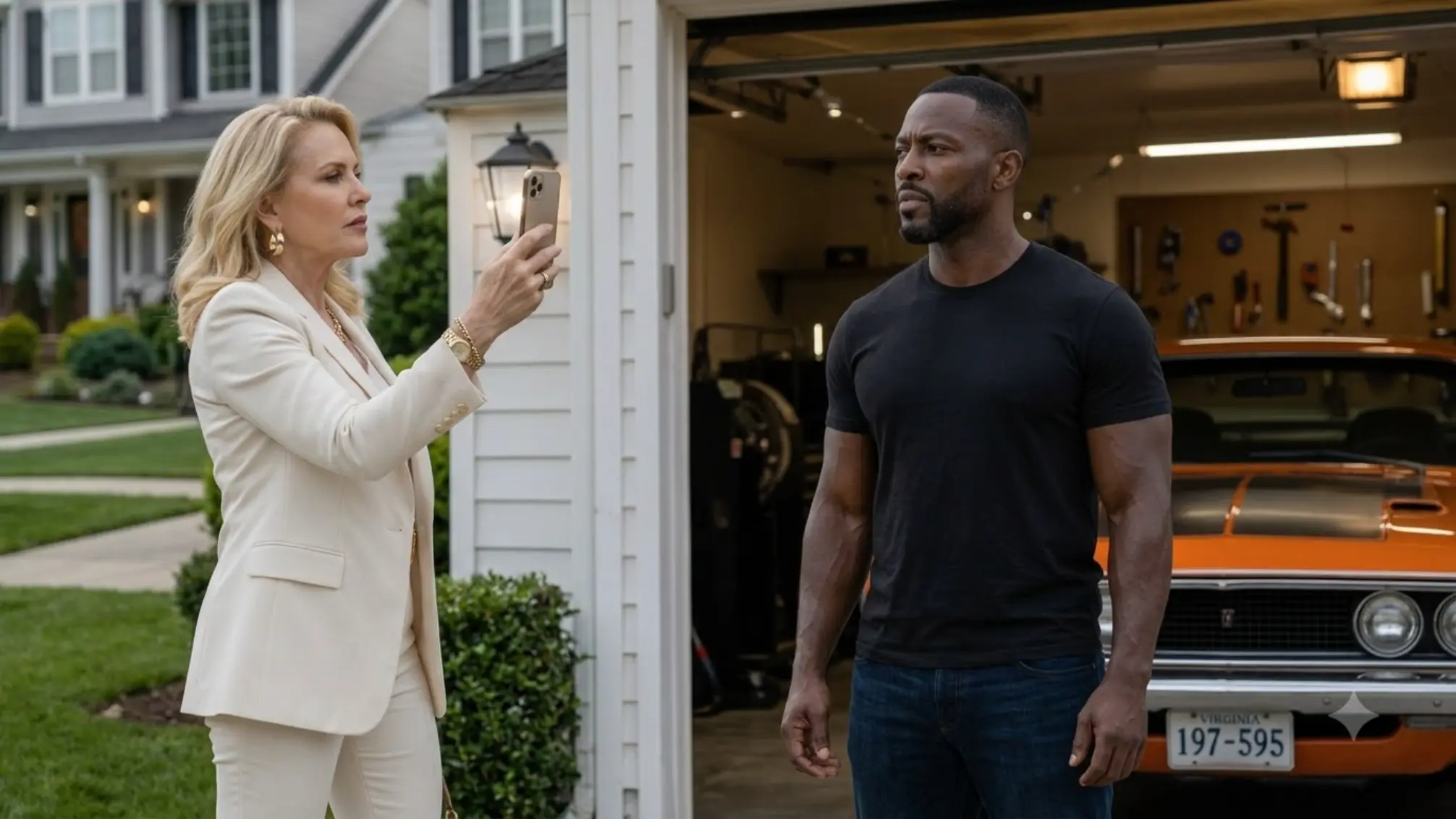
Marcus stood in the center of his driveway wearing a fitted black T-shirt, dark jeans, and heavy work boots. At forty-one, he had the muscular build of a man who still preferred repairing things himself, although his construction company had grown large enough that he no longer needed to. His dark eyes followed Cynthia calmly as she stepped completely off the sidewalk and onto his property. Several neighbors had already begun appearing on porches because everybody in Fairview Estates knew what usually happened when Cynthia Whitmore walked somewhere holding her phone.
“That eyesore violates my neighborhood standards,” Cynthia announced. “Move it today, or I’ll have it removed for you.”
Marcus looked over his shoulder at the Challenger.
The car was not rusty.
It was not sitting on blocks.
It was not parked on the street.
It was inside his private garage.
Marcus faced her again. “Your neighborhood?”
Cynthia lowered the phone slightly.
“You know exactly what I mean.”
“You crossed my lawn to threaten me over a car inside my garage.”
“The garage door is open.”
Marcus stared at her.
Cynthia continued as though that explained everything. “Anything visible from a common street is subject to architectural appearance regulations.”
Marcus almost smiled.
“Show me the rule.”
Her expression tightened.
“I don’t need to stand here reading bylaws to you.”
“Then email it.”
“You received three notices.”
“I received three letters saying my vehicle was inappropriate for the neighborhood.”
“Correct.”
“That isn’t a rule.”
Cynthia stepped closer.
“You have been difficult since the day you moved here.”
Marcus nodded slowly. “Because I ask you to show me the documents before I pay your fines?”
A neighbor across the street stopped pretending to water his flowers.
Cynthia saw him listening.
Her voice became louder.
“This is not about fines. It is about maintaining Fairview’s property values.”
Marcus glanced at the row of nearly identical expensive houses behind her.
“Explain how a restored classic sitting inside a garage lowers property values.”
“It attracts attention.”
“Apparently.”
A few people laughed quietly.
Cynthia turned toward them.
The laughter stopped.
She returned her attention to Marcus.
“Keep treating this like a joke.”
“I’m not.”
“I can assess five hundred dollars per day until the violation is corrected.”
Marcus’s jaw tightened.
“Under what section?”
“Marcus.”
“What section?”
Cynthia raised her phone again.
“You think being argumentative makes you intelligent.”
“No. Reading before paying makes me intelligent.”
Her face reddened.
“You have thirty days of unpaid fines already.”
“Fines I formally disputed.”
“They remain due.”
“Not while they’re under appeal.”
Cynthia stepped farther into the driveway.
“Your appeal was denied.”
“By you.”
“I am HOA president.”
Marcus stared at her for a moment.
That title came out of Cynthia’s mouth often.
HOA president.
She used it at pool meetings, parking disputes, landscaping inspections, mailbox arguments, and once when telling an elderly resident that the color of her Christmas wreath was not “architecturally harmonious.”
Marcus had lived at Fairview Estates for eleven months.
In that time, he had learned something important.
Cynthia did not lead through rules.
She led through exhaustion.
Most residents paid whatever she demanded because fighting her required time, letters, meetings, and arguments nobody wanted after working all day.
Marcus had more patience.
That irritated her.
He folded his arms.
“Leave my property.”
Cynthia smiled.
“Excuse me?”
“You heard me.”
She looked toward the Challenger again.
“No. I’m documenting the violation.”
“You can document it from the sidewalk.”
“This HOA has inspection authority.”
“Not inside my garage.”
“I’m not inside your garage.”
“You’re ten feet from it on my driveway.”
Cynthia stared at him.
Then her smile returned.
“Fine.”
She lifted the phone higher.
“I’ll have the vehicle towed.”
Marcus laughed once.
That sound hit Cynthia harder than anger would have.
“You think I’m bluffing?”
“I think you should try.”
The street became quieter.
Marcus took one slow step toward her.
“Because if a tow truck crosses this driveway and touches that car, we’re going to have a very different conversation.”
“Is that a threat?”
“No.”
He pointed toward her phone.
“Good thing you’re recording.”
Cynthia’s mouth tightened.
“I will bury this house in fines until you beg me to stop.”
Marcus held her stare.
“Try it.”
She lowered her phone.
“And when I do?”
“Then explain to the entire street why your name isn’t on the HOA documents you’ve been hiding.”
Cynthia froze.
It lasted perhaps one second.
But Marcus saw it.
So did the neighbor across the street.
“What did you say?”
Marcus walked toward the garage.
“Go home, Cynthia.”
She followed two steps.
“What documents?”
Marcus stopped.
“You know.”
“No, I don’t.”
“Then you have nothing to worry about.”
Her face changed.
The anger remained, but something else appeared underneath it.
Fear.
Cynthia pointed toward him. “You have no idea what you’re talking about.”
Marcus looked at her finger.
“Leave.”
“You cannot speak to me like this.”
“I just did.”
She stood there several more seconds, then turned sharply and marched back across the lawn.
Neighbors watched her go.
Marcus did not celebrate.
He simply closed the garage door.
Inside, the orange Challenger disappeared behind white panels.
The confrontation had started over a car.
But the car had never really mattered.
Three months earlier, Marcus had received the first violation letter claiming the Challenger constituted an “unapproved visible recreational vehicle.”
He laughed when he read it.
The Challenger was registered.
Insured.
Street legal.
And normally parked inside the garage.
The letter demanded a $250 corrective assessment.
Marcus responded politely.
He asked for the governing section.
Two weeks later, another letter arrived.
This time the fine had doubled.
Again, no specific rule.
Marcus asked again.
Then he did something Cynthia had not expected.
He read every recorded Fairview Estates governing document himself.
Marcus understood documents because construction had taught him to.
A subcontractor could lose six figures because somebody misunderstood six words in an agreement.
A property line could change the entire value of a project.
A missing signature could stop a closing.
Marcus read declarations the way mechanics listened to engines.
Slowly.
Patiently.
Looking for what did not fit.
Fairview Estates had been developed in phases twenty-three years earlier by Fairview Residential Development Corporation.
The original declaration created the homeowners association.
Phase One.
Phase Two.
Phase Three.
Everything seemed ordinary.
Then Marcus noticed the amendment creating Phase Four, the section containing his home, had never been properly incorporated into the HOA’s recorded master declaration.
There was a reference to an amendment.
There was a board resolution.
There were annual assessments.
But Marcus could not find the final county-recorded instrument granting Fairview HOA enforcement authority over twenty-seven homes on his side of Willow Crescent.
He assumed he had missed something.
So he hired a title researcher.
She found the same problem.
Then a real-estate attorney named Dana Mercer examined it.
Her conclusion was uncomfortable.
“Based on what I have,” she told Marcus, “Fairview HOA may have been collecting assessments and enforcing restrictions against Phase Four without recorded authority.”
Marcus stared at her across the conference table.
“For how long?”
“Possibly fifteen years.”
“Possibly?”
“I’m not giving you a final legal opinion until I see the original developer transfer documents.”
“Where are they?”
Dana smiled without humor.
“That is the interesting part.”
The HOA claimed records from that period were incomplete.
Cynthia had become president eight years earlier.
During those eight years, Phase Four homeowners had paid nearly nine hundred thousand dollars in combined assessments, special fees, fines, and charges.
Marcus asked whether that meant they could demand everything back.
Dana immediately stopped him.
“Do not jump there.”
“Why?”
“Because the association may have defenses. There may be later ratification documents. There may be equitable arguments. There may be something in a title package we haven’t found.”
Marcus nodded.
“What should I do?”
“Quietly gather records.”
So he did.
That was why Cynthia’s sudden obsession with his Challenger interested him.
Marcus suspected she knew he had begun requesting older documents.
A week before the driveway confrontation, he had sent a certified letter demanding copies of all incorporation records, developer transfers, board resolutions, property-management contracts, insurance files, and legal opinions concerning Phase Four authority.
Cynthia responded with three new violations in eight days.
Classic car.
Garage visibility.
Driveway pressure washing without approval.
Marcus had never pressure washed the driveway.
That mistake confirmed something.
The fines were not enforcement.
They were pressure.
The following morning, Marcus received an email.
EMERGENCY HOA HEARING.
Three days later.
Subject: Continuing violations and homeowner conduct.
Dana read it and called him.
“Do not go alone.”
“I wasn’t planning to.”
“You are enjoying this too much.”
“I’m enjoying understanding it.”
“That is not the same sentence.”
Marcus smiled.
“Close enough.”
The meeting took place Thursday evening inside the Fairview clubhouse.
Nearly seventy residents attended.
That was unusual.
Normally ten people attended HOA meetings, nine because they had complaints and one because he genuinely enjoyed parliamentary procedure.
This time everybody had heard about the driveway confrontation.
Cynthia sat at the center of a long table wearing a cream blazer, flanked by board treasurer Harold Price, secretary Melissa Grant, and property manager Neil Foster.
Marcus entered with Dana.
Whispers spread.
Cynthia tapped the microphone.
“Let’s begin.”
She read the allegations.
Failure to correct vehicle violation.
Disrespect toward an officer of the association.
Interference with HOA inspection.
Threatening language.
Dana raised her hand.
“Before responding, can you identify the provision allowing disciplinary action for disrespect toward an officer of the association?”
Cynthia looked toward her.
“And you are?”
“Dana Mercer. Counsel for Marcus Reed.”
The room reacted.
Cynthia’s confidence shifted.
“This is not a courtroom.”
Dana smiled.
“Then this should be easy.”
Harold lowered his eyes.
Marcus noticed.
Cynthia continued.
“The association expects residents to maintain respectful communication.”
Dana nodded.
“That’s nice. Where is it enforceable?”
Cynthia ignored the question.
She turned toward Marcus.
“Would you like to explain why you threatened me?”
Marcus leaned toward the microphone.
“I didn’t.”
“You told me I would regret towing your vehicle.”
“No.”
“You implied consequences.”
“I said touching my privately owned vehicle without lawful authority would create a different conversation.”
A resident in the back muttered, “Sounds reasonable.”
Cynthia slammed her folder shut.
“The vehicle violates Fairview standards.”
Marcus looked toward her.
“Which section?”
Silence.
Again.
Marcus waited.
Cynthia turned to Neil.
“Neil?”
The property manager began flipping through papers.
Marcus leaned back.
People noticed.
Eventually Neil said, “The association has broad aesthetic authority.”
Marcus nodded.
“Which section?”
Neil stopped.
Dana opened her folder.
“Perhaps we can save time.”
She distributed copies of the governing declaration.
“Nothing in the recorded standards prohibits a licensed passenger vehicle from being stored inside a homeowner’s enclosed garage.”
Cynthia’s face tightened.
Dana continued.
“More importantly, we have a threshold question.”
Harold looked toward her.
“What threshold question?”
Dana placed another document on the table.
“Whether this board has enforcement authority over Mr. Reed’s property at all.”
The clubhouse went silent.
Cynthia interrupted immediately.
“This nonsense again?”
Dana turned.
“You’re familiar with the issue?”
A mistake.
Cynthia realized it instantly.
The residents realized it seconds later.
Marcus looked toward Dana.
She did not smile.
“Again?” Dana repeated.
Cynthia recovered.
“Marcus has been harassing management with irrelevant document requests.”
“Requests concerning the legal authority under which you collect his money.”
Cynthia looked toward Neil.
He looked away.
Dana continued.
“Our county records search found no recorded Phase Four annexation into the Fairview Estates master declaration.”
People began whispering.
A woman stood.
“I live in Phase Four.”
Another man said, “So do I.”
Cynthia raised both hands.
“Everybody calm down.”
Dana spoke over the noise.
“We are not claiming tonight that anyone owes anyone money.”
Marcus glanced at her.
She had warned him about overstatement.
“We are saying there is a serious title and governance discrepancy requiring independent review.”
Harold suddenly leaned toward his microphone.
“Cynthia.”
She looked at him.
“Did we ever get that legal opinion?”
Her face went blank.
Marcus noticed.
Dana noticed.
Half the room noticed.
“What legal opinion?” someone called.
Harold swallowed.
“Three years ago, there was a question about Phase Four.”
Cynthia turned toward him.
“This is not appropriate.”
Harold stared.
“You told us counsel confirmed authority.”
“I said the issue was resolved.”
“Did counsel confirm it?”
Silence.
Melissa Grant slowly moved her chair away from Cynthia.
That tiny movement changed the room.
Cynthia stood.
“This meeting is adjourned.”
Dana spoke calmly.
“No vote?”
“I said adjourned.”
Marcus remained seated.
Cynthia gathered her papers.
Then the clubhouse doors opened.
An elderly man entered carrying a cardboard archive box.
Marcus recognized him.
Walter Jenkins.
Seventy-eight.
Original Fairview developer project manager.
Marcus had spent six weeks trying to locate him.
Walter looked toward Marcus.
“Sorry I’m late.”
Cynthia turned pale.
Dana rose.
“Mr. Jenkins?”
He nodded.
“Found what you wanted.”
He placed the box on the table.
The sound was small.
But the room went completely quiet.
Inside were original Fairview development records Walter had retained after the development company dissolved.
Survey maps.
Corporate correspondence.
Title transfers.
Draft amendments.
And one unsigned Phase Four annexation document.
Walter explained slowly.
“The developer intended to annex Phase Four.”
Cynthia stared at him.
“What do you mean intended?”
Walter looked toward her.
“Exactly what I said.”
“The documents were completed.”
“No.”
“They had to be.”
“They weren’t.”
Walter removed another paper.
“The developer went into bankruptcy during the final transfer period. Phase Four common-area obligations were assigned separately, but the annexation amendment never received final corporate execution.”
Someone gasped.
Walter continued.
“Later management apparently began treating the neighborhood as though annexation occurred.”
Cynthia’s face had lost all color.
“That’s impossible.”
Walter looked directly at her.
“No, ma’am.”
He held up the unsigned document.
“That’s paperwork.”
The whole street did not go quiet that evening.
The whole neighborhood did.
The board suspended all Phase Four enforcement immediately.
Dana insisted on independent legal review.
Cynthia resisted until Harold and Melissa voted against her.
Two days later, Cynthia resigned as HOA president.
But resignation did not end the investigation.
Outside counsel discovered Cynthia had known about the Phase Four problem for at least three years.
A prior attorney had warned the board that authority was uncertain and recommended pausing assessments until the title issue was resolved.
Cynthia had suppressed the memorandum.
Why?
Money.
Phase Four represented nearly twenty percent of Fairview’s annual assessment revenue.
Without it, the HOA budget would have required painful reductions or increased dues for the properly annexed sections.
Cynthia had decided stability mattered more than disclosure.
Then she spent years enforcing rules against homeowners whose legal relationship to the association was uncertain.
Marcus’s Challenger had simply become the first dispute involving someone stubborn enough to keep asking for a section number.
The legal process lasted eight months.
No dramatic courtroom explosion.
No instant million-dollar check.
Just accountants, title lawyers, mediators, insurers, and hundreds of pages of records.
In the end, Phase Four homeowners were allowed to vote on whether to formally join the association under a newly negotiated agreement.
They voted yes.
But under different terms.
Clear limits on inspection authority.
No fines without cited provisions.
Independent appeal panels.
Mandatory disclosure of legal opinions affecting homeowner rights.
Annual external audits.
And no HOA official could enter private property for routine enforcement without notice or permission unless an emergency existed.
Residents also received credits for improperly collected penalties.
Not every assessment was refunded because many had funded services Phase Four residents genuinely received.
Marcus agreed with that.
He never wanted free landscaping, road maintenance, or security simply because paperwork had been mishandled.
He wanted authority tied to rules.
Nothing more.
Cynthia sold her home six months later.
On moving day, Marcus happened to be working in his garage.
The Challenger sat near the door.
She stopped on the sidewalk.
For the first time since they had met, she did not step onto his property.
Marcus looked up.
Cynthia glanced toward the car.
“You kept it.”
Marcus wiped his hands.
“Was there some doubt?”
She almost smiled.
Then the expression disappeared.
“I thought I was protecting the neighborhood.”
Marcus nodded.
“I believe you.”
That surprised her.
“But?”
“But somewhere along the way, you started protecting your authority more than the neighborhood.”
Cynthia looked down.
“They blamed me for everything.”
“No.”
Marcus shook his head.
“They blamed you for what the records showed you did.”
She looked toward the moving truck.
“I lost friends.”
Marcus said nothing.
“I lost this house.”
“You sold this house.”
“You know what I mean.”
He did.
But he would not turn consequences into persecution simply because she disliked them.
Cynthia looked toward him again.
“You could have humiliated me worse.”
Marcus leaned against the garage frame.
“What would that fix?”
She had no answer.
After a moment, she walked away.
Marcus watched the moving truck disappear.
Then he returned to the Challenger.
His twelve-year-old son, Jordan, came through the interior garage door holding two sodas.
“Was that her?”
“Yes.”
“What did she want?”
“Nothing.”
Jordan handed him a drink.
“You still hate her?”
Marcus looked at him.
“Hate’s expensive.”
Jordan frowned.
“What does that mean?”
“It means you spend too much energy maintaining it.”
His son considered the answer.
“So you forgive her?”
Marcus opened the Challenger’s hood.
“That’s different.”
“How?”
“You can stop hating somebody and still remember what they did.”
Jordan nodded slowly.
Then looked toward the orange engine bay.
“So when do I get to drive this?”
Marcus laughed.
“Apparently never.”
“Dad.”
“At sixteen we discuss it.”
“You said that last year.”
“And you’re still twelve.”
Four years passed.
Fairview Estates became quieter.
Not because residents stopped disagreeing.
Because disagreements became boring.
A letter cited a rule.
A homeowner responded.
A committee reviewed it.
Nobody crossed lawns waving phones.
Nobody threatened five-hundred-dollar daily fines because a neighbor asked an inconvenient question.
Marcus preferred boring.
The Challenger became familiar around the neighborhood.
On occasional Saturday mornings, he drove it to local car shows with Jordan.
Nobody’s property value collapsed.
One spring afternoon, Marcus parked in the driveway after returning from a show.
The garage door remained open.
Across the street, Harold Price, now retired from the board, walked over.
“Still causing neighborhood destruction with that thing?”
Marcus smiled.
“Doing my best.”
Harold looked at the orange paint.
“You know, Cynthia probably did us a favor.”
Marcus raised an eyebrow.
“That’s a generous interpretation.”
“If she hadn’t picked this fight, nobody would have found the Phase Four issue.”
Marcus nodded.
“True.”
Harold rested one hand on the fence.
“We all knew she was too aggressive sometimes.”
“Then why didn’t anybody stop her?”
Harold looked toward the street.
That question carried more weight than Marcus expected.
Finally he answered.
“Because paying the fine was easier than becoming the next person she focused on.”
Marcus understood.
Systems rarely became abusive because one person had unlimited power.
They became abusive because everybody else calculated that resistance cost too much.
Harold sighed.
“We let her become what she became.”
“No.”
Marcus shook his head.
“She made her choices.”
Then he added, “But people made those choices easy.”
Harold nodded.
That was fair.
Years later, the confrontation became neighborhood legend.
New residents heard exaggerated versions.
Some claimed Cynthia had tried personally towing the Challenger.
Others claimed Marcus discovered he owned the entire HOA.
Neither was true.
The real story was less spectacular and more important.
A woman with authority stopped believing she needed to explain it.
A man receiving fines refused to pay simply because the letterhead looked official.
And a missing signature buried inside decades of property records forced an entire neighborhood to ask whether rules mattered if the people enforcing them refused to follow their own.
Marcus kept the first violation letter.
He framed it.
Jordan found it ridiculous.
“Why would you frame a fine?”
Marcus hung it beside the workbench.
“Reminder.”
“Of what?”
Marcus looked at the Challenger.
“That asking ‘show me the rule’ can be a pretty powerful sentence.”
Jordan laughed.
Marcus smiled.
Outside, Fairview Estates looked exactly as it always had.
Trim lawns.
Clean sidewalks.
Expensive homes.
Children riding bicycles.
Neighbors talking beside mailboxes.
Nothing visibly changed.
But beneath that ordinary appearance, the relationship between residents and the association had changed completely.
Authority no longer arrived as Cynthia Whitmore crossing somebody’s lawn with a phone raised and a threat ready.
It arrived with a document.
A cited section.
A process.
And the knowledge that whoever sat behind the HOA president’s desk was still required to follow the same rules as everybody else.
Marcus preferred it that way.
He opened the garage door completely.
Afternoon light rolled across the orange Challenger.
Across the street, nobody went quiet.
Nobody stared.
Nobody complained.
A little boy riding past on a bicycle stopped and pointed.
“Mr. Reed, that car is awesome!”
Marcus grinned.
“Thank you.”
The boy rode away.
Marcus looked at the framed violation letter one more time.
Then at the car Cynthia once threatened to remove.
The Challenger had never been the problem.
Neither had Marcus.
The real problem had been a system that worked only as long as nobody asked the person holding power to prove she actually had it.
And once Marcus finally asked, Fairview Estates discovered that the loudest authority on the street had been standing on incomplete paperwork all along.