The first board snapped at 8:14 on a Saturday morning.
Marcus Reed heard it from his kitchen while pouring coffee into a chipped black mug. At first he thought a branch had fallen against the side of the house, but then came a second crack, followed by the unmistakable groan of old wood being forced apart. Marcus set the mug down, walked through the laundry room, and stepped into his backyard wearing nothing more complicated than a charcoal-gray T-shirt, loose black sweatpants, and house slippers.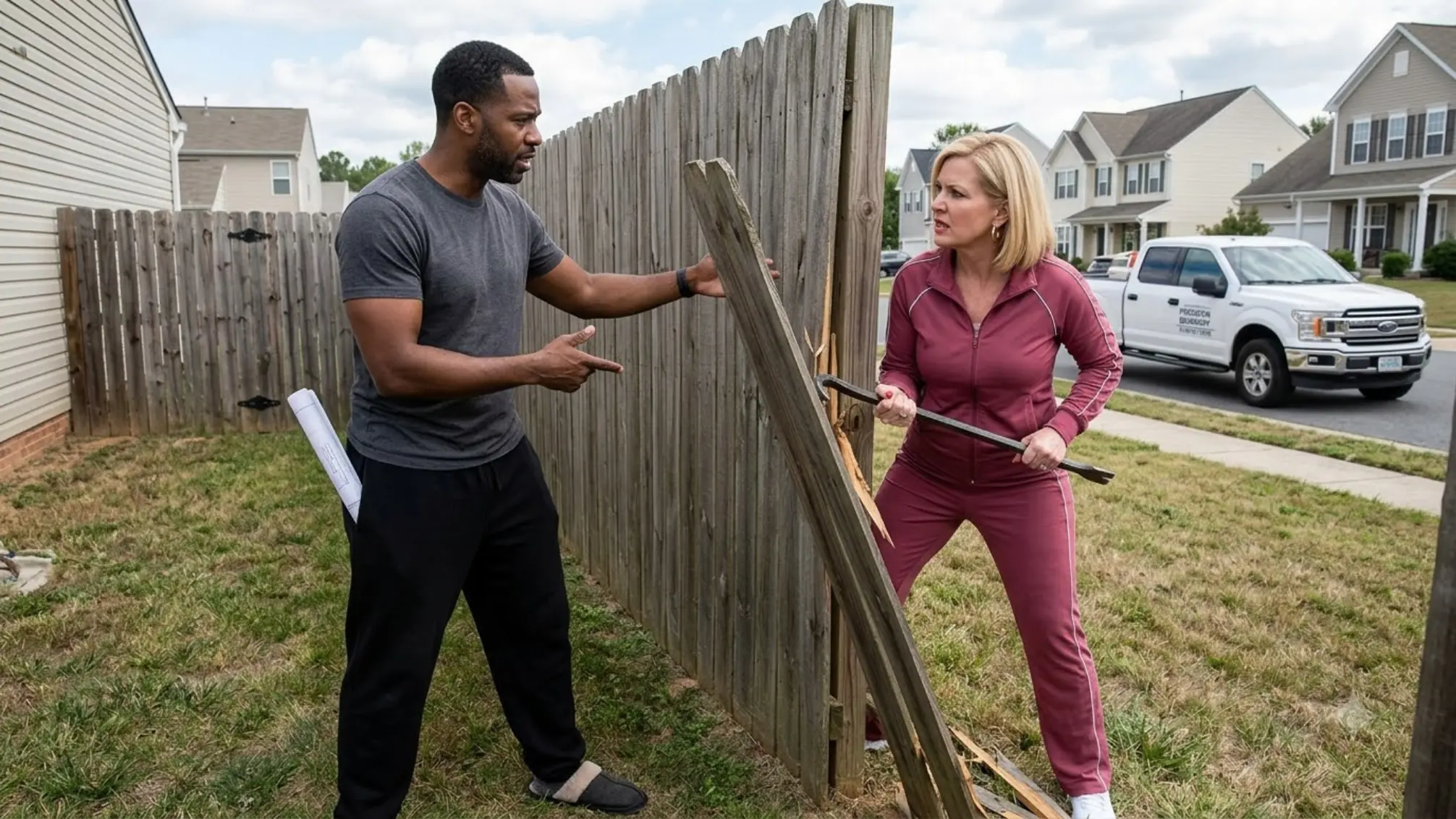
He stopped when he saw Cynthia Whitmore wedging a steel pry bar between two boards of his privacy fence.
Cynthia was fifty, blonde, wealthy, and president of the Fairview Estates Homeowners Association. She wore a fitted dark-pink tracksuit with thin white piping, spotless white sneakers, and gold earrings that flashed whenever she jerked the pry bar. Two fence boards were already broken, splintered wood lay in the grass, and Cynthia had one foot braced against Marcus’s fence as though she had been hired to demolish it.
Marcus stared at her.
“What are you doing?”
Cynthia pulled again.
The board cracked.
She turned with an expression that suggested Marcus had interrupted her, not the other way around.
“This fence is on my land. I’m taking it down.”
Marcus slowly looked toward the property line.
Then back at her.
“Your land?”
“You heard me.”
Cynthia drove the pry bar deeper.
Marcus stepped forward.
“Break one more board and you’re paying for every inch you touch.”
She laughed.
It was not nervous laughter.
It was the laugh of someone accustomed to neighbors deciding that arguing with her was more exhausting than surrendering.
“I run this HOA,” she said. “I’ll tear down the whole fence and send you the bill.”
Marcus stopped three feet away.
“You run meetings.”
Cynthia’s smile disappeared.
“You don’t own my yard.”
She straightened.
“This fence extends almost four feet into HOA-controlled common property.”
“No, it doesn’t.”
“I have the maps.”
“So do I.”
Cynthia lifted the pry bar again.
Marcus pointed toward it.
“Put that down.”
Her face hardened.
“Or what?”
Marcus held her stare.
“Or everything happening right now gets documented exactly the way you’re doing it.”
He nodded toward the phone propped on a patio chair behind her.
Cynthia had been recording herself.
That surprised her.
She glanced at the phone, then recovered quickly.
“Good. I want the board to see how uncooperative you are.”
Marcus almost smiled.
“Perfect.”
He stepped backward and pulled out his own phone.
Cynthia frowned.
“What are you doing?”
“Calling the surveyor.”
Her expression changed.
Only slightly.
But Marcus saw it.
He had been waiting for that reaction.
The fence dispute had not started that morning. Cynthia had sent Marcus three letters over two months claiming the southern fence line violated Fairview Estates’ boundary rules. The first letter demanded removal within thirty days. The second added a five-hundred-dollar fine. The third threatened daily penalties and “association-directed corrective action.”
Marcus responded the same way every time.
Please provide the recorded survey and governing provision establishing the claimed boundary.
Cynthia never did.
Instead, she sent highlighted photocopies of a neighborhood landscaping diagram.
Marcus had spent twenty years in commercial construction. He knew immediately that a landscaping sketch was not a legal boundary survey. He also knew Cynthia was either confused or hoping he would be.
Marcus bought the house six years earlier. The fence had existed before he moved in, but during closing, his title company had commissioned a full survey because the property bordered a narrow drainage strip running between his lot and the neighboring common area. Marcus still had the stamped survey in a fireproof folder.
The wooden fence sat twenty-two inches inside his property line.
Not outside.
Inside.
Marcus had even given Cynthia a copy.
She responded that the HOA’s “internal planning documents” superseded the survey.
That sentence was why Marcus hired Daniel Foster, a licensed land surveyor from Richmond, to verify everything independently.
Daniel was supposed to arrive at nine.
Cynthia apparently decided eight-fourteen was a better time to create facts with a pry bar.
Marcus dialed.
Daniel answered.
“You nearby?”
“Three minutes out.”
“Come straight to the side yard.”
“What happened?”
Marcus looked at Cynthia.
“She started without you.”
Daniel sighed.
“I’ll be there.”
Marcus ended the call.
Cynthia crossed her arms.
“You’re wasting money.”
“Maybe.”
“The HOA already settled this.”
“No, you settled it with yourself.”
“I am authorized to enforce violations.”
“On HOA property.”
“This is HOA property.”
Marcus looked toward the broken boards.
“We’re about to find out.”
Cynthia stepped closer.
“I don’t need some contractor you hired telling me where the boundary is.”
“He isn’t a contractor.”
“What is he?”
“Licensed surveyor.”
Something moved behind Cynthia’s eyes again.
Marcus noticed that too.
She lowered her voice.
“Marcus, this could have been handled quietly.”
He glanced at the destroyed fence.
“You brought a crowbar.”
“Because you ignored the notices.”
“I answered every notice.”
“You refused compliance.”
“I refused to destroy my fence because you highlighted a landscaping map.”
Cynthia pointed toward his house.
“You people move into established communities and immediately start challenging every standard that existed before you arrived.”
Marcus’s expression changed.
“You people?”
Cynthia realized she had stepped near a line and immediately redirected.
“Homeowners like you. Difficult homeowners.”
Marcus nodded slowly.
“Keep talking. Your phone’s still recording.”
She looked toward it.
For the first time, uncertainty became visible.
A white pickup truck turned onto Willow Glen Court.
Orange equipment cases filled the bed.
A yellow tripod was strapped behind the cab.
Marcus pointed toward the street.
“Perfect. Tell the surveyor that while he shows everyone whose land you’re actually standing on.”
Daniel Foster parked beside Marcus’s mailbox.
He climbed out wearing khaki work pants, steel-toe boots, a reflective survey vest, and the mildly irritated expression of a man who had expected to measure dirt, not mediate a neighborhood war.
He opened the truck door and removed a tablet.
“Morning.”
Cynthia immediately approached him.
“Are you Mr. Foster?”
“Yes.”
“I’m Cynthia Whitmore, HOA president.”
Daniel nodded politely.
Marcus almost laughed.
Cynthia had never introduced herself without the title.
She pointed toward the fence.
“This structure has been encroaching on association land for years. We need confirmation so we can proceed with removal.”
Daniel looked at the broken boards.
Then at the pry bar.
“You already started?”
Cynthia lifted her chin.
“We have internal surveys.”
Daniel looked toward Marcus.
“You have the title survey?”
Marcus went inside and returned with the folder.
Daniel placed both documents on the hood of his truck.
The difference was immediate.
Marcus’s survey contained bearings, distances, iron pin references, monument locations, certification numbers, and a licensed surveyor’s seal.
Cynthia’s document contained colored landscaping zones.
Daniel looked up.
“Mrs. Whitmore, this isn’t a boundary survey.”
“It is the HOA’s approved site plan.”
“Site plan isn’t the same thing.”
“It establishes common areas.”
“It illustrates common areas.”
Her jaw tightened.
Daniel continued.
“It doesn’t establish the legal boundary controlling this fence.”
Cynthia crossed her arms.
“Our attorney reviewed it.”
“What attorney?”
“That isn’t your concern.”
Daniel shrugged.
“Then I can only work from recorded documents and field evidence.”
He opened his equipment.
Neighbors began appearing.
The sound of Cynthia breaking the fence had already drawn attention, and Daniel’s survey truck finished the job.
Across the street, retired teacher Helen Mercer stepped onto her porch carrying coffee.
Next door, David Kim walked toward the sidewalk.
A younger couple from three houses down stood near their mailbox.
Cynthia noticed them.
“Everyone can go back inside. This is association business.”
Nobody moved.
Daniel set up the total station.
Marcus leaned against his patio railing.
Cynthia paced.
The survey took twenty-seven minutes.
Daniel located the first monument near the rear corner.
Then the second.
He checked recorded coordinates, measured the distance to the house foundation, and compared the current fence placement with the original title survey.
Each measurement made Cynthia quieter.
Finally, Daniel walked to his truck and removed two bright survey stakes.
He drove the first into the soil.
Not where Cynthia claimed.
Almost two feet beyond Marcus’s fence.
On the far side.
Then he measured forward and placed another.
Marcus looked at Cynthia.
She stared at the stakes.
Daniel checked his tablet again.
“Fence is inside Mr. Reed’s parcel.”
Silence.
David Kim crossed his arms.
Helen took a slow sip of coffee.
Cynthia stepped toward Daniel.
“How far?”
“Average setback from property line is about twenty-one to twenty-three inches.”
“That’s impossible.”
Daniel turned the screen toward her.
“No.”
She shook her head.
“The HOA strip starts at the fence.”
“Apparently not.”
“Our documents say it does.”
“Your documents are wrong.”
Her face reddened.
Marcus said nothing.
He did not need to.
Daniel continued.
“In fact, part of the landscaping strip the HOA has been maintaining is also inside Mr. Reed’s property.”
Cynthia froze.
Marcus straightened.
“What?”
Daniel pointed toward three decorative shrubs and a narrow line of mulch running along the fence.
“These.”
Cynthia stepped forward.
“That landscaped buffer belongs to Fairview.”
“Recorded boundary says otherwise.”
She stared at Marcus.
He looked genuinely surprised.
That mattered later.
Marcus had known the fence was his.
He had not known the HOA had been maintaining part of his property as though it belonged to them.
Daniel walked farther toward the street.
Then stopped near a decorative irrigation box.
He checked another measurement.
“Mr. Reed?”
Marcus joined him.
Daniel pointed down.
“This irrigation line may cross your parcel too.”
Cynthia interrupted immediately.
“No.”
Daniel looked at her.
“I said may. I need utility records before confirming.”
“This is absurd.”
Marcus turned toward her.
“You’re the one who wanted the boundary checked.”
Cynthia picked up her phone.
“This survey is biased.”
Daniel stared at her.
“How?”
“He hired you.”
“He hired me to identify a recorded line.”
“He paid you.”
“For surveying.”
Marcus folded his arms.
“You want another surveyor?”
“Yes.”
“Fine.”
Cynthia blinked.
Marcus continued.
“Hire one.”
She had expected resistance.
He gave her none.
“But until then,” Marcus said, “get off my property.”
Cynthia’s face tightened.
“This remains disputed.”
“The fence doesn’t.”
She looked toward the broken boards.
Marcus followed her eyes.
“Those are yours now.”
“What?”
“The repair bill.”
She laughed sharply.
“You’re not charging the HOA for an enforcement action.”
Marcus looked toward Daniel.
Then at the neighbors watching.
“That’s exactly what I’m doing.”
Cynthia marched away.
But she made one more mistake before leaving.
She grabbed Marcus’s survey stake.
Daniel’s voice changed instantly.
“Do not remove that.”
Cynthia stopped.
“It is on HOA property.”
“It is a temporary professional survey marker.”
She pulled anyway.
Daniel stepped forward.
“Mrs. Whitmore.”
His voice was calm.
“Put it back.”
She stared at him.
For once, someone she could not intimidate was giving her an instruction based on something more powerful than her title.
Cynthia dropped the stake.
Then she walked away.
By noon, photos of the broken fence were circulating through Fairview Estates’ private resident group.
By two, Cynthia posted a statement claiming Marcus had “aggressively interfered with lawful HOA enforcement.”
That was when Marcus uploaded something else.
Not an argument.
Not commentary.
Just Cynthia’s own video.
She had left her phone recording during the entire confrontation and, in her anger, had accidentally livestreamed part of it to the HOA’s resident page.
Residents had saved copies before the post disappeared.
The recording included:
“This fence is on my land.”
“I run this HOA.”
“I’ll tear down the whole fence and send you the bill.”
And, most importantly, Daniel telling her that her map was not a legal survey.
Marcus wrote one sentence beneath the video.
I have requested that all future communication regarding my property be made in writing.
Nothing else.
That restraint made the video worse for Cynthia.
She spent the weekend trying to explain.
Monday morning brought another development.
Marcus’s attorney, Rachel Sloan, requested Fairview’s original plats, easements, drainage agreements, landscaping contracts, and maintenance authorization for the strip beside Marcus’s property.
The property manager initially resisted.
Rachel sent a formal demand.
Three days later, a folder arrived.
Marcus sat with Rachel and Daniel inside her office.
Daniel spread the plans across a conference table.
He found the problem within fifteen minutes.
The HOA had been maintaining the strip for seventeen years.
But ownership had never transferred.
The original developer created a proposed landscape easement.
Proposed.
Not executed.
The final recorded plat showed the property line exactly where Daniel had marked it.
Marcus owned the strip.
The HOA did not.
Rachel leaned back.
“This gets interesting.”
Marcus looked toward her.
“How interesting?”
“The irrigation system serves six common-area plantings.”
“And crosses my property.”
“Looks that way.”
“Can I make them remove it?”
“Yes.”
Marcus considered that.
Rachel expected him to smile.
He did not.
“I don’t want the shrubs dying.”
Daniel looked at him.
Marcus continued.
“I want the paperwork fixed.”
Rachel nodded.
That was the right answer.
Marcus could have demanded removal immediately.
Instead, he offered the HOA a formal easement agreement allowing existing irrigation and landscaping to remain, provided the association acknowledged his ownership, repaired the fence, reimbursed survey and legal costs, and withdrew every related fine.
It should have ended there.
Cynthia refused.
At the next board meeting, nearly eighty residents attended.
Cynthia sat at the front table in a navy blazer instead of her pink tracksuit.
The board treasurer, Harold Kent, looked exhausted.
Marcus sat in the third row beside Rachel.
Cynthia opened with a statement about “maintaining community order.”
Then Rachel stood.
“We can resolve this tonight.”
Cynthia looked annoyed.
“This meeting is for residents.”
“My client is a resident.”
“You are not.”
Marcus spoke.
“She’s here as my representative.”
Cynthia could not stop her.
Rachel placed three documents on the projection screen.
First: Marcus’s recorded deed.
Second: the original subdivision plat.
Third: Daniel’s certified survey.
The boundary aligned in all three.
Then she displayed the HOA landscaping map.
It did not.
Residents started whispering.
Rachel explained the missing easement.
Then she showed the repair estimate.
$3,840.
Cynthia laughed.
“For a few fence boards?”
Marcus finally spoke.
“For restoring the damaged structural section and matching the original fencing.”
Cynthia turned toward him.
“You’re exploiting a technical error.”
Marcus looked at her calmly.
“You crossed onto my property with a crowbar.”
The room went quiet.
Harold spoke next.
“Cynthia, did the board authorize physical removal?”
She hesitated.
“I exercised presidential authority.”
“That wasn’t my question.”
The secretary, Laura Bennett, looked toward Cynthia.
“Did we vote on it?”
Cynthia became irritated.
“Not every enforcement action requires a vote.”
Harold opened the bylaws.
“This one does.”
Marcus watched Cynthia’s face change.
For months, she had behaved as though the HOA were an extension of her personality.
Now the actual bylaws sat open in front of her.
Harold continued.
“Entry onto private property for corrective action requires written notice, cure period, hearing opportunity, board authorization, and contractor insurance.”
Laura looked toward the broken-fence photos.
“None of that happened.”
Cynthia slapped her hand against the table.
“He refused compliance!”
Marcus did not raise his voice.
“I asked you for the rule.”
“You challenged everything.”
“I challenged something you couldn’t prove.”
A resident near the back called out.
“What other fines were based on maps like this?”
That question changed everything.
Another homeowner stood.
“You fined me over my shed setback.”
Someone else raised a hand.
“You made us move our garden wall.”
Then Helen Mercer spoke.
“You told me my flower bed crossed into common land.”
Cynthia looked toward the room.
The dispute was no longer about Marcus.
That was the moment she lost control.
Over the following month, the board commissioned an independent review of property-line enforcement during Cynthia’s presidency.
Most decisions were valid.
Some were not.
Seven homeowners had been fined based on inaccurate internal maps rather than recorded surveys.
Three had paid contractors to relocate improvements unnecessarily.
One elderly couple had removed a $9,000 stone garden wall that had been entirely inside their property.
The issue was not massive fraud.
It was something more ordinary.
Arrogance.
Cynthia trusted internal documents because they were convenient.
When homeowners questioned them, she treated questions as disobedience.
The board had allowed it because Cynthia volunteered more hours than anyone else and handled conflicts others hated dealing with.
Efficiency slowly became unchecked authority.
The board voted to reimburse documented losses caused by incorrect boundary enforcement.
Insurance covered part.
Reserve funds covered the rest.
Marcus received payment for the fence, survey, and reasonable legal expenses.
The fines disappeared.
The landscaping easement was formally recorded.
And Cynthia faced a recall vote.
She lost by seventy-three percent.
Two weeks later, Marcus was replacing one final board himself when a car stopped beside the curb.
Cynthia stepped out.
No tracksuit.
No HOA folder.
No phone raised.
Just jeans and a simple sweater.
Marcus continued working.
She approached the sidewalk but did not cross onto his grass.
That detail did not escape him.
“I came to apologize.”
Marcus set the drill down.
Cynthia looked toward the rebuilt fence.
“I was wrong.”
He waited.
“I thought you were being difficult because you didn’t respect the association.”
Marcus wiped sawdust from his hands.
“I didn’t respect how you were using it.”
She nodded.
“I see that now.”
“Do you?”
Her face tightened, but she did not become defensive.
“I kept thinking that because I had handled these disputes for years, I knew the neighborhood better than anyone.”
Marcus leaned against the fence.
“And?”
“And somewhere along the way, I stopped checking.”
He said nothing.
She looked toward the new survey marker.
“I was convinced the fence was wrong.”
“You were allowed to be wrong.”
Cynthia looked at him.
Marcus continued.
“You weren’t allowed to destroy something because you were convinced.”
That landed.
She nodded slowly.
“I know.”
For several seconds, they stood in silence.
Then Cynthia asked, “Do you hate me?”
Marcus almost laughed.
“No.”
She looked surprised.
“Why not?”
“Hating you wouldn’t rebuild the fence.”
She glanced toward the boards.
“I suppose not.”
Marcus picked up the drill.
Cynthia turned to leave.
Then he spoke.
“One thing.”
She stopped.
“If you ever disagree with a property line again?”
She waited.
Marcus pointed toward the survey stake.
“Call the surveyor before the crowbar.”
For the first time, Cynthia laughed at herself.
“Fair.”
She walked away.
Six months later, Fairview Estates adopted new enforcement rules.
Every property-line violation required a recorded survey or professionally verified boundary.
Homeowners received the exact governing provision with every notice.
No board member could personally perform corrective work.
No one could enter private property without permission unless a true emergency existed.
And disputed fines automatically paused until appeal review.
Marcus did not join the board.
Several neighbors asked.
He refused every time.
“I already have a job.”
Daniel Foster became unusually popular in Fairview Estates.
Marcus joked that Cynthia had accidentally created more business for him than any advertisement ever could.
The rebuilt fence remained exactly where it had always been.
Twenty-two inches inside Marcus’s property.
He left the extra strip untouched except for one small change.
Near the corner, he planted a young maple tree.
His daughter, twelve-year-old Aaliyah, helped him.
She held the tree straight while Marcus packed soil around the roots.
“Why here?”
Marcus looked toward the boundary stake.
“Because apparently we have more yard than we thought.”
She laughed.
“Did the HOA lady really think she owned it?”
“She did.”
“Was she lying?”
Marcus considered the question.
“No.”
Aaliyah frowned.
“But she was wrong.”
“Exactly.”
“What’s the difference?”
Marcus pressed soil around the trunk.
“Lying means you know the truth and say something else.”
He stood.
“Being wrong means you believe something that isn’t true.”
Aaliyah nodded.
“So being wrong isn’t bad?”
“No.”
Marcus looked toward the fence.
“Refusing to check can be.”
She thought about that.
“What if you checked and you’re still wrong?”
“Then you fix it.”
Aaliyah smiled.
“Like the fence.”
Marcus laughed.
“Exactly like the fence.”
Years later, neighbors still told the story of the Saturday morning Cynthia Whitmore arrived in a pink tracksuit carrying a crowbar.
Some versions became exaggerated.
People claimed police came.
They did not.
Others claimed Marcus sued the HOA for millions.
He did not.
A teenager once told a new family that Cynthia had accidentally torn down her own fence.
Marcus corrected him.
The real story did not need embellishment.
One person believed authority made evidence optional.
Another person refused to respond with anger when documents would do more.
And one surveyor drove two stakes into Virginia soil that turned an argument into something measurable.
Marcus kept a small piece of the broken fence board above his garage workbench.
Beside it, he mounted a photocopy of Daniel’s certified survey.
Aaliyah thought that was strange too.
“You keep weird souvenirs.”
Marcus shrugged.
“It reminds me.”
“Of Cynthia?”
“No.”
“Of what?”
Marcus looked toward the splintered wood.
“That confidence and correctness are not the same thing.”
Outside, the maple tree grew taller each year.
Its roots spread through soil Cynthia once called HOA land.
The irrigation line continued watering the shrubs through a properly recorded easement.
The fence stood straight.
Nobody touched it.
And whenever a new Fairview board member became a little too confident about where one homeowner’s rights ended and the association’s began, somebody inevitably pointed toward Marcus Reed’s side yard.
Not because Marcus had won a fight.
Because a surveyor had arrived, opened the records, measured the ground, and proved that even the loudest person in the neighborhood could not move a property line simply by believing hard enough that it belonged somewhere else.