“I had that junk hauled off because your little circus doesn’t belong in this neighborhood.” The HOA President stood in the middle of Willow Creek Drive wearing a fitted pink polo shirt and white pants, one finger aimed toward the colorful ice cream truck already tilted onto the back of a tow vehicle. Across from her, the Black Homeowner stood tall in a fitted navy polo and dark jeans, his expression tightening as children along both sidewalks began crying and begging the driver to stop. He stepped toward her and said, “You just made kids cry to feed your ego—put my truck back on the ground.”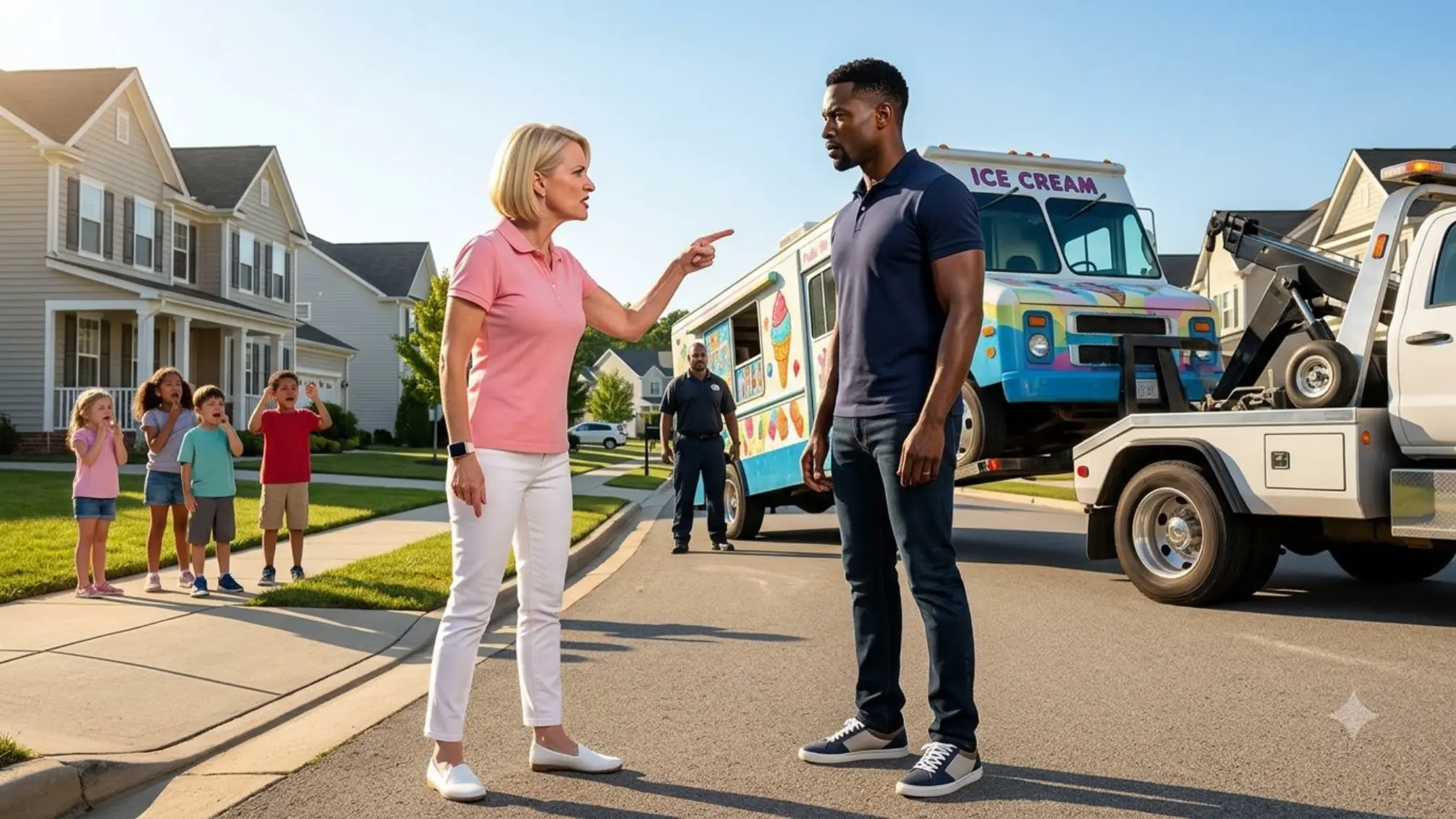
The woman gave a bitter laugh and lifted her chin. “Cry louder. This street answers to me, and I said that truck goes.” The Homeowner slowly pulled out his phone and raised it between them. “Good—say it again when the parents, the board, and the police hear why you stole a children’s event.”
The tow operator stopped working. His hand remained on the hydraulic control while he looked from the furious HOA President to the crying children surrounding the curb. Several parents were already walking quickly toward the scene, phones held high, while one little girl in a yellow dress clutched an unopened paper cup and sobbed because she thought the ice cream man was leaving forever. The Homeowner turned toward the tow operator and asked quietly, “Did she tell you this truck was parked on private property with the owner’s permission?”
The driver lowered his hand. “She said the HOA ordered an emergency removal.” The Homeowner pointed toward the driveway directly behind the truck. “That is my driveway, and the truck is mine.” The driver looked sharply at the HOA President, whose expression immediately changed from triumph to irritation.
The Homeowner’s name was Marcus Reed, and he had lived in Willow Creek for almost six years without a single serious dispute. He was thirty-eight, broad-shouldered, calm, and known around the block for helping neighbors repair fences, jump dead batteries, and carry heavy furniture without making a performance out of kindness. During the week he managed regional logistics for a restaurant-supply company, but every Saturday during summer he operated the restored ice cream truck that had once belonged to his father. The truck was more than a hobby because its bright blue-and-cream paint, old brass bell, and faded photographs inside the cab connected Marcus to the happiest part of his childhood.
His father had bought the truck twenty-nine years earlier after losing his factory job. For nearly a decade, he drove neighborhoods around Baltimore selling inexpensive ice cream while Marcus sat beside him during school breaks and learned how quickly a small treat could change a child’s afternoon. When his father died, the truck sat beneath a tarp for years until Marcus finally restored the engine, replaced the freezer, rewired the lights, and repainted the original hand-drawn cones along both sides. He never turned it into a serious business because he wanted it to remain what his father had intended: something simple that made neighborhoods feel alive.
That summer Marcus had promised Willow Creek’s children one free ice cream afternoon before school started again. Parents donated toppings, one neighbor bought boxes of napkins, and another volunteered to set up folding tables beside Marcus’s driveway. Marcus planned to cover the ice cream himself, and any voluntary donations would go to a local children’s hospital fund established after one of Willow Creek’s families spent months traveling back and forth for their daughter’s cancer treatment. Nearly forty families knew about the event.
The HOA President knew too. Her name was Linda Harrow, and she had been president of the Willow Creek Homeowners Association for three years. She was fifty-two, blond, impeccably organized, and capable of turning a six-inch patch of untrimmed grass into a thirty-minute lecture about community collapse. At first Marcus considered her merely overenthusiastic, but over time he noticed something more troubling: Linda seemed less interested in enforcing written rules than in being obeyed.
She began sending warnings over minor issues no other homeowner received. Marcus got a letter because his recycling bins remained beside the garage forty minutes beyond the neighborhood’s preferred collection window. Another claimed the navy cushions on his patio chairs were not part of the approved exterior palette, despite the chairs being invisible from the street. When Marcus asked politely for the actual bylaw supporting the violation, Linda responded by accusing him of “challenging community standards.”
Marcus did not argue. He simply requested everything in writing. That strategy irritated Linda because written rules were considerably less powerful than the authority she imagined she possessed.
The conflict over the ice cream truck began three weeks before the community event. Linda saw Marcus washing it in his driveway and marched across the lawn without greeting him. She told him commercial vehicles were prohibited in Willow Creek overnight, and Marcus calmly pointed out that the rule applied only to vehicles exceeding specified weight and signage requirements while being used for ongoing commercial operations. His restored truck was registered personally, fit within the driveway, and was not being operated as a daily business from the property.
Linda stared at him for several seconds. “It looks commercial.” Marcus rinsed soap from the side panel. “The rules don’t say ‘looks commercial.’” She frowned. “We can amend them.”
“Then amend them properly,” Marcus replied. “Until then, I’m following the rules you already have.” Linda walked away without answering, but the look on her face told Marcus the matter was not finished.
Two days later he received a notice claiming the truck created a “visual nuisance.” The notice cited Section 8.4 of the neighborhood covenants. Marcus opened the governing documents and discovered Section 8.4 regulated satellite dishes.
He emailed Linda. Wrong section. Please send the correct provision. No reply came.
Three days later another notice arrived. This one said the truck posed an “attractive nuisance to minors” because children gathered near Marcus’s property when he serviced it. Marcus read the letter twice because he could not decide whether to laugh or become angry. He forwarded it to the rest of the board and asked whether the HOA seriously intended to classify an ice cream truck parked in a private driveway as a safety hazard.
The treasurer replied first. I was not aware this notice had been issued. Another director wrote, Neither was I. Linda responded six hours later and insisted she possessed independent enforcement authority as HOA President.
That claim proved important later. Marcus had already started saving every message because something about Linda’s tone suggested the dispute might continue beyond ordinary neighborhood politics. He created a folder containing letters, emails, screenshots, photographs of the truck inside his driveway, and copies of the HOA rules.
The free ice cream event was scheduled for Saturday at 3:00 p.m. Marcus spent Friday evening loading frozen treats into the truck’s new commercial freezer, hanging paper decorations, and checking the generator twice. By Saturday morning, children had already begun riding bicycles past his house asking how many hours remained. Marcus laughed and told them to come back after lunch.
Linda appeared at 11:20. She was wearing the same pink polo and white pants she favored at weekend HOA events. She stopped at the driveway, looked at the decorations, and said, “You are not doing this.”
Marcus continued unloading napkins. “Doing what?”
“Operating a business from your residence.”
“It’s free.”
“Then it’s an event.”
“Yes.”
“You didn’t request HOA approval.”
“I don’t need HOA approval to give neighbors ice cream on my property.”
“You absolutely do.”
Marcus stopped and looked at her. “Show me the rule.”
Linda’s jaw tightened. “I am telling you.”
“That’s not the same thing.”
Children standing across the street began watching. Linda noticed them and lowered her voice. “Cancel it now, Marcus.”
“No.”
“You’re going to regret embarrassing me.”
“I’m not embarrassing you.”
Marcus returned to the truck.
“You’re doing that yourself.”
Linda walked away.
At 2:30 the first folding tables appeared. Parents carried bowls of toppings and coolers containing bottled water. Marcus rang the old brass truck bell once, and children started running toward the driveway.
By 2:45 almost thirty children had gathered. Marcus handed the first ice cream sandwich to a six-year-old boy who had been counting down the event for an entire week. Everyone was laughing when the black tow truck entered Willow Creek.
At first Marcus assumed somebody’s vehicle had broken down. Then the tow truck stopped directly in front of his house. Linda stepped from the passenger side.
The entire atmosphere changed. Marcus set down the box in his hands and walked toward the curb.
“What are you doing?”
Linda smiled. “Enforcing the rules.”
The tow driver approached Marcus’s ice cream truck carrying equipment. “Sir, I’ve been given authorization to remove this vehicle.”
“By whom?”
Linda answered. “The HOA.”
Marcus looked at the driver. “This is private property.”
The driver pointed toward Linda. “She said the association has towing authority.”
Marcus turned toward her. “Show me the authorization.”
Linda folded her arms. “You’ve had enough warnings.”
“That isn’t authorization.”
Children began whispering. One little boy asked whether the truck was being taken away.
Marcus told the tow driver not to touch anything until the documents were checked. The driver hesitated, but Linda stepped forward waving a sheet of paper and insisted the HOA would assume responsibility. She had already signed the tow request as association president and claimed Marcus’s driveway fell under an emergency enforcement provision.
That was false.
But the driver did not know that yet.
He attached the truck.
Children started crying when the front wheels lifted.
That was where Marcus’s phone recording began.
By the time Linda shouted that the truck belonged outside the neighborhood, twelve adults were watching. She seemed energized by the audience rather than cautious because she believed the tow truck represented visible proof of her authority. Marcus recognized the mistake immediately.
He asked the driver, “Can I see the tow order?” The man handed him the paper. Marcus photographed it.
The document claimed the truck had been “abandoned on common roadway property.” Marcus slowly lowered the page and looked toward his driveway. All four tires had been inside the property line when the tow began.
He smiled without humor. “Linda, you reported my truck as abandoned on the street?”
She shrugged. “Close enough.”
Three parents gasped.
Marcus lifted his phone. “Say that again.”
Linda realized what she had said and immediately changed direction. “I said the truck violates HOA standards.”
“That isn’t what the tow order says.”
She stepped toward him. “Put the phone down.”
“No.”
“You cannot record HOA proceedings without permission.”
“We’re standing on a public sidewalk.”
Her face turned red. “You think you’re clever.”
Marcus looked toward the children crying behind him.
“No. I think you made a terrible decision.”
A mother named Rachel stepped between Linda and the tow truck. “My daughter has been talking about this all week. Why are you doing this?”
Linda pointed at Marcus. “Because he believes rules don’t apply to him.”
Rachel looked toward the ice cream truck. “What rule?”
Linda said nothing.
Another parent joined them. Then another. Within two minutes, Linda was facing nearly twenty adults demanding to know why a free neighborhood event had been shut down.
The situation deteriorated rapidly.
Linda tried ordering everyone off the street. Nobody moved.
One father asked whether the board approved the tow. Linda shouted that she did not need a vote for emergency enforcement.
Marcus looked toward the HOA Treasurer, who had just arrived after receiving frantic calls from neighbors. “Did the board authorize this?”
The Treasurer stared at the tow truck.
“No.”
Linda spun toward him. “Stay out of this.”
He looked shocked. “Linda, you used HOA funds for a tow?”
“I used my authority.”
“You don’t have authority to tow from private driveways.”
“This truck violates the covenants.”
“Which covenant?”
Linda’s mouth opened.
Nothing came out.
Marcus almost felt sorry for her.
Then a seven-year-old girl began crying loudly because the tow truck lurched forward several inches. That sound erased whatever sympathy remained.
Marcus stepped toward the driver. “Please stop moving the truck until this is sorted out.”
The driver shut down the hydraulics completely. “I’m not touching anything else.”
Linda screamed at him. “I hired you!”
He pointed toward the tow order. “You told my dispatcher the vehicle was abandoned on common property.”
“It’s a technicality.”
“No, ma’am.”
The driver looked at Marcus.
“If this truck came off that driveway, I’m putting it back.”
Linda stepped between them. “Absolutely not.”
Marcus’s voice hardened.
“Move.”
She stared.
It was the first time all afternoon he sounded genuinely angry.
“Move away from my property.”
Linda jabbed one finger toward his chest. “You do not command me.”
Marcus took one controlled step backward instead of letting the confrontation become physical. “I’m telling you not to interfere with restoring property you falsely ordered removed.”
People were recording from every direction now.
Linda looked around and finally understood she had lost control of the audience. Her mistake was trying to regain it by becoming louder.
“This neighborhood was perfect before people like you started acting like every rule was optional!”
The street went silent.
Marcus stared at her.
“What exactly does ‘people like me’ mean?”
Linda froze.
The Treasurer closed his eyes.
Rachel whispered, “Oh my God.”
Linda immediately shook her head. “That’s not what I meant.”
Marcus kept recording. “Then explain what you meant.”
“You know exactly what I meant.”
“No.”
He lowered his voice.
“I’d really like to hear you say it.”
Linda backed away.
Sirens approached from the end of Willow Creek.
Somebody had already called police after the confrontation escalated. Two patrol vehicles stopped behind the tow truck, and officers stepped out.
Marcus immediately moved away from Linda. He raised both hands visibly and told the nearest officer that nobody was injured.
Linda rushed toward the second officer.
“Thank God. Arrest him.”
The officer looked toward Marcus.
“For what?”
“He’s interfering with an authorized HOA tow.”
Marcus handed the first officer the tow request. “My truck was parked entirely in my private driveway.”
The tow driver confirmed it.
The Treasurer confirmed the board had never approved removal.
Linda became louder.
“I’m the President. I don’t need permission.”
The officer looked toward her. “That isn’t how property ownership works.”
She folded her arms.
“You don’t understand HOA law.”
The officer pointed toward the driveway.
“Do you own that property?”
“No.”
“Did the homeowner authorize removal?”
“No.”
“Was the vehicle on the street?”
Linda hesitated.
Marcus’s phone remained raised.
“No.”
The officer looked at the false statement on the tow order.
“Then we have a problem.”
Linda’s face changed.
She turned toward the tow driver. “Take the truck anyway.”
He shook his head.
“I’m unloading it.”
“You work for me.”
“No, ma’am.”
The children began cheering as the hydraulics lowered Marcus’s ice cream truck back onto the driveway. Linda looked around at the celebration as though the entire neighborhood had betrayed her personally.
She walked toward the truck.
Marcus immediately stepped between her and the vehicle.
“Don’t touch it.”
Linda pointed at him. “Get out of my way.”
“No.”
One officer moved closer.
“Ma’am, step back.”
She ignored him and tried pushing past Marcus. Marcus moved sideways without touching her.
The officer caught her arm.
“That’s enough.”
Linda spun around.
“Take your hands off me!”
“Then stop approaching the vehicle.”
She jerked away hard enough that the officer had to reposition himself.
The second officer moved closer.
Parents began pulling children farther from the confrontation.
Marcus lowered his phone slightly.
For the first time, he stopped thinking about winning the argument. He simply wanted Linda away from the children.
She continued shouting until the officers finally ordered her to leave the immediate area. Because no physical damage had yet been confirmed and the legal status of the tow request required further investigation, she was not arrested that afternoon. But officers photographed the documents, collected witness information, obtained Marcus’s video, and recorded the tow driver’s statement.
Linda left furious.
The event resumed twenty minutes later.
Marcus rang the old brass bell.
Children surrounded the truck again.
The first little girl who had cried during the tow received a giant chocolate cone with rainbow sprinkles. Marcus refused payment from every family.
The donation jar filled anyway.
By sunset it contained nearly $4,700 for the children’s hospital fund.
That should have been the end.
Instead, Monday morning brought an emergency HOA meeting.
More than seventy residents attended.
Linda arrived carrying binders and demanded that the board discipline Marcus for operating an unauthorized commercial event. Nobody seconded her motion.
Then the Treasurer asked about the tow invoice.
Linda looked toward him.
“What about it?”
“You charged $612 to the HOA emergency account.”
“The tow was association business.”
“No authorization existed.”
“I’m President.”
The Treasurer leaned forward.
“You keep saying that like it means unlimited power.”
People applauded.
Linda slammed her palm against the table.
“This entire neighborhood is losing discipline because one homeowner keeps challenging me!”
Marcus sat in the back wearing the same navy polo he had worn Saturday.
He did not speak.
The Treasurer continued.
“You filed a tow request stating the truck was abandoned on common property.”
“It was violating community standards.”
“That isn’t what the form says.”
Silence.
Another director projected a photograph onto the wall.
It showed Marcus’s ice cream truck entirely within his driveway before towing began.
Then security footage played.
Linda’s voice filled the room.
Close enough.
The meeting erupted.
Linda tried stopping the video.
The board refused.
Another clip played.
This street answers to me.
Several residents laughed bitterly.
Then came the worst recording.
This neighborhood was perfect before people like you started acting like every rule was optional.
Nobody laughed.
Linda looked toward Marcus.
“That clip is taken out of context.”
Marcus finally stood.
“What context fixes it?”
She had no answer.
The board called for a vote to suspend her presidential authority pending investigation.
Five voted yes.
One abstained.
Linda voted no.
The suspension passed.
She stormed from the clubhouse.
The investigation uncovered more than the ice cream incident. Linda had independently issued twenty-one violation notices without proper architectural committee review, approved several legal expenses without required secondary authorization, and used association funds for enforcement actions outside established procedure.
Not every decision was malicious.
Some were simply careless.
But together they showed a President who had gradually started treating HOA authority as personal property.
The false towing request became the clearest example.
The towing company reimbursed Marcus for minor damage to one wheel caused during loading and terminated future HOA towing requests unless independent property authorization could be confirmed.
Police referred the false statement on the tow form for further review.
Marcus declined to pursue an aggressive civil case against the association after the board agreed to reimburse repair expenses and adopt new procedures.
He wanted reform more than revenge.
Linda was formally removed as HOA President two weeks later.
She remained a homeowner.
That mattered because Marcus would still occasionally see her walking through the neighborhood.
At first she refused to look at him.
Then one afternoon several months later, she passed while Marcus was polishing the ice cream truck.
She stopped.
Marcus waited.
Linda looked toward the truck.
“Kids still like that thing?”
“Yes.”
She nodded.
For once, no accusation followed.
She continued walking.
Marcus did not call it forgiveness.
He called it silence.
Sometimes that was enough.
The new HOA board created a simple rule for towing private vehicles: written verification of association authority, photographic evidence, and approval from two board members unless an immediate safety emergency existed.
They also changed violation notices.
Every citation now had to include the exact covenant provision.
Marcus appreciated that most.
The phrase Show me the rule had finally become policy.
The ice cream event returned the following summer.
This time the entire association sponsored it.
A permit was unnecessary, but the new President asked Marcus whether the HOA could contribute five hundred dollars toward the hospital fundraiser.
Marcus agreed.
The neighborhood children painted paper signs.
Parents brought tables.
The tow driver from the previous year even appeared with his own family.
Marcus laughed when he recognized him.
“You sure you’re not here for the truck?”
The man raised both hands.
“Never touching that thing again.”
They both laughed.
By evening, the fundraiser passed ten thousand dollars.
Marcus stood beside the truck wearing a navy polo, handing cones to children while the old brass bell rang above him.
Someone asked why he still kept the vehicle after all the trouble.
Marcus looked toward the faded photograph of his father taped inside the cab.
“Because one angry person doesn’t get to decide what something means.”
That was the answer.
Linda had seen an ice cream truck and called it junk.
Children saw Saturday afternoons.
Marcus saw his father.
Parents saw a neighborhood tradition.
The hospital saw donations.
One object carried different meanings depending on who looked at it.
Authority did not give Linda the right to choose everyone else’s interpretation.
Years later, people still told the story differently.
Some claimed Linda personally drove the tow truck.
She did not.
Others said police arrested her in front of the children.
They did not.
The truth was simpler and, to Marcus, more important.
An HOA President believed her title allowed her to order private property removed because one homeowner refused to surrender to rules she could not produce.
She expected the neighborhood to watch him lose.
Instead, the children cried.
The parents started recording.
The tow driver stopped.
The board asked questions.
And suddenly the authority she had spent years building through intimidation depended on something she had avoided every time Marcus challenged her.
Evidence.
Marcus kept one photograph from that afternoon.
It showed the truck halfway raised onto the tow platform.
In the foreground, several children stood crying.
Behind them, Marcus faced Linda in his navy shirt while holding his phone.
He did not frame it because he enjoyed seeing her failure.
He framed it beside his father’s photograph for another reason.
His father once told him that an ice cream truck was never really about ice cream.
“It gives people an excuse to come outside together,” he used to say.
That Saturday proved him right.
Linda tried taking the truck away.
Instead, she gave the entire neighborhood a reason to come outside.
And once they were all standing together, she discovered something more powerful than any HOA title.
People who finally stopped being afraid to ask:
“Who gave you the right?”