“Your police car violated our neighborhood rules, so I had it removed.”
Karen Stevens stood in Officer Walter Hayes’s driveway wearing an immaculate white pantsuit, nude heels, and oversized black sunglasses. A dark-green HOA binder rested against her chest as though it were a badge capable of outranking the Richmond Police Department. Behind her, Walter’s returned patrol cruiser sat beside a towing truck with fresh scratches across its front bumper and visible damage near the rear wheel. Walter held the unauthorized towing report in one hand and stared at the woman who had deliberately removed a clearly marked city-owned police vehicle from his private property.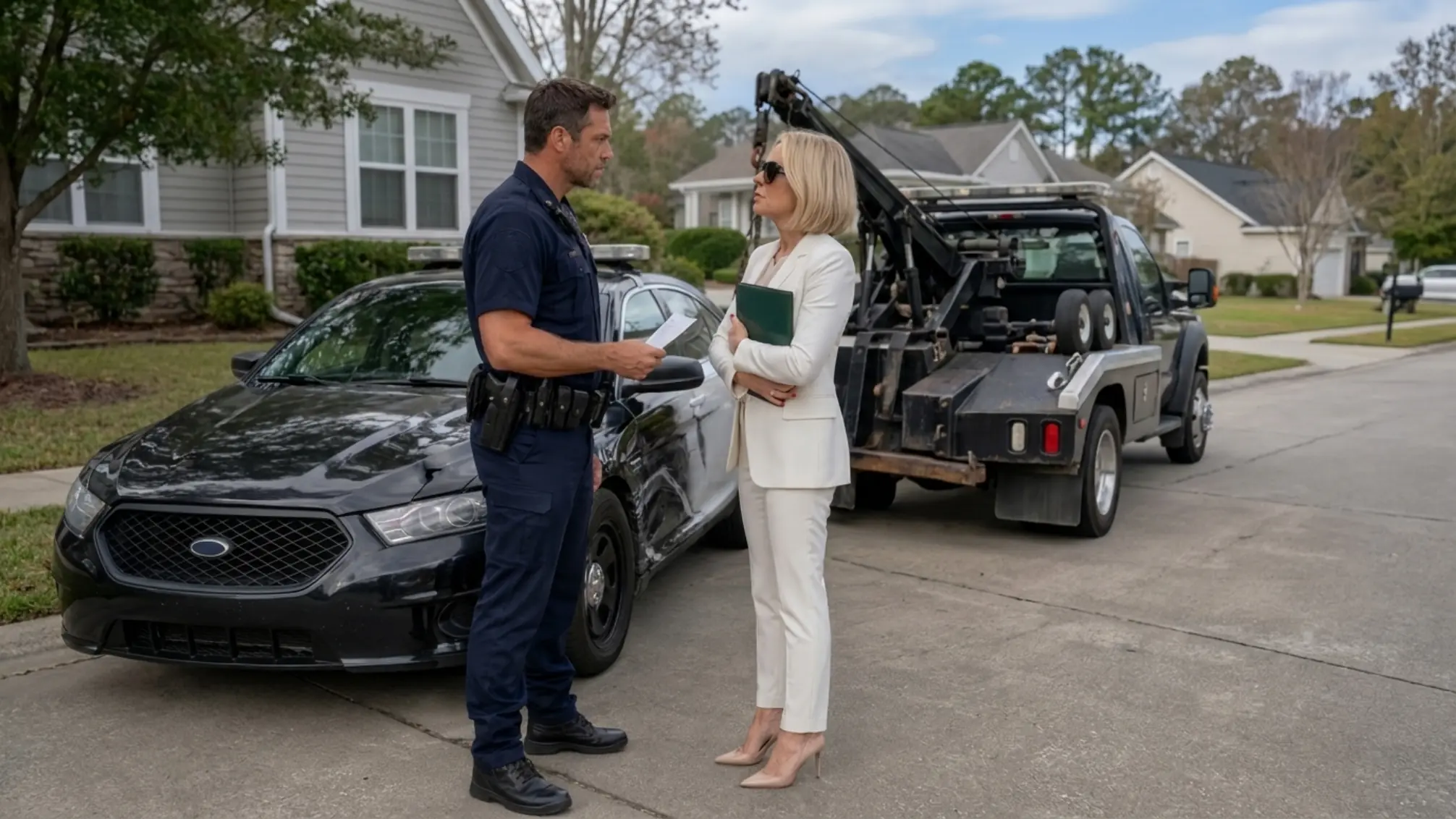
“You stole a city patrol vehicle,” Walter said.
Karen lifted her chin. “I’m the HOA president. I decide what leaves this neighborhood.”
Walter glanced toward the cruiser, then back at her. “Then decide whether you want the handcuffs in front or behind.”
For the first time, Karen’s confidence wavered.
Walter had served with the Richmond Police Department for eleven years. He had worked violent night shifts, domestic disturbances, traffic collisions, missing-child searches, and emergencies where seconds mattered more than explanations. As part of the department’s take-home vehicle program, he was assigned a marked patrol cruiser that remained parked in his driveway when he was off duty.
The policy allowed officers to respond quickly during emergencies and increased visible police presence in residential neighborhoods. Walter’s neighbors knew exactly why the cruiser was there. Several had told him they felt safer seeing it parked near the entrance to Riverside Gardens, especially when he worked overnight shifts.
For six years, no one complained.
Then Karen moved into a house four doors away.
She arrived in Riverside Gardens three months earlier and immediately began treating the neighborhood as an organization that had been waiting for her leadership. The HOA already had a president, property manager, and five-member board, but Karen spoke at meetings as though the subdivision had fallen into disorder before her arrival.
She complained about children leaving bicycles near porches. She reported a retired man for parking his fishing boat beside his garage over a holiday weekend. She submitted photographs of dogs without leashes and demanded that the board establish approved hours for outdoor basketball.
Within six weeks, she convinced enough residents to elect her interim HOA president after the previous officer resigned for health reasons.
Walter avoided her.
He had encountered enough people in uniform who confused minor authority with moral superiority. Karen’s position gave her the power to send violation letters and schedule landscaping contracts. She behaved as if it allowed her to control every driveway, every family, and every object visible from the street.
Two weeks after her election, Walter found a typed notice beneath his windshield wiper.
Commercial vehicles are prohibited from residential driveways. Remove this vehicle immediately.
Walter read it twice, looked through the windshield at the dashboard computer, radio, emergency lights, and city seal, then threw the notice into his recycling bin. A marked police cruiser was not a commercial vehicle. It was government emergency equipment protected under department policy and local law.
A second notice appeared one week later.
FINAL WARNING. FAILURE TO REMOVE THE UNAUTHORIZED VEHICLE WILL RESULT IN TOWING AT THE OWNER’S EXPENSE.
This time, Walter contacted Dennis Miller, the professional property manager hired by the HOA.
“Dennis, I’m receiving notices about my patrol unit.”
Dennis sighed before Walter finished the sentence. “Karen has called three times. We already told her the vehicle is exempt.”
“So the board has no issue with it?”
“None. Police, fire, utility, and emergency-response vehicles are specifically excluded from the commercial-vehicle restriction.”
“Does she know that?”
“I sent her the relevant section myself.”
Walter thanked him and ended the call. He assumed the written clarification would end the matter because no rational person would order the towing of a police vehicle after being told she lacked authority.
Karen was not interested in clarification.
She was interested in winning.
Walter worked an overnight shift the following Wednesday. He responded to a robbery alarm, helped locate a missing teenager, and spent nearly two hours completing reports after a driver fled a traffic stop. By the time he reached home shortly after seven in the morning, exhaustion pressed behind his eyes.
He parked the cruiser in his driveway as usual. The vehicle’s front end faced the street, and every police marking was clearly visible. Walter secured the weapons compartment, took his radio inside, showered, and fell asleep before eight.
He woke around three in the afternoon.
The first thing he noticed was the unusual brightness entering through his bedroom window. The patrol cruiser normally blocked part of the afternoon light. Walter stood, crossed the room, and looked outside.
The driveway was empty.
He checked the street, wondering whether the department had retrieved the cruiser for unexpected maintenance. There was no message on his phone and no department vehicle nearby. He immediately called his sergeant.
“Sarge, did fleet services collect my unit?”
“No. Why?”
“It’s gone.”
The sergeant became silent. “Define gone.”
“I parked it in my driveway after shift. It isn’t here now.”
“Stay where you are.”
Five minutes later, the sergeant called back.
“Richmond Recovery Towing removed it at eleven-thirty this morning. Their paperwork says an HOA representative reported an illegally parked commercial vehicle.”
Walter closed his eyes.
“Karen Stevens.”
“That name is on the request.”
“She was explicitly told the car was exempt.”
“I’ve notified command. Get to the impound lot, confirm the cruiser is secure, and document everything. The chief already knows.”
Walter drove his personal truck to the towing yard on Midlothian Turnpike. A tall metal fence surrounded rows of damaged vehicles, abandoned cars, and trucks awaiting release. Behind the gate, his patrol cruiser sat between a wrecked sedan and an old delivery van.
The sight angered him more than the empty driveway.
A heavyset manager in his fifties met Walter near the office.
“Can I help you?”
“I’m Officer Walter Hayes. You have my department vehicle.”
The manager looked through the window toward the police cruiser. “We received an authorized HOA tow request.”
“Who verified the authorization?”
“The caller identified herself as the association president.”
“That did not answer my question.”
The man shifted uncomfortably. “We generally rely on the HOA representative.”
“You relied on a civilian’s telephone call to remove a marked Richmond police vehicle from an officer’s private driveway?”
“She said it was violating commercial-parking restrictions.”
Walter pointed toward the cruiser. “Does that look like a plumber’s van?”
The manager’s face reddened. “There will be a tow charge and storage fee before release.”
Walter stared at him until the man looked away.
“You are holding city property removed without legal authorization. Release it immediately, or I will request officers, detectives, and city attorneys respond to this location and treat the vehicle as stolen.”
“I need to speak with the owner.”
“Make the call.”
The manager disappeared into the office. Walter photographed the cruiser from every angle through the fence while he waited. The towing company had dragged it improperly, scratching the front bumper and damaging the lower undercarriage.
Ten minutes later, the gate opened.
A worker drove the cruiser toward Walter and handed him the keys without requesting payment. Walter inspected the weapons compartment, computer system, emergency equipment, and body-camera charging station. Nothing appeared missing, but the damage would require an official fleet evaluation.
He drove the cruiser home and parked it in the same place.
Karen watched from the sidewalk.
She wore a cream sweater, dark trousers, and an expression of irritation rather than concern. Walter stepped from the cruiser but did not approach her.
“You brought it back,” she said.
“It belongs here.”
“No, it doesn’t.”
“The management company told you otherwise.”
“I reviewed the handbook myself. Commercial vehicles are prohibited.”
Walter pointed to the city seal. “This is an emergency vehicle.”
“It is used for your employment.”
“So is a firefighter’s engine.”
“Fire engines aren’t parked in driveways.”
“Some department vehicles are.”
Karen crossed her arms. “I will call the towing company again.”
Walter studied her face, trying to determine whether she genuinely failed to understand the consequences or simply believed consequences applied only to others.
“Do that,” he said. “Make certain you give them your full name.”
The next morning, Walter entered Police Chief Robert Daniels’s office carrying photographs, towing records, HOA notices, and Dennis’s written confirmation that the cruiser was exempt. Captain Morrison sat beside the chief with a legal pad open on his knee.
Walter described every event without exaggeration.
Chief Daniels examined the photograph of the damaged patrol car. “She knew it was a police vehicle?”
“Yes, sir.”
“She knew she lacked HOA authority?”
“Dennis told her in writing.”
“And she ordered a tow anyway?”
“Yes.”
The chief leaned back slowly. “That vehicle is worth approximately forty thousand dollars, contains police equipment, and was assigned for emergency response. She caused it to be removed and held without permission.”
Walter nodded. “The towing company released it after I explained the situation.”
“That does not erase the theft.”
Chief Daniels turned toward Captain Morrison. “Open a criminal investigation. I want the call records, HOA correspondence, towing authorization, vehicle damage report, and every communication proving she knew she had no authority.”
“Yes, Chief.”
“Do not treat this as a neighborhood disagreement. Someone knowingly caused the unauthorized taking of city-owned law-enforcement property.”
Detective Lawrence received the case that afternoon. He began with Richmond Recovery Towing, where the company’s recorded call system preserved Karen’s request.
Her voice was unmistakable.
“My name is Karen Stevens, president of the Riverside Gardens Homeowners Association. A prohibited commercial vehicle is parked at 1843 Riverside Gardens Drive. I want it removed immediately.”
The dispatcher asked what type of vehicle it was.
“A city car used for business.”
“Is it marked?”
“It has some decals.”
The dispatcher hesitated. “Is it a police vehicle?”
Karen paused before answering.
“It violates our rules. I am authorizing the tow.”
That pause became one of the most important pieces of evidence in the investigation. Karen had not mistaken the cruiser for a commercial van. She deliberately avoided identifying it accurately because she suspected the towing company might refuse.
Detective Lawrence interviewed Dennis next.
He provided emails proving that he had warned Karen three separate times. One message stated clearly:
The Richmond Police Department patrol vehicle parked at Officer Hayes’s residence is an exempt government emergency vehicle. You do not possess authority to tow it, fine it, or demand its removal. Do not take independent action.
Karen replied with only five words:
I disagree with your interpretation.
The detective also obtained video from a neighbor’s doorbell camera. It showed Karen standing in Walter’s driveway while the tow operator attached equipment to the cruiser. She directed the driver, photographed the removal, and smiled as the vehicle disappeared down the street.
Three days later, Detective Lawrence and another officer arrived at Karen’s home.
She answered wearing a white tailored pantsuit and carrying the green HOA binder.
“Mrs. Stevens, we need to discuss the patrol vehicle removed from Officer Hayes’s property.”
“I enforced a parking rule.”
“You ordered the removal?”
“Yes.”
“Were you aware it belonged to the City of Richmond?”
“It was parked in our subdivision.”
“That was not my question.”
Karen adjusted her sunglasses. “It was a work vehicle.”
“You were informed that police vehicles are exempt and that you lacked towing authority.”
“The management company does not outrank the elected HOA president.”
“The law does.”
Karen’s expression hardened. “This is harassment because he is a police officer.”
“No. We are investigating the unauthorized taking of city property.”
“I did not take anything.”
“You caused the vehicle to be removed, transported, and held at an impound lot. It sustained damage during that process.”
“I never drove it.”
“Criminal responsibility does not require you to drive the tow truck.”
Karen’s face began to lose color.
Detective Lawrence continued. “The cruiser is valued well above the threshold for felony grand larceny. You knowingly caused government property to be taken after receiving explicit notice that you had no authority.”
“This is an HOA matter.”
“It stopped being an HOA matter when you ordered someone to take a police car.”
Karen attempted to close the door.
The second officer stepped forward.
“Mrs. Stevens, place the binder inside and turn around.”
“You cannot be serious.”
“You are under arrest.”
Several neighbors watched from porches as officers placed Karen in handcuffs. She demanded to speak with the police chief, the mayor, her attorney, and the HOA’s insurance carrier. Detective Lawrence allowed her to make legal calls after booking.
The news spread through Riverside Gardens within hours.
Emergency HOA meetings were scheduled. Board members who had previously remained quiet discovered that Karen had ordered the tow without a vote, legal review, or management approval. She had falsely represented herself as possessing unilateral authority.
The board removed her as president that evening.
Karen’s attorney argued that she had made a sincere mistake while enforcing confusing parking regulations. The prosecution answered with Dennis’s emails, the recorded towing call, and the doorbell footage.
“She did not misunderstand,” the prosecutor said. “She was told no, and she decided her title made no more powerful than law.”
The city’s vehicle report documented $2,500 in towing-related damage. The department also calculated the cost of removing an active patrol unit from emergency availability for several hours.
Karen initially refused every plea agreement. She insisted a jury would understand that neighborhood appearance justified strict enforcement.
Then prosecutors played her recorded call during a preliminary hearing.
The moment she avoided admitting the vehicle was a police cruiser destroyed her defense. Her attorney requested a recess. Two weeks later, she accepted a reduced charge of unauthorized use of property rather than risk conviction on the original felony count.
The judge sentenced her to twelve months in jail, with six months suspended, two years of supervised probation, a $5,000 fine, and two hundred hours of community service. She was ordered to repay every dollar of damage and administrative cost connected to the tow.
Before sentencing, Karen addressed the court.
“I was only trying to protect property values.”
The judge looked over his glasses. “You damaged a forty-thousand-dollar city vehicle to preserve the appearance of a driveway.”
“I believed the rules supported me.”
“You were given the rule in writing.”
“The HOA elected me to enforce standards.”
“They did not elect you to commit crimes.”
The courtroom became silent.
“You saw a police car,” the judge continued. “You knew it belonged to the city. You knew the management company forbade you from towing it. Yet you acted because being told no offended your sense of authority.”
Karen lowered her eyes.
“This sentence is not about a parking disagreement. It is about deliberate conduct and your refusal to recognize any limit on your power.”
The towing company faced consequences as well. Investigators found that employees regularly removed vehicles based on telephone requests without confirming property ownership or association authority.
Although prosecutors did not file criminal charges against the company, the city suspended it from the approved towing rotation for six months. The owner paid for the cruiser’s damage and implemented mandatory verification procedures.
A retired firefighter named Thomas Reed became the new HOA president. He visited Walter personally after the board elected him.
“Officer Hayes, the association owes you and the department an apology.”
Walter invited him onto the porch.
“Karen acted alone,” Thomas continued. “The board has adopted a policy requiring management approval before any tow. Emergency vehicles are now explicitly protected in the neighborhood rules.”
“They already were.”
“I know. We made the language impossible to misinterpret.”
Walter accepted the apology.
He did not ask the board to remove Karen from the neighborhood. The criminal case, public humiliation, lost title, and financial consequences were enough. Revenge would not repair the cruiser or improve Riverside Gardens.
Karen served four months before being released early under supervision. She placed her house on the market almost immediately and moved to North Carolina after it sold.
On moving day, she passed Walter’s driveway one final time.
The patrol cruiser sat exactly where it had always been.
Walter stood beside it checking equipment before his evening shift. Karen slowed but did not stop. They looked at each other through their vehicle windows, neither offering a word.
Then she drove away.
The family who purchased her house included a retired Navy veteran, his wife, and their two grandchildren. On their first weekend, the husband introduced himself to Walter and said the marked police cruiser made him feel better about the neighborhood.
Other residents began expressing the same sentiment.
Parents told Walter they appreciated knowing an officer lived nearby. Elderly neighbors asked whether they could call him if they saw suspicious activity. Walter explained that emergencies should still go through dispatch, but he promised to help whenever possible.
The story eventually became well known throughout the Richmond Police Department. Chief Daniels used it during community meetings as an example of why take-home patrol vehicles benefited residential areas.
He also used it during command training for another reason.
“Authority has limits,” he told new supervisors. “The moment someone believes a title places them above those limits, that authority becomes dangerous.”
Months later, Walter stood in his driveway beside the cruiser while sunlight caught the repaired paint. A faint line remained near the bumper where the towing equipment had scraped the surface.
He could have requested another vehicle.
He chose to keep that one.
The scratches reminded him that obvious reality could disappear when entitlement became strong enough. Karen had looked directly at a marked police cruiser and seen only an object standing between her and obedience.
She believed calling it a commercial vehicle would make it one.
She believed carrying an HOA binder would transform personal anger into legal authority.
She believed ordering someone else to take the cruiser protected her from responsibility.
The law disagreed.
Walter locked the equipment compartment, entered the driver’s seat, and started the engine. Blue lights flashed once as the system completed its check.
Across Riverside Gardens, children played near sidewalks, dogs barked from fenced yards, and residents returned home from ordinary workdays. No one viewed the cruiser as a threat to the neighborhood’s appearance anymore.
It represented something Karen had never understood:
Real authority did not come from forcing people to obey.
It came with responsibility, restraint, and consequences when those powers were abused.
Karen ordered the patrol car removed because she wanted everyone to know she controlled the neighborhood.
Instead, she taught them something far more permanent.
Towing a police cruiser was not HOA enforcement.
It was the theft of government property—and even the loudest president in the neighborhood could not rewrite the law inside her handbook.