Iris Galloway had always believed that a confident voice and an official-looking folder were enough to make people obey.
For four years, she had been the president of Pembroke Commons Homeowners Association in Sacramento, California.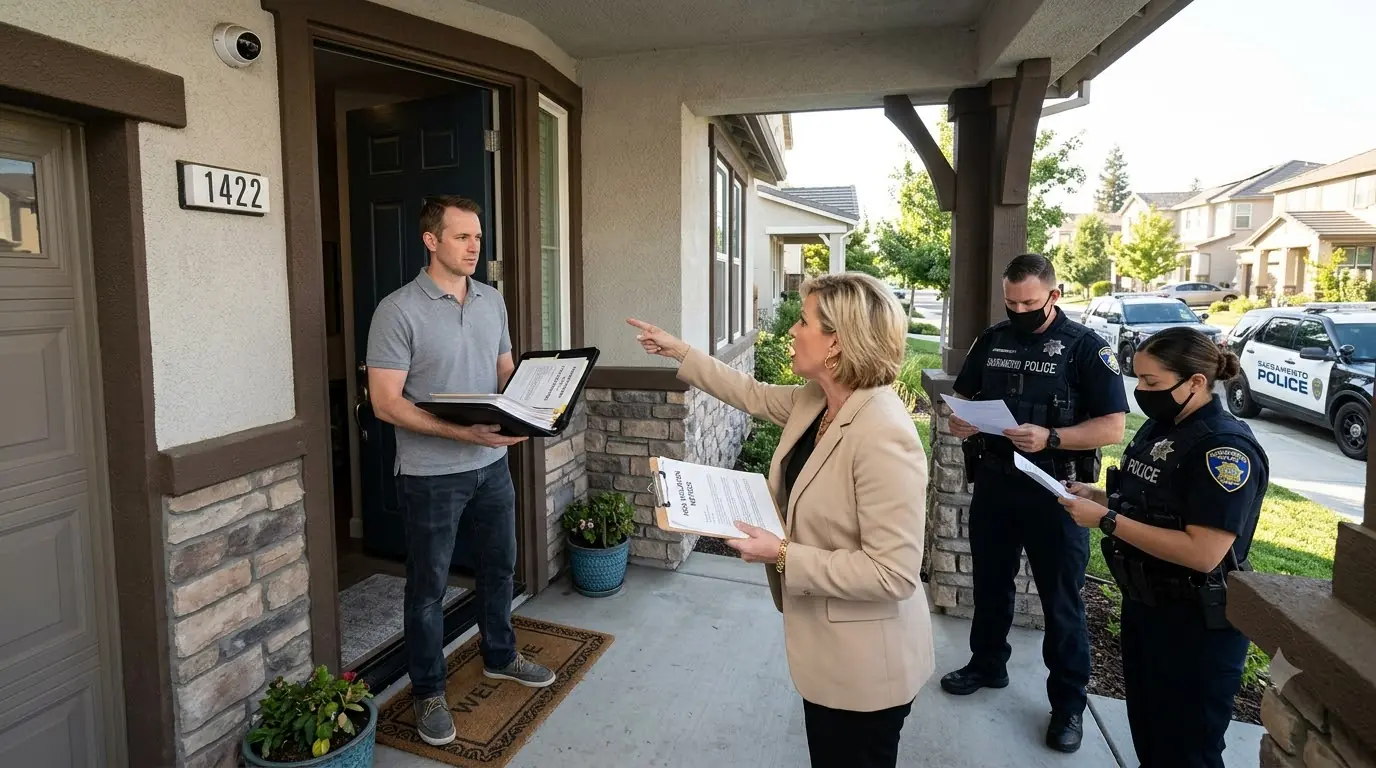
The community had 49 homes, identical beige exteriors, neatly trimmed lawns, matching mailboxes, and a strict set of rules that most residents followed without questioning.
But Iris had discovered something more powerful than rules.
People were afraid of authority.
Especially when that authority arrived smiling.
Her favorite time to use that advantage was when someone new moved in.
She would arrive within the first week carrying a welcome packet, a friendly expression, and what she called a “new resident interior orientation.”
According to Iris, every new homeowner needed to allow the HOA president to inspect the inside of their home.
She claimed it was necessary to ensure compliance with community standards.
Most residents never questioned it.
They had just bought a house.
They wanted to fit in.
They did not want their first interaction with the HOA to become a fight.
So, for years, doors opened.
Fourteen homes.
Fourteen families.
Fourteen times Iris walked inside with nothing more than confidence.
Until Weston Alcott moved in.
Weston was 39 years old and had just purchased a home at 3318 Pembroke Court.
Unlike many new residents, Weston did not react emotionally when Iris arrived.
He listened.
He smiled politely.
And then he asked one question.
“Which section of the governing documents gives the HOA authority to inspect the interior of a privately owned home?”
Iris paused.
She had expected hesitation.
She had expected politeness.
She had not expected someone to ask for legal authority.
“It is standard procedure for all new residents,” she replied.
Weston nodded.
“That wasn’t my question.”
For the first time, Iris’s smile weakened.
She told him she would follow up in writing.
Then she left.
Inside his new home, Weston opened the Pembroke Commons governing documents.
Thirty-nine pages.
He read every single section.
He searched for anything related to interior inspections.
There was nothing.
No clause.
No authorization.
No exception.
No rule.
The HOA had the authority to regulate certain exterior matters.
Maintenance standards.
Shared property.
Community appearance.
But the inside of his home?
That was private.
Weston closed the document.
Then he waited for Iris’s promised explanation.
Instead, three days later, he received a violation notice.
$250 fine.
Reason:
Failure to comply with new resident interior orientation requirements.
The document carried Iris Galloway’s signature.
Weston photographed it.
Saved a copy.
Created a folder on his computer.
Then he sent a formal written request to the HOA board.
He asked for one thing:
The exact bylaw number authorizing mandatory interior inspections.
Nothing more.
The letter was sent certified mail.
The HOA received it.
The board never answered.
Two weeks passed.
Nothing.
Thirty days passed.
Still nothing.
Weston sent a second certified request.
Again, silence.
That silence told him everything.
They did not have the answer.
Because there was no answer.
Weston began speaking quietly with neighbors.
The first person he contacted was Winifred Fairweather.
She was a retired librarian who had lived across the street for nine years.
When Weston asked if Iris had ever inspected her home after she moved in, Winifred became quiet.
“Yes,” she finally said.
Then she added something that surprised him.
“I wish someone had told me I could say no.”
That sentence changed the situation.
Because Weston realized this was not just about him.
It was a pattern.
A week later, Iris returned.
This time she brought Montgomery Stubbs, an HOA board member who rarely disagreed with anything Iris proposed.
They stood at Weston’s front door.
Iris explained that the board had reviewed his refusal.
They had decided his behavior represented a serious compliance issue.
Weston calmly asked the same question.
“Can you show me the governing document language that allows you to enter my home?”
Iris folded her arms.
“It is established community practice.”
Weston shook his head.
“Community practice is not the same as legal authority.”
Montgomery tried to interrupt.
“The board has approved this.”
Weston looked at him.
“The board cannot create authority that the governing documents do not provide.”
The conversation ended.
Weston closed the door.
The next week, another fine arrived.
This time:
$400.
The original $250 was still unpaid.
The total balance:
$650.
Weston did not argue.
He did not call Iris.
He contacted an attorney.
Evander Cross had spent 12 years handling property and civil rights cases.
He listened to everything Weston had collected.
The violation notices.
The unanswered letters.
The lack of authority.
The neighbor statements.
The repeated visits.
When Weston finished, Evander gave him three instructions.
“Do not pay anything.”
“Do not argue with Iris anymore.”
“And let me handle communication.”
Evander sent a formal request to the HOA demanding:
The complete governing documents.
The legal basis for interior inspections.
The board records approving the policy.
The enforcement history.
The HOA had 14 days to respond.
They did not.
Instead, Iris escalated.
More violations appeared.
A landscaping violation for grass that was within community standards.
A noise complaint without any documented incident.
A parking violation for a legally parked vehicle in Weston’s own driveway.
Every notice was photographed.
Every notice was saved.
Every notice made Evander’s case stronger.
Meanwhile, Iris continued showing up.