The afternoon sun hung over Willowbrook Estates, Florida, turning the water in Michael Reeves’s private swimming pool into a sheet of blue glass. Michael had spent the entire week dealing with county meetings, emergency calls, and paperwork that seemed to multiply whenever he finished a stack. On Saturday, he wanted nothing more than thirty quiet minutes in the pool behind the home he had purchased six months earlier. He had barely settled against the shallow-end steps when a sharp voice cut across his backyard.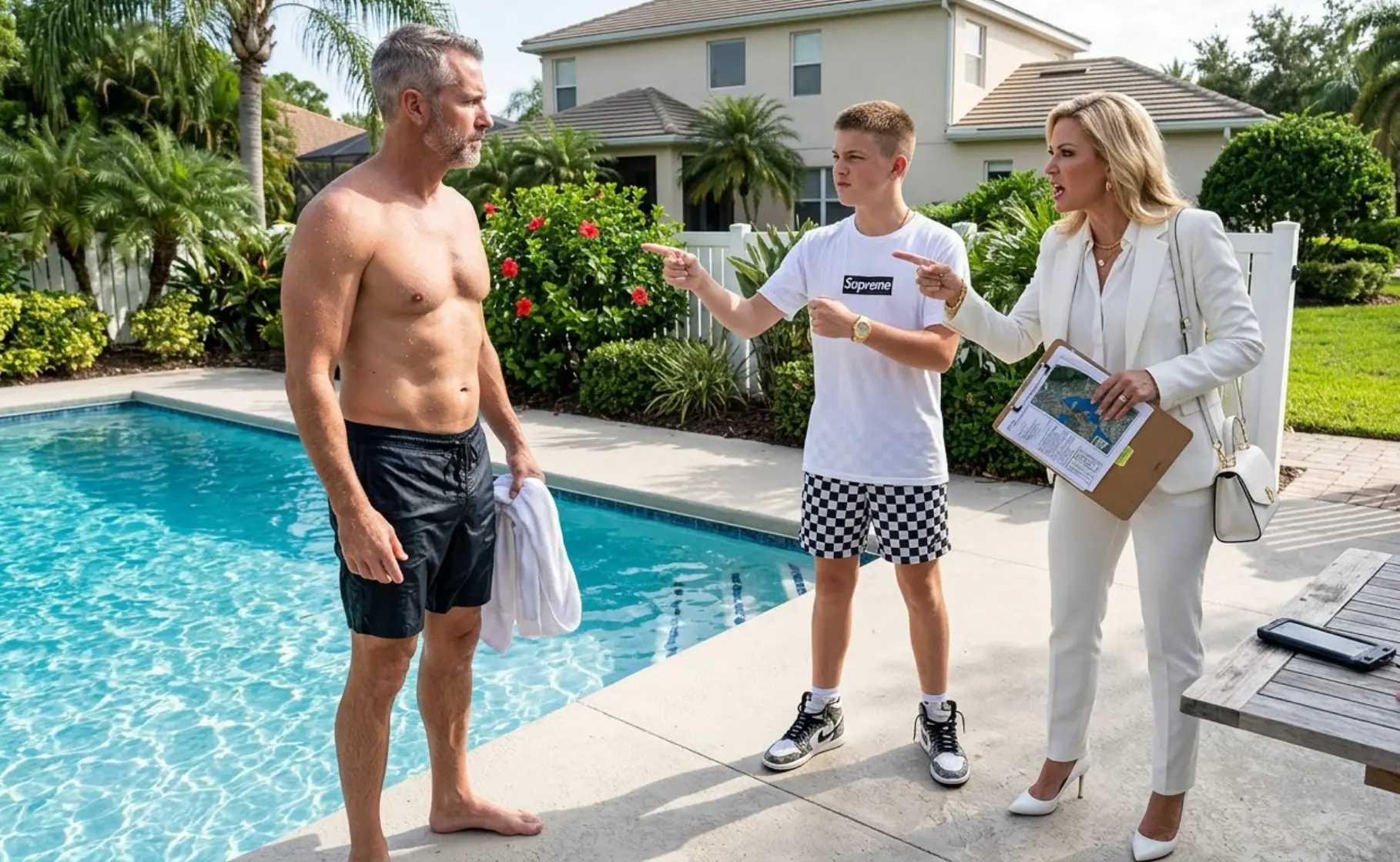
“Hey, you need to get out. This is my pool now.”
Michael slowly turned toward the patio.
Seventeen-year-old Brandon Mitchell stood at the edge of the water wearing a white Supreme T-shirt, black-and-white checkered swim shorts, expensive sneakers, and a gold watch that looked absurd beside the plastic pool bracelet around his wrist. He had entered through the side gate without permission and now pointed toward Michael as if ordering an employee away from a hotel pool. His fair face carried the smug certainty of a teenager who had never heard “no” without his mother appearing to reverse it. Michael remained in the water and studied him in silence.
“Your pool?” Michael asked.
Brandon folded his arms. “This whole area is HOA recreational property. My mom showed me the maps.”
Michael looked toward the six-foot privacy fence surrounding the backyard, the patio connected directly to his kitchen, and the county-approved permit framed inside his home office. There was no path leading from the neighborhood to the pool, no shared gate, and no sign suggesting public access. The nearest piece of HOA common property was a narrow flower bed beside the community mailbox nearly half a mile away. Brandon’s claim was so ridiculous that Michael almost laughed.
“Leave my property,” he said.
Brandon’s smile disappeared. “You don’t tell me what to do.”
“I just did.”
“My mom runs this neighborhood.”
Michael moved toward the steps and climbed out of the pool. Water ran from his shoulders as he reached for a towel, but Brandon did not retreat. Instead, the teenager raised one hand as if preparing to shove Michael backward if he came closer. Michael stopped beside the patio table, where his phone sat inside a waterproof case with the camera already recording.
“Touch me, kid,” Michael said quietly. “See where you sleep tonight.”
Brandon’s bravado flickered, but only for a second. He pulled out his phone and called his mother, speaking loudly enough for Michael to hear every exaggerated word. He claimed an aggressive stranger had threatened him on community property and refused to obey HOA rules. By the time he ended the call, his smile had returned.
“You’re finished,” Brandon said. “She’ll have your house before Monday.”
Michael wrapped the towel around his waist. “I’ll be waiting.”
Karen Mitchell arrived less than five minutes later.
The forty-five-year-old HOA president entered through the same private gate without knocking. She wore an immaculate white pantsuit, matching pointed heels, gold jewelry, and a white leather handbag beneath one arm. Her blonde hair was styled into a polished wave, and she carried a clipboard containing printed maps that appeared official until anyone looked closely.
Karen did not ask why her son had entered someone else’s backyard.
She pointed at Michael.
“Get away from the pool.”
Michael stared at her. “You entered private property without permission.”
Karen opened the clipboard. “This area was designated for community recreation when Willowbrook Estates was established.”
“No, it wasn’t.”
“I am the HOA president. I know our property boundaries.”
“I own the house, the yard, and the pool.”
“You own the structure.” Karen tapped one page with a manicured fingernail. “The land behind it remains under HOA authority.”
Michael stepped closer to the clipboard. The document displayed an altered neighborhood map with bright blue lines drawn over his lot. His parcel number was incorrect, the scale changed between sections, and the county seal had been copied from an old zoning document. It looked impressive only to someone unfamiliar with property records.
“That map is fake,” he said.
Karen’s face tightened. “Be careful.”
“Careful about what?”
“Accusing an HOA officer of fraud.”
Michael glanced toward Brandon, who was recording the confrontation and grinning. “You want the full truth on his video?”
Karen closed the clipboard sharply. “I want you out of our pool.”
Michael walked past them and closed the side gate. The latch snapped into place, leaving all three inside the backyard. Brandon shifted uneasily when Michael remained between them and the exit.
Karen lifted her chin. “Are you trapping us?”
“No. I’m stopping you from pretending you wandered in by accident.”
“My HOA can take your house whenever I say.”
Michael raised the waterproof phone from the patio table. Its red recording light remained visible.
“Good,” he said. “Tell that lie again for the sheriff.”
Karen laughed. “The sheriff has more important things to handle than a hostile homeowner who refuses to follow regulations.”
Michael looked directly at her. “You would be surprised.”
Karen announced that he would receive fifteen thousand dollars in combined fines for trespassing on common property, threatening a minor, obstructing HOA officials, and using an unauthorized swimming facility. She also threatened to tow his pickup truck, place a lien on the home, and call an emergency board meeting to begin forced-sale proceedings. Brandon stood beside her, nodding as if each threat carried the force of law. Neither understood that almost every sentence strengthened the case Michael had already begun building.
Six months earlier, Michael had moved into Willowbrook Estates after winning election as county sheriff. He wanted to live as an ordinary homeowner rather than advertise his title to every neighbor. He told people only that he worked in county public service, wore casual clothing when off duty, and parked his unmarked work truck in the driveway. He believed privacy would allow him and the community to form honest relationships.
Instead, privacy showed him what people did when they believed no authority was watching.
Karen’s first violation notice arrived three days after his moving truck temporarily blocked part of a neighboring driveway. The second concerned grass that supposedly exceeded the approved height by one-quarter inch. The third called his pickup an unauthorized commercial vehicle, despite its standard registration and lack of business markings. Michael responded only when the rules were legitimate and quietly documented every invented violation.
He soon learned that Karen controlled Willowbrook through fear.
She fined elderly residents for decorations that had stood on their porches for decades. She threatened young families over minor parking mistakes while allowing Brandon to block sidewalks and driveways. Homeowners who challenged her received surprise inspections, legal letters, and rapidly increasing penalties. Board members approved her decisions because opposing her often meant becoming her next target.
Brandon had learned the same system.
He played loud music after midnight, damaged borrowed property, threw parties, and mocked neighbors who complained. Whenever anyone confronted him, Karen accused them of harassing a minor. She used the HOA’s attorney to send threatening letters, while Brandon bragged that his family could do whatever it wanted.
Michael collected photographs, videos, financial records, complaint letters, and statements from residents who were too frightened to speak publicly. He had not yet opened a formal criminal investigation because he needed clear evidence connecting the intimidation to fraud. Karen’s fabricated pool map and direct threat to seize his home provided exactly that.
“Monday night,” Karen said before leaving the backyard, “you will appear before the board.”
Michael unlocked the gate.
“I’ll be there.”
“You should bring a lawyer.”
“I think I’ll manage.”
Brandon paused beside the opening. “Enjoy the pool while it’s still yours, old man.”
Michael smiled without warmth. “Enjoy your weekend.”
The teenager did not understand why the answer made his mother look uneasy.
That evening, seventy-two-year-old Margaret Patterson knocked on Michael’s front door carrying a casserole dish. Her hands trembled as she explained that Karen had fined her more than three thousand dollars over garden ornaments, mailbox paint, and porch lighting. Margaret had skipped medication twice to make HOA payments because Karen threatened to place a lien on the home she had shared with her late husband for thirty years. She believed the fines were cruel but had no money to fight them.
Michael placed the untouched casserole on the kitchen counter and began writing.
The next morning, more neighbors arrived.
A young couple described receiving a five-hundred-dollar penalty because their car sat three inches beyond a painted parking line. A single father showed security footage of Brandon’s BMW near his property shortly before someone vandalized his fence. Another family reported that their home was egged after their teenage daughter rejected Brandon at school. Karen threatened all of them when they tried to complain.
By Sunday night, Michael had seventeen written statements.
He also received preliminary financial records from the state agency responsible for monitoring community associations. Special assessments collected by Karen did not match deposits into the HOA’s official account. Several supposed landscaping companies had received payments despite having no licenses, equipment, employees, or legitimate business addresses. Two were connected to bank accounts Karen controlled.
The emergency meeting Karen scheduled as Michael’s public humiliation was quickly becoming her own evidentiary hearing.
Monday evening, the Willowbrook community center was packed.
Karen had sent dramatic emails accusing Michael of threatening her son, stealing HOA property, and refusing lawful instructions. Residents filled every chair while others stood along the walls. Brandon sat in the front row wearing another Supreme shirt, phone ready to record what he expected would become his mother’s victory.
Michael arrived wearing jeans and a plain blue button-down shirt. He carried one thick leather folder beneath his arm. Karen looked disappointed that he did not appear frightened.
She stood behind the board table and called the meeting to order.
“For six months,” she began, “one homeowner has repeatedly rejected the standards that protect our community.”
A projector displayed photographs of Michael’s house, pickup, and swimming pool. The image of the pool had been cropped so tightly that viewers could not see the surrounding private fence or patio. Karen described it as community recreational property illegally occupied by Michael.
Then Brandon stood.
“I asked him politely to leave,” he said. “He became aggressive and threatened me.”
Michael remained seated.
Brandon continued claiming that he feared for his safety, despite video on his own phone showing him entering the yard and ordering Michael out. Karen placed one protective hand on her son’s shoulder and recommended fifteen thousand dollars in fines, immediate towing of Michael’s truck, and legal action to force the sale of his home.
Several board members looked uncomfortable but said nothing.
Karen faced Michael with a triumphant smile.
“Does the accused homeowner have anything to say?”
Michael stood and carried his folder to the front.
“First, let’s discuss ownership.”
He removed the recorded deed, county survey, building permits, and an official zoning letter. Each document confirmed that the pool, patio, yard, and surrounding fence belonged entirely to Michael. No easement or HOA recreational designation existed anywhere on the property.
Karen dismissed the documents as potential forgeries.
Michael connected his tablet to the projector.
The county clerk’s official online portal appeared, displaying the same deed with its verification number and digital seal. A murmur moved through the room. One board member leaned forward and examined Karen’s map.
“The parcel number on your document belongs to the drainage basin,” he said.
Karen snapped, “That is an administrative discrepancy.”
“It is a different property,” Michael replied.
He then played the recording from the pool.
The room heard Brandon’s first words clearly: “Hey, you need to get out. This is my pool now.”
They watched Karen enter without permission, present the altered map, threaten to seize the house, and claim the sheriff would support her. No one saw Michael threaten a child. No one heard him use abusive language.
Brandon lowered his phone.
Karen’s smile vanished.
“That recording was made illegally,” she said.
“Florida requires consent from all parties in certain private conversations,” Michael answered. “But there was no reasonable expectation of privacy while you trespassed in my yard, publicly asserted HOA authority, and allowed your son to record the same exchange. My outdoor security cameras also captured the entire incident.”
“You manipulated the footage.”
“I have six continuous angles.”
Michael advanced to the next file.
The screen showed Brandon’s BMW stopping near several homes during nights when vandalism occurred. Another video captured him tossing garbage onto Michael’s lawn. A third showed him slashing one tire on the pickup before running back toward his car.
Brandon stood abruptly. “That isn’t me.”
The enlarged frame clearly displayed his face.
Michael changed the video again.
Twenty teenagers climbed over his backyard fence on Friday night while he worked late. They drank alcohol beside the pool, threw bottles into the water, overturned furniture, damaged flower beds, and pushed Michael’s grill into the deep end. Brandon appeared in the center of almost every frame, laughing while he directed others.
The room fell silent.
Karen stared at her son. “You told me the homeowner invited you.”
Brandon’s panic surfaced. “I thought it was community property.”
“You climbed a locked fence,” Michael said.
“It was a joke.”
“A twelve-thousand-dollar joke.”
Karen struck the board table with her palm. “This meeting concerns his violations, not my son.”
“It concerns both of you.”
Michael displayed financial spreadsheets comparing HOA assessments with official bank deposits. More than forty thousand dollars had disappeared during Karen’s three years as president. Payments to nonexistent vendors aligned with deposits into accounts connected to her.
The board members turned toward her.
Karen’s face became white.
“Those records are confidential.”
“They became relevant after multiple residents reported fraudulent fines and misused assessments.”
“You have no authority to obtain my banking information.”
“I had probable cause and a warrant.”
Karen stared at him. “Who are you?”
Michael reached into the folder and placed a gold shield on the table.
“I’m Michael Reeves, the elected sheriff of this county.”
The reaction moved through the room in waves. Neighbors gasped. Board members pushed back their chairs. Brandon dropped his phone onto the floor.
Karen’s lips moved before sound came.
“That’s impossible.”
Michael clipped the shield to his belt.
“You knew I worked in county public service. You never bothered asking what that meant.”
“This was entrapment.”
“Entrapment requires law enforcement to pressure someone into committing a crime. I did not pressure you to create false maps, collect fraudulent fines, threaten homeowners, misappropriate funds, or trespass on my property.”
Karen stepped around the table.
“You moved here to investigate me.”
“I moved here because I liked the neighborhood. Your behavior created the investigation.”
Brandon rose and moved toward Michael with clenched fists.
“You think that badge makes you tough?”
Michael looked at him calmly. “Sit down.”
“You ruined my family.”
“No. You recorded your family ruining itself.”
Brandon shoved Michael in the chest.
The entire room froze.
Michael caught his wrist, turned him away without striking him, and secured both hands behind his back. Two deputies who had been waiting outside entered immediately.
“Brandon Mitchell,” Michael said, “you are under arrest for assault, criminal trespass, vandalism, property destruction, and offenses connected to underage drinking.”
Brandon’s confidence collapsed.
“I barely touched you.”
“You placed your hand on me in front of one hundred witnesses.”
Karen lunged between them.
“You are not taking my son.”
One deputy moved her aside without unnecessary force.
“Ma’am, step back.”
“I run this community.”
A board member stood.
“Not anymore.”
Gerald Watkins, the board’s vice president, raised one hand. “I call for an immediate vote to remove Karen Mitchell as HOA president pending a full financial audit.”
Karen turned toward him. “I made you vice president.”
“You threatened my wife when I questioned an assessment.”
Another board member stood.
“She threatened my business.”
A third joined them.
“She altered the monthly reports before meetings.”
Gerald looked across the room. “All in favor?”
Every board member raised a hand.
Residents followed, though only the board’s votes were necessary.
Karen stood alone beside the table while her son was escorted through the doors. The white pantsuit that looked commanding at the beginning of the meeting now made her appear exposed beneath the bright fluorescent lights.
“This is not over,” she whispered.
Michael closed the folder.
“It is only beginning.”
The state audit eventually confirmed more than forty thousand dollars in misappropriated HOA money. Karen had created false vendors, redirected assessment payments, and issued fabricated penalties to residents she believed lacked the resources to fight. She faced criminal charges, civil claims, and removal from every leadership position connected to the association.
Brandon received probation, community service, counseling, and an order to repay the damage to Michael’s property. His driver’s license was restricted, his BMW was sold to cover restitution, and the teenager who once ordered neighbors around spent his weekends repairing common areas under supervision. For the first time in his life, his mother could not erase the consequences.
Willowbrook elected a new HOA board.
Fraudulent fines were canceled, liens were removed, and money was returned to families whenever records allowed. Margaret Patterson placed her garden ornaments back on the porch. Families no longer closed their curtains when board members approached.
Months later, Michael hosted a voluntary neighborhood gathering beside the same pool.
Children played in the water while parents shared food across the patio. The grill had been repaired, the furniture replaced, and the side gate remained open because Michael chose to open it. Nothing about the gathering turned the pool into community property.
Margaret sat beneath an umbrella and watched the children laugh.
“You know,” she told Michael, “Karen’s son was partly right.”
Michael raised an eyebrow.
“This became everyone’s pool.”
He looked across the backyard.
“No,” he said with a smile. “It’s still mine.”
Margaret laughed.
“But good neighbors are welcome.”
That difference was something Karen and Brandon had never understood.
Community was not created by declaring ownership over another person’s home. Authority did not come from threats, fabricated maps, expensive clothing, or a title printed on HOA stationery. It came from trust, fairness, and people choosing to respect one another even when no sheriff was standing nearby.
Brandon had entered the yard believing the pool belonged to whoever acted the most entitled.
Karen arrived believing a loud voice could transform a lie into law.
Neither expected the quiet homeowner wrapping a towel around his waist to possess more authority than their entire little empire.
But Michael had never needed the badge to know the truth.
The badge only ensured that when they finally crossed the line, they could no longer threaten everyone else into pretending it was not there.