The first time Karen Whitmore sent me a letter threatening to take my home, I actually laughed.
Not because it was funny.
Not because I underestimated her.
I laughed because for a brief moment, I genuinely believed there had been some kind of mistake.
I thought someone had typed the wrong address.
I thought some paperwork had been mixed up.
I thought a neighborhood association had accidentally sent a legal notice to the wrong person.
Because the letter sitting on my kitchen table claimed that the homeowners association next door had the authority to place a lien on my family's 150-year-old farmhouse.
A house that had existed before the neighborhood around it.
A house that had existed before the streets were paved.
A house that had existed before the people sending me threats were even born.
The letter claimed I owed five years of unpaid HOA fees.
It claimed my refusal to participate in their association was a violation.
It claimed they had the legal right to force me into compliance.
And if I didn't pay the alleged debt, they would begin the process of taking my property.
My family's land.
My family's home.
The place my ancestors built with their own hands.
I read the letter three times.
Then I placed it carefully on the table.
Because the first thing I needed to do was calm down.
The second thing I needed to do was call my lawyer.
The third thing I needed to do was find out why the president of a neighborhood association believed she could take something that had belonged to my family for six generations.
My name is Thomas Walker.
And before Karen Whitmore decided to challenge me, she should have learned one very important thing.
My family does not give up easily.
Especially not when it comes to the land we built our lives on.
The farmhouse had been standing for 150 years.
My great-great-great-grandfather built it shortly after the Civil War.
Back then, the land looked completely different.
There were no perfect streets.
No carefully planned neighborhoods.
No identical houses with matching lawns and strict rules about mailbox colors.
There was just open land.
Fields.
Trees.
A family trying to rebuild after a devastating war.
My ancestor, Samuel Walker, returned home with almost nothing.
The war had taken nearly everything from him.
Buildings were gone.
Money was gone.
The future looked uncertain.
But Samuel had something many people underestimate.
Determination.
He rebuilt the farmhouse himself.
Every beam.
Every wall.
Every piece of furniture he could make.
People came to him afterward offering money for the land.
At the time, the area was considered worthless by many outsiders.
They saw empty fields.
Samuel saw home.
He refused every offer.
He believed land was more than something you sold when someone offered enough money.
It was a place where families were created.
A place where memories were made.
A place that carried the people who came before you.
That belief stayed with every generation after him.
The house changed over time.
It had additions.
Modern plumbing.
Electricity.
A renovated kitchen.
A stronger roof.
Technology slowly entered the old walls.
But the heart of the house never changed.
The original wooden beams remained.
The original fireplace remained.
The old photographs stayed on the walls.
The land was still the land.
When my father inherited the property, he treated it like a responsibility, not an asset.
My father was not a wealthy man.
He didn't own companies.
He didn't drive expensive cars.
He didn't care about impressing anyone.
He worked.
Every single day.
He grew up on that farm and spent most of his life making sure it survived.
He was an only child, but he never complained about the responsibility.
From the time he was young, he worked the fields.
He repaired equipment.
He cared for animals.
He built fences.
He met my mother when they were young, and somehow convinced her that spending her life on a farm was a good idea.
She used to joke that she didn't marry a farmer.
She married a man who happened to own a farm and refused to stop working.
My father was strict.
Very strict.
But nobody who knew him could deny his character.
He believed discipline mattered.
He believed education mattered.
And most importantly, he believed his children deserved opportunities he never had.
My siblings and I grew up working around the farm, but my father made one rule very clear.
None of us would spend our entire lives trapped by the same limitations he had faced.
"You will get an education first," he told us.
"Then you can decide what kind of life you want."
He was proud when I graduated college.
The first man in my family to do so.
My older brother had served in Vietnam and never came home the same person.
That loss shaped our family forever.
My father carried that pain quietly.
He never talked about it much.
Instead, he worked.
That was his way.
When I graduated and got a job in the city, my father was happy.
Not because I was leaving.
Because I had choices.
The farm remained home.
I lived in apartments.
I built a career.
I created a life outside the property.
But every weekend, I returned.
Because some places are impossible to leave completely.
Eventually, my father grew older.
The man who once worked from sunrise until sunset started slowing down.
The farm had become harder to maintain.
The city had expanded around us.
What was once farmland was becoming suburban development.
Developers began appearing with offers.
Then bigger offers.
Then ridiculous offers.
They wanted the land because of its location.
A historic property surrounded by growing neighborhoods was valuable.
But my father always refused.
"This land isn't for sale," he would say.
Simple.
Final.
After he passed away, the responsibility came to me.
I became the next person protecting the property.
And I never hesitated.
Some people inherit money.
Some people inherit businesses.
I inherited a promise.
The years after my father passed were interesting.
The city kept growing.
The neighborhood around us transformed completely.
A massive housing development was built nearby.
Beautiful houses.
Perfect lawns.
Identical fences.
Everything carefully planned.
And eventually, letters started arriving.
Most were from real estate companies.
They wanted to buy the land.
They offered more money every year.
I always refused.
Then the HOA letters started.
At first, they were polite.
They introduced themselves as the neighborhood association.
They explained how joining would "protect property values."
They suggested my land would benefit from their guidelines.
They offered membership.
I declined.
Then they tried again.
And again.
Eventually, I stopped responding.
My property did not need their protection.
My family had protected it for 150 years.
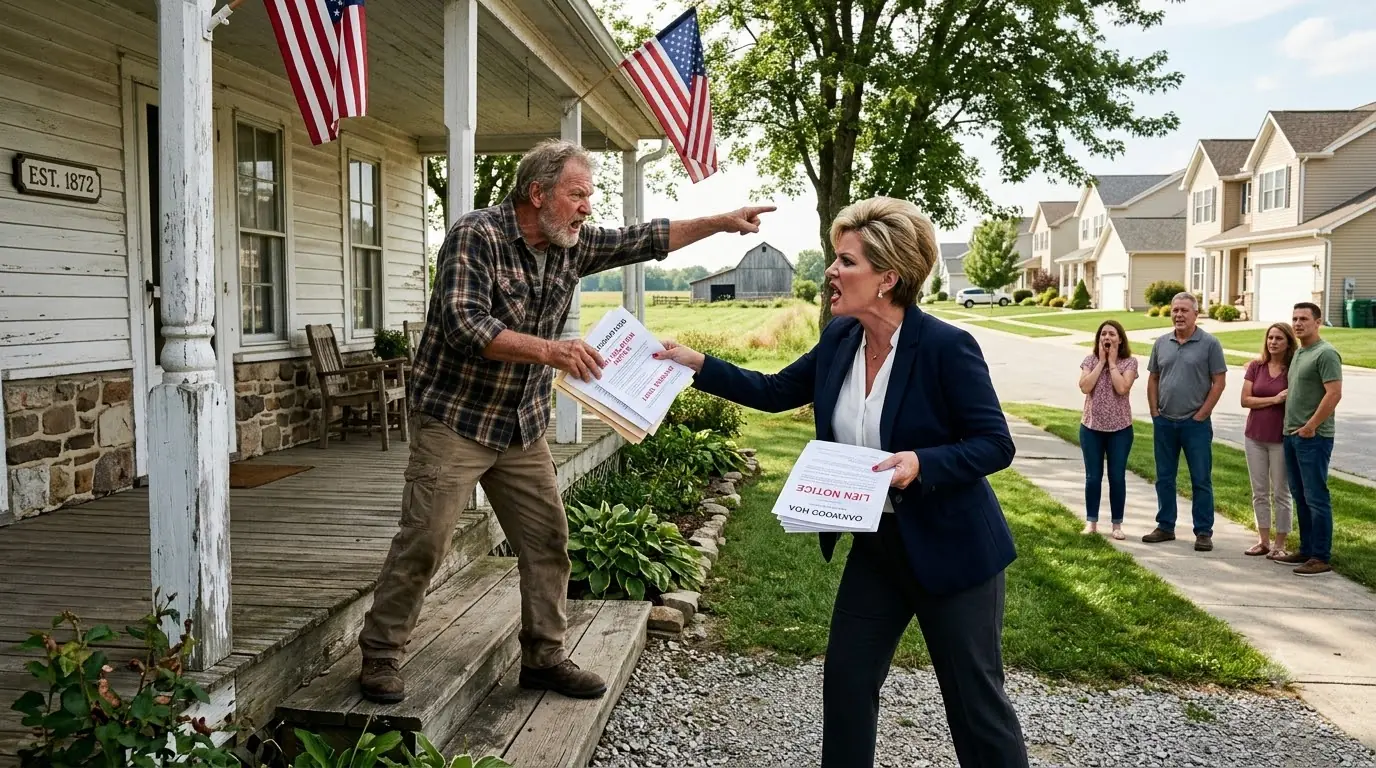
Then came the letter.
The one that changed everything.
It was not an invitation.
It was not a request.
It was a threat.
The HOA claimed I owed years of unpaid fees.
They claimed my property was somehow under their authority.
They claimed they could place a lien on my home.
A lien.
On a house my ancestors built before their neighborhood existed.
I immediately called my lawyer.
He read the letter.
Then he laughed.
Not because the situation was funny.
Because he couldn't believe someone had actually written it.
"Thomas," he said, "before we discuss legal strategy, I have one question."