At 6:00 on a Tuesday morning, Leonard Coss drove to the road entrance and hung a gate. It was not a threat; it was a fact.
Leonard had been a contractor for thirty-five years, and he owned the three-acre parcel where the only road into a fifty-eight-home neighborhood crossed his land.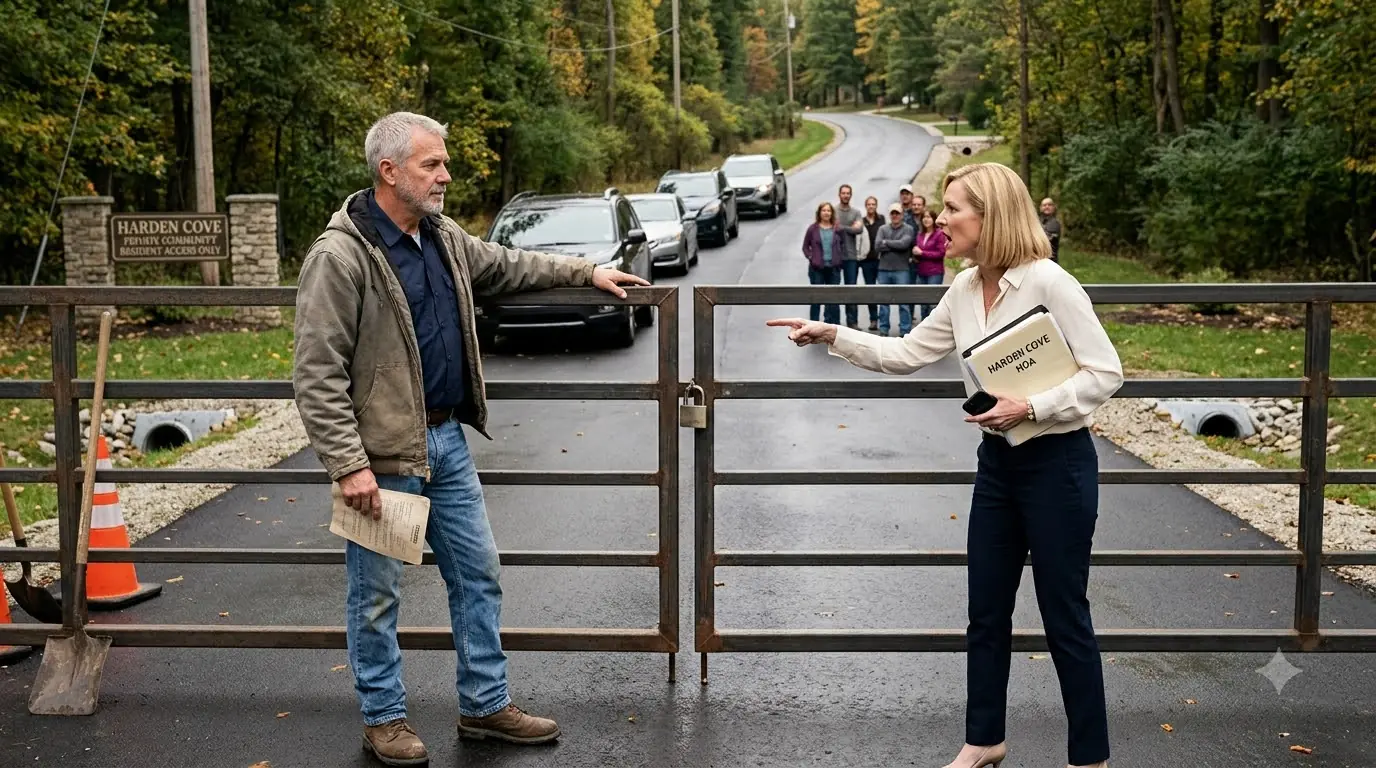
The Harden Cove HOA had used that crossing since 1974.
The previous winter had destroyed the road. Leonard repaired it with a culvert replacement, base work, and new asphalt at a total cost of $49,500.
He had sent proper notice before the work, submitted complete documentation afterward, and invoiced the HOA for its half. The 1989 maintenance agreement was four pages long, and Section 3 said exactly what mattered: notice before, documentation after, reimbursement within forty-five days.
The board claimed the repair required prior approval. Leonard had read the agreement when he bought the property in 2004 and had written one note in the margin beside Section 3: “Notice required, not approval.”
The board voted twice to refuse payment. Their own attorney told them the argument was weak, and the judge eventually agreed.
The gate went up on Tuesday. Nine days later, the HOA paid.
Leonard had owned the parcel at the Harden Cove Road entrance for nineteen years. It consisted of three acres of mixed timber and cleared frontage at the point where the county road ended and the private road began.
The property sat at the lake community’s single point of connection to the public road system, like a hinge between two different worlds. Leonard had bought it in 2004 for reasons that had little to do with the road itself.
He wanted the timber acreage on the northern half and the cleared section on the south for an equipment storage yard. A man who had run a heavy-equipment contracting business for fifteen years needed ground to park machines without paying commercial lease rates.
The road had been incidental to the purchase. It crossed the parcel’s southern edge for 340 feet, entering from the county road at the western property line and exiting at the eastern boundary where it met the Harden Cove HOA’s community gate.
The road had crossed the parcel since 1974, when the original development was laid out and the route became the community’s sole access corridor to the public road system. The 1989 maintenance agreement had been negotiated between the parcel’s prior owner, a man named Garrett, and the Harden Cove HOA board.
Garrett had grown tired of maintaining a road used daily by fifty-eight households without contribution. He hired an attorney to formalize cost sharing.
The resulting instrument was four pages long, recorded against both parcels in the county deed records, and had governed road maintenance for thirty-four years by the time Leonard received Sylvia Trent’s refusal letter in April 2023. Leonard had read the agreement carefully before purchasing the property.
The agreement was straightforward. Maintenance costs were split equally, fifty percent each.
The party initiating a repair had to provide written notice before work began, submit documentation after completion, and receive reimbursement within forty-five days of the documentation package. The agreement covered both routine maintenance and structural repairs without distinguishing between them for cost sharing.
It required notice. It required documentation.
It required reimbursement within forty-five days.
It did not require prior approval. Leonard had marked that distinction in the margin of his copy in 2004 and kept the agreement in his contractor files under a tab labeled “Harden Cove Road Maintenance Agreement, 1989.”
He had referenced it twice in nineteen years without conflict. In 2009 he repaired a drainage pipe and the HOA reimbursed him within thirty days.
In 2016 the HOA resurfaced a section near the gate, and Leonard paid his half within three weeks. The arrangement had worked because both parties read the agreement the same way and acted accordingly.
The winter of 2022–2023 was the county’s wettest on record. Eleven freeze-thaw cycles struck between November and February, saturating and refreezing the ground in alternating weeks.
The soil beneath road bases throughout the county expanded and contracted with every cycle. The county road department posted spring load restrictions in March, while private roads absorbed the damage without county maintenance.
Leonard walked Harden Cove Road on the first clear morning in March, Tuesday the third. The temperature had stayed above freezing for five consecutive days.
He started at the county road entrance and walked east toward the HOA gate, reading the surface the way a man with thirty-five years of road-construction experience reads a road. He moved methodically from edge to edge, studying what the surface revealed about the base beneath it.
The western eighty feet showed map cracking, the spiderweb fractures that form when a road base loses structural integrity and the asphalt begins flexing on a compromised foundation. Leonard pressed his boot into the worst section and felt the pavement move.
It was not a surface problem. It was a base problem.
The middle section had heaved. A forty-foot stretch had risen roughly two inches above original grade on the north side of the center line.
The heave ran diagonally across the lane in the classic pattern of frost damage in poorly drained subgrade. It was already deflecting surface drainage sideways instead of through the designed path.
The drainage crossing was the critical failure. Two hundred twenty feet from the county road entrance, a twenty-four-inch corrugated metal pipe had carried seasonal runoff from the timber acreage since 1974.
Forty-nine years of service and eleven freeze-thaw cycles had taken their toll. The inlet end had partially collapsed, the soil above it had subsided, and the road surface had dropped four inches across the full width.
Water collected in the depression and worsened the damage with every vehicle crossing. Leonard stood there for a full minute and assessed what he was seeing.
He had built and repaired roads for thirty-five years and knew exactly when a surface patch would be useless. The culvert needed replacement, and the base on both sides had to be excavated, recompacted, and rebuilt with new aggregate.
If the work was delayed through another season of garbage trucks, fuel deliveries, contractor vehicles, and daily traffic, the base failure would spread in both directions. A roughly $49,000 repair could become a $120,000 repair.
Leonard returned to the house for his camera. He photographed the road systematically from both directions.
He took overlapping images of the full 340-foot crossing, the map cracking in the western section, the frost-heave ridge in the middle, and the drainage depression from four angles with a measuring tape showing the four-inch drop. He also photographed the collapsed culvert inlet where the surface had fallen away.
There were forty-seven photographs in all, each carrying camera metadata from March 3, 2023. That evening he wrote a condition summary in his job log.
He recorded each damage category and measured location, identifying the drainage crossing as the primary structural failure. His professional assessment was simple: repair was necessary before summer traffic season.
“Deferral risk: progressive base failure propagating from crossing in both directions,” he wrote. “Repair now or pay significantly more later.”
On March 8, Leonard wrote the notice letter. He addressed it to Sylvia Trent, the HOA president, and to the HOA management company.
The letter described the damage, attached five representative photographs, referenced the 1989 maintenance agreement, and stated Leonard’s intent to obtain contractor bids and initiate repair. He sent it by certified mail on March 9 and emailed a copy the same afternoon.
Sylvia received it March 11. She forwarded it to Dale Morrow, the HOA’s property manager of eight years.
Dale had driven the road himself in late February and had already noted the drainage depression in his inspection log. His entry read, “Culvert failure, road subsidence, recommend repair before spring traffic season.”
Dale emailed Sylvia after reviewing Leonard’s notice. “Leonard’s assessment matches my February inspection.”
“The drainage crossing is a legitimate structural failure. The repair is necessary.”
“His notice is consistent with the maintenance agreement’s process.”
Sylvia replied, “Thank you, Dale. I’ll handle the response.”
“” She did not respond to Leonard.
Leonard obtained three contractor bids during the third week of March. He solicited licensed paving and site-work companies whose work he knew from decades in the industry.
The scope included culvert replacement, full-depth base excavation and recompaction across a sixty-foot section centered on the crossing, aggregate base installation, and asphalt surface repair across the full 180-foot affected length. The bids came in at $52,400, $49,500, and $61,800.
Leonard selected the middle bid from Cascade Site Services. The company was licensed, bonded, insured, and run by a principal Leonard had worked beside on two county road projects during the previous decade.
The lowest bidder’s bonding had lapsed the previous year, and its license renewal was still pending. Leonard verified licensing and bonding for all three companies and documented those checks in his job log.
He attached all three bids and the selected contractor’s current license and bonding certificates. Again, he sent both certified mail and email.
Sylvia received the second letter March 26 and forwarded it to Dale with one word: “FYI. ” Dale replied, “The contractor selection looks solid.”
“License and bonding are current. The bid is competitive for this scope.”
“Should we send Leonard an acknowledgment?”
Sylvia did not reply.
Cascade Site Services mobilized on April 4. The crew arrived at 7:00 a.m., with the excavator and dump trucks on Leonard’s storage yard by 7:30.
Leonard remained on site through the first full day. Thirty-five years of project management had taught him that the first day established the production rhythm for everything that followed.
The culvert replacement took two days. The old twenty-four-inch corrugated pipe came out in sections, its partially collapsed inlet confirming exactly what the road surface had indicated.
Leonard specified a new thirty-inch high-density polyethylene pipe. The maturing timber canopy was producing greater runoff volumes, and the original undersized pipe had contributed to the subgrade’s long-term deterioration.
The new pipe was installed with proper bedding and backfill. The base repair took three more days.
Excavation revealed inadequately compacted original subgrade from 1974. It had remained marginally functional for forty-nine years before eleven freeze-thaw cycles finally exhausted its remaining bearing capacity.
Leonard noted the condition in his job log with the quiet satisfaction of a contractor whose pre-repair assessment had been confirmed by excavation. The surface work took another two days.
The crew reclaimed the map-cracked western section, leveled the frost-heave ridge, and installed a new asphalt overlay across the full 180-foot repair length. Work was completed April 12, the surface rolled and cooling in the afternoon while the drainage crossing ran clean through the new culvert.
The road was smooth and level across the repaired section for the first time in what Leonard believed had been several years of gradual deterioration. He photographed the finished work just as carefully as the damage.
There were forty-three completion photographs documenting the new surface, the culvert inlet and outlet, construction-stage base layers, and the corrected drainage crossing. Leonard spent the following week compiling the full documentation package.
It included the March 3 before-condition photographs, all three bids, the selected contractor’s license and bonding certificates, construction photographs, completion photographs, Cascade’s $49,500 invoice, and a one-page summary of the completed work. On April 20 he sent the package to Sylvia by certified mail and email.
His cover letter referenced the 1989 maintenance agreement and confirmed that the documentation requirement had been satisfied. It also stated that the HOA owed $24,750, representing fifty percent of the total repair cost, and that payment was due within forty-five days of receipt under Section 3B.
The letter set the due date as June 6, 2023. Sylvia received the package April 22 and called a board meeting for the following Tuesday.
The board met April 25 with all five members present and Dale Morrow attending as property manager. Sylvia presented Leonard’s documentation package and invoice.
“Leonard Coss has submitted a repair invoice for $24,750,” she said, “representing his claimed fifty-percent share of a road repair he initiated without obtaining the board’s prior written approval.”
She argued that the maintenance agreement’s documentation requirement implied that repairs had to be authorized before they were undertaken. The board had not approved the contractor or the scope, she said, and therefore should not reimburse the expense.
Dale objected immediately. “The repair was necessary.”
“I documented the drainage crossing failure in my February inspection. The culvert was failing.”
“If Leonard hadn’t repaired it this spring, it would have been twice the cost by fall.”
Sylvia said necessity was not the issue. The question, in her view, was whether the HOA was obligated to reimburse a repair it had not authorized.
“The maintenance agreement doesn’t require authorization,” Dale replied. “It requires notice and documentation.”
“Leonard sent notice in March and documentation in April. He followed the agreement exactly.”
Sylvia insisted that the documentation requirement implied a prior approval process. Dale told her plainly, “Sylvia, that’s not what the agreement says.”
She ended the discussion and called the vote. The board refused payment four to one.
The sole dissent was Phil Caruso, who had read the maintenance agreement before the meeting and had already told Sylvia privately that he could not find any prior approval requirement. The written refusal arrived at Leonard’s home on April 28.
The letter, signed by Sylvia on HOA letterhead, said the board had declined reimbursement because the repair had been initiated without prior board approval. It also declared that future repairs requiring HOA cost sharing must be submitted for board authorization before work began.
Leonard read the letter at his kitchen table. Then he walked to his contractor files, pulled the 1989 agreement, and read all four pages from beginning to end.
He read Section 3 three times. The phrase “prior approval” did not appear.
The word “approval” did not appear anywhere in the agreement. The document required notice before work, documentation afterward, and reimbursement within forty-five days.
Leonard had administered hundreds of contracts during thirty-five years in construction. He knew exactly what a prior approval clause looked like.
It was deliberate text on a specific line, not an implication derived from a documentation requirement and not a board president’s interpretive theory. Those words simply were not there.
He placed the agreement beside Sylvia’s refusal letter. One document said what the parties had actually agreed to, while the other claimed the agreement contained a term it did not contain.
In his job log he wrote, “April 28, 2023. HOA refusal received.”
“Board claims prior approval required by agreement. Agreement reviewed.”
“No prior approval requirement exists in text. Word approval does not appear.”
“Board has invented a contract term. Refusal is without contractual basis.”
“Reimbursement deadline June 6. Call Vera Okafor Monday.”
He closed the log. Monday was two days away, and June 6 was thirty-nine days after that.
Vera Okafor had practiced real-property and contract law for twenty-two years. Her practice was built on reading instruments carefully and telling clients what the documents actually said rather than what they hoped they said.
She had handled road-maintenance agreements, private-road disputes, shared-driveway cost sharing, and access-easement maintenance obligations before. The category of problem was familiar.
The morning after Leonard dropped off a copy of the 1989 agreement, Vera needed about twenty minutes to assess the issue. She called him at 10:15 a.m.
“I’ve read the agreement,” she said.
“And?” Leonard asked.
“There is no prior approval requirement. The word approval does not appear in the document.”
Vera explained that Section 3 required written notice before work commenced and documentation after completion. Section 3B required reimbursement within forty-five days after the documentation package was received.
“That is the complete cost-sharing mechanism,” she said. “There is nothing in the text that conditions reimbursement on prior board authorization.”
“That’s what I read,” Leonard said.
“You read it correctly.”
Vera told him Sylvia’s theory had no textual foundation. The HOA president had taken a post-completion documentation obligation and tried to transform it into a pre-approval process that the agreement never contained.
“Contract interpretation does not allow a party to imply a material term that the drafters chose not to include,” Vera said. “If Garrett and the HOA board wanted a prior approval requirement in 1989, they would have written one.”
She stressed that notice and approval were legally distinct obligations. The agreement contained one and omitted the other.
“Can she make that argument in court?” Leonard asked.
“She can make it,” Vera replied. “It won’t succeed.”
The contract language was clear enough that a court would apply the plain meaning. In Vera’s view, the plain meaning was simple: notice before, documentation after, reimbursement within forty-five days.
She told Leonard she would prepare a demand letter. It would quote the agreement, dismantle the prior-approval theory, and remind the HOA that the forty-five-day clock was still running.
“The letter will give them one final opportunity to pay before you exercise your property rights over the road crossing,” she said.
Leonard paused. “What does exercising my property rights mean in practical terms?”
“The road crosses your parcel for 340 feet,” Vera said. “The maintenance agreement governs maintenance cost sharing, but it does not independently grant the HOA an access easement.”
She had already checked the county deed records. Leonard’s parcel carried no separately recorded access easement in favor of the HOA or Harden Cove community.
The community had used the road for decades because the road was historically present and the maintenance agreement had kept the relationship functional. If the HOA materially breached the reimbursement provision, Vera believed Leonard could argue that his own obligations under the framework were suspended.
“And the practical expression of that position?” Leonard asked.
“A gate.”
Leonard was quiet for a moment. “A gate on my property across the road.”
“On your property at the point where the county road meets your western property line,” Vera said. “The road is on your land for 340 feet.”
“If the HOA refuses to honor its reimbursement obligation, the framework is broken.”
She added one important caution: the access question was not legally trivial. Decades of historical use could create arguments about implied rights, so the gate should be used only after Leonard had fully complied with the agreement and the reimbursement period had expired.
“When does the forty-five-day window close?” he asked.
“You delivered the documentation package April 22. Forty-five days later is June 6.”
“Write the letter,” Leonard said.
Vera sent the demand letter May 5. It went to Sylvia Trent and to Frank Citro, the HOA’s retained counsel.
Frank had been named in the refusal letter as the attorney consulted in connection with the board’s decision. Vera’s demand ran nine pages and included twelve exhibits.
The first three pages analyzed the agreement. Section 3 was quoted in full, with each operative obligation identified separately.
The notice provision required written notice before repair or maintenance work began. Leonard’s March 9 letter had been received March 11, so notice was satisfied.
The documentation provision required contractor invoices, scope descriptions, and photographic evidence after completion. Leonard’s complete package had been received April 22, so documentation was satisfied.
The reimbursement provision required the receiving party to reimburse fifty percent of documented repair costs within forty-five days. Because the documentation package arrived April 22, payment was due June 6.
The next pages addressed the board’s prior-approval argument. Vera wrote with the precision of an attorney who knew the best response to an invented contract term was not outrage, but demonstration.
“The HOA’s refusal letter asserts that the maintenance agreement requires prior board approval before the initiating party may commence repair work,” she wrote. “The agreement contains no such requirement.”
She noted that neither “approval” nor “prior approval” appeared anywhere in the agreement. No section made board authorization a condition of cost sharing.
“Section 3’s documentation requirement is a post-completion obligation,” Vera wrote. “It requires the initiating party to document what has been done, not to seek permission for what is proposed.”
She explained that interpretation mattered only when text was ambiguous. This text was not ambiguous.
“It says what it says and does not say what the HOA claims it says.”
The sixth page addressed implied terms. Vera argued that contract law did not permit a court to insert a material term the parties chose not to include when the written agreement already addressed the repair process completely.
“Notice before, documentation after, reimbursement within forty-five days,” she wrote. “The parties negotiated this framework in 1989 with the assistance of counsel.”
If they had intended an approval requirement, they could have included one. Its absence from a lawyer-negotiated agreement was not an oversight for a future board president to repair by implication.
The seventh page summarized the factual record. It included Leonard’s March notice, Sylvia’s silence, Dale Morrow’s February inspection note confirming the culvert failure, the March 24 contractor-selection letter, the completed repair, and the April documentation package.
The eighth page made the demand. The HOA owed $24,750 under Section 3B, payable no later than June 6, 2023.
“Full payment by that date will resolve this matter,” Vera wrote. “If payment is not received by June 6, Mr. Coss will exercise his property rights with respect to the road crossing on his parcel consistent with the HOA’s material breach of the maintenance agreement’s reimbursement obligation.”
The ninth page contained the signature block and exhibit list. Sylvia received the letter May 8 and called Frank Citro before she finished reading it.
Frank had practiced general law in the county for eighteen years, handling wills, real-estate closings, some business contracts, and occasional HOA matters. He had already told Sylvia he was not a specialist in road-maintenance agreements.
When Sylvia first contacted him in late April, Frank reviewed the board’s desired refusal position and drafted the refusal letter on Sylvia’s instructions. In his own file memo, he noted that the prior-approval theory came from Sylvia’s interpretation rather than explicit language in the agreement.
After reading Vera’s demand, Frank examined every alternative defense he could think of. None improved the HOA’s position.
The scope argument failed because Leonard had repaired a failing culvert and road base, exactly the sort of maintenance and repair the agreement covered. The contractor-selection argument failed because the agreement contained no contractor-selection procedure.
Leonard had obtained three bids, checked licensing and bonding, and chosen a competitive middle bid from an established contractor. The cost-reasonableness argument failed as well.
Frank called two local contractors informally and described the work. Both told him that $49,500 for culvert replacement, base excavation, recompaction, aggregate installation, and asphalt overlay across 180 feet was a reasonable regional price.
He called Sylvia on May 12. “I’ve looked at scope, contractor selection, and cost reasonableness.”
“None of them gives us a viable defense.”
“The prior approval argument is the HOA’s strongest position,” Frank continued, “and it is weak.”
“What do you recommend?” Sylvia asked.
“Pay the invoice. Twenty-four thousand seven hundred fifty dollars resolves the matter before June 6 and avoids whatever Leonard means by exercising his property rights over the road crossing.”
Frank told her he did not know exactly what that threat would become, but he knew the road crossed Leonard’s land for 340 feet and the maintenance agreement contained no access-easement provision. Sylvia reminded him the board had already voted to refuse payment.
“The board can vote again,” Frank said.
She called another board meeting for May 16. The same five board members attended, with Dale Morrow present and Frank participating by phone.
Sylvia summarized Frank’s assessment. The prior-approval argument was weak, and the alternatives were weaker.
Phil Caruso spoke first. “I said this in April.”
“The prior-approval requirement isn’t in the agreement. We should have paid then.”
Sylvia put Frank on speakerphone. “Tell the board directly.”
“The maintenance agreement’s text does not support the prior-approval argument,” Frank said. “Vera Okafor’s analysis is accurate on the contract language.”
He could not identify a defense likely to survive court scrutiny. His recommendation remained payment before the June 6 deadline.
Board member Carol Finch asked what would happen if they did not pay. Frank told them the demand letter threatened an exercise of Leonard’s property rights over the road crossing.
“The road crosses his parcel for 340 feet,” he said. “The maintenance agreement is a cost-sharing instrument.”
“It does not contain an access-easement clause granting the HOA a right of access independent of that relationship.”
Carol asked the question everyone had begun thinking. “He can actually lock us out?”
“It is not a simple legal question,” Frank replied, “but it is not simple in our favor.”
Sylvia refused to retreat. “The board voted in April on a principle.”
“Repairs require board approval, and we cannot abandon that principle because an attorney wrote a demand letter.”
“The principle isn’t in the agreement,” Dale said.
“That’s a matter of interpretation,” Sylvia replied.
“It’s not,” Dale said. “Frank just told you the argument is weak.”
“Phil said it in April. Vera spent nine pages explaining it.”
“The word approval is not in the agreement.”
Sylvia told him his input had been noted and called the vote. The board again refused payment four to one, with Phil dissenting a second time.
Frank spoke before the meeting ended. “I want the minutes to reflect that I recommended paying the invoice and the board voted against my recommendation.”
“So noted,” Sylvia said.
The days between May 16 and June 6 passed with the particular quiet of a decision waiting for its consequences. Leonard checked his mail without expectation.
He did not expect a check after the second refusal any more than he had expected one after the first. What he expected was the calendar.
He used those three weeks to prepare. He bought a fourteen-foot commercial steel gate rated for repeated vehicle contact, with a heavy drop bar and a commercial padlock hasp.
On a Saturday morning in late May he set two gate posts in concrete three feet inside his western property line. The gate would span the full road width with about a foot of clearance on each side.
He did not hang the gate yet. The posts stood curing in the concrete, waiting.
On May 28 he wrote in his job log, “Gate posts set, western approach, road crossing entrance. Concrete curing, seven days.”
“Gate ready to hang. Padlock purchased.”
“June 6, nine days.”
He emailed Vera. “Posts are in.”
“I’ll hang the gate the morning of June 6 if no payment has been received. Let me know if anything changes on your end.”
“Nothing has changed,” she replied. “The board voted four to one on May 16 to maintain the refusal after Frank Citro told them the prior-approval argument was weak.”
“I’ll be available June 6 if you need me.”
June 5 fell on a Sunday. Leonard checked the mail and found nothing.
He stood near the entrance that afternoon and looked at the gate posts casting long shadows across the road. Fifty-eight households sat on the other side of the gate he was preparing to hang.
Those families had no dispute with him. Most had probably never read the agreement or attended the board meetings.
Leonard felt no satisfaction at the thought of inconveniencing them. What he felt was the absence of alternatives that comes after every proper notice has been sent, every required day has passed, every reasonable opportunity has been offered, and the other side still refuses to perform.
That night he wrote, “June 5, 2023. No payment received.”
“Documentation delivered April 22. Forty-five-day window closes June 6.”
“Board voted twice to refuse payment. Prior-approval requirement does not exist in the agreement.”
“I gave notice. I documented the repair.”
“I submitted the invoice. I sent a demand letter.”
“I waited forty-five days. Tomorrow, I hang the gate.”
The gate posts stood at the entrance to a road the community had used since 1974, a road Leonard had repaired in April and the HOA had decided twice was not worth $24,750 to maintain. June 6 was the next morning.
Leonard arrived at 6:00 a.m. beneath a cool overcast sky. The county road was empty in both directions.
In the bed of his truck sat the fourteen-foot steel gate, drop-bar hardware, the commercial padlock, and two aluminum signs measuring twelve by eighteen inches. The signs read, “Private Property.”
“Coss Parcel. Road Closed.”
“Contact Leonard Coss,” followed by his phone number.
He also brought his contractor camera and job log. Hanging the gate took forty minutes.
Leonard bolted the strap hinges to the left post, seated the frame, installed the drop-bar receiver on the right, and checked alignment with a level. He swung the gate twice to make sure it moved freely and the drop bar seated correctly.
He mounted a sign on each post at eye level, readable from either direction. Then he removed the padlock from its packaging, threaded it through the drop-bar eye and hasp, and clicked it shut.
Leonard stepped back. The steel frame spanned the road, the drop bar was seated, the lock engaged, and the signs were visible from both approaches.
Beyond it, the repaired road ran east for 340 feet toward Harden Cove’s community gate. The April asphalt lay smooth and level beneath the gray morning light.
Leonard photographed the entrance from three angles. At 6:47 a.m. he opened the job log.
“June 6, 2023. Day 46.”
“Gate installed and locked. Western entrance, road crossing, Coss parcel.”
“Documentation delivered April 22. Forty-five-day reimbursement window closed June 5.”
“No payment received. Gate locked.”
“Padlock engaged. Road closed pending payment of invoice April 2023, $24,750.”
Then he drove home, made coffee, and waited.
The first call arrived at 7:22 a.m. It came not from Sylvia, but from Gary Pelham, a retired engineer who lived in the third house beyond the community gate.
Gary took the same morning walk every day and had reached Leonard’s gate at 7:19. He read the sign and called the number.
“Mr. Coss, this is Gary Pelham, 14 Harden Cove Drive. Your gate is locked across the road.”
“Yes,” Leonard said.
“I can’t get out.”
“That’s right. The gate is locked because the HOA did not pay a road-repair invoice that was due yesterday under the 1989 maintenance agreement.”
“When they pay it, the gate opens.”
Gary asked what invoice Leonard meant. Leonard explained the April culvert and base repair, the $49,500 total cost, and the HOA’s $24,750 share.
“I submitted the invoice April 20. It was due June 5.”
“They didn’t pay.”
“The board voted not to pay?” Gary asked.
“Twice. Once in April and once in May, both four to one.”
Gary was quiet. “And now the gate is locked?”
“Yes.”
“Who do I call?”
“The board president is Sylvia Trent. Her number is on the HOA website.”
“The gate opens when the invoice is paid.”
Leonard ended the call and logged it at 7:22. The next calls came every ten or fifteen minutes.
It was the rhythm of a neighborhood waking up and discovering that the only road out was blocked by a locked gate and a sign with a phone number. Leonard answered every caller with the same facts.
He explained the repair, the invoice, the forty-five-day period, the board’s two refusal votes, and the gate. He was patient, factual, and consistent.
By 8:30 he had taken eleven calls. By 9:00 he had taken sixteen.
Sylvia called at 8:54. “Leonard, this is Sylvia Trent.”
“I need you to open the gate.”
“Good morning, Sylvia. The gate opens when the invoice is paid.”
“Twenty-four thousand seven hundred fifty dollars. The account information is on the invoice you received in April.”
“You cannot close a road that fifty-eight families depend on for access to their homes.”
“It’s my road where it crosses my property. The maintenance agreement required reimbursement within forty-five days.”
“The forty-five days ended yesterday.”
Leonard told her the gate was the consequence of the board’s decision not to pay. Sylvia repeated that the board still believed the repair required prior approval.
“The agreement doesn’t require prior approval,” Leonard replied. “Vera Okafor explained that in nine pages.”
“Your own attorney told you the argument was weak. The board voted to maintain the refusal anyway.”
Sylvia threatened an emergency injunction compelling him to open the gate. Leonard told her she had every right to seek one.
“The gate stays locked until the invoice is paid or a court orders otherwise,” he said. “I’d suggest calling Vera before you file so you understand what the injunction requires.”
“I know what an injunction requires,” Sylvia snapped.
“Then you know it requires likelihood of success on the merits. The merits are the maintenance agreement.”
“I’ll talk to you when the invoice is paid.”
Leonard ended the call and wrote in his log, “8:54 a.m. Sylvia Trent. Threatened injunction.”
“Advised payment resolves matter. Gate stays locked.”
Sylvia called Frank Citro at 9:03. “The gate is up.”
“Leonard locked the road this morning. I need you to file an emergency injunction.”
Frank asked for the details. Sylvia described the gate, the signs, and Leonard’s statement that the road would remain closed until payment arrived.
Frank was silent for a moment. Then he explained the three basic elements required for emergency injunctive relief: likelihood of success on the merits, irreparable harm, and a balance of equities favoring the injunction.
“Fifty-eight households locked out of their homes is a strong irreparable-harm showing,” he said. “The balance of equities is arguable.”
“The likelihood of success is the problem.”
“Explain the problem.”
“The underlying dispute is the maintenance agreement. The HOA’s position is the prior-approval argument, and I told the board May 16 that the argument was weak.”
A judge considering emergency relief would read the same four-page document Frank had read. The word “approval” would still not be there.
“So you’re telling me we can’t get an injunction?” Sylvia asked.
“I’m telling you it’s difficult. The court may sympathize with fifty-eight families, but sympathy does not substitute for likelihood of success on the merits.”
“File it anyway. We need to show residents we’re acting.”
Frank tried once more. “The most effective response is paying the invoice.”
“Twenty-four thousand seven hundred fifty dollars reopens the road this morning.”
“The board voted to refuse payment. I’m not reversing a board vote without another meeting.”
“Then call one today.”
“I need the injunction filed first. File it.”
Frank agreed to file that afternoon, but urged her to keep the board-meeting option moving in parallel. Sylvia ended the call without responding to the recommendation.
An emergency board meeting was scheduled for 2:00 p.m. All five members received notice at 10:00 under the HOA bylaws’ urgent-business provision.
By then the Harden Cove community forum had been active for hours. Residents had called Leonard, learned about the unpaid invoice, and begun asking why their board had created the lockout.
Sandra Olson of 22 Harden Cove Drive posted first among the most direct questions. “Can someone explain why the board voted twice to refuse to pay a road-repair invoice?”
She said she had called Leonard and heard a clear explanation of the agreement, the forty-five-day deadline, and the two refusal votes. “We are now locked in.”
“What is the board’s explanation?”
Robert Finch posted that he had a medical appointment at 10:00 the next morning and needed to know whether the gate would be open. A retired contract attorney named Marcus Webb posted something more damaging.
“I’ve practiced contract law for thirty years,” Marcus wrote. “I pulled the 1989 maintenance agreement from the county deed records this morning.”
He stated that there was no prior-approval requirement anywhere in the document. “The board refused payment on a legal theory that does not exist in the text.”
“I’d like the board to explain its legal basis at the emergency meeting.”
Dale Morrow read the forum from his office and drove to the gate. He studied the signs, the locked steel frame, and the repaired road beyond it for two full minutes.
Then he returned to his office and called Sylvia. He told her residents were reading the sign, calling Leonard, and pulling the agreement from the deed records themselves.
“Marcus Webb has already posted that there’s no prior-approval requirement,” Dale said. “This is going to get worse before two o’clock.”
He pointed out that residents were missing work and facing medical conflicts because of a $24,750 invoice the board had refused despite the advice of its own attorney. Sylvia said the HOA was handling it through the injunction and the meeting.
“The injunction requires likelihood of success,” Dale reminded her. “Frank told you the prior-approval argument was weak.”
“Paying the invoice opens the gate today.”
“That decision is the board’s, not yours,” Sylvia replied.
“Then I’ll make my recommendation to the board at two.”
The emergency meeting began at 2:00 p.m. All five board members were present, with Frank on speakerphone and Dale in the room.
Sylvia opened by announcing that Leonard had locked the road and that Frank had filed or was preparing an emergency injunction to compel him to reopen it. Phil Caruso immediately said the next step should be payment.
“I said that in April and in May,” Phil told the board. “The gate is what voting twice against Frank’s advice produces.”
Sylvia repeated the board’s prior-approval theory. Marcus Webb had requested public comment under the HOA bylaws and was allowed to call into the meeting.
“I pulled the agreement from the county deed records this morning,” Marcus said. “There is no prior-approval requirement in it.”
He asked Frank directly what he believed the HOA’s likelihood of success was on that theory. Frank did not evade the question.
“I assessed it as weak in my recommendation to the board on May 16,” he said. “That assessment has not changed.”
“Thank you,” Marcus replied.
Dale then put his own position on the record. The April road repair had been necessary, he said, and he had independently documented the culvert failure before Leonard ever sent notice.
Leonard’s documentation package was complete, the contractor choice was reasonable, and the price was competitive. The prior-approval requirement was absent from the agreement.
“The board has refused a legitimate claim twice against the advice of its own attorney,” Dale said. “That has produced a situation in which fifty-eight households are locked out on a Tuesday morning.”
He recommended immediate payment. Sylvia told him his legal opinion had not been requested.
“My opinion on the road condition was documented in February,” Dale answered. “My opinion on the agreement’s language is the same opinion Frank gave you two weeks ago.”
Carol Finch asked Frank what would happen if the injunction failed. Frank told her the gate could remain locked while the underlying contract dispute was litigated.
“How long would that take?” she asked.
“Months, at minimum.”
That answer shifted the room. Sylvia called a vote on payment of Leonard’s $24,750 invoice.
Phil voted yes immediately. Carol looked at Sylvia and also voted yes.
Tom Graves, who had voted against payment twice, looked at the laptop showing the growing community-forum outrage and voted yes. Janet Osay followed with another yes.
Sylvia looked at four votes that had turned against her. “I vote no.”
“The motion carries four to one. The invoice will be paid.”
Frank said he would withdraw the injunction motion before the end of business. But the timing of the filings and the board process was messy, and the emergency motion had already been prepared for the court’s docket.
Frank formally filed the injunction motion at 4:15 p.m. on June 6, just before the clerk’s emergency filing deadline. It ran fourteen pages and bore the compressed structure of a motion drafted under several hours of pressure.
Its strongest section was irreparable harm. Frank described fifty-eight households unable to reach work, school, medical appointments, and emergency services without an open road.
He spent five of the fourteen pages on that point because it was the fact most likely to move a judge. The damage was immediate, recurring, and not something easily compensated with money later.
The likelihood-of-success section was harder. Frank had only the same prior-approval argument he had already told Sylvia was weak.
He reframed it as an implied term arising from the documentation structure and cited two contract cases involving implied obligations in maintenance agreements. Neither case was directly on point.
He included them because weak authority was still better than none. After filing, Frank sat at his desk knowing this was a motion he had filed because his client ordered him to file it, not because he believed in it.
He emailed a copy to Vera. She read the motion that evening and called Leonard at 7:00 p.m.
“Frank filed the emergency injunction. Fourteen pages,” she said.
“The irreparable-harm section is strong. The likelihood-of-success section is the prior-approval argument dressed in implied-term language.”
“When is the hearing?”
“Emergency injunctions usually get a hearing within seventy-two hours. Thursday or Friday.”
“I’ll file our response Wednesday morning.”
“What do I need to show?”
“We need to defeat likelihood of success. If the court finds the prior-approval theory legally insufficient, the injunction fails no matter how serious the lockout is.”
Vera also wanted to address a second theory before Frank developed it further. Forty-nine years of community road use could support an argument for an implied easement based on prior use.
“Is that argument available?” Leonard asked.
“It’s a recognized doctrine, but the 1989 agreement changes the analysis,” Vera replied. “When parties reduce their road relationship to a written recorded instrument, that instrument should govern.”
The agreement covered road maintenance and cost sharing but did not grant a separate access easement. Vera intended to argue that a court should not imply what represented parties deliberately omitted from a negotiated instrument.
Her response brief was filed Wednesday at 9:00 a.m. It ran twenty-one pages.
The first section attacked likelihood of success directly. Vera quoted Section 3 in full and bolded each operative clause.
The agreement required notice before work, documentation after completion, and reimbursement within forty-five days. Those were the complete cost-sharing mechanics.
Vera wrote that the HOA’s implied-approval theory failed for three reasons. First, the text was unambiguous and therefore left no room for an implied term.
Second, contract law would not insert a material term the parties had chosen not to include. Third, the HOA’s own retained counsel had told the board May 16 that the prior-approval argument was weak.
Vera had obtained the board minutes through the HOA’s records process the previous afternoon. Frank’s own warning now appeared in the opposing brief as a contemporaneous admission about his client’s legal position.
The second section addressed implied access rights. Vera argued that the 1989 recorded instrument displaced any theory that the HOA possessed a separate implied easement running alongside it.
The parties had formally addressed the road relationship through a negotiated document. They included cost sharing, notice, documentation, and reimbursement, but omitted an access-easement grant.
A court, she argued, should not manufacture the right they chose not to write. The third section addressed material breach.
“The HOA’s obligation under Section 3B was to reimburse Leonard Coss within forty-five days after receipt of the documentation package,” Vera wrote. “The package was received April 22.”
“The payment window closed June 5. No payment was made.”
The failure to reimburse went to the heart of the agreement’s cost-sharing purpose. A material breach by one party could suspend the other party’s performance obligations.
“Leonard Coss’s gate is not a wrongful act,” Vera wrote. “It is the practical consequence of the HOA’s decision to breach its reimbursement obligation.”
The final section addressed equities. Vera acknowledged the hardship on fifty-eight households but directed responsibility back toward the board.
Those families were locked in because the board refused a legitimate claim twice after its own attorney warned that the legal theory was weak. The remedy was payment, not an injunction forcing Leonard to absorb the cost of the HOA’s breach.
“The gate opens the moment the invoice is paid,” Vera wrote.
The hearing was scheduled for Friday at 9:00 a.m. before Judge Carol Menton in County District Court, Courtroom 1.
Judge Menton had spent six years on the civil docket after a background in commercial contract disputes. She was known for reading the primary documents herself instead of relying only on lawyers’ summaries.
By Friday morning she had read both briefs. She also had a certified copy of the 1989 maintenance agreement pulled from the county deed records by her clerk.
Frank and Vera took their places at counsel table at 8:55. Leonard sat behind Vera, and Sylvia sat behind Frank.
Judge Menton opened the hearing at 9:02. “I’ve read both briefs.”
“I’ve also read the 1989 maintenance agreement.”
She said she wanted to begin with likelihood of success because that element controlled the availability of emergency relief regardless of the strength of the harm showing. Then she looked directly at Frank.
“Mr. Citro, the HOA’s position is that the agreement requires prior board approval before the initiating party can commence a repair. Point me to the provision that establishes that requirement.”
Frank stood. “Your Honor, the HOA’s position is that the documentation requirement in Section 3 implies a prior approval process.”
“I understand the implication argument,” Judge Menton replied. “I’m asking you to point me to the provision.”
Frank looked through his copy. He reviewed Section 3, the definitions section, the general maintenance obligations, and then returned to Section 3.
“The explicit language requiring prior approval is not in the agreement, Your Honor,” he finally said. “The HOA relies on an implied term.”
Judge Menton asked whether the agreement had been negotiated by parties represented by counsel in 1989. Frank confirmed that it had.
“The agreement contains a notice requirement before work commences, but not an approval requirement,” she said. “The drafting parties knew how to write a pre-commencement requirement because they wrote one.”
She asked Frank whether an approval term was truly necessary for the contract to function. Frank conceded the agreement could operate without it.
“If the agreement can function without the implied term, then the implied term is not necessary to give the agreement business efficacy,” Judge Menton said. “The doctrine does not apply.”
She called the HOA’s theory a policy argument about what the agreement should have said rather than a legal argument about what it did say. Then she invited Vera to respond.
Vera spoke for eight minutes. She addressed implied terms, material breach, the balance of equities, and Frank’s own May 16 assessment recorded in the board minutes.
Judge Menton made a note. “I’m going to rule from the bench.”
She denied the emergency injunction. The HOA had not established likelihood of success on the merits.
“The 1989 maintenance agreement does not contain a prior approval requirement,” she said. “The implied-term doctrine does not apply.”
The parties had written an express pre-commencement notice requirement and had not written an approval requirement. That choice, in the judge’s view, indicated deliberate drafting rather than oversight.
Without likelihood of success, she explained, the injunction was unavailable regardless of how strong the irreparable-harm showing might be. She also noted that the reimbursement provision itself was clear.
The documentation package had been delivered in April. The forty-five-day period had expired without payment.
“The gate on Leonard Coss’s property is the practical consequence of the HOA’s decision not to reimburse within the contractual window,” Judge Menton said. “The court’s equitable authority does not extend to shielding a party from the consequences of its own breach.”
She closed the file. “The motion is denied.”
“The gate remains.”
Then she looked at Frank. “I encourage you to advise your client that the path to reopening the road is payment of the invoice.”
“Yes, Your Honor,” he said. The gate had been locked for five days when the rain arrived.
It began Thursday evening as a slow front from the northwest and continued through the night into Friday.
By the time Judge Menton denied the injunction Friday morning, the county had received roughly two inches and the forecast called for more through the weekend. The only alternate route available to residents was a rough farm path through the neighboring agricultural parcel to the south.
That route existed because Harden Cove resident Peter Connelly knew the neighboring farmer, Bob Deats. On the second day of the lockout, Bob had agreed to leave his farm gate unlocked so residents could use the two-track path through his hayfield to reach the county road a quarter mile south of Leonard’s gate.
In dry weather the path was passable at low speed. It was narrow, ungraded, and made from gravel mixed with packed clay, never designed for the volume of passenger cars now using it.
Bob had warned Peter that it was a farm track, not a residential road. Still, for several days it gave the neighborhood a slow way in and out.
Rain changed everything. By Thursday evening the clay was softening beneath three days of concentrated traffic.
Tire tracks cut through the surface into the subgrade. Runoff from the field began crossing the low sections.
By Friday morning the worst stretch had turned into a slick, soft channel that could still be crossed by a high-clearance vehicle driven carefully but trapped lower cars easily. At 7:15 a.m., resident Carol Vance’s sedan became the first casualty.
Her rear wheels spun in the softened clay until the car slipped sideways into the drainage channel. Carol called her husband, who called Peter, who called Bob.
Bob arrived with his tractor and pulled the car out in twenty minutes. Clay had packed into the undercarriage, and the exhaust bracket was bent.
By Friday afternoon two more vehicles became stuck in the same area. Bob pulled both of them free.
After the second recovery, he called Peter. “I can’t keep pulling cars out of my drainage channel.”
“If this rain continues, the path is going to be impassable by Saturday morning.”
Peter called Sylvia immediately. He described the stuck cars, Bob’s warning, and the fact that the injunction had been denied.
“Sylvia, the path is going to close by Saturday. When it closes, there is no slow way in or out.”
“There is no way.”
“I’m aware of the situation,” she said.
“Are you aware that residents may have no access to their homes tomorrow morning?”
“The board is convening this afternoon.”
“This afternoon needs to produce a check.”
The rain continued. The farm track softened, Leonard’s gate remained locked, and the invoice remained $24,750.
Saturday morning, Bob walked the path at first light. The low section had flooded overnight.
Water from the drainage channel overtopped its bank across roughly twenty feet of the road. Bob’s boots sank four inches into the clay at the worst point.
He called Peter at 7:00. “I’m sorry.”
“I can’t let people drive through this. Someone’s going to end up in the ditch, and I won’t be able to get them out until the ground dries.”
Peter understood. At 7:15 he posted to the community forum that the farm path was closed.
“There is currently no vehicle access in or out of Harden Cove,” he wrote. “Foot access is possible only.”
He stated plainly that the problem resulted from the board’s refusal to pay Leonard’s road-repair invoice. “The board can resolve this today by paying the invoice.”
“The gate opens when the payment clears.”
The tone of the community forum changed that morning. Residents were no longer merely frustrated; they were confined.
Sandra Olson posted at 7:40 that her husband attended dialysis three times a week. His transport van could not reach their home, and the company would not attempt the flooded farm path.
“I need to know what the board is doing today to resolve this,” she wrote.
Robert Finch posted at 8:05 about a scheduled delivery of glucose-monitoring equipment that could no longer reach his home. He had called the HOA management line and received no response.
At 8:20 Marcus Webb posted a legal summary of the entire situation. The board had refused payment twice, lost the injunction, and now had residents unable to obtain medical transportation and supplies.
“The invoice is $24,750,” he wrote. “The board has been advised by its own attorney that the prior-approval argument has no legal basis.”
Marcus invoked Article 7 of the HOA bylaws, which allowed thirty percent of households to petition for a special board meeting. He needed seventeen more signatures.
By 9:00 he had twenty-three. By 10:00 he had thirty-one, far beyond the threshold.
Dale drove to the farm path Saturday morning and walked the flooded section himself. He photographed the water over the path, the soft clay, and the overtopped drainage channel.
Then he returned home and opened Leonard’s April repair photographs on his phone. He posted a before-and-after comparison to the community forum at 10:30.
The left column showed the road on March 3: map cracking, subsidence, and the damaged culvert crossing. The right column showed the completed April 12 repair.
Dale captioned it, “These are the road-repair photographs from Leonard Coss’s documentation package submitted April 20. The repair the board refused to reimburse.”
Sylvia removed the post at 10:41. Two minutes later, she emailed Dale a formal written warning on HOA letterhead.
She accused him of posting proprietary documentation without board authorization and warned that another violation would result in termination of his management contract. Dale read the letter once and forwarded the entire exchange to Vera at 10:51.
“I thought you should have this,” he wrote.
Vera read it and called Leonard at 11:15. She explained that Sylvia had used her authority to remove factual repair records from the forum while residents were locked in.
“The proprietary characterization is questionable,” Vera said. “More important, the written warning creates a record of the board president suppressing factual information during an active lockout.”
Leonard asked why that mattered beyond optics. Vera told him the consequences were no longer limited to the contract dispute itself.
“Sandra Olson’s husband cannot reach dialysis. Robert Finch cannot receive medical supplies.”
“Residents have missed work. Cars were damaged on the farm path.”
Those losses could become consequential-damages claims against the HOA. Vera warned that individual board members might also face personal exposure because they had voted to continue the refusal after receiving explicit advice from retained counsel.
At 1:00 p.m. she sent a letter to Frank Citro laying out that exposure. Frank called Sylvia almost immediately after reading it.
Meanwhile, the Article 7 petition had been delivered to the HOA office at noon with thirty-one signatures. The bylaws required a special meeting within forty-eight hours.
Sylvia scheduled it for Sunday afternoon, twenty-four hours after delivery. Frank arrived thirty minutes early and asked to speak privately with the five board members before residents were admitted.
This time he did not soften the assessment. “The injunction was denied Friday.”
“Judge Menton read the agreement and found the prior-approval theory legally insufficient.”
He reminded them that his own May 16 advice had been the same. Then he raised Vera’s new warning.
“Individual board members may have personal liability exposure for consequential damages,” Frank said. “A dialysis patient has missed treatment.”
“A medical supply delivery failed. Vehicles were damaged.”
“Residents lost income.”
Carol Finch repeated the words slowly. “Personal liability?”
“Potentially. I am not predicting a judgment, but the exposure exists and it grows each day the gate remains locked.”
Frank added that directors-and-officers insurance did not always protect decisions made contrary to explicit advice of counsel. The May 16 minutes showed the board had been warned and voted against the recommendation anyway.
Tom Graves stared down at the table. “Frank, we should have paid in April.”
“Yes,” Frank said.
Sylvia responded with the same phrase she had used for weeks. “The board voted on a principle.”
“The principle is not in the agreement,” Frank answered. “I told you that in May.”
“The judge confirmed it Friday.”
He recommended immediate payment of $24,750. “The gate opens when the payment clears.”
“The personal-liability exposure stops growing, and the residents waiting outside get a resolution instead of another continuation.”
Sylvia called the vote. Phil Caruso voted yes before she finished the motion.
Carol Finch voted yes. Tom Graves voted yes.
Janet Osay voted yes. Sylvia looked at the four members who had abandoned her position and voted no.
“The motion carries four to one,” she said. “The invoice will be paid by wire transfer today.”
Outside the closed session, Dale waited with Marcus Webb, Peter Connelly, Sandra Olson, and other residents who had signed the petition. When Sylvia opened the door and announced the vote, Sandra lowered her eyes and sat quietly for a moment.
She had spent more than a week living inside a problem that threatened her husband’s medical care. Now someone had finally said it was ending.
Marcus asked the practical question. “When does the gate open?”
“When the wire clears,” Sylvia said.
Dale already had his phone out to call Leonard.
The transfer did not clear immediately. It cleared at 9:47 a.m. on June 15, completing the HOA’s $24,750 reimbursement.
Vera called Leonard from her office. “The wire cleared.”
“Twenty-four thousand seven hundred fifty dollars is in the escrow account. I’ll send the confirmation number.”
“I’ll go now.”
Leonard drove to the entrance in the same truck he had used to bring the gate nine days earlier. The weekend rain had ended, and the ground was beginning to dry under June sunlight.
The gate looked exactly as he had left it. The steel frame crossed the road, the drop bar was seated, the padlock remained engaged, and the signs still faced both directions.
Beyond it, the repaired asphalt lay clean and level. The new culvert had carried the weekend rainfall without any subsidence.
Leonard took the key from his jacket and opened the padlock. He removed it from the hasp and put it in his pocket.
Then he lifted the drop bar and swung the gate open against the left post. He secured it with the hook-and-eye latch.
Leonard stood there for a moment and looked east toward Harden Cove. The road his parcel had carried for forty-nine years was open again.
He removed both aluminum signs with a driver from his truck and placed them in the bed. The screw holes in the posts were the only evidence the signs had been there.
At 10:12 a.m. he opened his job log. “Wire transfer confirmed 9:47 a.m. $24,750 received.”
“Gate open 10:12. Padlock removed.”
“Signs removed. Road open.”
“Invoice 2023-04 paid. Matter pending amendment.”
A car passed him heading out of Harden Cove. It moved through the open gate at ordinary speed without slowing.
That was what an access road looked like when it was simply doing its job. The dramatic part was over, but Leonard knew the agreement itself still needed repair.
Negotiations began the following week. Vera represented Leonard, while the HOA retained a new property attorney named James Okafor, who was unrelated to Vera.
Marcus Webb recommended James after the Sunday meeting. Before his first call with Vera, James read the 1989 agreement and the full record of the dispute.
“The amendment needs to close the four gaps that produced this,” James told the board. “I want all four fixed before anything is recorded.”
Negotiations took three weeks. The amendment was recorded in mid-July as a five-page instrument cross-referenced to the original 1989 agreement in the county deed records.
The first provision created an explicit pre-commencement review period of ten business days. During that time the non-initiating party could review the proposed scope and cost estimate and raise written objections based on specific contractual, technical, or cost grounds.
The provision made one point unmistakable: the ten-day period was for notice and review, not approval. After ten business days the initiating party could proceed whether or not the other side responded, and proper cost sharing still applied.
Vera insisted the word “approval” not appear. James agreed.
The second provision created a joint annual road inspection every March before the spring thaw. Both parties or their representatives would walk the road together and sign a written report identifying maintenance needs.
Repairs identified during that inspection would receive a shortened five-business-day notice period because both sides had already documented the condition together. Leonard had proposed the process based on the walk he had been taking alone for nineteen years.
The third provision created a capital reserve fund. Both parties would make equal annual contributions based on the joint inspection’s expected maintenance needs, subject to a minimum funding floor.
Repairs would be paid from the reserve first, with supplemental invoicing only if costs exceeded the balance. A future $49,500 repair would no longer arrive as an unexpected $24,750 obligation to a board that had saved nothing toward it.
The fourth provision was the most unusual. Vera proposed a personal-awareness acknowledgment for every current HOA board member.
Each director had to sign a one-page exhibit confirming that they had read the 1989 agreement as amended, understood the mandatory forty-five-day reimbursement window, and understood the consequences of nonpayment demonstrated by the June 2023 lockout. It was not a personal guarantee.
It simply eliminated a future defense of ignorance. Four board members signed without objection.
The fifth signature line stayed blank. Sylvia Trent resigned as president the Wednesday after the Sunday vote, citing personal reasons.
She did not attend the amendment signing. Dale Morrow was elected interim president at a community meeting three weeks after the gate reopened.
Forty-one of fifty-eight households attended, the highest turnout in Harden Cove’s recorded history. Dale won the vote forty to one.
He accepted without ceremony. “I’ll serve until the October election.”
“Between now and then, I want the reserve fund established and next March’s inspection scheduled.”
Marcus Webb immediately said he intended to nominate Dale for the full term in October. Dale smiled faintly.
“Let’s get through the summer first.”
The amendment was recorded July 19, 2023, against both parcels in the county deed records. Leonard received the confirmation from Vera that afternoon.
He opened his job log and added a single line beneath the June entry. “Amendment recorded July 19, 2023.”
“Matter closed.”
Then he placed the log on the shelf beside his 2004 copy of the maintenance agreement. His handwritten note in the margin of Section 3 was still there: “Notice required, not approval.”
It had always said that. It still said that.
The morning after the gate opened, Leonard walked the road again. The air was clear after nine days of intermittent rain, and the ground was beginning to firm under the June sun.
He started at the western entrance, where the gate now rested open against the left-hand post. Then he walked east along the same southern edge he had walked March 3.
The western section was clean and uncracked. The new asphalt surface showed the tight texture of properly seated fresh mix.
The map cracking was gone because the damaged base beneath it had been excavated and rebuilt, not merely covered. Leonard pressed his boot into the area that had flexed in March.
Nothing moved. The base was sound.
The frost-heave ridge was gone as well. The lane now sat level from edge to edge, and surface water drained evenly instead of being pushed toward the south shoulder.
The drainage crossing was what Leonard most wanted to inspect. He stood over the point where the road had dropped four inches above the failed culvert months earlier.
The surface was now flush with the approaches on both sides. The weekend storms had delivered the repair’s first serious test, and the new thirty-inch culvert had carried the runoff cleanly.
Leonard crouched near the inlet. The high-density polyethylene pipe was open, the bedding stable, and the channel clear of debris.
There was no sign of the partial collapse that had pulled the old road surface downward. The pipe was doing exactly what it had been installed to do.
Leonard stood and looked across the repaired crossing. Nine days of lockout, a denied injunction, two four-to-one refusal votes, a flooded farm path, medical appointments disrupted, and a special meeting had all grown from a contract term one board president insisted existed even though it had never been written.
The road itself had not changed its story. In March it had been failing, and by June it was repaired.
The new amendment would make the next inspection a shared process. Both parties would walk the road, write down what they saw, and sign the same piece of paper before the spring repair season began.
Leonard pulled out his job log. He turned to the June 15 entry and wrote another inspection note.
“Road walked. Full repair section, gate to HOA boundary, west to east.”
“Surface sound. No cracking.”
“Drainage correct. Culvert performing.”
“Inlet clear. Road surface level.”
“No subsidence. Base confirmed sound.”
“Repair complete and holding.”
He summarized the dates beneath it: repair completed April 12, invoice submitted April 20, payment due June 5, gate installed June 6, invoice paid June 15, gate opened June 15, lockout nine days, injunction denied, amendment recorded July 19.
Then he wrote the final line at the bottom of the page. “The agreement said what it said.”
“It always did.”
A car appeared at the community gate and headed west. Its tires crossed the repaired drainage section without slowing.
The vehicle passed through Leonard’s open gate onto the county road and turned south. Leonard watched it disappear.
Then he walked back to his truck, placed the job log on the passenger seat, and drove home. The gate remained open, the signs were gone, the road was sound, the invoice was paid, and the amended agreement now ran with both parcels in the county deed records.
For thirty-four years, the 1989 maintenance agreement had said exactly what it said before anyone tried to add something that was not there. It would continue saying it for decades more.