Eighteen months. They harassed my family for eighteen months.
Violation notices zip-tied to our fence, security trucks parked across our gate, and the woman behind all of it, Renata Faye, wearing a tactical vest with an embroidered logo and wire-rimmed glasses, her voice sweet as honey but cold as a blade, looked my grandfather dead in the eye and declared, “This entire corridor is now within our community’s jurisdiction.”
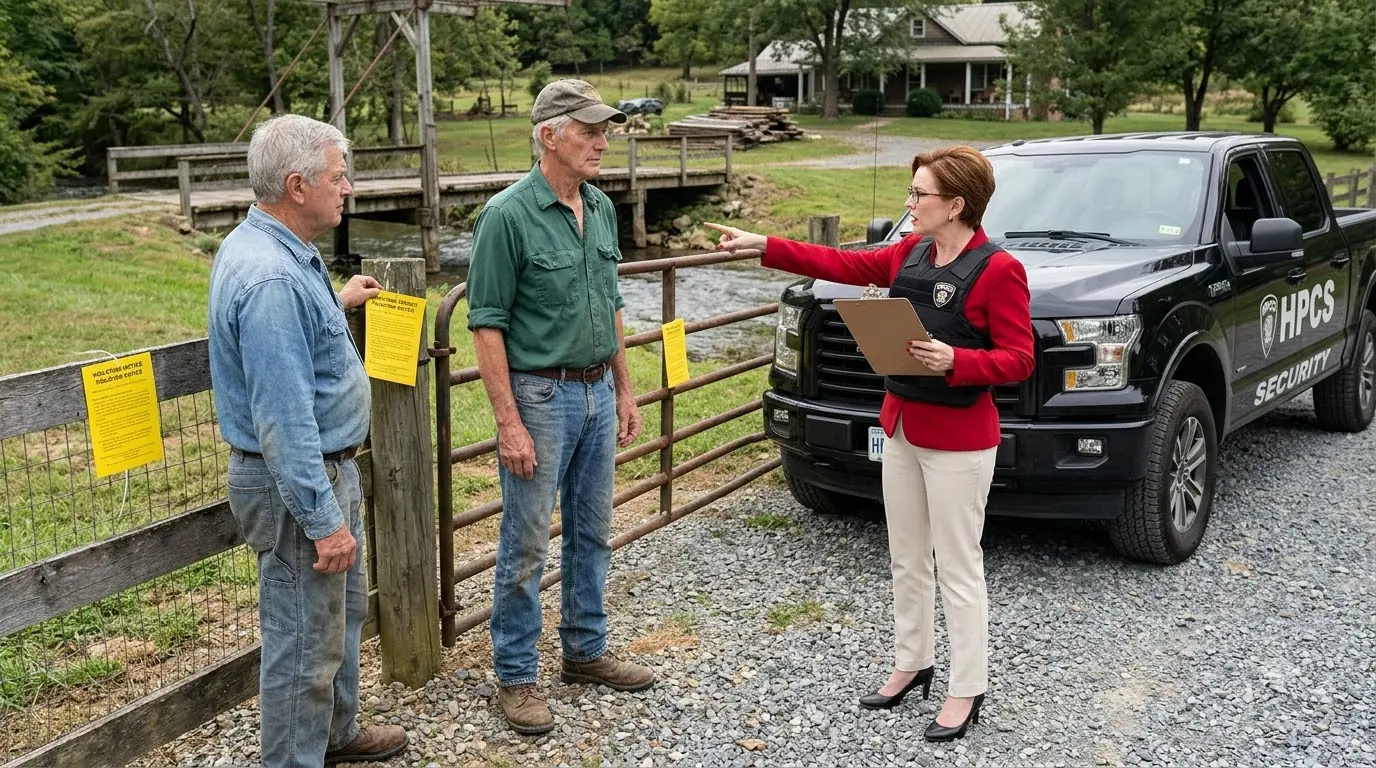
She said it on land my grandfather had worked since 1951, in front of his own farmhand. No apology, no shame, not even a flicker of hesitation.
My grandfather did not shout back. He just nodded, walked into the kitchen, poured himself a cup of coffee, and started waiting.
Because Renata Faye did not know one thing. The only bridge leading back toward her neighborhood had been built by my grandfather with his own hands, and he could raise it whenever legitimate maintenance required it.
One night in October, in pouring rain, Renata Faye found herself stranded on the wrong side of Sallow Run while that bridge sat legally closed for documented repairs.
To understand why that night mattered so much, you have to understand where we come from.
My grandfather, Wendell Drexel, bought thirty-four acres in Harwick County, Virginia, in 1951. Back then the land was nothing but walnut trees, a cold creek called Sallow Run, and a gravel road that dead-ended at the water.
He was twenty-two years old, newly out of the Army, with calloused hands and enough stubbornness to build something out of nothing. And that was exactly what he did.
He cleared the land himself, built the farmhouse board by board, and planted the walnut grove that still stands today. The place smelled like pine tar, machine oil, and cold creek water, and to me that smell has always meant home.
In 1987, after the county’s culvert washed out in a flood, Grandpa Wendell built a drawbridge over Sallow Run. He used steel I-beams, hand-laid plank decking, and a hand-crank hydraulic lift mechanism he designed from decades of structural work with the Army Corps of Engineers.
The county granted a road easement across it, meaning the public could use the route for passage. But the bridge itself, every bolt, every beam, every plank, remained on Wendell’s land and belonged to Wendell.
For decades, none of that mattered very much. The road on the other side of the bridge led nowhere anybody cared about, just open farmland and tree lines.
We used the bridge every day, and so did a few neighbors. It was quiet, familiar, and ours.
Then Stonebrook Properties arrived.
In 2018, they broke ground half a mile north of us. By 2020, 240 homes had been built, sold, and bundled into the Harwick Pines Homeowners Association, complete with landscaping rules, architectural review committees, and a private security team called Harwick Pines Community Security, or HPCS.
Their job was to patrol the development and enforce community standards. Their patrol vehicles were black Ford F-250s, spotless enough to look as if they had never touched a dirt road.
The problem was geography. The most convenient western exit from Harwick Pines ran straight down the county road, past our fence line, past Grandpa’s truck shed, past our mailbox, and across our bridge over Sallow Run.
About three hundred residents started using that route daily. Commuters, delivery trucks, school buses—nobody asked us, nobody thanked us, and most people did not even wave.
Then Renata Faye showed up.
Faye was the head of HPCS, fifty-one years old, sharp-featured, and always dressed as if she were about to conduct an inspection, even when she was only buying coffee. She had the specific energy of someone who had spent an entire career believing she deserved more authority and had finally gotten some.
She drove the black F-250 herself. She carried a clipboard and had memorized the community standards document the way some people memorize scripture.
Within six months of Harwick Pines going live, Faye had issued more than 140 written warnings to residents. Wrong-colored mulch, visible trash cans, unapproved wind chimes—she was thorough and relentless.
For reasons I still do not fully understand, she decided our family’s property was her next project.
The first notice arrived on a Tuesday morning in March. Faye stopped her truck on the county road, got out, walked to our fence line, and zip-tied a yellow warning notice to a post, citing our farmhand Corcoran’s lumber stack as a violation of community aesthetic standards.
Corcoran told her politely that she was standing next to private property and had no jurisdiction there. Faye looked at him over her wire-rimmed glasses and said, “This entire corridor is part of our community footprint now.”
Then she got back in her truck and drove away.
That evening, Grandpa Wendell came home, found the notice on the fence post, and read it twice in the fading light. He did not crumple it up, and he did not call anyone in anger.
He carried it inside, set it on the kitchen table beside his coffee mug, and looked at it for a long time. Then he called me.
“Petra,” he said, “I need you to come home this weekend and bring your paralegal books.”
I drove down from Richmond that Friday night. The cool air carried that particular Shenandoah smell of dry leaves, distant wood smoke, and something cold underneath it all, like the earth getting ready for winter.
I had been listening to Grandpa describe the situation on the phone for three weeks, and the thing that worried me most was not what he was saying. It was how calmly he was saying it.
By the time I arrived, the notices had multiplied.
A second one cited Grandpa’s tool shed as a nonconforming structure, even though it had stood there for thirty years, long before Harwick Pines existed on any map. A third complained that our two dogs were unrestrained within what Faye called the “community aesthetic zone,” even though both dogs were behind a fence on our property.
The “community aesthetic zone” appeared to be something Renata Faye had invented herself.
She had also started the drive-bys. Three times a day, sometimes four, her black truck would roll slowly past our fence line while she stopped to photograph whatever caught her eye—the gate latch, the truck shed, the walnut trees, as if the trees themselves were in violation of something.
Some mornings I could smell the diesel exhaust from the kitchen window before I heard the engine. It had that sharp cold-morning bite that seemed to stick in the back of your throat.
I spread all three notices across the kitchen table beneath the yellowed lamp and read them carefully. The wood was warm and smooth under my forearms, worn down by decades of mail, coffee cups, engine parts, and family decisions.
Grandpa sat across from me with both hands around his mug, watching me read.
“She can’t enforce any of this,” I said. “You’re not in the HOA.”
“I know,” he said.
I looked up. “So why are you smiling?”
He had already started his counterattack three weeks earlier, before I even knew there was a war.
The first thing he had done was bolt a Browning Strike Force trail camera to the same fence post where Faye left her notices. Nothing fancy, just a weatherproof camera that logged every vehicle, every timestamp, and every license plate that came down the county road.
Eighteen days of footage were already saved to a hard drive in his shop.
The second thing he had done was call the Harwick County Clerk’s Office and request a certified copy of the original road easement, a four-page document from 1953 typed on a manual typewriter and describing precisely what the county had the right to use—and what it emphatically did not.
The road surface, yes. The bridge, the banks, the adjacent land, and the fence line, no.
He filed the certified copy in a manila folder and labeled it in block letters with a marker: FAYE MATERIAL.
The third thing he had done was file a formal written complaint with the Harwick County Sheriff’s Office describing the harassment pattern and citing three specific dates supported by timestamps from the trail-camera footage. The deputy who logged it, a young woman named Mayberry, told him it would be entered into the file.
“Log it good,” Grandpa told her.
Then Faye escalated.
She filed a countercomplaint claiming that our fence posts encroached on the county road easement by fourteen inches and demanded a formal land survey. In her mind, I think she believed this was genius: force an old man to spend money, tie him up in process, and let bureaucracy grind him down.
The complaint arrived by certified mail on a Thursday. Grandpa signed for it, opened it, read it twice, and called an old Army friend named Thad Grimshaw, a licensed land surveyor out of Staunton.
Thad drove out that Saturday and spent four hours working in the cool spring air that smelled of creek water and new grass, moving his equipment along the fence line with careful precision.
When he finished, his report was unambiguous. Our fence posts were not fourteen inches over the easement line; they were fourteen inches inside it.
We owned more of the road edge than Faye had claimed.
The survey cost Grandpa six hundred dollars. It was about to become worth far more than that.
While Thad still had his equipment out, Grandpa asked one more question, almost casually. “While you’re here, run the bridge coordinates too.”
The result confirmed what Grandpa had suspected for years but never formally verified.
The bridge over Sallow Run, every plank, every bolt, every hand-welded beam, sat entirely within our surveyed parcel. The county easement granted passage across it, but it said nothing about owning the structure or about transferring control of the bridge itself to anyone else.
Grandpa filed the survey with the county that Monday. He put a second copy in the manila folder and labeled it in the same block letters: BRIDGE.
That night he called me.
I listened to everything, then said, “Don’t do anything yet.”
“I’m not,” he said. “I’m just reading.”
May came in hot and humid, and Renata Faye came with it at full speed.
She started working the HOA residents directly, stopping people at the mailboxes, in parking areas, and at the entrance gate, telling anyone who would listen that our property was an “eyesore corridor” dragging down their home values. She suggested we had unresolved code violations and implied we were difficult neighbors who refused to cooperate with reasonable community standards.
None of it was true. All of it was the specific kind of whisper campaign that is hard to fight because it rarely puts the accusation in writing.
She also started following Corcoran.
Twice that month, when Corcoran drove his old Chevy down the county road for deliveries, Faye pulled her F-250 alongside him and paced him, rolling at the same speed and staring through the spotless passenger window.
Corcoran was sixty years old and had served two tours in Vietnam. He had been stared at by people considerably more frightening than Renata Faye.
He told me later that he simply stared back. After about a quarter mile, she accelerated away, and he seemed almost disappointed it had not lasted longer.
The HOA board was getting nervous.
Their chair, Winifred Hollis, a retired pediatric nurse with a practical mind and very little patience for drama she had not personally generated, called Faye into a closed meeting after three board members received complaints from residents about the treatment of our family.
Faye told Hollis that our property was a “liability corridor” and that she was protecting community interests. Hollis told her to document everything formally or stand down.
Faye chose to document.
What she documented next was a noise complaint.