Fourteen men in tactical gear arrived before sunrise carrying a steel battering ram and an eviction order with Grant Mercer's name forged across the bottom.
Behind them stood the HOA president, smiling as if the house already belonged to her.
She ordered them to break down the door, drag him outside, and seize everything inside.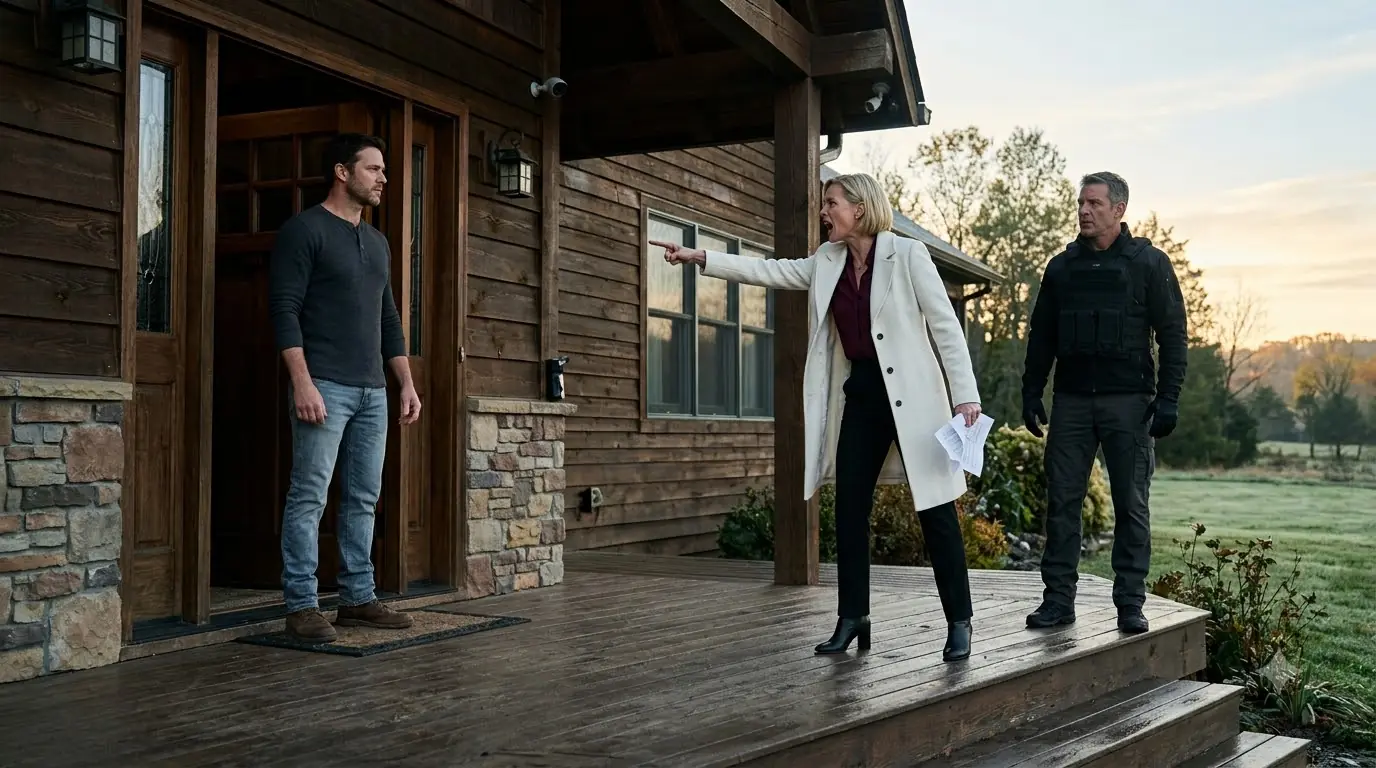
What she did not know was that the man behind that door had spent twelve years as a Force Recon Marine surviving missions far more dangerous than her hired crew could imagine.
By the time the door shattered, every camera was recording, and every man who stepped inside had walked into the worst mistake of his life.
Before any of it began, before the trucks, the battering ram, and the woman in the white coat screaming orders across his own front yard, there had been only a quiet man and a quiet house. Almost no one in Stonehaven Ridge understood what kind of quiet that truly was.
Grant lived alone in a timber-framed house set on eighteen acres at the edge of a neighborhood called Stonehaven Ridge in the rolling hills of Virginia.
The land had belonged to his uncle long before any developer drew a line on a map, and the house itself had stood there for decades, weathered but solid, before Stonehaven Ridge existed as anything more than empty pastureland. When a luxury housing development finally rose around it, the newly formed homeowners association began sending Grant letters. They were polite at first, then increasingly demanding.
The association insisted that he repaint his house to match its approved palette, remove the flagpole that honored his years of service, relocate his tool shed, and pay a mandatory joining fee of $17,600.
His property, however, had never been part of the community and never would be. Grant answered every letter the same way, calmly and without emotion, attaching copies of his deed and the county plat map proving that his land had existed independently long before the association was chartered.
She insisted that because Stonehaven Ridge now surrounded Grant's property on three sides, he was somehow obligated to follow its rules regardless of what the paperwork said. Grant never raised his voice during those visits.
He simply asked her to leave his private property, watched her return to her car, and quietly noted the license plate, the time of day, and every word she said. He filed those details away with the same methodical discipline he had once used to record terrain features and hostile movements on deployments most people would never hear about. What Marla did not say aloud, though she thought it every time she looked at his land, was that a development company called Westmore Leisure had offered the association $11 million for access to the lake behind Grant's property.
Without a road through his land, there was no way to reach the lake. Without the lake, there was no resort, no $11 million, and no way to quietly cover the enormous hole already opened in the association's finances.
When Grant refused to sell, refused to join, and refused to be intimidated, Marla decided that his refusal was simply an obstacle to be removed. One afternoon, on her way back to her car, she turned at the end of his driveway and told him that within a month he would no longer be standing on that land.
Grant said nothing. He only watched her leave. A few days later, an envelope arrived in his mailbox marked as a final eviction and property surrender order. It warned that if he did not vacate within seventy-two hours, the association had the authority to use what it called an authorized enforcement team to remove him.
Grant studied the signature at the bottom. It belonged to a judge who, as far as he already suspected, had never seen the document in his life. He understood immediately that Marla Voss had crossed a line that had nothing left to do with homeowner regulations.
He photographed the letter and sent copies to his attorney, Tessa Whitlock, a meticulous thirty-nine-year-old property fraud specialist who had warned him months earlier that the association's paperwork looked suspiciously inconsistent.
Within a few phone calls, Tessa confirmed what Grant already suspected. No lawsuit had been filed against him anywhere in the county system. No judge had signed an eviction order bearing his name. The case number printed on the document belonged to an unrelated bankruptcy filing that had closed four years earlier.
The court seal had clearly been copied from a public record and pasted onto the page. The signature on the supposed homeowners association membership agreement, which Marla claimed Grant had signed years earlier, did not match his handwriting in a single stroke.
Tessa wanted to file an emergency injunction immediately, but the courthouse would not review new filings until Monday morning. Marla's seventy-two-hour deadline expired before dawn on Sunday, a timing far too convenient to feel accidental.
When Grant contacted the sheriff's office to report a likely threat of unlawful forced entry, the on-duty deputy logged it only as a civil dispute. The association had already filed its own complaint accusing Grant of illegally occupying community property. That false report had planted a narrative in the system before anyone in uniform ever set foot on his land. Grant understood exactly what it meant.
Someone was building a story designed to make responding officers arrive already suspicious of him rather than of Marla. Against a story like that, evidence would matter more than any argument he could make while standing on his own porch. His years in Force Recon had never trained him merely to prepare for a fight.
They had trained him to prepare for contact, which was a different discipline built around detecting intrusion early, documenting events as they happened, preserving a clear route of retreat, and isolating the person giving orders from those simply following them.
Above all, that discipline meant avoiding force unless a life was genuinely at risk. Grant spent the following day checking his security cameras, motion-activated floodlights, and backup power systems.
He set every device to mirror its footage automatically to a remote server Tessa could access the instant anything went wrong. He cleared the entryway of anything that could be mistaken for a weapon.
He sealed his original deed, military discharge papers, and copies of every complaint he had filed inside a fireproof document bag. He also placed a quiet call to a former colleague still working in law enforcement, letting him know that an organized intrusion might be coming to his address.
That evening, an unmarked pickup truck circled his property three times at a crawling speed. Later, Grant found a small signal-jamming device clipped to the utility pole nearest his driveway.
It was proof that whoever was coming had already scouted the house and intended to cut off communication when they arrived. At 4:43 in the morning, a vibration sensor buried along the eastern service road triggered an alert on Grant's monitor. Through the feed, he watched four black sport utility vehicles roll to a stop, followed by an equipment truck and finally Marla's Mercedes sedan.
Fourteen men climbed out wearing tactical vests, gloves, and matching jackets stenciled with the words Civil Enforcement. The clothing was designed to look official to anyone who did not look closely enough to notice there was no agency name, badge number, or verifiable authority behind it. One man carried a steel battering ram toward the front door. Another carried a coil of plastic restraints looped over his shoulder.
Marla stood behind them in a crisp white coat, pointing toward the house and calling for her men to get Grant outside before the police could arrive. She spoke with the casual confidence of a woman who never imagined the cameras were recording every word.
Brock Harlan, the forty-six-year-old owner of a private security firm called Harlan Civil Solutions, led the group onto the porch and raised a bullhorn. He read aloud a scripted demand for Grant to open the door immediately.
Grant answered through his intercom, calmly informing them that they were standing on private property, that no valid court order existed, and that every second of what was happening was already being recorded.
Brock warned him that he had thirty seconds to surrender before force would be used. Grant asked him to hold the supposed order up to the camera. A close zoom revealed no issuing agency, no raised court seal, and no verification number a reasonable person could call.
Grant repeated slowly and clearly enough for the recording to capture every syllable that he was not resisting law enforcement because the men on his porch were not law enforcement. Marla snatched the bullhorn from Brock's hand and shouted that she was president of the association and had full authority over every property inside Stonehaven Ridge. Grant asked her directly, on camera, whether she was ordering fourteen men to break down his door and physically remove him from his own home.
Marla answered without hesitation. She told them to break the door, drag him out, and declared that by the end of the day the house would belong to the association. Her answer would later become the single most damaging piece of evidence in the case. Two men moved to block the porch camera with a metal shield while Brock's crew switched to a power drill and then a hammer, striking the reinforced door again and again.
Grant withdrew to a secondary vantage point. He made sure never to stand directly behind the door and never to give anyone a reason to claim he had provoked what was coming. He triggered his exterior alarm, flooded the yard with light, sent an emergency alert directly to Tessa, and activated a prerecorded 911 message that transmitted his address with a description of fourteen armed men attempting forced entry.
Brock's crew realized too late that a second hidden camera embedded in the eaves had survived their jamming device. As the reality of what they were doing began to sink in, several men slowed their advance. Marla pushed them forward again, screaming that none of them would be paid if Grant remained inside the house. On the sixth strike, the door frame finally split.
Brock led five men into the living room, expecting to find a frightened homeowner cornered and easy to control. Instead, they found Grant standing calmly near the staircase with his hands open and visible. In a level voice, he told them that they had just committed an armed break-in in front of dozens of cameras. He added that anyone who set down his tools now would still have a chance to explain that he had been misled.
What none of the fourteen men understood, not even Brock, who had built a career around the appearance of controlled aggression, was that the calm they mistook for fear was the most dangerous thing in the room. Grant had spent more nights than he could count moving through terrain where one wrong decision meant men under his command did not come home. Against that memory, a crowded living room full of frightened contractors pretending to be law enforcement barely registered as a threat.
Grant never struck first. He retreated toward the parts of the house with the clearest camera coverage, forcing every man who followed him to expose his actions on tape rather than hide behind the confusion of a crowded room. When Brock lunged with a set of plastic restraints, Grant redirected the grab and sent him stumbling off balance without throwing a blow. When another man swung a metal baton, Grant shifted a heavy table between them and used the obstacle to blunt the force of the attack.
His training had taught him to maintain distance, avoid being surrounded, and use narrow spaces to prevent several people from reaching him at once. It had also taught him to watch hands and body language closely enough to distinguish those who were genuinely dangerous from those who were frightened and already regretting their choices. Two men spotted a camera near the ceiling and tried to tear it down. Grant reminded them, in the same even tone he had used all night, that the footage had already left the building and was stored somewhere they could never reach.
That single sentence caused three more men to lower their tools and ask Brock whether the eviction order was even real. Brock threatened to withhold their pay and ordered them to continue, but the group's unity was already coming apart. When Wade Kessler pulled a canister of chemical spray from his belt, Grant pulled down a heavy curtain as a barrier, deflected the spray, and shut Wade behind a locked interior door before he could reach anyone else. He used only the force necessary to stop the immediate threat.
From the yard, Marla watched her plan collapse in real time. She ordered two of the remaining men into Grant's study to retrieve the property deed. The command revealed her true objective more clearly than any supposed eviction order could. This had never been simply about removing Grant from the land.
It was about seizing and destroying the one document that legally proved he owned it. Grant heard the order through his intercom feed and allowed them to break open a decoy safe he had deliberately placed in plain sight. The two men triumphantly carried out a sealed envelope they believed contained the original deed. A camera recorded every second of Marla directing them to take it.
Grant then called out to Brock directly. He reminded him that Marla was standing safely outside while fourteen other men absorbed all the criminal exposure inside the house. As Brock looked through the shattered doorway, he saw Marla already backing toward her car. Grant told him plainly that the moment police arrived, she would call the operation rogue and insist she had never authorized anyone to break down a single door.
Whatever loyalty had held the group together vanished. When sirens finally echoed down the access road, Marla spun around and ran toward the arriving patrol car in tears. She screamed that Grant had attacked her enforcement team and was a dangerous armed former soldier who needed to be subdued. Sheriff Nolan Price arrived with six deputies to find a shattered front door, more than a dozen men in matching tactical gear, and Grant standing alone in plain civilian clothes.
Marla insisted that he had violently resisted a lawful eviction. Brock offered the vaguer claim that his team had simply been assisting in an asset recovery. Nolan ordered Grant out of the house with his hands raised. Grant complied immediately, without argument and without using his military background to demand special treatment, even while Marla shouted for deputies to handcuff him.
Grant asked only that they examine the seal on the document Marla was holding and review the security footage beginning at 4:43 that morning. Nolan checked the case number printed on the supposed order and found it belonged to no active filing in the county system. The retired judge whose name appeared on the signature line had left the bench years earlier. At that exact moment, Tessa called to confirm that she held a certified copy of Grant's original deed and had warned the sheriff's office days earlier about the possibility of an unlawful forced entry.
When Grant provided access to the stored footage, Nolan and his deputies watched the entire sequence unfold in order. They saw Marla ordering the door broken down, Grant repeatedly warning that the men were trespassing, Brock's crew hammering through the frame, and Marla directing two men toward the study to seize the deed. They saw Grant standing unarmed throughout, the restraints and chemical spray carried by Brock's team, a camera deliberately blocked, and Marla attempting to retreat to her car the moment sirens appeared.
Nolan ordered his deputies to separate all fourteen men for individual statements. Brock, beginning to understand that Marla had handed him a fabricated legal order, admitted that the contract for his services had come directly from the association's office and had been signed personally by Marla. She immediately denied it and claimed her own signature had been forged. Brock then produced a recorded voicemail in which Marla promised an additional $10,000 if his team finished the job before the courthouse reopened.
One of the younger deputies noticed a framed Force Recon insignia among the wreckage of Grant's study and asked whether he had served in that unit. Grant answered simply that he had spent twelve years there. The brief reply visibly unsettled Brock, who suddenly understood how much restraint Grant had shown when he could easily have caused far greater harm. Nolan placed Brock in handcuffs for organized breaking and entering and destruction of property.
He then turned toward Marla, who still wore the easy confidence of a woman certain that her social standing would protect her. Nolan told her she was not permitted to leave the county because a state investigator was already on the way. Audrey Sloan, a forty-four-year-old financial fraud specialist, arrived minutes later carrying a thick case file. She told Marla plainly that authorities were not there only because of a broken door.
Audrey explained that her division had been quietly investigating Stonehaven Ridge's homeowners association for six months. An audit showed that the community reserve fund, which should have contained more than $4.1 million, was missing roughly $2.8 million. The money had been drained through phantom consulting fees, maintenance contracts with nonexistent companies, emergency security charges, payments to vendors sharing addresses with Marla's properties, and a secret deposit tied to the Westmore resort deal.
Marla needed the lake access secured quickly to plug the enormous financial hole before the annual audit exposed her. The only route to the construction site crossed Grant's land. When he refused to sell, she and a corrupted attorney fabricated documents claiming his late uncle had once agreed to place the property inside the association. That false history was followed by fraudulent fines, a counterfeit lien and seizure order, forged meeting minutes, the false eviction notice, and finally the contract hiring Brock's team, all supported by the same forged judicial signature.
Audrey explained that the scheme had not appeared overnight. It had been built patiently over nearly two years, one falsified invoice and quiet transfer at a time, until the difference between what the reserve fund should have held and what remained became too large to hide as ordinary bookkeeping error. Vendors that existed only on paper billed the association for landscaping never performed and security patrols that never drove past a single house.
The addresses tied to those vendors led investigators back to properties owned directly by Marla or through her relatives. When auditors cross-referenced the timeline, they found that every surge in Marla's spending matched a milestone in her secret negotiations with Westmore. It appeared that each payment for silence, cooperation, or influence had been drawn from the same community she claimed to protect.
The decoy envelope stolen from Grant's study contained a small tracking device he had placed inside it. Investigators later found it in the trunk of Marla's Mercedes. The footage showed one of Brock's men handing the envelope directly to her. Tessa argued that this proved far more than a misunderstanding over property lines.
It demonstrated unmistakable intent to seize the deed and erase Grant's legal claim to his own land. Hoping to reduce his exposure, Brock handed investigators the signed contract bearing Marla's name, text messages instructing his crew to bring restraints, a hand-drawn map of Grant's house, photographs of windows and cameras, and an order requiring Grant to be taken to a storage warehouse and held for six hours while his phone and computer were confiscated. He also provided proof that $30,000 had already been paid from the association's account before the operation began.
The detail about the warehouse changed the entire nature of the case. Marla had never wanted Grant merely removed from the property. She wanted him illegally detained long enough for a demolition crew to level the house and create a situation no court could easily undo. She believed that once the building was gone, Grant would have no practical choice but to accept a token settlement rather than fight to reclaim empty land.
Audrey ordered a search of the association's offices. Investigators arrived to find smoke rising from the rear of the building, where someone was burning boxes of financial records in a metal drum. The association's vice president stood beside the fire, watching years of evidence turn to ash. Deputies extinguished the flames before most of the documents were destroyed.
Even if they had not, investigators had another source. Through a separate audit trail Tessa had quietly arranged, copies of the association's compromised financial records had already been preserved. Four members of the board were found to have accepted payments from Marla in exchange for approving the Westmore agreement without bringing it to a resident vote.
An emergency community meeting was called at the neighborhood clubhouse. Marla insisted on attending, still convinced she could shape the narrative in front of her neighbors as she always had. Before hundreds of homeowners, she claimed Grant was dangerous, Brock's team had acted far beyond its authorized scope, and she had wanted only to enforce reasonable community standards. She described the financial investigation as a smear campaign created by people who resented the association.
Marla also claimed that Grant had engineered the entire confrontation to extract a payout from community funds. Tessa answered by playing the recording for the entire room. Marla's own voice filled the silence as she ordered the men to break the door, drag Grant out, and declared that the house would belong to the association. No one spoke until Audrey revealed the $30,000 payment from the association's account directly to Brock's company.
Residents who had trusted Marla for years began demanding answers. They asked why their dues had risen by thirty-eight percent over eighteen months, why the road repair fund had disappeared, why an $11 million agreement with a private developer had never come up for a community vote, and why association money had been used to fund an armed assault on a man who was not even a member.
When Grant finally rose to speak, he mentioned neither medals nor deployments and asked for no sympathy. He told the room that the real failure was not that Marla happened to choose a former Force Recon Marine as her target. The failure was that she believed she had the right to do this to anyone. No resident, he said, should need combat experience simply to feel safe within the walls of a home.
That statement shifted the room decisively. By the end of the meeting, residents voted to suspend the entire board and replace it with a temporary committee instructed to cooperate fully with state investigators. Westmore Leisure publicly withdrew from the resort deal and claimed it had been misled. That claim later fell apart when Audrey discovered an internal email in which a Westmore project director instructed Marla to “resolve the landowner before construction began.”
Marla was arrested that evening on charges related to organized unlawful entry, forgery of official documents, unlawful detention, conspiracy, misappropriation of association funds, obstruction of an investigation, and ordering the destruction of evidence. As deputies led her from the clubhouse, she turned toward Grant and warned that the bank would seize his house before any lawsuit reached a conclusion. Grant did not understand what she meant until the following morning.
He then learned that Marla had used forged paperwork to place a fraudulent mortgage against his land. A finance company called BryerStone Capital sent him a default notice claiming that he had borrowed a large sum using the property as collateral and had missed payments for eight straight months. Grant had never taken out that loan.
Tessa's investigation uncovered a forged deed, a copy of an old driver's license photograph, a counterfeit electronic signature, an email account that had never belonged to Grant, a notary secretly hired by Marla, and a chain of shell companies. The borrowed money had moved through several intermediaries before landing partly in the Westmore project and partly in Marla's personal accounts.
Grant read the default notice twice before the words fully registered. In twelve years of deployments and a decade of civilian life afterward, he had never missed a payment on anything he actually owed. The idea that his home could be mortgaged from under him by a woman already sitting in jail seemed almost absurd. Then he remembered how far she had already been willing to go.
BryerStone initially insisted that it had made the loan in good faith and retained the right to foreclose regardless of how the funds were later used. Tessa therefore had to prove that the lender had ignored warning signs of fraud from the beginning. While reviewing months of surveillance footage, Grant recognized one of the fourteen men from the break-in visiting a small notary office three weeks before the attack.
Brock, now cooperating fully with prosecutors, confirmed that Marla had paid the man to impersonate Grant during a video verification call with the lending company. Traffic cameras, phone records, and payroll documents proved the real Grant had been working at an energy facility more than two hundred miles away on the day the loan was supposedly signed. Tessa moved immediately for an emergency order blocking any foreclosure while the fraud was litigated.
At the hearing, BryerStone's attorney suggested that Grant might have staged the episode to escape a legitimate debt. Tessa methodically presented the original deed, an independent handwriting analysis, Marla's internal computer records, footage of the impersonator, the flow of stolen funds into association accounts, the secret Westmore contract, and finally the video of fourteen men storming Grant's house to seize the same deed now being disputed.
The judge declared the mortgage void and ordered BryerStone to surrender its internal compliance records to federal investigators. It later emerged that one of the lender's compliance officers had flagged the paperwork as suspicious months earlier. A regional director had overruled the warning, unwilling to jeopardize future business connected to the larger Westmore development.
With Grant's ownership secured, Tessa moved to freeze every remaining asset connected to the conspiracy. Those assets included Marla's home, the personal accounts of board members who had taken payoffs, the corporate holdings of Brock's collapsing security firm, funds Westmore had already transferred, and the association's liability insurance policy. Tessa told Grant that if they had wanted to turn his house into their asset, their assets could now stand as security for the damages they owed him.
Months later, the criminal charges and Grant's civil case reached trial together. The fourteen men who had stood united on his porch faced very different outcomes depending on how far each had gone. Those who had assaulted Grant or destroyed property faced the harshest charges. Those who hesitated and later cooperated received more lenient treatment.
Brock pleaded guilty to conspiracy and testified openly against Marla. He revealed that two men had been told to make Grant disappear for several hours, while another had been assigned to bring a bulldozer to the property after Grant was removed. Grant testified calmly. When Marla's attorney tried to portray him as a dangerous former soldier who had lured innocent men into a trap, Grant explained that he had prepared cameras and backup systems because Marla had promised in advance to take his home.
His preparation, he said, had been intended to keep the truth alive, not to hurt anyone. Marla took the stand confident that she could still win over the jury. She claimed Grant threatened the community and argued that the resort project would have brought economic benefit to everyone. Tessa asked whether that benefit was for the community or for the $2.8 million Marla had already stolen from it.
The question broke Marla's composure. She blurted out that she deserved the money for turning Stonehaven Ridge into a place worth living. Tessa then asked, one point at a time, whether Marla had ordered the door broken, instructed men to seize the deed, hired someone to impersonate Grant for the fraudulent loan, intended to demolish the house before a court could intervene, and funneled association funds into a private development arrangement.
Each time Marla denied something, Tessa answered with a recording, email, contract, or bank transfer proving otherwise. The most damaging document was an email Marla had sent to a Westmore director. In it, she described Grant as an isolated man living alone and promised that fourteen men would teach him that ownership existed only for those strong enough to defend it.
Tessa told the jury that Grant had indeed proved strong enough to defend his home. The strength that saved him, however, had never been his fists. It was evidence, restraint, and the law itself. Deliberations lasted less than a day.
That outcome surprised almost no one who had watched Marla's own words dismantle every defense her attorneys attempted to build. Jurors later said the recording of her standing on Grant's porch and ordering fourteen men to break his door and drag him out had been the hardest evidence to explain away. No legal argument could soften a command spoken in her own voice with complete certainty because she believed no one capable of stopping her was listening.
The jury found Marla, the compromised board members, Harlan Civil Solutions, and Westmore jointly liable. Grant was awarded $12.4 million for destruction of his home, lost income, security expenses, legal costs, violation of his property rights, emotional harm, and punitive damages arising from the deliberate fraud and unlawful detention conspiracy. The association's insurance covered only a fraction because Marla's actions were ruled intentional rather than accidental. The remainder was secured by the assets Tessa had frozen months earlier.
In the criminal proceeding that followed, the judge sentenced Marla to a lengthy prison term as the architect of the scheme. As she was led away in handcuffs, she looked back at Grant and told him he had taken everything from her. Grant replied that she was the one who had carried everything to his front door herself.
In the months that followed, Marla's remaining property was liquidated under court order to satisfy the judgment, along with assets belonging to board members who had accepted her money. Grant did not seek to seize innocent residents' homes or punish people who had played no part in the fraud. He insisted that the settlement be handled transparently and that those residents remain untouched.
Part of the award repaired Grant's house and restored a section of woodland that Westmore had surveyed without permission. Another portion established a legal defense fund for homeowners facing similar abuse from overreaching associations. Grant also funded an independent auditing system for Stonehaven Ridge and supported veterans transitioning into civilian security work through programs built around accountability and proper oversight.
Harlan Civil Solutions was permanently dissolved. Brock served his sentence and continued cooperating with investigators. He eventually wrote Grant a letter of apology, admitting that he had once believed uniforms and a large enough group of men could turn wrongdoing into something that looked like authority. Grant did not forgive that belief easily, but he acknowledged that Brock's cooperation had helped uncover the larger conspiracy.
Stonehaven Ridge elected a new board under a revised set of rules. Every major contract had to be made public, no president could unilaterally hire outside enforcement, residents received an independent appeals process for fines, the HOA reserve fund required an annual audit, community money could not be used in disputes beyond the association's actual boundaries, and every board meeting had to be recorded and archived for public review.
Several longtime residents later admitted, quietly and with shame, that they had known something was wrong for years and had chosen not to ask questions. They had trusted that a woman as polished and confident as Marla could not possibly be capable of the crimes now described in newspapers across the state. That discomfort became its own lesson for the community, one that no set of bylaws could fully repair.
The new board invited Grant to its first public meeting, not as a member, but as a guest. He declined to speak at length. He told the room only that oversight worked when people were willing to look closely at leaders they liked, especially leaders they liked. Comfort, he said, was exactly the condition Marla had relied upon while no one checked her numbers.
Grant never joined the association. The court's final ruling permanently affirmed the independence of his land. Still, the neighborhood's view of him changed. Neighbors who had once avoided him because of Marla's rumors now understood that he had been the one person willing to stand still long enough to expose a system that had been stealing from every one of them.
A year after the attack, Grant stood before a new front door made of solid oak. The frame still bore a small dent near the place where the old one had split. When Tessa visited and asked why he had not replaced that section of wood, Grant said the mark reminded him that a door was never protected by a lock alone.
A home was protected by ownership, preparation, evidence, people willing to speak the truth when it mattered, and a legal system that, however slowly, could still hold powerful people accountable when the proof became undeniable. Sheriff Nolan stopped by that same week and handed Grant the final closed case file. Its cover displayed a photograph from the first morning, showing fourteen men standing outside the house.
Nolan remarked that Marla had clearly chosen the wrong man to threaten. Grant shook his head and said no one had ever been the right person for her to do that to. Beside the road, near the gate where the black vehicles had once poured onto the property, a new sign carried no threat or warning. It read simply: Private Property. Rights Defended by Law.
Grant closed the door behind him. This time, the sound did not belong to a man isolating himself from the world outside. It belonged to someone who had reclaimed the quiet, uncontested peace of standing inside a home that was entirely his, beyond any forged paper or false authority.
He set the closed case file on the kitchen table beside a cup of coffee that had gone cold. For a long moment, he stood at the window watching light move across the hills his uncle had pointed out to him as a boy, long before any of this had a name. He thought about the fourteen men who had entered believing size and numbers could substitute for legitimacy.
He also thought about the woman who believed a title and a bank account could substitute for the law. The lesson beneath everything was simpler than anyone in the courtroom had made it sound. Power borrowed from intimidation eventually meets someone who refuses to be intimidated. When it does, every forged document, every diverted dollar, and every person willing to look away comes due at once.
Grant Mercer had not needed to win a fight that morning. He had needed only to survive it long enough for the truth to catch up. In the end, the truth arrived as it often does for those patient enough to preserve it: slowly, thoroughly, and without mercy for the people who had counted on it never appearing at all.