“I want you and this entire trash heap gone by the end of the month. That is not a request.”
“Ma’am, I’d appreciate it if we could talk about this calmly.”
“Calmly? I sent three lawyers to your porch with a ninety-day notice. I remember. You stood there in some ridiculous black robe like a crazy person. Didn’t say a word. Now those lawyers won’t even return my call.”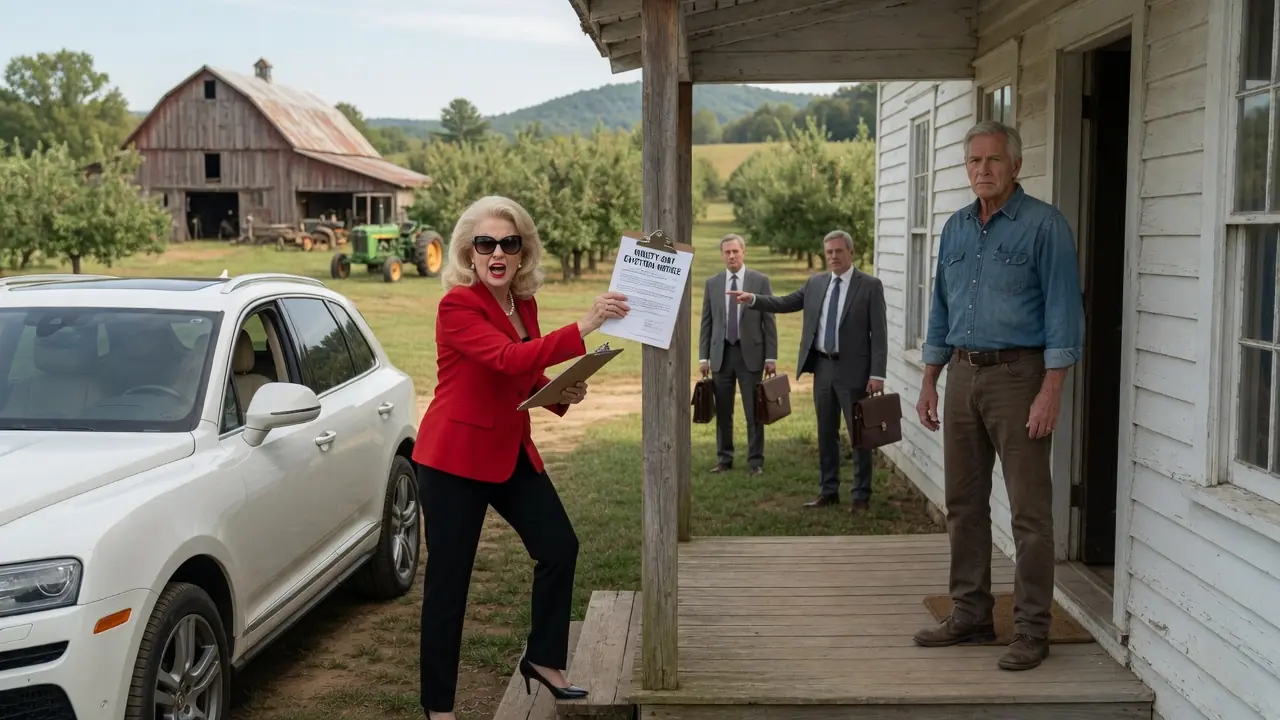
“That wasn’t a costume, ma’am.”
“Then what was it?”
Dead silence.
I just looked at her.
“My judicial robes.”
She had spent six months trying to bully me off my grandfather’s land.
“Your what?”
“Twenty-two years on the Virginia Circuit Court bench. One of your lawyers argued a case in front of me last year. He lost.”
She had no idea what I was about to do to her.
My name is Garrett Hollowell, and the land under my boots has been in my family since before the Korean War started.
My grandfather, Everett, bought those forty-seven acres in the spring of 1946. He had spent three years in Europe watching the world burn, and when he came home, all he wanted was quiet dirt and honest work.
He found both in Albemarle County, Virginia.
He built the farmhouse himself. White clapboard, two stories, a wraparound porch that faces east so you catch the sunrise over the Blue Ridge.
He planted apple trees along the south slope the following year. Galas, Honeycrisps, and a row of Arkansas Blacks that still fruit every October like clockwork.
The bark on those trees is thicker than my arm now. The roots go deeper than any foundation in Sterling Ridge.
I grew up running through those orchards.
The smell of overripe apples rotting in the grass every September, sweet and sharp at the same time, that is the smell of my childhood.
My dad took over the land in 1971.
I left for UVA Law, became a prosecutor, and eventually got appointed to the circuit court bench.
I served twenty-two years.
I saw every flavor of petty cruelty that one person can inflict on another through paperwork and process.
My wife, Eleanor, loved this place more than I did.
Every summer, we would drive out from Charlottesville, and she would kick off her shoes the second we hit the gravel driveway.
She planted lavender along the fence line. She said the smell reminded her of her grandmother’s kitchen in North Carolina.
The lavender still blooms every June.
Eleanor doesn’t.
She died of pancreatic cancer four years ago. Forty-one days from diagnosis to funeral.
I retired the day after they lowered her casket, moved onto the land full-time, and started fixing what seventy-five years of weather had broken.
That was what I was doing when Sterling Ridge Estates arrived.
Six years ago, the dairy farm next to mine sold to a developer.
Within eighteen months, the pastures were gone.
In their place stood ninety-three houses, white vinyl fencing, an HOA rule book thicker than the county code, and a clubhouse that looked like a Marriott had a baby with a strip mall.
It was the kind of neighborhood where people pay four hundred thousand dollars for a house and then complain about the sound of a tractor.
Brenda Whitfield came with the development like mold comes with moisture.
She was the HOA’s first president and never let go.
Fifty-four years old, blonde hair that had not seen its natural color since the Clinton administration, and a body that suggested her morning yoga sessions were not working as hard as she claimed.
She drove a pearl-white Cadillac Escalade the way some people carry a badge, like it gave her authority over everything in a three-mile radius.
The first time I met her, I was fixing fence posts along the property line.
The Escalade rolled up, the window went down, and out came a voice that could curdle fresh milk.
“I need to talk to whoever owns this property.”
She said property the way you would say dumpster fire.
She stepped out, Gucci sunglasses pushed up on her head, a white linen blazer over black yoga pants, clipboard in her left hand.
She handed me a piece of paper. It had the Sterling Ridge logo at the top and the word violation in red block letters.
My barn was an aesthetic disruption.
My tractor was a noise hazard.
My apple trees were attracting pest populations that threatened community wellness.
All from a woman whose jurisdiction ended at her own property line.
I looked at the paper, then looked at her.
“Ma’am, I’m not in your HOA.”
She smiled.
The kind of smile that is really just teeth.
“Honey, everyone on this road is under our jurisdiction now.”
That was the moment I understood exactly who Brenda Whitfield was.
She was the kind of person who gets elected president of forty-seven households and genuinely believes it is the same thing as a seat in the Senate.
Two weeks after Brenda’s first visit, a letter arrived in a cream-colored envelope, heavy enough to double as a paperweight.
The return address said Kessler, Brandt and Associates, Attorneys at Law.
The paper was thick, textured, the kind that costs more per sheet than most people spend on lunch.
It smelled like ambition and bad decisions.
The letter was two pages of legal language that boiled down to one simple demand.
Sell your property within ninety days or face litigation.
They cited community standards, property value depreciation, and something called adjacent parcel aesthetic compliance, a term I am fairly confident was invented in that very letter, because in twenty-two years on the bench, I had never seen it in a single filing.
I sat on the porch and read it twice.
Not because it was complicated.
Because it was so poorly constructed that I wanted to make sure I was not missing something clever hidden underneath the bluster.
I wasn’t.
This was a scare letter, plain and simple. The legal equivalent of a Halloween mask designed to frighten people who do not know any better.
I folded it neatly, slid it back into the envelope, and filed it in the kitchen drawer next to Brenda’s violation notices.
The drawer was starting to get full.
Three days later, a black sedan pulled into my driveway.
A Lincoln Town Car with tinted windows and a fresh wax job, looking about as natural on my gravel road as a tuxedo at a pig roast.
Three men got out.
Gray suits, leather briefcases, shoes polished to a mirror shine.
They walked up the path single file, and their Oxfords crunched on the gravel with every step. A sharp, deliberate sound, like they were trying to announce themselves as serious people.
The leader adjusted his tie.
The one behind him checked his watch.
The third carried a folder thick enough to prop open a door.
I was inside, standing in my study, holding the last piece of my old life.
My judicial robes.
Twenty-two years of wearing them, and the fabric still felt heavy on my shoulders, heavier than any suit I had ever owned.
The black wool carried the faint smell of old courtrooms, wood polish, paper dust, and the particular staleness of rooms where people’s lives get decided.
I was trying them on one final time before folding them into a box.
The doorbell rang.
I walked to the front door and opened it.
Todd Hensley stood in the middle, mouth already shaped around whatever rehearsed opening line he had prepared in the car.
He was in his mid-thirties, well-groomed, the kind of lawyer who practices his handshake in the mirror.
His mouth opened, then his eyes moved from my face down to the robe, then back up to my face.
The color drained out of him like someone had pulled a plug.
Pink to chalk in maybe two seconds.
His briefcase hand dropped about three inches.
“Judge. Judge Hollowell.”
I remembered him.
Twelve months earlier.
Commercial property dispute. The Westover case.
He had represented a developer trying to push a family off a parcel using a manufactured code violation.
I ruled against him.
The irony was so thick you could spread it on toast.
The two lawyers behind Todd looked at him, then at me, then at the robe.
Nobody spoke.
The only sound was wind moving through the apple trees and the distant hum of a lawn mower somewhere in Sterling Ridge, the neighborhood that was apparently funding this visit.
I stood in the doorway, hands at my sides, and let the silence do the work.
Ten seconds.
Fifteen.
In a courtroom, silence is a tool.
Most people cannot handle it. They fill it with confessions, excuses, or retreats.
Todd chose retreat.
“I think there has been a misunderstanding, Your Honor.”
He closed his briefcase with a soft click.
“We apologize for the intrusion.”
They walked back to the Lincoln in single file.
Nobody looked back.
The car reversed down my driveway, and I watched the taillights disappear past the oak tree my grandfather planted the same year he laid the foundation for this house.
I wondered how much Brenda had paid for that forty-five-second visit.
Probably enough to repaint the barn she hated so much.
That evening, I called Gil Norwood.
Gil was sixty-seven, lived two miles down Route 7, and had been farming this valley since before Sterling Ridge was a line on a developer’s napkin.
He picked up on the second ring.
“She sent lawyers, Gil.”
He was quiet for a moment.
“She’s done that before, Garrett. Three families on this road sold because of her. The Pattersons, the Wellers, the Dunns. You’re the last one standing.”
I looked out the window at the orchard.
The sun was setting behind the ridge, painting the sky in shades of copper and rust.
Eleanor would have called it God showing off.
“Then I guess I’d better stand well,” I said.
Here is something most people do not realize.
In Virginia, sending a legal threat letter with no factual basis can constitute abuse of process, a civil tort that allows the target to sue for damages.
Brenda’s lawyers had just hand-delivered me a cause of action on cream-colored stationery.
Some gifts come in expensive packaging.
Brenda did not slow down after the lawyer debacle.
She shifted tactics the way a chess player switches from direct attack to positional warfare.
If she could not scare me with legal threats, she would weaponize the bureaucracy.
The first complaint hit two days after the lawyers left.
The county health department called to inform me that an anonymous concerned citizen had reported a septic system leak on my property. They were required to investigate.
Could I be available Thursday?
Thursday came.
Two inspectors in khaki pants and rubber boots walked every inch of my septic field.
They took soil samples. They tested the groundwater. They poked probes into the earth like they were performing surgery on my yard.
Four hours later, the lead inspector shook my hand and said, “Mr. Hollowell, your system is cleaner than most we see in new construction. Whoever filed this didn’t have a clue what they were talking about.”
One day of my life, gone for nothing.
The second complaint arrived the following week.
This time, it was building and safety.
Brenda, or her anonymous proxy, had reported that my barn was structurally compromised and posed an imminent collapse risk to neighboring properties.
The inspector drove out, walked through the barn, knocked on the posts, and checked the joists.
He spent forty minutes inside, breathing in the smell of dry hay and seventy-five years of honest work baked into the wood.
When he came out, he was almost smiling.
“Sir, this barn is built better than half the houses in Sterling Ridge. Your grandfather knew what he was doing.”
I wanted to frame that quote and mail it to Brenda.
The third complaint was my favorite.
Agricultural services received a report that my apple orchard was harboring insect populations that presented a clear and present danger to community health.
I did not make that language up.
Someone actually wrote clear and present danger about apple trees.
The agricultural inspector came out, walked through the rows, checked the bark, and examined the fruit.
He pulled off a Honeycrisp, turned it over in his hand, and said, “These are some of the healthiest trees in the county. Who filed this?”
In six weeks, Brenda filed seven complaints with four different county agencies.
Seven inspections.
Seven cleared results.
Seven complete wastes of government resources paid for by taxpayers who had no idea their money was funding one woman’s grudge against an apple orchard.
If Brenda had put this much energy into literally anything else, volunteer work, continuing education, competitive hot dog eating, she would have been nationally ranked by now.
I started keeping a file.
Every complaint.
Every inspection report.
Every date.
Every inspector’s name.
I bought a three-ring binder and labeled it Whitfield.
The binder got thick fast.
I called the county clerk’s office one afternoon.
“I’d like copies of every complaint filed against my property in the last two months.”
The woman on the other end paused.
“All seven of them?”
She sounded tired.
I did not blame her.
Here is something worth knowing.
In Virginia, filing false reports with government agencies can constitute a misdemeanor under state code.
Penalties can include fines and possible jail time per complaint.
Brenda had filed seven.
I was not counting yet, but I was keeping the receipts.
One evening after the fifth inspection, I sat on the porch with a glass of bourbon and watched the fireflies drift over the orchard.
The crickets were loud that night, a pulsing rhythmic chorus that Eleanor always said sounded like the earth breathing.
She used to sit right here in the rocker next to mine, bare feet on the rail, reading whatever novel she had found at the library sale.
The rocker was still there.
The cushion still held the shape of her.
I looked at the empty chair and said quietly, “What would you do, Eleanor?”
I could almost hear her voice.
She would have laughed first, that low, warm laugh that started in her chest. Then she would have said something like, “Honey, she picked the wrong porch.”
I finished the bourbon and went inside.
Tomorrow, there would be another complaint, another inspector, another waste of everyone’s time.
But I was starting to see the pattern now.
Brenda was not just harassing me for sport.
She was building a paper trail.
Seven complaints.
Seven visits.
The illusion of a problem property.
She was constructing a narrative, a case.
She wanted enough on file to go to court and argue that my land was a public nuisance.
The thing about paper trails is that they work both ways.
She was building hers.
I was building mine.
The difference was that mine had truth in it.
The letter from the Albemarle County Planning Commission arrived on a Tuesday.
Plain white envelope, official seal, no perfume of expensive law firms this time, just cold bureaucratic paper.
Notice of Proposed Rezoning.
Parcel number 4471-02.
From agricultural to residential mixed-use.
I read it standing by the mailbox.
The wind carried the cloying sweetness of chemical fertilizer from Sterling Ridge’s golf course lawns, a smell that had nothing to do with nature and everything to do with people trying too hard to make things look perfect.
The financial implications hit me before the anger did.
Agricultural zoning on forty-seven acres meant my property taxes ran about eight hundred dollars a year.
Residential mixed-use zoning would push that number to roughly fourteen thousand.
That is not a tax increase.
That is a financial eviction.
An eighteen-fold jump designed to make the land too expensive to keep.
I scanned to the bottom of the notice.
Proposed by Commissioner Darren Whitfield.
I almost laughed.
Almost.
Brenda’s husband, the man who sat on the county planning commission and also happened to own Whitfield & Sons Construction, the primary contractor for Sterling Ridge Estates.
He was not even trying to hide it.
In twenty-two years on the bench, I had seen hundreds of conflicts of interest.
Most people at least had the decency to use a frontman or a proxy.
Darren just signed his own name like he was ordering lunch.
Gil Norwood called that afternoon.
“You see the rezoning notice, Garrett?”
“I’m holding it.”
“That’s Darren’s play. He did the same thing to the Henderson farm in 2019. Filed for rezoning, jacked up the tax estimate, and the Hendersons sold within six months. Couldn’t afford to hold on.”
Gil’s voice was flat, the way it gets when someone is telling you something they have seen too many times.
“He rezones it. His company builds on it, and Brenda gets to expand her little kingdom. Same playbook, different victim.”
The public hearing was scheduled for a Thursday evening at the county government center.
I drove over in my truck, parked between a Tesla and a Mercedes with a Sterling Ridge parking sticker, and walked into a room with fluorescent lights, plastic chairs, and the faint smell of floor wax and political ambition.
Darren sat at the front behind a curved desk with four other commissioners.
Navy suit.
Cufflinks that caught the light.
Cologne you could smell from the third row.
He had the smile of a man who had already counted his winnings before the cards were dealt.
I signed in to speak during the public comment period.
When my name was called, I walked to the microphone.
The room was maybe half full.
A few Sterling Ridge residents.
Some county staff.
A board reporter from the local weekly.
I kept it simple.
I stated the history of the parcel, eighty years of continuous family ownership.
I mentioned the conservation easement my father had filed in 1987 with the Virginia Outdoors Foundation.
I cited the agricultural exemption and what the rezoning would cost me.
I spoke clearly, without notes, in the same measured tone I had used for twenty-two years from the bench.
When I finished, Darren leaned into his microphone.
“The county’s growth plan requires us to consider all options for responsible community development, Mr. Hollowell. No one is trying to push anyone off their land.”
He said it with a straight face.
I will give him that.
I leaned back toward my microphone.
“Commissioner Whitfield, for the record, does your construction firm currently hold active contracts with Sterling Ridge Estates?”
The room went quiet.
Not library quiet.
Courtroom quiet.
The kind of silence where you can hear someone swallow.
Darren’s jaw tightened. His eyes shifted to the commissioner on his left, then back to me.
“I don’t see how that’s relevant to this hearing.”
“I think it’s extremely relevant,” I said. “But I’ll let the record speak for itself.”
The commission chair cleared her throat and announced that the rezoning proposal would be tabled for further review.
Translation: someone had just asked a question nobody wanted to answer in public.
I drove home on the county road, windows down, the cool Virginia evening air washing through the cab.
The Blue Ridge was dark against the last strip of sunset.
I had been calm for twenty-two years on the bench.
I could be calm for a few more months.
But something had shifted.
I knew now that Brenda was just the face.
The clipboard.
The Escalade.
She was loud and visible because that was her job: to distract, to intimidate, to make noise.
Darren was the one behind the curtain.
His fingerprints were on the rezoning.
His company stood to profit.
His wife was the enforcer.
And the HOA treasury was the war chest.
Brenda was the gun.
Darren was the one pulling the trigger.
I spent the next three weeks doing what I had done for twenty-two years: reading documents, following money, and connecting dots that other people assumed would never be connected.
A judge does not investigate.
A judge evaluates evidence that others bring.
But I was not a judge anymore.
I was a property owner being squeezed off his own land by a woman with a clipboard and a man with a construction company.
So I put on a different hat and started digging.
The Freedom of Information Act request came first.
I filed for all contracts between Whitfield & Sons Construction and any entity associated with Sterling Ridge Estates.
The county responded in eleven business days.
Three contracts.
Total value: 4.2 million dollars.
Pool construction.
Clubhouse expansion.
Road resurfacing.
Darren had voted to approve every Sterling Ridge-related proposal that came before the planning commission without ever disclosing his financial interest.
That was a direct violation of Virginia’s conflict-of-interest statute.
Not a gray area.
Not an interpretation.
A textbook violation.
I sat in my study that night, the desk lamp casting a warm circle over stacked file boxes.
The room smelled like old paper and black coffee, the same smell that followed me through two decades of late nights at the courthouse.
Some smells become comfort.
The HOA financial records came next.
Virginia’s Property Owners’ Association Act requires associations to make their books available to members upon request.
I was not a member, but Tammy Griggs was.
She requested the records, and the HOA had fifteen days to comply.
They took fourteen.
Lydia Crenshaw, the forensic accountant I called in, spread the ledgers across her desk and started reading.
Ten minutes in, she looked up over her glasses.
“Garrett, this isn’t creative bookkeeping. This is embezzlement.”
Eighty-seven thousand dollars.
That was how much had been moved from the HOA’s legal reserve fund to pay for legal consultation regarding adjacent property compliance.
No board vote on record.
No membership approval.
No minutes from any meeting authorizing the expenditure.
Brenda had taken dues money, money paid by her own neighbors for pool maintenance and landscaping, and spent it on a personal vendetta against me.
Then came the kill shot.
I read the CC&Rs of Sterling Ridge Estates front to back.
All forty-three pages.
Article Two, Section One.
This association shall have jurisdiction exclusively over lots within the recorded plat of Sterling Ridge Estates.
My property was never part of that plat.
Not one square foot.
Every violation notice Brenda had ever slid under my door, every letter, every demand, they were all legally meaningless.
She had been waving a badge that had no authority outside her own neighborhood.
And the conservation easement my father filed in 1987 with the Virginia Outdoors Foundation ran with the land permanently.
Any owner, any decade, any commission vote, it did not matter.
The easement prohibited residential development on twenty of my forty-seven acres.
Darren’s rezoning proposal was not just aggressive.
It was legally impossible.
I placed four folders on my desk and looked at them the way I used to look at a case file when the prosecution had just rested and the evidence was overwhelming.
For the first time in months, I smiled.
Not a happy smile.
A courtroom smile.
The one that comes when a defendant lies on the stand and does not realize the documentary evidence is already in the record.
Brenda and Darren had spent six months trying to push a judge off his land by violating at least four state statutes.
That is the kind of strategy you come up with when you watch too much reality television and do not read enough law books.
I did not rush.
In twenty-two years on the bench, I learned one thing that most people never figure out.
The person who moves first usually loses.
The person who moves last, with everything in order, wins.
My plan had five parts.
Not because I am dramatic.
Because the problem had five layers, and each one needed its own blade.
Lydia Crenshaw handled the money.
I brought her every financial document Tammy had pulled from the HOA, plus the FOIA response on Whitfield & Sons contracts.
Lydia worked out of a small office on Main Street in Charlottesville, the kind of place with framed certifications on the wall and a printer that never stopped running.
She spent four days going line by line through the HOA’s books.
When she called me back, her voice had that flat professional calm that accountants use when they have found something ugly.
“Garrett, it’s clean. By that I mean the embezzlement is clean. Simple transfers, no shell entities, no layering. She moved the money directly from the legal reserve to a vendor account that she controls. Eighty-seven thousand, plus another twenty-five she just authorized without quorum. One hundred twelve thousand total. A first-year auditor could prove this in an afternoon.”
I filed the first formal complaint with the Virginia Judicial Inquiry and Review Commission regarding Darren’s undisclosed conflicts of interest.
I did not call any friends on the bench.
I did not ask for favors.
I walked the paperwork through the front door the same way any citizen would.
The process exists for a reason.
When a public official uses his position to benefit his own company while punishing a private citizen, the system has a mechanism for that.
I just knew where the front door was.
The second complaint went to the Virginia State Bar concerning Kessler, Brandt and Associates.
The firm had sent a demand letter threatening litigation with no legitimate legal basis.
That is not aggressive lawyering.
That is a potential ethics violation.
The bar takes those seriously, especially when the complainant happens to be a retired judge who can cite the relevant rules of professional conduct from memory.
Then I called Pete Salana.
Pete was an investigative reporter at the Charlottesville Daily Progress. Young, hungry, the kind of journalist who still believed the job meant something.
I met him at a coffee shop downtown and slid a folder across the table.
“Read it,” I said. “If there’s a story, write it. If there isn’t, don’t.”
He opened the folder.
His eyes moved fast.
He flipped pages, stopped, went back, and read something twice.
Twenty minutes later, he closed the folder and looked at me.
“Judge, there’s a story. There’s a hell of a story.”
The hardest part was not the filings or the forensics.
It was the neighbors.
I drove to Tammy Griggs’s house on a Wednesday evening.
She lived in a three-bedroom on Magnolia Court, one of the smaller lots in Sterling Ridge, the kind that backs up to the sound wall.
She opened the door looking tired, a toddler on her hip and a five-year-old watching cartoons behind her.
Tammy had been fined three thousand two hundred dollars over two years.
Trash cans left out past noon: two hundred dollars.
Car parked six inches past the driveway edge: one hundred fifty.
Garage door open after seven p.m.: one hundred.
She had paid every one because she was afraid of Brenda.
Afraid of the letters.
Afraid of losing her house.
“I’ve been scared of that woman for three years,” Tammy said.
The toddler grabbed her earring.
She did not flinch.
“Tell me what to do, and I’ll do it.”
I told her what I needed.
Signatures.
Virginia law says that twenty-five percent of HOA members can demand a special meeting.
Sterling Ridge had forty-seven households.
I needed twelve signatures.
Over the next two weeks, I got them.
Tammy helped.
Gil spread the word to the old-timers along Route 7.
One by one, residents came forward, each with their own Brenda story, their own stack of fines, their own quiet anger.
The Mercers got fined for a garden gnome.
The Kohls got fined for a basketball hoop.
The Proctors got a violation for having the wrong shade of beige on their shutters.
Twelve families signed.
Thirteen, actually.
The petition was filed on a Monday morning.
I prepared my presentation for the annual meeting the way I used to prepare for trial.
Every exhibit numbered.
Every argument mapped.
Every possible objection answered before it could be raised.
The difference was that this time, the defendant did not have a good lawyer.
She had a clipboard and a pearl-white Escalade.
Word travels fast in a neighborhood where everyone watches everyone else’s trash cans.
It took Brenda about four days to figure out that her residents were talking to me.
She did not take it well.
I woke up on a Friday morning at 5:30, the way I always do.
The air was cool, still damp with fog that had not burned off yet. I pulled on my boots, grabbed my coffee, and walked out to check the fence line the way I had every morning since moving back.
The routine was sacred.
Boots.
Coffee.
Fence.
Cows.
In that order.
The first thing I noticed was the sound.
Or rather, the absence of it.
My six head of cattle are creatures of habit. By 5:30, they are usually clustered near the north gate, waiting for feed.
That morning, the north pasture was empty and silent, just mist hanging over flat grass.
I walked to the fence.
Three sections of wire had been cut clean.
Not snapped.
Not sagged.
Cut.
The ends were shiny and precise, the work of someone with a good pair of wire cutters and a reason to use them.
I followed the tracks through the gap and onto Sterling Ridge property.
My cattle had wandered across the development’s back perimeter, across two manicured lawns, and into the cul-de-sac on Birchwood Lane.
Six Herefords standing on a carpet of Kentucky bluegrass that someone paid a landscaping company eighty dollars a week to maintain.
The hoofprints were deep and symmetrical.
The evidence they left behind was organic and abundant.
Brenda called animal control before most people had finished their first cup of coffee.
I will give her this.
It was the earliest I had ever known her to be awake for something other than sunrise yoga.
I photographed the cut fence.
Every angle.
Every clean edge.
I measured the distance from the cuts to the nearest Sterling Ridge property line.
Forty-two feet.
I noted the time, the weather, the direction of the tracks.
Then I added it all to the binder.
The cattle were rounded up by noon.
No damage to anyone’s property beyond some lawn divots and a memorable smell, but Brenda had already sent a neighborhood-wide email calling it a dangerous livestock incident and demanding that the board take emergency action.
She was just getting started.
Over the next ten days, a rumor began circulating through Sterling Ridge.
Garrett Hollowell was experiencing cognitive decline.
He was unstable.
He was a potential danger to the community.
One resident told Tammy that Brenda had said, “A man his age, living alone on that property with all those animals, someone should really check on him for his own safety.”
Let me be clear about something.
I spent twenty-two years evaluating the credibility of witnesses.
I can tell you the exact tone of voice people use when they are genuinely concerned about someone’s well-being.
And I can tell you the exact tone they use when they are building a case to discredit a threat.
Brenda was not worried about my health.
She was worried about her freedom.
Then came the road.
I drove home one afternoon to find two metal posts and a length of yellow nylon rope stretched across the dirt road that leads from Route 7 to my driveway.
A hand-lettered sign hung from the rope.
Private Property. Sterling Ridge HOA. No Unauthorized Access.
I stopped my truck, engine idling, and looked at the sign.
The rope was new.
The posts were new.
The audacity was timeless.
That road has been there since 1952.
My grandfather signed the original easement agreement with Albemarle County when they paved Route 7.
It is a recorded right-of-way.
Public access.
Legally guaranteed.
Documented in the county land records.
Blocking a recorded easement is not just rude.
It is obstruction of a right-of-way.
I photographed the barricade.
I called the county sheriff’s office.
A deputy arrived within an hour, confirmed the easement on his laptop, and had the posts pulled and the rope removed before dinner.
That night, I sat in the living room.
The fire was low, just embers and the occasional pop of oak.
On the mantel, Eleanor looked out from a silver frame, a photo from the summer we painted the kitchen.
Her hair tied back.
Paint on her chin.
Laughing at something I had said.
I could not remember the joke.
I wished I could.
“Almost there, sweetheart,” I said quietly. “Almost there.”
Every move Brenda made was a new page in my binder.
Every lie.
Every fence cut.
Every fake sign.
She thought she was tightening the noose.
She was tying it around her own neck.
Brenda’s second law firm lasted about as long as her first attempt at subtlety.
The new letter arrived on a Thursday.
Thinner paper.
Cheaper envelope.
Different logo.
Crawford Legal Solutions, not Kessler, Brandt and Associates.
That firm had quietly dropped the case after Todd Hensley spent an uncomfortable forty-five seconds on my porch.
The downgrade was telling.
When you fire your first lawyer and hire a cheaper one, you are not escalating.
You are hemorrhaging.
It is a pattern I saw a hundred times from the bench. The more desperate the client, the lower the quality of representation.
Brenda had gone from a hundred-dollar steak to a gas station sandwich.
And the letter read like it.
Final notice.
Sell the property within thirty days or face a civil nuisance lawsuit.
I held the paper up to the window light.
Thin.
Almost translucent.
I could see the shadow of the apple trees through it.
There was a metaphor in there somewhere, but I did not need metaphors.
I needed three more days.
Darren, meanwhile, was running his own clock.
He had called an emergency session of the planning commission to vote on the rezoning, trying to ram it through before my formal complaint reached the review board.
He scheduled it for Tuesday.
The annual HOA meeting was Thursday.
He wanted the rezoning approved before anyone in Sterling Ridge knew what was happening, but the judicial inquiry had already received my complaint.
Judge Clarice Patton, a colleague from my years on the circuit, called me on Monday evening.
We had served together for eight years. She was now chief judge of the appeals court, and she did not call about personal matters unless something mattered.
“Garrett, I can’t discuss specifics, but the inquiry received your filing, and they’re moving on it. Darren has not been notified yet.”
“Thank you, Clarice.”
“That’s all I needed to hear.”
That same week, Brenda held an emergency board meeting, if you could call three people in a room a meeting.
She voted, along with her two loyal board members, to authorize another twenty-five thousand dollars from the HOA treasury for a community legal defense fund.
There was no quorum.
No proper notice.
No minutes distributed to the membership.
Just three hands raised in a room with the blinds drawn, moving money that belonged to forty-seven families.
Tammy called me that night.
Her voice was tight.
“She held a vote, Garrett. Three people. Nobody else was invited. Nobody else knew. Twenty-five thousand.”
I was quiet for a moment.
“Good. Let her take it.”
“Good? Garrett, she’s stealing their money.”
“Every dollar she takes is another count on the indictment. Tammy, let her dig.”
On Wednesday, Pete Salana called.
His investigation was complete.
The story would run in the Charlottesville Daily Progress on Monday, three days after the HOA meeting, but the timing did not matter for my purposes.
The evidence existed whether the newspaper printed it or not.
Pete’s story was the match.
The fuel had been stacking up for months.
I spent Wednesday night in my study assembling the final presentation.
Thirty-two slides.
Supporting documents copied and collated for every household.
Forty-seven packets, each in a manila folder.
Lydia’s audit report.
The CC&Rs with Article Two, Section One highlighted in yellow.
The conservation easement from 1987.
FOIA responses showing Darren’s contracts.
Copies of every false complaint Brenda had filed.
Photographs of the cut fence.
Photographs of the illegal barricade.
The petition with thirteen signatures.
I called Sheriff Boyd Cassell on Thursday morning.
Boyd was a straight shooter, twenty years in law enforcement, no political ambitions, the kind of man who arrests people because the law says so, not because someone asks him to.
“Boyd, I’m going to need you at the Sterling Ridge annual meeting tonight.”
“Is this about the Whitfield matter?”
“It is.”
“I’ll be there. I’ll bring the paperwork you filed last week.”
I hung up and looked at the closet where my judicial robes hung behind the door.
The heavy black fabric.
The zipper I had pulled up a thousand times before walking into court.
I did not need them tonight.
Tonight, I was not a judge.
I was a plaintiff.
A property owner.
A grandson of a man who came home from war and built something that mattered.
The evidence was airtight.
The law was clear.
And Brenda Whitfield was about to learn something that twenty-two years on the bench had taught me.
The loudest person in the room is almost never the most powerful one.
The Sterling Ridge clubhouse smelled like cheap coffee and carpet cleaner.
Fluorescent lights buzzed overhead, casting the kind of flat, unflattering light that makes everyone look tired.
Rows of folding chairs faced a long table at the front of the room.
Brenda stood behind it in a fresh white blazer, hair freshly blown out, greeting people as they filed in with the enthusiasm of a homecoming queen running for reelection.
I arrived at 6:45, fifteen minutes before the meeting started.
The parking lot was fuller than anyone expected.
Thirty-eight of forty-seven households had shown up.
Word had spread.
Something was happening tonight.
Tammy and the twelve other signatories sat scattered throughout the room.
Not clustered.
Not obvious.
They looked like regular residents attending a boring annual meeting.
That was the point.
Pete Salana sat in the back corner, reporter’s notebook open on his knee, pen already moving.
He dressed down, khakis and flannel, to blend in.
He did not need to take notes to remember.
He was taking them so Brenda could not later claim the press had not been present.
Sheriff Boyd Cassell stood near the door in uniform, hat tucked under his arm.
Brenda glanced at him when he walked in, but did not seem concerned.
She probably assumed he was there for traffic or safety.
She was half right about the safety part.
Brenda opened the meeting at seven sharp.
Agenda items: annual budget review, landscaping contract renewal, pool hours for summer, community standards update.
She moved through them briskly, confident, the clipboard in her hand like a scepter.
When she reached new business, I stood up.
“Madam President, under Section 4.7 of the Sterling Ridge bylaws, any member may raise a motion from the floor during new business.”
Brenda’s smile tightened one degree.
“We’ll get to open comments at the end, Mr. Hollowell.”
“I’m not a member, Mrs. Whitfield, but twelve of your members have signed a petition under Virginia law requiring that this discussion happen now.”
Tammy stood up.
She walked to the front and placed the petition, thirteen signatures, on the table in front of Brenda.
The room went very quiet.
Brenda looked at the signatures.
Her jaw moved slightly, like she was chewing on something bitter.
“Fine,” she said. “You have ten minutes.”
I did not need ten minutes.
I connected my laptop to the projector and began.
Slide one.
Article Two, Section One of the Sterling Ridge CC&Rs projected eight feet wide on the wall.
This association shall have jurisdiction exclusively over lots within the recorded plat of Sterling Ridge Estates.
My property had never been part of that plat.
Every violation notice, every demand letter, every complaint, legally void.
I heard someone in the third row whisper, “Are you kidding me?”
Slide two.
Seven false complaints filed with four county agencies.
Seven inspections.
Seven cleared results.
Estimated cost to taxpayers: fifteen thousand dollars.
Slide three.
Lydia Crenshaw’s forensic audit.
Eighty-seven thousand dollars moved from the HOA legal reserve to fund the campaign against my property.
No board vote.
No membership approval.
No recorded authorization.
Slide four.
Emergency vote.
Three people.
No quorum.
No notice.
Twenty-five thousand additional dollars authorized and moved.
Total misappropriated: one hundred twelve thousand dollars.
Slide five.
Whitfield & Sons Construction.
Three active contracts with Sterling Ridge totaling 4.2 million dollars.
Commissioner Darren Whitfield voted to approve every one without disclosing his financial interest.
Slide six.
Conservation easement filed in 1987 with the Virginia Outdoors Foundation.
Twenty acres permanently protected.
Rezoning: legally impossible.
The room was silent.
Not uncomfortable silence.
The kind of silence that happens when forty people simultaneously realize they have been lied to for six years.
Brenda stood behind the table, clipboard hanging at her side, mouth slightly open.
The blazer that had looked crisp an hour ago now looked like a costume.
Darren shot to his feet from the second row.
“This is completely out of order. This is—you can’t just—”
Sheriff Cassell stepped forward from the doorway.
“Mr. Whitfield, I’d strongly recommend you sit down.”
Darren sat.
I reached into my briefcase and pulled out a single piece of paper, yellowed, creased, eighty years old.
The original deed to my property signed by Everett Hollowell in 1946, stamped with the seal of Albemarle County.
I held it up so every person in that room could see it.
“This land was here before your subdivision, before your HOA, before your ambition. My grandfather bled for this country and came home to build something real on this soil. It will be here long after your plastic fences, your fake violations, and your stolen money are forgotten.”
The room erupted.
Not in anger.
In applause.
Chairs scraped.
People stood.
Sheriff Cassell walked to the front table.
“Mrs. Whitfield, I have a warrant for your arrest on charges of embezzlement, fraud, and misuse of fiduciary funds.”
Brenda’s face crumbled.
The clipboard hit the floor.
Darren fumbled for his phone, hands shaking so badly he dropped it on the carpet.
He was trying to call a lawyer.
His third one.
Under those cheap fluorescent lights, in a room that smelled like stale coffee and broken authority, the queen of Sterling Ridge finally learned something fundamental.
A clipboard, an Escalade, and a white blazer are not armor.
They are a costume.
And costumes come off.
Pete Salana wrote faster than I had ever seen anyone write.
His story would be on the front page by morning.
Brenda Whitfield was charged with embezzlement and fraud.
Her attorney, the fourth one if you are counting, entered a not-guilty plea, but the evidence Lydia assembled was clean enough to frame on a wall.
The forensic trail was short and stupid.
Direct transfers from a fiduciary account to a vendor account Brenda controlled.
No vote.
No authorization.
No attempt to hide it.
She had stolen with the confidence of someone who genuinely believed no one was watching.
Darren did not fare much better.
The judicial inquiry forced his immediate recusal from the planning commission pending investigation.
The state bar opened a separate inquiry into his failure to disclose conflicts of interest.
Whitfield & Sons Construction quietly withdrew from two pending Sterling Ridge contracts.
The rezoning proposal died on the table like a fish pulled from water.
It flopped once, then stopped moving.
The HOA held a special election two weeks later.
Tammy Griggs won the presidency by a vote of thirty-four to three.
The first motion she introduced was a full audit of all HOA expenditures over the previous six years.
The second motion was immediate reimbursement of every questionable fine levied during Brenda’s tenure.
Over forty thousand dollars went back into the pockets of families who had been too afraid to push back.
The Mercers got their garden gnome fine refunded.
The Kohls got their basketball hoop penalty back.
The Proctors, the couple who had been cited for having the wrong shade of beige on their shutters, received a formal apology from the new board.
They repainted anyway.
A nice defiant shade of blue.
I did not sue Brenda personally, though I could have.
Instead, I took the settlement from the HOA’s insurance carrier and used it to establish the Eleanor Hollowell Community Legal Fund, a nonprofit that provides free legal consultation to homeowners facing HOA abuse anywhere in Virginia.
The first call came in before the website was even finished.
A retired teacher in Henrico County whose HOA had tried to force her to remove a wheelchair ramp.
The fund’s attorney had the complaint dismissed in four days.
That fall, I donated five acres along the property line to the county as a public easement.
The Hollowell Community Trail now winds through a corridor of old-growth oaks and ends at the southern edge of my apple orchard, where anyone from Sterling Ridge or anywhere else can pick fruit every October.
I built a small wooden sign at the trailhead.
It reads, In memory of Eleanor Hollowell, who believed that land should bring people together.
The first Saturday in October, I hosted the Hollowell Harvest Festival on the property.
Long tables under the apple trees.
Fresh cider pressed that morning.
A bluegrass trio from Staunton playing under a string of lights that Eleanor would have loved.
Kids from Sterling Ridge chased each other through the orchard while their parents ate pie and talked to people they had been too busy or too scared to know for six years.
Gil Norwood showed up with a bottle of bourbon older than Sterling Ridge itself.
We sat on the porch after the last guests left, watching the stars come out over the Blue Ridge the way people have watched them from this porch for eight decades.
“Everett would have been proud,” Gil said.
I took a sip and thought about that.
My grandfather, who crossed an ocean and came back to build something from nothing.
My father, who preserved it.
Eleanor, who loved it.
“She would have told me I took too long,” I said.
Gil laughed.
“I did too.”
It felt good.
In the clubhouse parking lot that night, someone noticed a pearl-white Cadillac Escalade sitting in the used-car section of the Sterling Ridge community board, listed for sale at a steep discount.
The previous owner, it said, was relocating due to personal circumstances.
I suppose that is one way to describe a pending felony trial.