“Sign these papers right now, or you’re finished.”
“I’m not signing a damn thing. You and your thugs get off my land.”
She thought she was suing a stubborn old farmer.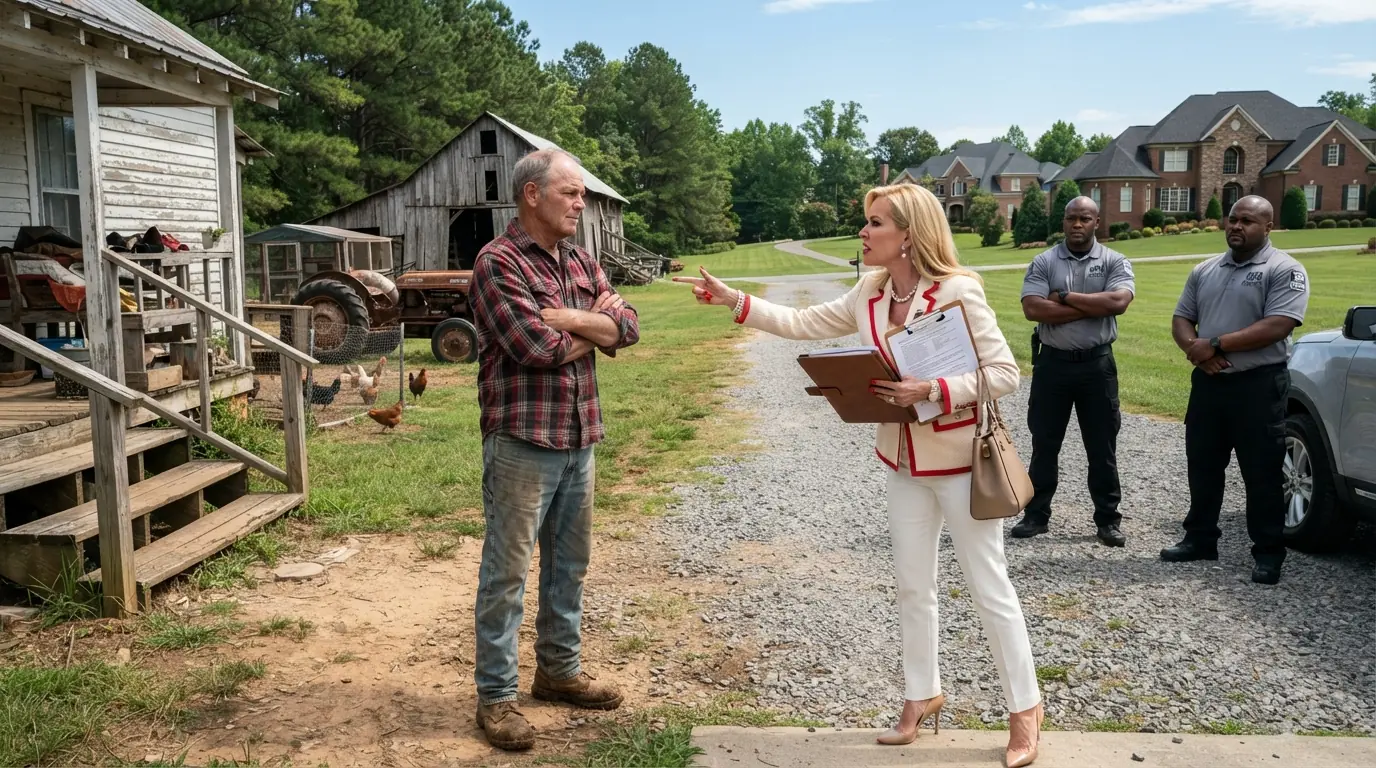
She was wrong.
Karen Whitmore stood in the Chesterfield County courtroom, confident her HOA lawsuit would force Daniel Reeves to leave. His farmhouse sat in the center of her luxury subdivision, peeling paint, leaning barn, rusty tractor. It was destroying property values. The judge would order him to upgrade or sell.
Then Daniel’s attorney asked one question.
“Your Honor, are you aware my client owns Riverside Community Bank?”
The courtroom went silent.
Karen’s face went pale. She had just remembered something she had ignored six months earlier: a letter about her mortgage servicing transferring to a new lender. She had thrown it in the recycling without reading it.
Daniel Reeves was not just the farmer next door. He was the CEO who held the mortgages on 167 homes in the subdivision, including hers, and she was four months behind on payments.
Karen made the mistake every entitled neighbor makes, judging someone by their truck instead of checking who holds power. She assumed wrong.
This is the story of how an HOA president lost her house, her career, and her reputation because she never asked one question.
Who is this man I’m suing?
Seven foreclosures. One dissolved HOA. One hundred forty-two residents voting to end the organization that started the war. All because property law does not care how your neighbor’s house looks. It cares who signs your mortgage.
But let me start from the beginning.
The Chesterfield County Circuit Courtroom had the smell of old wood and recycled air. It was October 2025, midmorning, and the fluorescent lights hummed overhead. The gallery was half full, mostly residents from Magnolia Heights subdivision, curious about the case. A few reporters sat in the back row, notepads open.
At the defendant’s table sat Daniel Reeves. He was 58 years old, wearing a flannel shirt, faded jeans, and work boots that looked like they had walked through mud more times than courtrooms. His hair was gray and thinning. His hands were calloused, weathered from decades of outdoor work.
He looked exactly like what Karen Whitmore thought he was: a stubborn old farmer who refused to move with the times.
Next to Daniel sat his attorney, Grace Chen. She was in her 50s, wearing a tailored navy suit, her dark hair pulled back in a severe bun. Her briefcase was expensive leather. Her shoes were polished to a shine. She looked like she belonged in a Washington, D.C., boardroom, not a small-town Virginia courtroom.
Because she did.
Grace was one of the top real estate attorneys on the East Coast. But she was here as a favor. Daniel Reeves was not just a client. He was an old friend.
Across the aisle at the plaintiff’s table sat Karen Whitmore and her attorney, Mitchell Carver. Karen was 54, blonde, wearing a cream-colored blazer and pearls. She looked polished, confident, like someone who was used to getting her way. She was the president of the Magnolia Heights Homeowners Association.
She had been trying to get rid of Daniel Reeves for 18 months.
Mitchell Carver was in his mid-40s, wearing an expensive charcoal suit and a silk tie. His hair was slicked back. His cufflinks flashed when he moved. He was the kind of lawyer who charged $450 an hour and made sure you knew it. He represented the HOA, and he was confident they were going to win.
The judge, Honorable Patricia Hendricks, mid-60s, gray hair, no-nonsense expression, sat behind the bench reviewing documents. She had been a circuit court judge for 20 years. She had seen a lot of property disputes.
This one had seemed straightforward when she read the briefs. An old farmhouse in the middle of a luxury subdivision. A stubborn owner refusing to upgrade. A community trying to protect property values.
Simple.
Or so she thought.
“Mr. Carver,” Judge Hendricks said, looking up. “You may call your first witness.”
Mitchell stood and buttoned his jacket.
“Thank you, Your Honor. The plaintiff calls Karen Whitmore.”
Karen walked to the witness stand, was sworn in, and sat down. She smoothed her blazer and folded her hands in her lap. She looked calm, composed. She had rehearsed this.
“Ms. Whitmore,” Mitchell began. “Can you describe your role in the Magnolia Heights community?”
“I’m the president of the homeowners association,” Karen said. “I’ve lived in Magnolia Heights for two years. I was elected president last year.”
“And what prompted this lawsuit?”
Karen took a breath and looked at the judge.
“Your Honor, Daniel Reeves owns a property in the center of our subdivision. A farmhouse. It’s old, unmaintained, and frankly, it’s an eyesore. The paint is peeling. The barn is falling apart. There’s rusty farm equipment scattered around. It looks like a junkyard, and it’s surrounded by homes worth $700,000 to over a million dollars.”
Mitchell projected photos onto a screen.
The first image showed Daniel’s farmhouse, a two-story wooden structure. White paint faded and chipped, shutters hanging crooked. The roof had visible patches. Behind it, an old barn leaned slightly to one side, its red paint almost entirely worn away. In the foreground, an ancient tractor sat on cinder blocks, rust covering the wheel wells.
The second image showed the subdivision. Pristine two-story homes with manicured lawns, fresh paint, brick facades, and magnolia trees lining the streets. It looked like a magazine spread.
The contrast was stark.
“Ms. Whitmore,” Mitchell continued. “How has Mr. Reeves’s property affected the community?”
“It’s destroying our property values,” Karen said, her voice rising slightly. “People drive through our neighborhood, and the first thing they see is that farmhouse. It’s embarrassing. We’ve had potential buyers walk away from homes because they didn’t want to live next to that.”
She gestured toward Daniel without looking at him.
“And have you attempted to resolve this issue with Mr. Reeves?”
“Multiple times,” Karen said. “I’ve spoken with him personally. I’ve sent letters on behalf of the HOA. We’ve offered to help him renovate. We even offered to pay for part of the work. He refused everything.”
“Did he give a reason?”
“He said it’s his family’s property, and he’ll do what he wants with it,” Karen said. “He doesn’t care about the community. He doesn’t care that he’s hurting the rest of us.”
Mitchell nodded and turned to the judge.
“Your Honor, Mr. Reeves has been offered generous compensation for his property. The original developer offered him $2 million. He refused. The HOA offered to subsidize renovations. He refused. He’s had every opportunity to be a good neighbor, and he’s chosen not to. The community has rights, too.”
Judge Hendricks glanced at Daniel, who was sitting quietly, expression neutral.
“Mr. Reeves, you’ll have your chance to respond. Mr. Carver, anything else?”
“Just one more point, Your Honor.”
Mitchell projected another document.
“In August 2025, Chesterfield County passed Ordinance 2025-47, the Neighborhood Standards Act. It requires property owners in residential zones to maintain their properties according to community aesthetic standards. Mr. Reeves’s property is in clear violation. We’re asking the court to enforce the ordinance and order Mr. Reeves to either upgrade his property to meet community standards or sell it.”
Judge Hendricks leaned back and looked at the photos again. She did not look thrilled, but she was listening.
“Ms. Chen, does your client have a response?”
Grace stood.
She did not rush. She took her time smoothing her jacket and picking up a tablet.
“Yes, Your Honor. But before we address the merits of the HOA’s claims, I’d like to introduce evidence that fundamentally changes the nature of this case.”
Mitchell frowned. Karen’s expression shifted slightly. She looked puzzled.
Judge Hendricks raised an eyebrow.
“Proceed.”
Grace tapped her tablet.
A document appeared on the screen.
Riverside Community Bank Mortgage Portfolio Acquisition Agreement, March 2024.
“Your Honor,” Grace said, her voice calm and precise. “My client, Daniel Reeves, is the CEO and majority shareholder of Riverside Community Bank, a regional lender with over $400 million in assets. In March 2024, seven months before this lawsuit was filed, Mr. Reeves’s bank acquired the mortgage portfolio for Magnolia Heights subdivision from the original lender, First National Mortgage Group.”
The courtroom became very quiet.
Grace continued.
“Mr. Reeves now holds the mortgages on 167 of the 180 homes in the subdivision.”
She paused and let that sink in.
“Including the home of the plaintiff, Ms. Karen Whitmore.”
Karen’s face went pale. Her mouth opened slightly, but no sound came out. Mitchell’s expression hardened.
“Your Honor—”
Grace did not stop.
“Every one of those mortgages contains a standard acceleration clause, which is legal and enforceable under Virginia law. The clause allows the lender, in this case, Mr. Reeves, to demand immediate full payment of the loan if the collateral, meaning the home, is threatened with a loss of value.”
Judge Hendricks leaned forward.
“Counselor, what’s your point?”
“My point, Your Honor, is this. If the HOA succeeds in forcing Mr. Reeves off his property, and if property values decline as a result, which the HOA itself claims will happen, then Mr. Reeves has the legal right to accelerate every one of those 167 mortgages. That means 167 homeowners would be required to pay off their loans in full immediately. We’re talking about approximately $120 million in outstanding mortgage debt.”
The courtroom erupted.
Residents in the gallery started whispering, some standing. Judge Hendricks banged her gavel.
“Order. Order.”
Mitchell shot to his feet.
“Your Honor, that’s extortion. This is a blatant attempt to intimidate—”
“No, Mr. Carver,” Grace said sharply. “It’s contract law. Your clients signed those mortgages. They agreed to the terms, including the acceleration clause. Mr. Reeves is simply informing the court and the HOA of his legal rights. If the HOA forces him off his property and property values drop, he has every right to protect his collateral.”
Judge Hendricks looked at Daniel, who had been sitting quietly the entire time.
“Mr. Reeves, is this accurate?”
Daniel stood.
He was slow about it, like standing in court was not something he did often.
“Yes, Your Honor,” he said.
His voice was soft and calm, with a slight Virginia drawl.
“I bought that mortgage portfolio as a business investment. My bank has been the lender for Magnolia Heights since March 2024. I’ve been fair to every borrower. If someone pays on time, they never hear from me. But if this HOA tries to force me off land my family has owned since 1895, I’ll protect my interests. And that includes the value of the collateral securing those loans.”
Judge Hendricks’s expression was unreadable.
“Mr. Carver, does your client wish to proceed with this lawsuit?”
Mitchell turned to Karen and leaned down. They whispered frantically. Karen was shaking her head, her face red now, her hands trembling. She whispered something sharp. She shook her head again.
Mitchell straightened and cleared his throat.
“Your Honor, we… we need to reassess. To consult with our client and the HOA board.”
Judge Hendricks sighed.
“Motion to recess granted. One hour. We’ll reconvene at noon.”
She banged the gavel.
The courtroom exploded into noise. Residents were talking loudly, some shouting. A reporter in the back row was already on her phone.
Karen sat frozen at the plaintiff’s table, staring at Daniel. Her expression was a mix of shock, fury, and something close to panic.
Daniel sat back down and folded his hands. Grace leaned over and whispered something to him. He nodded.
Across the aisle, Mitchell was gathering his papers, his jaw tight. Karen finally stood, her legs unsteady. She looked at Daniel one more time, and her expression was pure hatred.
But behind the hatred was fear.
Because Karen Whitmore had just realized something.
She thought she was suing a powerless old farmer.
She had just found out she was suing the man who could take her house with one phone call.
I grew up in that farmhouse.
Not the pristine version you see in magazines with fresh paint and flower boxes and a perfectly restored barn. The real version. The one with creaky floors and drafty windows and a kitchen that had not been updated since the 1950s. The one where you could hear mice in the walls at night and the roof leaked when it rained hard.
But it was home.
My great-grandfather, William Reeves, bought the land in 1895. Five acres on the outskirts of what is now suburban Richmond, Virginia. Back then, it was pure countryside, farmland as far as you could see. Dirt roads. Neighbors a mile apart.
William built the house himself. Timber frame, white clapboard siding, two stories, four bedrooms, a wraparound porch. He raised tobacco on the land, made enough to feed his family, not much more. My grandfather took over in the 1930s and switched from tobacco to soybeans.
My father inherited it in 1968, the year I was born. By then, the suburbs were creeping closer, developments going up a few miles away, highways being built. But our land stayed untouched.
My father ran a small-scale produce operation. Cucumbers, squash, sold them at roadside stands and farmers markets. We were poor. Not desperate, but poor. My clothes were hand-me-downs. We ate what we grew. My father drove a pickup truck that was older than I was.
I did not know we were poor. Not really.
I thought everyone lived like that.
My father taught me how to work. How to wake up at dawn and check the fields. How to fix a fence, patch a roof, keep equipment running with duct tape and stubbornness. He was not educated. He did not finish high school. But he was smart in the ways that mattered.
He knew land. He knew weather. He knew how to survive.
He died when I was 17. Heart attack. Middle of the day, middle of summer, 1985. He was 49 years old. My mother found him collapsed in the barn. By the time the ambulance arrived, he was gone.
I was supposed to start college that fall. University of Virginia, full scholarship. I had gotten perfect SAT scores, straight A’s, teachers telling me I was going places. But after my father died, I almost did not go.
My mother needed help. The farm needed running.
She would not let me stay.
“Your father wanted you to go,” she said. “He wanted you to have more than this. Don’t waste it.”
So I went.
I studied finance, lived in the dorms, worked part-time jobs, and came home on weekends to help my mother. She kept the farm going. Barely. She sold off most of the equipment and leased some of the land to neighbors.
It was not really a farm anymore.
Just a house on five acres with a woman living alone.
I graduated in 1989 and got a job at a bank in Richmond. Entry level, nothing glamorous. Loan officer. I was good at it. I understood numbers, risk, how money moved.
I got promoted, then promoted again. By the mid-1990s, I was managing a branch. By 2000, I was a regional vice president.
And I started to see something.
Big banks did not care about small borrowers. They did not care about local businesses, family farms, people who needed $20,000 to keep their shop open or $50,000 to buy a house. Big banks wanted big loans, big returns, low risk.
If you did not fit their model, you were invisible.
So in 2003, I started Riverside Community Bank. Small at first. One branch, four employees, $5 million in startup capital I had scraped together from investors and my own savings. We focused on community lending, small businesses, working families, first-time home buyers, people the big banks ignored.
It grew.
By 2010, we had five branches. By 2015, 12. By 2020, assets over $400 million. We became one of the largest community banks in Virginia.
I became wealthy.
Not billionaire wealthy, but comfortable. Very comfortable.
And I never left the farmhouse.
People asked me why. Investors, colleagues, friends.
“You’re a CEO. You should live like one. Buy a mansion. Move to Richmond. Join a country club.”
I did not want that.
The farmhouse was my home. It was my father’s home, my grandfather’s, my great-grandfather’s. It had history. It had weight. Money did not change that.
My mother died in 2015. She was 82. Died in her sleep in the bedroom she had shared with my father for 30 years. I inherited the property. By then, the suburbs had crept even closer. Developments everywhere. Strip malls. Traffic.
But my five acres stayed untouched.
I kept living there. Kept the house maintained. Not fancy, but functional. Kept chickens because my mother always had chickens. Kept the old barn standing even though it leaned a little and the paint was gone.
It was part of the landscape. It was part of the history.
Then in 2022, a developer came knocking.
Crescent Homes LLC. Big regional developer. Built luxury subdivisions all over Virginia. They had bought 150 acres adjacent to my property. They wanted my five acres to complete their project.
The sales rep, a slick guy in his 30s wearing an expensive suit, sat in my kitchen and laid out the offer.
“Two million dollars cash. More than fair market value, Mr. Reeves. You could buy a beautiful home anywhere you want.”
I said no.
He looked confused.
“Mr. Reeves, this is a generous offer. Your property is… it’s old. It needs work. Two million dollars would let you—”
“It’s my family’s home,” I said. “It’s not for sale.”
He tried again. Came back a week later with a revised offer. $2.2 million. I said no.
He came back again. $2.5 million. Plus, they would help me find a new property.
I said no.
Eventually, he stopped coming.
Crescent Homes built their subdivision anyway.
They built it around me.
Magnolia Heights. One hundred eighty homes on winding streets with names like Willow Grove Lane and Heritage Oak Drive. Homes priced between $700,000 and $1.2 million. Brick facades, two-car garages, professionally landscaped yards, marketed as luxury living in historic Virginia countryside.
My farmhouse sat right in the middle.
Literally.
If you drove into the subdivision from the main entrance, the first thing you saw was my property. Five acres of old trees, overgrown grass, a weathered farmhouse, and a leaning barn. An island of the past in a sea of the present.
At first, the neighbors were curious, polite. They would wave when they drove past. A few stopped by to introduce themselves.
“We love the historic character of your home,” they would say. “It adds charm to the neighborhood.”
I would nod, thank them, and keep to myself.
But then Karen Whitmore moved in.
That was 2023.
She bought a house on the northern edge of the subdivision. A $900,000 colonial with a three-car garage. She was a real estate agent, had been for 20 years, and she was obsessed with property values. Everything was about comps, market trends, resale potential.
She did not like my farmhouse.
The first time she came to my door, she was friendly. Smiled. Introduced herself. Brought a basket of muffins.
“Welcome to the neighborhood,” she said.
Even though I had been there 50 years longer than her.
“Just wanted to chat about your property,” she said. “It’s such a lovely piece of history, but I think with a little updating, it could really shine. Fresh paint, maybe replace that barn, clean up the yard. The HOA has funds for community improvement projects. We could help.”
I thanked her for the muffins and told her I was not interested.
Her smile tightened.
“Mr. Reeves, I think you should consider it. Your property is very visible. It’s the first thing people see when they enter the neighborhood. Right now, it looks… well, it looks rundown.”
“It’s a 130-year-old farmhouse,” I said. “It’s supposed to look old.”
“But it doesn’t have to look neglected.”
“I maintain it fine.”
Her smile disappeared.
“Mr. Reeves, I’m trying to be neighborly here, but your property is affecting everyone’s home values. You need to think about the community.”
“I am thinking about the community,” I said. “I’m not bothering anyone. I keep to myself. If people don’t like how my house looks, they don’t have to look at it.”
She left.
She did not take the muffin basket with her.
Two weeks later, I got a letter from the Magnolia Heights HOA. Formal, printed on official letterhead. It listed violations: peeling paint, unmaintained barn, unsightly farm equipment, my grandfather’s old tractor, which I kept for sentimental reasons, and chickens.
Apparently, livestock was not allowed in the subdivision.
I read the letter and threw it away.
My property predated the HOA by 127 years. I was not subject to their rules. They had no authority over me.
Karen did not stop.
Over the next year, she sent more letters. Showed up at my door three more times. Organized a petition. One hundred fifty residents signed it, demanding I upgrade or leave. She even tried to get the county involved, claiming my property was a health hazard.
It was not.
I ignored all of it. I had work to do. A bank to run. A life to live.
But in March 2024, something happened that Karen did not know about.
My bank acquired the mortgage portfolio for Magnolia Heights.
It was a standard business transaction. First National Mortgage Group, the original lender for the subdivision, wanted to offload some regional mortgages. They were consolidating, focusing on larger markets. My bank was expanding.
We bought the portfolio.
One hundred sixty-seven mortgages. About $140 million in outstanding debt.
I did not plan it as leverage against the HOA. I did not even think about the HOA when we made the deal. It was just good business. Solid collateral, reliable borrowers, decent interest rates.
But I did not advertise it either.
Borrowers got letters notifying them that their loan servicing had transferred to Riverside Community Bank. Most people do not read those letters. They keep making payments to whoever sends the bill as long as the terms do not change. They do not care who holds the mortgage.
Karen got one of those letters. I know because my bank’s records show it was mailed to her address.
She did not read it.
By the summer of 2024, Karen’s harassment campaign had escalated. She was posting about me on social media, calling me a blight on the community. She organized neighborhood meetings to discuss the “farmhouse problem.” She contacted county officials, pushing for stricter property maintenance laws.
In September 2025, the county passed Ordinance 2025-47, the Neighborhood Standards Act. It was vague, poorly written, pushed through by developer lobbying and HOA pressure. It required property owners in residential zones to maintain aesthetic standards consistent with the surrounding community.
Karen saw her opening.
In October 2025, the Magnolia Heights HOA filed a lawsuit against me. They claimed my property violated the new ordinance, depressed property values, and constituted a community blight. They wanted a court order forcing me to upgrade the property or sell it.
I hired Grace Chen.
Grace and I went to UVA together. We were in the same economics class freshman year, became friends, stayed in touch over the decades. She went to law school and became one of the best real estate attorneys on the East Coast.
When I called her about the lawsuit, she did not hesitate.
“They’re suing you over a farmhouse?” she said. “That’s insane.”
“That’s Karen Whitmore,” I said.
Grace flew down from D.C., reviewed the case, and started digging.
She discovered the mortgage connection within a week.
“Daniel,” she said on the phone. “Do you realize you own their mortgages?”
“I know,” I said.
“Do they know?”
“I don’t think so.”
There was a pause.
Then Grace laughed.
“Oh, this is going to be fun.”
We planned the courtroom strategy carefully. Let Karen and her lawyer make their case. Let them feel confident. Then drop the bomb.
And that is exactly what we did.
Karen thought she had me cornered. Thought I was just a stubborn old man clinging to the past. Thought she could pressure me, sue me, force me out.
She had no idea I had been holding all the cards from the beginning.
The conference room down the hall from the courtroom was small and windowless. Karen and Mitchell huddled around a scratched wooden table, the door half closed behind them.
Karen’s hands were shaking. Her face was flushed red, a combination of anger and panic.
“He owns my mortgage,” she said, her voice too loud. “How is that even possible?”
Mitchell loosened his tie and sat down heavily.
“Banks buy and sell mortgage portfolios all the time, Karen. It’s standard practice. The terms of your loan don’t change, just who you’re paying. Borrowers get notified, but most people don’t pay attention.”
Karen’s mind raced back.
March 2024. She had gotten a letter, something about loan servicing transfer. She had glanced at it, saw her payment amount was the same, and thrown it in the recycling. She got a dozen financial notices every month.
Who reads all of them?
“This is insane,” she said. “He can’t actually call the loans due, can he? That would be retaliation. That’s illegal.”
Mitchell started to answer, but a voice from the hallway interrupted.
“Actually, he can.”
They both turned.
Grace Chen was standing just outside the door, which neither of them had fully closed. She was holding her tablet, expression neutral.
“Acceleration clauses are standard in every mortgage contract,” Grace said. “If the lender can demonstrate that the collateral, the home, is at risk of losing value, they have legal grounds to accelerate the loan. That means demanding full payment immediately. It’s rarely exercised, but it’s legal.”
Mitchell’s jaw tightened.
“You’re eavesdropping.”
“You left the door open,” Grace said.
She did not move.
“And for the record, Mr. Reeves doesn’t need the acceleration clause. Anyone who’s behind on payments is already in default. He can foreclose under standard terms.”
Karen’s face went white.
The room tilted slightly.
Mitchell looked at her.
“Karen, you’re current on your mortgage, right?”
Karen opened her mouth, closed it, then opened it again.
“I’m… I’m three months behind.”
“What?”
“The real estate market’s been slow,” Karen said quickly. “Commissions are down, and expenses… I was going to catch up this month. I have a closing next week. I was going to make a lump payment.”
“Three months,” Mitchell said.
He stood up and started pacing.
“Karen, that’s 90 days overdue. That’s foreclosure territory.”
“I know, but I was handling it.”
“He doesn’t even need to threaten acceleration,” Mitchell said. “He can foreclose on you right now for nonpayment. You’re in default.”
Karen felt like she could not breathe.
Grace was still standing in the hallway, watching. Karen wanted to scream at her, but she could not find the words.
Grace turned and walked away, heels clicking on the tile floor.
Karen’s panic spread fast.
She pulled out her phone with trembling hands and started texting the HOA board members.
Emergency meeting now. Courthouse hallway.
Within five minutes, six of them were gathered near the vending machines. Tom Hendricks, the treasurer, with a beard, wearing a windbreaker. Lisa Vaughn, the secretary, early 40s, blonde, yoga instructor. Brad Morrison, the vice president, late 30s, worked in tech, always wearing a Patagonia vest.
And three others: Maria Santos, Greg Palmer, and Keith Robbins.
Karen explained the situation quickly, words tumbling out. Daniel owned the bank. The bank owned their mortgages. He could call the loans due.
Tom pulled out his phone immediately and opened his banking app.
His face went pale.
“Jesus Christ, Karen. Riverside Community Bank. That’s Daniel’s bank.”
Lisa checked her phone.
“I have my mortgage with them, too.”
“Me, too.”
Maria, Greg, Keith, same.
The realization spread like a shock wave through the group.
“Almost everyone in the subdivision has their mortgage with Riverside,” Tom said slowly.
“We all got our loans through First National originally,” Brad said. “But First National sold the portfolio to Daniel.”
They all turned to look at Karen.
“Why the hell did you sue him without checking this?” Tom’s voice was rising now. “You’re the HOA president. You’re supposed to do your homework before you file a lawsuit.”
“How was I supposed to know he owned a bank?” Karen snapped back. “He lives in a shack. He dresses like a farmer. He drives a truck older than my daughter.”
“That’s exactly why you should have checked,” Tom said. “You made assumptions. Now you’ve put all of us at risk.”
Lisa looked like she was about to cry.
“If he calls my loan due, I’ll lose my house. I don’t have $640,000 in cash sitting around.”
“None of us do,” Brad said. “That’s the whole point of a mortgage.”
Karen tried to defend herself.
“He’s bluffing. He won’t actually do it. It would be a PR nightmare. He’d destroy his own bank’s reputation.”
Tom started texting on his phone. Within seconds, he was forwarding the news to other residents.
Word spread through the subdivision like wildfire.
Within 30 minutes, the courthouse lobby was filling with Magnolia Heights homeowners. Some came because they were already at the trial. Others drove over after getting frantic texts.
Amanda Pierce, a 38-year-old elementary school teacher, pushed through the crowd toward Karen.
“You sued the man who holds my mortgage? Are you insane?”
Jay Kowalski, an engineer, was right behind her.
“If he calls my loan due, I’ll lose everything. I don’t have $680,000 in cash. Do you understand what you’ve done?”
“He’s not going to do it,” Karen said.
But her voice was shaking.
“He’s trying to scare us.”
Grace Chen walked past at that exact moment, heading toward the courtroom. She did not stop, but she said over her shoulder, loud enough for everyone to hear, “Mr. Reeves doesn’t bluff.”
The crowd went silent.
Court reconvened at noon.
Judge Hendricks returned to the bench and took her seat. The gallery was packed now, standing room only. Residents from Magnolia Heights filled every available space. The energy in the room was tense, electric.
“Mr. Carver,” the judge said. “Have you consulted with your client?”
Mitchell stood. His expression was tight, controlled.
“Yes, Your Honor. The plaintiff wishes to withdraw the lawsuit. Immediately.”
Judge Hendricks raised an eyebrow.
“Motion granted. Case dismissed.”
She banged the gavel once.
Karen sat frozen at the plaintiff’s table. Her face was blotchy, her hands clenched in her lap. She looked like she was going to cry, but would not let herself.
Daniel stood and nodded politely to the judge. He picked up his jacket from the back of his chair and walked toward the exit. Grace followed him.
Neither of them looked at Karen.
The courtroom erupted into murmurs as they left.
Outside the courthouse, the October sun was bright and cool. Reporters were waiting on the steps. Three local news crews, a couple of print journalists. Word had leaked during the recess that something unusual was happening.
A reporter with a microphone rushed toward Daniel.
“Mr. Reeves, did you buy those mortgages to intimidate the HOA?”
Daniel stopped and turned to face the camera. His expression was calm, almost tired.
“No. I bought them as a business investment in March 2024. The lawsuit wasn’t filed until October 2025, seven months later. I had no way of knowing this would happen.”
“Will you accelerate the mortgages?” another reporter shouted.
“Not unless I have to,” Daniel said. “I’m a fair lender. People who pay on time have nothing to worry about. I’ve never foreclosed on anyone who kept their end of the agreement.”
Grace stepped forward.
“That’s all. Thank you.”
She and Daniel walked toward the parking lot. The cameras followed them.
Daniel unlocked a faded blue 1998 Ford F-150. The paint was chipped. One of the side mirrors was held on with duct tape. He climbed in, and the engine started with a rattling cough.
One of the reporters leaned toward her cameraman and whispered, “That’s the guy who owns a $400 million bank.”
The cameraman zoomed in on the truck as it pulled away.
Back at the courthouse, Karen was leaving through a side exit, trying to avoid the cameras. But she was surrounded almost immediately, not by reporters, but by residents.
Tom Hendricks stepped directly into her path.
“You’re done, Karen. We’re calling a vote to remove you as HOA president.”
“You can’t—”
“Watch us,” Lisa Vaughn interrupted, her voice cold. “Emergency meeting tomorrow night at the community center. Bring your resignation.”
Brad Morrison crossed his arms.
“You put every single one of us at risk because you couldn’t let go of a grudge. I’ve got two kids and a mortgage. If Daniel Reeves decides to call my loan, I’m homeless because of you.”
Karen tried to push past them, but Maria Santos blocked her way.
“You told us this lawsuit was a sure thing. Said we had the law on our side.”
“We did.”
“You lied,” Greg Palmer said.
“You were incompetent. Either way, you’re finished.”
Karen finally shoved through the crowd, almost running toward her car. Her hands were shaking so badly she dropped her keys twice before she got the door open. She climbed in, slammed the door, and sat there for a moment, breathing hard through the windshield.
She could see the other residents talking in clusters. Some were looking at her car. Some were still yelling.
She started the engine and drove away.
That evening, Daniel returned to his farmhouse.
The sun was setting, casting long shadows across the property. He parked the truck in the gravel driveway and walked to the chicken coop behind the barn.
His chickens, six Rhode Island Reds, rushed toward him, clucking expectantly. He scattered feed, checked their water, latched the coop door. Then he walked to the porch and sat down in the old rocking chair that had been there since his father’s time.
His phone rang.
Grace.
“You handled that well,” she said.
“I didn’t want this, Grace.”
“I know. But they pushed you.”
Daniel looked out at the fields, the old barn silhouetted against the darkening sky.
“You think they’ll leave me alone now?”
Grace paused.
“Karen, no. She’s not the type to let go. She’s humiliated, angry, and backed into a corner. That’s dangerous. But the rest of them? They’ll fall in line. They know what’s at stake now.”
Daniel sighed.
“I just want to live in peace.”
“I know,” Grace said. “But sometimes peace has a price.”
They talked for a few more minutes, then hung up.
Daniel sat on the porch as the stars came out, listening to the crickets and the distant sound of traffic from the subdivision. He thought about Karen’s face in the courtroom. The shock. The rage.
Grace was right.
Karen was not done.
Karen lost the lawsuit. But she did not lose her anger, and that was going to be a problem.
I woke up at 5:30 a.m., same as every day, made coffee in the old percolator my mother used, and stood on the porch while it was still dark, listening to the world wake up.
Two weeks since the trial.
Two weeks since Karen’s lawsuit collapsed in that courtroom.
I thought it was over.
I walked down the gravel driveway toward the road to get the newspaper. Yes, I still get the physical paper.
And I saw it immediately.
My mailbox was destroyed.
The post was bent at a 45-degree angle. The metal box was smashed in like someone had taken a baseball bat to it. Letters and flyers were scattered across the grass, damp with morning dew.
I stood there, coffee mug in hand, staring at the wreckage.
This was the third incident that week.
Monday morning, I found eggs thrown at the side of the farmhouse. Yolk running down the clapboard siding, shells stuck in the dried paint. It took me an hour to clean it off.
Wednesday, someone dumped a bag of trash at the entrance to my driveway. Fast food wrappers, empty bottles, spoiled food. I had to pick it up piece by piece, load it into garbage bags, and haul it away myself.
And now this.
I knew who was behind it.
I did not have proof, but I knew.
Karen Whitmore.
The week after the trial, the HOA held an emergency meeting. I was not there. I was invited, but I declined. Grace told me what happened.
The board voted six to one to remove Karen as president. The only vote against was Karen’s own. Tom Hendricks, the treasurer, was elected the new president. His first act was to issue a formal apology to me on behalf of the HOA.
He sent it in a letter hand-delivered to my door.
Mr. Reeves, we deeply regret the conflict that has arisen. The board recognizes that your property predates the subdivision and is not subject to HOA rules. We promise no further harassment and hope to coexist peacefully as neighbors.
I appreciated the gesture.
I thought maybe things would settle down.
But Karen refused to resign from the board. She kept her seat as a member at large. According to Tom, she had been seething ever since.
I picked up my scattered mail and straightened what I could of the mailbox post. It was too bent to fix properly. I would need to replace it.
I walked back to the house, my coffee cold now.
Karen started a private Facebook group two days after losing her position as president. I did not have Facebook. Never saw the point. But my neighbor Diane Chen told me about it.
Diane was 62, a retired high school teacher who lived three houses down from the entrance to the subdivision. She was one of the few people in Magnolia Heights who had been consistently kind to me.
She stopped by one afternoon looking concerned.
“Daniel, you need to know something,” she said. “Karen started a Facebook group. She calls it Magnolia Heights Property Values Defense. It has 47 members out of 180 homes. Not exactly a majority, but she posts about you constantly. Three, four times a day.”
“What kind of thing?”
“Still refuses to upgrade his property. His barn is an eyesore. We have rights. That kind of thing.”
I sighed.
“Let her talk. I’m not bothering anyone.”
“Daniel, I think she’s organizing something. Some of the posts talk about taking action and making a stand. I just wanted you to be careful.”
“I will. Thanks, Diane.”
She left, and I sat on the porch looking out at the subdivision. I could see the rooftops of the houses, the manicured streets, the identical mailboxes lining the road.
I did not want trouble.
I never did.
But trouble kept finding me.
Saturday morning, early November, I woke to the sound of voices outside. At first, I thought it was neighbors talking on the street. But the voices were too loud. Too many of them.
I got out of bed, pulled on jeans and a flannel shirt, and walked to the window.
There were people on my driveway.
Twenty, maybe thirty of them, standing in a cluster near the road, holding signs.
Upgrade or leave.
Respect the neighborhood.
Stop holding us hostage.
And at the front of the group holding a megaphone was Karen Whitmore.
“Daniel Reeves!” Her voice crackled through the speaker, loud and distorted. “Come out and talk to us. We deserve answers.”
I stood at the window watching. My chest felt tight. This was my property. My home. And they were standing on my driveway like they owned it.
I pulled out my phone and called Grace Chen.
She answered on the second ring.
“Daniel?”
“There are protesters on my property. Karen Whitmore and about thirty people. What do I do?”
“Don’t engage,” Grace said immediately. “Do not go outside. Call the sheriff. They’re trespassing.”
I hung up and dialed the sheriff’s office.
The dispatcher took my information and said deputies were on the way.
I waited.
The protesters kept chanting. I could not make out all the words, but I heard my name over and over.
Fifteen minutes later, a sheriff’s cruiser pulled up.
Deputy Martinez, I had met him before and filed reports with him, stepped out and walked toward the group.
“Ma’am,” he said to Karen. “This is private property. You need to leave.”
Karen lowered the megaphone.
“We have a right to protest.”
“Not on private property, you don’t. You have five minutes to clear out, or I start making arrests.”
The crowd grumbled and shifted. A few people started walking toward their cars immediately. Others hesitated, looking at Karen.
Karen glared at Martinez, then turned toward my house. She looked directly at the window where I was standing.
This isn’t over, she mouthed.
Then she turned and walked away.
The rest of the protesters followed.
Martinez stayed for a few minutes, talking to me through the front door.
“You want to press charges?”
“Not yet,” I said. “Just get them off my property.”
“You got it. We’ll increase patrols in the area. But if this happens again, call us immediately.”
“I will.”
He left.
I sat on the porch watching the last of the cars disappear down the road.
Two days later, the story hit the local news.
The segment aired on Monday evening. I did not watch it, but Diane recorded it and brought me a copy on a USB drive.
The title card read: Suburban David versus Goliath: HOA Battles Bank CEO Over Historic Farmhouse.
The reporter interviewed Karen outside her home. She was wearing a blazer, makeup perfect, hair styled. She looked composed, reasonable.
“He’s using his wealth and power to bully an entire neighborhood,” Karen said. “We just want him to maintain basic standards. Paint his house, repair his barn, be a good neighbor.”
The interviewer asked, “But his property isn’t subject to HOA rules.”
“Correct. Technically, no,” Karen said. “But morally, he has a responsibility to his neighbors. We all live here together. His property affects all of us.”
The segment showed photos. My weathered farmhouse next to the pristine subdivision homes. The contrast was stark. They made me look like the villain, the stubborn hermit disrupting a peaceful community.
The story went semi-viral locally. Regional news outlets picked it up. I started getting emails at the bank, messages from people I did not know, some supportive, most not.
Grace called.
“Don’t comment. Don’t engage. Let it blow over.”
I agreed.
I stayed silent.
But the letters kept coming.
Anonymous notes slipped into my mailbox or left on my porch. Most were printed. No handwriting to trace.
Sell and leave.
You’re not welcome here.
Go back to whatever hole you came from.
One was particularly nasty.
You know you’re home alone. Old farmhouses burn easy.
I took that one to the sheriff’s office.
Martinez read it, his expression grim.
“We’ll increase patrols,” he said. “But unless you have proof of who sent it…”
“I know who’s behind this.”
“Knowing and proving are different things, Mr. Reeves.”
I left the sheriff’s office feeling helpless.
Angry.
Mid-November, I walked out to the barn one morning and found it vandalized.
Someone had spray-painted LEAVE in huge red letters across the side. The paint was still wet, dripping down the weathered wood. Inside the barn, the tires on my grandfather’s old tractor, the one Karen had called unsightly farm equipment in court, had been slashed.
I stood there staring at the damage.
I called the sheriff again.
Martinez came out, took photos, and filed a report.
“Any witnesses? Security cameras?”
“No cameras. It’s a farm, not Fort Knox.”
“I’ll put it in the report. But without evidence…”
“I know.”
Without evidence, there was nothing they could do.
That same day, Karen posted in her Facebook group. Diane sent me a screenshot.
Interesting news from the farmhouse. Guess karma works in mysterious ways.
I forwarded the screenshot to Grace.
“It’s not enough for a lawsuit,” she said. “She didn’t admit to anything. But keep documenting. Save everything.”
I was documenting.
I was saving everything.
But I was also running out of patience.
Late November, I walked out to the chicken coop one morning and found three of my hens dead.
I froze.
These were not just chickens. I had had them for years. I knew their personalities. The Rhode Island Red who always pecked at my boots. The smaller one who was shy and hid in the corner.
They were pets.
Two others were alive but sick, stumbling, breathing hard.
I scooped them up and rushed them to the vet in town.
The vet examined them and ran tests.
“Antifreeze poisoning,” she said. “Someone fed them something. These two might make it, but it’s touch and go.”
I felt something break inside me.
I called the sheriff again.
Martinez came out and examined the coop.
“No signs of forced entry,” he said. “Someone just walked in.”
My property was not fenced on the side facing the subdivision. People could access it easily if they wanted to.
“I’ll file the report,” Martinez said. “But unless we catch someone in the act…”
“I know,” I said quietly. “I know.”
That night, I sat on the porch staring at the dark subdivision. Lights glowed in the windows of the houses. Families inside, eating dinner, watching TV, living their lives.
One of them had poisoned my chickens.
I was done being patient.
I called Grace.
“Check Karen Whitmore’s mortgage records,” I said. “How far behind is she?”
There was a pause.
“Daniel… are you sure?”
“She killed my chickens, Grace. She’s been harassing me for months, vandalizing my property, organizing protests. I’ve been patient. I’ve been fair. I’m done.”
Grace sighed.
“Let me pull the records.”
The next day, she called back.
“Karen is 120 days past due,” Grace said. “Four months. That puts her officially in the foreclosure window.”
“Can I proceed legally?”
“Yes. But Daniel, if you foreclose on her now, she’ll say it’s retaliation. The optics—”
“I don’t care about optics,” I said. “She stopped paying her mortgage. That’s a breach of contract. I’m enforcing the terms she agreed to. This isn’t retaliation. It’s accountability.”
“The timing will look suspicious.”
“The timeline shows she stopped paying in June, before the lawsuit was even filed. The facts are on my side.”
Grace was quiet for a moment.
“You sure about this?”
“I’m sure.”
“All right,” she said. “I’ll draft the foreclosure notice.”
I hung up and sat on the porch watching the sun set over the farmhouse.
Karen thought she could push me until I broke. Thought I would eventually give up, sell the property, disappear.
She was wrong.
I do not break.
I just stop being merciful.
Karen Whitmore woke up early on a cold December morning, the kind where frost covers the windows and your breath clouds in the air.
She was about to make coffee when she noticed something taped to her front door.
A certified letter. Large envelope. Official-looking.
She opened the door and pulled it off.
Her hands were already shaking before she even opened it.
Notice of Foreclosure.
Riverside Community Bank is hereby initiating foreclosure proceedings on the property located at 42 Heritage Oak Drive pursuant to default on mortgage loan number 47829921. Borrower is currently 120 days past due on mortgage payments. Total arrearage: $18,400, including four months of missed payments plus late fees and administrative costs.
Borrower has 30 days to cure the default by paying the total arrearage in full or vacate the property. Failure to comply will result in foreclosure sale and eviction proceedings.
Karen’s legs went weak.
She sat down hard on the entryway floor, still holding the letter.
$18,400.
She did not have it.
The real estate market had been brutal for the past six months. Commissions down, sales falling through, clients backing out. She had been living on credit cards, juggling bills, telling herself she would catch up once the next closing went through.
But the closings kept getting delayed.
And now it was too late.
She pulled out her phone with trembling hands and dialed Mitchell Carver. Seven in the morning, but this was an emergency.
He answered on the fourth ring, voice groggy.
“Karen?”
“He’s foreclosing on me.” Her voice cracked. “Daniel Reeves. He’s foreclosing.”
There was a pause. She heard Mitchell moving, probably sitting up in bed.
“Did you stop paying your mortgage?”
“I had a rough few months. I was going to catch up.”
“How far behind are you?”
“Four months.”
Mitchell’s sigh was long and heavy.
“Karen.”
“Then he has every legal right to foreclose. This isn’t retaliation. You’ve breached the contract.”
“But the timing. It’s right after the lawsuit, after everything—”
“Doesn’t matter,” Mitchell said. “You stopped paying in June. The lawsuit wasn’t filed until October. The timeline proves you were already in default before any of this started. He’s within his rights.”
“Can’t I fight it?”
“On what grounds?” Mitchell’s voice was sharp now. “You owe the money. You didn’t pay. There’s no defense here, Karen. This is basic contract law.”
Karen felt tears burning in her eyes.
“What do I do?”
“Pay the $18,400 in full within 30 days or lose the house.”
“I don’t have that kind of money.”
“Then you’re going to lose your house.”
Mitchell paused.
“I’m sorry, Karen, but you did this to yourself.”
He hung up.
Karen sat on the floor of her entryway staring at the foreclosure notice, crying.
Within an hour, Karen posted in her Facebook group, the one with 47 members.
Daniel Reeves is foreclosing on my home. This is retaliation for standing up to him. He’s using his power as a banker to destroy anyone who opposes him. This is what happens when you challenge the rich and powerful. Please share this. People need to know what kind of man he is.
The responses started coming in immediately.
This is criminal.
We need to protest again.
Don’t let him get away with this.
But then other comments started appearing.
Wait, did you stop paying your mortgage?
Why should he let you slide when everyone else has to pay?
You filed a lawsuit against him, and now you’re surprised there are consequences?
You got yourself into this, Karen.
The support she expected was not there. The group that once rallied behind her was fracturing. Some people were defending her, but more were questioning her.
The narrative was shifting.
Karen watched the comments stack up, feeling the ground crumble beneath her.
That same week, six other homeowners in Magnolia Heights received identical foreclosure notices.
Brad Morrison, the former HOA vice president, found his taped to the door just like Karen did. He was two months behind. $9,200 owed. He had been struggling since his company did layoffs. He thought he had time to catch up.
Lisa Vaughn, the former secretary, got hers in the mail. Three months behind. $13,800. Her husband had lost his job in September. They had been burning through savings.
Four others, Maria Santos, Greg Palmer, Keith Robbins, and Jennifer Hangel, received notices.
All were vocal supporters of the lawsuit. All had signed the petition demanding Daniel leave. And all were between 60 and 120 days overdue on their mortgages.
Seven foreclosures total.
All at once.
Panic spread through Magnolia Heights like wildfire. Residents started frantically checking their mortgage accounts, making sure they were current. Some made extra payments just to be safe. Others called the bank, demanding confirmation that they were not on the list.
Tom Hendricks, the current HOA president, called an emergency meeting. It was held at the community center on a Thursday evening.
One hundred forty residents showed up. The largest turnout in the subdivision’s history.
Tom stood at the front of the room looking tired. He had been fielding phone calls and angry emails for two days straight.
“Let me be very clear,” he said, voice firm. “Daniel Reeves is not randomly foreclosing on people. Every single person who received a notice is behind on their mortgage payments. Some by two months, some by four. If you’re current on your payments, you have nothing to worry about.”
Karen stood up from the back row. Her face was blotchy, eyes red.
“This is targeted. He’s punishing us for the lawsuit.”
Tom turned to face her.
“You stopped paying your mortgage, Karen. That’s not punishment. That’s consequences.”
Brad Morrison stood up too.
“I’m only two months behind. That’s not foreclosure-worthy.”
“Actually, legally, it is,” Tom said. “Most banks offer grace periods and work with borrowers, but they’re not required to. You signed a contract. You agreed to make payments. You stopped paying. Daniel Reeves is enforcing the contract. That’s his right.”
Lisa Vaughn was crying now.
“What are we supposed to do?”
Tom’s expression softened slightly.
“Pay what you owe or lose your houses. I’m sorry, but those are the only options.”
The room erupted into arguments. Some people defended the foreclosed homeowners, saying Daniel was being cruel. Others said they had brought it on themselves.
The meeting devolved into chaos until Tom finally adjourned it early.
Karen tried everything.
She called her sister in North Carolina and asked to borrow the money. Her sister refused.
“Karen, I don’t have $18,000 lying around, and even if I did, you’d never pay me back.”
She called friends. No one had that kind of cash to lend.
She applied for a personal loan at three different banks. All denied her. Her credit score had tanked from the missed mortgage payments.
She tried to list her house for a short sale, selling it for less than she owed and asking the bank to accept the reduced amount. She filled out the paperwork and submitted it to Riverside Community Bank.
Three days later, she got a response.
Short sale denied. Property appraisal indicates current market value exceeds outstanding loan amount. Full payment of arrearage required.
Translation: her house was worth more than she owed. The bank would not take a loss when it did not have to.
In desperation, Karen drove to Daniel’s farmhouse.
It was late afternoon, the sun low in the sky. She parked on the gravel driveway, walked up to the porch, and knocked.
Daniel opened the door. He was wearing jeans and a flannel shirt, holding a cup of coffee. He looked at her but said nothing.
“Please,” Karen said.
Her voice was shaking.
“I know I made mistakes. I know I went too far. Please give me more time. I’ll pay you back. I swear. Just don’t take my house.”
Daniel’s expression did not change.
“You had time, Karen. You had months. You spent that time vandalizing my property, organizing protests, poisoning my chickens, and making my life hell. Now you want mercy.”
“I didn’t poison your chickens.”
“You orchestrated everything else,” Daniel said calmly. “You filed a lawsuit trying to take my home. You harassed me for 18 months. You turned my neighbors against me, and now you want me to save your house.”
Karen was crying now, tears streaming down her face.
“I made mistakes. I’m sorry. Please.”
Daniel looked at her for a long moment.
“You’re not sorry for what you did. You’re sorry you’re losing. There’s a difference.”
“Please…”
“You have 30 days,” Daniel said. “I suggest you use them to find somewhere else to live.”
He closed the door.
Karen stood on the porch sobbing, then turned and walked back to her car.
Thirty days passed.
December bled into January. The holidays came and went. None of the seven homeowners could come up with the money.
The foreclosure sales were scheduled.
Local media picked up the story.
Bank CEO Forecloses on Seven Neighbors in HOA Dispute.
A reporter interviewed Karen outside her house. Cameras rolling. She had lost weight, looked exhausted.
“He’s destroying families,” she said, voice raw. “Seven families losing their homes right before Christmas. This is what happens when one person has too much power.”
The reporter tried to get a comment from Daniel, called his office, showed up at the farmhouse.
Daniel declined every interview.
The foreclosure sales were completed in mid-January 2026. All seven properties reverted to Riverside Community Bank ownership. Sheriff’s deputies served eviction notices. Karen had two weeks to vacate.
She packed her belongings in cardboard boxes and loaded them into a U-Haul she rented with her last credit card.
She was moving into a small rental apartment across town. One bedroom, $1,200 a month, in a neighborhood she used to drive through quickly with the doors locked.
Her real estate career was finished. A foreclosure on her record meant her credit was destroyed. Her license was still valid, but no one wanted to hire an agent who could not manage her own finances.
As she was loading the last boxes, neighbors walked past. Some looked sympathetic. Most just looked away.
Diane Chen, Daniel’s friendly neighbor, walked by with her dog. She stopped and looked at Karen.
“You brought this on yourself, Karen.”
Karen did not respond.
She climbed into the U-Haul and drove away.
Daniel stood on his porch that afternoon, watching the moving truck pull out of Karen’s driveway. The house sat empty now, windows dark.
His phone rang.
Grace.
“Seven foreclosures,” she said. “You know what people are saying about you?”
“That I’m ruthless.”
“Yes.”
Daniel leaned against the porch railing.
“Good. Maybe they’ll think twice before they mess with me again.”
“What are you going to do with the houses?”
Daniel looked out at the subdivision. He could see seven empty houses now. Seven families displaced. He felt the weight of it, but he did not regret it.
“I have an idea,” he said. “But first, I’m going to let things settle.”
Grace was quiet for a moment.
“You won, Daniel.”
“I know.”
“But it doesn’t feel like winning, does it?”
Daniel did not answer.
He hung up and sat down in the old rocking chair.
Karen was gone.
But the story was not over, because Daniel was not done making a point.
The story exploded in late January 2026.
What started as a local news segment turned into regional coverage, then state coverage, then national outlets picking it up as a human-interest story. The headlines got more dramatic with each retelling.
Billionaire Banker Evicts Seven Families in HOA Feud.
I am not a billionaire. My bank has $400 million in assets. I am comfortable, but I am not running a Fortune 500 company.
It did not matter.
The narrative was too good.
Wealthy CEO ruthlessly destroys working families over a petty property dispute.
Photos circulated online. Karen loading boxes into a U-Haul, tears on her face. Brad Morrison’s kids watching as movers cleared out their house. Lisa Vaughn sitting on her front steps, head in her hands.
And me?
I was the villain.
The cold-hearted banker who cared more about a rundown farmhouse than human lives.
The hate mail started immediately.
Emails flooded into the bank’s general inbox.
You’re a monster.
Do you sleep at night?
I hope you lose everything like those families did.
Some were coherent, angry but reasonable. Others were unhinged, full of threats and obscenities.
My assistant, Linda Perkins, called me one afternoon.
“Daniel, we’re getting dozens of calls a day. People demanding we fire you. They don’t understand you own the bank.”
“Ignore it,” I said. “It’ll blow over.”
“There are protesters outside the building.”
I paused.
“What?”
“About fifteen or twenty people. They’ve been here since this morning. Signs, chanting. Banks are predators. Homes are human rights. That kind of thing.”
I rubbed my eyes.
“Call security. Make sure everyone stays safe. Don’t engage with them.”
“The staff is worried, Daniel. Worried about the bank’s reputation. Worried about their jobs.”
“Their jobs are fine. The bank is fine. This will pass.”
But I was not sure I believed it.
Karen went on television three days after the evictions. Local news interview. Morning show. I did not watch it live, but Grace sent me a recording.
Karen sat in a chair across from the interviewer, looking smaller than I remembered. Her hair was pulled back. No makeup, wearing a plain sweater. She looked like someone who had been through hell.
“I fell behind on my mortgage because the real estate market was slow,” Karen said, voice trembling. “I was going to catch up. I had commissions coming in, but Daniel Reeves didn’t give me a chance. He used his power to destroy me because I stood up to him.”
The interviewer nodded sympathetically.
“And you believe this was retaliation?”
“Absolutely,” Karen said. “He poisoned the whole neighborhood against me. He used his money and his position to manipulate everyone. He’s a bully. He couldn’t handle someone challenging him, so he destroyed me.”
“Mr. Reeves claims you harassed him for months.”
Karen shook her head.
“I was advocating for property standards. That’s not harassment. I was trying to protect our community’s property values. That’s my job as a real estate professional.”
“What about the vandalism?” the interviewer asked. “The protest on his property?”
“I never vandalized anything,” Karen said firmly. “And the protest was peaceful. We were exercising our First Amendment rights. He called the police on us like we were criminals.”
The interview ended with Karen crying.
“I lost everything. My home, my reputation, my career. And for what? Because I asked a rich man to paint his house.”
I turned off the recording feeling sick.
Grace’s advice was simple.
“Don’t comment. Don’t engage. Let it blow over.”
I tried.
I stayed silent.
But it was eating at me.
Clients started cancelling. Three small businesses moved their accounts to other banks. Our Yelp page got flooded with one-star reviews.
Evil predatory lender.
Avoid at all costs.
They’ll take your home over nothing.
My board of directors called an emergency meeting.
Roger Lynn, a retired banker in his 60s, led the charge.
“Daniel, this is affecting the business. Deposits are down. Loan applications are down. Our reputation is taking a hit. You need to respond.”
“What do you want me to say?” I asked. “That I foreclosed on people who stopped paying their mortgages? It’s what banks do. That’s how the system works.”
“The optics are terrible,” Roger said.
Patricia Gomes, an attorney and another board member, leaned forward.
“Roger’s right. Right now, all anyone sees is seven families evicted by a banker in a grudge match. You look vindictive.”
“They stopped paying before the lawsuit was even filed,” I said. “The timeline proves it.”
“Then make that public,” Patricia said. “Show the receipts. Show the evidence. Right now, Karen Whitmore controls the narrative, and she’s painting you as a villain.”
I sat back in my chair thinking.
I hated the idea of going public. I am a private person. I do not do interviews. I do not seek attention.
But Patricia was right.
Karen was controlling the story.
And I was losing.
“All right,” I said finally. “I’ll do one interview. But it has to be someone fair, someone who will actually investigate.”
Grace suggested Marcus Webb, a local investigative reporter in his 40s who worked for the Richmond Times-Dispatch and had a reputation for being thorough and fair.
I agreed.
The interview took place at my farmhouse on a cold February afternoon. Marcus arrived with a cameraman and a notepad. Professional, but not hostile.
We sat on my porch, the same place I sit every morning with my coffee.
“Mr. Reeves,” Marcus began. “Critics say you foreclosed on seven families as retaliation for an HOA lawsuit. What’s your response?”
“It’s false,” I said. “All seven homeowners were behind on their mortgage payments before the lawsuit was ever filed. Karen Whitmore, for example, stopped paying in June 2025. The lawsuit wasn’t filed until October. I didn’t act, even though she was behind on payments, until after the case was dismissed and my bank sent routine notices.”
“Why foreclose now? Why not work out payment plans?”
“We tried,” I said. “My bank sent multiple notices to all seven homeowners. We offered payment plans, extensions, every option we legally could. All seven refused to engage or couldn’t come up with the funds. And in Karen’s case specifically, while she was ignoring her mortgage obligations, she was vandalizing my property, organizing harassment campaigns, and making my life hell.”
Marcus leaned forward.
“You have evidence of that?”
“Yes.”
I handed him a folder.
Police reports documenting vandalism. Smashed mailbox. Graffiti on my barn. Slashed tires. Vet bills for my poisoned chickens. Screenshots of Karen’s Facebook group, where she celebrated the vandalism. Text messages from other residents describing her obsession with driving me out.
Marcus flipped through the documents, nodding.
“I gave her every chance to act like an adult,” I said. “She chose harassment instead. And when her mortgage came due, I enforced the contract she signed. That’s not retaliation. That’s accountability.”
Marcus spent the next week investigating.
He contacted the sheriff’s office and verified the police reports. He interviewed other residents of Magnolia Heights. He pulled mortgage records and confirmed the payment timelines.
His follow-up article ran the following Sunday.
The Full Story: What Really Happened in Magnolia Heights.
The article was thorough, detailed, and fair. It included a timeline showing that all seven homeowners had stopped paying months before the lawsuit. It showed evidence of Karen’s harassment campaign: vandalism, protests, social media posts. It quoted other residents who confirmed Karen’s obsession.
“Karen was relentless,” one neighbor said. “She wouldn’t let it go. She made it her personal mission to get rid of Daniel. She brought this on herself.”
Another resident said, “She stopped paying her mortgage and spent her time harassing him instead of fixing her finances.”
The article went viral locally first, then regionally. Public opinion shifted almost overnight.
Comments under the article changed.
Okay, so he didn’t just randomly evict people.
She poisoned his chickens. She deserved it.
Why is no one talking about the harassment he endured?
Some people still defended Karen.
Banks shouldn’t have this much power.
Foreclosure is cruel no matter the circumstances.
But the majority opinion had changed.
She stopped paying her mortgage and harassed him for months. Actions have consequences.
Karen’s troubles did not end with losing her house.
Two weeks after Marcus’s article ran, the Virginia Real Estate Board suspended her license. An investigation triggered by the publicity around the lawsuit found that she had failed to disclose conflicts of interest in prior deals and had misrepresented property values to clients.
Her license was suspended pending a formal review. Grace told me it would likely be revoked permanently.
Karen filed for bankruptcy in March.
Then, three months after moving into her rental apartment, she was evicted again. Noise complaints. Conflicts with neighbors. She moved in with her sister in North Carolina.
The other six foreclosed homeowners quietly moved on. Brad Morrison found a rental apartment, set up a payment plan, and started rebuilding his credit. Lisa Vaughn divorced. Her husband’s financial stress had destroyed the marriage. She moved to a different city to start over.
The others scattered, some staying local, some leaving Virginia entirely.
None of them publicly blamed me anymore.
They knew they had stopped paying. They knew the consequences.
One evening in late February, Grace came to visit. We sat on the porch, watching the sun set over the farmhouse.
“You won,” she said. “The story’s out. Your reputation’s recovering. Karen’s gone.”
“I didn’t want to win,” I said. “I wanted to be left alone.”
“You were left alone. Now you are again.”
I looked out at the subdivision. Lights glowing in the windows. Families inside living their lives. Seven houses still sat empty, dark.
“At what cost?” I asked. “Seven families lost their homes.”
“Seven families stopped paying their mortgages and harassed you,” Grace said firmly. “You enforced the contracts they signed. That’s not cruelty, Daniel. That’s accountability.”
“It still feels heavy.”
Grace was quiet for a moment.
“It’s because you’re a good person. But good people are allowed to defend themselves. You didn’t start this. Karen did. You just finished it.”
I nodded, but the weight did not lift.
The foreclosures were over. The media storm was fading. Karen was gone.
But I still owned seven empty houses in a subdivision that had spent the last year hating me.
It was time to do something about that.
February 2026.
Seven houses sat empty in Magnolia Heights. The windows were dark. The driveways bare. No cars, no lights, no signs of life. They stood like ghosts in the middle of the subdivision, reminders of what happened when the neighborhood went to war with Daniel Reeves.
Riverside Community Bank owned all seven properties.
Legally, Daniel could sell them on the open market, recover his losses, maybe even turn a profit. Market value for homes in the subdivision was still strong, $700,000 to $900,000 each.
But Daniel had a different idea.
He called Tom Hendricks, the current HOA president, and asked for a meeting.
Tom agreed immediately.
He had been trying to repair the neighborhood’s relationship with Daniel for months.
The meeting was held at the community center on a Tuesday evening. Tom brought three other board members. Janice Woo, an accountant in her 40s. Diane Chen, Daniel’s friendly neighbor. And Robert Kim, a retired engineer.
Grace Chen sat beside Daniel, her briefcase open on the table in front of her.
“Thank you for coming,” Daniel said.
He was wearing jeans and a button-down shirt, relaxed but serious.
“Of course,” Tom said. “What did you want to discuss?”
Daniel leaned forward.
“I want to dissolve the HOA.”
The room went silent.
Tom blinked.
“What?”
“The HOA,” Daniel repeated. “I want it dissolved. Terminated. Gone.”
Janice Woo frowned.
“Mr. Reeves, you can’t just dissolve an HOA. We have bylaws, a legal structure. There are covenants attached to every property deed.”
Grace interrupted smoothly.
“Actually, you can. Under Virginia law, if 75% of homeowners vote to dissolve the HOA, it’s terminated. All covenants, rules, and restrictions end. The properties revert to standard zoning regulations.”
Tom looked stunned.
“Why would homeowners vote for that?”
“Because I’m going to make them an offer,” Daniel said.
He explained.
Daniel would sell the seven foreclosed homes back to the community at 20% below market value. A house for $700,000 would be listed at $560,000. It was a significant discount, enough to attract buyers who could not otherwise afford homes in the subdivision.
But there was a catch.
The HOA had to be dissolved first, and all buyers had to agree to permanent covenants protecting Daniel’s property. No future lawsuits. No harassment. No attempts to force him to alter or sell his land.
Grace slid a document across the table.
“It’s legal. It protects Mr. Reeves and gives the community a chance to buy quality homes at reduced prices. Everyone wins.”
Tom picked up the document and read it slowly.
“And if we don’t agree?”
Daniel’s expression did not change.
“Then I sell the houses on the open market. Whoever buys them buys them. And the HOA stays intact, with me holding the mortgages on 167 of your homes. Your choice.”
Tom looked at the other board members. Janice was reading the document. Diane was nodding slowly. Robert looked thoughtful.
“Can we bring this to the full membership?” Tom asked.
“That’s why I’m here,” Daniel said.
Tom called an emergency HOA meeting for the following Saturday.
One hundred sixty residents showed up, almost the entire subdivision. The community center was packed. Folding chairs filled the room, people standing along the walls. The energy was tense but curious.
Tom stood at the front holding the proposal.
“Daniel Reeves has made an offer. He is willing to sell the seven foreclosed homes at 20% below market value. But he’s asking for two things in return. The dissolution of the HOA and protective covenants on his property, preventing future legal action or harassment.”
The room erupted into murmurs.
“Why should we dissolve the HOA?” someone shouted from the back.
“Because it’s caused nothing but problems,” Tom said bluntly. “It gave Karen Whitmore a platform to harass a man who’d done nothing wrong. It led to a lawsuit. We lost foreclosures, bad publicity, and a year of chaos. What has the HOA actually done for us?”
Janice Woo stood.
“I’ll be honest. I’ve been on the board for two years. Most of what we do is argue about paint colors and mailbox styles. The HOA hasn’t improved property values. It’s just created conflict.”
Diane Chen stood next.
“I’ve lived here three years. The HOA has done nothing but cause problems. It gave people like Karen power to bully others. I vote to dissolve it.”
A man near the front, Jeff Torres, mid-30s, works in finance, stood up.
“This feels like extortion. He’s forcing us to give up our HOA, or he won’t sell the houses.”
“It’s not extortion,” Tom said. “He owns the houses. He can do whatever he wants with them. He could sell them at full price to anyone. Instead, he’s offering us a discount. That’s a gift, not a threat.”
Another resident, Amanda Pierce, the teacher who had confronted Karen at the courthouse, stood.
“I’m tired of the drama. If dissolving the HOA means we can move on, I’m in favor.”
The debate continued for 30 minutes. Some residents argued that HOAs protected property values, maintained standards, provided structure. Others argued that this HOA had only caused harm.
Finally, Tom called for a vote.
“All in favor of dissolving the Magnolia Heights Homeowners Association and accepting Mr. Reeves’s offer, raise your hand.”
Hands went up across the room.
Tom counted. Janice counted. Diane counted.
One hundred forty-two votes in favor.
Thirty-eight opposed.
Seventy-nine percent.
The motion passed.
The HOA was officially dissolved.
Daniel listed the seven homes two days later. Price: 20% below market. The listings went live on a Tuesday morning.
By Friday, all seven had offers.
A young couple in their late 20s, first-time home buyers who had been priced out of the market, bought Karen’s former house.
They were ecstatic.
“We never thought we’d be able to afford something like this,” the wife said, crying as she signed the paperwork.
A family relocating from California for a job bought Brad Morrison’s old house.
“The discount made all the difference,” the father said. “We were worried about the move, but this makes it possible.”
An investor bought two of the homes, planning to rent them out to young professionals.
The remaining three were purchased by local families, all grateful for the opportunity.
Every buyer signed the covenant protecting Daniel’s property.
No one objected.
Daniel closed the sales within three weeks. He netted a small profit, enough to cover the bank’s administrative costs, but far less than he could have made selling at full market value.
He was fine with that.
Peace was worth more than money.
March 2026.
Magnolia Heights was quieter now.
There were no more HOA meetings. No more violation notices. No more arguments about paint colors or lawn height or holiday decorations. Residents maintained their properties voluntarily, and most did fine.
The neighborhood looked the same as it did before. It was attractive. It was organized. But the tension was gone.
Daniel continued living in his farmhouse.
In early April, he hired a crew to paint the exterior. Not because anyone forced him, not because of a lawsuit or a protest, but because he wanted to. The fresh white paint brightened the house, made it look cared for without erasing its history.
He repaired the barn, too. Replaced some rotted boards. Reinforced the frame. It still leaned a little. He liked it that way. But it was stable now.
He got new chickens. Six Rhode Island Reds, just like before. He named them after his favorite historical figures: Eleanor, Harriet, Rosa, Amelia, Marie, and Ada.
They followed him around the yard, clucking expectantly whenever he appeared.
When he walked to his mailbox now, neighbors waved. Some stopped to chat. The hostility was gone.
Karen Whitmore was still in North Carolina. She was living with her sister in a small town outside Charlotte, working retail at a furniture store. Her bankruptcy was discharged in May. Her credit score was slowly climbing back from the wreckage.
She posted on Facebook occasionally. Vague complaints about injustice, about the system being rigged, about how the powerful always win.
But no one from Magnolia Heights engaged.
No one commented.
No one shared.
She had become a cautionary tale. The woman who picked a fight with the wrong neighbor and lost everything.
Spring 2026.
Daniel sat on his porch one Saturday morning, drinking coffee, watching the sun rise over the farmhouse. Grace Chen pulled into the driveway and got out of her car. She was wearing jeans and a sweater, casual, off duty.
She climbed the porch steps and sat in the chair beside him.
“How’s retirement?” she asked.
Daniel smiled.
“I’m not retired. I still run the bank.”
“You know what I mean. How’s life?”
“Quiet,” Daniel said. “The way it should be.”
Grace looked out at the fields, the barn, the chickens pecking in the grass.
“Any regrets?”
Daniel thought for a moment.
“Sometimes. Seven families lost their homes. It’s heavy. No matter the circumstances.”
“They made their choices,” Grace said. “You made yours.”
“I know. But it still sits with me.”
Grace nodded.
“That’s because you’re a good person. But you protected your home, your family’s legacy. That matters.”
“It does.”
Grace grinned.
“And you dissolved an HOA. That’s a public service.”
Daniel laughed.
“Someone should put that on my tombstone.”
They sat in comfortable silence, watching the morning unfold.
Summer 2026.
Daniel was kneeling in his garden, pulling weeds, when he heard footsteps approaching. He looked up. A man in his early 30s was walking across the lawn.
Marcus Chen, one of the new residents who had bought a foreclosed home.
“Hey, Daniel,” Marcus said, smiling. “I’m grilling tonight. Burgers, hot dogs, the whole deal. Want to come over and meet the family?”
Daniel stood, brushing dirt off his jeans.
He was surprised. It was the first time a neighbor had invited him to anything in years.
“Sure,” Daniel said. “I’d like that.”
Marcus grinned.
“Great. Around six. And hey, thanks again for the deal on the house. Couldn’t have afforded this place otherwise. You made it possible for us.”
“You’re welcome.”
Marcus walked back toward his house, and Daniel watched him go.
He sat down on the porch steps, smiling to himself.
Grace was right.
Dissolving the HOA really was a public service.
Daniel Reeves never wanted a war.
He just wanted to live in the house his great-grandfather built, on the land his family had worked for 130 years. He wanted to wake up in the morning and feed his chickens, sit on his porch and watch the sunrise, tend his garden in peace.
But when Karen Whitmore and the HOA tried to take that from him, when they sued him, harassed him, vandalized his property, and poisoned his animals, they learned a hard lesson.
Do not mistake humility for weakness.
And do not pick fights with people who hold all the cards.
Daniel did not start the fight, but he finished it. And when it was over, he did not gloat. He did not punish the subdivision. He gave them a path forward, a way to move on, rebuild, coexist.
Because that is what Daniel does.
He builds. He protects. He endures.
Late summer evening.
Daniel stood on his porch looking out at the farmhouse. The paint was fresh now, the barn repaired. The chickens were safe in their coop. The garden was full of tomatoes and cucumbers, just like his father used to grow.
Beyond the property line, the subdivision glowed with evening lights. Families inside, living their lives. No HOA meetings. No conflict. Just neighbors coexisting.
Daniel took a sip of his coffee, still hot from the pot inside.
He was not rich because he owned a bank.
He was rich because he got to stay home.