Brandon Rogers had owned the eighty-seven-acre cattle ranch outside Fort Worth, Texas, for fifteen years, and during that time he had learned to recognize almost every sound his land could make. He knew the metallic rattle of the west gate before a storm, the groan of the old barn roof in winter, the particular rumble of the feed truck climbing the hill, and the difference between his cattle moving peacefully and something frightening them. So when he heard tires tearing across the private dirt road shortly after seven-thirty one morning, he knew immediately the vehicle did not belong there. By the time he reached the gate, a spotless white SUV carrying the Whispering Pines HOA logo was disappearing toward the highway in a cloud of dust.
His PRIVATE PROPERTY sign lay broken beside the road.
Brandon picked up the splintered post and stared after the SUV. He had installed that sign only three days earlier, after noticing the same vehicle using his ranch as a shortcut every morning. The road crossed entirely through his property from the western gate to County Route 16, and Brandon had maintained every foot himself since buying the ranch. Whoever had broken the sign had not made an innocent navigation mistake.
The next morning, Brandon waited beside his truck.
At 7:32, the white SUV appeared.
The driver slowed when she saw him blocking the lane. She was Clare Phillips, president of the recently built Whispering Pines subdivision across the creek, a fifty-five-year-old woman with a sharp blonde bob, expensive sunglasses, and the confidence of someone accustomed to having people step aside when she spoke. She lowered her window only halfway.
“Morning,” Clare said. “Something wrong?”
“This is a private ranch road.”
Her smile remained.
“I know whose road it is.”
“Then stop using it.”
Clare glanced toward the highway beyond him.
“We’re neighbors, Brandon. It saves me twelve minutes getting into town.”
“That doesn’t give you access.”
She sighed.
“You own nearly ninety acres.”
“And?”
“You’re seriously protecting a strip of dirt?”
Brandon stared at her.
“Yes.”
Clare laughed softly.
“We’ll see what the board says.”
She drove around the edge of his truck before he could answer, spraying dust across his jeans and boots. Brandon watched her SUV disappear and realized the conversation had not failed because she misunderstood him. It had failed because she understood perfectly and simply believed her convenience mattered more than his ownership.
Whispering Pines had not existed three years earlier. The land beyond Brandon’s creek had once belonged to the Henderson family, who sold it to a regional developer who carved it into more than a hundred expensive suburban lots. New houses appeared almost overnight, followed by ornamental ponds, decorative stone entrances, cameras, golf carts, and an HOA board. The subdivision had its own two-lane access road to the highway, but that route curved south for nearly two miles before joining County Route 16.
Brandon’s road was much shorter.
Within weeks, Clare began using it regularly.
Then a second HOA vehicle appeared.
Then residents.
Brandon responded with signs, locked gates, emails, and finally certified letters. The traffic decreased temporarily, but Clare continued, acting as though her position within Whispering Pines gave her jurisdiction over neighboring land that was not even part of the association.
The confrontation escalated when Brandon returned from the feed store and discovered six people standing at the entrance to his road.
Clare was among them.
She wore a fitted white designer blazer over a white blouse, matching tailored pants, nude heels, and gold jewelry that looked wildly out of place beside the dusty fence. A thick black HOA binder rested beneath her arm.
“What’s going on?” Brandon asked.
Clare smiled.
“Community access assessment.”
“You’re standing on my ranch.”
“We’re evaluating a shared easement.”
“There isn’t one.”
“The board believes there should be.”
Brandon laughed once.
Clare’s expression hardened.
“This road benefits the entire area.”
“That isn’t how easements work.”
“We intend to file a proposal with the county.”
“Then file whatever you want from your side of the fence.”
The three board members behind Clare exchanged uncomfortable looks, but she stepped closer.
“People like you need to understand that development changes things.”
Brandon raised an eyebrow.
“People like me?”
“Landowners who refuse to adapt.”
“This ranch was here before Whispering Pines.”
“That doesn’t mean progress stops because you want everything frozen in 1985.”
Brandon pointed toward the subdivision.
“You built your own entrance.”
“It’s inefficient.”
“That sounds like your problem.”
The following evening, he found a laminated HOA notice in his mailbox.
The board had supposedly “voted” to incorporate his road into community travel access. Resistance, the letter warned, could result in fines and legal action under Whispering Pines community standards. Brandon read the sentence twice before laughing because there was one obvious issue.
He did not live in Whispering Pines.
His ranch had never joined the HOA.
They had no authority to fine him.
Still, Brandon kept the letter.
He had grown old enough to know that ridiculous documents sometimes became useful evidence when ridiculous people became serious.
Then the situation became more than annoying.
Clare’s SUV began appearing twice a day.
Residents followed.
One delivery van nearly collided with Brandon’s tractor near the cattle gate. Another vehicle frightened a young heifer through a damaged section of fencing, forcing Brandon and his ranch hand to spend two hours recovering her from a neighboring pasture.
That was when Brandon stopped treating the matter like suburban nonsense.
He called his attorney, Mara Pritchard.
Mara had handled ranch boundaries, agricultural easements, and land disputes for more than twenty years. She listened without interrupting while Brandon explained the broken signs, HOA letters, vehicles, and supposed community vote. When he finished, she asked one question.
“Do you have your original title file?”
“Yes.”
“Bring everything.”
The next morning, they spread Brandon’s deed, title policy, old surveys, county plats, and purchase documents across Mara’s conference table.
Nothing showed an HOA easement.
Nothing gave Whispering Pines access.
But Mara frowned at the oldest plat.
“The development property existed before your ranch was divided into its current parcel.”
“So?”
“So I want every historical easement ever recorded against either tract.”
Brandon visited the county records office that afternoon.
The clerk disappeared into archives and returned carrying more paper than he expected. Most documents meant nothing to him, but one yellowed agreement from 1976 caught his attention. It involved the original Whispering Pines development parcel, although the subdivision itself would not be built for decades.
Brandon read it slowly.
Then again.
The agreement required any future development on that tract to construct independent highway access.
More importantly, it explicitly prohibited that tract and its successors from using existing private agricultural roads crossing neighboring property.
Brandon stared at the county seal.
The document had never been revoked.
He immediately photographed it and called Mara.
Twenty minutes later, she said:
“Get a certified copy.”
Brandon smiled.
“That good?”
“Better than good.”
“Meaning?”
“Meaning Clare’s shared-access fantasy died in 1976.”
Brandon left the records office with three certified copies.
One went to Mara.
One went into his ranch safe.
The third he laminated.
Two days later, Clare arrived again.
She was standing beside the Whispering Pines rear gate with two residents when Brandon pulled up.
Her expression changed when she saw him.
“I hope you’ve reconsidered.”
“I did some research.”
“Wonderful.”
Brandon handed her the laminated document.
She scanned the first paragraph.
Then the second.
Her smile disappeared.
“What is this?”
“The original development easement agreement.”
“This is almost fifty years old.”
“Still recorded.”
“That doesn’t mean it applies.”
“The county says it does.”
Clare read further.
Her face became rigid.
The provision was painfully clear. Any successor development on the Whispering Pines tract was required to maintain independent access and prohibited from using Brandon’s agricultural road.
“This is outdated.”
“Get your attorney to challenge it.”
“We will.”
Brandon nodded.
“Good.”
She looked up.
“You could simply cooperate.”
“You smashed my sign.”
“I did no such thing.”
“You’ve been trespassing for months.”
“I’ve been using a community connection.”
“You don’t have one.”
Clare pushed the document back toward him.
“This isn’t over.”
Brandon took it.
“You’re right.”
He looked toward the HOA gate.
“Because now everything gets documented.”
The next change on Brandon’s road had nothing to do with revenge.
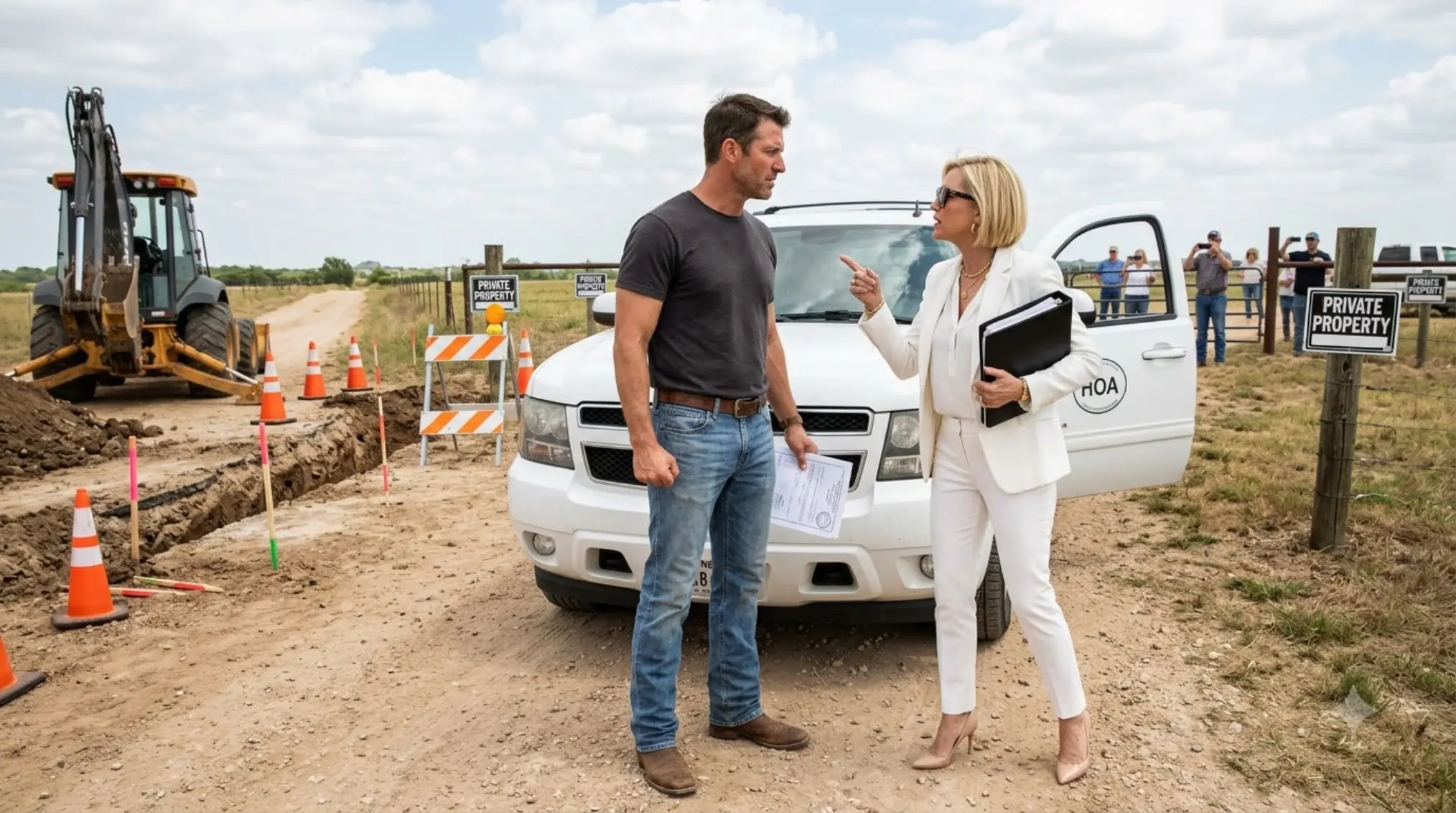
Heavy summer rain had started washing soil from a low section near the cattle crossing. Brandon had planned drainage work there for months, and after speaking with an agricultural contractor, he scheduled an open drainage excavation across part of the lane. The work zone was marked properly with reflective barriers, orange cones, survey stakes, and warning signs.
The road would remain closed temporarily.
That was entirely normal for a private working ranch.
Clare treated it like a personal attack.
She drove to the barricade on the first morning of construction and stopped her SUV thirty feet away. Brandon was standing beside a backhoe reviewing measurements when she climbed out wearing her white blazer and carrying the black binder. Her heels sank slightly into the loose soil.
“What is this?”
“Drainage work.”
“You’re blocking the HOA access route.”
Brandon turned toward her.
“There is no HOA access route.”
“You know residents use this road.”
“Without permission.”
“You cannot just close it.”
“It’s mine.”
Clare slammed the SUV door.
“The board voted.”
Brandon laughed.
“Your board can vote all night.”
He reached into his truck and removed the laminated 1976 agreement.
“This county record says your HOA has zero access to my land.”
Her face reddened.
“You think that paper makes you untouchable?”
“No.”
Brandon pointed toward the barricades.
“The deed does a pretty good job too.”
Clare stepped closer.
“Move those barriers.”
“No.”
“Keep fighting me and I’ll bury this ranch in fines, lawyers, and violations until you beg me for a road.”
Several Whispering Pines residents had gathered behind the distant gate. Phones were coming out.
Brandon raised the document.
“Go ahead, Clare. File everything, because the next meeting happens in court, and this paper gets the final vote.”
Clare realized they were being recorded.
Her tone changed immediately.
“You’re threatening the community.”
“No. I’m telling you to stay off my ranch.”
She left furious.
The next morning, Brandon received an HOA “environmental violation” demanding one hundred dollars per day until the drainage work was removed.
Mara laughed when she saw it.
“They’re fining someone outside their jurisdiction?”
“Apparently.”
“Excellent.”
Brandon looked confused.
“Excellent?”
“Every letter makes our argument easier.”
She drafted a formal cease-and-desist notice demanding that Whispering Pines stop entering Brandon’s property, stop issuing fraudulent fines, withdraw its access claim, and compensate him for damaged signs and fencing. The letter attached the 1976 agreement and warned that future trespass would be documented for civil proceedings.
The HOA refused.
Clare’s written response called the historical easement “obsolete paperwork” and insisted modern community needs outweighed the original restriction.
Mara filed suit.
The complaint was not dramatic.
No wild accusations.
No speeches.
Just documents.
Deed.
Survey.
1976 agreement.
Photographs.
Broken sign.
HOA letters.
Vehicle records.
Repair receipts.
The association countersued, claiming it had established access through repeated use and that Brandon’s closure created safety problems for the subdivision.
Mara read the filing.
“They have their own public entrance.”
“Yes.”
“Fire department uses it?”
“Yes.”
“Ambulances?”
“Yes.”
“Garbage?”
“Yes.”
She closed the folder.
“Then their safety argument is convenience wearing a costume.”
Discovery created problems for Clare almost immediately.
Emails showed that HOA board members had repeatedly warned her that Brandon was not part of Whispering Pines.
One director wrote:
We cannot fine Rogers because he is outside the association.
Clare answered:
Pressure still works even if collection is complicated.
Another email addressed the 1976 agreement.
The HOA’s management company had discovered it months earlier.
A property manager emailed Clare:
Recorded restriction appears to prohibit access through Rogers Ranch. Recommend counsel review before further action.
Clare responded:
If we use the road consistently, practical access becomes harder for him to challenge. Keep this internal for now.
Brandon stared at the email when Mara showed it to him.
“She knew.”
“Apparently.”
“And kept driving across anyway.”
“Yes.”
Mara tapped the paper.
“That matters.”
The board began collapsing around Clare.
Treasurer Howard Bennett had never seen the emails.
Neither had two directors.
They believed Clare had received legal confirmation that the HOA could pursue an easement.
At an emergency meeting, Howard confronted her.
“You told us county counsel agreed.”
“I said we had a legal position.”
“That is not what you said.”
Clare folded her arms.
“We need to protect community interests.”
A resident shouted:
“By taking somebody else’s ranch road?”
Another asked why the HOA had spent nearly $38,000 on legal fees pursuing access when its existing road worked perfectly.
Clare insisted the shortcut would increase property values.
A retired engineer stood from the second row.
“By twelve minutes?”
The room erupted.
Clare slammed the gavel.
Brandon attended quietly with Mara.
He was surprised by how many Whispering Pines residents approached during recess to apologize.
“We didn’t know.”
“She told us the ranch road was already part of an old easement.”
“We thought you were blocking something legal.”
Brandon gave everyone the same answer.
“I’m not angry at residents for believing their board.”
Then he added:
“But boards need records too.”
The case reached county court six months after the first broken sign.
Judge Helen Carver reviewed the historical agreement before either side gave opening statements. She asked the HOA attorney whether the association disputed authenticity.
“No, Your Honor.”
“Whether it remains recorded?”
“No.”
“Whether a superseding easement exists?”
The attorney hesitated.
“No.”
Judge Carver leaned back.
“Then explain why we are here.”
The attorney argued changed circumstances, long-term use, community necessity, and implied access.
Mara responded with maps.
Whispering Pines had a functioning public entrance built specifically to satisfy the 1976 development requirement.
The subdivision had never been landlocked.
No emergency required Brandon’s road.
The HOA simply preferred it because it shortened trips toward Fort Worth.
Then came Clare’s emails.
Judge Carver read them silently.
The courtroom became uncomfortable.
Finally she looked toward Clare.
“You were advised that the recorded restriction might prohibit this access?”
Clare shifted.
“I was advised there could be an interpretation issue.”
The judge looked at the email again.
“It says, ‘appears to prohibit access.’”
Clare said nothing.
“And after receiving that warning, you encouraged continued use?”
“I was protecting residents.”
“By creating the very pattern of use you hoped to rely upon later?”
Silence.
Judge Carver’s expression hardened.
“That is not how property rights work.”
The ruling came that afternoon.
Brandon owned the road.
Whispering Pines had no easement over it.
The 1976 restriction remained enforceable.
The HOA was permanently prohibited from entering, modifying, designating, advertising, or treating Brandon’s ranch road as community access.
Every purported fine issued against Brandon was declared unenforceable.
The HOA also had to compensate him for documented property damage and contribute toward legal costs.
Clare remained motionless.
Then Judge Carver addressed her directly.
“An HOA board governs property subject to its covenants. It does not become a municipal government simply because its officers prefer a wider jurisdiction.”
Brandon almost smiled.
The sentence spread throughout Whispering Pines before he reached the parking lot.
Within two weeks, Clare resigned as president.
The board replaced her with Howard Bennett, who began his first meeting by placing a county map on the projector.
A thick red line marked Whispering Pines.
Brandon’s ranch sat clearly outside it.
Howard pointed toward the line.
“Our authority stops here.”
Nobody argued.
The subdivision completed improvements to its original public road instead. The board added a second turning lane, better lighting, and new directional signs. The project cost less than the legal dispute had already consumed.
Brandon finished the drainage work on his ranch road.
The excavation was properly graded, reinforced, and converted into a safe culvert crossing designed to handle stormwater without washing out the lane. New gravel went down afterward, and the road looked better than it had before the dispute.
At the entrance, Brandon installed a new steel sign.
ROGERS RANCH
PRIVATE PROPERTY
NO THROUGH ACCESS
Beneath it he added a smaller plaque.
COUNTY RECORDS AVAILABLE UPON REQUEST.
His friend Derek laughed when he saw it.
“You’re getting soft.”
“Why?”
“No threats.”
Brandon smiled.
“Paperwork worked better.”
Months passed.
Traffic disappeared.
Morning returned to cattle, birds, gravel, and the occasional feed truck Brandon actually expected.
One evening, he sat on the porch watching the sun fall behind the pasture when a vehicle stopped at the front gate.
It was Howard.
Brandon walked down.
The new HOA president stayed outside the fence.
That small gesture mattered.
“Evening,” Howard said.
“What can I do for you?”
“I wanted to tell you the new roadwork is finished.”
“I saw.”
Howard nodded.
“And apologize again.”
“You already did.”
“Not officially.”
He handed Brandon an envelope.
Inside was a formal letter signed by every current Whispering Pines director acknowledging the ranch road as private property and apologizing for the previous board’s conduct.
Brandon read it.
“No smiley face.”
Howard laughed.
“We debated adding one.”
“Good decision.”
Howard looked down the long dirt road.
“You know what bothers me most?”
“What?”
“All of this was unnecessary.”
Brandon nodded.
“That’s usually the expensive part.”
They shook hands through the gate.
Howard drove away using the subdivision’s actual entrance.
Brandon remained beside the fence for several minutes.
Fifteen years earlier, he had built that road because he needed dependable access between his barn and the highway. He had graded it in summer heat, repaired it after storms, cleared fallen branches, and rebuilt washed-out sections with his own tractor.
To Clare, it had looked like unused convenience.
To Brandon, it was something else.
It was labor made physical.
Ownership made visible.
And a boundary worth defending precisely because someone else had decided it was too small to matter.
The HOA had votes.
Binders.
Letters.
Lawyers.
Luxury SUVs.
Brandon had one old county document signed almost half a century earlier.
In the end, that faded 1976 easement agreement carried more authority than every board vote Clare Phillips ever called.
Because no matter how confidently somebody declares another person’s land “community property,” ownership does not change by applause.
And Brandon Rogers never had to surrender an inch of road to prove it.