The arrogant HOA Woman stared at the silver badge as though it were another object she could dismiss by raising her voice. Her manicured finger remained inches from the Sheriff Deputy’s dusty gray work shirt, but the confidence behind it had begun to crack. Beside them, the stolen green tractor stood beneath the stone sign marking the Lakeside Ridge HOA maintenance area, its tires coated with fresh mud and crushed wildflowers. Her eighteen-year-old Son stopped leaning against the rear wheel and pulled the hood of his expensive Gucci sweatshirt farther over his head.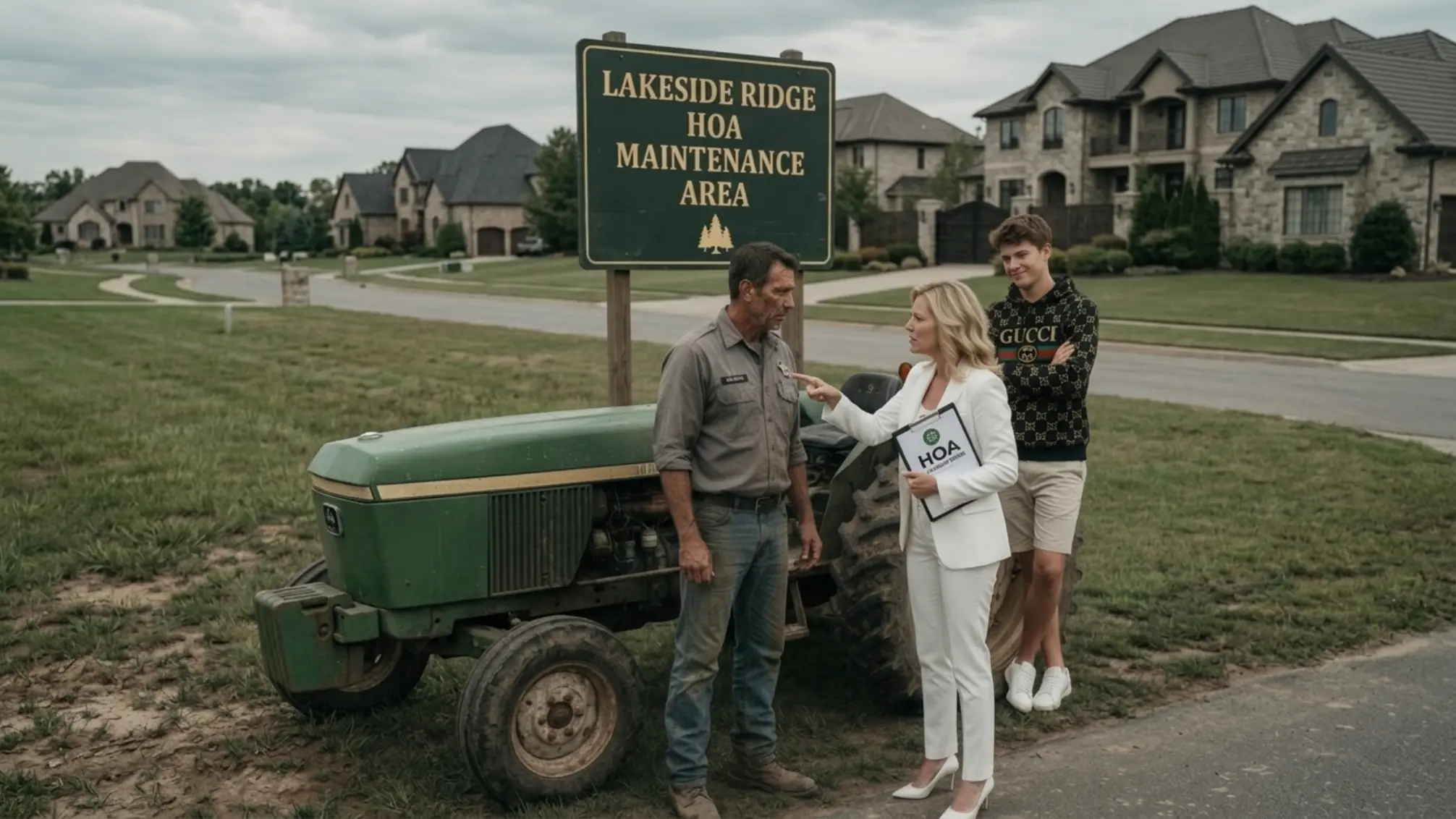
The Sheriff Deputy had not arrived wearing a uniform because he had not expected to make an arrest that afternoon. He had spent the morning repairing fencing along the twenty-two acres he inherited from his father, land that bordered the polished subdivision but had never belonged to it. At forty-eight, he still worked the property himself whenever his duty schedule allowed, wearing old jeans, work boots, and shirts stained with grease and soil. To the HOA Woman, those clothes made him a powerless farmer she could threaten in front of her Son.
Less than an hour earlier, the Sheriff Deputy had walked out of his equipment barn and discovered an empty space where his tractor should have been. The chain across the access gate had been cut, the ignition compartment showed scratches, and deep tire tracks led toward the subdivision. He followed them on foot before calling anyone because he knew exactly where the tractor had gone. For three weeks, the HOA Woman had been demanding that he allow her association to widen a private maintenance road across his property.
He had refused every request.
The land she wanted was not a neglected strip beside the neighborhood. It contained a natural drainage channel that carried stormwater away from his fields and several older homes farther downhill. Paving over it would redirect water toward those homes, but it would also give the subdivision access to a planned luxury clubhouse near the lake. The HOA Woman saw a shorter road and higher property values; the Sheriff Deputy saw flooded basements, damaged crops, and a construction project crossing land she did not own.
Her first letter called the road expansion a “community improvement.”
Her second called his refusal “antisocial obstruction.”
The third threatened fines, although his property was legally outside the association.
That morning, her Son apparently decided the dispute could be solved by taking the tractor and beginning the work himself. He used it to pull two boundary posts from the ground and scrape away vegetation along the disputed path. Then he drove the machine into the HOA maintenance lot, posed beside it for photographs, and told several friends that the association had confiscated equipment from a stubborn farmer.
The Sheriff Deputy found him still celebrating.
“You can’t arrest anybody,” the Son said, forcing a laugh. “You’re off duty.”
The Sheriff Deputy looked toward the deep scratches across the tractor’s side panel. “The law doesn’t switch off because my uniform is hanging at home.”
“My mother authorized me to move it.”
“Your mother doesn’t own it.”
The HOA Woman stepped between them. She was a beautiful forty-five-year-old white American woman with carefully styled blonde hair, fair skin, and the rigid posture of someone accustomed to controlling every conversation. Her all-white outfit—a tailored blazer, silk blouse, fitted trousers, and pointed designer heels—looked completely out of place beside the muddy tractor. She held an HOA clipboard against her chest like a symbol of government authority.
“The machine was abandoned beside a community access route,” she declared. “Our maintenance department had every right to remove it.”
“It was locked inside my barn.”
“Your barn obstructs the route.”
“The route ends at my property line.”
“That boundary is under review.”
The Sheriff Deputy’s eyes moved toward the empty holes where his survey markers had stood. “Is that why your son tore out the markers?”
The Son glanced at his mother.
She answered too quickly. “Those posts were incorrectly placed.”
“By a licensed county surveyor?”
“Surveyors make mistakes.”
“So you corrected the county map with a stolen tractor?”
Several Lakeside Ridge residents had gathered along the sidewalk. The subdivision consisted of nearly identical two-story homes, manicured lawns, trimmed shrubs, and carefully approved porch decorations. Most residents had seen the HOA Woman confront people over garbage cans, garden ornaments, and parking positions, but they had never watched anyone speak back to her without fear.
A retired American teacher stood near the stone sign with one hand covering her mouth. A young couple recorded from their front lawn, while a middle-aged homeowner folded his arms and watched the HOA Woman’s Son shift nervously beside the tractor. No one stepped away when she ordered them to return indoors.
“This is official HOA business,” she shouted.
The Sheriff Deputy turned toward the residents. “Did anyone see him drive the tractor here?”
Three hands rose.
The Son’s face reddened. “They don’t know where it came from.”
The retired teacher spoke first. “I watched you come through the service entrance. You nearly hit my mailbox.”
“That’s not true.”
“My doorbell camera faces the road.”
The young couple held up a phone. They had recorded the Son circling the maintenance lot while laughing and attempting to perform sharp turns in the heavy machine. In the video, the tractor carried a broken chain across its front attachment. The Son could also be heard boasting that his mother had finally taken control of the farmer’s land.
The HOA Woman moved toward the couple. “Delete that immediately. Recording inside a private community violates association policy.”
The Sheriff Deputy stepped into her path. “Do not threaten witnesses.”
“They are my residents.”
“They are not your property.”
Her eyes narrowed behind the sunglasses resting on top of her head. “You think that badge frightens me?”
“No.”
“My husband knows the County Commissioner. The Board Treasurer plays golf with the Sheriff. Half your department lives in communities managed by my company.”
“That still doesn’t make the tractor yours.”
“You could lose your job before dinner.”
The Sheriff Deputy had heard threats during arrests, traffic stops, domestic disputes, and courthouse transports. Most came from frightened people reaching for any piece of power they imagined could protect them. The HOA Woman spoke differently. She believed connections were not merely protection but ownership over everyone around her.
He removed his phone and called dispatch.
“This is an off-duty property-crime report,” he said. “Stolen agricultural equipment recovered at Lakeside Ridge. Suspects are present. Request an on-duty unit and supervisor.”
The HOA Woman laughed. “You are reporting your own personal dispute to your friends?”
“I’m creating a record.”
“I’ll create one too.”
She called emergency services and claimed an armed man was threatening her child. Her voice changed instantly, becoming trembling and breathless. She described the Sheriff Deputy as aggressive, unstable, and possibly intoxicated, never mentioning that he had identified himself as law enforcement.
The residents listening nearby reacted with disbelief.
The Sheriff Deputy kept both hands visible. “Tell the dispatcher I’m an off-duty deputy and my badge number is on display.”
She turned away from him. “He’s claiming to be an officer, but I cannot verify that.”
The young couple continued recording.
Within minutes, two marked patrol vehicles entered the subdivision, followed by a supervisor’s SUV. The responding officers stopped several yards away and approached cautiously because the emergency report described a possible weapon. The Sheriff Deputy placed his badge and identification on the tractor seat, then moved back without argument.
The senior officer recognized him immediately.
“What happened?”
The HOA Woman rushed forward. “Thank goodness. This man attacked us after my Son moved abandoned equipment away from an HOA maintenance route.”
The Sheriff Deputy remained silent until the officer finished listening.
Then he described the cut chain, missing tractor, tire marks, damaged survey posts, and discovery of the machine in the HOA lot. He provided his registration documents through a secure county database and asked the responding officers to handle the case because he was personally involved.
The senior officer examined the tractor’s identification number.
“It belongs to him,” she said.
The HOA Woman lifted her clipboard. “The HOA possesses emergency authority over vehicles obstructing common property.”
“Was it on common property when your Son took it?”
“It was near a disputed access route.”
“That means no.”
The Son attempted to slip away while the adults spoke. A younger patrol officer noticed and called him back. The teenager froze near the sidewalk, hands buried inside the pocket of his Gucci hoodie.
“Where are the tractor keys?” the officer asked.
“I don’t have them.”
“How did you start it?”
“It was already running.”
The Sheriff Deputy’s expression hardened. “It was locked inside a closed barn with the key stored in my house.”
The officer repeated the question.
The Son looked toward his mother.
She spoke for him. “He found an emergency ignition tool in the maintenance shed.”
The officer turned. “An ignition tool designed for this tractor?”
“It was part of the community equipment.”
The Sheriff Deputy walked to the maintenance shed and pointed through its open door. On a workbench rested a set of lock picks, a cut section of chain, bolt cutters, and a portable programming device used to bypass older agricultural ignition systems.
The responding officers exchanged looks.
The HOA Woman stepped backward. “Those are standard maintenance tools.”
“For breaking into barns?” the Sheriff Deputy asked.
The senior officer requested permission from the HOA’s property manager to secure the shed while obtaining a search warrant. The HOA Woman objected, insisting she alone controlled access. Her protest only intensified when the officer photographed the tools from outside without touching them.
The retired teacher approached the Sheriff Deputy carefully.
“This isn’t the first machine they’ve taken,” she said.
The HOA Woman spun toward her. “Do not start spreading lies.”
The teacher ignored her. Two months earlier, her late husband’s riding mower had disappeared from a locked backyard shed. The HOA claimed it had been removed because its engine violated neighborhood noise limits, although she had not used it since her husband died.
The mower was never returned.
Another resident stepped forward and reported a pressure washer taken after he refused to pay a landscaping fine. A third said the association confiscated expensive tools from his open garage during an inspection. Each time, the HOA Woman called the equipment abandoned and transferred it to the maintenance department.
The Sheriff Deputy listened as a pattern formed around the tractor.
The Son appeared increasingly frightened. “Mom said those things became HOA property after violations.”
The HOA Woman grabbed his arm. “Stop talking.”
He pulled away. “You told me the board approved it.”
“The board did approve it.”
A man standing beside the stone sign shook his head. He was the HOA Board Treasurer, a quiet fifty-six-year-old American accountant who had watched the confrontation from across the road. He held up both hands before approaching.
“The board never voted to seize personal equipment,” he said.
The HOA Woman’s face tightened. “You signed the maintenance authorization.”
“I signed a budget for storing abandoned items left in common areas.”
“These were abandoned.”
“Inside locked garages?”
The Treasurer looked toward the patrol officers. He explained that the HOA Woman controlled most enforcement notices and often presented completed decisions to the board after claiming urgent action was required. He had questioned unusually high equipment resale income listed under “maintenance recovery,” but she told him it came from scrap metal.
The senior officer asked where those records were stored.
The Treasurer pointed toward the clubhouse.
The HOA Woman attempted to leave.
This time, the Sheriff Deputy did not stop her. The on-duty officer stepped into her path and instructed her to remain available during the investigation. She accused the department of harassment and demanded to speak directly with the Sheriff.
The supervisor contacted him.
The Sheriff arrived twenty minutes later, accompanied by a county property-crimes investigator. He was an experienced sixty-year-old Black American man who had led the department for more than a decade. He greeted the off-duty Deputy professionally but did not offer special treatment.
“You are the complainant,” the Sheriff said. “You will provide a statement like anyone else.”
“That is what I want.”
The HOA Woman looked relieved, believing the arrival of a higher-ranking official would give her another opportunity. She described her relationship with the County Commissioner, referenced community donations to sheriff programs, and warned that arresting her Son would create public outrage.
The Sheriff listened without interruption.
When she finished, he asked one question.
“Did your Son have the owner’s permission to enter that barn and take the tractor?”
“The ownership boundaries are disputed.”
“That is not an answer.”
“The HOA had authority.”
“Show me the court order.”
She opened her clipboard but produced only violation notices signed by herself.
The Sheriff turned toward the investigator. “Proceed.”
The Son was detained for questioning, but the officers did not immediately place him in handcuffs. Because he was eighteen, he was legally an adult, yet the Sheriff wanted investigators to determine whether he understood the equipment-seizure operation or merely followed his mother’s instructions.
The tractor theft alone remained clear.
The Son admitted cutting the chain after his mother gave him the bolt cutters. He claimed she told him the HOA had already obtained legal ownership of the machine. She also promised he could use the tractor for social-media videos before it was sold.
The HOA Woman shouted that he was confused.
The Son began crying. “You told me nobody could touch us.”
The words spread through the crowd.
The county investigator secured a warrant for the maintenance shed and clubhouse records. Inside the shed, officers found the retired teacher’s riding mower beneath a tarp. Its serial number had been partially removed.
They also found chainsaws, generators, power tools, bicycles, and lawn equipment matching property reported missing by residents. Some items carried new labels identifying them as Lakeside Ridge maintenance assets. Others had photographs attached for online auction listings.
The tractor had not been taken only to intimidate the Sheriff Deputy.
It was valuable inventory.
The HOA Woman had used neighborhood rules to identify equipment she wanted, issue impossible fines, and claim the property when residents failed to pay. Her Son photographed the items, created online listings, and helped transport them to a warehouse owned by a company registered in another county.
The widening of the maintenance road hid an even larger plan.
Records inside the clubhouse revealed that the HOA Woman had negotiated secretly with a luxury developer to sell the association’s wooded common area for townhouses. The developer required a construction entrance across the Sheriff Deputy’s land.
She could not complete the sale without access.
Instead of negotiating honestly, she attempted to erase the property boundary, create a road with his stolen tractor, and later claim the path had existed for years. Photographs taken by her Son were intended to serve as false evidence that the HOA routinely maintained it.
The Sheriff Deputy felt a colder anger than he had experienced over the tractor.
The drainage channel along the proposed road protected several houses during heavy rain. Paving it without engineering review could flood lower streets and damage the homes of the same residents whose association fees paid the HOA Woman’s salary.
She had risked their property to complete a private deal.
The investigator found draft documents promising her a consulting payment after the land sale. The amount exceeded two hundred thousand dollars.
The Board Treasurer stared at the contract. “She told us the developer offered nothing.”
The HOA Woman attempted to dismiss it as an early proposal.
Then the investigator displayed an electronic transfer of twenty-five thousand dollars into a company controlled by her sister. It was labeled as an advance advisory payment.
The Sheriff stepped toward her.
“You are being detained while we continue this investigation.”
She raised her chin. “You do not have enough evidence to arrest me.”
The Sheriff looked toward the stolen tractor, removed survey posts, recovered equipment, cut chain, false emergency call, and hidden developer contract.
“We have more than enough.”
An officer turned her around and placed her in handcuffs.
The woman who had ordered residents to obey instantly began screaming that the cuffs were too tight. She demanded her attorney, threatened the Sheriff’s budget, and claimed the entire neighborhood had conspired against her. Her polished white blazer wrinkled as officers guided her toward the patrol vehicle.
Her Son watched with a pale face.
“Am I going too?” he asked.
The property-crimes investigator answered honestly. “You stole the tractor and damaged property. What happens next depends on whether you keep telling the truth.”
The Son lowered his head.
He admitted helping move equipment on six occasions. He claimed his mother told him every item had been legally seized. He knew some owners objected, but he believed the association’s authority protected him.
He had grown up watching adults retreat whenever his mother raised her voice.
The tractor was the first object whose owner refused to retreat.
The Son was arrested for theft, burglary, and property damage, but the prosecutor later considered his immediate cooperation and limited role in the larger financial scheme. The Gucci hoodie, expensive shoes, and electronics he received from the equipment sales were seized as potential proceeds.
Without them, he looked younger.
The HOA Woman spent the night in county custody while investigators searched the warehouse named in the records. They recovered more than sixty stolen items from Lakeside Ridge and two other communities managed by her private consulting company.
Some belonged to residents who never realized the HOA had taken them.
A widowed veteran recovered a generator he believed neighborhood thieves stole during a hospital stay. A young mechanic received tools taken after he argued about parking rules. The retired teacher cried when officers returned her husband’s mower.
“It isn’t worth much,” she said.
The Sheriff Deputy helped guide it into her garage. “That was never the point.”
The tractor required repairs.
The Son had damaged the ignition, bent a steering component, and scratched the body while striking one of the survey posts. The association’s insurance initially refused responsibility because the theft was intentional.
The Board Treasurer called an emergency meeting.
Residents filled the clubhouse, but the atmosphere differed from every meeting the HOA Woman had controlled. No one sat silently waiting to be fined. People brought folders, photographs, and records of threatening messages.
The Treasurer stood before them and apologized.
“I signed documents without reading closely enough because I believed disagreement would create conflict,” he said. “My silence allowed greater conflict.”
The board voted to suspend every enforcement action issued during the HOA Woman’s presidency. An independent attorney reviewed the fines, equipment removals, contracts, and proposed land sale.
More than seventy percent of the penalties were invalid.
Families received refunds. Liens were withdrawn, and foreclosure threats were canceled. The board ended its contract with the HOA Woman’s management company and hired an outside administrator through a transparent bidding process.
The land sale was rejected unanimously.
The Sheriff Deputy attended only to discuss the disputed road. He displayed the county survey and an engineer’s stormwater report showing that the drainage channel could not safely be paved.
Residents who had once assumed he was blocking progress now understood he had been protecting their homes.
A young father stood. “Would you consider allowing a walking path instead?”
The Sheriff Deputy reviewed the proposal with an engineer. A narrow raised boardwalk could cross part of the land without damaging drainage or transferring ownership. The HOA would cover construction, insurance, and maintenance.
He agreed under a limited easement.
The decision surprised residents who expected anger to make him reject every request. He had no desire to punish an entire neighborhood for one woman’s corruption.
He only required honesty.
The criminal case took almost a year.
The HOA Woman faced charges involving theft, fraud, false statements, property damage, obstruction, and filing a false emergency report. Prosecutors also pursued financial crimes connected to the developer payment and sales of confiscated equipment.
Her defense argued that association bylaws were complicated and she believed she had authority.
The evidence destroyed that claim.
Messages to her Son instructed him to enter properties while residents were at work. She described one elderly homeowner as “too frightened to fight.” In another exchange, she told the developer that removing the Sheriff Deputy’s boundary markers would make the access route “look established enough to survive a challenge.”
She knew exactly where her authority ended.
She simply expected no one to stop her.
The Son pleaded guilty to reduced charges after testifying truthfully. The court sentenced him to probation, restitution, community service, and mandatory vocational training. He was also prohibited from working in property management during the probation period.
His mother considered his cooperation betrayal.
He considered it the first decision she had not made for him.
Several months after the case, the Son appeared at the Sheriff Deputy’s farm wearing plain work clothes. He stood outside the repaired equipment barn and waited until invited closer.
“I came to apologize.”
The Sheriff Deputy examined him carefully. “The court ordered that?”
“No. The court ordered restitution.”
“Then speak.”
The Son admitted he had enjoyed frightening residents. He liked wearing expensive clothes purchased with money he had not earned and believed his mother’s connections made consequences impossible.
“When you showed the badge, I thought you were just trying to scare us.”
“I wasn’t.”
“I know.”
“You would still have stolen from a farmer without a badge.”
The Son looked toward the ground. “Yes.”
“That is the part you need to understand.”
The Sheriff Deputy did not forgive him immediately or offer friendship. He directed him toward a damaged section of fence and explained that restitution included replacing the posts removed by the tractor.
The Son worked for six hours.
His hands blistered because he had never used a post driver correctly. The Sheriff Deputy showed him the technique but did not complete the task for him. By sunset, the boundary stood again.
“Does this make us even?” the Son asked.
“No.”
The answer surprised him.
“It begins repayment,” the Sheriff Deputy continued. “Being even takes longer than one hard day.”
The Son returned the following weekend.
Over several months, he helped repair the barn door, repaint the tractor, and restore the drainage channel damaged during the attempted road construction. He began attending a community college mechanics program and earned money through legitimate work.
The Sheriff Deputy never allowed him to forget the theft.
He also did not define him forever by it.
The HOA Woman received a prison sentence, restitution order, and permanent prohibition from managing residential associations. Assets purchased through the equipment sales were seized, including luxury clothing, jewelry, and a vehicle registered through her consulting company.
At sentencing, she blamed the Sheriff Deputy for humiliating her.
He addressed the court only once.
“I did not make her enter my barn, steal my tractor, erase my boundary, or sell her neighbors’ belongings. I only refused to pretend those actions became legal because she wore a blazer and carried a clipboard.”
The judge agreed.
One year after the confrontation, Lakeside Ridge placed a new sign beside the maintenance area. The stone monument remained, but a smaller plaque had been added beneath it.
Community property begins where private ownership ends. Respect both.
The restored tractor stood nearby during the neighborhood’s annual summer gathering. Children climbed onto it only after receiving permission, while residents displayed returned tools and equipment as part of a community property-registration program.
The Sheriff Deputy attended in clean jeans and a plain shirt.
He carried no visible badge.
The retired teacher brought him lemonade, and the Board Treasurer thanked him for approving the raised walking path. Families now used it to reach the lake without crossing the drainage channel or entering his working fields.
The former HOA Woman believed the tractor represented control.
Her Son believed taking it would prove that their family was untouchable.
Instead, the machine led investigators from a cut chain to a stolen-property warehouse, a fraudulent land deal, and years of intimidation hidden behind community rules.
The Sheriff Deputy did not expose them because he was more powerful.
He exposed them because ownership, evidence, and law still mattered even when the victim looked like an ordinary farmer.
When the HOA Woman pointed at his dirty shirt, she believed she was confronting the weakest man near her maintenance lot.
She discovered too late that the “dirty farmer” understood property law, preserved evidence, and carried the authority to arrest the people who had mistaken fear for permission.