At 4:36 on a bright Tuesday afternoon, Marcus Reed stepped into his driveway wearing a gray T-shirt, black lounge pants, and house slippers—and found his HOA president halfway up a ladder, spraying red paint across his solar panels.
Vivian Harrow wore an immaculate white blazer, white blouse, and tailored white pants as though she had dressed for a charity luncheon rather than a felony. Her sculpted blonde hair barely moved in the breeze, oversized sunglasses covered half her face, and pearl earrings gleamed while she finished the final letter. Across the black glass panels, dripping red paint formed two enormous words:
DIRT MAN.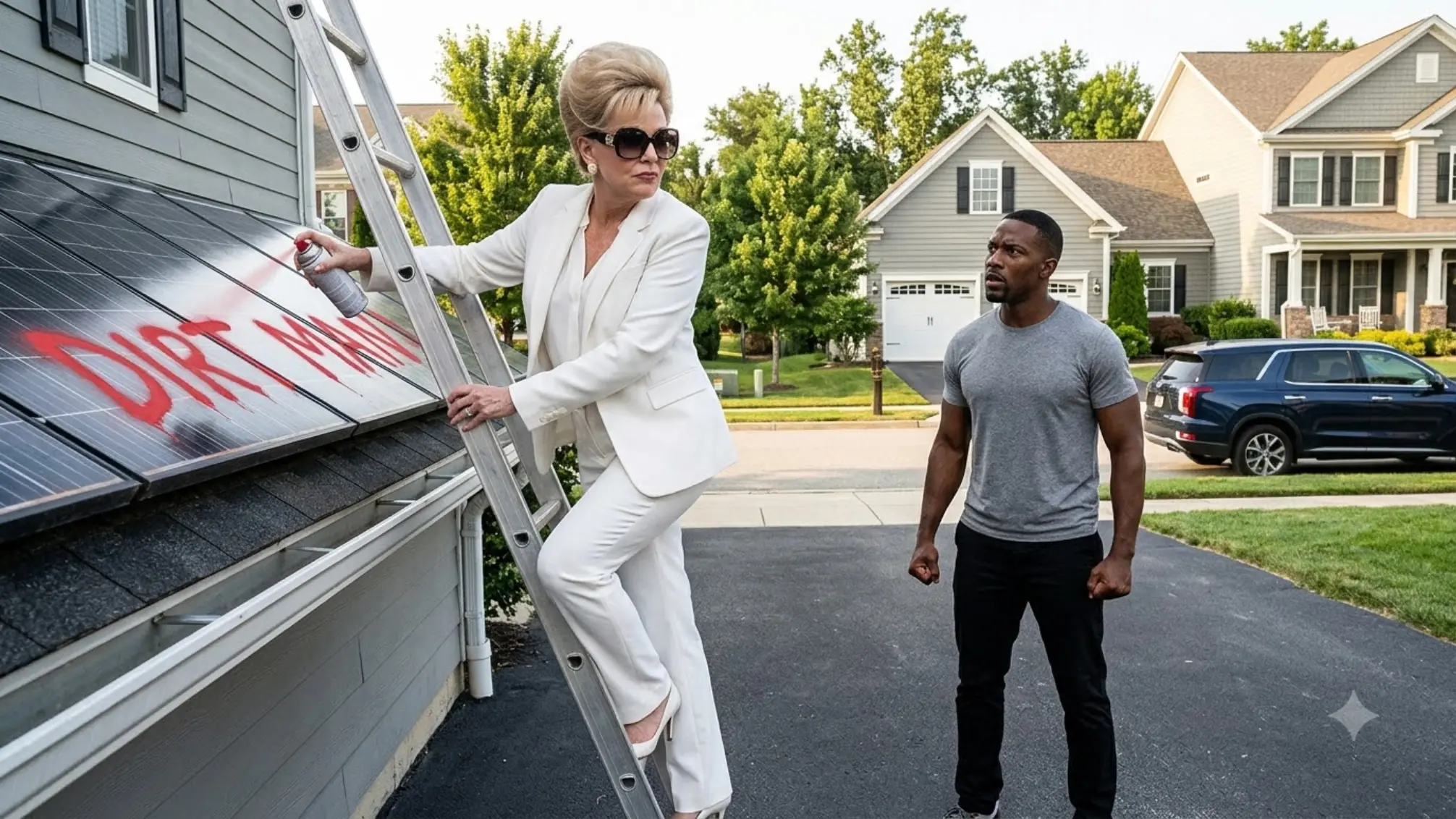
Marcus stopped beneath the ladder.
Black Homeowner (furious, stepping toward the ladder): “Get off my roof and drop that can right now.”
HOA President (mocking, spraying the last letter): “Then stop acting like this street belongs to some dirt man stealing our sunshine.”
Black Homeowner (coldly, pointing at the panels): “You vandalized my property in daylight—when police pull the footage, you’re finished.”
HOA President (smirking, climbing down one step): “Then watch it fast—because what’s buried in those permits blows this neighborhood open.”
Marcus stared at her.
The last line did not sound like ordinary arrogance. It sounded rehearsed, almost like she wanted him to discover something but believed she could control what happened afterward. Before he could question her, Vivian descended another rung and extended the spray can toward him as if daring him to take it.
Marcus did not move.
“You climbed onto my house,” he said.
“The panels violate community standards.”
“The association approved them.”
“That approval is under review.”
“By whom?”
“The board.”
“I am on the board mailing list. No review was announced.”
Vivian stepped onto the driveway and adjusted the sleeve of her blazer. “You receive the notices the association decides you need.”
Marcus looked toward the camera mounted above his garage. Its indicator light remained active. A second camera under the roofline recorded the ladder, Vivian’s arrival, and every drop of paint she had sprayed.
She followed his eyes.
Her smile faded.
“You cannot record people without consent.”
“You entered my property.”
“This exterior is visible from the street.”
“You crossed the driveway, unlocked my side gate, carried a ladder against my wall, and climbed onto my roof.”
“I acted under HOA enforcement authority.”
Marcus pulled out his phone. “Show me the section authorizing property damage.”
Vivian’s voice sharpened. “You think your money makes you untouchable.”
“No. My deed makes this house mine.”
“You bought into a community.”
“I did not buy a dictatorship.”
Vivian turned toward the sidewalk, where two neighbors had stopped walking their dogs. Marcus recognized one of them as Helen Price, an elderly widow who lived three houses away. Helen stared at the red letters with both hands covering her mouth.
Vivian raised her voice so the witnesses could hear.
“This homeowner installed unauthorized industrial equipment, refused inspection, and endangered property values.”
Marcus looked up at the professionally installed solar array. The panels followed the roofline, could not be seen from the front street without stepping onto his driveway, and had passed city inspection nine months earlier.
“They are residential solar panels,” he said.
“They reflect heat toward neighboring homes.”
“That is not how they work.”
“You are not an environmental engineer.”
Marcus almost laughed.
He was the founder and chief executive of Reed Grid Solutions, one of the largest privately held renewable-energy infrastructure companies in the United States. His company developed battery systems, solar controls, and emergency power networks for hospitals, schools, and municipal buildings.
His own rooftop system was simpler than most installations his company designed.
Vivian knew his occupation.
She simply believed insulting him publicly gave her greater authority than facts.
Marcus called the police.
Vivian folded her arms.
“You will regret making this official.”
“You made it official when you brought paint.”
“I warned you.”
“You sent fines without legal citations.”
“You refused to pay them.”
“Because they were fraudulent.”
Her expression changed for less than a second.
Marcus noticed.
The first patrol car arrived seven minutes later. Officer Daniel Ruiz stepped out, followed by Officer Amanda Cole. Both American officers wore body cameras, and Marcus immediately pointed toward his security cameras and the spray can resting near the ladder.
Vivian approached them first.
“This man became aggressive while I performed a lawful compliance inspection.”
Officer Cole looked at the roof.
“Did the inspection require spray paint?”
Vivian removed her sunglasses. “The markings identify noncompliant equipment for removal.”
Marcus stared at her. “You wrote ‘DIRT MAN.’”
“The contractor needs visible identification.”
Officer Ruiz looked toward the dripping letters. “That does not appear to be a contractor code.”
Vivian’s mouth tightened.
Marcus opened his camera application and showed the recording. The video captured Vivian arriving alone in a white SUV, removing the ladder from her trunk, entering through the unlocked side gate, and carrying two red spray cans toward the roof.
She did not knock.
She did not post a notice.
She did not inspect anything.
She climbed directly to the panels and began painting.
Officer Cole watched the footage twice.
“Mrs. Harrow, did the homeowner give you permission to enter?”
“The HOA controls exterior compliance.”
“That is not permission.”
“The declaration grants access for emergencies.”
“What emergency?”
“The panels are connected to an illegal energy system.”
Marcus looked at her. “You know they are approved.”
Vivian pointed toward the meter beside the garage. “That meter is not listed in the community utility agreement.”
“It is a city-approved bidirectional meter.”
“The HOA has an exclusive energy contract.”
“That contract cannot cancel state law or my right to generate power.”
Officer Ruiz raised a hand. “We are not resolving the utility dispute here. We are documenting trespassing and property damage.”
Vivian stepped closer to him. “Do you understand who I am?”
“Yes, ma’am. You identified yourself as the HOA president.”
“I manage three hundred and twelve properties.”
“Today we are discussing one property you entered without permission.”
Marcus almost admired the officer’s restraint.
Vivian did not.
Her face reddened beneath the expensive makeup.
“This neighborhood will collapse if people like him ignore the rules.”
Marcus’s jaw tightened.
“People like me?”
She looked toward the officers and attempted to correct herself.
“Owners who treat community standards as optional.”
Marcus remained silent.
The camera had already preserved the words.
A solar technician arrived while the officers were still taking statements. Marcus had called Reed Grid’s local service supervisor, Jasmine Walker, after discovering the damage. Jasmine climbed the ladder carefully, examined the panels, and photographed the paint.
When she returned to the driveway, her expression was serious.
“The paint contains an industrial bonding additive,” she said. “It may damage the anti-reflective coating.”
Marcus looked at Vivian. “Where did you get industrial marking paint?”
Vivian said nothing.
Jasmine continued. “Two cables also appear partially cut beneath the lower panel.”
Marcus stared at the roof.
“Cut?”
“Not disconnected. Sliced enough to fail under load.”
Officer Cole turned toward Vivian.
“Did you touch the wiring?”
“No.”
“The camera will show whether she did,” Marcus said.
The side-angle recording captured Vivian reaching beneath the lower row before spray-painting the glass. Her hand movement remained partly hidden by the panel, but a small tool glinted between her fingers.
Officer Ruiz collected the spray cans and asked Vivian whether she possessed a knife or wire cutter.
She refused consent to search her handbag.
The officers did not force the issue, but they informed her that investigators might request a warrant after reviewing the footage.
Vivian placed her sunglasses back on.
“This is political retaliation.”
Marcus looked directly at her. “You climbed onto my roof because your scheme depends on killing my solar system.”
The words surprised even him.
He had not planned to say them aloud.
Vivian froze.
Her reaction confirmed the suspicion.
Officer Cole noticed too.
“What scheme?” she asked.
Marcus looked toward the meter, then toward the neighborhood utility cabinet at the corner. For months, he had received unexplained HOA notices claiming his solar production caused accounting irregularities. The association demanded that he disconnect his panels and purchase electricity through SunVale Community Energy, a private supplier selected by Vivian’s board.
Marcus had reviewed the contract and found the rates nearly forty percent above the public utility’s price.
He assumed the board had negotiated badly.
Now he wondered whether the price was the purpose.
“My system records energy flow,” he said. “It has been showing power losses across the community network.”
Vivian turned toward her SUV.
Officer Ruiz stepped between her and the driver’s door.
“You are not detained, but we still need your complete statement.”
“My attorney will provide one.”
She entered the vehicle only after surrendering her identifying information.
Before driving away, she lowered the window and looked at Marcus.
HOA President (coldly, gripping the steering wheel): “Fix those panels, and the next failure burns more than your roof.”
Black Homeowner (fiercely, stepping toward her window): “Threaten my home again, and your entire board goes under with you.”
She accelerated away.
That night, Marcus reviewed nine months of energy data.
His solar panels had produced enough power to reduce his monthly electric bill by almost seventy percent. Yet the HOA repeatedly charged him community-grid adjustment fees, infrastructure recovery costs, and unauthorized generation penalties.
Those fees totaled more than fourteen thousand dollars.
He had challenged them through written appeals.
Vivian denied every appeal personally.
Marcus accessed public utility records and compared his home with six neighbors who had installed solar before Vivian became president. Each had received similar penalties. Three eventually disconnected their systems.
One homeowner sold her house.
Another accepted an expensive SunVale battery package through a contractor recommended by the HOA.
Helen Price answered Marcus’s call after ten that evening.
Her late husband had installed solar panels seven years earlier. After his death, Vivian claimed the system violated updated fire codes and ordered Helen to replace it. Unable to afford the recommended contractor, Helen disconnected the panels and began purchasing energy through SunVale.
Her bills doubled.
“Did the HOA recommend the contractor?” Marcus asked.
“Yes.”
“What company?”
“Harrow Residential Energy.”
Marcus closed his eyes.
Vivian’s last name was Harrow.
“Is it connected to her?”
“She said her brother owned it, but the association had approved the relationship.”
“Did homeowners vote?”
“I do not remember any vote.”
Helen lowered her voice.
“Marcus, she told me I could lose my house if I kept questioning the charges.”
By midnight, Marcus had identified nineteen homes that received solar violations. Fifteen owners removed or disabled their systems. Twelve later signed contracts with Harrow Residential Energy.
The pattern was too consistent to be accidental.
The following morning, Marcus hired forensic accountant Naomi Ellis and property attorney David Chen. They requested five years of HOA financial records, board votes, utility contracts, vendor disclosures, and violation histories.
Vivian refused.
She claimed executive sessions protected the information.
David sent a formal demand citing Arizona condominium and homeowners-association law. The association had ten business days to respond.
Before the deadline expired, the HOA filed a lien against Marcus’s home for unpaid energy penalties.
The amount was $86,400.
Marcus read the notice twice.
Nine months of disputed charges had somehow grown into nearly ninety thousand dollars through fines, legal fees, inspection costs, and emergency remediation assessments.
The lien gave the association authority to begin foreclosure proceedings if the debt remained unpaid.
Vivian was no longer trying to disable his panels.
She was trying to seize his house.
Marcus called an emergency neighborhood meeting.
Vivian scheduled her own meeting for the same evening and told residents that Marcus’s solar equipment had damaged the community grid. She claimed his company used the neighborhood as an unauthorized technology experiment.
Marcus arrived carrying a laptop, printed utility data, and the police report.
More than two hundred residents filled the clubhouse.
Vivian stood at the front wearing an ivory suit and pearls.
She opened the meeting with a prepared speech about safety, community character, and protecting families from reckless owners. Then she displayed photographs of Marcus’s vandalized panels without mentioning who had sprayed them.
“The markings demonstrate the equipment identified for emergency removal,” she said.
Marcus stood.
“They demonstrate the crime you committed.”
The room erupted.
Vivian pointed toward security.
“Remove him.”
The security supervisor did not move.
Marcus connected his laptop to the display.
The video began.
Residents watched Vivian carry the ladder across his driveway. They watched her climb the roof and spray “DIRT MAN” across the panels. They watched her reach beneath the wiring before the system failed.
Several people gasped.
Helen stood in the front row.
“You told us vandals did that.”
Vivian raised her voice. “The footage lacks context.”
Marcus paused the video on the spray can.
“What context turns racial humiliation into code enforcement?”
Vivian looked toward the door.
David Chen stepped beside Marcus and distributed copies of the vendor records Naomi had obtained through state corporate filings.
SunVale Community Energy was owned by a holding company called Desert Crest Utilities.
Desert Crest’s principal investor was Vivian’s husband.
Harrow Residential Energy belonged to her brother.
The law firm collecting HOA penalties employed her son as a partner.
Every violation moved homeowners toward companies connected to Vivian’s family.
Marcus displayed a flowchart.
The association fined solar owners.
Owners disconnected their panels.
SunVale sold them expensive electricity.
Harrow Residential replaced systems at inflated prices.
Those who could not pay received liens collected by Vivian’s son’s firm.
Four homes had entered forced sale proceedings.
A property investment company quietly purchased three.
That company belonged to Vivian’s sister.
The clubhouse became chaotic.
Residents shouted questions from every direction.
Vivian attempted to disconnect the screen.
Marcus stepped between her and the cable.
HOA President (furious, reaching for the laptop): “Turn this off before you destroy property values.”
Black Homeowner (coldly, blocking her hand): “You destroyed families to raise your profits.”
HOA President (threateningly, leaning close): “Walk away now, or that lien takes your house.”
Black Homeowner (fiercely, holding up the audit): “Your forged lien just became the warrant that takes your freedom.”
Police entered through the rear doors.
Officer Cole accompanied two financial-crimes detectives and a representative from the Arizona attorney general’s office. They had obtained a search warrant that afternoon after Naomi connected the vendor network to the vandalism investigation.
Vivian’s confidence collapsed.
She attempted to leave through a side door, but detectives stopped her.
The association treasurer surrendered immediately.
He admitted that Vivian ordered him to create special solar assessments without board approval. She promised him discounted energy service and a share of future management fees.
The search of Vivian’s office uncovered more than residents expected.
Investigators found unsigned lien forms, copied homeowner signatures, altered inspection reports, and lists ranking properties by equity. Homes owned by elderly residents, single parents, and people unlikely to afford legal representation were marked as priority conversion opportunities.
Marcus’s house carried a different notation:
High-value resistance case. Break publicly.
The words “DIRT MAN” had not been random rage.
Vivian wanted the vandalism to humiliate him, frighten other solar owners, and create visual evidence that his equipment had been marked for removal.
She expected Marcus to react angrily.
If he touched her, shouted violently, or damaged HOA property, she planned to portray him as dangerous and use the incident to accelerate the lien.
Instead, he recorded her.
Within three weeks, state regulators froze the HOA’s enforcement authority. SunVale’s exclusive energy contract was suspended. Every solar penalty issued during Vivian’s presidency entered independent review.
Investigators calculated that residents had paid more than $3.2 million in inflated electricity charges, fraudulent inspections, forced upgrades, legal fees, and selective penalties.
Vivian had transferred hundreds of thousands into family-controlled companies.
Her husband, brother, sister, and son all became subjects of the investigation.
At trial, Vivian’s attorney argued that she made aggressive but legal decisions to protect the community grid. Utility engineers testified that privately installed solar systems had caused no damage.
In fact, community energy losses came from an unreported billing device connected to SunVale’s monitoring equipment. The device exaggerated neighborhood consumption and reduced recorded solar credits.
Residents paid for power they never used.
Marcus testified on the sixth day.
The defense attorney approached him with a photograph of the red-painted panels.
Defense Attorney (skeptically, displaying the image): “Mr. Reed, you were deeply offended by those words.”
Black Homeowner (firmly, watching him): “I was angry that someone vandalized my home.”
Defense Attorney (pressing, stepping closer): “And you used your wealth and company resources to destroy Mrs. Harrow.”
Black Homeowner (coldly, folding his hands): “I used records to reveal what she built.”
Defense Attorney (sharply, raising his voice): “Would this investigation exist without your personal grudge?”
Black Homeowner (fiercely, meeting his eyes): “The theft existed first. The paint only showed me whose hand was holding the can.”
Vivian was convicted of fraud, conspiracy, forgery, criminal damage, trespassing, and offenses connected to filing fraudulent liens.
Her family members accepted separate plea agreements.
The companies involved were dissolved, and their remaining assets entered a restitution fund.
The fraudulent liens were canceled.
Homeowners who had sold under pressure received compensation based on the difference between their sale prices and fair market value. Helen Price’s solar panels were restored at no cost, and her inflated energy charges were refunded.
The neighborhood elected a new board.
Marcus refused the presidency.
“I did not fight one person’s control to collect it for myself,” he told residents.
The new board required independent audits, public vendor bidding, conflict disclosures, and homeowner votes before major utility contracts. No director could award work to a relative’s company without full disclosure and outside review.
Nine months after the vandalism, Marcus stood in his driveway while technicians installed the final replacement panel.
The damaged panels had been preserved as evidence throughout the trial. One still carried part of the red word Vivian sprayed across it.
Marcus donated it to a local legal-aid organization that helped homeowners fight fraudulent liens.
They displayed it beside a sign:
Property rights do not depend on who an authority figure believes belongs in the neighborhood.
Marcus’s new solar array began generating power that afternoon.
The meter moved backward as sunlight crossed the roof.
Helen stood beside him holding two glasses of lemonade.
“She called you a dirt man,” Helen said.
Marcus looked toward the clean black panels.
“She forgot dirt is where foundations begin.”
Vivian believed the red paint would mark his home for removal.
Instead, it marked the first piece of evidence in a $3.2 million scheme.
She tried to silence one Black homeowner by destroying his solar panels in daylight.
But the cameras preserved her insult, the permits revealed her lies, and the energy records exposed the business she had hidden behind HOA rules.
She thought she was writing his place across the roof.
What she actually wrote was the beginning of her own conviction.