“Son, do you have any idea how much money was in that wallet?”
Jackson Callahan stared at the twenty-year-old standing before him, dirt under his fingernails, boots held together by stubbornness alone, and waited.
Noah Bennett looked him dead in the eye.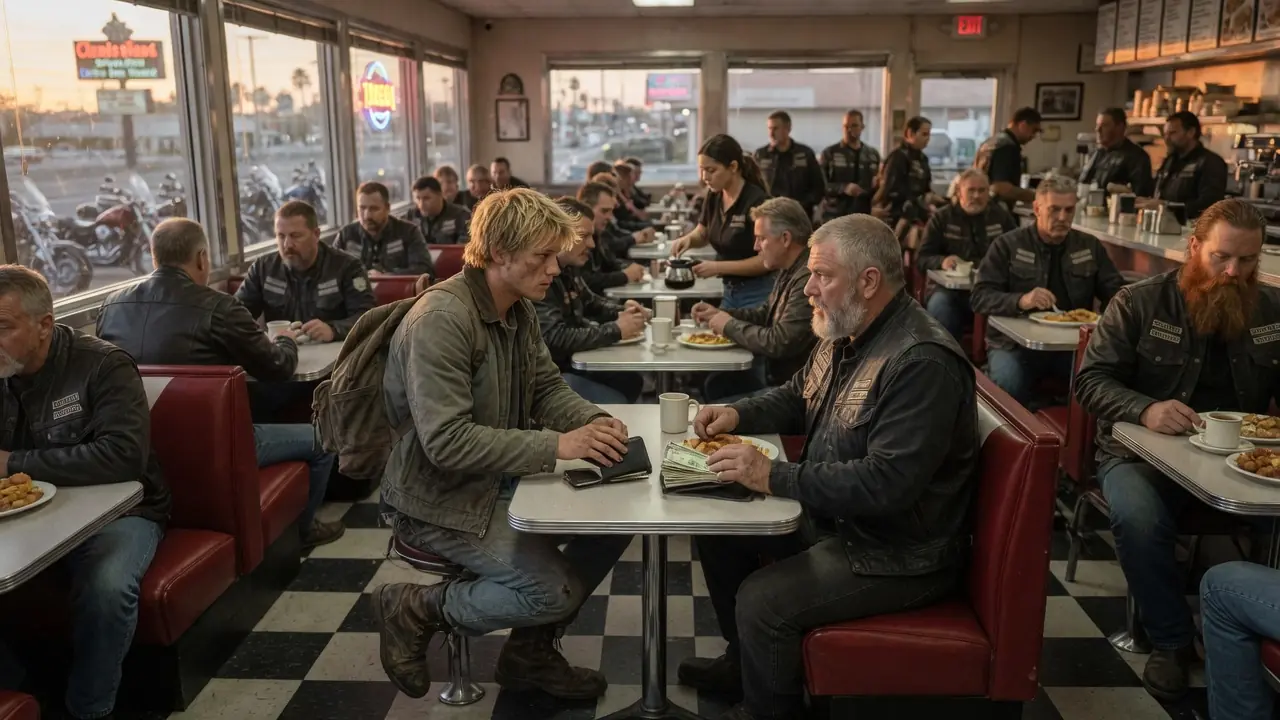
“Enough to change my life,” Noah said. “But it wasn’t mine to take.”
The entire diner went quiet.
Thirty-eight bikers would later say that was the moment everything changed.
Not just for Noah.
For all of them.
Noah Bennett woke up before the sun did.
Not because he had somewhere to be. Not because an alarm pulled him from sleep, or a job was waiting, or coffee was brewing in some warm kitchen down the hall.
He woke up early because sleeping too long in one place made you a target.
That was the first rule he had learned after eleven months on the streets of Las Vegas, Nevada.
And it was the kind of lesson that did not need to be taught twice.
He was twenty years old. His blond hair had grown past the point where it looked intentional, just past the point where it might be mistaken for style, hovering somewhere in the territory of survival.
His jacket was a dark canvas thing he had found folded behind a laundromat eight months earlier, and he had washed it so many times in gas station bathroom sinks that the color had faded to something between gray and green.
His boots were the worst of it.
The left sole had separated at the toe, and he had wrapped it twice with electrical tape he had found in a hardware store parking lot.
Every time he took a step, it made a soft slapping sound against the pavement, like a tired heartbeat.
His backpack held everything.
One change of clothes.
A water bottle he refilled wherever he could.
A small notebook with a broken spiral where he sometimes wrote things down because he had read somewhere that writing things down helped you hold on to your sanity when everything else was sliding.
A granola bar he had been saving since Tuesday.
And a photograph, folded soft at the creases and worn nearly transparent at the corners, of himself at sixteen standing next to his mother in front of a house that no longer belonged to their family.
That photograph was the most valuable thing he owned.
He had been sleeping near the back end of a strip mall on the east side of the city, in a space between a shuttered tax prep office and a wall of overgrown oleander bushes that smelled sharp and sweet in the cool desert morning.
It was not comfortable.
It was not safe.
But it had a lip of concrete awning overhead, and the oleanders blocked the wind.
And in Las Vegas, wind at five in the morning was no small thing.
He gathered his backpack, checked the zipper twice, always twice, and stepped out onto the sidewalk.
The city that never slept had at least quieted down.
The neon had dimmed to a hum. Delivery trucks rumbled somewhere east. The air smelled like concrete cooling after a long, hot night, and something faintly fried drifting from a ventilation shaft two blocks over.
Noah followed the smell out of pure instinct.
His stomach was already making its case for attention.
He walked six blocks east on Charleston Boulevard before he found a roadside diner called May’s Place.
It was the kind of establishment that had probably looked exactly the same since 1987 and intended to stay that way.
The parking lot was half full, which was already more activity than he expected for that hour.
The reason became clear when he got close enough to see the motorcycles.
There were a lot of them.
Not a few.
Not a handful.
An entire formation of motorcycles parked along the far edge of the lot, arranged with a kind of order that felt intentional, almost military.
Big machines.
Heavy chrome.
Leather saddlebags and custom paint and the kind of detail work that took years, real money, and a particular relationship with a machine that went beyond transportation into something closer to identity.
Noah had seen motorcycle clubs before.
He was from Las Vegas. You could not live in this city for twenty years, even a hard twenty years, without understanding the basic landscape of who occupied what corner of it.
He knew better than to stare.
He knew better than to linger.
He adjusted his course to skirt the edge of the parking lot rather than cut through the middle of it.
That was when he saw it.
He almost did not.
His eyes were moving across the asphalt in that half-conscious scanning pattern he had developed over nearly a year of outdoor survival, looking for anything useful, anything discarded, anything that might be breakfast or dry socks or a few dollars that had fallen from someone’s pocket.
His brain processed the black rectangle on the ground near the rear wheel of a massive motorcycle a full half second before it consciously registered what he was looking at.
A wallet.
Black leather.
Thick.
Lying flat on the ground near the back tire of the biggest motorcycle in the row.
Noah stopped.
He stood completely still for a moment, the way an animal freezes when it hears something unexpected, and he looked at the wallet without moving toward it.
He looked at the diner.
The windows glowed warm yellow. Through the glass, he could see figures, big men in dark vests, filling the booths and counter stools.
His eyes went back to the wallet.
Then to the diner again.
Then down.
He walked over and picked it up.
The weight of it was immediate and substantial.
Not the weight of leather.
The weight of content.
He held it for a second without opening it, feeling the thickness of it between his fingers.
Then he flipped it open.
The cash was right there, folded into the bill compartment in a way that suggested the owner did not spend a lot of time worrying about it.
Large bills, organized not by denomination but simply by direction.
All facing the same way out of what looked like personal habit.
Noah’s eyes moved over the money without touching it, doing the quick arithmetic that hungry people become involuntarily skilled at.
His brain arrived at a number somewhere above five thousand dollars before he even got through the first fold.
He stopped counting.
He looked at the ID card instead.
Jackson Callahan.
A face stared back at him from the small plastic rectangle.
A man in his fifties, heavyset in the way that came from muscle that had settled but had not gone soft. Gray hair cropped short. A beard that was more gray than anything else. Eyes that were pale and direct and seemed to be looking at something slightly beyond the camera.
The address was local.
The birth year made him fifty-four.
Noah read the name again.
Jackson Callahan.
He stood there in the cold morning air with more money than he had seen in one place in over a year, and he let himself feel it.
He did not look away from it or pretend it was not what it was.
He held the wallet in both hands and stood there, letting the full weight of what he was holding press down on him.
He thought about the shelter on Foremaster Lane that had turned him away three weeks ago because they were over capacity.
He thought about the woman at the city jobs office who had told him, not unkindly but very clearly, that without a residential address, his applications would continue to go to the bottom of the stack.
He thought about the electrical tape on his boot, the granola bar in his backpack that he had been rationing since Tuesday, and the photograph of his mother that was the only thing in his life that still connected him to a version of himself that had existed before all of this.
Five thousand dollars.
Probably more.
Nobody saw him.
Nobody was watching.
He was twenty years old and homeless and cold and hungry.
And the universe had just placed a solution directly at his feet in the empty morning parking lot of a roadside diner in Las Vegas, Nevada.
He stood there for a long time.
A truck passed on the boulevard.
A bird landed somewhere nearby and left again.
The neon sign above May’s Place buzzed in a low, steady frequency.
Noah closed the wallet.
Then he walked toward the diner.
He pulled the glass door open and stepped inside.
The warmth hit him first, the dense warmth of a place that had been full of people for hours, layered with coffee and grease and the particular heat of a commercial kitchen running hard.
Then the smell.
Then the sound, which dropped sharply when the door closed behind him because fifteen or twenty men in leather vests had just turned to look at whoever had walked in.
Noah had spent eleven months learning to read rooms fast.
He read this one in about four seconds.
These were not men who dealt in uncertainty.
Their vests, black leather, heavy with patches and pins and the particular insignia of an organization that operated by its own internal laws, told you immediately who they were to each other and what that meant.
Some of them were older, in their fifties and sixties, with the kind of settled authority that did not require demonstration.
Some were younger, in their thirties, watching everything with the sharp alertness of men still earning their place.
All of them were looking at Noah.
The diner staff had gone quiet, too.
A waitress behind the counter had stopped pouring coffee mid-cup.
Noah walked to the nearest booth, which happened to be occupied by the man he recognized from the ID card, and he put the wallet on the table.
“I found this in your parking lot,” Noah said. “Thought you’d want it back.”
Jackson Callahan looked at the wallet.
Then he looked at Noah.
He picked it up and opened it with the slow deliberateness of a man who did not hurry for anything.
He looked inside.
Nobody in the diner made a sound.
Jackson went through the wallet the way you check a safe after you think someone might have been inside it: methodically, thoroughly, checking not just the obvious compartments but the small ones, the card slots, the hidden fold behind the bill section.
He checked everything.
When he was done, he looked up at Noah again with those pale, direct eyes.
“Sit down, son,” he said.
It was not quite a request.
Noah sat.
Jackson set the wallet on the table between them and folded his hands on top of it.
He looked at Noah the way very few adults had looked at Noah in a very long time, like he was actually trying to understand something about him, not just categorize him.
“You counted it?” Jackson asked.
Noah nodded once.
“Didn’t take anything?”
“No, sir.”
“Why not?”
It was a genuine question.
Not rhetorical.
Not a test.
Or at least not only a test.
The man actually wanted to know.
Noah thought about how to answer it.
He could have said something about principles. He could have reached for something noble sounding, something that would land well in a room full of men who organized themselves around codes of conduct.
But he did not.
“Because it wasn’t mine,” he said. “That’s it. That’s the whole reason.”
Jackson studied him.
“How old are you?”
“Twenty.”
The older man looked at him for another long moment.
Then he said, “What are you drinking?”
“Water’s fine.”
“You eating today?”
Noah did not answer immediately, which was an answer.
Jackson turned and raised two fingers at the waitress, who had not moved from behind the counter.
She nodded and disappeared toward the kitchen.
Around them, the diner slowly returned to its own conversations, the way water fills back in after you lift your hand out of it.
“Talk to me,” Jackson said.
He leaned back in the booth, not relaxed exactly, but settled like a man who had conducted a thousand difficult conversations across tables exactly like this one and knew how to make space for one more.
“What’s your situation?”
“I’m managing,” Noah said.
Jackson looked at the boots, the jacket, and the backpack Noah had kept on his lap when he sat down, the automatic possessiveness of a person who could not afford to lose anything.
“You’re not managing,” Jackson said.
Not unkindly.
Just directly.
Noah felt something shift slightly in his chest.
There was something disarming about a man who simply told you the truth without dressing it up.
He was so accustomed to people either pitying him or ignoring him that someone just reading the facts out loud and saying them plainly caught him off guard.
“I’m figuring it out,” Noah said.
“How long have you been on the street?”
A pause.
“Eleven months.”
“Where are you from originally?”
“Here. Las Vegas. I grew up on the east side.”
Jackson nodded slowly.
“Family?”
Noah looked at the table.
“It got complicated. My dad’s been gone since I was twelve. My mom did her best. We lost the house when I was nineteen. She went to stay with her sister in Reno. I didn’t want to crowd them, so I stayed. Thought I’d figure something out.”
He drew a breath.
“You got work?”
“I’ve had day labor, some warehouse stuff, a few weeks at a kitchen downtown, but they cut staff when the slow season hit.”
Noah kept his eyes on the table while he talked, not because he was ashamed exactly, but because the act of laying it all out in plain language in front of a stranger required something from him, some particular kind of effort, and it was easier to do it without making eye contact.
“I’ve been applying. It’s hard without an address. That’s the part people don’t tell you. How much harder everything gets without an address.”
Jackson did not say anything right away.
He let what Noah said sit there.
The food came.
A full plate.
Eggs, bacon, toast, a short stack of pancakes, a large orange juice Noah had not been expecting, and the coffee that Jackson had apparently ordered for both of them without asking.
Noah looked at the plate.
“Eat,” Jackson said.
Noah picked up the fork.
He tried to eat slowly.
He had learned early on that eating too fast when you had been hungry made you sick, and he had trained himself out of the instinct to inhale food the moment it appeared in front of him.
But the eggs were hot and real, and the toast was buttered.
After a few seconds of discipline, hunger overtook caution, and he ate with the quiet, focused energy of a person who had been waiting for exactly this for longer than the morning.
Jackson watched him without making it obvious.
He sipped his coffee.
He looked out the window.
He gave Noah the dignity of not being observed too closely.
After a few minutes, Noah slowed down.
He set the fork across the plate and looked up.
“Thank you,” he said. “I’ll pay you back when I—”
“I didn’t do this for repayment,” Jackson said.
“I know. But I will anyway when I can.”
Jackson looked at him for a moment, and something in his expression shifted almost imperceptibly, but Noah caught it.
The older man uncrossed his arms.
“You walked into a room full of bikers you didn’t know to return a wallet with five thousand dollars cash in it,” Jackson said slowly. “At twenty years old. With nothing in your pockets and a backpack that looks like it’s been through a flood.”
Noah said nothing.
“That took something,” Jackson said.
“It took common sense,” Noah said. “Keeping it would have been the start of something I didn’t want to be part of.”
“A lot of people would have called that stupid.”
“Probably.”
“You don’t think so?”
“No,” Noah said. “I think the people who call it stupid are the ones who’ve never lost anything that matters and found out that your word is the one thing that’s hard to get back once you spend it.”
The diner had been loud when Noah walked in.
It was not loud now.
Not because anything dramatic had happened. No confrontation, no raised voices, no moment of visible tension.
It was just that the conversations at the neighboring booths had gradually oriented themselves in the direction of this one, the way iron filings drift toward a magnet without being commanded to.
Jackson noticed.
He did not acknowledge it directly.
He just leaned forward slightly and kept his eyes on Noah.
“You said your dad left when you were twelve,” Jackson said.
“Yeah.”
“And you stayed out here rather than go to Reno with your mother because you didn’t want to crowd them.”
“That’s right.”
“Not because you’re too proud to ask for help.”
Noah opened his mouth, then closed it.
Jackson tilted his head slightly.
“Because there’s a difference. Proud men usually tell you they don’t need anything. You just told me your situation in plain language the first time I asked. That’s not pride. That’s something else.”
“What is it?”
“Respect,” Jackson said. “You didn’t want to be a burden to people you love. That’s a different thing than being too stubborn to admit you need something.”
He paused.
“The stubborn ones would have kept that wallet.”
Noah stared at him.
“I’m not trying to embarrass you,” Jackson said. “I’m just telling you what I see. And I’ve been reading people for a long time.”
A man from two booths over, big, with a red beard and the kind of forearms that suggested he had not spent his life behind a desk, leaned toward the table without being invited.
His name patch read Gravel.
“Stone,” he said, addressing Jackson by what was clearly a road name. “Kid walked in here with your wallet.”
“He did.”
Gravel looked at Noah with an evaluative expression that was somewhere between respect and suspicion, the way you look at something that turns out to be more than you expected.
“That’s your wallet? You found Jackson’s?”
“I found it in the parking lot,” Noah said. “I assumed it belonged to whoever owned the bike it was next to.”
“You know who owns that bike?” Gravel asked.
“I do now,” Noah said.
Gravel sat back and looked at Jackson.
Something passed between them that Noah could not translate, but could feel.
A kind of acknowledgement.
Gravel returned to his booth without another word.
Jackson reached into the breast pocket of his vest and pulled out a card.
No email address on it.
No website.
Just a name, Jackson Callahan, and a phone number.
He slid it across the table.
“If you need something,” he said, “call that number.”
Noah picked it up.
He looked at it.
He turned it over, found nothing on the back, and tucked it into the front pocket of his jacket.
“I appreciate it,” Noah said.
“You going to call?”
Noah was quiet for a second.
“I don’t like needing things.”
“I know,” Jackson said. “But calling isn’t the same as needing. Sometimes it’s just smart.”
He stood up, which was the signal that the conversation was concluding.
But he did not do it abruptly.
He did it the way a man who had thought about what he wanted to say stands up after he has said it.
“What you did this morning, returning that wallet, that’s not a small thing. Not to us.”
“It was the right thing,” Noah said.
“Yeah,” Jackson said. “But the right thing is only easy when it doesn’t cost you anything. This morning, it cost you something real.”
He picked up his coffee cup.
“Don’t lose that card.”
Noah watched him walk back toward the front of the diner, where the other men were beginning to stand, gather, and signal to each other with the wordless efficiency of people who had spent years moving in formation.
He sat in the booth for another ten minutes after they left, finishing his coffee, letting the warmth of the diner settle into him.
The waitress came by and refilled his cup without asking.
She gave him a brief look that was not quite pity and not quite admiration, but something in the neighborhood of both.
He kept his hand on the card in his jacket pocket.
He did not plan to use it.
He was twenty years old, and he had survived eleven months without asking anyone for anything that mattered.
He believed, with the particular stubbornness of a person who had made dignity into the only currency he still possessed, that he could keep doing exactly that.
He was not wrong about needing people.
He was wrong about not being in danger yet.
Three days later, everything Noah had managed to hold together came apart at once.
Not because he made a mistake.
Not because he trusted the wrong person.
But because someone had been watching him that morning in the parking lot.
Someone who had not seen what Noah saw when he looked at that wallet.
Someone who had not seen a test or a moral line or his own reflection in the chrome of a stranger’s motorcycle.
This person had seen something else entirely.
He had seen a weapon.
And he had been waiting ever since to figure out exactly how to use it.
His name was Derek Holloway.
He was thirty-one years old, and he had been working the same stretch of East Las Vegas for the better part of four years.
Not a criminal in the way that required a police file, though he had one.
Not violent in the way that required hospitalization, though he had come close.
Derek operated in the margins the law struggled to reach, the soft gray spaces where vulnerability met desperation and someone with no conscience and a good memory for leverage could make a very comfortable living.
He remembered faces.
That was his gift, if you could call it that.
He remembered the face of every person he had ever seen doing something that could later be twisted into something else.
He cataloged people the way a library catalogs books, not out of interest, but out of utility.
You kept a thing on the shelf until it was useful.
Noah’s face had gone on the shelf the moment Derek saw him crouch beside that motorcycle in the May’s Place parking lot.
Derek had been sitting in his car at the edge of the lot, working through a breakfast sandwich and watching the bikers the way you watched a weather system you did not want to be caught in.
He had seen the wallet the same moment Noah had.
He had watched Noah pick it up.
He had watched Noah open it.
And he had watched Noah close it and walk into the diner.
That last part was the part Derek could not stop thinking about.
Because Derek Holloway, in thirty-one years of watching people and learning what they were capable of when no one was looking, had almost never seen someone do what that kid had done.
And the fact that someone had done it did not fill him with admiration.
It filled him with a very specific kind of calculation.
A kid that honest, Derek figured, was also a kid that defenseless.
People who operated on principle were, in Derek’s experience, almost laughably easy to destroy because they believed the world worked the way they operated: on truth, on evidence, on what actually happened.
They did not understand that the stories someone told about you could be more powerful than the actual facts.
Especially when the person being talked about had no home, no employer, no neighbors, no network.
Especially when the story involved a motorcycle club.
Derek began spreading the story by the end of that same day.
He was careful about it.
He did not announce it.
He planted it.
A word here.
A mention there.
The way you seed a garden, letting each telling take root in a different patch of ground.
He found the shelter where Noah sometimes tried to get a temporary mat, and he found two men there who owed him enough to say what he told them to say.
He found the day labor office where Noah had been registered and dropped something in the ear of the manager.
Nothing definitive.
Just a question.
The kind of question that makes people suddenly unavailable for follow-up calls.
He let the story breathe.
By the third day, it had grown into something with its own momentum.
The story, as Derek designed it, went like this.
A young homeless man had found a biker’s wallet in a parking lot. He had taken the money, almost the whole amount, and returned only the wallet, claiming he had found it empty. The bikers, too intimidated to call police, had let it go. But people in the area knew. People had seen.
It was elegant in the way the best lies were elegant, built around a real event, shaped just enough to invert its meaning, almost impossible to disprove because the real proof, the evidence that contradicted it, was locked inside a diner conversation between two people, one of whom was now unreachable.
Noah did not know about it until it had already cost him.
He returned to the shelter on Foremaster Lane that had turned him away before, hoping a bed had opened up.
The man at the intake desk looked at him differently than he had before.
Not unfriendly.
But guarded.
He said the shelter was full.
Noah saw at least three empty cots through the door behind him.
Then two men from the street, men Noah had nodded to before, watched him leave and said something to each other.
Not loud enough for Noah to hear.
But he saw their faces.
Something had changed.
He found out what had changed when a woman who sometimes let him use the bathroom at her laundromat in exchange for folding clothes refused to unlock the door.
She looked at him through the glass, shook her head, and turned away.
He sat on a bus stop bench and tried to trace it backward.
He went over the last three days, each one hour by hour, looking for the fracture point, trying to identify what had shifted, who he had spoken to, what someone might have misunderstood.
He did not find it that way.
He found it at the end of the third day when a man he vaguely recognized from the shelter’s outer courtyard sat down beside him, looked straight ahead, and said without preamble, “You know someone’s been going around saying you robbed that biker.”
Noah’s jaw tightened.
“What?”
“Dude named Derek has been telling it around. Says you took money from the biker’s wallet and brought the wallet back empty.”
The man still did not look at him.
“I heard it from three different people. Two of them said they saw you do it.”
Noah sat perfectly still.
“They didn’t,” he said. “I brought it back with everything in it.”
“I know,” the man said quietly. “I believe you. But I’m one person.”
He stood up and walked away.
Noah sat on the bench as the sun went down, and the temperature dropped, and the streetlights came on one by one down the boulevard.
Each one cast its orange circle of light on the pavement.
None of them particularly illuminated anything.
He had nothing to prove his story with.
He had returned the wallet.
He had been given a meal and a phone number.
That was the entire transaction.
No receipt.
No witness statements.
No documentation of any kind because the world he occupied did not produce that kind of record.
He was homeless and twenty years old, and someone had constructed a story around a true event and inverted its meaning.
Now the small community of people who had been willing to give him the benefit of the doubt had closed its doors.
In his jacket pocket was Jackson Callahan’s card.
He took it out.
He held it in both hands under the orange streetlight and looked at the number for a very long time.
He thought about what Jackson had said.
Calling isn’t the same as needing.
Sometimes it’s just smart.
He thought about his mother in Reno, how she would feel if she knew where he was right now, sitting on a bus stop bench with nothing but a card, a granola bar, and boots held together with electrical tape.
He thought about the moment three days ago when he had stood in the parking lot with five thousand dollars in his hands and chosen to give it back.
He had made that choice because he believed in something.
Now someone was using that choice against him.
He pulled out the cheap prepaid phone he kept charged at library kiosks and dialed the number before he could talk himself out of it.
It rang twice.
“Yeah.”
The voice was immediate and direct.
No greeting.
No hesitation.
The voice of a man who answered his phone the same way in the middle of a Tuesday evening as he probably did in the middle of a crisis.
“Mr. Callahan,” Noah said. “This is Noah. From the diner.”
A brief silence.
“I remember,” Jackson said. “You call me Stone.”
“Stone.”
Noah paused.
He had rehearsed this sitting on the bench, going over what he was going to say.
He had planned to be concise and factual, to present the situation without editorializing or sounding desperate or asking for anything specific.
“I have a problem. Something’s happened.”
“Tell me.”
And Noah did.
He told it straight through, start to finish, without decoration.
He explained what the man at the bus stop had told him. He explained the shelter, the laundromat, the looks he had been getting. He explained Derek Holloway, what he knew of him, which was not much: a name, a vague presence on the eastern side of the community, someone who had a reputation for operating in the margins.
He explained that he had nothing to refute it with except the truth, and that the truth was not currently circulating.
When he finished, there was a silence on the line.
Not a long one.
Maybe three seconds.
But in those three seconds, Noah heard something that surprised him.
Not anger exactly, and not the kind of deliberate calm people put on when they are concealing anger, but something more focused than either.
Something that felt like the cognitive equivalent of a man rolling up his sleeves.
“Where are you right now?” Jackson asked.
Noah told him the cross streets.
“Stay there,” Jackson said. “I’m coming.”
“You don’t have to—”
“Noah.”
“Yeah?”
“Stay there.”
The line went dead.
Noah put the phone in his pocket.
He sat on the bench, looked at the empty street, breathed in the cooling night air of Las Vegas, and waited.
He did not know what was coming.
But for the first time in three days, for the first time honestly in a long time, he did not feel entirely alone.
He heard them before he saw them.
That was the thing about motorcycles.
They announced themselves, not rudely, not aggressively, but with the particular authority of machines that had no interest in going unnoticed.
The sound built from a distance, low at first, a vibration more than a noise, something Noah felt in his sternum before his ears fully registered it.
Then it multiplied.
Then it multiplied again.
He stood up from the bench.
The first headlight turned the corner two blocks north.
Then another beside it.
Then four more behind those.
Then the sound became a wall of sound, a rolling thunder that filled the avenue the way water fills a pipe completely, corner to corner.
Noah stood on the sidewalk under the orange streetlight and watched them come.
He had told himself, sitting on that bench waiting, that it would probably be Jackson and maybe one or two others.
Maybe a small group.
Maybe five or six men, enough to be a statement without being a scene.
He had not even come close.
They came around the corner in pairs, filling both lanes of the street, motorcycles running in the synchronized formation of people who had done this so many times it had become instinct.
Not chaos.
Discipline.
A moving column of iron and leather in the particular kind of silence that very loud things carry in their center.
Noah counted past twenty and stopped counting.
Jackson Callahan pulled to the curb directly in front of the bus stop.
He cut the engine, and the men behind him cut theirs in a ripple, one row at a time.
The sudden quiet was almost as loud as the noise had been.
Jackson swung off the bike, pulled off his helmet, and looked at Noah standing on the sidewalk with his backpack on his shoulders, his electrical-tape boots, and his jacket faded to somewhere between gray and green.
“You ate today?” Jackson asked.
Noah blinked.
“That’s your first question?”
“It’s a yes or no.”
“Granola bar this morning.”
Jackson turned his head slightly.
“Gravel.”
The big man with the red beard was already off his bike.
“On it.”
He turned and said something to the man behind him.
Somewhere in the column, someone peeled off in the direction of what Noah assumed was food.
Jackson looked at Noah for a long moment.
His expression was the same as it had been in the diner, not warm exactly, but engaged. Present. The look of a man who was paying full attention.
“Tell me about this Derek.”
“I told you most of it on the phone.”
“Tell me again in person. Everything.”
Noah went through it again.
He was more specific this time, now that he was standing in front of the man rather than sitting alone on a bench trying to hold his voice steady.
He described the shelter, the laundromat woman, the two men in the courtyard. He described the man who had sat beside him at the bus stop and told him what was circulating. He described Derek Holloway as best he could from the fragments: the car he had seen him in, the general territory where he worked, and the reputation that had floated through the shelter community in vague, unverifiable terms for as long as Noah had been on this side of the city.
Jackson listened without interrupting.
When Noah finished, Jackson asked, “You know where he is right now?”
“No.”
“You know where he usually operates?”
“East side somewhere around Maryland Parkway, I think. He used to sit outside the convenience store near the library. That’s the only place I’ve seen him directly.”
Jackson looked past Noah’s shoulder for a moment, processing something internal.
Then he looked back.
“Here’s what I need you to understand,” Jackson said. “The story he’s spreading, it doesn’t just hurt you. It touches us. You understand what I’m saying?”
Noah was quiet.
“Someone says a homeless kid stole money from one of our wallets and we let it go, that’s not just a story about you. That says something about us.”
Jackson’s voice had not risen.
It was completely level, which somehow made it carry more weight than anger would have.
“So this isn’t just me coming out here because you made a phone call. This is us coming out here because someone decided to use our name as part of a lie. And that is a thing we take seriously.”
A man Noah had not noticed before stepped up beside Jackson.
He was younger, maybe late thirties, lean, with dark hair going silver at the temples and the kind of economy of movement that suggested he thought before he acted.
His patch read Decker.
“The shelter manager, the one who gave you trouble,” Decker said. “What’s his name?”
“I don’t know his last name. Tall guy, kind of heavyset. Larry, maybe. It’s the place on Foremaster.”
“We know it,” Decker said.
He looked at Jackson.
“Terrence runs intake there now. He’ll talk to us.”
Jackson nodded once to Noah.
“Anything else? Anyone specific who told you directly that they’d heard this?”
“The man at the bus stop. I don’t know his name. He just sat down and told me and walked away. He was doing me a favor. I don’t want him pulled into anything.”
“Understood,” Jackson said. “Anyone else?”
“The two men in the courtyard. I don’t know them well. They didn’t say anything to me directly. I just saw their faces. They had heard something.”
Jackson looked at Decker again.
Something passed between them that was more communication than most people managed with a paragraph.
Decker took out his phone and walked away.
Gravel reappeared from somewhere to Noah’s left with a paper bag that smelled of something hot and wrapped.
He handed it to Noah without ceremony.
“Eat,” he said, in exactly the same tone Jackson had used at the diner, which Noah was beginning to understand was less a habit of that specific man and more a dialect of the culture he was standing in the middle of.
Noah took the bag.
He did not argue.
Jackson gestured toward his bike.
There were two men standing near it, not blocking it, just present, the way men in this particular community were often just present near things that mattered.
Jackson moved to lean against the side of a parked truck instead, giving them both some space, and Noah followed.
“How long did you say you’ve been out here?” Jackson asked.
“Eleven months.”
“Before that, what were you doing?”
“I was finishing my second year at Nevada State. General studies. I didn’t know what I wanted to focus on yet.”
He paused.
“Turned out the timing made the decision for me.”
“What happened to your family’s money, if you don’t mind?”
“My father had a business. Construction. Contracting. Small-scale. When he left, he left debt. My mom tried to manage it for a few years. She did better than most people would have, but the market went sideways and there was a lien situation with the house that got complicated. By the time I was nineteen, most of it was already decided.”
He ate while he talked, methodically, the way he had eaten at the diner, controlled first, then with the quiet urgency of a body that had been waiting.
“She didn’t fail,” Noah said. “She just ran out of options. That happens to people. And it’s not always about bad choices. Sometimes the math just doesn’t work.”
“No,” Jackson said. “It’s not always about choices.”
Something in the way he said it made Noah look up.
Jackson was looking at the street. His jaw was set in a way that suggested he was looking at something that was not quite visible from where Noah was standing.
“I grew up without money,” Jackson said. “Differently than your situation, but I know what it looks like when the math doesn’t work and the person beneath it is still trying.”
He paused.
“I also know what it looks like when someone uses that situation against a person. That particular kind of cruelty, targeting somebody because they’ve got no one to stand up for them. That’s not something I’ve ever had much patience for.”
He said it the way you stated a fact about yourself.
No drama.
No performance.
Noah finished the food, folded the wrapper into the bag, and held it.
“I want you to know something,” Noah said. “I didn’t call you because I expected you to do all this. I called because you told me to call if I needed something, and I thought maybe you could just, I don’t know, tell people I brought the wallet back full. I didn’t expect…”
He gestured vaguely at the street, where dozens of men were still present, still waiting.
“This.”
“I know you didn’t,” Jackson said.
“I don’t want to be someone who causes trouble for people who were decent to me.”
Jackson turned and looked at him directly.
“You didn’t cause this. Derek Holloway caused this. Are we clear on that?”
Noah said nothing.
“Are we clear on that?” Jackson repeated.
It was not a question the second time.
“Yeah,” Noah said. “Clear.”
Decker came back, phone in hand, his expression organized in the way of a man who had just learned several things and was now sorting them by priority.
“Talked to Terrence at the shelter,” he said. “He said he didn’t start the story, but he heard it and he ran with it because Derek told one of the intake volunteers that a biker had confirmed it.”
He looked at Jackson.
“He used your name.”
The air between the three of them changed temperature.
Jackson did not move.
His body did not tense.
His jaw did not tighten.
His hands did not shift.
He stood exactly as he had been standing.
But the quality of his stillness became different.
It became deliberate.
The stillness of a man choosing not to react rather than having nothing to react to.
“He used my name,” Jackson said.
“Said Jackson Callahan had confirmed the kid took the money.”
Jackson was quiet for a moment.
“Where is he?”
“Maryland Parkway. The 7-Eleven near Sahara. He’s there most evenings.”
Jackson looked at Noah.
“You stay here.”
“I’m coming.”
“No, you’re not.”
“It’s my problem.”
“It’s your problem, and it became our problem,” Jackson said. “That means we handle our part first, and then we’ll see what’s left.”
He put a hand briefly on Noah’s shoulder.
Not gentle.
Not paternal.
Just direct, the way you make contact with someone when you need them to actually hear what you are saying.
“You trust me?”
Noah had known this man for approximately four hours across two encounters.
He had no logical basis for the answer he was about to give.
“Yeah,” he said.
“Then stay here. Gravel stays with you.”
He walked back toward the column of motorcycles.
Gravel materialized at Noah’s elbow as if he had been waiting for the cue.
Noah watched Jackson swing onto his bike. He watched the column organize itself with an efficiency that came from years of practice. He watched them pull away from the curb one after another, filling the street again with that particular sound.
Then they were gone, turning the corner, the sound fading but not disappearing.
The street seemed very wide and very quiet.
“Come on,” Gravel said. “There’s a place two blocks down that makes decent coffee.”
“You’re babysitting me,” Noah said.
Gravel looked at him with the flat, unbothered expression of a man who had been told more offensive things before breakfast on a given Tuesday.
“I’m keeping you company,” he said. “Come on.”
They walked.
Gravel was not a man who filled silence with noise, which Noah appreciated because he had enough noise in his own head to manage without external contributions.
The coffee place turned out to be a twenty-four-hour diner, smaller than May’s but the same essential creature: counter service, booths with vinyl seats, the reliable smell of industrial coffee made with more volume than finesse.
They took a corner booth.
Gravel ordered two coffees and a slice of pie without consulting Noah, which seemed to be a pattern with these men.
They decided what the situation called for and provided it without asking, which under other circumstances might have felt presumptuous.
Right now, it just felt like someone had grabbed the wheel for a minute.
“How long have you known Jackson?” Noah asked.
“Going on twenty-two years,” Gravel said.
“What kind of man is he?”
Gravel looked at him over his coffee cup.
“You asking me to give you a character reference for the man who just went to clean up your problem?”
“I’m asking because I want to understand what I’m in the middle of.”
Gravel set the cup down.
He thought about it, which Noah respected.
He did not immediately reach for the nearest flattering thing.
He actually considered the question.
“He’s fair,” Gravel said. “Which sounds like a small thing. It’s not. A man who’s actually fair, not fair when it’s easy, fair when it costs him something, that’s rarer than most people want to admit. Stone’s that kind of man.”
He picked up his coffee again.
“He’s also the kind of man who remembers faces and debts and the people who treated him right when he didn’t have anything.”
He looked at Noah steadily.
“He didn’t always have something. Nobody always has something.”
Noah absorbed that.
“Is he going to get in legal trouble for this?” Noah asked. “Going after Derek?”
“Define trouble.”
“Legal trouble.”
Gravel almost smiled.
Almost.
“Thirty-eight men didn’t just drive across town to beat somebody up. If that was the play, you’d have heard about it differently. Stone doesn’t operate that way.”
He paused.
“What he does is make sure the people who need to hear the truth hear it directly from him in person. And in this city, when Jackson Callahan shows up in person to say something is a lie, people tend to believe him.”
“Because they’re afraid of him?”
“Because they respect him,” Gravel said.
There was a slight edge to it.
Not defensive.
Just corrective.
“There’s a difference. Afraid people do what you say and wait for you to leave. Respectful people actually change their behavior.”
Noah thought about that.
They sat with their coffees for a while.
The diner hummed around them. A couple of truckers sat at the counter. A young woman worked on a laptop in the booth across the way. A cook was visible through the pass-through window, moving with the automatic efficiency of someone who had been making the same motions for years.
“Can I ask you something?” Noah said.
“You’ve been asking me things.”
“Something more personal.”
Gravel lifted one shoulder.
Not quite permission.
But not refusal.
“Why does it matter to all of you?” Noah asked. “What I did. Returning the wallet. Why does it matter that much? From where I’m standing, I just did what anyone should do. I didn’t do it for a reward or because I expected anything. I did it because it was right. And I guess I don’t fully understand why that becomes such a big thing to a group of men who—”
He stopped.
“Who you thought might be exactly the kind of people who wouldn’t care about right and wrong,” Gravel finished without heat.
“I wasn’t going to say it like that.”
“It’s okay. A lot of people think it like that.”
Gravel turned his coffee cup in his hand slowly, looking at it.
“Here’s the thing about what you did. It’s not that we haven’t seen honesty before. It’s not that you’re the first decent person who’s crossed our path. It’s the context.”
He looked up.
“You had nothing. That’s not a figure of speech. You had literally nothing. No house. No money. Almost no food. No safety net. No one watching. And in that moment, with that wallet in your hands, you had everything. You had the means to completely change your immediate situation. And you still made the right choice. Not the easy choice. Not the smart choice by some people’s math. The right one.”
He paused.
“That kind of integrity means more in a vacuum than it does when it’s comfortable. Anyone can be honest when it doesn’t cost them. You were honest when it cost you everything you didn’t have.”
The booth was quiet.
Noah looked at the table.
He felt something in his chest that he did not quite have a word for.
Not relief.
Not gratitude exactly.
Something older than both.
Something closer to the feeling of being seen.
“I didn’t think of it that way at the time,” he said.
“No,” Gravel said. “Good people never do.”
Noah’s phone buzzed on the table.
He picked it up.
Jackson.
One message.
Four words.
Come to May’s now.
He looked at Gravel.
Gravel was already standing, dropping cash on the table with the automatic gesture of a man who had always been the one who paid.
“Let’s go,” he said.
They were back at May’s Place in nine minutes.
Jackson’s motorcycle was out front, along with a dozen others.
Through the lit window, Noah could see men at the tables and counter.
He pushed through the glass door with Gravel behind him, and the warmth and noise hit him again, the same as that first morning.
He stopped just inside the door.
Derek Holloway was sitting in a booth, not comfortably.
He was a man in his early thirties with the particular look of someone who had spent years operating just outside the consequences of his actions and had not yet fully absorbed that this particular evening was going to be different.
He was medium build, wearing a dark hoodie, and his hands were on the table in front of him in the manner of a man who had been told to keep them visible.
He was not physically restrained.
He was not being threatened.
But six bikers were in the immediate vicinity, and Jackson Callahan was sitting directly across from him, and the math of the situation was doing its own kind of persuasion.
Jackson looked up when Noah came in.
“Come here,” he said.
Noah crossed the diner.
He slid into the booth beside Jackson, across from Derek, and looked at the man who had tried to destroy what little he had left with a story built around a moment of honesty.
Derek looked at him with the calculation of someone whose best option was currently being determined in real time.
“Tell him what you told me,” Jackson said to Derek.
Derek’s jaw worked for a second.
“I made it up,” Derek said.
His voice was flat, stripped of the confidence that had apparently characterized his delivery when he had been spreading the story around East Las Vegas.
“The story about the money. I saw the kid find the wallet and return it. I didn’t see him take anything. I made up the part where he took the money.”
“Why?” Jackson said.
Not a question.
A direction.
“Because…”
Derek stopped.
Started again.
“Because I thought I could use it.”
“Use it how?” Jackson said.
“He’s homeless. Nobody to back him up. I figured if people thought he’d stolen from bikers, he’d get cleared out of the area. There’s—”
He stopped again, evidently calculating how much of the rest of it to say.
“There’s what?” Jackson said.
“There’s territory on the east side. People who will pay me to keep it clear of certain kinds of people.”
Jackson did not react visibly.
He looked at Derek with the same level expression he seemed to use for most things.
“And who pays you?”
“I’m not a—”
“Derek.”
The name landed with the kind of weight that did not require volume.
“Richie Okafor,” Derek said. “He runs the lot on Charleston. He doesn’t want homeless people near it. Scares off customers.”
Jackson looked at Decker, who was standing at the edge of the booth.
Decker had his phone out and was already moving.
Noah watched him step away and understood without being told that Richie Okafor was now a name making its way through a network that Richie Okafor had not anticipated being part of.
Jackson looked back at Derek.
“Here’s what’s going to happen,” Jackson said. “Tomorrow morning, you’re going to go to every person you told that story to. Every single one. You’re going to tell them the truth. That you made it up. That the kid returned the wallet with everything in it. That you lied because someone paid you to clear people out of an area. You’re going to do it in person. Not a text. Not a phone call. In person.”
He paused.
“And when you’re done, you’re going to be done with this area, with this kind of work. Do you understand what I’m saying to you?”
Derek looked at him.
“I’m not asking if you agree with it,” Jackson said. “I’m asking if you understand it.”
“Yeah,” Derek said. “I understand it.”
“Good.”
Jackson stood up.
He looked at Noah.
“Come outside.”
They walked out together.
The night air hit Noah’s face, and he let out a breath he had not known he was holding.
Jackson stood beside him on the sidewalk and was quiet for a moment.
“Is that enough?” Noah asked.
“It’s a start,” Jackson said. “He’ll do it because he has more to lose now than he gains by not doing it. The people he told will hear the correction. Some of them will believe it immediately. Some will take time. But the story’s been pulled at the root.”
Noah leaned against the wall.
He was tired in a way that went beyond physical.
The bone-deep exhaustion of a person who had been running on alert for too long and suddenly had a reason to stop.
“The shelter,” he said. “The woman at the laundromat.”
“Decker’s handling it,” Jackson said. “Terrence at the shelter is a practical man. When he finds out the story he repeated had our name in it without our knowledge, he’ll be motivated to correct it quickly. And the laundromat, we know people in that neighborhood. Word travels.”
“You move fast,” Noah said.
“I’ve had practice,” Jackson said.
Noah was quiet for a moment.
“Stone?”
“Yeah.”
“I need you to know I’m not going to be someone who keeps needing things. This isn’t… I don’t want you to think calling tonight means I’m going to be calling every time something goes sideways.”
Jackson looked at him.
“Why are you telling me that?”
“Because I don’t want to be a burden to people who’ve been straight with me.”
“Noah.”
Jackson’s voice was patient but direct.
“You called once. You called when it was a real situation that had our name in it. That’s not being a burden. That’s being smart.”
He looked out at the street.
“You know what makes a man a burden to the people around him? Carrying things that break him until he’s no good to himself or anyone else, and then having everyone around him deal with the aftermath.”
He turned his head back.
“You called once. Tonight we handled it. That’s how things work between people who respect each other.”
Noah did not have an answer for that.
He just stood with it.
The motorcycles on the street were starting to move. Men were pulling on helmets, starting engines, the column beginning to reassemble with the same disciplined ease with which it had arrived.
The sound started up again, that rolling, layered thunder filling the street.
“Where are you sleeping tonight?” Jackson asked.
The question landed simply.
“I’ll find somewhere,” Noah said.
Jackson reached into his jacket pocket and produced a key on a plain ring.
“There’s a room above the shop on Lamb Boulevard. It’s been empty. The heat works. The lock is solid.”
He held the key out.
“It’s not a gift. You want to use it, you maintain the place. Keep it clean. That’s the arrangement.”
Noah looked at the key.
“Stone.”
“I’m not asking you to be grateful,” Jackson said. “I’m offering you a practical arrangement. You maintain the space. You have a place to sleep. Simple transaction.”
Noah took the key.
It was warm from Jackson’s pocket.
He held it in his palm and looked at it, a small, ordinary, completely unremarkable piece of metal that felt in his hand heavier than anything he had carried in nearly a year.
“Thank you,” he said.
“Don’t thank me for practical,” Jackson said.
There was the faintest edge of something in his voice that might have been, under other circumstances and in the expression of a different kind of man, called warmth.
“Get some sleep.”
He walked to his bike.
Noah stood on the sidewalk with a key in his hand and watched the column move out for the second time that night.
That great rolling sound filled the street, then faded corner by corner until the avenue was quiet again.
He looked at the key one more time.
Then he put it in his pocket next to the card he had finally used, and he started walking toward Lamb Boulevard.
He did not know yet what the next morning would look like.
He did not know what it would feel like to wake up in a room with four walls, a working lock, and heat.
He did not know how long it would take for the story Derek had planted to fully come apart, or whether some version of it would cling to the edges of the community the way bad stories always did.
But he had a key.
And that night, for the first time in eleven months, Noah Bennett did not have to calculate which overhang offered the best shelter or which stretch of concrete would be warmest by morning.
He did not have to wake up at five in the morning because sleeping too long in one place made you a target.
He turned the key in a lock that worked.
He closed the door behind him.
And for the first time in as long as he could remember, he slept.
He slept for eleven hours.
He knew this because the last thing he had done before lying down on the narrow bed in the room above the shop on Lamb Boulevard was check the time on his prepaid phone.
11:47 p.m.
And the first thing he did when he opened his eyes was check it again.
10:52 a.m.
The numbers registered.
Then the room registered.
Then the fact of the room registered.
All of it arrived in sequence, and Noah lay there for a long moment just letting it land.
Four walls.
A ceiling.
A door with a lock that he had turned himself.
He had not slept past dawn in eleven months.
His body had trained itself out of it.
The early-warning system.
The five-in-the-morning calculus of vulnerability.
But last night, behind that locked door, something in him had finally switched off.
Not the vigilance exactly, but the part underneath it, the older animal part that stayed alert even in sleep, listening for footsteps, for weather, for the particular silence that preceded someone deciding you were in their way.
That part had gone quiet.
He sat up, put his feet on the floor, and looked at his boots by the door, the left one with its electrical-tape repair, the right one worn thin at the heel.
He thought, with the clear, unsentimental logic of a man reviewing a situation, that he needed to move forward.
He had a room.
He had a key.
He had, for the first time in nearly a year, a fixed address, which meant he had something to write on a job application.
He was twenty years old, and he had been handed a door.
What happened next was on him.
He washed his face in the bathroom sink, which worked.
The hot water worked, too, which was something he stood in front of for a full thirty seconds before turning on, just registering the fact of it.
He changed into a spare set of clothes.
He made a mental inventory of everything he needed to do and arranged it in order of urgency.
Then his phone rang.
Jackson’s name was on the screen.
“You awake?” Jackson asked when Noah picked up.
“Yeah, just.”
“Come down to the shop when you’re ready. I want you to meet somebody.”
The shop was directly below the room.
Callahan’s Custom Cycles.
A motorcycle repair and modification business that occupied a wide, high-ceilinged space.
Noah had seen it only briefly the night before, when Jackson had walked him to the side entrance and pointed up the exterior stairs.
Now, coming through the interior door that connected the room above to the space below, he got the full version of it.
The smell hit him first.
Oil and metal and something chemical and clean underneath both.
It was a working smell.
An honest smell.
The smell of a place where things got fixed.
Jackson was standing near the far end of the space talking to a man Noah had not seen before.
The man was somewhere in his mid-fifties, shorter than Jackson by about four inches, with a compact build that suggested he had spent decades doing physical work.
His hair was mostly white, cut short, and he wore glasses he had pushed up onto his forehead as if he had just looked up from something.
His hands, even at rest, had the particular quality of a craftsman’s hands: scarred in specific places, stained in ways that never fully washed out, knuckled and capable.
“Noah,” Jackson said. “This is Gavin Miller.”
Gavin extended a hand.
His grip was predictably firm.
“Jackson tells me you’ve got some mechanical instinct,” Gavin said.
He was looking at Noah with the direct, assessing gaze of someone who evaluated things for a living.
“I took some coursework,” Noah said. “Engineering basics. My dad had some tools when I was a kid. I used to take things apart to see how they worked.”
“Did you put them back together?”
“Usually.”
Gavin’s mouth moved in what might have been the beginning of a smile, then returned to neutral.
“What’s your experience with engines specifically?”
“Automotive more than motorcycle. I worked a few weeks at a shop downtown. More oil changes and tire rotations than anything diagnostic. But I’ve read a lot.”
He paused, aware of how that sounded.
“I know reading isn’t the same as doing.”
“No,” Gavin said. “It’s not. But it’s better than not reading.”
He looked at Jackson briefly, then back at Noah.
“I’ve got more work than I’ve got hands right now. I’m not going to lie to you about what that means. It means the work is hard and the hours are real. For the first few months, you’re going to be learning more than you’re contributing. I can pay you hourly, starting below what the work will eventually be worth, with the understanding that when you know enough to earn more, you’ll earn more.”
He folded his arms.
“I don’t do charity. Jackson knows that. This is a job offer because Jackson says you’re worth taking a risk on. I trust his read, but you’ll have to justify it.”
“What would I be doing?” Noah asked.
“Starting with cleaning and organization, because that’s where everyone starts and because a clean shop is a safe shop. Moving into basic maintenance tasks as I see what you know. Diagnostics and custom work come later, when I’m confident you can handle them without costing me a client’s bike or your own fingers.”
Gavin uncrossed his arms.
“Questions?”
Noah had a dozen questions.
He asked the one that mattered most.
“When do I start?”
Gavin looked at his watch.
“After lunch.”
Jackson had been quiet during the exchange, standing slightly to the side in the manner of a man who had arranged a meeting and was now watching it handle itself.
When Gavin walked back toward the far end of the shop, Jackson looked at Noah.
“Well?” he said.
“I start after lunch,” Noah said.
Something moved in Jackson’s expression.
Not quite a smile either, but in the same territory as what Gavin’s almost-smile had been.
These were men Noah was beginning to understand expressed most things in degrees of restraint.
“There’s food upstairs,” Jackson said. “I had Gravel stock the kitchen this morning.”
Noah stopped.
“You—”
“Basic stuff. Don’t make a thing out of it.”
Noah made a thing out of it anyway, internally, standing in the middle of that shop that smelled like oil and metal and the particular honest odor of work, holding the key in his pocket with one hand and feeling the full strangeness of being someone people were choosing to invest in.
He did not say any of that.
“Thanks,” he said.
“Go eat,” Jackson said. “And wear something you don’t mind ruining.”
The first week in the shop was harder than Noah had expected, which was itself useful information about the gap between what he thought he knew and what he actually knew.
Gavin was not an unkind teacher, but he was a precise one.
He did not accept approximate.
He did not find charm or good intentions relevant to whether a torque spec had been met.
He could tell within seconds when Noah was guessing versus when he actually understood what he was doing, and he responded to guessing not with anger but with the specific kind of correction that required you to understand the principle before you touched the tool again.
“Why are you doing it that way?” Gavin asked on the third day, watching Noah work on a carburetor that had been pulled from an older touring bike.
“Because that’s the sequence in the manual,” Noah said.
“What does the manual say the sequence is for?”
Noah paused.
“To avoid contamination of the fuel circuit,” he said slowly, working it out as he spoke.
“So if you know that,” Gavin said, “you also know why step four has to come before step three in this specific case, even though the manual lists them the other way.”
Noah looked at the carburetor.
He looked at the fuel circuit.
He thought about what Gavin had just said and worked backward from the principle rather than forward from the instruction.
After about fifteen seconds, he saw it.
“Because this one’s been running dirty,” he said. “If I do step three first, I push the contamination further in.”
“There you go,” Gavin said.
Then he walked away.
That was Gavin’s version of excellent work.
Noah learned to recognize it.
By the end of the first week, he could clean and reassemble a carburetor in the correct sequence and explain why every step was in the order it was.
By the end of the second week, he could diagnose the four most common idle problems on the primary engine types that came through the shop without being told what to look for.
He worked six days.
He kept the shop cleaner than Gavin had asked him to.
He arrived before Gavin got there in the morning and left after the last job was secured for the night.
He was building something.
He could feel the shape of it starting to take form, the way you can feel a foundation curing under you even before the structure above it rises.
But the world outside the shop had not been standing still.
Derek Holloway had done what Jackson told him to do.
Or most of it.
Noah learned this in fragments from Gravel, who stopped by the shop on the fourth day with two cups of coffee in the particular manner of a man delivering a report.
“The shelter manager corrected it,” Gravel said. “Told his staff directly. Told the residents who had heard anything. The laundromat woman came around on her own, actually. Somebody in the neighborhood told her the real version, and she felt bad enough about it to go find Noah and say so.”
Jackson, who was in the shop that afternoon, looked up from a parts invoice.
“And Derek?”
“He made most of the rounds. There are a couple people on the east side he didn’t hit yet. I think he’s dragging his feet on those because he owes them something from before, and facing them is complicated.”
“Is he going to finish it?”
Gravel looked at his coffee.
“Decker’s having a conversation with him today.”
“Good,” Jackson said, and returned to the invoice.
Noah processed all of this while pretending to organize a parts shelf.
What struck him was not the efficiency of it, though that was striking, but the matter-of-factness with which these men handled a consequence of something he had done.
Not resentfully.
Not as a favor they were keeping track of.
Just as a thing that needed to be handled.
So they were handling it.
He was still thinking about that when Gravel paused at the shop door on his way out.
“There’s something else,” Gravel said.
Jackson looked up again.
“Richie Okafor.”
Gravel’s tone had shifted slightly.
Still level, but carrying more weight.
“Decker dug further into what Derek told us. Okafor is not just running a parking lot. He’s been operating a systematic pressure campaign on the east side for about two years, paying people like Derek to move homeless populations away from his properties. And not just away. He’s been steering them toward areas where he has other operations running, using them basically to create problems in neighborhoods he wants to acquire cheaply.”
The shop went quiet.
Noah set down the part he was holding.
“How many people?” Jackson asked.
“Decker’s still counting, but it’s not small.”
Jackson was quiet for a moment.
“Does anyone know yet?”
“Not officially. Decker’s talking to someone at the housing authority. There’s a woman, an advocacy journalist at a local paper, who’s been sniffing around Okafor’s property dealings for about six months. She just didn’t have the thread to pull.”
Jackson looked at Noah.
Noah understood what the look meant.
“Whatever you need from me,” Noah said, “I’ll talk to whoever you need me to talk to. I’ll tell exactly what I know.”
“What you know is limited,” Jackson said. “You’re a piece of it, not the whole thing.”
“Then I’ll tell my piece accurately.”
He paused.
“Derek tried to use what happened to me to do something to other people, too. That’s not just about me anymore.”
Jackson held his gaze for a moment.
“No,” he said. “It’s not.”
This was the thing Noah had not seen coming.
Not the help.
Not the job.
Not the room.
This.
The way a single act could ripple forward and backward simultaneously.
He had returned a wallet because it was the right thing to do. That had brought Jackson into his life. Jackson’s involvement had exposed Derek’s operation. Derek’s exposure had started unraveling a thread connected to Richie Okafor. And Okafor’s activities had been quietly devastating to people exactly like Noah.
People with no fixed address.
No voice.
No one to stand in the gap for them.
He had been one of those people three weeks ago.
The thoughts settled in him with a specific kind of gravity.
That evening, after Gavin locked up and Noah went upstairs, he sat on the edge of the bed and pulled out the folded photograph of himself and his mother from his backpack.
He sat with it for a while.
Then he pulled out his phone and dialed a number he had not dialed in two months.
It rang four times.
“Noah.”
His mother’s voice was immediately alert, the alertness of a woman who had spent years waiting for the other shoe to drop.
“Hey, Mom.”
“Noah, are you… are you okay? You sound different.”
“I’m okay.”
He paused.
“Actually, things have changed. I have a room. A real one.”
A silence on the line.
“A room,” she said.
Her voice did something complicated.
“Above a motorcycle shop. It’s real, Mom. It’s a real thing. I’m not calling to worry you. I’m calling because I wanted you to know.”
He heard her exhale.
A long, slow exhale that told him more about the last eleven months of her life than anything she could have said in words.
“How did this happen?” she asked.
“It’s a long story,” he said. “I’ll tell you all of it. But the short version is, I found something that wasn’t mine and I gave it back. The person I gave it back to turned out to be someone who pays attention to that kind of thing.”
Another silence.
“You’re not in any trouble?”
“No,” he said. “For the first time in a while, I’m actually not.”
He heard her cry then.
Not loudly.
Not dramatically.
She had never been that kind of woman.
Just the quiet, private sound of a person letting go of something they had been holding so tightly for so long that the release itself was almost painful.
“Mom,” he said.
“I’m fine,” she said immediately. “I’m fine. I’m just… I’m glad you called.”
“I’m going to call more,” he said. “I promise.”
They talked for forty minutes.
He told her more than he had intended to, not because he planned to, but because something about having a door to close and a key in his pocket made the story easier to tell.
He told her about the wallet and the diner and Jackson and the room.
He told her about Gavin and the shop.
He left out Derek and the darkness of the weeks before, not because he was hiding it, but because she had carried enough of his fear already.
When they hung up, he sat in the quiet of the room for a long moment.
Then he lay back on the bed, stared at the ceiling, and let himself feel, for just a few minutes, the particular complicated fullness of a life that was beginning to resemble something livable.
He was three weeks into that livable life when the first hard thing happened.
He should have seen it coming.
He had been around enough marginal situations to know that stability, when it arrived, rarely arrived cleanly.
But he had been focused on the shop, on learning, on the slow reconstruction of a daily life that had structure and purpose and forward motion.
He had not been watching the edges as carefully as he should have been.
The first sign was a man outside the shop on a Tuesday morning.
No one noticed him because he was standing in a way that was not quite casual, the way people stand when they want to appear as if they have no particular reason to be somewhere, which always means they have a specific reason to be somewhere.
The man was in his forties, heavy, wearing a jacket that was too warm for the morning.
He was watching the shop entrance.
Noah mentioned it to Gavin.
Gavin looked out the window once and went back to what he was doing.
“Not the first time someone’s watched this place,” he said. “Doesn’t always mean what you think.”
But it happened the next morning, too.
Different man.
Same studied casualness.
Noah called Gravel.
Gravel was at the shop within twenty minutes.
He looked at the street from the window, asked Noah to describe both men in detail, and made a phone call.
He spoke in low tones Noah could not fully catch, and when he hung up, his expression had shifted into something that was not quite alarm but had some of alarm’s characteristics.
“What?” Noah asked.
“Stay in the shop today,” Gravel said. “Don’t run errands. Don’t go anywhere alone.”
He paused.
“I mean it.”
“What’s happening?”
“We’re checking something.”
“Gravel.”
The big man turned from the window and looked at him directly.
“Richie Okafor knows we’ve been asking questions about his operation. Word got back to him. He’s not a man who responds well to being looked at.”
Noah absorbed that.
“He’s sending people to watch the shop.”
“To watch you,” Gravel corrected. “Specifically.”
The weight of that sat on Noah’s chest like something physical.
Three weeks ago, he had been invisible, a young man the world walked past without noticing.
Now he was visible enough to be worth watching by a man who ran property operations across the east side of Las Vegas and had no obvious good intentions.
“What does he think I’m going to do?” Noah asked.
“It doesn’t matter what he thinks you’re going to do,” Gravel said. “It matters that he wants you to feel watched. That’s the first move. Make a person feel seen so they know they can be reached.”
“That’s a threat.”
“It’s the shape of a threat. Not the thing itself yet.”
Gravel pulled out his phone again.
“I’m telling Stone.”
Jackson arrived at the shop that afternoon.
He did not come with a column of motorcycles this time.
He came alone.
Which somehow said more.
A man who brought an army the first time and came by himself the second time was making a different kind of statement.
He sat down across from Noah in the small office at the back of the shop.
“Tell me what you saw,” Jackson said.
Noah told him.
Both men.
Both mornings.
The details he had given Gravel.
Jackson listened.
“You scared?”
“Honestly? Always.”
“Yeah,” Noah said. “A little.”
“Good,” Jackson said. “Fear that’s proportionate is useful. Keeps you paying attention.”
He leaned forward slightly.
“Here’s what I need you to understand. Okafor is watching because you’re connected to us now, and he knows we’re connected to the housing authority investigation. He’s trying to figure out how much exposure he has. Watching you is a way of asking the question without asking it directly.”
“What’s the answer he’s going to get?” Noah asked.
Jackson looked at him.
“The answer he’s going to get is that you’re a twenty-year-old kid who works in a motorcycle shop and does his job and minds his business, and the people who are looking into his operation are doing so with information that has nothing to do with you anymore.”
“That’s not—”
“Noah. Stop.”
“That’s not entirely true.”
“No,” Jackson said. “It’s not. But it’s the version of events that keeps you safe while the people who are actually building a case do what they need to do without Okafor focusing his attention on the individual most exposed.”
Noah was quiet for a moment.
“You’re protecting me by making me look smaller than I am.”
“I’m protecting you by making you an unattractive target,” Jackson said. “There’s a difference.”
He paused.
“The people at the housing authority and the journalists, they don’t need you to be visible for this to work. They have Derek’s statement. They have Okafor’s property records. They have two years of patterns that you don’t even need to be named in. Your piece of the story opened the door. The people who walk through it professionally can do it without you walking in front of them.”
Noah thought about the people Okafor had been systematically displacing.
People who were right now exactly where he had been three weeks ago: unhoused, invisible, without anyone to stand beside them or care what happened to them.
Being made small in this particular moment felt wrong.
“I know,” Jackson said. “You want to be useful. That’s the right instinct. But useful doesn’t always look like visible.”
He held Noah’s gaze.
“Sometimes the most important thing you can do is trust the people who have more tools than you do and stay steady while they use them. Your time to be visible comes later. Right now, you stay quiet, do your job, let us handle the external situation, and trust the process.”
“You’ve done this before,” Noah said.
“More than once.”
“People using leverage, trying to scare someone into silence or backing off.”
“That’s a description of most of Tuesday,” Jackson said.
Noah almost laughed.
It came out more like a breath, but it changed the air in the room slightly.
“There’s something else I want to tell you,” Jackson said.
His tone shifted.
Not more serious exactly, but more personal, the way a man’s tone shifts when he moves from operational to something closer to true.
“The situation with Derek, with Okafor, this is all moving the way it needs to move. Decker is good at what he does. The people at the housing authority are serious. The journalist published something this morning. Did you see it?”
“No. I’ve been in the shop all day.”
Jackson pulled out his phone and turned the screen toward Noah.
It was a short piece, four paragraphs in the digital version of a local paper.
The headline read:
Advocacy Group Raises Questions About East Side Property Displacement.
The piece named Richie Okafor’s company twice. It named the shelter Derek had targeted. It cited housing authority concerns without naming specific sources.
It was not a bombshell.
It was the first stone landing in a pond.
Noah read it twice.
“That’s because of what happened to me,” he said.
“That’s because a chain of events started when a twenty-year-old kid gave back five thousand dollars in cash because it wasn’t his,” Jackson said. “And the chain didn’t stop where you thought it would.”
Noah handed the phone back.
He sat with the feeling that produced.
Not pride exactly.
Something more complex than pride, because pride was about you, and this felt bigger than him.
It felt like something he had been part of rather than something he had caused, and that distinction mattered to him.
“How’s the shop going?” Jackson asked.
The shift was deliberate, back to the immediate and concrete.
“Good,” Noah said.
Then, because Jackson was a man who could hear the difference, he added, “Really good, actually. Gavin teaches in a specific way. He makes you understand the principle before he lets you apply it. I feel like what I’m learning is actually going in the right place, not just on top.”
“He’s the best mechanic I’ve ever seen work,” Jackson said. “And I’ve known some good mechanics.”
“He doesn’t give a lot of feedback.”
“He keeps you on,” Jackson said. “That is his feedback.”
Noah looked at his hands, already developing the particular staining of a man who worked with engines, a faint darkness in the knuckle creases that soap did not entirely reach.
He had been vaguely worried about that the first week.
Now it looked to him like the beginning of something.
“Stone,” he said.
“Yeah?”
“The people being watched by Okafor’s guys, the ones on the east side who he’s been pushing around for two years…”
He chose his words carefully.
“Is there anything I can do for them? Not right now, I know. But eventually. Is there something that comes out of this situation that makes their situation better, not just mine?”
Jackson was quiet for a moment.
“What are you thinking?”
“I don’t know yet. I’m not in a position to think concretely about it, but I want to.”
Noah looked at him.
“I spent eleven months in that situation. I know what the math feels like from inside it. I know what it looks like when someone is systematically making it harder, even when you can’t prove it. If there’s ever a point where what I know and what I’ve been through is useful to someone who can actually change something structural, I want to be available for that.”
Jackson looked at him for a long moment.
“You know,” Jackson said slowly, “when I got your call three days ago saying you were coming in to return something, I told the guys I thought you’d probably taken fifty bucks out of the petty cash.”
Noah blinked.
“You thought I stole from you.”
“I’m not a man who defaults to trust,” Jackson said. “I’ve been burned by my optimism before. You were a stranger who’d had access to the office for a week.”
He paused.
“You were calling to tell me you had found a fifty-dollar bill that had fallen behind the desk and wanted to give it back.”
Noah stared at him.
“There was a fifty behind the desk.”
“There was. I use the back of the desk drawer as a spot I’ll remember to look when I need emergency cash. The fifty had fallen out the back. You found it when you were cleaning.”
The quiet in the room was very complete.
“That’s when I knew for certain,” Jackson said. “Not at the diner. Not that first morning. Plenty of people can be honest under pressure with an audience. But finding fifty dollars alone in a room with nobody watching and returning it without being asked, that’s a different thing.”
Noah did not say anything.
“I tested you,” Jackson said.
There was no apology in it, but no aggression either.
Just the plain statement of a man who operated by verification.
“I needed to know that the person I brought into our space was who he appeared to be. You passed.”
He stood up.
“I thought you should know that.”
He walked toward the shop floor, pausing at the office door.
“Gavin wants to start you on electrical systems next week. He says you’ve got a feel for diagnostic work. That’s the harder skill to teach. Most people either have it or they don’t.”
He walked out.
Noah sat in the office for a moment after he left.
The fifty-dollar bill.
The test he had not known he was taking.
The fact that Jackson Callahan, a man who had sent thirty-eight motorcycles across the city on a Tuesday night for a stranger, had still needed to verify before he fully committed, and had verified it not by asking questions but by watching what Noah did when no one appeared to be looking.
That was a lesson.
Not a cruel one.
A true one.
About the difference between a person’s word and a person’s pattern.
About how trust, real trust, was built, not in dramatic moments but in the invisible ones.
In the fifty-dollar moments.
In the things you did when the audience had gone home and the decision had already been made and all that was left was you and your character in an empty room.
He looked at his stained hands again.
He stood up, went back to the shop floor, and got back to work.
Outside, somewhere on the street, Okafor’s people were probably still watching.
The newspaper article was probably being read right now by people who did not know his name, but whose lives it might eventually change.
His mother in Reno was probably going about her afternoon with something slightly lighter in her chest than there had been yesterday.
And Noah Bennett was twenty years old in a motorcycle shop on Lamb Boulevard in Las Vegas, Nevada, learning how to fix something that was broken, which he was starting to understand was exactly what he had needed to learn.
The watchers outside the shop were gone by the end of the week.
Noah noticed their absence the same way he had noticed their presence: by paying attention to the edges of things, to the quality of stillness on the street, to whether the casual postures of people nearby held that particular tension of deliberate observation.
By Friday morning, the street outside Callahan’s Custom Cycles had returned to its ordinary texture.
People with ordinary reasons for being places moving with ordinary purpose.
He mentioned it to Gravel when the big man stopped by that afternoon.
“Okafor pulled them back,” Gravel said, not looking up from the coffee he was doctoring at the small counter by the office. “Decker had a conversation with someone in Okafor’s orbit, laid out clearly what the consequences of continued harassment would look like.”
“What consequences?”
“The kind that come from the housing authority investigation going from preliminary to formal.”
Gravel took a sip.
“Okafor is a businessman first. Businessmen understand leverage. When the leverage equation shifted, he made the logical decision.”
“So he just backed off.”
“Smart rats know when the trap has changed,” Gravel said. “Doesn’t mean he’s done. Means he’s recalculating.”
Noah went back to work with that sitting in the back of his mind.
Not as fear.
As information.
The distinction mattered.
He had spent eleven months living in fear’s shadow, letting it make decisions for him.
He had decided somewhere in the last month that he was done with that.
Fear as information you acted on intelligently was useful.
Fear as a weather system you simply endured was a way of handing your life to whoever was making you afraid.
He was not going to do that anymore.
The shop was becoming his world in the way absorbing work becomes your world when you let it, when you stop clocking hours and start thinking in problems.
Gavin had moved him on to electrical systems the week before, as Jackson had said he would.
It turned out that electrical diagnostics was the thing Noah was quietly, almost embarrassingly, good at.
The work required a specific kind of thinking.
Not linear.
Not sequential in the way assembly work was sequential.
Relational.
You had to hold a whole system in your head simultaneously and feel your way through it, asking not what is broken, but where is the system failing to communicate with itself?
Noah had been doing a version of that his entire life.
He just had not had a vocabulary for it until now.
“You traced that short in forty minutes,” Gavin said on a Thursday afternoon, looking at the diagnostic report Noah had written out longhand on the shop notepad. “I’ve had guys who’ve been here three years take two hours on the same class of fault.”
“I got lucky with where I started looking,” Noah said.
Gavin set the notepad down and looked at him over the top of his pushed-up glasses.
“You don’t have to minimize it,” he said. “I’m not going to think less of you for being good at something.”
Noah did not have an immediate response to that.
“Don’t apologize either,” Gavin said. “Just receive the information accurately. You’re good at electrical diagnostic work. That’s a fact about you. Write it down somewhere if you have to.”
He walked away.
Noah stood there for a moment.
Then, half seriously, he wrote it in his small spiral notebook.
Good at electrical.
The notebook that had been for holding on to his sanity now held the beginning of something else.
The second week of electrical work brought the first custom client of Noah’s limited experience.
A man named Cortez, who rode a modified touring bike he called Perpetua, and treated it with the particular reverence some men reserve for things they have built themselves over many years.
Cortez was in his sixties, lean and precise in his speech, and he had a problem with Perpetua’s running lights that three other shops had not been able to fully resolve.
Gavin put Noah on it.
Not alone.
Gavin was there, working on two other bikes simultaneously, available for questions.
But the diagnostic lead was Noah’s.
Cortez stood near the bike for the first hour, watching Noah work with the undisguised skepticism of a man who had been disappointed by professionals and was preparing himself to be disappointed by an amateur.
“You’re new,” Cortez said.
“Yeah.”
“How new?”
“About six weeks.”
A silence that expressed itself clearly without words.
“I’ll tell you something,” Cortez said. “Three other shops looked at this bike. First one told me it was the ground wire. Replaced the ground wire. Problem came back. Second one told me it was the switch assembly. Replaced the switch assembly. Problem came back. Third one told me it was probably an intermittent fault, and those were hard to chase, and maybe I should just live with it.”
“What did you say?” Noah asked, not looking up from the wiring harness.
“I told him I didn’t pay thirty thousand dollars for a bike I had to make peace with.”
Noah almost smiled.
He kept his eyes on the harness.
“How long does the fault take to present?”
“About twenty minutes after the lights come on. Sometimes thirty.”
“Hot weather or cold?”
Cortez paused.
“More common in summer. I didn’t put that together.”
“Thermal expansion,” Noah said. “There’s a connection somewhere in the circuit that makes good contact when it’s cold and loses it when the metal expands. Probably not a broken wire. More likely a connector that’s slightly undersized for the pin it’s mating with, or corrosion at a junction point that’s still conducting cold but opens up under heat.”
He said this without flourish, the way Gavin had taught him to speak about mechanical things, as facts being reported, not theories being argued.
Cortez was quiet.
“None of the others said anything like that,” he said.
“They weren’t looking for a thermal fault,” Noah said. “You have to know to look for it.”
He found it forty-five minutes later.
A corroded junction at the secondary distribution point for the running light circuit, hidden behind a bracket.
Intermittent in exactly the way he had described.
He cleaned it, applied dielectric grease, reseated the connector with a pin that actually matched the housing tolerance, and ran Perpetua’s lights for fifty minutes under a heat lamp to simulate operating temperature.
The lights ran clean the entire time.
Cortez watched the full fifty minutes.
He did not say much.
When Noah cut the heat lamp and wrote up the diagnostic report, Cortez read it word by word, the way you read a legal document you are not ready to fully trust.
Then he looked at Noah.
“You’re going to be good at this,” he said.
It was the plainest, most direct compliment Noah had received in a long time, possibly because of its complete absence of qualification.
Not good for someone new.
Not impressive given the circumstances.
Just you’re going to be good at this.
A statement about his future from a stranger who had been evaluating him skeptically for the better part of two hours.
“Thank you,” Noah said.
Cortez paid at the counter.
On his way out, he paused near Gavin.
“Where’d you find him?” Cortez asked.
Gavin did not look up from what he was doing.
“He found us,” he said.
The month that followed was the most consistent Noah had lived in two years.
He worked.
He learned.
He called his mother every Sunday without fail, and the calls got longer as there was more to tell her.
Something in her voice changed week over week, the tight, wound quality of a woman waiting for disaster gradually loosening into the different quality of a woman beginning to let herself believe.
He started a bank account.
The first deposit was sixty-three dollars, which he made in person at a branch on Maryland Parkway, standing at the teller window with his new fixed address on the form and the particular sensation of someone performing a completely ordinary transaction that did not, for the first time in a long time, feel ordinary at all.
He was rebuilding.
He knew it.
He could feel the architecture of it, piece by piece.
And he was careful with it, the way you are careful with things that have taken a long time to begin.
Then came the morning that changed the geometry of everything again.
It was a Tuesday, six weeks after he had started in the shop.
He was in the back cleaning a set of caliper brackets when Gavin called him out to the front.
A woman was standing at the counter.
She was in her late thirties, wearing a jacket with press credentials on a lanyard around her neck, with the kind of direct, assessing gaze Noah was beginning to recognize as characteristic of people whose job required them to look at things accurately.
Her name, she said, was Renata Cruz.
She wrote for the Nevada Current.
She had been covering Richie Okafor’s property dealings for six months.
“I think you know why I’m here,” she said to Noah.
He looked at her lanyard.
He looked at her recorder, which was on the counter but not running.
“I know why you’re here,” he said.
“I’m not going to record anything without your permission,” she said. “I’m not going to use your name without your permission. I want you to understand that before we talk.”
“What do you want to know?”
She pulled out a small notebook.
“Everything,” she said. “From the beginning. The wallet, the diner, Derek, all of it. In your own words, in whatever order makes sense to you.”
Noah looked at Gavin, who was behind the counter and had made no move to leave.
“He can stay,” Noah said. “I don’t mind.”
He had told the story before.
To Jackson over the phone.
To his mother in the careful version.
In fragments to Gravel.
In the compressed version to himself lying awake at night, reconstructing how he had gotten from a bus stop bench to a shop on Lamb Boulevard in six weeks.
But this was the first time he told it from the very beginning, in full sequence, to someone whose job was to make it mean something to people who had not been there.
He spoke for forty-five minutes.
Renata Cruz asked seventeen questions by Noah’s count.
Most of them were clarifications, not challenges.
Not leading questions.
Not the kind of interrogation that tried to put words in your mouth.
She wanted the facts clean.
She wanted his actual experience, not the shape of a story she was already telling.
When he finished, she sat quietly for a moment.
“Can I tell you what I know on the other end of this?” she asked.
“Yeah.”
“Richie Okafor has been operating a displacement network across the east side for approximately twenty-six months. He employs, and I use the word loosely, approximately nine people like Derek Holloway in different parts of the city. Their job is to manufacture social pressure that drives unhoused people away from specific areas. In at least four documented cases, people who were displaced ended up in areas with elevated crime exposure. Two of those people were subsequently victimized in ways that have police reports attached to them.”
She paused.
“Those police reports didn’t get connected to Okafor because nobody was looking for the connection until now.”
The shop was very quiet.
“Two people got hurt,” Noah said.
“At minimum, two with documentation. Probably more without it.”
Noah looked at the counter.
He thought about eleven months of sleeping outside.
He thought about the calculation he had made in that parking lot, the wallet in his hands, the full weight of everything it could have changed.
He thought about Derek Holloway sitting in a diner booth with six bikers nearby, his confidence stripped down to a flat admission.
I made it up.
He thought about what Jackson had said that first night.
Real strength is making sure the truth gets heard.
“What do you need from me?” Noah said.
“Your story on record, with your name attached, if you’re willing,” Renata said. “I’m not going to minimize the risk. Okafor has resources, and he’s already demonstrated he’s willing to use them when he feels threatened. Being named in this piece puts a target on you that being unnamed doesn’t.”
“There’s already a target on me,” Noah said.
She looked at him.
“He had people watching the shop two weeks ago,” Noah said. “Jackson Callahan’s people handled it, but I was already visible before you walked through that door. The only question is whether my name in your article does more good for other people than it does risk for me.”
Renata Cruz looked at him for a long moment.
Something moved in her expression.
A professional kind of respect, the kind that came from having done this work long enough to know that most people, when you gave them the honest version of the risk, found a reason to stay anonymous.
“That’s a remarkably clear way to frame it,” she said.
“I’ve had time to think about it,” Noah said.
He called Jackson that afternoon.
Jackson picked up on the second ring.
“Renata Cruz came to the shop,” Noah said.
A brief pause.
“I know.”
“I told Decker to let her have the access.”
“You knew she was coming.”
“I knew she was working toward it. She’s been careful. She’s good. She’s been building from Okafor’s property records for six months, and she needed a human thread to pull the whole thing into focus.”
Another pause.
“I didn’t tell you in advance because I wanted your reaction to be yours, not filtered through what I thought about it.”
Noah sat with that.
“You were testing me again,” he said.
Not accusatory.
Just observational.
“I was giving you a clean choice,” Jackson said. “There’s a difference.”
“I told her yes,” Noah said. “My name on record.”
The silence that followed was slightly longer than the others.
“You sure about that?” Jackson asked.
“I’m sure that two people got hurt because nobody connected what was happening to them,” Noah said. “And I’m sure that if I can help change that by letting my name be attached to the story of what happened to me, that’s the right call. I’m not sure about the risk, but I don’t think I should let the risk make the decision when the decision affects more than just me.”
Another silence.
Then Jackson said, “Okay.”
Just that.
Okay.
But the word carried something in it, a weight that was not quite pride because Jackson Callahan did not seem like a man who dealt in pride easily, but something adjacent to it.
Something that sounded like a man who had made a bet on someone and was watching the bet pay out in a direction he had hoped for but not assumed.
“I’m going to have Decker reach out to a friend at the DA’s office,” Jackson said. “We want the right people reading the article before Okafor has time to put his own spin on the timeline. You’ll need to be available to answer questions from that direction, too. You okay with that?”
“Yeah,” Noah said.
“This is going to get more complicated before it gets simpler,” Jackson said. “I know you understand what you’re walking into.”
“I understand better than I would have three months ago,” Noah said. “Before, I had nothing to lose, which sounds like freedom, but it isn’t. It means you’ve got nothing to protect. Now I’ve got something to protect, which means this is actually a real choice instead of just what falls out when you’ve got no options.”
Jackson was quiet for a moment.
“When did you get this clear-headed?” he asked.
“I’ve been working for a man who doesn’t let you proceed without understanding the principle,” Noah said.
He heard something on the other end of the line that might, under an extremely charitable interpretation, have been Jackson Callahan laughing.
“I’m going to tell Gavin you said that,” Jackson said.
“He’ll deny that he taught me anything and just look at his coffee,” Noah said.
“Yeah,” Jackson said. “He will.”
Another pause.
“You’re going to be all right, Noah.”
It was the first time Jackson had said it directly.
Not implied it.
Not organized events around the likelihood of it.
Not made practical arrangements premised on it.
Said it plainly to Noah’s face over a phone on a Tuesday afternoon.
Noah did not have a response that matched the weight of it.
“I’ll be in touch,” Jackson said, and hung up.
Renata Cruz’s article ran the following Thursday.
Noah knew it was live because his phone started buzzing before six in the morning.
First a text from his mother, who had apparently set up a Google alert on his name without telling him.
Then from Gravel.
Then from a number he did not recognize that turned out to be Decker.
Then three more unknown numbers that he let go to voicemail.
He sat on the edge of his bed in the room above the shop and read the article on his phone screen.
It was long.
It was careful.
It named Okafor explicitly, cited public records, included statements from the housing authority, and described the displacement network in terms that were specific enough to be verifiable and readable enough to matter to someone who did not follow city property law.
His name appeared four times.
His story, the wallet, the diner, Derek, and the ripple effect occupied the first section of the piece.
The human thread Renata had said she needed to pull the whole thing into focus.
She had gotten it right.
Not embellished.
Not dramatized.
Not shaped into something more convenient than the truth.
Right.
He read it twice, then put his phone down and looked at the ceiling.
His phone buzzed again.
A number he did not know.
He picked up.
“Is this Noah Bennett?”
A man’s voice.
Professional, slightly formal.
“Who’s this?”
“My name is Aldridge. I’m with the Nevada Attorney General’s Consumer Protection Division. We’re reaching out to individuals named in Renata Cruz’s piece this morning. We’d like to ask you a few questions at your earliest convenience.”
Noah closed his eyes briefly.
“Yeah,” he said. “I’m available.”
The meeting with Aldridge and a colleague happened two days later in a conference room downtown, in a building that smelled of carpet and floor cleaner and fluorescent lighting and the particular bureaucratic patience of a government office that moved carefully and deliberately.
Jackson sent Decker to sit in the room.
Not as legal counsel.
Noah could not afford legal counsel, though he was beginning to think about what that would eventually look like.
But as a present, visible indication that Noah was not alone in this room or in this situation.
The questions were thorough.
Aldridge and his colleague were not friendly in the way that put you at ease, but they were professional in the way that kept the temperature of the room consistent.
They wanted dates.
Times.
Exact words where Noah remembered them.
They were honest about what they could and could not use.
Noah gave them what he had.
He gave it clearly and without editorializing, in the manner Gavin had inadvertently taught him to report on technical problems.
Here are the facts.
Here is the sequence.
Here is what I observed versus what I inferred.
At one point, Aldridge looked up from his notes.
“Mr. Bennett, you returned a wallet with five thousand dollars in it while living unsheltered. You then reported a systematic harassment campaign against yourself and, at personal risk, agreed to be named in a press investigation. Now you’re here.”
He paused.
“You understand most people in your situation wouldn’t have done any of those things.”
“Most people in my situation didn’t,” Noah said. “That’s the problem we’re talking about.”
Aldridge wrote something in his notepad.
The meeting lasted two and a half hours.
Walking out afterward, Decker fell into step beside him on the sidewalk.
“How do you feel?” Decker asked.
“Like I just ran a long way,” Noah said. “But not in a bad way. Like the kind of tired where you know you covered ground.”
Decker nodded.
He did not say anything else until they reached the corner.
“Stone wants to see you tonight,” he said. “At May’s. Not urgent. He just said when you’re free.”
May’s Place at seven in the evening was different from May’s at five in the morning.
The warmth was the same.
The smell of coffee and grease was the same.
But the light had shifted into the amber register of evening, and the booths held people with the relaxed energy of those who had finished their days rather than the sharp alertness of those beginning them.
Jackson was in the back booth.
Just him for once.
No Gravel.
No Decker.
No column of anything.
Noah slid into the seat across from him.
The waitress appeared with coffee for both of them without being asked, which meant Jackson came here often enough that she knew what he needed, which somehow made the place feel like a home base in a way it had not quite registered as before.
“You did well today,” Jackson said.
“Aldridge told you.”
“Decker sat in the room,” Jackson said, which was a sufficient answer.
“I just told the truth,” Noah said. “I keep telling the truth and it keeps turning out to be enough.”
“That’s because most people don’t,” Jackson said.
He wrapped both hands around his coffee cup.
“You know what’s going to happen next with Okafor?”
“The AG’s office investigates.”
“And they’re going to find what Renata found, plus more, because they have subpoena power. It won’t be fast. These things never are. But it’s moving now in a direction it’s not coming back from.”
He paused.
“The two people who got hurt, the ones with police reports, the AG’s office is connecting Okafor to those situations. That’s a different category of consequence for him.”
Noah absorbed that.
“He’s going to try to make this harder for me before it gets better,” Noah said.
“Probably,” Jackson said. “He’ll come after credibility first. Try to find something in your past that makes you look unreliable. He’ll find the homeless history and try to use it.”
“He can find it,” Noah said. “It’s true. I was homeless. I don’t plan to lie about it.”
“No,” Jackson said. “Don’t. It’s actually your strongest point.”
He held Noah’s gaze.
“A man who was at the absolute bottom of his circumstances, who had every reason and opportunity to make a choice that would have helped himself and who still made the honest choice. That person’s credibility isn’t diminished by hardship. It’s confirmed by it.”
The diner hummed around them.
Someone laughed at a nearby booth, a real laugh, the kind that surprised the person doing it.
“Stone,” Noah said.
“Yeah?”
“Can I ask you something personal?”
Jackson looked at him with the expression of a man who was not startled by the request, but was weighing it.
“You can ask,” he said.
“Why does this matter so much to you? Not just the wallet. All of it. The room, the job, going after Okafor’s people, the fifty-dollar test, tonight.”
Noah kept his voice level.
“You could have given me breakfast and a phone number and left it there. You did your part. Instead, you’re…”
He gestured vaguely at the space between them, which had accumulated over six weeks into something that did not have a simple name.
“You’re here. And I want to understand why.”
Jackson was quiet for a long moment.
He turned his coffee cup in his hands once the way Gravel did, which Noah had come to understand was a thinking gesture shared between men who had spent decades together.
“I was nineteen when I hit the worst point of my life,” Jackson said. “Different circumstances than yours. I wasn’t homeless. I had a floor to sleep on, barely, but I had nothing else. No direction. People who were supposed to be in my corner who weren’t. And I made some choices in that period that could have gone a completely different way.”
He paused.
“One person saw something in me that I wasn’t seeing in myself. He didn’t rescue me. He gave me a floor to work from, just enough to get my feet under me.”
He looked up.
“He’s been dead for twelve years. I’ve never found a way to pay him back directly. So I pay it forward when I see someone who deserves a floor.”
Noah did not say anything.
“You deserve the floor,” Jackson said. “That’s it. That’s the whole answer.”
Noah looked at the table.
He felt something move in his chest that he did not try to name or manage or compress into something easier to carry.
“Thank you,” he said.
“Stop thanking me,” Jackson said. “Start building.”
“I am building.”
“I know you are.”
Jackson picked up his coffee.
“That’s why I keep showing up.”
Outside the diner, the city was doing what Las Vegas did at night, lighting itself up into something that looked more certain than it was.
All neon confidence and forward motion.
The perpetual present tense of a place that had decided the past was someone else’s problem.
Noah walked back toward Lamb Boulevard with his hands in his jacket pockets, the cold desert air pressing against his face and something happening in him that was too large and too new to fully hold yet.
Something that would take more time than six weeks to understand completely.
He passed a man on the sidewalk.
Young.
Hood pulled up.
Backpack on.
The particular quality of presence that meant the backpack held everything.
He had passed a hundred people like this in the past month without stopping.
He was twenty years old and two months out from the worst of it, still learning how to be in his own life again, still figuring out the shape of what came next.
But he stopped.
“Hey,” he said.
The young man turned wary, with the instant animal alertness of a person trained by circumstance.
“You okay?” Noah asked.
The young man looked at him for a second, calculating the question, deciding what the question actually was.
“Managing,” he said.
Noah recognized the word.
He had said exactly that word to Jackson Callahan, sitting in the same city six weeks ago, and Jackson had looked at his boots and said, You’re not managing.
“There’s a shelter on Foremaster,” Noah said. “It’s been under new management since about a month ago. They’re running cleaner. If you need a mat tonight.”
The young man looked at him with the specific expression of a person who had been given information and was trying to determine the cost of it.
“Why are you telling me?” he asked.
Noah thought about how to answer that.
He thought about a wallet in a parking lot and a diner and a phone call and a key that was still in his pocket.
He thought about a man who had been dead for twelve years, and the debt that could not be paid backward, so it got paid forward.
“Because someone told me something useful when I needed it,” Noah said. “That’s all.”
The young man held his gaze for a moment.
Then he nodded once, the tight, compressed nod of someone protecting themselves from hoping too much, and walked on.
Noah watched him go.
Then he turned back toward Lamb Boulevard and the room above the shop and the life that was piece by piece becoming something he could recognize.
He did not know yet what the next part of it looked like.
He had the outlines.
The shop.
Gavin.
The AG investigation.
His name attached to a story that was moving through the city in ways he could not fully track.
He had a bank account with sixty-three dollars in it, and a phone that people were beginning to call on, and a mother in Reno who answered on the first ring now.
He had a floor to build from.
And for tonight, that was enough.
The AG investigation moved the way government investigations always move.
Not fast.
Not clean.
But with the grinding inevitability of something that has found its footing and is not going to be stopped by the resistance of the person it is aimed at.
Noah learned this in real time over the weeks that followed, not from official channels, but from Decker, who had the particular gift of being present in important rooms without appearing to be important in them, and from Renata Cruz, who called every few days with updates that she prefaced by saying she was speaking off the record and followed by actually telling him something true.
Okafor had lawyered up within forty-eight hours of the article running.
His attorneys had issued a statement calling the piece speculative and politically motivated, which Renata told Noah was a standard first move that meant exactly nothing about guilt and exactly everything about the fact that the target understood the seriousness of the situation.
Three of the nine people Okafor employed in his displacement network had already given statements to investigators.
Derek Holloway had given a second, more detailed statement that apparently included names, dates, and specific instructions he had received, the kind of operational detail that moved the case from circumstantial to documentary.
“He’s cooperating fully,” Decker told Noah one afternoon in the shop. “Which means he’s scared enough of what’s coming to make himself useful before it lands.”
“What is coming?” Noah asked.
“At minimum, civil liability for the two people who were directly harmed. Possibly criminal, depending on what the AG decides about the conspiracy angle.”
Decker paused.
“And the housing authority has opened a formal review of every property transaction Okafor’s company completed in the last three years. That’s not nothing.”
It was not nothing.
Noah understood that clearly.
He also understood, with the particular clarity that comes from having been on the receiving end of systematic disregard, that legal consequences for Richie Okafor were not the same as material improvement for the people who had been moved around the east side of Las Vegas like pieces on a board.
One was about accountability.
The other was about repair.
Both mattered.
But they were different things, and only one of them was being handled by the people with subpoena power.
He had been thinking about the other one.
He brought it to Jackson on a Saturday morning at the shop, when Jackson stopped by to look at a bike Gavin was building for him, a custom touring build that had been in progress for eight months and was nearing completion in a way Gavin discussed with the restrained satisfaction of a surgeon pleased with a particularly clean closure.
Noah waited until Jackson had finished his conversation with Gavin.
Then he pulled him into the small office at the back.
“I want to talk to you about something,” Noah said.
Jackson sat down.
“Talk.”
“The people Okafor displaced, some of them are still out there. The investigation fixes the legal problem. It doesn’t fix the immediate problem of people who are still sleeping outside because of what his network did to them.”
He set his hands flat on the desk.
“I’ve been thinking about what I could do. What we could do. The shop, the community you have. There are people who need what I needed three months ago. A floor. Not charity. A floor.”
Jackson looked at him steadily.
“What are you proposing?”
“A job pipeline,” Noah said. “I know that sounds large. I’m not talking about starting an organization or building something bureaucratic. I’m talking about something simple. Gavin needs hands. You know other shop owners in the community who need hands. Half of what makes it impossible for people in my situation to get work is the address requirement and the reference gap. They can’t get an address without money, and they can’t get money without a job, and they can’t get a job reference without a work history, and nobody gives them work history because they don’t have an address.”
“It’s a locked room,” Jackson said.
“We can put a door in it.”
Noah paused.
“We have the room upstairs. It’s been my room for three months. We could build another one or find another space. A person with two weeks of verifiable employment at this shop and a fixed address for mail has a different application than someone with nothing. That’s the first step.”
Jackson was quiet.
Noah pressed forward because he had been building this argument in his head for two weeks, and he needed to get it out completely before Jackson’s silence became a verdict.
“I’m not asking you to fund something,” he said. “I’m asking you to let me try to build something using the resources that already exist. Your network. Gavin’s operation. The connections you have across the east side. I do the organizational work on top of my hours here. I don’t take anything away from the shop. I build it in the margins, and I bring you a real plan in thirty days.”
Jackson looked at him for a long moment.
“You’ve been sitting on this,” Jackson said.
“Three weeks,” Noah admitted.
“Why didn’t you bring it sooner?”
“Because I wanted to make sure I was proposing it because it was the right thing, not because I felt guilty about being the one who made it out.”
Jackson tilted his head slightly.
“Is there a difference?”
“Yeah,” Noah said. “A guilty person builds something to make themselves feel better. A person who’s thought it through builds something because it has a realistic chance of working.”
He held Jackson’s gaze.
“I’ve thought it through.”
Jackson stood up.
He walked to the window that looked out onto the shop floor, where Gavin was currently explaining something to a young man Noah did not recognize, using the direct, no-nonsense teaching manner Noah had been on the receiving end of for three months.
Jackson watched this for a moment.
“Who’s that?” Noah asked.
“New guy,” Jackson said. “Gavin brought him in yesterday. Kid from the shelter on Foremaster. Apparently someone pointed him in this direction.”
He turned from the window and looked at Noah with an expression that was as close to a full smile as Noah had seen on his face.
“Funny how that works.”
Noah stared at him.
“The young man on the sidewalk,” he said slowly. “Two weeks ago.”
“Apparently, he took the suggestion,” Jackson said. “Showed up at the shelter, got a mat, and someone there told him about the shop.”
He walked back to the desk.
“His name’s Marcus. He’s eighteen, and Gavin says he’s got mechanical instinct.”
Noah looked through the window at the young man on the shop floor, who was listening to Gavin with the concentrated, slightly overwhelmed expression of someone trying to absorb everything at once.
He had been that person three months ago.
“Your proposal,” Jackson said, pulling Noah’s attention back. “Thirty days. Bring me something. Real numbers. Logistics. How the room situation works. Which employers in the network would participate. What the address verification process looks like. How you handle the screening so we’re not setting people up for situations they can’t handle. Real plan.”
“I’ll have it in twenty,” Noah said.
Jackson looked at him.
“Twenty-five,” Noah said.
“Thirty,” Jackson said. “Do it right.”
He walked back out to the shop floor and resumed his conversation with Gavin about the touring build.
Noah stood in the office doorway and watched Marcus listen to Gavin explain something about torque.
He felt the full weight of the moment.
Not its drama.
Not its significance in the narrative sense.
Its simple structural truth.
A thing had started.
He had been the start of it without knowing he was starting anything.
And now the question was what you built once you understood the start had already happened and the only remaining variable was what came next.
He went back to work.
He had an engine to finish and twenty-five days to write a plan that could actually hold weight.
The days that followed had a different quality than the weeks before them.
Not more dramatic.
In some ways, less.
Because Noah had stopped spending emotional energy on the Okafor situation, the investigation, and the external circumstances he could not control, and had redirected that energy inward toward the work directly in front of him and the plan taking shape in the spiral notebook.
The notebook had moved from sanity holding to job recordkeeping, and was now filling up with the early architecture of something larger.
He talked to Gavin about it on a Wednesday afternoon, approaching it carefully because Gavin was a man who did not respond well to being pitched.
He did not pitch him.
He just told him what he was thinking.
Gavin listened without interrupting, which was already a better response than Noah had been prepared for.
“How many people are we talking about realistically in a given month?” Gavin asked when he was done.
“One or two to start,” Noah said. “With the goal of building toward five or six if the network can absorb them. I’m not trying to create volume. I’m trying to create a repeatable process.”
“What do you need from me specifically?”
“Two things. Agreement that the shop can serve as an official employment reference point. Not charity. Actual work. And willingness to bring in one person at a time on trial the way you brought me in.”
Gavin looked at him over his glasses.
“The way I brought you in.”
“I know that was Jackson’s arrangement, not yours,” Noah said. “I know you took a risk on me because you trusted Jackson’s read. I’m asking if you’d be willing to extend that trust to the process instead of just the individual, if the individual is properly vetted.”
Gavin was quiet for a moment.
“Show me the vetting criteria,” he said. “In writing. Before you go to Jackson with the full plan.”
Noah had the vetting criteria written up and on Gavin’s desk within forty-eight hours.
Gavin read it, made three margin notes, and handed it back without a word.
The margin notes were corrections, not rejections.
Noah revised accordingly.
The plan came together in twenty-two days, three days ahead of Jackson’s deadline, which Noah treated as a private victory rather than something worth announcing.
He presented it to Jackson on a Thursday evening at May’s, which had by now accumulated enough associations that it felt less like a random diner and more like the place where things got decided.
Jackson read it straight through without asking questions, which meant he was reading it seriously.
When he finished, he set it on the table and looked at Noah.
“You talked to Cortez,” he said.
It was not a question.
Cortez’s name appeared twice in the document as a potential participating employer.
“He said yes immediately,” Noah said. “He also said he’s been looking for a reason to expand his shop capacity for two years and stopped because he couldn’t find reliable help.”
“You talked to Maria Reyes at the housing authority.”
“She’s been trying to build an employment bridge program for eighteen months with no private sector partners willing to take the liability risk. We solved that by making it voluntary trial employment rather than formal hiring from the start.”
“The address verification,” Jackson said, tapping a section of the plan. “You’re using this address as the mail address for program participants during the trial period.”
“Yes.”
Noah held his gaze.
“I cleared it with Gavin. There’s a mailbox in the shop that doesn’t get used. It becomes the official correspondence address. It gives people a real street address for applications. The moment they’re earning consistently, they find their own housing and the address transfers with them.”
Jackson looked at the plan again.
“You thought about liability.”
“Decker helped me think about liability,” Noah admitted. “He was surprisingly useful.”
“Don’t tell him that. His head’s already a reasonable size.”
Noah almost smiled.
Jackson set the plan down.
“This works,” he said.
It was four words, and they carried the weight of a man who did not say things worked when he was not certain they did.
“We start with two participants. One from the shelter pipeline, one from the housing authority referral. We run it for ninety days and measure it against the outcomes you described in section three.”
“Agreed,” Noah said.
“And you run it,” Jackson said. “Not me. Not Decker. You. It’s your program.”
The phrase landed strangely.
Your program.
He was twenty years old and four months out from a bus stop bench, and someone was using those words about something he had built.
“I have a lot to learn about running something,” he said.
“Everyone does the first time,” Jackson said. “The difference between people who learn it and people who don’t is whether they’re willing to find out what they don’t know.”
He looked at Noah steadily.
“You’ve been doing that since day one.”
The meeting ran for another hour, working through logistics, timeline, and the specific language they would use with the housing authority and the participating employers.
By the time Noah walked out of May’s that night, something had shifted in the air around him.
Not dramatically.
Not with the weight of ceremony.
But with the quiet, sturdy quality of a decision made and a foundation poured.
He was building something.
The Okafor verdict came six weeks later, arriving not as a dramatic courtroom moment but as a news notification on Noah’s phone at 7:43 in the morning while he was doing a pre-start diagnostic on a client’s touring bike.
He read the headline twice.
Civil liability confirmed.
Criminal referral for two counts of conspiracy to defraud.
Property review resulting in three contract voidings.
And a line at the bottom, brief and factual, that said two individuals who had filed reports connected to the displacement network had reached settlements with Okafor’s company.
He put his phone in his pocket and went back to the diagnostic.
Gavin came through the shop twenty minutes later and stopped near Noah’s station.
“You saw the news,” Gavin said.
“Yeah.”
“How do you feel about it?”
Noah thought about it.
“Honestly? Relieved,” he said. “But mostly, I’m thinking about whether the two people who settled got enough to actually change their situation or just enough to close the case.”
Gavin looked at him for a moment.
“That’s a good thing to be thinking about,” he said, and walked on.
The first two participants in what Noah had started privately calling the Bridge Program began in early spring.
Their names were Darnell and Patricia.
Darnell was twenty-six, had aged out of foster care at eighteen, and had been navigating the gap between that and a stable life for eight years with diminishing success and undiminishing effort.
Patricia was forty-one, had lost her housing after a medical situation consumed her savings, and possessed an administrative precision and organizational intelligence that became apparent the moment she was put in a situation where those qualities could function.
Darnell went to Cortez’s shop.
He had an instinct for bodywork that Cortez identified in the first week and began developing immediately.
Patricia went to Maria Reyes at the housing authority, not as a client but as part-time administrative support, one of the program’s first placements that was not in the trades, which Noah had built into the plan’s flexibility provisions.
Noah checked in with both of them weekly.
Not as a supervisor.
He was careful about that, careful not to replicate the dynamic of a person with slightly more standing watching a person with slightly less.
He checked in as someone who had been in their position and wanted to know honestly how it was going.
Darnell was direct.
“The work is hard, and Cortez doesn’t explain things more than once, which stressed me out the first week, and now I appreciate it.”
Patricia was precise.
“The mail address worked. I’ve submitted four applications this week. Two have already responded.”
Noah wrote both responses in his notebook under a section he had titled outcomes.
He was building the evidence base for the ninety-day review.
It was Gravel who told him about the gathering on a Friday afternoon in late spring.
“Stone wants you at May’s tomorrow,” Gravel said.
“What’s happening?”
“A gathering,” Gravel said.
He said it in the particular tone of a man deliberately underplaying something.
“What kind of gathering?”
Gravel looked at him with the flat, unbothered expression.
“The kind where you show up,” he said.
Noah showed up.
He walked into May’s at noon on a Saturday, and the first thing he understood was that the gathering was not at May’s.
May’s was just the starting point.
Jackson was there.
Gravel.
Decker.
Cortez.
Gavin, wearing a clean shirt that still had the shop smell embedded in it because some things do not wash out.
A dozen men Noah had seen before at various points in the last five months: riders, community members, people from the east side network who had been present in his story without always being named in it.
Jackson looked at Noah when he walked in and said, “Come on.”
They walked out together, all of them, onto the street where motorcycles were parked in the formation Noah had first seen on that cold morning five months earlier in this exact parking lot.
More bikes than he had seen that first morning.
He counted past fifty and stopped.
“Where are we going?” Noah asked.
“You’ll see,” Jackson said.
They rode through the east side of Las Vegas in a column that was impossible to ignore.
Not because it was trying to be dramatic, but because several dozen motorcycles moving together have a presence that is simply undeniable.
People on the sidewalk stopped and watched.
Some took out phones.
Some just stood and looked.
They stopped at a building on a side street Noah did not know well, a converted commercial space with a fresh coat of exterior paint and a sign above the door new enough that Noah could smell the materials.
The sign read:
Bennett Bridge Community Employment Initiative.
Noah stood on the sidewalk and looked at it for a long time.
Then he looked at Jackson.
Jackson said nothing.
He stood with his arms crossed in the expression of a man who had arranged something and was watching it be received, with no particular interest in narrating it.
“You named it,” Noah said.
“Gavin named it,” Jackson said. “I just approved it.”
“I didn’t…”
Noah stopped.
He was having difficulty getting the sentence to the end.
“I didn’t ask for—”
“No,” Jackson said. “You asked to build something that would help people. We built you the space to build it in.”
He unfolded his arms.
“The lease is three years. The buildout is done. There’s a front office, two workstations, a small meeting room, and space for a part-time administrator when you’re ready to bring one on.”
Noah turned back to the sign.
Around him, the men who had ridden across the city were dismounting and moving toward the building, talking among themselves with the easy energy of people who had been looking forward to this moment.
Gavin was already inside.
Noah could see through the front window that he was looking at something on the wall, probably a structural detail, because that was what Gavin did when he entered a new space.
Cortez appeared at Noah’s elbow.
“The first time I watched you trace that thermal fault on Perpetua,” Cortez said, “I thought, this kid is going to be somebody.”
He looked at the sign.
“Turns out you already were.”
Noah did not have words for that.
He did not try to manufacture them.
He walked through the door of the building that had his name on it and stood in the middle of the space, letting the full weight of it settle on him.
Not just the building.
Not just the sign.
Everything that had preceded it.
Eleven months on the street.
A wallet in a parking lot.
A decision made in the cold morning air before anyone was watching.
A diner.
A phone number.
A key.
A room.
A man who had needed his own floor fifty-four years ago and had never stopped paying the debt forward.
Jackson came to stand beside him.
They stood together in the middle of the empty room and looked at what had been built.
“What do you say to people,” Noah said quietly, “when you don’t have a word big enough for what you mean?”
“You say thank you,” Jackson said. “And then you get to work.”
Noah looked at the front window, through which he could see the street, the bikes, the men standing in the spring morning, talking and laughing with the ease of a community that had been in formation long before he arrived and would be in formation long after him.
He saw Darnell’s face for a moment.
The young man had come.
Cortez must have brought him.
Darnell was looking at the sign with a particular expression of someone doing the math on what a thing like this might mean for people like him.
Noah made a note of that expression.
He was going to need to remember it when the building work got hard, when the administration was messy, when the outcomes were slower than the plan said they would be.
He was going to need the memory of that particular expression on Darnell’s face as a fixed reference point.
He pulled out his phone and called his mother.
She picked up on the first ring.
She always did now.
“There’s something I want to tell you,” he said.
“Are you okay?”
The automatic question.
The question she had asked at the beginning of every call for two years.
The question that carried everything she had not been able to say directly about the fear she had carried.
“Mom,” he said.
His voice was steady in the way it had taken him five months to learn to make steady, in the way Gavin had taught him without knowing he was teaching it.
Don’t proceed until you understand the principle.
“I’m more than okay. I’m exactly where I’m supposed to be.”
She was quiet for a moment.
“Tell me,” she said.
He told her.
He stood in the middle of the building with his name on the door and told his mother about the wallet and the diner and the key and the shop and Gavin and Cortez and Marcus and Darnell and Patricia and the man in the attorney general’s office and the article and the plan and the ninety-day review and the three-year lease.
She listened without interrupting for the first time in his memory.
Because when a story is complete enough and true enough, even the people who love you most understand that the only right thing to do is listen to all of it.
When he finished, she was crying again.
The same quiet, private way as before.
But it was a different kind of cry.
Not the release of held fear, but something that had no single word for it in English.
Maybe not in any language.
The sound of a person whose child has become someone.
“I’m proud of you,” she said. “I’m so proud of you.”
He did not say anything for a moment.
Then he said, “I learned it from you. The part about keeping your word even when it cost you. That was you. I just finally had a situation that required it.”
She laughed through the tears, the specific laugh of a mother recognizing something she put into the world coming back to her transformed.
“Come home soon,” she said.
“I will,” he said. “I promise.”
He hung up and stood in the room and breathed.
Jackson put a hand briefly on his shoulder, the same direct, non-theatrical contact he had made the night he told Noah to stay at the bus stop.
The gesture of a man who expressed what needed to be expressed through presence rather than performance.
“Five months ago,” Noah said, “I was in a parking lot with five thousand dollars in my hands and nothing in my pockets.”
“Yeah,” Jackson said.
“And I gave the money back because I believed that your character is the only thing that’s hard to rebuild once you spend it.”
“Yeah,” Jackson said again.
“I want you to know that I know the wallet was the beginning, but it’s not the reason any of this happened. The wallet just opened the door. Everything that came through it came through because of people. You, Gavin, Gravel, Decker, Cortez, the people who vouched for me and tested me and gave me work and a room and a platform and a sign with my name on it.”
He turned and looked at Jackson directly.
“A man doesn’t build a life by himself. He builds it with people who decide he’s worth building with.”
Jackson looked at him for a long moment.
“You’re going to be fine,” he said.
“I know,” Noah said.
And for the first time since a cold morning in a parking lot when he had held someone else’s fortune in both hands and chosen to give it back, for the first time in all the months of surviving and rebuilding and learning and deciding and building again, he said those words and meant them completely.
Without qualification.
Without the shadow of doubt that had walked beside him through eleven months of hard ground.
He knew.
He was twenty years old.
He had a building with his name on the door, a plan written in a spiral notebook, a mother who answered on the first ring, a mentor who expressed approval by keeping you on, and a community of men who had ridden across the city on a Tuesday night because someone had done the right thing with nobody watching.
He had started with nothing but his word.