A boy with nothing to sell will sell the only thing he owns: his two hands and his willingness to work.
On a blistering stretch of California highway, one sixteen-year-old traded that for a single sandwich.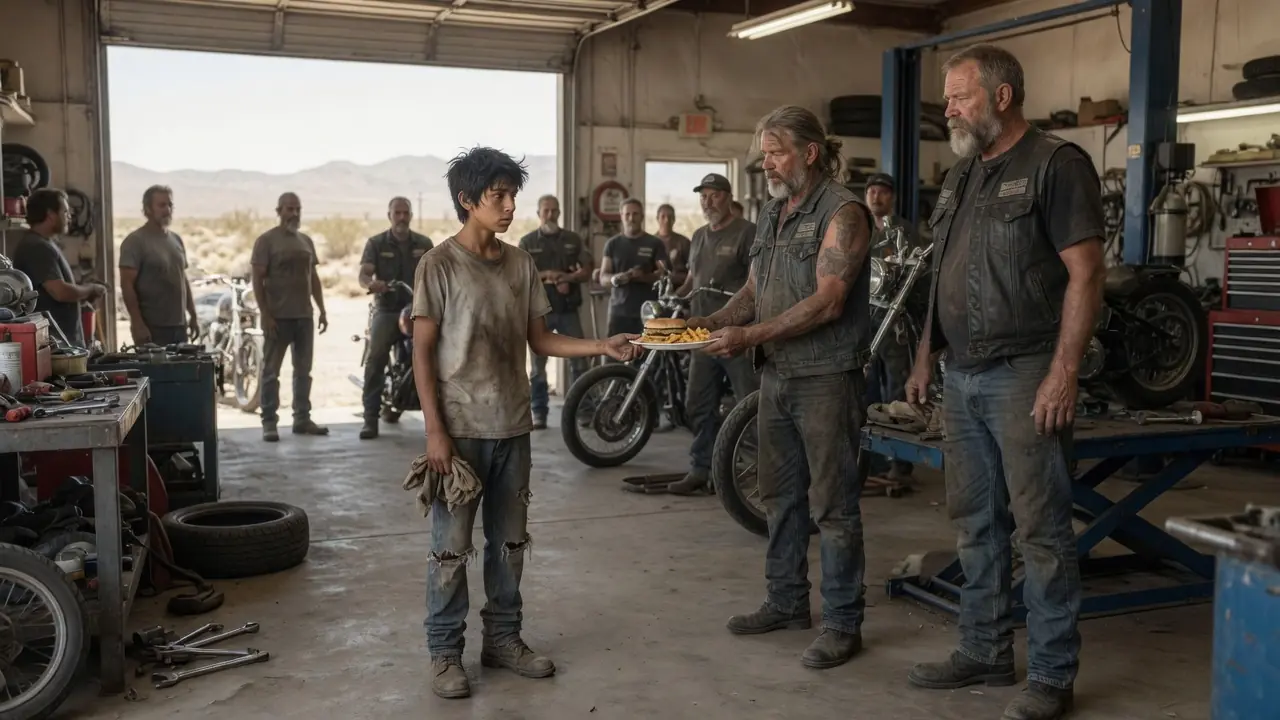
And by sundown, ninety Hells Angels had rolled in behind a truck so loaded with food that the whole town came out to watch.
Route 58 runs flat and mean through the Mojave, past Kramer Junction, where the heat comes off the asphalt in sheets you can see. The Sunfire Truck Stop sits at the crossroads, diesel in the air, coffee scorched down to tar on the burner, and a white glare on everything hard enough to make your eyes ache.
It was 11:40 in the morning when Eli Ramos walked the shoulder toward the diner.
Elijah Ramos was sixteen years old, five-foot-seven, one hundred and thirty pounds with his boots on. He wore a shirt washed so many times the color had quit it. His mother had been in Kern County General for nineteen days, pneumonia that had turned into something worse.
The bills climbed.
The rent did not wait.
Here were the numbers Eli carried in his head like stones.
Rent owed: $1,240.
Days until the eviction notice went final: six.
Cash in his pocket: $18.
Last thing he had eaten: half a gas station burrito yesterday, a little before noon.
He had not come to beg. Begging got you moved along. He had come to work.
He knew this stretch of road the way you know a thing you have walked out of desperation. Eleven miles from the room he and his mother rented, all of it on foot since the bus route got cut.
He had started before dawn while the desert still held a little of the night’s cool. He had watched the sun come up hard and mean over the Cady Mountains, and he had counted trucks to keep his mind off his stomach.
He had tried the two gas stations closer to town first. One already had a kid sweeping the lot. The other had a sign in the window that said, No loitering. No exceptions.
So he had kept walking, because the truck stop at the junction was the biggest place on the map, and big places had more people, and more people meant somebody somewhere might say yes.
His father had been gone four years.
Walked out to buy cigarettes and just kept driving.
The oldest joke in the world, except nobody in the Ramos household had laughed.
His mother had held them together on a home health aide’s wages and a spine that would not quit, until three weeks ago, it did. Pneumonia, then the hospital, then the letters.
Eli carried the numbers because the numbers were all he had that was solid.
Rent owed: $1,240.
Days until the eviction notice went final: six.
Cash in his pocket: $18, folded so many times it had gone soft as cloth.
Last thing he had eaten: half a gas station burrito yesterday, a little before noon.
He had drunk water from a bathroom tap that morning until his stomach stopped complaining, which was a trick he had learned and wished he had not.
The parking lot held a row of motorcycles off to the side, lined up neat in the shade of the fuel canopy, chrome throwing sparks of sun. Eli had seen the riders inside through the window, filling a corner booth. Big men. Quiet men.
He picked the nearest bike.
Then he waited for its owner to come out.
Then the sound caught up. A slow, heavy idle as a man crossed the lot toward the row.
The bike was a black Harley Softail, stripped clean, no chrome it did not need. The man was built to match it: six-foot-three, two hundred and sixty pounds, and none of it soft.
There was gray in his beard and his forearms looked like knotted rope. His cut was worn leather, cracked pale at the seams. Top rocker across the shoulders: Hells Angels. Bottom rocker: California. Between them, the winged death’s head, faded but unmistakable.
On the front, over the heart, was the small diamond patch.
This was not a costume.
This was a man’s whole life stitched onto his back.
Eli’s mouth went dry.
He almost turned around.
“Sir.”
His voice cracked. He steadied it.
“Can I wash your bikes for a sandwich?”
The big man stopped, looked at him, and looked a long time.
“Say that again.”
“The row,” Eli said. “All of them. I’ll do a good job. I’ve got my own rag.”
He pulled it from his back pocket like proof.
“I’m not asking for money. Just something to eat. Whatever’s cheapest.”
The man’s name was Walter Boyd. Everybody who knew him called him Tank.
He had been riding thirty-one years, and he had heard a lot of pitches in parking lots. Most of them ended with a handout.
This kid was not holding his hand out.
He was holding out a rag.
“There’s forty bikes going to be in this lot by noon,” Tank said.
His voice was gravel dragged over gravel.
“You going to wash all forty for a sandwich?”
“Yes, sir.”
“Why?”
Eli’s jaw worked.
“Because I don’t have anything else to trade.”
Tank looked at him a while longer.
The boy did not fill the silence.
Most people filled the silence. That was how you could tell they were working an angle.
This one just stood there in the white glare with his rag and his empty stomach and waited to be told no, the way you wait for a thing you have been told a hundred times.
“How old are you?” Tank said.
“Sixteen.”
“Your people know you’re out here washing bikes off Route 58?”
“It’s just me and my mom.”
Eli’s throat moved.
“She’s in the hospital. Kern County General. It’s just me right now.”
Something crossed the big man’s face and was gone.
He looked at the row of motorcycles, then back at the kid.
Then he jerked his chin at the diner.
“Get inside. Eat first. You wash after.”
That should have been the whole story.
A kid, a meal, a kindness.
It would have been if not for the man in the Range Rover.
His name was Bradford Callister. Brad.
He came out of the diner just as Eli followed Tank toward the door, and he had the look of a man for whom the world had always moved aside.
Pressed shirt. A watch worth more than the diner made in a month. A black Range Rover parked crooked across two spaces, nose out, in a hurry to be somewhere better than here.
He clocked Eli’s washed-out shirt and busted shoes in one glance.
“They letting strays in now?”
Brad said it to nobody, loud enough for everybody.
“Kid, this isn’t a shelter.”
Eli looked at the ground.
“Flat broke,” Brad said. “Figures.”
Then he laughed, the short kind.
“Course he is.”
He kept walking to his truck, phone already out.
Inside, Eli ate a cheeseburger, fries, and a milkshake Tank ordered without asking. Then, when the boy slowed down like he was being polite, Tank pushed a second cheeseburger across the table with two fingers and a look that said, Don’t argue.
The boy ate like he was afraid the plate might be taken back.
Tank watched and said nothing and drank his coffee black.
Across the diner, the corner booth full of his brothers watched, too.
None of them said a word, but something had settled among them, the way it does when men who have seen hard things recognize a kid standing on the same ledge they once stood on.
Then Eli went out and washed the bikes.
He did it right.
Wheels. Spokes. The grime baked into the engine fins. The road film on the tanks that most men would not have bothered with.
Bike after bike, on his knees on tar hot enough to raise a blister through denim, sweat cutting clean lines through the dust on his face.
He did not rush, and he did not slack.
He worked like the work was the point.
Like doing it right was the only wealth he had left, and he was going to spend all of it.
The riders drifted out to watch this skinny kid working like his life depended on a job nobody had really hired him for.
One of them, an older man they called Preacher, crouched down beside him at the third bike and watched him do the spokes.
“You’ve done this before.”
Eli said he had washed cars at a lot in Barstow until the lot closed.
Preacher nodded slowly, stood up, and said to nobody, “Kid’s got a work ethic on him.”
A couple of them slipped Eli folded bills.
He tried to say no. He tried to say the deal was a sandwich, and the sandwich was already more than fair.
They did not let him.
He was on the last row when he heard the crunch.
Brad Callister was backing his Range Rover out, not looking, not caring.
The rear bumper caught the front end of a parked Dyna, folded the mirror, gouged a long silver scar down the tank, and knocked the bike hard into the one beside it.
Brad felt it.
He had to have felt it.
He stopped for one second.
Then he pulled forward and kept going, swinging toward the exit like he had hit a shopping cart.
Eli was ten feet away.
He saw all of it.
“Hey!”
Eli was up and moving before he thought about it.
“Hey, you hit it. You got to stop.”
Brad’s window came down two inches.
“I didn’t touch anything.”
“I watched you.”
“You watched nothing.”
The window went up, and that would have been that, too, except Brad Callister was a man who liked to win clean.
So before he drove off, he made a call.
When the Kern County Sheriff’s cruiser rolled in twenty minutes later, it was not because of the damaged bike.
It was because Brad had reported that a biker group and a vagrant kid were harassing customers and threatening him in the lot.
The deputy was young.
He stepped out with his thumbs in his belt, taking in forty Hells Angels and one skinny teenager, and you could see him doing the math the easy way, the way Brad had counted on.
“Who’s in charge here?” the deputy asked.
Nobody moved.
Then Eli stepped forward.
His hands were shaking. You could see it.
His heart was slamming so hard he could hear it, because he understood the way poor kids understand early exactly how this worked.
Brad Callister had a lawyer, a watch, and a truck.
Eli had eighteen dollars and a rag.
If he told the truth, a rich man would remember his face, and rich men had long arms. Brad could reach his landlord, his mother’s hospital, everything.
The smart thing, the safe thing, was to look at his shoes and say nothing.
“Officer,” Eli said, and his voice shook, but he said it anyway. “The man in the Range Rover hit that motorcycle. He scraped the whole tank and drove off. Nobody threatened him. He lied to you.”
The deputy looked at the damaged Dyna, at the silver gouge, at the kid who was trembling and not backing down.
“You’d swear to that?”
“Yes, sir. I saw it happen.”
Tank stepped up beside him, a mountain in leather, and put one heavy hand on the boy’s shoulder.
He did not say a word.
He did not have to.
The hand said everything.
Brad, who had circled back when he saw the cruiser, because men like Brad cannot help but come back to watch themselves win, leaned out of his window and pointed a finger at the boy.
“You’d better think real hard about this, kid,” he said.
His voice had gone low and pleasant, which was worse than shouting.
“You have no idea who I am. I own half the paper in this county. You want to make an enemy today over a scratched-up piece of motorcycle?”
He smiled.
“Walk away. Say you didn’t see anything. I’ll even make it worth your while.”
Eli’s heart was going so hard it hurt.
$1,240.
Six days.
His mother in a hospital bed.
Everything he needed, and this man was dangling it.
All Eli had to do was look at the ground and say he was not sure.
“I saw you hit it,” Eli said. “And I saw you lie about it. That’s what I saw.”
The deputy took Eli’s statement.
He took photos.
He took the plate number the security camera over the pumps had already caught.
And Brad Callister’s clean little win came apart at the seams.
He drove off at last, slow, and he looked at Eli the whole way out of the lot, memorizing him.
Eli understood that the look was a promise.
Brad was not a man who lost quietly.
Nine days later, the reality crashed down on Eli all at once.
His landlord, who it turned out rented three properties from a development company owned by Callister Holdings, moved the eviction up.
No warning.
A notice taped to the door.
Seventy-two hours.
The under-the-table job Eli had washing dishes at a place in Boron dried up overnight.
The owner was apologetic, mumbling something about a call he had gotten, about not wanting trouble.
His mother was still in the hospital.
The bill had reached numbers Eli could not say out loud.
And now they had no place to bring her home to.
He did not tell her.
He sat by her bed that evening and held her hand and told her the food at the truck stop was good, and that he had made a little money washing bikes, which was true.
He let her believe the small true thing so she would not have to carry the large true one.
She squeezed his hand and told him he was a good boy, and that his father had been a fool.
Then she fell asleep.
Eli sat in the plastic chair and watched the monitor draw its green line, and he did the math one more time.
The math still came out the same.
Zero.
There was no version of the numbers where they came out all right.
Brad Callister had reached out one long arm and flicked, and a sixteen-year-old’s whole life started coming down.
Eli sat on the curb outside the emptying apartment with two garbage bags of everything he owned and did not cry, because crying was a thing you did when there was something left to do about it.
And there was not.
He never called Tank.
He did not have a number.
He figured that was the end of it.
A good sandwich.
A good day gone.
But the club had a network, and the network was fast.
A waitress at the Sunfire was married to a rider two chapters over. She had heard that the kid who stood up for the Angels had been run out of his home by the same rich man who had lied to the cops.
She made one phone call.
That call made three more.
By the next morning, ninety men in three counties knew the whole story.
It did not take a meeting.
It took a day.
Eli was back at the Sunfire.
It was the only place he knew to go.
Then he felt it in the concrete under the curb.
A tremor, faint at first, then not faint.
The coffee in a cup on the counter inside shivered into rings.
Then came the sound.
Ninety engines coming up Route 58 in one long thundering column, riding two by two, tight enough to touch.
Chrome blazing in the low sun.
Behind them, at the tail of the column, came a white box truck.
Ninety Hells Angels rolled into that lot and shut it down.
Tank swung off his bike and walked straight to the kid.
“You didn’t call.”
“I don’t have your number.”
“You do now.”
Tank pressed a card into Eli’s hand.
Then he nodded at the truck.
“Open it up, boys.”
The back of the truck came up on pallets of food.
Rice.
Beans.
Canned goods stacked to the roof.
Cases of water.
Crates of oranges and potatoes and onions.
Boxes of chicken and ground beef packed in ice.
Bread still soft in the bag.
Not just for Eli.
For the whole hard-luck stretch of that highway town.
For the families the recession had never really let go of, the ones who worked two jobs and still watered down the milk.
The club had learned somewhere in the network that this was not a rich place, and they had come loaded for all of it.
They set up folding tables in the lot and started handing it out.
The town came, wary at first.
A woman with two kids hanging back by the ice machine.
An old man pretending to check his tires.
Then Tank walked over to the woman himself, a two-hundred-and-sixty-pound man in a death’s head cut, and crouched down to her kids’ level.
He asked them what they liked.
He loaded a box.
Then he carried it to her car for her.
After that, the wariness was gone.
By four in the afternoon, there was a line.
And there was laughing in the line.
The Sunfire parking lot looked like something between a food bank and a family reunion.
The manager, who might have chased Eli off a week ago, was carrying cases of water in his apron, because ninety Hells Angels have a way of making a man rediscover his better nature.
But the food was the loud part.
The quiet part happened at a folding table by the truck.
Tank sat Eli down and slid an envelope across.
Inside was a cashier’s check for the $1,240 of back rent, made out not to Eli, but to the landlord.
Paid in full.
Beneath it was a receipt showing the eviction had been rescinded that morning.
Beneath that was a second envelope, thicker, that Eli did not understand until Tank explained it.
“Your rich friend,” Tank said. “Callister. Turns out he’s been stiffing the men who build his houses. Drywall crews, framers, electricians. Owes half of them, walks away, dares them to sue.”
He tapped the thick envelope.
“That’s names, dates, dollar figures, lien filings. A reporter in Bakersfield already has a copy.”
Eli looked at the envelope.
“You’re going to…”
“We’re not going to do anything,” Tank said.
He almost smiled.
“We just made sure it stopped being a secret. Men like that only work in the dark. We turned the light on.”
He leaned back.
“He’ll settle with you before lunch tomorrow to make it go away. Watch.”
Some of those men had waited two years to get paid.
Tank went on, still quiet.
“Lost trucks. Lost houses. One of them lost his marriage over it. Callister figured nobody would ever put it all in one place where a reporter could see it.”
He tapped the folder again.
“We put it all in one place.”
He slid a business card on top of the folder.
A lawyer’s card.
A woman in Bakersfield who handled construction liens.
“She’s calling him Monday,” Tank said. “And the paper runs the story Wednesday whether he settles or not. So he’s got a real short window to decide what kind of man he wants the county to think he is.”
Brad Callister paid Eli’s mother’s hospital balance in full within forty-eight hours through a lawyer with a letter that used the word misunderstanding four times.
He also quietly made good on three of the contractor debts before the Wednesday paper, because a man that exposed will pay a great deal to shrink the headline.
Not one Hells Angel ever laid a hand on him.
They did not need to.
A reputation is worth more than a fist, and Brad’s was suddenly worth very little.
Before Tank left, he sat with Eli on the tailgate.
For a while, he did not say anything.
Then he did.
“I had a boy,” Tank said, looking at the highway. “Danny. He’d be your build. Skinny like you. Sixteen.”
He turned the ring on his finger around and around.
“He got sick. The kind you can’t wash bikes hard enough to fix. And when it was bad, when we needed people…”
He held up a fist and opened it slowly.
“Nothing. Zero. Whole world went quiet.”
Eli said nothing.
Tank looked across the lot, where men in leather were handing boxes of food to families who had come from every broken corner of the town.
“I promised myself if I ever saw a kid standing alone, doing the right thing with nobody behind him…”
His voice caught just once, and he cleared it.
“You stood alone in that lot and told the truth to a badge with forty of us watching and a rich man ready to bury you. You didn’t have to.”
He shook his head slowly.
“You had a rich man offering to pay you to look away, and a mama in a hospital bed, and every reason on God’s earth to take the easy road.”
Tank stared at the highway.
“Danny would have liked you. Danny would have stood right where you stood. That’s the hell of it.”
He was quiet a moment, and the highway hummed.
Then he said the last of it barely above the engines.
“You can’t save the one you lost. I know that now. But every once in a while, you get to catch one on the way down. That’s the closest thing to grace a man like me is ever going to get.”
He put his hand on the back of Eli’s neck, the way a father does, and held it there a moment.
Then he stood up.
A month later, Eli Ramos wore a pair of coveralls with his name over the pocket.
The club ran an affiliated shop off Route 58. Bikes, trucks, honest work, and they had taken him on as an apprentice mechanic, paid on the books with the promise that he would finish school around the hours.
Preacher, the old rider who had said the kid had a work ethic, turned out to be the man who ran the shop.
He took Eli’s education personally, standing over him at the bench, handing him wrenches, teaching him the difference between fixing a thing and doing it right, which was the only difference Eli had ever really believed in anyway.
His mother came home to a small, clean place with the rent square.
She was getting stronger every week.
Some evenings, the low thunder of Harleys came up the road and stopped in their driveway just to check on her, and she learned all their names.
She would make coffee for whichever two-hundred-pound man was standing sheepish in her kitchen, and she would tell them the story of her son the way mothers do, embarrassing and proud.
They let her.
Most of them had mothers once and knew what a rare thing it was to still have one to make you blush.
On a Sunday near the end of that month, the club threw a cookout behind the shop.
Long tables.
Smoke off the grill.
Kids running loose.
A hundred people who three weeks earlier had been strangers.
Eli stood in the middle of it with a paper plate in his hand, Tank’s voice booming across the yard, and the whole loud, warm mess of it around him.
He thought the one thought he never expected to think again.
I will never be alone again.