Nobody in the fading town of Blackwood expected a nine-year-old boy’s single desperate act of kindness to trigger an earthquake.
When an orphaned child handed his only meal to a shaking, terrifying outlaw in a freezing alley, he unknowingly summoned a roaring army. What followed was not just a spectacle. It was absolute reckoning.
The wind howling through Blackwood, Oregon, that November felt less like weather and more like a personal punishment. 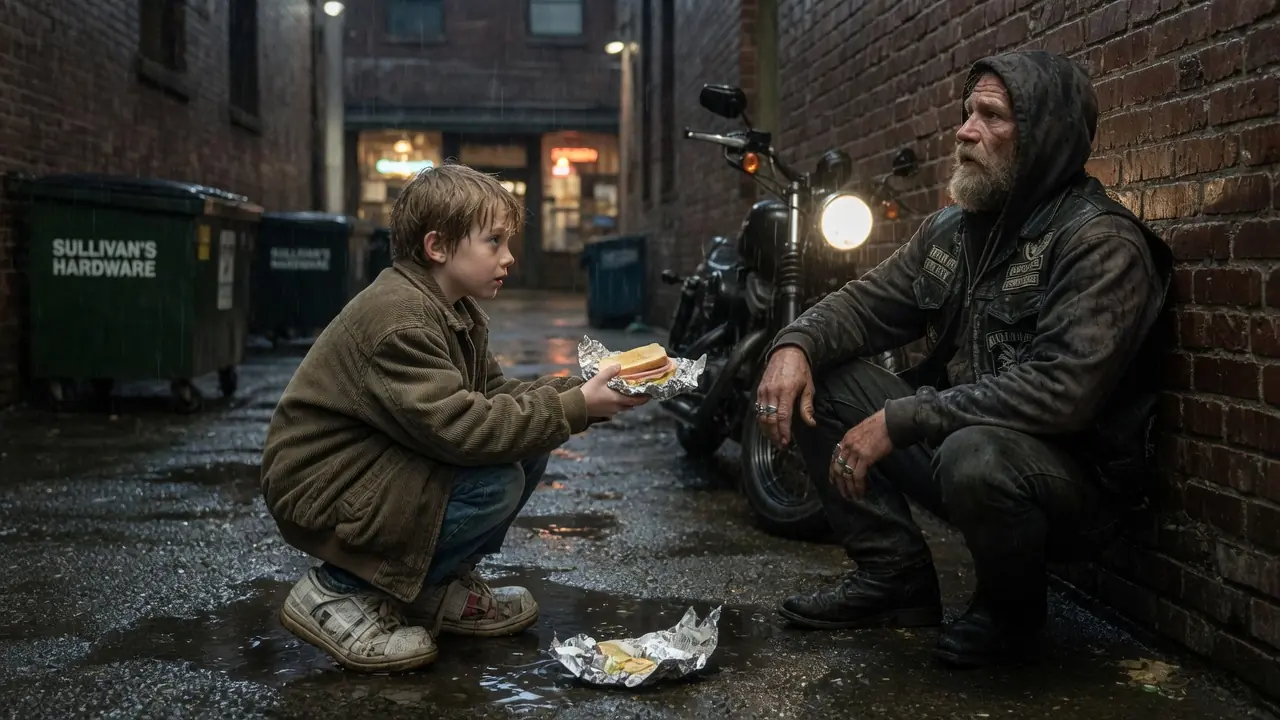
For nine-year-old Oliver Finch, the cold was a physical weight pressing against his thin, oversized corduroy jacket.
It was eight o’clock on a Tuesday night, and the streets were completely dead, abandoned by sensible folks with warm living rooms and hot dinners. Oliver had not known a hot dinner in seven months.
Since his mother, Sarah, passed away from a sudden, aggressive pneumonia in the spring, Oliver had been thrust into a broken state system. After two weeks in a nightmare of a group home, he had done the only thing that made sense to his grieving mind.
He ran.
Now his bedroom was a stack of flattened cardboard boxes tucked behind the rusting dumpsters of Sullivan’s Hardware.
That particular Tuesday had been a rare stroke of luck. Oliver had spent three hours sweeping the stockroom floors of a local bakery down on Main Street. The owner, a stern but tired woman named Clara Peterson, could not offer him cash off the books, but she handed him something just as valuable.
A massive, freshly made ham, cheddar, and apple butter sandwich wrapped in thick foil.
It was the heaviest piece of food Oliver had held in days. His stomach cramped painfully at the smell of the smoked meat and sharp cheese leaking through the wrapping.
He planned to take it back to his alley, crawl under his tarp, and savor every single bite.
But as he rounded the corner into the narrow brick corridor of Elm Street, a shadow blocked his path.
It was not a monster, though it certainly looked like one.
A massive Harley-Davidson, customized in matte black and chrome, leaned heavily against the brick wall. Beside it, slumped on the freezing, rain-slicked pavement, was a giant of a man.
He wore heavy, scuffed leather boots, thick denim, and a leather cut over a heavy hoodie. On the back of the cut, the unmistakable winged death’s head of the Hells Angels Motorcycle Club was emblazoned, accompanied by a bottom rocker that read Oregon.
Oliver froze.
Every survival instinct he possessed screamed at him to back away. The town’s police always talked about biker clubs like they were the devil incarnate.
But as Oliver took a step back, the giant groaned, his massive head lolling to the side.
The man’s face was pale, slick with a terrifying amount of cold sweat. His hands, adorned with heavy silver rings, were trembling violently. He was clutching his abdomen, his breathing shallow and rapid.
Oliver recognized that violent trembling immediately.
His mother had been a severe type 1 diabetic. When she could not afford her insulin and her blood sugar plummeted, she would shake just like that, sweating through her clothes, unable to form words, inches away from losing consciousness.
The giant biker was not drunk. He was not hurt from some gang fight.
He was crashing hard.
Oliver looked down at the warm foil in his hands.
It was his only meal.
He swallowed hard, a lump forming in his throat.
Slowly, fighting his own terror, Oliver stepped closer.
“Mister,” he whispered.
The biker’s eyes fluttered open. They were a piercing, stormy gray, but completely unfocused. He tried to speak, but only a dry rasp came out.
“Meds,” he mumbled, his jaw locked tight with tremors. “Sugar.”
Oliver did not hesitate anymore.
He dropped to his knees in the puddles, his thin jeans instantly soaking through. He frantically tore open the foil. The smell of the ham and apple butter hit him again, making his mouth water violently, but he pushed the sandwich toward the man’s face.
“Here,” Oliver urged, his small voice surprisingly firm. “Eat this. The apple butter has sugar. You have to eat it.”
The biker, a man known to the underworld as Silas “Grizzly” Henderson, president of the Blackwood charter, blinked through the haze of a severe hypoglycemic episode. He had been riding back from a grueling three-day run, had not eaten since dawn, and his body had finally mutinied.
He was alone, stranded in a dead zone, and he had honestly believed he was going to die in a wet alleyway.
Silas’s massive, shaking hand reached out. He took a clumsy bite of the sandwich.
The sweet apple butter and the protein from the ham hit his system quickly. Oliver sat beside him in the freezing rain, breaking off smaller pieces and handing them to the terrifying outlaw, making sure he chewed.
It took twenty minutes.
Twenty minutes of silence in the freezing Oregon rain.
Finally, the violent shaking stopped. Silas leaned his head back against the cold brick, his breathing stabilizing. The color slowly returned to his scarred, weather-beaten face.
He looked down at the empty foil wrapper and then at the shivering, soaking wet kid sitting cross-legged next to him.
Silas noted the boy’s sunken cheeks, the dark circles under his eyes, and the shoes that were two sizes too big and stuffed with newspaper.
“That was your dinner, wasn’t it, kid?” Silas asked, his voice a deep, gravelly baritone that vibrated in the tight alley.
Oliver looked down at his shoes and nodded slightly.
“Yes, sir.”
Silas stared at him, a profound, heavy silence settling between them.
“Why did you give it to me? You’re starving.”
“My mom,” Oliver said softly, his voice cracking. “She used to shake like that. When her sugar got low, she didn’t make it. I couldn’t let you just sit here and shake like she did. Nobody helped her. I didn’t want you to be alone.”
Something imperceptible shifted in Silas’s stormy eyes.
This hardened man, this outlaw who had seen the darkest corners of humanity, felt a physical ache in his chest that had nothing to do with his blood sugar.
Silas slowly reached into his heavy leather jacket. Oliver flinched, but Silas only pulled out a heavy, fleece-lined leather riding vest.
He leaned forward and draped it over Oliver’s tiny shoulders.
It enveloped the boy like a heavy, warm blanket smelling of gasoline, old leather, and pine.
“What’s your name, son?” Silas asked.
“Oliver.”
“Listen to me, Oliver,” Silas said, pulling a heavy, custom-engraved silver Zippo lighter from his pocket and pressing it into the boy’s cold hand. “My name is Silas. I have to go get my rig patched up, but you keep this. You stay right here in this alley. I’m coming back for you tomorrow morning. And I swear on my life, you will never go hungry again. Do you understand me?”
Oliver, clutching the heavy silver lighter, nodded.
Silas managed to kick-start his Harley. The roar echoed off the bricks, and he vanished into the rainy night.
But Silas would not find Oliver the next morning.
Dawn brought no warmth to Blackwood, only a gray, unforgiving light. Oliver awoke under his damp tarp, wrapped in Silas’s massive leather vest, feeling a strange glimmer of hope.
He waited.
He watched the mouth of the alley, but the roar of a Harley never came.
Instead, the screech of tires and the flashing of red and blue lights shattered the morning.
Before Oliver could scramble out from under his cardboard fort, a heavy hand grabbed him by the collar of the vest, hauling him up into the air.
It was Deputy Miller, a notoriously cruel officer who treated the town’s homeless population like a personal infestation he needed to exterminate.
“Gotcha, you little rat,” Miller spat, his breath smelling of stale coffee and cigarettes.
He noticed the heavy Hells Angels vest draped over the boy and ripped it off Oliver’s shoulders with a sneer.
“Stealing from bikers now? You’re really trying to get yourself killed. Get in the cruiser.”
Oliver kicked and screamed, clutching the silver Zippo in his pocket, but he was no match for the grown man. He was thrown into the back of the police cruiser, the doors locking with a terrifying click.
Deputy Miller did not take him to the station.
He drove him straight to the edge of town, to a large decaying Victorian house surrounded by a wrought iron fence.
It was the residence of Gregory Hayes.
On paper, Gregory Hayes was a respectable citizen, a state-licensed foster provider who took in difficult boys. He received a hefty check from the state for every child under his roof.
In reality, Hayes was a monster.
He used the boys as free labor for his landscaping business, starved them to keep costs down, and ruled the house with absolute, terrifying control.
Oliver had run away from Hayes’s house three weeks ago after watching a teenager get beaten with a belt buckle for dropping a plate.
As Miller dragged Oliver up the porch steps, the front door opened.
Hayes stood there, a tall, imposing man with dead, cold eyes.
“Found your runaway, Gregory,” Miller said casually, handing Oliver over. “Caught him sleeping behind Sullivan’s. Had this gang trash on him.”
Miller tossed Silas’s leather vest onto the porch.
“Appreciate it, Miller,” Hayes said, his grip tightening like a vise on Oliver’s arm. “The state was starting to ask questions. I’ll make sure the boy learns not to wander.”
The moment the police cruiser pulled away, Hayes’s facade dropped.
He dragged Oliver inside, ignoring the boy’s cries.
“Three weeks,” Hayes hissed, his face inches from Oliver’s. “Do you know how much trouble you caused me? Do you know how much money the state almost withheld?”
He did not wait for an answer.
Hayes dragged Oliver down the main hallway, unlocked a heavy oak door, and shoved the boy down a flight of wooden stairs.
Oliver tumbled, scraping his knees and elbows, landing hard on the concrete floor of the cellar.
“You can sit in the dark and think about your poor choices until I decide you’re allowed to eat.”
Hayes slammed the heavy door shut, and the deadbolt slid into place with sickening finality.
The cellar was pitch black, smelling of mold and damp earth. Oliver curled into a tight ball in the corner, sobbing silently into his knees.
He reached into his pocket and pulled out the silver Zippo, tracing the engraved letters in the dark.
Silas.
He had promised.
But the police had ruined it.
Oliver was trapped in hell, and no one in the world knew where he was.
Twenty miles away, at the heavily fortified Hells Angels clubhouse on the outskirts of the county, the atmosphere was entirely different.
Silas “Grizzly” Henderson sat at the head of a massive scarred oak table. He looked exhausted, having spent the night at the hospital getting IV fluids and having his insulin levels stabilized.
But his eyes were sharp and burning with a terrifying intensity.
Surrounding him were twenty of his highest-ranking officers, men with names like Bones, Harrison, Declan Vance, and Sullivan. These were men who lived by a strict, violent code, but a code nonetheless.
“I went back to Elm Street,” Silas said, his voice deadly quiet.
The room fell utterly silent.
“The boy was gone. But I found my vest in a trash can near the alley. And I found tire tracks. Police issue.”
Silas looked over at his sergeant-at-arms, Bones, a man who stood six foot six and weighed three hundred pounds.
“Bones, you still have that contact down at dispatch?”
“Yeah, boss,” Bones grunted.
“Find out what cruiser was in the Elm Street sector at seven this morning. Find out where they went, and find out where the state puts orphaned kids in this miserable county.”
It took less than an hour.
Bikers operated networks that rivaled federal intelligence, built on favors, fear, and deep-rooted community ties.
Bones walked back into the meeting room, his face dark with fury.
“Cruiser belonged to Deputy Miller,” Bones reported, slamming a notepad onto the table. “Dispatch records show he responded to a vagrancy call. He didn’t take the kid to lockup. He took him to a state foster house on the ridge. Guy named Gregory Hayes runs it.”
Silas narrowed his eyes.
“Tell me about Hayes.”
“It’s bad, brother,” Bones said, his jaw tight. “I made a few calls to some of the local boys. Hayes is untouchable. Golfs with the judge, drinks with the sheriff. The state pays him to house kids. But the word on the street is it’s a labor camp. Kids go missing. Kids get hurt. Cops look the other way because he keeps the problem children off the streets.”
Silas stood up slowly. The chair scraped loudly against the wooden floorboards.
He walked over to the wall where his heavy leather president’s cut hung. He slipped it on, the leather creaking in the silent room.
“That kid gave me his last meal while he was starving in the freezing rain,” Silas said to the room, his voice echoing with absolute authority. “He saved my life. And right now, he is sitting in a torture chamber run by a corrupt scumbag because a dirty cop put him there.”
Silas turned to look at his men. The air in the room crackled with kinetic energy.
“Call the northern chapters,” Silas commanded, his eyes burning with cold fire. “Call the valley boys. Call the nomads. Tell them we have a church run. Every man who can ride gets on his bike. Now.”
Bones grinned, a terrifying wolfish smile.
“How many are we looking at, boss?”
Silas strapped a heavy buck knife to his belt.
“All of them. We’re going to tear that house down to the studs.”
By two o’clock that afternoon, the quiet, oppressive silence of Blackwood began to vibrate.
It did not start as a sound, but as a feeling.
The coffee in the mugs at the local diner began to ripple. The glass windows of the hardware store vibrated gently in their frames. Dogs in backyards stopped barking, their ears pinned back, whining at the horizon.
Then came the sound.
A low, guttural, synchronized thunder.
It rolled over the hills and through the pine trees, growing louder and louder until it drowned out the wind, the cars, and the very thoughts of the townspeople.
Residents spilled out onto the sidewalks, staring down Main Street in absolute shock.
Coming over the crest of the hill, riding in perfect military-style formation, was a river of roaring chrome and matte black.
It was not ten bikers.
It was not twenty.
It was one hundred and fifty fully patched Hells Angels.
They rode two abreast, stretching for blocks, a terrifying cavalry of leather, steel, and exhaust smoke. The ground shook beneath their tires.
The local police, including Deputy Miller, who was sitting in his cruiser eating a donut, froze in sheer panic. Miller did not even dare turn on his sirens. He just shrank down in his seat as the massive convoy roared past, ignoring the speed limits and the red lights.
They were not stopping at the bars.
They were not heading for the highway.
They were turning up the ridge, heading straight for the wrought iron gates of Gregory Hayes’s property.
The decaying Victorian house on the ridge had always stood as an imposing fortress of misery.
But at two fifteen that afternoon, it became an island completely surrounded by a sea of chrome, leather, and fury.
Gregory Hayes was in his ground-floor office, meticulously adjusting the fraudulent billing ledgers he submitted to the state, when his coffee cup began to rattle against its saucer.
He frowned, assuming it was a low-flying cargo plane.
But the vibration did not pass.
It amplified.
It crept up his legs, rattled the picture frames on the wall, and shook the glass in the windowpanes until they buzzed like angry hornets.
Hayes stood up, irritated, and walked to the front window. He pulled back the heavy velvet curtain.
The blood drained from his face so fast he nearly lost his balance.
Pouring through the open wrought iron gates of his driveway was an endless, roaring tide of motorcycles.
They did not just park.
They executed a perfectly orchestrated blockade.
Dozens of bikes sealed off the exit, parking horizontally across the driveway. Others fanned out across the dying grass of the front lawn, their tires chewing up the turf. More riders circled to the back of the property, effectively sealing every door, window, and escape route.
The engines idled, creating a synchronized, chest-rattling mechanical growl that sounded like the earth itself was splitting open.
Then one hundred and fifty men killed their engines simultaneously.
The sudden ringing silence that followed was somehow more terrifying than the noise.
From the center of the pack, Silas “Grizzly” Henderson dismounted his matte black Harley.
He did not rush.
He moved with the slow, deliberate, and terrifying grace of an apex predator that had successfully cornered its prey.
Flanking him were Bones, clutching a heavy steel crowbar casually in his left hand, and Sullivan, a heavily tattooed enforcer whose eyes were dead and completely devoid of mercy.
Hayes, panicking, grabbed the phone on his desk and dialed 911.
“Dispatch, this is Gregory Hayes. I need Sheriff Caldwell and every deputy you have at my property right now. It’s a gang invasion. They’re trespassing.”
He slammed the phone down, his hands trembling violently. He rushed to his front hallway, locking the deadbolt and throwing the heavy brass chain into place.
He was a man who thrived on terrorizing defenseless children, but faced with actual danger, his bravado vanished into thin air.
Heavy steel-toed boots echoed on the wooden planks of the porch.
Knock.
Knock.
Knock.
The strikes against the heavy oak door were slow and measured.
“Go away!” Hayes screamed, his voice cracking. “The police are on their way. You’re all going to federal prison for this!”
Outside, Silas did not even raise his voice. He spoke calmly, but the baritone carried easily through the wood.
“Open the door, Hayes, or we take the house down to the foundation with you in it.”
“I don’t know who you are, but you’re making a massive mistake!” Hayes shouted back, retreating toward the staircase.
On the porch, Silas looked at Bones and nodded once.
Bones did not bother with the doorknob. He stepped back, raised a massive size fourteen boot, and kicked the door just beside the lock.
The sheer concussive force splintered the oak frame instantly. The deadbolt tore through the wood, and the heavy brass chain snapped like cheap jewelry.
The door flew inward, crashing violently against the hallway wall.
Silas stepped over the threshold, his stormy gray eyes scanning the dim interior.
The house smelled of stale bleach, boiled cabbage, and absolute despair.
Behind him, a dozen high-ranking Hells Angels filed into the hallway, filling the space with their immense, intimidating presence.
Hayes was backed against the banister, pale and sweating.
“You’re dead!” he stammered. “You hear me? You biker trash are dead. I know the judge. I know the mayor.”
Silas walked slowly toward him.
He did not draw a weapon.
He did not need one.
He reached out with terrifying speed, grabbed Hayes by the throat, and slammed him hard against the floral wallpaper. The impact knocked the wind out of the abusive foster provider in a sharp gasp.
“I’m going to ask you one time,” Silas said softly, the calm in his voice contrasting sharply with the force of his grip. “Where is the boy?”
Hayes clawed at Silas’s wrist.
“Nine years old,” Silas continued. “Name is Oliver. You brought him here at seven this morning.”
“I don’t know what you’re talking about,” Hayes choked out, his eyes bulging. “State confidentiality.”
Silas tightened his grip just a fraction.
“Bones. Sullivan. Search the house. Tear it apart.”
The bikers dispersed like a tactical strike team.
Doors were kicked open. Furniture was overturned.
Within minutes, Sullivan emerged from the kitchen, guiding three terrified, emaciated teenage boys. They were wearing ragged clothes, and one of them had a fresh, dark purple bruise across his cheekbone.
Silas looked at the boys, his jaw tightening.
He looked back at Hayes, pure disgust radiating from his face.
“You run a real nice charity here, Gregory.”
“Mister?”
One of the teenage boys, a kid named Daniel, spoke up, his voice trembling. He was looking at the winged death’s head on Silas’s leather cut.
“You looking for the new kid? The little one?”
Silas dropped Hayes to the floor. The man collapsed, gasping for air.
Silas knelt down so he was eye level with the teenager.
“Yeah, son. I’m looking for Oliver.”
“He put him in the cellar,” Daniel whispered, pointing a shaking finger toward the back hallway. “He threw him down the stairs. The door is locked from the outside.”
Silas’s eyes went completely cold.
He stood up, stepping right over Hayes’s wheezing body, and walked down the hall.
He found the heavy oak door.
It had a heavy iron deadbolt secured on the outside.
Silas did not ask Bones to kick this one down. He reached out, undid the heavy iron latch himself, and pulled the door open.
The smell of damp earth and mold hit him.
The staircase descended into pitch blackness.
“Oliver!”
Silas called out, his deep voice carrying down into the dark.
For a moment, there was only silence.
Then, a faint metallic click.
At the bottom of the stairs, a tiny orange flame sparked to life. It illuminated a small, shivering figure curled tightly in the corner of the concrete floor.
Oliver was holding the heavy silver Zippo lighter with both hands, using its meager flame to push back the terrifying darkness.
“Silas!”
A tiny, tear-streaked voice called back.
Silas descended the stairs rapidly, ignoring the creaking wood. He dropped to his knees on the freezing concrete.
Oliver dropped the lighter and threw his small arms around the giant biker’s neck, burying his face in the rough leather cut, sobbing uncontrollably.
Silas wrapped his massive arms around the boy, pulling him close, shielding him from the damp and the cold. He felt the boy’s ribs through his thin shirt.
“I got you, kid,” Silas whispered fiercely, his own voice thick with emotion. “I got you. I told you I’d come back.”
“The policeman,” Oliver sobbed into his shoulder. “He took your jacket. He took me away.”
“I know,” Silas said, standing up and lifting the nine-year-old effortlessly into his arms, carrying him like he weighed absolutely nothing. “And that policeman is about to have a very, very bad day.”
When Silas emerged from the cellar with Oliver in his arms, the front lawn had become a powder keg.
Five Blackwood police cruisers had skidded onto the dying grass, their sirens blaring.
Sheriff Thomas Caldwell and Deputy Miller stood behind their open vehicle doors, hands hovering nervously near their holsters. They were vastly outnumbered by one hundred and fifty Hells Angels standing in dead silence, forming an impenetrable wall of leather and muscle.
Silas stepped onto the porch.
Bones followed closely, dragging a sobbing Gregory Hayes by the collar and tossing him down the wooden steps into the dirt.
“Henderson!” Sheriff Caldwell shouted, his voice cracking under the pressure. “Put the boy down. You’re trespassing and kidnapping a state ward. Surrender now, or this gets worse.”
Silas did not flinch.
He set Oliver down gently, keeping a massive, protective hand on the boy’s trembling shoulder.
“Kidnapping?” Silas echoed, a dark, mocking laugh rumbling in his chest. “We’re not breaking the law, Caldwell. We’re doing the job you’re paid to ignore.”
“I don’t have time for your games,” Deputy Miller spat, pale with panic.
The real twist did not arrive with the roar of a motorcycle, but with the quiet, stealthy hum of a black SUV pulling up behind the police barricade.
The bikers parted seamlessly, creating a clear path.
Four federal agents stepped out, led by Special Agent Rebecca Thornton of the anti-corruption task force.
Sheriff Caldwell’s face drained of color.
“Agent Thornton? What is this?”
Thornton ignored him, walking straight to Silas.
From the crowd of bikers, Wyatt, the club’s tech specialist, stepped forward and handed Thornton a thick manila envelope and a flash drive.
“Every offshore wire, fraudulent state document, and kickback Hayes paid to Caldwell and Miller for the last five years,” Wyatt stated calmly. “Hayes took the state’s money to run a labor camp, and the local cops took a cut to look the other way.”
Thornton turned her icy gaze to the local law enforcement officers.
“Sheriff Caldwell, Deputy Miller, you are under federal arrest for extortion, wire fraud, and child endangerment.”
The corrupt officers instantly surrendered, realizing the bikers had not just outmuscled them.
They had outsmarted them entirely.
As agents put cuffs on Hayes, Caldwell, and Miller, Thornton looked at Silas and the frail boy clinging to his leg.
“He’ll need an emergency placement,” Thornton noted softly.
“He’s not going back into the system,” Silas stated, his tone leaving no room for argument. “My club’s lawyers are drawing up the emergency foster paperwork tonight. He stays with me.”
Silas looked down at Oliver.
“You like motorcycles, kid?”
Oliver managed a small, genuine smile.
“I still have your lighter.”
“Keep it,” Silas said, scooping the boy up. “You’ll never go hungry again, Oliver. That’s a club promise.”
A single act of pure, selfless compassion in a freezing alleyway completely dismantled a corrupt town’s darkest regime.
Oliver Finch lost his family to tragedy, but by offering his last crumb of comfort to a dying stranger, he gained an army.
Gregory Hayes and the corrupt officers faced federal prison, while Oliver found a permanent home, proving that sometimes the fiercest protectors wear leather, ride iron, and answer to a brotherhood bound by honor.