When eighteen-year-old Leo noticed an SUV circling the local playground for the fifth time, he knew something was wrong.
As a young man living on the streets, he also knew that calling the police often resulted in him being moved along rather than being heard.
He had already tried once that afternoon. 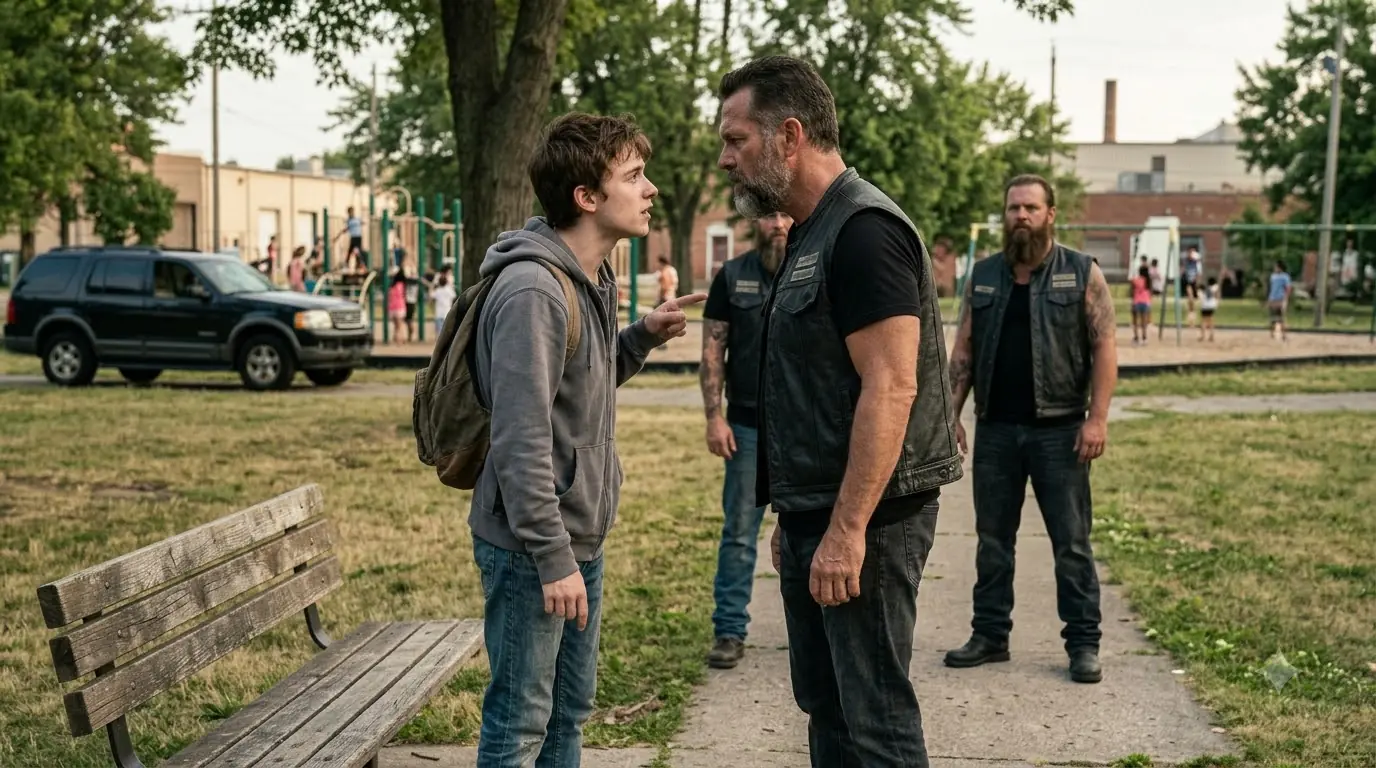
A patrol car rolled past Miller Park, and Leo stood from his weathered bench, waving both arms until the officer cracked the window and told him to move his belongings or risk being cited for loitering.
The cruiser drove away before Leo could explain what he had seen. The black SUV appeared again moments later, moving slowly past the section of the park where the youngest children played.
Leo was eighteen, but his eyes looked older. He had spent the previous two years navigating shelters, alleys, abandoned corners, and park benches after his foster mother died and the system decided he was old enough to manage on his own.
He did not beg and he did not cause trouble. He watched, remembered, and learned how neighborhoods moved because paying attention had often been the difference between safety and danger.
Miller Park was the brightest piece of green in an otherwise gray industrial district. Families filled the playground on weekends, parents sat beneath the trees, and children raced between the swings, sandboxes, and basketball courts.
Because Leo sat in nearly the same place every day, he noticed the small things other people missed. He knew which cars belonged to regular visitors, which delivery drivers cut through the park road, and which parents always arrived late to collect their children.
The black SUV did not belong. It was an older Suburban with windows so dark they reflected the afternoon sky, no permanent plates, and a dealership tag that looked temporary and out of place.
It moved too slowly. Each time it passed the playground entrance, it eased almost to a crawl, then continued around the block only to return again.
Leo had seen people watch children that way before. His stomach tightened with a recognition he wished he did not have.
Across the street stood the Iron Grill Diner. Outside it, parked in a gleaming row, were about twenty motorcycles belonging to the local Hell's Angels chapter led by a gray-bearded man named Jax.
Most people crossed the street when they saw the men in leather vests. Leo had watched them long enough to know that their reputation and their behavior were not always the same thing.
He had once seen several of them stop a mugging behind the diner and then quietly help the elderly flower seller on the corner. They could be intimidating, but they noticed what happened in the neighborhood.
Leo adjusted the straps of his worn backpack and crossed the street. The bikers grew quieter as he approached the center table.
"You lost, son?" Jax asked.
Leo leaned closer.
"That black SUV has circled the playground five times. No plates."
"It slows down near the little kids every time, and the police wouldn't listen to me."
Jax did not move for several seconds. Then he followed Leo's gaze toward the corner.
The Suburban appeared again. It slowed near a five-year-old boy who had wandered several yards from his mother while chasing a ball.
Jax stood. Nineteen other men rose almost at once.
There was no cheering and no grand speech. Jax told Big Mike and T-Bone to cover the park exits while the others spread out where they could observe the vehicle and keep families away from the road.
Within moments, motorcycles moved into visible positions around the perimeter. The driver of the Suburban noticed the sudden attention and tried to leave, but the exits were now occupied by bikers who made it clear that no one was going anywhere until the situation was understood.
Jax approached the driver's window with several club members nearby. He kept his hands visible and his voice controlled.
"Roll it down," he said.
The glass lowered only a few inches. A nervous man inside complained that he had done nothing wrong and threatened to call the police.
"The police didn't want to talk to Leo," Jax replied. "So explain why you've circled the same playground five times."
The driver claimed he was looking for an address. Big Mike pointed out that nobody needed five laps around a playground to find a house.
The man grew more agitated. Jax asked him to step out and wait while someone called the authorities.
As the door opened, the bikers saw binoculars on the passenger seat and several suspicious items in the rear of the vehicle, including unopened children's toys and other materials that made the situation feel far more serious than a wrong turn. No one touched anything further.
Jax immediately called Leo over. "Is this the vehicle?"
Leo looked at the Suburban and nodded.
"Yes. That's the one."
Jax told the driver to remain where he was until the police arrived. He made it clear that the man's safest choice was to cooperate and not go anywhere near the families in the park.
Big Mike contacted a sergeant the club knew at the Fourth Precinct. Within minutes, sirens approached from several directions.
Parents began pulling their children closer as officers secured the scene. The mood in Miller Park shifted from confusion to fear, then to relief as people realized Leo had noticed something before anyone else did.
A police sergeant examined the SUV and spoke with detectives by radio. After several tense minutes, he walked back to Leo.
"You did good, kid," he said.
"We've been looking for a vehicle matching this description in neighboring counties. You may have helped us stop someone we've been trying to identify for a while."
The sergeant then looked at Jax.
"I'll handle the paperwork. Don't think this makes us friends."
Jax grinned. "Wouldn't dream of it, Sarge."
Nearby, a businessman who owned a local security company had been at the park with his children. He approached Leo after watching officers photograph the SUV and take the driver into custody.
The man had watched the entire scene unfold from the edge of the playground, first with confusion and then with the sober expression of someone realizing how close a normal afternoon had come to becoming something else. His polished watch and expensive shirt made him look out of place beside Leo's worn hoodie and frayed backpack, but there was no contempt in his face.
He had also watched Leo stay near the officers, answering questions carefully instead of trying to claim attention. That, more than anything, seemed to interest him.
"You have a good eye," the man said. "Why did you go to the bikers instead of the police?"
Leo looked toward the patrol cars. "Because they were the only ones who didn't look through me."
The businessman had no quick answer. He simply nodded, as if Leo had given him something he would be thinking about long after that afternoon.
Jax stepped beside him and rested a hand on his shoulder.
"He saw what everybody else missed. That's what mattered today."
When the crowd finally dispersed, Leo looked back toward his old bench. Jax noticed.
"That bench is retired," he said.
"We've got a spare room at the clubhouse. Warmer than this place, and we could use somebody who pays attention the way you do."
Leo stared at the motorcycles, then at the playground. For the first time in years, he did not feel like a ghost moving through someone else's city.
That first night at the clubhouse was overwhelming. The place smelled of coffee, motor oil, leather, and cedar, but the room Jax gave him had a real bed and a door that locked from the inside.
The room was simple: a narrow bed, a small dresser, a lamp with a crooked shade, and one clean window facing the alley. To Leo it looked almost impossibly luxurious because nobody had told him when he had to leave.
Big Mike left a clean towel and a stack of folded clothes outside the door without comment. Someone else placed a sandwich wrapped in foil and two bottles of water on the dresser.
Nobody asked Leo to explain the shelters, the alleys, or the nights he had spent awake on park benches. They gave him a room and treated the matter as settled.
Leo lay awake for a long time because safety felt unfamiliar. Eventually, exhaustion won.
He kept expecting footsteps outside the door or a voice telling him he had overstayed his welcome. Instead, he heard distant laughter, dishes being washed, and eventually the deep silence of a building full of people going to sleep.
Sometime before dawn, the tension finally left his shoulders. For the first time in years, he slept without keeping one ear open.
By Monday morning, the atmosphere had changed. The arrest at Miller Park had attracted attention from people connected to the detained driver, and unfamiliar vehicles had begun appearing near the clubhouse.
One dark sedan passed twice before sunrise, while a delivery van parked across the street without making a delivery. The club did not pretend certainty, but the pattern was enough to make everyone cautious.
Static copied the footage for law-enforcement contacts and marked the times each unfamiliar vehicle appeared. Jax's first decision was not retaliation; it was making sure Leo was never left alone.
Jax, Big Mike, and T-Bone reviewed footage from the club's exterior cameras. They did not like the pattern.
"Somebody is watching the block," T-Bone said. "They know Leo identified the SUV."
Leo stood in the doorway with a mug of coffee. The rest he had gotten over the weekend had softened his face, but not his awareness.
Jax motioned him in.
"You did a brave thing. Sometimes brave things attract the wrong kind of attention."
Leo set down the mug. "If this is connected to more kids, they're not going to stop because one driver got caught."
He told them he had seen similar vehicles near the industrial district before, especially around an old cold-storage warehouse near Pier 19. While living outside, he had learned the routes people used when they wanted not to be noticed.
Leo remembered a black SUV idling near the warehouse months earlier. He remembered a blue van with temporary tags, a silver sedan that appeared repeatedly before dawn, and security lights burning at hours when the building was supposedly inactive.
None of those details had seemed important separately. Now, with the Miller Park SUV in police custody, they began to form a shape.
Jax listened carefully. He did not ask Leo to prove anything.
He knew the difference between memory and evidence. The point was not to turn Leo's suspicions into facts; it was to give investigators a lead they could verify.
"Tell us what you remember," he said.
Leo described the black SUV, a blue van, and a silver sedan that appeared around the warehouse at unusual hours. He remembered trucks arriving before dawn and leaving quickly.
The club passed the information to a trusted contact in law enforcement. Rather than storming the property themselves, they agreed that the safest move was to help authorities establish whether the warehouse was connected to the Miller Park arrest.
Leo worked with Static, the club member who handled computers and security systems, to reconstruct the vehicles' likely routes using publicly available traffic information, old photographs, and Leo's memory of the industrial district. The goal was not to break into anything but to give investigators a map of where to look.
The work lasted for hours. Static would pull up a map, and Leo would point out an alley, a loading road, or a place where he remembered seeing the same vehicle sit too long.
Leo did not remember streets the way most people did. He remembered them as smells, broken lights, fences, barking dogs, steam vents, places where you could sleep, and places you absolutely could not.
What had once been a survival map of the city became an investigative map. The knowledge Leo had gained by being unwanted was suddenly helping people who had never known he existed.
Again and again, the routes converged near Pier 19. What Leo remembered lined up with reports detectives had already begun collecting.
The sergeant from Miller Park returned to the clubhouse that evening. This time, he did not treat Leo like a nuisance.
He carried a thin folder and asked Jax if they could talk at the dining table. Leo expected to be sent away, but the sergeant pulled out a chair for him.
That small gesture did not erase what had happened at the park. Leo noticed it anyway.
"We have a task force looking at Pier 19 now," he said. "Your information filled in gaps we didn't know we had."
The sergeant explained that detectives had connected the detained driver's phone and travel history to prior reports involving missing children in nearby counties. Nothing had been proven yet, but the warehouse was now part of an active investigation.
Leo listened without interrupting. The sergeant looked at him differently now, as though still adjusting to the fact that the teenager he had nearly cited for loitering had handed detectives their strongest new lead.
Leo asked what would happen if there were children inside. The sergeant told him trained teams would handle the entry and that Leo's job was to stay safe.
Jax agreed.
"You've already done enough. You don't have to prove anything by putting yourself in danger."
Leo wanted to argue, but he understood the difference between courage and recklessness. He gave investigators every detail he knew, including where he had once sheltered near the warehouse during a winter storm and which streets provided a clear view of the loading area.
Before dawn the next morning, police and federal agents moved on Pier 19 under a court-authorized operation. Jax and several club members stayed several blocks away with Leo, waiting for updates.
The bikers hated waiting, but Jax enforced it.
"We gave them the map," he said. "Now we let the people with warrants and rescue teams do their jobs."
Leo understood the difference between courage and recklessness, but understanding did not make the waiting easier.
The wait felt endless. Leo paced beside the motorcycles, thinking about every strange noise and every vehicle he had seen around that part of the city.
He wondered whether he had remembered something wrong. He wondered whether the warehouse would be empty and everyone would decide the homeless kid had finally imagined too much.
Then he imagined the opposite and felt worse. Jax noticed his hands shaking and handed him a paper cup of coffee without saying anything.
Then radios crackled. Officers had located multiple frightened children inside the property along with records linking the warehouse to a broader trafficking network.
Several minutes later, the sergeant came toward them at a fast walk. The look on his face told Leo the answer before he spoke.
The children were alive. Rescue workers were already moving them toward safety.
The operation spread quickly through the building. Several suspects tried to flee, but exits had already been secured by law enforcement.
Within less than an hour, emergency medical teams were caring for the children. Investigators began collecting records, phones, financial documents, and vehicle information that pointed to other people involved in the network.
Blankets appeared, bottles of water were passed around, and child advocates arrived to stay with the youngest victims. The scene was still tense, but the center of it had shifted from danger to care.
The evidence suggested the operation was larger than one driver and one warehouse. Leo had not simply noticed a suspicious car; he had opened a door investigators had been trying to find.
Leo stood behind a police barrier when the first children were escorted out. He recognized one of the young faces from Miller Park.
His knees nearly gave out. Jax caught his shoulder before he fell.
"You saw it," Jax said quietly. "You saw what everybody else missed."
The same sergeant who had dismissed Leo days earlier walked toward him. His face looked different now, stripped of the impatience Leo remembered.
He removed his cap.
"I owe you an apology. I looked at your clothes and your backpack and saw a problem instead of a person."
Leo said nothing. The sergeant continued.
"You tried to warn me, and I didn't listen. Because you kept trying anyway, these kids are going home."
Jax stepped beside Leo. "Remember that next time somebody without an address or a clean shirt tells you something matters."
The sergeant nodded. "I will."
The investigation that followed was far larger than anyone at Miller Park had imagined. Evidence from the warehouse led to arrests in other parts of the city and helped investigators identify people who had financed, transported, or protected the operation.
For weeks, reporters tried to turn the case into a story about outlaw bikers declaring war on criminals. Jax rejected that version every time.
"The kid saw something," he told one reporter.
"The rest of us finally listened. That's the story."
The details stayed mostly out of Leo's hands, which was exactly how Jax wanted it. Leo had survived by becoming invisible; now the club wanted his next chapter to be about building a future, not chasing danger.
The security-company owner from the park returned and offered Leo part-time work when he was ready. Identification documents, housing forms, medical appointments, and school applications suddenly received the same attention the club usually gave to broken motorcycles.
Leo discovered that ordinary bureaucracy could feel almost as intimidating as the street. Jax sat beside him through forms he did not understand and never once made him feel stupid for asking what a box meant.
News outlets began calling him the Lion of Miller Park. Leo hated the nickname at first, but neighborhood kids loved it.
The city council invited him to a public ceremony and offered him a medal of valor along with a symbolic key to the city. Leo declined.
He had no interest in standing beneath bright lights while officials congratulated themselves for finally noticing him. He wanted something more practical.
A month later, the bikers held a small gathering in the sunlit courtyard behind the clubhouse. There were no cameras and no politicians.
Leo thought it was only a Saturday barbecue until Jax called him forward. The older biker looked uncomfortable with ceremony and even more uncomfortable with emotion.
"We argued about giving you a patch," Jax said. "Decided that wasn't your road unless you ever chose it for yourself."
Jax handed Leo a set of keys. They belonged to a renovated apartment above the Iron Grill Diner, close enough to the park that Leo could still see the playground from the upstairs window.
The apartment had one bedroom, a tiny kitchen, a secondhand couch, and sunlight that came through the front windows in the afternoon. To Leo, it looked bigger than any place he had ever been allowed to call his own.
"This is yours as long as you need it," Jax said.
Leo stared at the keys. For years, every place he slept had belonged to someone else or could be taken away without warning.
Then Big Mike handed him a thick envelope. Inside was a scholarship package funded by the club, neighborhood donors, and several parents whose children had been in Miller Park that Saturday.
The scholarship also covered books, transportation, and the ordinary expenses that so often stop low-income students long before tuition does. Big Mike looked away while Leo read the letter, pretending to be deeply interested in the grill.
The money would cover tuition for a university program in sociology and law if Leo chose to pursue it. Nobody told him he had to become a cop, a lawyer, or anything else.
"The world needs people who notice who's being ignored," Jax told him. "You saved those kids because you knew what it felt like to be invisible."
Leo looked toward Miller Park. Children were running through the playground while parents talked beneath the trees.
The black SUV was gone. In its place were ordinary minivans, bicycles, strollers, and the familiar noise of a neighborhood relaxing again.
Leo had spent much of his life believing visibility was dangerous. Now he understood that being seen by the right people could change everything.
He moved into the apartment above the diner with a backpack, two changes of clothes, several library books, and the first set of house keys he had ever truly been able to call his own. Jax helped him carry a secondhand desk upstairs.
Static found him a refurbished laptop. Big Mike bought groceries and pretended he had simply ordered too much for the clubhouse.
The sergeant kept his promise, too. He returned to Miller Park several times over the following months and made a point of speaking to people who were usually ignored by patrol officers.
He and Leo never became close friends, but they developed something neither expected: respect. When Leo gave information, the sergeant listened before deciding what it meant.
The security-company owner who had first spoken to Leo after the SUV arrest offered him part-time work monitoring cameras and writing incident reports. Leo accepted because it let him turn the skill he had developed for survival into a legitimate job.
He was good at it. Very good.
Within a year, Leo was taking community-college classes while preparing for university. He still spent Saturday mornings at the diner.
Every weekend, a row of motorcycles appeared outside the Iron Grill, and the men who once frightened half the neighborhood drank coffee with the young man who had walked up to their table with a warning nobody else wanted to hear.
Sometimes parents from Miller Park stopped by to thank him. Leo never knew what to say, so he usually nodded and asked how their children were doing.
Jax watched those conversations with quiet pride. He never called Leo a hero to his face.
Instead, he gave him ordinary responsibilities.
Lock the back door. Pick up coffee.
Help Static with the camera logs. Remember that Big Mike hated onions.
That normality mattered more than any medal. Leo had not simply been rescued from the street; he had been invited into a community where he was expected to stay.
Years of being overlooked had taught him to see what other people missed. For once, that survival skill had become something larger than survival.
Miller Park remained noisy, imperfect, and alive. Kids still wandered too far from their parents, teenagers still argued on the basketball court, and the old benches still collected people with nowhere else to go.
Leo never forgot his bench. Sometimes he sat there after class with a coffee and watched the road, not because he expected another black SUV, but because paying attention had become part of who he was.
He was no longer waiting for the city to see him. He had found people who already did.