The first time ten-year-old Lily Carter brought breakfast to the old biker, she had not eaten anything herself.
She stood barefoot on the cracked sidewalk of Millstone Avenue in Fairview, Missouri, wearing an oversized gray hoodie that reached almost to her knees. Her pale blonde hair was tied into a loose ponytail, and the morning wind had turned her cheeks pink. In both hands, she carried a small brown paper bag containing one biscuit, two strips of bacon, and a cup of coffee with a plastic lid pressed crookedly on top.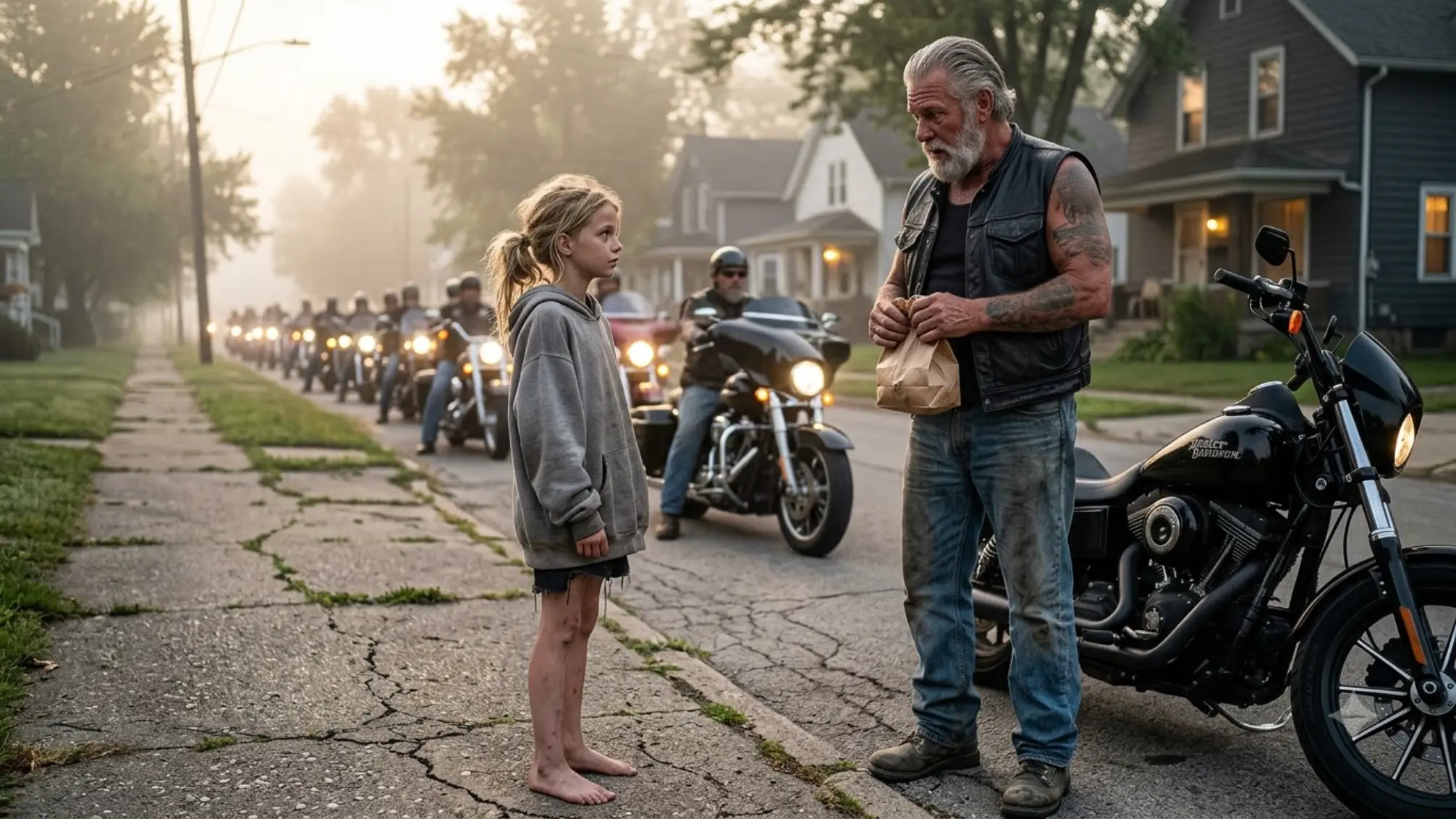
The biker sat alone beside a black motorcycle parked near an abandoned storefront.
His name was Silas “Bear” Mercer. He was fifty-nine years old, tall and heavily built, with weathered skin, gray hair brushed back from his face, and a thick beard that hid most of his expression. Tattoos covered his muscular arms beneath a worn black leather vest, and the patches on his back made most people cross the street before reaching him.
Lily did not cross.
She stopped beside the motorcycle and held out the bag.
“I brought you breakfast.”
Bear looked at her, then at the food.
“Why?”
Lily shrugged. “You always look like nobody else does.”
Bear’s rough hand tightened around the coffee he had already purchased from the gas station. He had heard insults, threats, and frightened whispers for most of his life, but no one had ever described his loneliness so simply.
“Kid, most people see the patches and walk the other way.”
“I just saw you eating alone.”
Bear accepted the bag carefully, as though it contained something breakable.
“You hungry?”
“No.”
Her stomach answered for her.
The growl was quiet, but Bear heard it.
He opened the bag, tore the biscuit in half, and held one piece toward her.
Lily stepped backward. “That’s yours.”
“Not anymore.”
“I brought it for you.”
“And I’m sharing it with you.”
She hesitated until he sat on the curb, lowering his enormous body so he no longer towered over her. He placed half the biscuit on the paper wrapper between them.
“We eat together,” he said. “That’s the deal.”
Lily finally sat.
They ate without speaking while the town slowly awakened around them. Delivery trucks rolled toward the grocery store, porch lights went dark, and commuters drove past without noticing the thin little girl sharing breakfast with the man everyone called dangerous.
When Lily finished, she stood quickly.
“I have to go.”
Bear looked at her bare feet.
“Where are your shoes?”
“They got wet.”
“That wasn’t my question.”
She pulled the sleeves of her hoodie over her hands. “I’ll bring breakfast tomorrow.”
Then she ran down the sidewalk and disappeared behind a row of neglected houses before he could stop her.
Bear remained beside the motorcycle with half a strip of bacon in his hand.
He had come to Fairview because the town held memories he had spent fifteen years avoiding. His younger brother, Daniel Mercer, had died there after a warehouse accident. Bear blamed himself because Daniel had called him the night before, asking for help leaving a dangerous job, but Bear had been riding across Texas and ignored the call.
Daniel left behind a wife and infant daughter.
Bear sent money for several years, but the letters eventually returned unopened. Daniel’s widow moved, and Bear lost contact with them. He convinced himself they were better without a scarred biker appearing in their lives carrying guilt instead of answers.
He returned to Fairview only because his club planned a charity ride through Missouri. Bear arrived early, intending to visit Daniel’s grave before the others came.
Instead, he met Lily.
The following morning, Bear waited beside his motorcycle at seven.
At seven fifteen, Lily appeared carrying another paper bag.
This time, the bag held a sausage sandwich and a bruised apple.
Bear accepted it, then opened the saddlebag attached to his motorcycle.
He removed a pair of new sneakers.
Lily stared at them.
“No.”
“They’re not expensive.”
“I can’t pay you.”
“They cost the same as breakfast for a week.”
“I didn’t ask.”
“Neither did I.”
Lily looked toward the nearby houses as though someone might be watching.
Bear placed the shoes on the sidewalk and stepped away.
“You can leave them there. But if you walk barefoot past broken glass again, I’m going to be angry all day.”
She studied his face, searching for a hidden demand.
There was none.
She sat on the curb and pulled on the sneakers. They were slightly too large, but Bear had included thick socks. Lily tied the laces twice and looked down at her feet with a small smile she tried to hide.
“They’re nice.”
“They’re shoes.”
“They’re the nicest shoes I’ve ever had.”
Bear turned away, pretending to examine his motorcycle because emotion had begun pressing behind his eyes.
They shared the sandwich.
Before Lily left, Bear asked where she lived.
“Nearby.”
“With your parents?”
“My mom.”
“What’s her name?”
“Rachel.”
“Does she know you’re out here?”
Lily’s smile disappeared.
“She sleeps a lot.”
“Is she sick?”
“Sometimes.”
Lily stood and brushed crumbs from her hoodie.
“I’ll see you tomorrow.”
“Lily.”
She froze because he had never asked her name.
“You told the cashier yesterday,” Bear explained. “I heard.”
“Oh.”
“Bring your mother tomorrow.”
“She won’t come.”
“Then tell her Bear wants to meet her.”
Lily looked almost amused. “She’ll think you’re an actual bear.”
“Most people do.”
For the next four mornings, Lily arrived with breakfast.
Sometimes she brought food from the church kitchen, where volunteers distributed leftovers before opening the pantry. Other days, she saved part of the free meal served at school and wrapped it carefully in napkins.
Bear never ate until Lily sat beside him.
He also never asked why she was giving away food she clearly needed. He understood that pride could be the final possession left to someone who had lost nearly everything. Refusing her gift would make her feel powerless, so he accepted it and quietly doubled every meal.
On the fifth morning, rain fell hard enough to empty the streets.
Lily did not come.
Bear waited beneath the awning of the abandoned storefront until nine.
At nine fifteen, he started his motorcycle and followed the direction Lily always took when she left. He rode slowly through a neighborhood where paint peeled from old houses and abandoned cars rested beside overgrown yards.
He found one of the new sneakers near a drainage ditch.
The lace was broken.
Bear stopped the motorcycle, picked up the shoe, and felt fear tighten his chest.
A postal worker recognized Lily’s description and pointed toward a boarded house at the end of Holloway Street. Bear found the front door partly open and knocked hard enough to shake the frame.
“Lily?”
No answer.
He stepped inside.
The house smelled of damp wood, dust, and cold medicine. Blankets covered the broken living-room windows, and a camping stove rested on the floor beside several empty soup cans.
Lily sat near the couch holding her mother’s hand.
Rachel Carter looked far older than thirty-four. Her face was pale, her lips nearly colorless, and sweat covered her forehead despite the cold room.
Lily looked toward Bear with terror.
“Please don’t call anyone. They’ll take me away.”
Bear knelt beside the couch.
“I’m calling an ambulance.”
“We don’t have money.”
“Money is not the first problem.”
Rachel opened her eyes.
For several seconds, she stared at Bear’s face. Then her gaze moved to the leather vest and the old patch above his heart.
“Silas?”
Bear stopped breathing.
No one except family called him that.
Rachel tried to sit but lacked the strength.
“You’re Daniel’s brother.”
Bear looked from Rachel to Lily.
The child’s blonde hair, blue eyes, and stubborn expression suddenly became familiar. He saw Daniel at ten years old, standing beside a stolen bicycle and refusing to apologize until Bear helped repair it.
“Rachel Mercer?” he whispered.
She nodded weakly.
“I went back to my maiden name after Daniel died.”
Bear turned toward Lily.
She was his niece.
For six mornings, Daniel’s daughter had fed him while living in an abandoned house without heat.
Bear closed his eyes.
The guilt he had carried for fifteen years became something heavier.
“I tried to find you.”
Rachel’s expression held no anger, only exhaustion.
“We moved after the warehouse company denied the claim. I lost the apartment. Then my phone changed, and everything kept falling apart.”
“Why didn’t you contact the club?”
“I didn’t know how.”
“You had my name.”
“I thought you blamed me for Daniel’s death.”
Bear shook his head. “I blamed myself.”
The ambulance arrived eight minutes later.
Rachel had severe pneumonia, dehydration, and an untreated heart condition worsened by months without medication. Paramedics carried her outside while Lily gripped Bear’s hand with both of hers.
At the hospital, a social worker began asking questions about housing, school attendance, food, and guardianship. Lily answered carefully, watching Bear every few seconds as though one wrong sentence might make him disappear.
Bear did not leave.
He sat beside her through tests, paperwork, and the long wait for doctors to stabilize Rachel. He bought Lily a proper meal, but she ate only half and wrapped the rest in a napkin.
“You don’t have to save it,” he said.
“I might need it tomorrow.”
Bear lowered his voice.
“You will eat tomorrow.”
“You don’t know that.”
“Yes, I do.”
“How?”
“Because I’m going to be here.”
Lily looked down.
“Adults say that.”
“I’m not good at saying things I don’t mean.”
“You disappeared before.”
The words struck directly at the wound he had hidden.
“Your mom told you?”
“She said Uncle Silas lived far away.”
Bear nodded.
“I was ashamed.”
“Of us?”
“Of myself.”
Lily looked at him with the serious expression of a child forced to understand adult failure too early.
“That’s not the same thing.”
“No. But it hurt you anyway.”
Rachel remained hospitalized for nine days.
Doctors believed she could recover, but only if she had stable housing, medication, and time away from the physical work she had been doing at a motel laundry. The abandoned house belonged to a distant relative who had allowed them to stay temporarily, but the city planned to condemn it.
A child-services worker explained that Lily might enter temporary foster care unless a safe relative could take her.
Bear volunteered immediately.
The worker looked at his vest, tattoos, motorcycle, and criminal record from twenty-eight years earlier. He had served eighteen months for aggravated assault after a bar fight when he was young.
“Placement requires an approved residence,” she said carefully. “Background checks, interviews, and home inspection.”
“I have a cabin.”
“Does it have a bedroom for a child?”
“It will by tonight.”
“This is not something you can solve with construction.”
“Then tell me what else.”
The worker gave him a list.
Bear completed every requirement.
He removed dangerous tools from the living area, locked his firearms in a certified safe, installed smoke detectors, purchased furniture, and submitted to every interview. Two club members drove overnight to help repair the second bedroom.
Lily visited the cabin with her caseworker.
She stood in the doorway of the newly painted room and stared at the bed, desk, lamp, and shelves.
“Whose room is this?”
“Yours, if you want it.”
“What if Mom gets better?”
“Then she lives here too until you both decide what comes next.”
Lily touched the blue blanket.
“You don’t even know us.”
Bear leaned against the doorframe.
“You brought me breakfast six mornings in a row when you had almost nothing.”
“That doesn’t mean we’re good people.”
“No. Daniel being your father means you’re family. The breakfast means you have his heart.”
The temporary placement was approved.
Bear did not tell his club immediately because Lily feared crowds and noise. He sent only one message to Elias “Stone” Mercer, the national road captain and Bear’s closest friend.
Found Daniel’s girl. She and her mother need us. Keep it quiet.
Stone replied:
Tell us when quiet stops being enough.
Rachel left the hospital two weeks later and moved into Bear’s cabin. She needed oxygen during sleep and could not return to work for months. Bear covered her medical costs with money he had saved for retirement, though she protested until he reminded her that Daniel once paid Bear’s motorcycle insurance after he lost a job.
“Family debt doesn’t collect interest,” Bear said.
The three of them developed a cautious routine.
Bear drove Lily to school in an old pickup because she refused to ride the motorcycle. Rachel attended medical appointments and slowly regained strength. Lily continued bringing Bear breakfast, though now she carried it from the kitchen to the porch instead of across town.
For the first time in years, Bear began looking forward to mornings.
The peace lasted until the warehouse company learned Rachel had returned to Fairview.
Daniel’s death had never been investigated properly. The company claimed a faulty storage rack collapsed accidentally, killing him and two other workers. Rachel had always believed safety reports were altered, but she lacked money to challenge the company’s lawyers.
Before becoming sick, she had found Daniel’s old notebook inside a box left at a storage facility. It contained equipment numbers, dates, and names of supervisors who ordered employees to continue working after discovering structural damage.
The company learned she possessed it.
A representative arrived at Bear’s cabin with a settlement offer.
The amount was large enough to purchase a house, cover Rachel’s medical care, and give Lily stability. The agreement required Rachel to surrender the notebook and sign a permanent confidentiality clause.
Bear read the contract.
“They’re buying silence.”
Rachel stared at the amount.
“They’re buying Lily a future.”
Lily stood in the hallway listening.
Bear lowered his voice.
“Daniel’s notebook might protect other families.”
“Daniel is dead. I’m sick. Lily has slept in buildings with no heat.”
“I know.”
“No, Silas. You found us after the worst part. You don’t know what every night felt like.”
Bear absorbed the anger without defending himself.
Rachel began crying.
“I cannot ask my daughter to keep suffering for the truth.”
Lily entered the room.
“You didn’t ask me.”
Rachel wiped her face.
“Sweetheart, this is grown-up business.”
“Dad wrote the notebook because people could get hurt.”
Rachel looked toward Bear.
“You told her?”
“No.”
Lily continued. “I read it when Mom was sick. It says the shelves were bending and the boss made them keep working.”
The company representative returned the following morning expecting a signature.
Instead, he found Bear, Rachel, Lily, a labor attorney, and a state safety investigator waiting at the cabin.
Rachel handed over a copy of Daniel’s notebook.
The representative left without the settlement agreement.
Two days later, someone broke into the cabin while the family attended a medical appointment. Nothing valuable was stolen, but drawers were opened and Daniel’s storage boxes were emptied.
Bear’s security camera captured a vehicle registered to the warehouse company’s private contractor.
That was when quiet stopped being enough.
Bear called Stone.
“They came into the house.”
“Did they hurt anyone?”
“No.”
“Do you need witnesses?”
Bear looked at Lily, who was standing beside the empty drawer holding Daniel’s photograph.
“Yes.”
“How many?”
“Enough that no one mistakes her for alone again.”
Stone ended the call.
The next morning, Lily woke to a sound she first believed was thunder.
It grew steadily until the windows trembled.
Bear walked with her onto the porch.
Motorcycles filled the road.
They arrived in long disciplined lines from every direction—black machines, touring bikes, old cruisers, and polished custom motorcycles stretching beyond the curve at the end of the street. Riders wore patches from clubs across the United States, veterans’ organizations, charity groups, and independent associations.
Three thousand bikers came to Fairview.
They did not enter yards, block emergency lanes, or threaten anyone. They parked in organized rows and remained beside their motorcycles while news crews gathered near the intersection.
Stone approached the porch carrying a small brown breakfast bag.
He knelt in front of Lily.
“This is for you.”
She opened it.
Inside was a warm biscuit, bacon, an apple, and a note signed by hundreds of riders.
You fed one of us when he was alone. None of us will let you be alone again.
Lily looked toward Bear.
“Did all these people come because of breakfast?”
Bear’s voice broke.
“They came because kindness travels farther than fear.”
The bikers escorted Rachel and Lily to the state hearing investigating the warehouse deaths. Their presence was not an act of intimidation. It ensured cameras, reporters, attorneys, and public witnesses followed the family into the building.
The company could no longer pressure Rachel privately.
Daniel’s notebook matched internal maintenance records obtained through a warrant. Supervisors had known the storage system was unstable for six weeks. Repairs were delayed to avoid interrupting production, and managers instructed workers to alter inspection forms.
The break-in contractor admitted he had been hired to recover the notebook.
The company’s safety director and two executives were charged with destroying records and obstructing the investigation. Families of the three dead workers received settlements without confidentiality requirements, and the warehouse was forced to rebuild its safety program under outside supervision.
Rachel used part of the settlement to purchase a small home near Bear’s cabin.
She refused to move far away.
Lily returned to school full-time, joined the art club, and stopped hiding food after several months. Her new bedroom contained photographs of her parents, Bear’s motorcycle, and the morning thousands of headlights filled Holloway Street.
Bear continued eating breakfast with her every day.
Years later, people told the story as though three thousand bikers had arrived to repay a little girl for feeding one old man.
The truth was quieter.
Lily did not give Bear breakfast because she expected protection. She did it because she recognized loneliness while carrying more of it than any child should.
Bear did not remain because he wanted gratitude. He stayed because a little girl had looked beyond his leather vest and reminded him that guilt was not the same as responsibility.
One kept bringing food.
The other finally stopped running from family.
On Lily’s fifteenth birthday, Bear gave her Daniel’s restored motorcycle helmet. She was still too young to ride on her own, but she held it carefully while reading the words Bear had painted inside:
The smallest kindness can call an army home.
Lily looked toward the breakfast table.
“Would you really have stayed if I hadn’t brought you that first biscuit?”
Bear thought for a moment.
“No.”
Her face fell slightly.
He reached across the table and covered her hand.
“I would have visited the cemetery and left town before learning what I’d been missing.”
Lily squeezed his fingers.
“Then I’m glad you looked hungry.”
Bear smiled through tears.
“So am I, kid.”
The first morning, Lily brought breakfast to an old biker because she believed nobody else would.
Days later, three thousand riders returned—not to frighten a town, but to make one promise visible from every window on the street.
The homeless girl who had once carried her only meal inside a paper bag would never have to wonder again whether someone was coming back for her.